
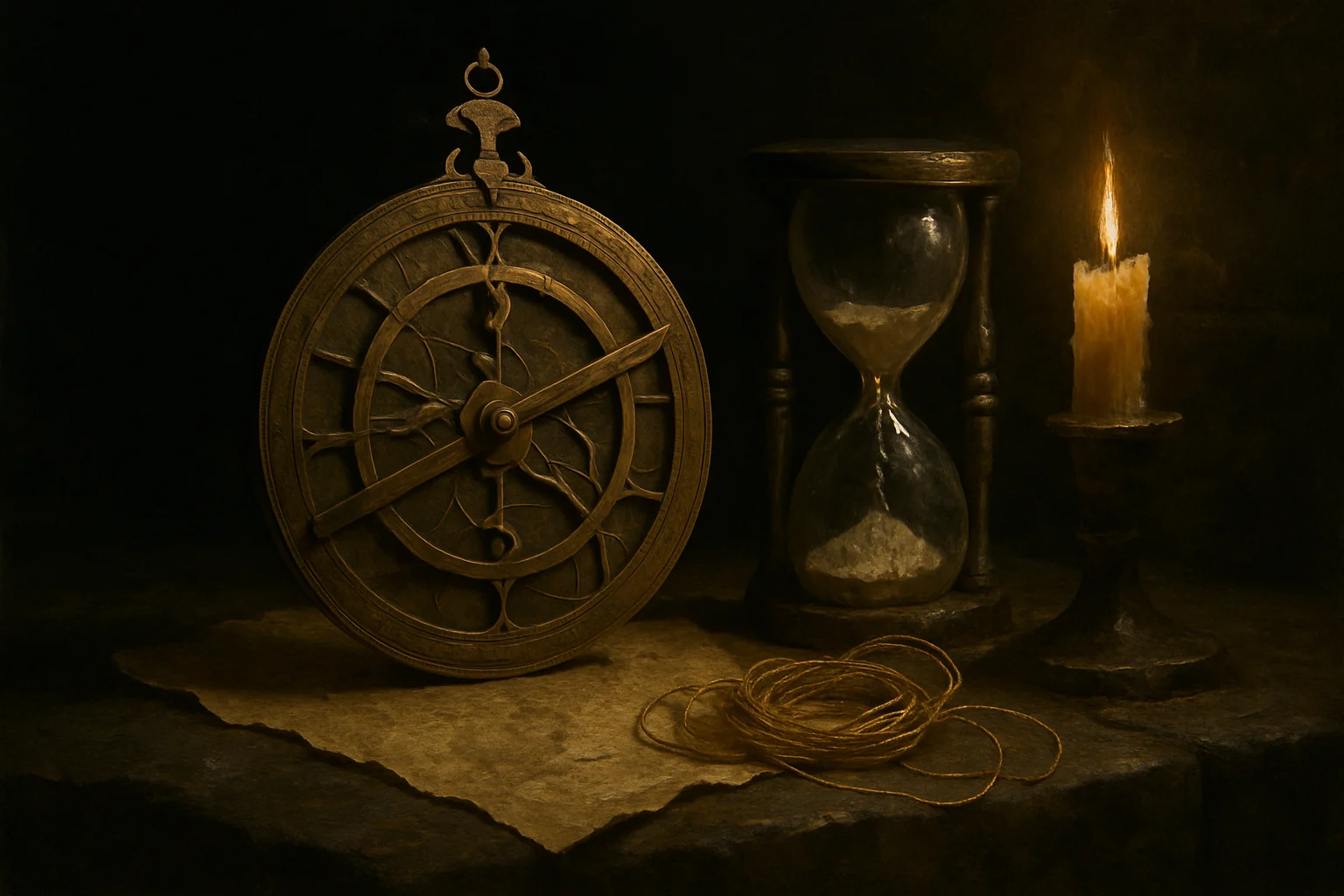
How the Greek Gods of Time Invented the Clock
How Chronos, Kairos, and the Horai shaped Greek timekeeping, from divine personification to the water clocks of Ctesibius and Plato's alarm.
Contents
The Greek gods of time did not invent the mechanical clock, but the Greek theological distinction between Chronos (sequential, measured time) and Kairos (opportune, qualitative time) created the intellectual framework that made precise timekeeping both necessary and possible. Greek mythology personified time as divine forces governing seasons, moments, and cosmic order, and these theological concepts directly shaped the development of water clocks, sundials, and eventually the anaphoric clock in Hellenistic Alexandria. Vitruvius credits Greek engineers with refining the clepsydra, the water clock that measured court speeches and ritual intervals, transforming abstract divine order into measurable civic reality.
The Greeks did not simply build devices to track hours. They built them because their gods had already taught them that time was not one thing but many: the relentless march of days, the fleeting chance, the turn of seasons. Understanding how those divine categories became gears and water requires starting with theology, not engineering.
The Greek Theology of Time: Chronos and Kairos
The Greeks did not worship a single god of time. They recognized at least two distinct divine principles, each governing a different aspect of temporal experience. Chronos represented time as duration, the endless succession of moments that could be counted and measured. Kairos represented time as opportunity, the critical instant when action must be taken or lost forever. This theological division was not academic hairsplitting. It reflected a practical understanding that not all moments are equal, and that measuring duration is a different problem from recognizing significance.
Chronos: Sequential Time Without End
Chronos appears in later Greek philosophical and mystical texts as the personification of time itself, sometimes conflated with Kronos the Titan but more often treated as a separate, primordial force. He is depicted as an old man with a long beard, turning the wheel of the zodiac, embodying the inexorable passage of years and seasons. Plato's Timaeus describes time as "a moving image of eternity," a concept that requires both the eternal (the Forms) and the temporal (the physical cosmos) to coexist. This philosophical abstraction had practical consequences: if time is measurable and regular, it can be divided, tracked, and used to organize human affairs.
The word "chronology" descends directly from this deity's name. So does "chronic," "chronicle," and "synchronize." The Greeks understood that sequential time was the foundation of memory, history, and coordination. Without Chronos, there could be no shared calendar, no agreed-upon past, no way to say "meet me at noon."
Kairos: The Moment That Matters
Kairos was the youngest son of Zeus in some traditions, depicted as a youth with winged feet and a single lock of hair on his forehead. The iconography is instructive: you must seize him as he approaches, because once he passes, there is nothing to grab. Aristotle discusses kairos in the Nicomachean Ethics, Book I, as the right measure of action at the right time, the quality that distinguishes virtue from mere rule-following. A physician must know not only what medicine to give but when to give it. A general must recognize the instant to attack. This is not clock time. It is judgment.
The distinction between Chronos and Kairos maps onto the difference between a sundial and a strategist. One measures; the other decides. Greek timekeeping technology emerged from the Chronos side of this divide, but the culture never forgot that the most important moments cannot be scheduled.
The Horai: Goddesses Who Measure the Seasons
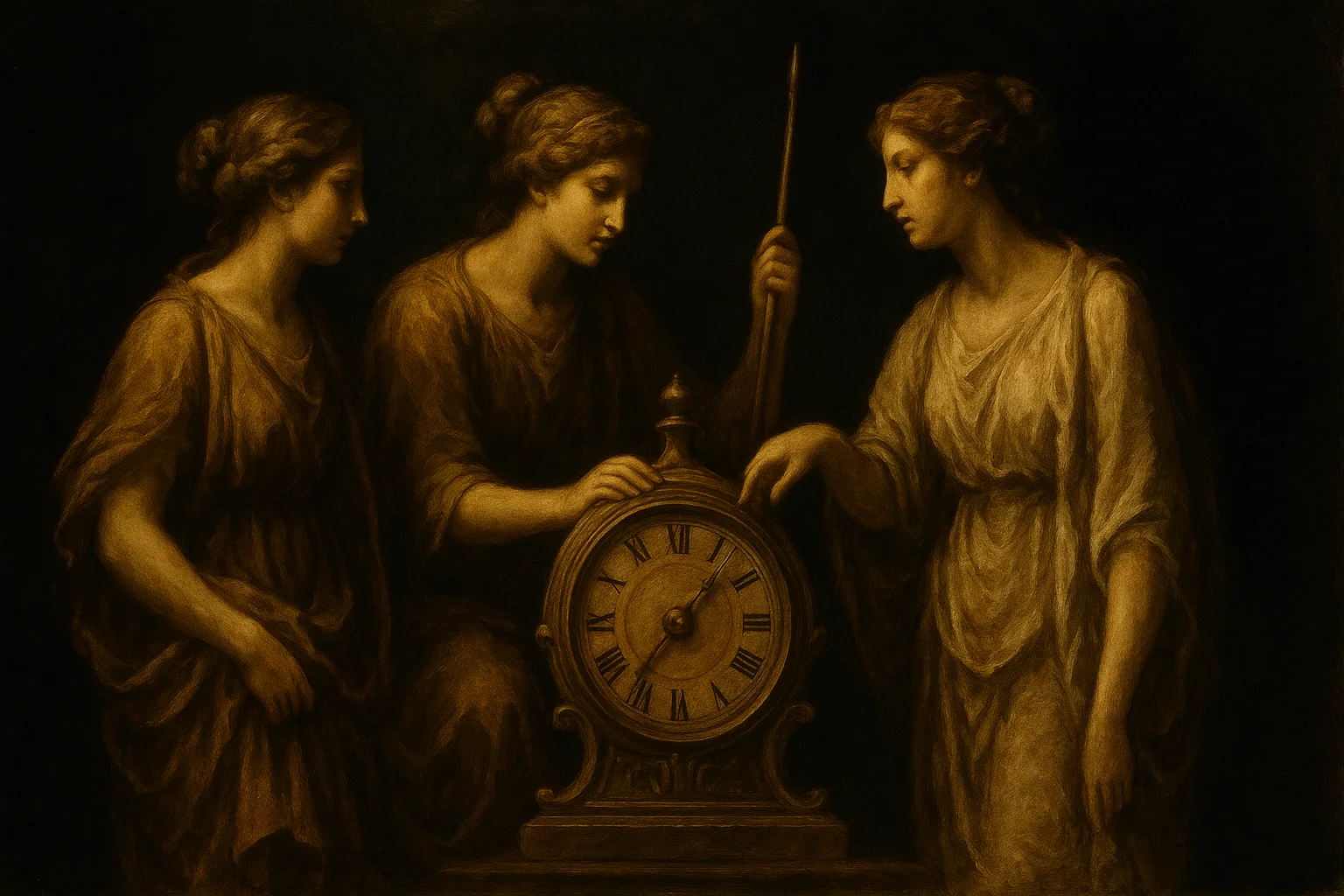
The Horai (Seasons) were daughters of Zeus and Themis, goddesses who regulated the orderly passage of time through the agricultural year. Hesiod's Theogony, lines 901-906, names three of them: Eunomia (Good Order), Dike (Justice), and Eirene (Peace). Their role was not merely decorative. They opened and closed the gates of Olympus, controlled the ripening of crops, and ensured that human life unfolded in harmony with cosmic law. Pausanias, in his Description of Greece, Book V, describes statues of the Horai at Olympia holding symbols of the seasons: fruit, grain, and flowers.
The Horai embodied the idea that time is not arbitrary. Spring follows winter not by accident but by divine decree. This theological conviction underwrote the Greek calendar, which was lunar but adjusted to the solar year through intercalation. The Athenian calendar, for instance, inserted an extra month periodically to keep festivals aligned with the seasons. The Horai guaranteed that Demeter's rites would fall at harvest, that the Dionysia would coincide with the grape vintage, that the cosmos would remain intelligible.
Their names reveal the Greek conviction that time and justice are inseparable. Eunomia, Dike, and Eirene are not neutral forces. They are moral agents. A society that ignores the proper timing of planting or ritual is not merely inefficient; it is impious. The clock, when it arrived, inherited this burden: it was not just a convenience but a guardian of order.
Why the Greeks Needed to Measure Time
Religious Ritual and the Calendar
Greek religion operated on a strict schedule. Festivals, sacrifices, and processions had to occur at the correct moment in the lunar month and the solar year. The Panathenaia, the great festival of Athena, took place every four years on the goddess's birthday. The Eleusinian Mysteries required initiates to arrive at Eleusis in the month of Boedromion. Missing the date was not an option. The gods expected punctuality.
Priests and civic officials maintained calendars, but these were not uniform across Greece. Each city-state had its own month names and its own system of intercalation. Athens, Sparta, and Corinth could all be in different months on the same day. This fragmentation created practical problems for diplomacy, trade, and military alliances. The need to synchronize time across polities was one reason the Olympic Games, held every four years, became a pan-Hellenic dating system. Events were dated "in the third year of the 87th Olympiad," a shared reference point in a world of competing calendars.
Civic Life and the Law Courts
Athenian democracy required precise timekeeping. Speakers in the law courts were allotted a fixed amount of time to make their case, measured by the clepsydra, a water clock. Plato's Republic, Book IV, contrasts the leisurely philosophical dialogue with the rushed arguments of the courtroom, where "the water in the clock urges them on." The clepsydra ensured fairness: rich and poor, eloquent and stammering, all received the same measure of time. The clock became an instrument of justice.
Public assemblies also used water clocks to limit speeches and votes. The Athenian Council of 500 met daily, and without time limits, business would have ground to a halt. The clepsydra was not a luxury. It was infrastructure, as essential to democracy as the ballot or the rostrum.
The Clepsydra: Water as Timekeeper
How the Water Clock Worked
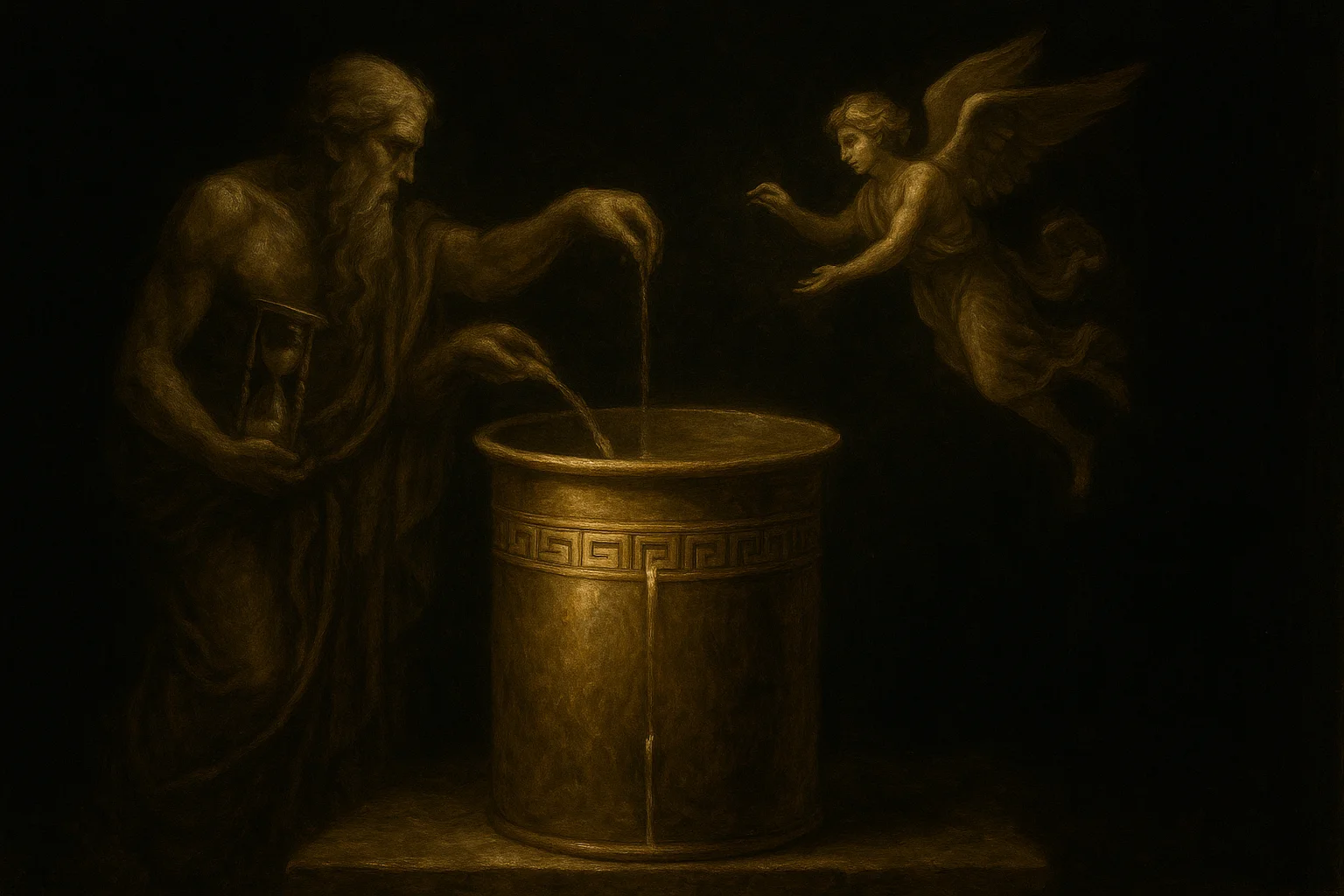
The clepsydra (literally "water thief") was a vessel with a small hole near the base. Water dripped out at a steady rate, and the level inside marked the passage of time. The simplest versions were just clay pots with calibrated lines on the interior. More sophisticated models used multiple chambers, floats, and gears to drive pointers on a dial. Vitruvius, in De architectura, Book IX, describes several designs, including one with a rotating drum that displayed the hours as the water level changed.
The advantage of the clepsydra over the sundial was obvious: it worked indoors, at night, and on cloudy days. The disadvantage was also obvious: it required constant refilling and recalibration. Water flows faster when the vessel is full, slower as it empties, unless the design compensates for the changing pressure. Greek engineers solved this by using an overflow tank that maintained a constant head of water, ensuring a steady drip rate.
Plato's Alarm Clock
Plato is said to have invented an alarm clock to wake his students for early-morning lectures. The device used a clepsydra connected to a series of siphons and a whistle. As the water level rose in the lower chamber, it triggered a siphon that dumped water into a vessel containing air. The compressed air escaped through a pipe, producing a loud sound. The mechanism is described in later sources, and while we cannot be certain Plato built it himself, the design is consistent with fourth-century BCE hydraulic engineering.
The anecdote is telling. Even philosophers, who claimed to care only about eternal truths, needed to wake up on time. The divine order of Chronos and the Horai had to be translated into the mundane order of lectures and meals.
Chronos (Greek)
Sequential, measurable time; the endless succession of moments; the basis for calendars, clocks, and historical chronology.
Kairos (Greek)
Opportune, qualitative time; the critical instant for action; the domain of judgment, strategy, and rhetoric, not measurement.
Ctesibius and the Anaphoric Clock
Ctesibius of Alexandria, working in the third century BCE, built the most advanced water clock of antiquity. His anaphoric clock used a float connected to a toothed rack that turned a gear train, which in turn rotated a celestial sphere showing the positions of the sun, moon, and stars. The device did not merely tell the hour; it displayed the cosmos in motion, a mechanical model of the divine order the Horai maintained.
Vitruvius praises Ctesibius for his ingenuity, noting that the clock required precise metalwork, calibrated orifices, and an understanding of gear ratios. The anaphoric clock was not a tool for the masses. It was a prestige object, built for temples and wealthy patrons, a demonstration that human craft could mirror divine regularity. The machine embodied the Greek conviction that the cosmos is rational, ordered, and knowable.
Ctesibius also invented the hydraulis, the water organ, and improved the catapult. His career illustrates the link between timekeeping and other technologies of precision. The same skills that built a clock built a siege engine. Both required understanding leverage, flow, and synchronization. The gods of time had inspired not just philosophy but engineering.
From Divine Order to Mechanical Precision
The Greek gods of time did not hand down blueprints. They provided something more fundamental: a conceptual framework in which time was both sacred and measurable, both eternal and divisible. Chronos taught that duration could be quantified. The Horai taught that the year had structure. Kairos taught that not all moments are equal, but that the equal moments still needed counting.
Greek timekeeping technology emerged from this theological matrix. The clepsydra was not invented in a vacuum. It was built by a culture that believed the cosmos operated on schedule, that justice required equal time, that the gods themselves kept track of seasons and hours. When Ctesibius built his anaphoric clock, he was not rejecting mythology. He was translating it into bronze and water.
The mechanical clock of medieval Europe, with its escapement and weight-driven gears, descends from these Greek experiments. The theology changed, but the conviction remained: time is order, and order can be made visible. The gods of time invented the clock not by forging metal but by teaching mortals that the invisible rhythm of the cosmos could be captured, measured, and displayed. The rest was engineering.
Frequently asked questions
Who were the Greek gods of time?
The Greek gods of time included Chronos, the personification of sequential, measurable time; Kairos, the god of the opportune moment; and the Horai, daughters of Zeus and Themis who regulated the seasons and cosmic order. Chronos represented duration and the passage of years, while Kairos embodied the critical instant when action must be taken. The Horai, named Eunomia, Dike, and Eirene in Hesiod's Theogony, ensured that the agricultural year and religious festivals unfolded in harmony with divine law. These deities provided the theological foundation for Greek timekeeping practices.
What is the difference between Chronos and Kairos?
Chronos represents quantitative, sequential time that can be measured and divided into hours, days, and years, while Kairos represents qualitative, opportune time, the fleeting moment when action is most effective. Chronos is the domain of calendars, clocks, and chronology; Kairos is the domain of judgment, strategy, and rhetoric. Aristotle discusses Kairos in the Nicomachean Ethics as the right measure of action at the right time, a quality that cannot be scheduled or mechanized. Greek timekeeping technology focused on Chronos, but the culture never forgot that the most important moments resist measurement.
Did the ancient Greeks invent the clock?
The ancient Greeks did not invent the first timekeeping device, but they significantly advanced clock technology, particularly the clepsydra (water clock) and the anaphoric clock. The clepsydra, used in Athenian law courts to time speeches, predates Greek civilization, but Greek engineers refined it with constant-pressure tanks and gear-driven displays. Ctesibius of Alexandria built the anaphoric clock in the third century BCE, which used a float and gear train to show the positions of celestial bodies. These innovations transformed timekeeping from simple duration measurement into mechanical models of cosmic order.
How did Greek water clocks work?
Greek water clocks, or clepsydras, worked by allowing water to drip at a steady rate from a vessel with a small hole, with the water level or flow marking the passage of time. Simple versions used calibrated lines inside a clay pot; advanced models employed overflow tanks to maintain constant water pressure, ensuring a uniform drip rate. Vitruvius describes designs in De architectura that used floats connected to pointers or rotating drums to display the hours. The most sophisticated versions, like Ctesibius's anaphoric clock, used gear trains to translate water flow into the rotation of a celestial sphere.
What was Plato's alarm clock?
Plato's alarm clock was a hydraulic device that used a water clock connected to siphons and a whistle to produce a loud sound at a predetermined time. As water filled the lower chamber of the clepsydra, it triggered a siphon that dumped water into a vessel containing trapped air, and the compressed air escaped through a pipe, creating a noise to wake students for early lectures. While later sources attribute the invention to Plato, the design reflects fourth-century BCE Greek hydraulic engineering. The device demonstrates that even philosophers concerned with eternal truths needed practical solutions for punctuality.
How did Greek mythology influence timekeeping technology?
Greek mythology provided the conceptual framework that made precise timekeeping both necessary and possible by personifying time as divine forces governing order, seasons, and opportunity. The theological distinction between Chronos (measurable duration) and Kairos (opportune moment) taught that time could be quantified and that cosmic order was regular and knowable. The Horai ensured that religious festivals and agricultural cycles followed a divine schedule, creating practical demand for calendars and clocks. Greek engineers built water clocks and anaphoric devices not in opposition to mythology but as mechanical expressions of the divine order the gods maintained, translating theological conviction into bronze, water, and gears.
Further reading on Mythologis
Free 25-page sample
Want the whole story?
Take the first 25 pages free. If it pulls you in, the full edition is yours as an instant PDF download, with a paperback on Amazon for selected titles.
Greek
The Greek Mythology Book: Zeus, the Olympians, the Heroes, and the Sacred Stories of Ancient Greece
Zeus, the Olympians, the Heroes, and the Sacred Stories of Ancient Greece
The complete guide to Greek mythology from Hesiod's Theogony to Homer's epics. Every Olympian, every hero, every descent to the underworld.
More from Greek
All articles
Greek
The 12 Labors of Heracles: Every Trial, Every Monster, Every Meaning
From the Nemean Lion to the cattle of Geryon, the 12 labors of Heracles were punishment, pilgrimage, and myth-making on an epic scale. Here is every trial laid bare.
Greek
The Minotaur of Crete: Bull, Labyrinth, and the Price of Hubris
Half man, half bull, born from a queen's impossible desire: the Minotaur of Crete is one of Greek mythology's most haunting figures, a creature whose story cuts to the heart of shame, sacrifice, and the limits of royal pride.
Greek
The Trojan War Origins: Discord, Desire, and the Apple That Broke the World
Before a single spear was thrown at Troy, a golden apple rolled across a banquet table and three goddesses made demands of a mortal shepherd. The seeds of the Trojan War were sown in divine vanity, a stolen bride, and a promise no one could keep.
Greek
Medusa the Gorgon: Monster, Martyr, and Mirror of Greek Fear
Medusa the Gorgon turns stone every eye that meets hers, yet her own story is one of transformation, divine violence, and enduring power. Here is the full myth, from serpent hair to severed head.