
The Rainbow Bridge Bifrost in Norse Mythology
Bifrost, the trembling rainbow bridge of Norse myth, spans the gap between Asgard and the mortal world. It is a road of fire, light, and divine order that will shatter at the end of all things.
Contents
A Bridge Between Worlds
At the heart of Norse cosmology stands a structure unlike any wall, gate, or road conceived by mortals: Bifrost, the luminous, shivering bridge that arcs from the realm of the gods down to the earth below. Its colors burn like fire. Its surface hums with a sacred fragility. And at its foot, armed and eternal, stands Heimdall, the watchman of the gods, listening for the first tremor of catastrophe.
The rainbow bridge Bifrost in Norse mythology is far more than a scenic pathway. It is a theological statement, a boundary, a covenant between the divine and the mortal. To understand Bifrost is to understand something essential about how the Norse imagined the relationship between gods and humans, between order and chaos, between the present age and its inevitable end.
The Name and Its Many Meanings
The name Bifrost appears in Old Norse as Bifröst, generally translated as "the shimmering path" or "the swaying road." The element bif connects to the Old Norse verb bifa, meaning to tremble or to quiver, and röst refers to a road, a league of distance, or the current of a river. Together, the name evokes something in perpetual, subtle motion: a bridge that shakes, that ripples like light on water.
An alternative name preserved in the Prose Edda of Snorri Sturluson is Bilröst, where bil may carry the sense of a fleeting moment or an unstable interval. This reading deepens the poetic image considerably. Bifrost is not simply a physical structure. It is a threshold suspended in time, a momentary connection between what is divine and what is mortal, perpetually on the edge of dissolving.
Some scholars of comparative mythology have noted parallels with the Norse conception of the rainbow in broader Indo-European traditions, where the arc of color after rain frequently marks a meeting point of the celestial and the terrestrial. Norse poets, however, gave this universal image a precise architectural and eschatological weight that sets it apart.
Architecture of Fire and Light
In Snorri Sturluson's Gylfaginning, the first section of the Prose Edda compiled around 1220 CE, the bridge is described with deliberate grandeur. It is called the best of all bridges, fashioned with great skill and cunning, made from three colors, and burning with fire. That last quality is crucial: Bifrost is not merely beautiful. It is actively dangerous.
Three Colors, One Structure
Snorri specifies that the bridge is composed of three hues, and this tripartite structure carries symbolic weight. Three is a sacred number throughout Norse cosmology: three roots anchor Yggdrasil, the world tree; three wells supply its roots; the cosmos itself is organized in layers of three. The three colors of Bifrost echo this pattern, suggesting that the bridge participates in the same deep order that governs the nine worlds.
The Burning Red Strand
Of the three colors, the red is identified as fire. This is not decorative. The fiery band exists specifically to prevent the frost giants, the jotnar, from crossing the bridge and invading Asgard. The gods themselves made it this way deliberately, as Snorri notes. Even a structure of transcendent beauty is, at its core, a defensive fortification. This duality, splendor and peril coexisting in the same object, is deeply characteristic of Norse mythological thinking.
The fire of Bifrost is so intense that even the hooves of Asgard's horses scorch as they cross. The bridge bears the weight of divine passage but resists all unauthorized transit with merciless heat.
Heimdall: The Eternal Sentinel
No discussion of Bifrost is complete without the god who guards it. Heimdall, called Hallinskidi and Gullintanni (the one with golden teeth) in the Eddic tradition, is stationed at the bridge's foot in a hall called Himinbjorg, meaning "the sky cliffs" or "the heavenly mountain." His purpose is singular and absolute: to watch.
Heimdall's perceptual gifts are described in extraordinary terms throughout the Prose Edda and the Poetic Edda. He requires less sleep than a bird. He can see for hundreds of leagues in every direction, even in darkness and in fog. His hearing is sharp enough to detect the growth of grass and the wool growing on sheep. He stands vigil on behalf of all the gods, and when Ragnarok finally arrives, it is his horn, the Gjallarhorn, that will sound the alarm across all nine worlds.
This pairing of Bifrost with Heimdall reveals something important about the Norse imagination. A bridge of such power and consequence cannot be left unattended. The cosmos requires a guardian, someone who lives at the boundary, who is neither fully of Asgard nor fully of the worlds below, but exists precisely at the interface. Heimdall is, in a sense, the living embodiment of the threshold itself.
Heimdall and the Gods
The Rigsthula, a poem preserved in the Poetic Edda, offers a remarkable expansion of Heimdall's character. Under the name Rig, he wanders through the human world and fathers the three classes of mankind: thralls, farmers, and warriors. This makes him not merely a watchman but a progenitor, a god whose domain includes the very society that lives beneath the bridge he guards. The boundary between Asgard and Midgard is, it seems, far more permeable than the fire suggests, at least when a god chooses to cross it.
Bifrost and the Daily Passage of the Gods
The Prose Edda makes clear that Bifrost serves as the primary road along which the Aesir travel when they ride to their daily council beneath Yggdrasil at the well of Urd. Every day, the gods cross the bridge to sit in judgment and deliberation at that sacred site. The bridge is therefore embedded in the rhythmic, ordered life of the divine community.
This image, of gods crossing a rainbow each day to hold court, has a striking elegance. It suggests that divine governance requires movement, descent, a willingness to engage with the broader cosmos rather than remain sealed within the golden walls of Asgard. The bridge is not merely a feature of the landscape. It is part of the daily ritual that sustains cosmic order.
Thor is notably exempt from this daily procession. Being the son of the earth goddess Jord as well as Odin, and bearing enormous elemental power, his crossing would damage the bridge. He wades instead through the rivers that mark the borders of the worlds. Even among the gods, Bifrost must be treated with care.
The Fate of Bifrost at Ragnarok
However radiant its daily function, Bifrost carries within it the shadow of its own destruction. The Norse cosmos is deeply eschatological: everything that exists is moving, however slowly, toward the cataclysm of Ragnarok, the twilight of the gods.
At Ragnarok, the sons of Muspell, the fire giants of the southern realm, will ride northward in a vast and terrible host. The Gylfaginning states explicitly that as they ride, Bifrost will crack and break beneath them. The bridge, which has held for ages against the frost giants of Jotunheim, will finally fail under the onslaught of fire from Muspelheim.
This detail is rich with irony. Bifrost is itself made partly of fire, set ablaze precisely to deter the enemies of the gods. Yet it is fire, in its most apocalyptic form, that ultimately destroys it. The very element woven into the bridge's defense becomes the agent of its ruin.
After Bifrost falls, the field of Vigrid fills with combatants. Heimdall sounds the Gjallarhorn. The world tree shudders. The wolf Fenrir breaks his chains. What was guarded so vigilantly for so long is no longer guardable. The threshold collapses, and the separation between realms dissolves entirely.
Bifrost Across Time: Survival and Echoes
The mythology of Bifrost has shown a remarkable endurance across the centuries since the Norse literary tradition was first committed to parchment. Medieval Icelandic scholars preserved it. Nineteenth-century Romantics revived it. Contemporary popular culture, from Richard Wagner's operatic cycle Der Ring des Nibelungen to modern cinema, has drawn on its imagery repeatedly.
What persists is the core image: a bridge of light connecting the divine and the human, beautiful and burning, watched over by a figure of absolute vigilance, destined to fall at the end of time. That image speaks to something durable in the human imagination, the desire for a visible, traversable connection between the world as we know it and a more radiant realm beyond ordinary sight.
In the Norse conception, the rainbow is not a passive symbol of hope after storm. It is a road, a barrier, a covenant, and a countdown. Every morning it arcs across the sky, and every morning it is one day closer to shattering.
The Bridge as Cosmological Axis
To place Bifrost within the full architecture of Norse cosmology is to see it in relation to Yggdrasil, the immense ash tree that holds the nine worlds in its branches and roots. Where Yggdrasil is the vertical axis of existence, rooted in the underworld and reaching toward the heavens, Bifrost is the lateral connector, the horizontal span that allows movement between realms that would otherwise remain forever separate.
Together, Yggdrasil and Bifrost form a cosmological grid: one structure for ascent and depth, another for passage and connection. The Norse cosmos is not a static hierarchy but a dynamic web of relationships, and Bifrost is the most visible, most luminous strand in that web.
This is, perhaps, why the bridge burns. A cosmos built on relationship and movement cannot afford a barrier that merely stands. It must pulse, shimmer, and warn. It must be alive with the tension between invitation and exclusion. Bifrost is all of these things at once: a welcome and a warning, a road and a rampart, a rainbow and a ring of fire.
Free 25-page sample
Want the whole story?
Take the first 25 pages free. If it pulls you in, the full edition is yours as an instant PDF download, with a paperback on Amazon for selected titles.
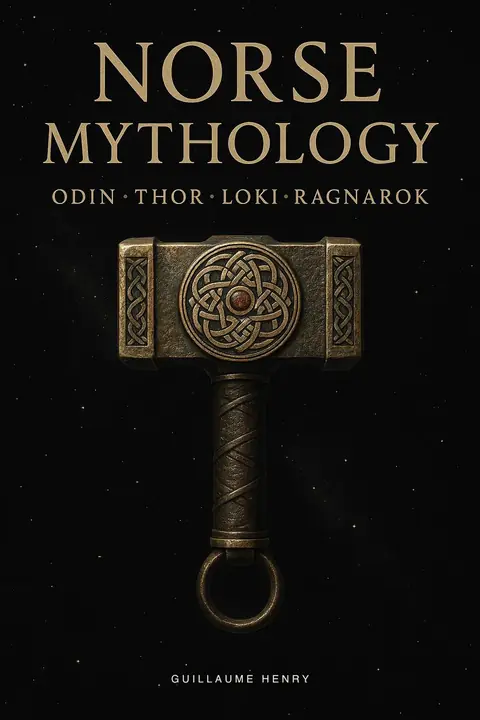
Norse
The Norse Mythology Book: Odin, Thor, Loki, Ragnarok and the Sagas of the Vikings
Odin, Thor, Loki, Ragnarok and the Sagas of the Vikings
The complete guide to Norse mythology drawn from the Eddas, the sagas, and the scholarship of those who read the source texts. Every god, every world, every myth.
More from Norse
All articles
Norse
The Prose Edda and Poetic Edda: Primary Sources of Norse Myth
The Prose Edda and Poetic Edda are the two great written pillars of Norse mythology, preserved in medieval Iceland centuries after the gods had stopped receiving sacrifices. Without them, Odin, Yggdrasil, and Ragnarok would be shadows.
Norse
Odin: Allfather of Asgard
Odin stands at the center of Norse cosmology as ruler, wanderer, and keeper of forbidden wisdom. His contradictions make him the most haunting deity in the Germanic pantheon.
Norse
Mjolnir: The Sacred Symbol of Thor's Hammer
Mjolnir, the hammer of Thor, is one of the most potent symbols in Norse mythology, a weapon of divine thunder, a ward against chaos, and a mark of sacred covenant worn by Vikings for centuries.
Norse
Yggdrasil the World Tree: Axis of the Norse Cosmos
Yggdrasil the World Tree stands at the center of Norse cosmology, binding nine worlds in its roots and branches. Explore the myths, creatures, and sacred meanings woven into its eternal bark.