
Fenrir the Giant Wolf: Bound God-Killer of Norse Myth
Born of Loki and fated to swallow Odin at Ragnarok, Fenrir the giant wolf is Norse mythology's most terrible prisoner. This is his full story.
Contents
The chain snapped. Then it snapped again. The Aesir had already broken two of their finest iron fetters against the wrists and ankles of the wolf, and now Fenrir the giant wolf sat in the middle of Asgard's assembly field, larger than anyone had expected, watching the gods with yellow eyes that held no fear at all. The gods laughed and called it a game. Fenrir was not deceived, but he played along.
That moment sits near the center of Norse cosmology: a creature so powerful that the gods cannot kill it, cannot cage it with any tool they themselves forge, and cannot reason it into compliance. What they can do, with the help of the dwarves of Svartalfheim, is trick it. And even that trickery costs one of them a hand.
Fenrir is not a monster in the simple sense. He is a son, a prisoner, a prophecy walking on four legs. Understanding him requires following three threads simultaneously: his parentage among the most dangerous figures in the Norse cosmos, his relationship with the gods who raised and then imprisoned him, and the end he is promised at Ragnarok. Pull any one thread and the others unravel with it.
The Parentage That Made the Aesir Afraid
Loki and Angrboda produced three children in the land of giants, and the Aesir knew about all three of them. The Prose Edda, compiled by the Icelandic scholar Snorri Sturluson around 1220 CE, records that prophecy reached Odin directly: these offspring would cause great harm. Odin's response was characteristically decisive and characteristically insufficient. He had Jormungandr thrown into the ocean encircling Midgard. He sent Hel down to Niflheim to govern the realm of the ordinary dead. And Fenrir he brought to Asgard.
The reasoning, presumably, was control. A serpent in the sea and a goddess in the underworld could be managed from a distance. A wolf in Asgard could be watched.
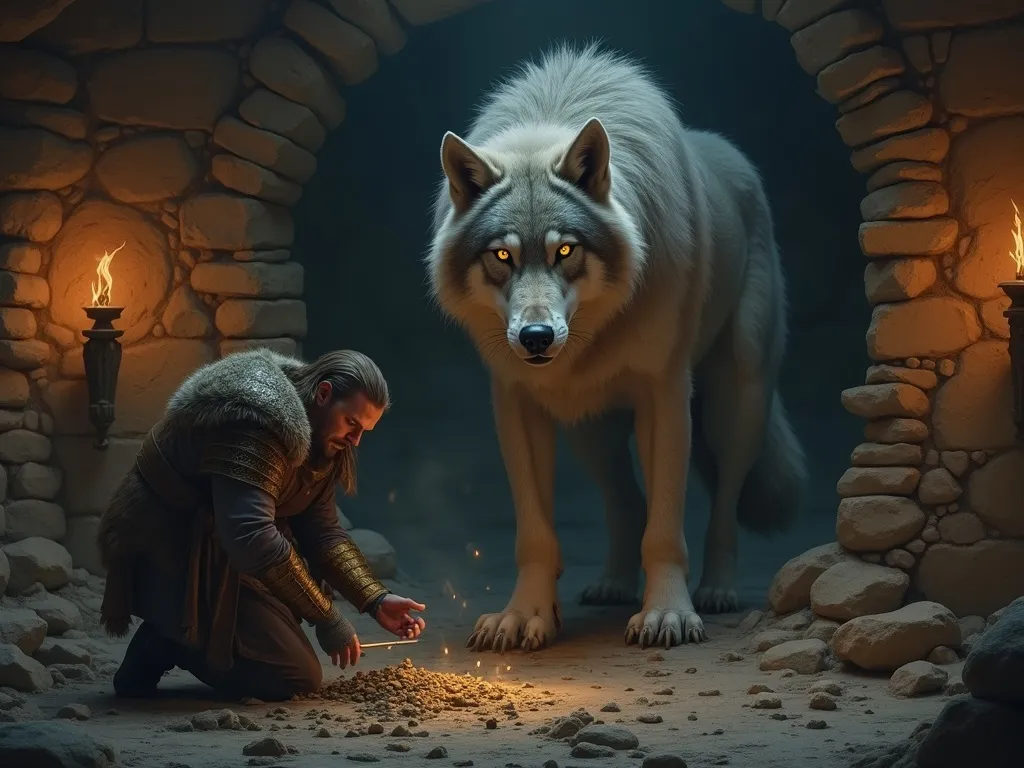
It was a mistake that took years to reveal itself. Fenrir grew. He grew at a rate no natural wolf could match, and the Aesir watched his shoulders pass the height of their tallest warriors, then their rooftops, then their watch-towers. Only one god among them was willing to feed him: Tyr, the one-handed god of law and martial honor. The Prose Edda is specific on this point. Tyr alone had the courage each day to bring meat to a wolf who was already large enough to bite him in two.
That detail is worth pausing on. It says something about both figures. Tyr's willingness to feed Fenrir is not recklessness; it is a sense of obligation toward a living creature brought into Asgard under false pretenses. Fenrir's acceptance of this daily ritual suggests something other than mindless ferocity. He received the hand that fed him, right up until the day the same hand contributed to his binding.
How the Gods Bound Fenrir: The Ribbon That Could Not Break
The gods commissioned two chains before they got it right. The first was called Laeding. They brought it to Fenrir as a challenge, the way men test a strong dog by suggesting it cannot break a leash. Fenrir assessed the chain, judged it breakable, and broke it. The second, Dromi, was heavier, doubled in weight and iron. Same result. Snorri records that Fenrir broke Dromi by planting his feet and pushing outward with every muscle until the links burst apart.
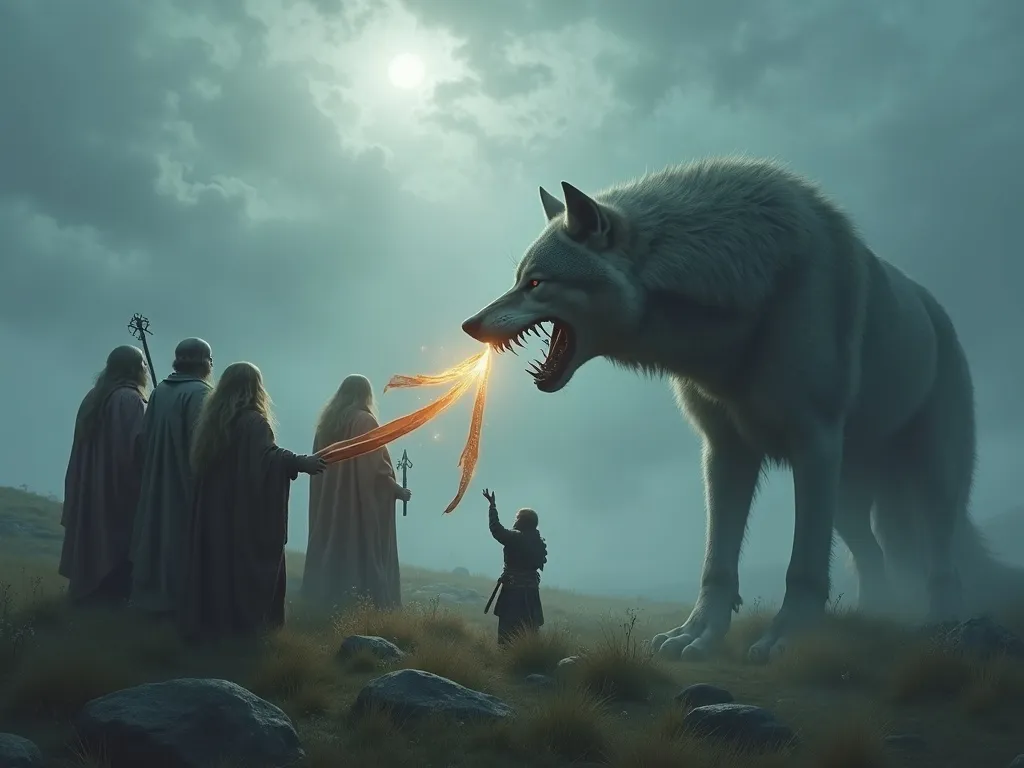
This is where the dwarves enter the story. Odin sent messengers to Svartalfheim, the realm of the dark elves or dwarves, asking them to make something no wolf could break. What they produced was called Gleipnir, and it looked like a length of silk ribbon. The Prose Edda lists its components as a catalogue of impossibilities: the sound of a cat's footstep, the beard of a woman, the roots of a mountain, the sinews of a bear, the breath of a fish, the spittle of a bird. Because all of these things either do not exist or cannot be extracted, Gleipnir is paradoxically made of nothing, and nothing can destroy it.
Fenrir took one look at the ribbon and refused to let them bind him with it. He was not fooled by its appearance. He understood that something so thin and light, offered by gods wearing careful smiles, had to be dangerous. He named his terms: one of them must put a hand in his mouth as a pledge of good faith. If the ribbon proved to be trickery, he would bite the hand off. If not, no harm done.
The gods looked at one another. Nobody moved. Then Tyr stepped forward and placed his right hand between Fenrir's jaws.
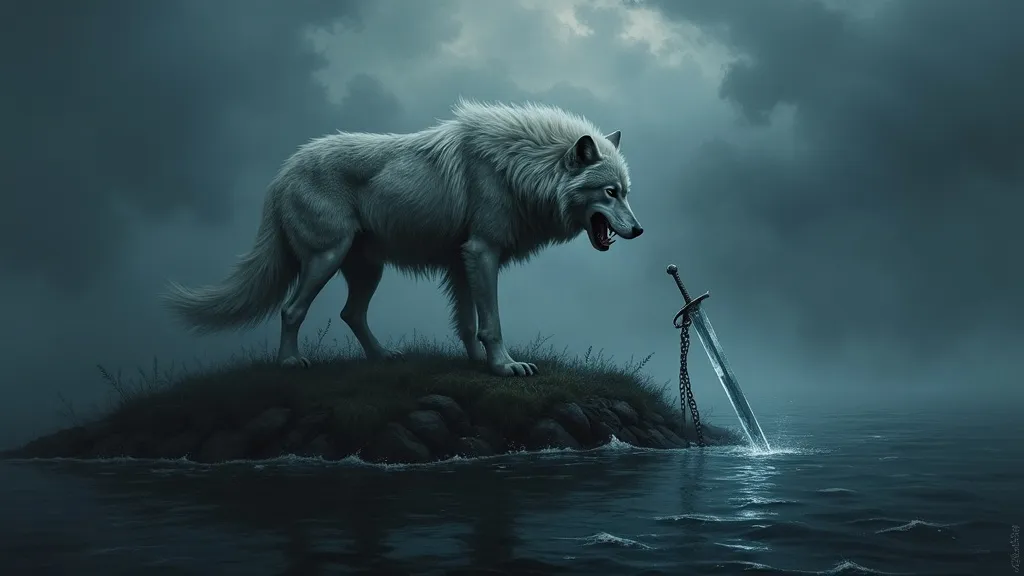
Gleipnir held. Fenrir bit. Tyr lost his hand at the wrist, and Fenrir lost his freedom for what the Norse sources call the duration of this world. They anchored him to a boulder called Gjoll with a cord called Gelgja threaded through the slab. They propped his jaws open with a sword. He howled, and rivers formed from his saliva.
Gjoll, the Rock, and the Geography of Confinement
Norse cosmology does not place Fenrir's prison on any single map with precision. The Prose Edda indicates the rock Gjoll is driven into the earth on an island called Lyngvi in the lake Amsvartnir. These are not common crossroads names; Snorri is describing a place that exists specifically to contain this one creature. It sits outside Asgard, outside Midgard, partway toward the edges of the world.
The image the sources give is uncomfortable. Fenrir lies on his side, jaws forced open by a sword whose hilt is in the ground and whose blade rests against his upper palate. He cannot close his mouth. He cannot move without the cord pulling at the stone. The drool that falls from those open jaws runs into the river called Von (in some translations, "Hope," which makes the geography mordantly ironic). He has been in this position since before human memory begins in the myth cycle, and he will remain there until Ragnarok.
This confinement gives Fenrir a quality that monsters in other traditions rarely have: patience. He is not raging. He is waiting. The wolf who was raised in Asgard, fed by the hand of Tyr, broken by a promise made in bad faith, waits on an island whose name means "heather-covered" for the single day when everything ends.
Fenrir's Role in Ragnarok: The God-Killer Unleashed
Ragnarok, the doom of the powers, is not a surprise in Norse tradition. It is a prophecy that every figure in the cosmos already knows. Odin knows he will die in the jaws of Fenrir the giant wolf. He knows it the way a man on a sinking ship knows the water is coming. He spends the whole of the mythological cycle preparing for it, gathering warriors in Valhalla, seeking wisdom from every source, sacrificing his eye and hanging on Yggdrasil, all so that when the moment comes, the Aesir will fight as well as possible before they lose.
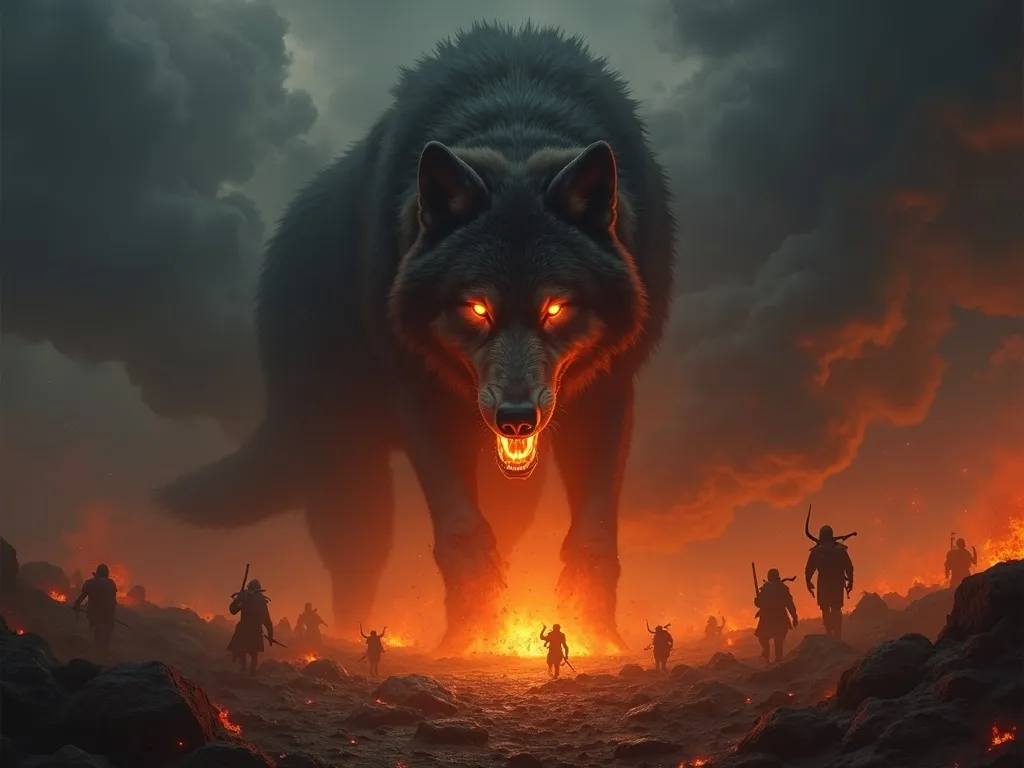
When the world begins to break, Fenrir breaks free. The Poetic Edda, the older anthology of Norse mythological poetry, describes the sequence in Voluspa (the Seeress's Prophecy): the wolf runs with its mouth agape, upper jaw scraping the sky and lower jaw scraping the earth, fire blazing from its eyes and nostrils. It swallows Odin whole.
Then Vidar, Odin's son, acts. He is called the silent god, and he has been preparing for exactly this moment. In one version he wears a shoe made from all the leather scraps ever trimmed from human footwear (which is why Norsemen were traditionally told to leave a small piece when cutting leather, to help build that divine shoe). He plants one foot on Fenrir's lower jaw and tears the wolf's upper jaw from its socket, killing the creature that killed his father.
The symmetry is complete and brutal. Fenrir swallows the king of the gods. The king's son tears the wolf apart. Every participant in the original binding story is accounted for at the end.
Fenrir at the Binding
Young enough to still accept Aesir hospitality; growing but not yet fully realized; willing to negotiate terms of the binding; restrained by obligation and by Tyr's sacrifice.
Fenrir at Ragnarok
Fully grown, jaw spanning sky and earth; beyond negotiation or restraint; fulfills the cosmic prophecy precisely as stated; killed in the act of killing Odin.
The Symbolism Inside the Wolf
Scholars have read Fenrir in several ways, none of them mutually exclusive.
The most structural reading places him as the embodiment of chaos in a cosmos that defines itself through order. Norse cosmology is a world of bounds: the sea has its serpent, the underworld has its keeper, Asgard has its walls. Fenrir is the one figure who cannot be placed within any of these bounded systems. He is too large for Asgard and too dangerous for Midgard. The gods' only solution is a location outside the normal map entirely.
A second reading focuses on the breach of frith, the Old Norse concept of peace and social obligation. Fenrir came to Asgard as, essentially, a ward or guest. The Aesir's decision to bind him violates the reciprocal duties of that relationship. Tyr's hand is not merely a practical pledge; it is the gods' acknowledgment that they are doing something that requires a price. Some scholars, including the medievalist John Lindow in his work on Norse mythology and religion, have noted that the whole episode reads like a legal transaction that the gods deliberately corrupt, and that Fenrir's ultimate revenge at Ragnarok is the natural result of that corruption.
A third reading concerns the wolf as a liminal creature. Wolves in Norse culture occupied the borderlands: they were neither domestic nor entirely wild, they traveled in groups that mirrored human social structures, and they appeared in the kennings of warriors (vargr meaning wolf or outlaw, both terms rooted in social exclusion). Fenrir at his full mythological scale is the wolf-nature pushed to its absolute limit, the point where the border-creature becomes the border itself, the edge between this world and its destruction.
Fenrir's Siblings and the Network of Doom
Jormungandr, the Midgard Serpent who encircles the world with its body, is Fenrir's younger sibling. Hel, who divides the dead between her realm and Valhalla, is their sister. The three together cover sea, land, and the underworld: every domain of existence has one of Loki's children in it as a destabilizing presence.
At Ragnarok, all three act simultaneously. Jormungandr rises from the ocean, poisoning the sky. Hel sends her armies of the ordinary dead northward. Fenrir runs with his jaws open. Their father Loki, freed from his own separate imprisonment, steers the ship Naglfar made of dead men's nails. The coordinated nature of this catastrophe is not accidental in the myth-telling. These siblings are not acting independently; they are, by the logic of the prophecy, fulfilling a single design built into the cosmos from the moment of their birth.
This makes Fenrir something more than a dangerous animal. He is one-third of an apocalyptic mechanism. The gods knew this when they brought him to Asgard. They knew it when they bound him. What they chose to do with that knowledge is precisely what makes the Norse tradition so unflinching: they acted, they bought time, they prepared, and they accepted that preparation would not be enough.
Fenrir in Old Norse Poetry: What the Sources Actually Say
The primary sources for Fenrir's myth are two texts compiled in Iceland in the thirteenth century, both drawing on older oral and poetic traditions. The Poetic Edda (also called the Elder Edda) preserves the poem Voluspa, which is a seeress's account of the cosmos from creation to Ragnarok. Fenrir appears here as Fenrisulfr (the Fenris wolf), and his release at Ragnarok is treated as one of the clearest signs that the end has arrived. The poem Lokasenna names his parentage directly. Vafthrudnismal records Odin learning of his own fate at Fenrir's jaws.
The Prose Edda, Snorri's systematic retelling, fills in the narrative texture: the two broken chains, the construction of Gleipnir, Tyr's pledge, and the mechanics of Fenrir's confinement. Snorri was a Christian writing about a pre-Christian tradition, which means his account has both preservationist value and interpretive distortion. He is generally considered reliable on narrative detail, more cautious as an interpreter of symbolic meaning.
No surviving runic inscription or archaeological find from the Viking Age depicts a scene definitively identified as Fenrir's binding, though the Gosforth Cross in Cumbria, England, dated to the tenth century, shows what many scholars identify as Ragnarok imagery including a figure with its jaws propped open, consistent with Fenrir's confinement description.
What Survives of Fenrir in Modern Imagination
The wolf does not stay in the thirteenth century. Fenrir the giant wolf has traveled further into modern culture than almost any other Norse creature, partly because the archetype of a cosmic, unchainable predator maps easily onto contemporary anxieties, partly because the story of his binding has the clean architecture of a great myth: pride, sacrifice, trickery, inevitable consequence.
J.R.R. Tolkien's wolves of Angband, particularly Carcharoth in The Silmarillion, carry clear Fenrir genetics. Carcharoth swallows a divine artifact, grows to monstrous size, and can only be contained temporarily before causing catastrophic damage at the gates of Valinor. The parallel is structural, not accidental; Tolkien was a medievalist who read Old Norse in the original.
Marvel's adaptation, beginning with the comics and extended through the film Thor: Ragnarok (2017), takes wide liberties with the myth but keeps the core identification: Fenrir as an enormous wolf, associated with chaos and the destruction of the existing order. The film's version serves Hela rather than acting as an independent figure, which strips away most of the ethical complexity, but the visual scale is faithful to the Voluspa description.
Contemporary Norse-influenced fiction, from Joanne Harris's Gospel of Loki to Neil Gaiman's Norse Mythology, has restored more of the original's nuance. Gaiman's brief treatment in particular honors the ambiguity of Fenrir's situation: a creature that was not born evil but was placed in circumstances where becoming the instrument of destruction was the only role left available to it.
Frequently Asked Questions About Fenrir the Giant Wolf
Frequently asked questions
Who are Fenrir's parents in Norse mythology?
Fenrir is the son of Loki, the trickster god, and Angrboda, a giantess from Jotunheim. The Prose Edda records these parentages explicitly. His siblings are Jormungandr the World Serpent and Hel, the ruler of the realm of the ordinary dead.
What is Gleipnir, and why could Fenrir not break it?
Gleipnir is the magical ribbon forged by the dwarves of Svartalfheim from six impossible ingredients: the sound of a cat's footstep, the beard of a woman, the roots of a mountain, the sinews of a bear, the breath of a fish, and the spittle of a bird. Because these things do not exist in nature, Gleipnir has no material structure that can be stressed or snapped. It holds precisely because there is nothing in it to break. Fenrir suspected this, which is why he demanded Tyr's hand as a pledge before allowing himself to be bound.
Does Fenrir actually kill Odin at Ragnarok?
Yes, according to both the Poetic Edda and the Prose Edda. At Ragnarok, Fenrir breaks free from Gleipnir, runs with his jaws spanning sky and earth, and swallows Odin whole. Odin's son Vidar then kills Fenrir by either tearing his jaw apart or driving a sword through the roof of his mouth, depending on the source. This sequence is presented not as a surprise but as the fulfillment of a prophecy Odin had known since long before the events unfold.
Why did the Aesir raise Fenrir in Asgard instead of killing him?
The sources do not give an explicit statement of reasons, but scholars infer two factors. First, killing the children of Loki might have required confronting Loki directly, a politically costly move. Second, the Aesir may have believed proximity gave them control, a calculation that proved wrong as Fenrir's growth exceeded every expectation. The Prose Edda notes that the gods knew from prophecy these children would cause harm, which makes their choice to bring Fenrir into Asgard specifically a gamble that failed.
Is Fenrir related to other famous wolves in Norse myth?
Yes. The wolves Skoll and Hati who chase the sun and moon are described in some sources as Fenrir's sons. At Ragnarok, Skoll catches the sun and Hati catches the moon, extinguishing them. This makes Fenrir, in a sense, the progenitor of the forces that will end light itself. The Prose Edda also mentions Managarm (Moon-hound) as a descendant in the same lineage, nourished on the bodies of the dying.
What does Fenrir represent symbolically in Norse thought?
Scholars have proposed several overlapping readings. Fenrir represents uncontainable chaos in a cosmos built on order and bounded spaces. He also represents the long-term consequences of broken trust, since the gods' violation of their guest-obligations to him is what ensures the cosmic damage he causes. More broadly, he functions as the Norse tradition's refusal to offer false comfort: the worst thing that can happen is already scheduled, and the best response is not optimism but courageous preparation.
The Ethics of Chains: What Fenrir's Story Forces Us to Confront
There is a reading of Fenrir's myth that the binding narrative itself invites, though it rarely appears in casual retellings. The gods did not chain a monster that had already attacked them. They chained a young wolf who had broken two iron fetters in what was framed to him as a game, who had done nothing yet to deserve the restriction, and who agreed to the third binding only because Tyr put his hand forward as collateral.
Tyr loses his hand because the gods needed Fenrir contained before he could act on his nature. This is pre-emptive punishment on a cosmic scale, and the Norse sources do not entirely let the Aesir off the hook for it. The prophecy made Fenrir dangerous. The binding made that danger personal. When he swallows Odin at Ragnarok, the act is simultaneously the fulfillment of a predetermined fate and a response to a specific, remembered wrong.
This is what separates Fenrir from a simple apocalyptic wolf. He carries the moral weight of his own story. The drool falling into the river called Von (Hope) while he lies pinned on his island is not incidental. It is Norse mythology doing what it does best: taking the largest possible stakes and threading through them a very small, very human question about what we owe the creatures we decide to fear.
The Norns wove his fate before he was born. The Aesir shaped the conditions that made that fate personal. And Fenrir, chained on his heather island with a sword in his mouth and a river of hope running from his jaws, waits for the one moment when the waiting ends.
Free 25-page sample
Want the whole story?
Take the first 25 pages free. If it pulls you in, the full edition is yours as an instant PDF download, with a paperback on Amazon for selected titles.

Norse
The Norse Mythology Book: Odin, Thor, Loki, Ragnarok and the Sagas of the Vikings
Odin, Thor, Loki, Ragnarok and the Sagas of the Vikings
The complete guide to Norse mythology drawn from the Eddas, the sagas, and the scholarship of those who read the source texts. Every god, every world, every myth.
More from Norse
All articles
Norse
The Valkyries: Choosers of the Slain in Norse Mythology
Armored, spear-bearing, and answerable only to Odin, the Valkyries rode into every battle to decide who lived and who fed the ravens. Here is the full story.
Norse
Valhalla: Hall of the Slain in Norse Mythology
Valhalla is not paradise for the virtuous. It is a war-hall for the chosen dead, where Odin gathers his army for the last battle. Every detail inside its gold-shimmering walls tells you exactly what Norse cosmology valued most.
Norse
Ragnarok: The End of Days in Norse Mythology
Ragnarok is not simply a Norse apocalypse. It is a cosmos that chooses to burn so it can be reborn, and the gods who march into that fire know exactly what awaits them.
Norse
The Prose Edda and Poetic Edda: Primary Sources of Norse Myth
The Prose Edda and Poetic Edda are the two great written pillars of Norse mythology, preserved in medieval Iceland centuries after the gods had stopped receiving sacrifices. Without them, Odin, Yggdrasil, and Ragnarok would be shadows.