
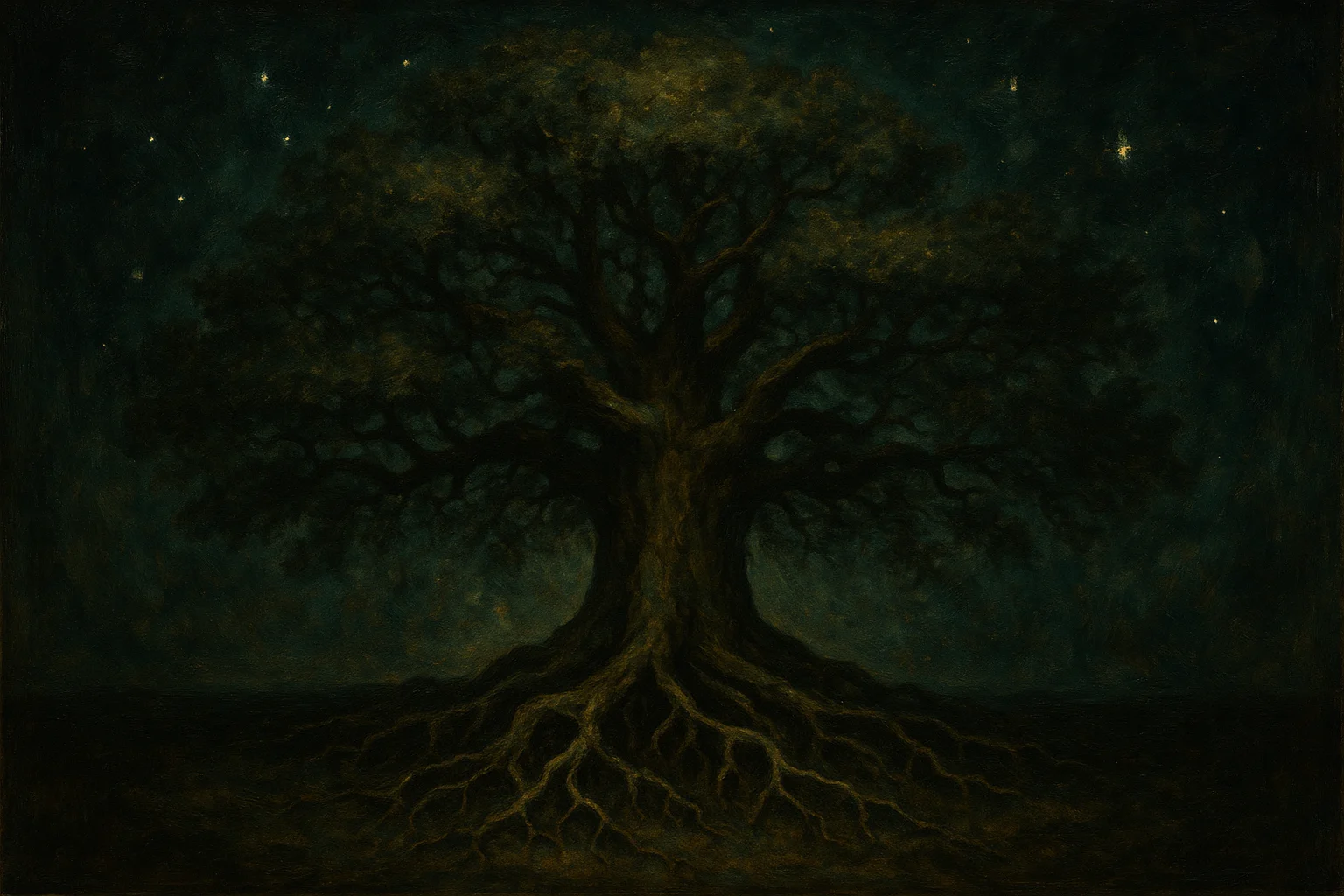
World Trees in Mythology
From Yggdrasil to the Maya ceiba, world trees anchor cosmos to earth. A comparative study of axis mundi motifs across Norse, Vedic, and Maya traditions.
Contents
A world tree is a cosmological structure appearing in numerous mythologies, typically an axis or pillar that connects the underworld, the earth, and the heavens, organising the cosmos vertically and often serving as the dwelling place of gods, spirits, and cosmic animals. Norse Yggdrasil, the Vedic Ashvattha, and the Maya ceiba are the most fully documented examples. These trees do not merely symbolise life or growth; they function as the structural skeleton of reality itself.
The pattern repeats across continents with remarkable consistency, yet the details diverge in ways that reveal how each culture imagined space, time, and the relationship between gods and mortals. Some trees bear fruit, some shelter serpents, and some hold the fate of the cosmos in their roots.
What a world tree does
A world tree organises the cosmos by providing a vertical axis. It is not decoration. In most traditions, the tree holds realms apart, prevents their collapse, and offers a route for gods, shamans, or souls to travel between levels. The tree may also generate life, anchor time, or serve as the genealogical root of a people.
Three functions recur across cultures. First, the tree as axis: it stands at the centre and defines up, down, and middle. Second, the tree as bridge: gods, spirits, and the dead move along its trunk or branches. Third, the tree as genealogy: it bears the first humans, the gods themselves, or the ancestors of a lineage. Some trees perform all three roles. Others specialise.
The vertical structure matters because it reflects how these cultures conceived space. The cosmos is not a sphere or a plane but a stack of worlds, and the tree is the only thing holding them in place. When the tree shakes, falls, or burns, the worlds collapse. This makes the apocalypse traditions of tree-centred cosmologies especially vivid.
Yggdrasil: the ash that holds nine worlds
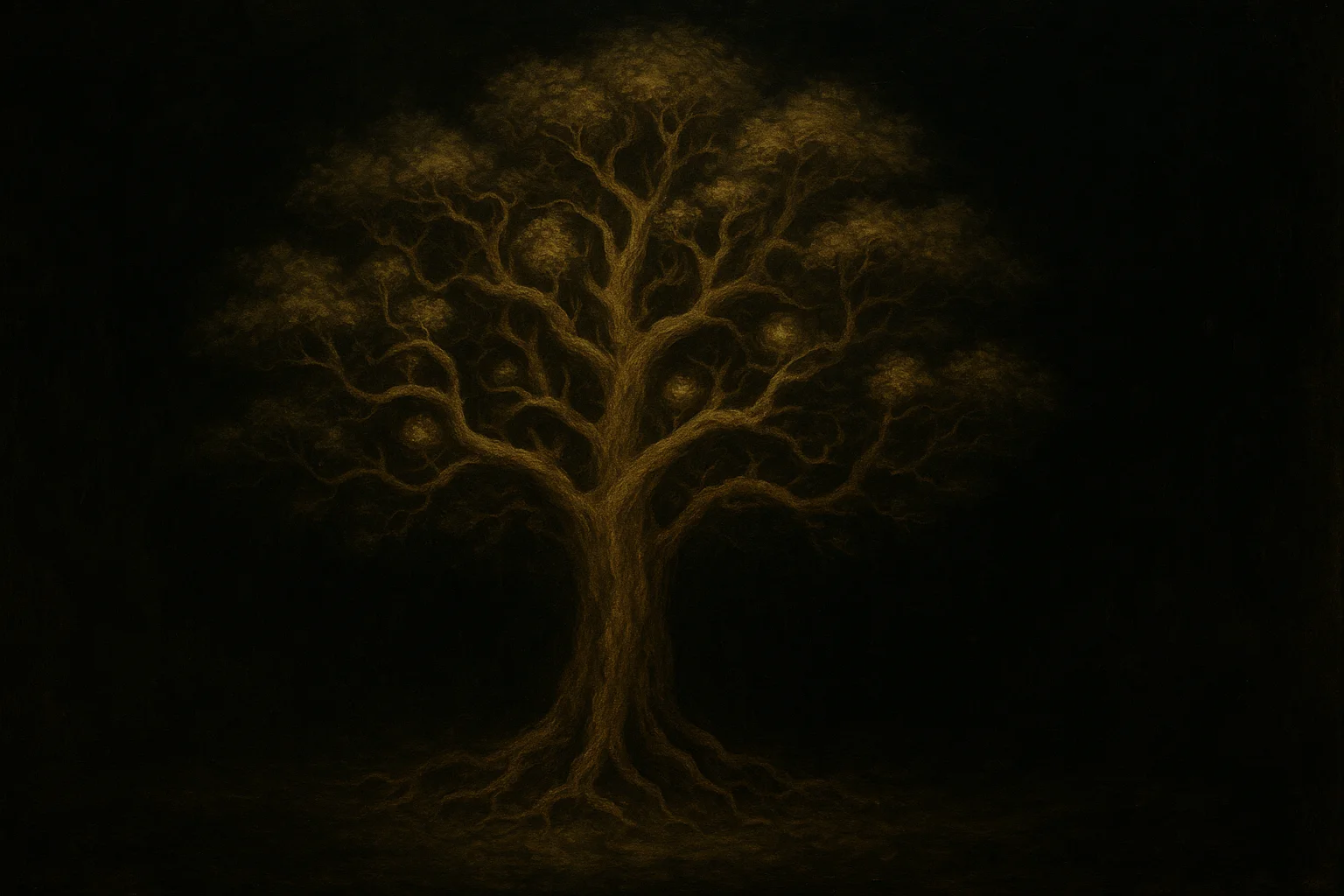
Yggdrasil is an ash tree in Norse cosmology, described most fully in the Poetic Edda and Prose Edda. It supports nine realms, including Asgard, Midgard, and Hel, and extends its branches over all the worlds. The name likely means "Odin's horse," a kenning for the gallows, recalling Odin's self-sacrifice when he hung from the tree for nine nights to gain the runes.
Grímnismál, stanzas 29 through 35, lists the tree's inhabitants: an eagle perched at the top, a squirrel named Ratatoskr running up and down the trunk carrying insults between the eagle and the serpent Níðhöggr below, and four stags grazing on the branches. The tree suffers constantly. Níðhöggr gnaws at its roots, the stags strip its bark, and rot works through the trunk. Yet it endures, watered by the Norns at Urðarbrunnr.
The wells and the roots
Three roots anchor Yggdrasil, each reaching a different realm. One extends to Asgard, where the well Urðarbrunnr lies. The Norns, three women who shape fate, draw water from this well and pour it over the root to preserve the tree. A second root reaches Jötunheimr, the land of giants, and touches Mímisbrunnr, the well of wisdom guarded by the head of Mímir. Odin sacrificed an eye to drink from this well. The third root stretches to Niflheimr, where the spring Hvergelmir bubbles, and where Jörmungandr coils beneath the roots.
Völuspá, stanza 19, describes the tree as standing "ever green over Urðr's well," a detail that emphasises its dependence on the Norns' care. The wells are not passive features. They sustain the tree and, by extension, the cosmos. When Ragnarök comes, Yggdrasil shudders but does not fall, and two humans, Líf and Lífþrasir, survive by hiding in its branches.
Inhabitants and guardians
The creatures living on and around Yggdrasil are more than fauna. The eagle at the crown may represent the sky or the gods' perspective. Ratatoskr, the squirrel, carries messages and insults, embodying communication and perhaps mischief. Níðhöggr, the serpent, gnaws at the root and consumes corpses in Náströnd, a hall of the dead. The four stags, named Dáinn, Dvalinn, Duneyrr, and Duraþrór, eat the tree's foliage, a detail that suggests even sacred structures are subject to decay.
The Vedic cosmic pillar and Ashvattha
The Rig Veda refers to a cosmic pillar or tree that supports the heavens, though the imagery is less concrete than Yggdrasil. Rig Veda 1.24.7 describes Varuna's cosmic order as upheld by a pillar, and 10.97.5 praises plants as rooted in the heavens, a reversal of the expected direction. The Ashvattha, or sacred fig, appears more explicitly in later texts, especially the Bhagavad Gita.
Bhagavad Gita 15.1-3 describes the Ashvattha as an inverted tree with roots in the heavens and branches extending downward to earth. This inversion reflects Vedic cosmology, where the divine source is above and the material world below. The tree is eternal, yet Krishna advises cutting it down with the axe of detachment, a metaphor for liberation from the cycle of rebirth. The Ashvattha thus functions as both cosmic structure and spiritual obstacle.
"They speak of the imperishable Ashvattha tree, with roots above and branches below. Its leaves are the Vedic hymns; one who knows this tree knows the Vedas." Bhagavad Gita 15.1
The fig tree also appears in Buddhist tradition as the Bodhi tree, under which Siddhartha Gautama attained enlightenment. While not a world tree in the structural sense, it retains the axis function, marking the centre of spiritual transformation. The continuity between Vedic and Buddhist tree symbolism suggests a shared Indo-Aryan cosmological grammar.
The Maya ceiba and the four-quartered cosmos
The ceiba tree, known as yaxche in Yucatec Maya, stands at the centre of the Maya cosmos and connects the thirteen layers of heaven, the earth, and the nine levels of the underworld, Xibalba. The Popol Vuh, Part III, describes the Hero Twins' descent into Xibalba, where they encounter trials and gods, but the ceiba itself is mentioned more often in colonial-era sources and ethnographic records than in the surviving pre-Columbian codices.
The Maya cosmos is organised horizontally as well as vertically. Four ceibas stand at the cardinal directions, each associated with a colour: red in the east, white in the north, black in the west, yellow in the south. The central ceiba, sometimes coloured green or blue, rises through the centre and holds the sky aloft. This five-point structure appears in temple layouts, ritual calendars, and creation myths.
Norse Yggdrasil
Vertical axis connecting nine stacked realms, no horizontal quadrants, single central tree, emphasis on fate and decay.
Maya ceiba
Vertical axis plus four-directional schema, five trees total, colour-coded, emphasis on spatial order and ritual orientation.
The ceiba also serves as a route for shamans and the dead. Souls climb the central tree to reach the heavens or descend its roots to Xibalba. The tree's flowers and fruit have ritual significance, and living ceibas are still treated as sacred in some Maya communities. The tree's thorny trunk, which deters climbers, may symbolise the difficulty of the journey between worlds.
Mesopotamian and Egyptian sacred trees
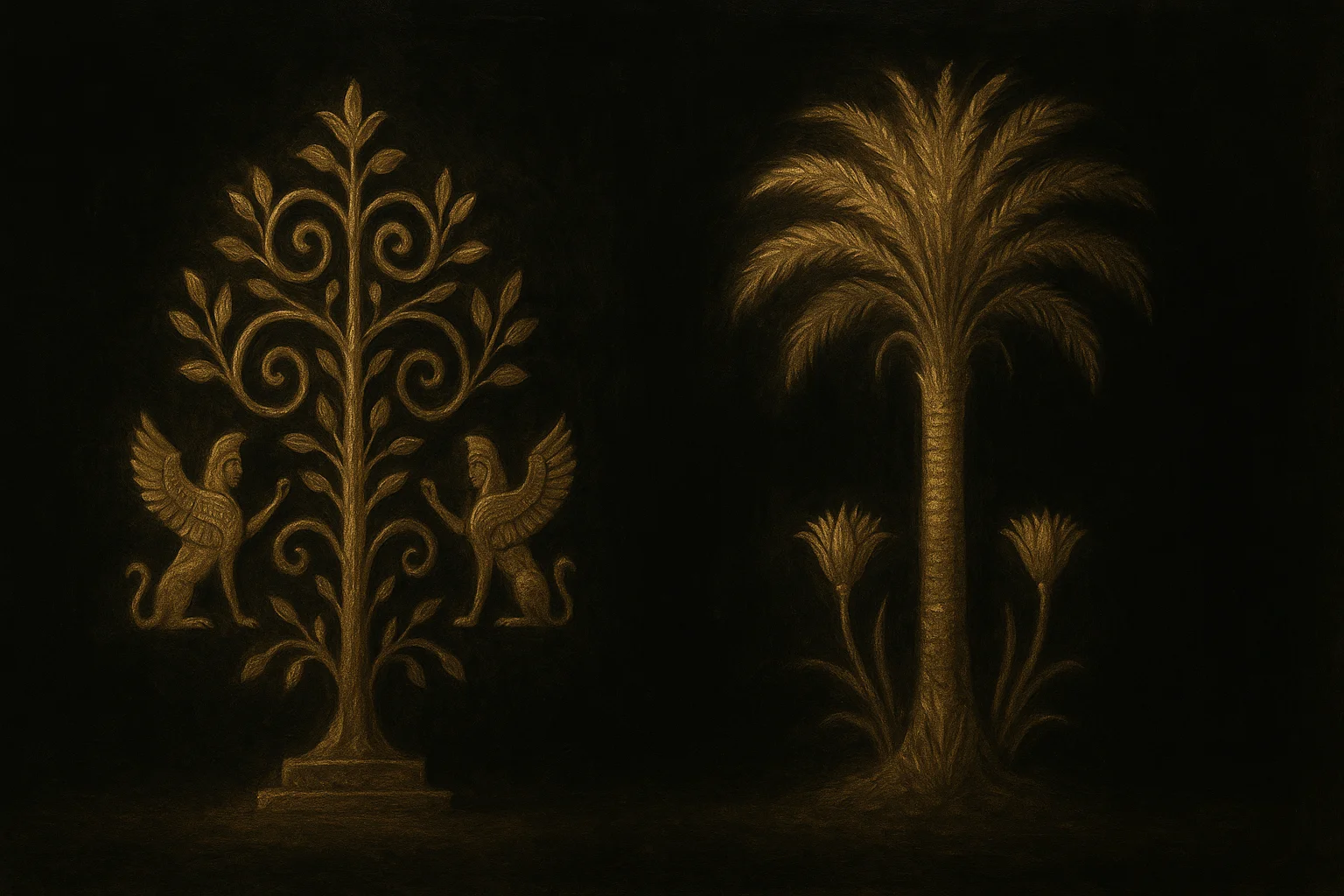
Mesopotamian mythology does not feature a single world tree, but sacred trees appear in several contexts. The Epic of Gilgamesh, Tablet XII, tells of the huluppu tree, which Inanna plants in her garden. A serpent nests in its roots, the Anzu bird in its crown, and the demon Lilith in its trunk. Gilgamesh kills the serpent and drives out the others, and Inanna uses the wood to make a throne and a bed. The tree here is not cosmic but symbolic, a contested space inhabited by dangerous beings.
Egyptian tradition includes the sycamore of Nut, mentioned in the Book of the Dead, Spell 109. The tree stands at the eastern edge of the sky, and the goddess Nut offers bread and water to the dead from its branches. The tree is not an axis but a threshold, marking the boundary between the living world and the afterlife. The sycamore also appears in tomb art, where it shelters the deceased and provides sustenance.
Both traditions treat trees as sacred and inhabited, but neither develops the full cosmological architecture seen in Norse or Maya sources. The Mesopotamian and Egyptian trees are more localised, tied to specific gods or rituals rather than organising the entire cosmos. This may reflect the different spatial concerns of river-valley civilisations, where horizontal geography, irrigation, and boundaries mattered more than vertical stacking.
Turkic, Siberian, and Mongol variants
Turkic and Siberian shamanic traditions feature a world tree called the Ulukayın or simply the cosmic tree, which connects the three worlds: the upper world of spirits, the middle world of humans, and the lower world of the dead. The tree grows at the centre of the earth, and its branches reach the pole star. Shamans climb the tree during trance journeys, moving between worlds to retrieve souls, consult spirits, or negotiate with gods.
Mongol cosmology includes a similar tree, sometimes identified with the birch, which serves as the axis for shamanic ascent. The tree is not described in surviving pre-modern texts with the same detail as Yggdrasil, but ethnographic accounts from the nineteenth and twentieth centuries document its role in ritual. The shaman's drum is often made from the wood of a sacred tree, and the drumstick represents the shaman's mount or the tree itself.
- Turkic traditions place the tree at the centre of the earth, with roots in the underworld and branches at the pole star.
- Siberian shamans use birch trees as ladders, notching them to represent the levels of the cosmos.
- Mongol cosmology associates the tree with the sky god Tengri and the earth goddess Umay.
- The tree is both a physical object, often a birch planted near the shaman's yurt, and a spiritual structure accessed in trance.
The Turkic and Siberian trees share the axis function with Yggdrasil and the ceiba, but they are more closely tied to individual shamanic practice than to collective cosmology. The tree is a tool, a map, and a being. It does not suffer decay like Yggdrasil, nor does it anchor a four-quartered space like the ceiba. It simply stands, and the shaman climbs.
Why trees, and why the centre
Trees offer a natural vertical structure. They grow upward, they have roots below, and they occupy a middle space. They are also alive, which makes them more dynamic than a pillar or a mountain. A tree can be wounded, fed, or destroyed, and this vulnerability mirrors the fragility of the cosmos itself. The choice of tree over stone or metal suggests that these cultures understood the universe as organic, subject to growth and decay.
The centre matters because it defines orientation. Without a centre, there is no up or down, no cardinal direction, no here or there. The tree marks the point from which all other space is measured. It is the first location, the origin of geometry. This is why mother goddesses and thunder gods are so often associated with the tree: they are the powers that establish and maintain order.
The tree also serves as a meeting place. Gods descend, the dead ascend, and humans stand in between. This makes the tree a site of exchange, negotiation, and conflict. Trickster figures and dying-and-rising gods often interact with the tree, either climbing it, hanging from it, or being reborn beneath it. The tree is where transformation happens, where the boundaries between worlds become permeable.
The recurrence of the world tree across unrelated cultures, from Scandinavia to Mesoamerica to Siberia, suggests either independent invention or a very old shared tradition. Comparative mythology has not settled the question. What is clear is that the tree answers a structural need: how to organise a cosmos that is both stable and alive, both ordered and vulnerable. The tree does this by being both scaffold and organism, both map and inhabitant.
Frequently asked questions
What is a world tree in mythology?
A world tree in mythology is a cosmological structure, typically a large tree or pillar, that connects the underworld, the earth, and the heavens, serving as the vertical axis around which the cosmos is organised and often providing a route for gods, spirits, and souls to travel between realms. Examples include Norse Yggdrasil, the Vedic Ashvattha, and the Maya ceiba. These trees are not merely symbolic but function as the structural framework of reality, holding the worlds apart and preventing cosmic collapse.
Which cultures have world tree myths?
World tree myths appear in Norse, Vedic, Maya, Turkic, Siberian, Mongol, and some Mesopotamian and Egyptian traditions, each with distinct structural and symbolic features. Norse mythology describes Yggdrasil, an ash tree connecting nine realms; Vedic texts refer to the inverted Ashvattha with roots in heaven; Maya cosmology centres on the ceiba, which marks both vertical and horizontal axes. Turkic and Siberian shamanic traditions use the cosmic tree as a ladder for spirit journeys, while Mesopotamian and Egyptian sources mention sacred trees without full cosmological integration.
What does Yggdrasil connect in Norse mythology?
Yggdrasil connects nine realms in Norse mythology, including Asgard (home of the gods), Midgard (the human world), Jötunheimr (land of giants), Niflheimr (realm of ice and mist), and Hel (the underworld), with its three roots extending to different wells and its branches sheltering gods, humans, and spirits. The tree suffers constant assault from the serpent Níðhöggr, four stags, and internal rot, yet it endures through the care of the Norns, who water it from the well Urðarbrunnr. Yggdrasil also serves as the site of Odin's self-sacrifice and the refuge for the last two humans during Ragnarök.
How does the Maya ceiba differ from Yggdrasil?
The Maya ceiba differs from Yggdrasil primarily in its horizontal as well as vertical organisation: while Yggdrasil is a single tree connecting stacked realms, the Maya cosmos includes a central ceiba plus four directional ceibas, each colour-coded and associated with a cardinal point, creating a five-point spatial grid. Yggdrasil emphasises fate, decay, and the suffering of the tree itself, with creatures gnawing at its roots and bark, whereas the ceiba functions more as a stable axis and ritual marker, with less emphasis on vulnerability. Both serve as routes for souls and gods, but the ceiba's role in orienting ritual space and temple architecture is more pronounced.
Why do so many cultures use trees as cosmic symbols?
Trees serve as cosmic symbols because they naturally embody a vertical axis, with roots below, a trunk in the middle, and branches above, making them ideal structures for organising a cosmos conceived as stacked layers of underworld, earth, and heaven. Trees are also alive, which allows them to represent a dynamic, vulnerable universe subject to growth, decay, and renewal, unlike static pillars or mountains. Their centrality in underworld journeys and their role as meeting places for gods, spirits, and humans further reinforce their cosmological importance across unrelated cultures.
Further reading on Mythologis
Read the full book
Want the whole story?
The complete edition is an instant PDF download here, with a paperback on Amazon for selected titles.
Mythology
The World Mythology Book: The Gods, Heroes and Myths of Every Culture
The Gods, Heroes and Myths of Every Culture, in One Volume
The whole of world mythology in a single volume: Greek, Norse, Egyptian, Japanese, Hindu, Celtic, Slavic, Mesoamerican and African myths gathered side by side, each drawn from the primary sources.