
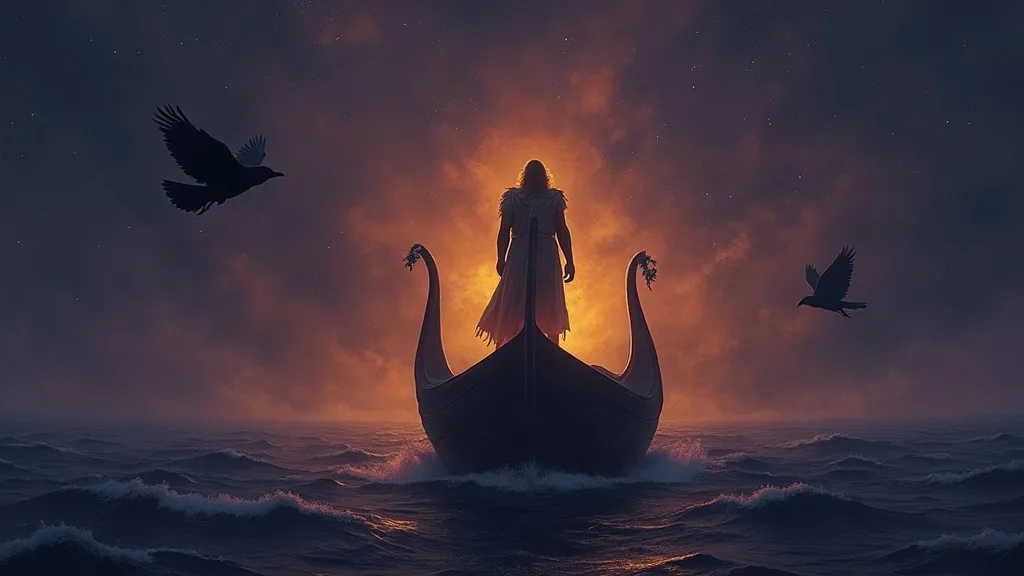
Baldur the Shining God: Light, Death, and the End of the Norse World
Baldur the shining god dies by a sprig of mistletoe, and the Norse cosmos trembles. Trace his myth from the Prose Edda to Ragnarok, and see why his story still resonates.
Contents
The dream comes first. Baldur the shining god wakes troubled, haunted by visions of his own death, and the nightmare is vivid enough that every deity on Asgard takes notice. His mother Frigg rides out across every realm, extracting oaths from fire, water, iron, stone, wood, disease, animals, birds, and poison. Everything swears not to harm her son. The gods relax. They turn Baldur's invulnerability into sport, hurling spears and axes at him while he laughs. Nothing bites. Nothing wounds. For a short, shining interval, one god seems genuinely safe in a cosmos built for catastrophe.
Then Loki hands a blind god a sprig of mistletoe. One throw. One death. The entire Norse mythological framework tilts on that moment, because Baldur's death is not just the story of one god's murder. It is the first crack in the wall that holds back Ragnarok, the catastrophic end of the world. Snorri Sturluson, writing in Iceland around 1220 AD, places Baldur's story at the structural centre of the Prose Edda. He calls Baldur "the best of the gods" and says light radiates from him so strongly that white flowers are named after his brows. That is not casual praise. That is a cosmological signal.
Reading his myth carefully, the reader finds grief coded into its architecture from the very beginning. Baldur is the most beloved figure in Asgard, and precisely because of that, his loss breaks something that cannot be repaired before the world burns.
Who Baldur Is: His Place Among the Aesir
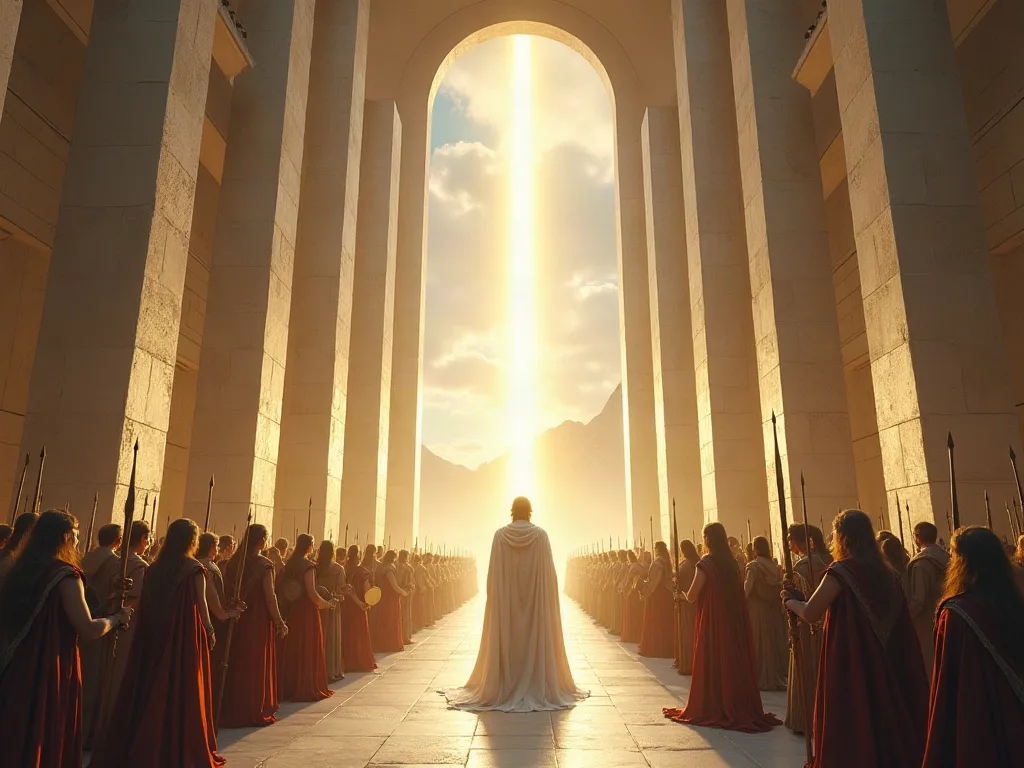
Baldur is the son of Odin, the Allfather, and Frigg, the queen of Asgard. His wife is Nanna, a goddess associated with devotion, and together they have a son called Forseti, who presides over justice and mediation. His hall is Breidablik ("Broad Gleaming"), described in the Prose Edda as the place in all existence where the least evil dwells. No lie can be spoken there. No blood spilled within its walls.
Those details matter. Breidablik is not simply a grand mansion. It is a kind of sanctuary, a zone of moral purity inside a cosmos that includes Loki's treachery, Odin's ruthless hunger for wisdom, and the barely restrained violence of giants and monsters. Baldur represents what the Norse world aspires toward: clarity, fairness, and the absence of malice.
His name is generally traced to the Proto-Germanic balðraz, connected to concepts of courage and lordship. The Old Norse baldr also functions as a common noun meaning "hero" or "prince," which suggests the name encoded high status before it became a proper name at all. The Danish scholar Hilda Ellis Davidson noted in her 1964 work Gods and Myths of Northern Europe that Baldur's radiance probably linked him to sunlight, though his precise domain within the Norse pantheon is never as rigidly defined as, say, Thor's mastery over storms.
That ambiguity is actually part of his power as a mythological figure. He is the pure potential of what the cosmos might be if violence did not govern it.
The Two Sources: Snorri and the Eddic Poems
Most readers encounter Baldur the shining god through two primary bodies of text. The first is the Prose Edda, composed by the Icelandic historian and poet Snorri Sturluson around 1220 AD. Snorri's account in the section called Gylfaginning ("The Tricking of Gylfi") gives the fullest narrative: the dreams, Frigg's oaths, the blind god's fatal throw, the failed mission to retrieve Baldur from Hel's realm, and Loki's punishment.
The second source is older and fragmentary. The Poetic Edda, a collection of Old Norse poems assembled in the Codex Regius manuscript around 1270 AD (though the poems themselves are older, some possibly from the 9th or 10th century), contains Baldrs draumar ("Baldur's Dreams"), a short poem of only 14 stanzas. In it, Odin rides down to Niflheim, the realm of mist and the dead, and forces a dead völva (a seeress) to wake and prophesy. She reveals that a "brother of Höðr" will avenge Baldur, naming Váli, a son Odin will father specifically for that purpose.
These two sources do not always agree. Snorri's telling is polished and elaborated, shaped by a Christian-educated writer trying to preserve pre-Christian traditions. The Poetic Edda gives rawer, terser accounts. Scholars including John Lindow (in his 2001 Norse Mythology: A Guide to the Gods, Heroes, Rituals, and Beliefs) have argued that Snorri may have harmonised and expanded details that were far more fragmentary in the living oral tradition.
A third, more controversial source comes from the 12th-century Danish chronicler Saxo Grammaticus, whose Gesta Danorum ("Deeds of the Danes") tells a radically different version: here, Balderus is a mortal warrior who competes with a rival called Høtherus for the hand of a woman named Nanna. The supernatural elements are muted. The death is still present, but it reads more like a heroic saga than a cosmological myth. Scholars debate whether Saxo's version reflects an older, more euhemerised layer of the tradition, or simply a different regional variant.
How Baldur Died: The Mistletoe and the Blind God
The death sequence in Snorri's Prose Edda unfolds in stages, each one a small failure of protection.
Frigg extracts her great oath from everything in existence. But she skips the mistletoe, considering it too young and too tender to be worth asking. This is the gap Loki finds. He disguises himself as an old woman, visits Frigg, and through careful conversation extracts the fact that mistletoe never swore. Loki then cuts a sprig, sharpens it into a dart, and approaches Höðr, Baldur's blind brother, who stands apart from the sport, unable to participate.
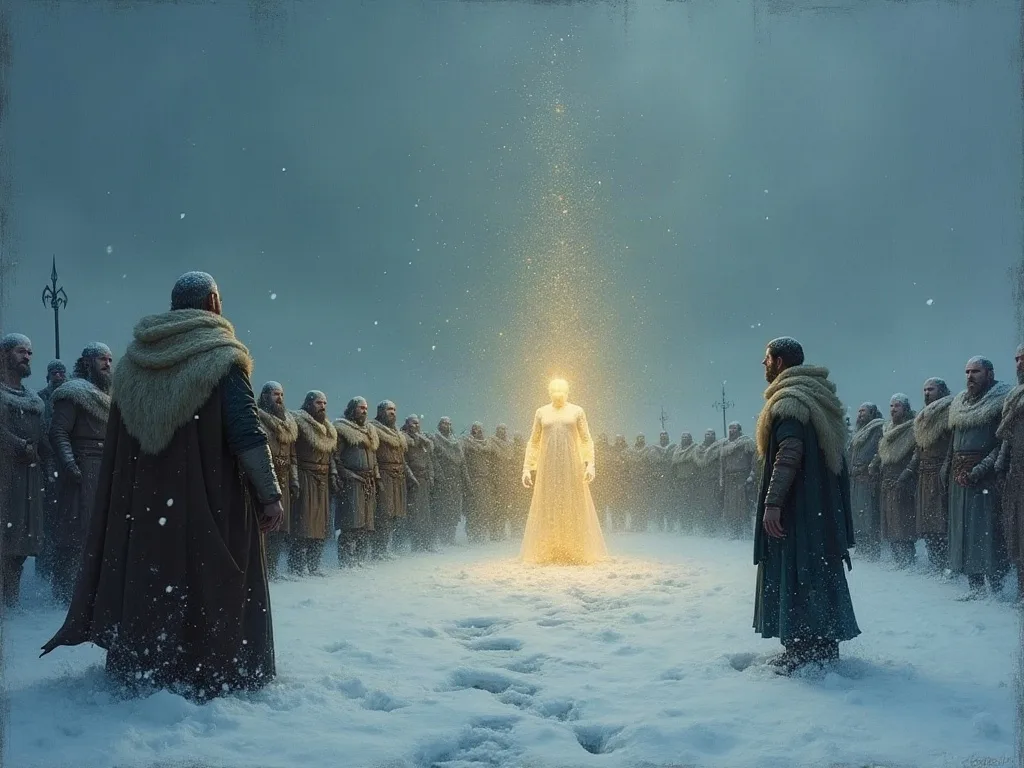
Loki offers to guide his arm. He places the mistletoe dart in Höðr's hand, points him at Baldur, and Höðr throws. The dart pierces Baldur through. He falls. The gods stand silent, unable to believe what just happened. Then the grief breaks open, and Snorri writes that the Aesir wept so loudly they could not speak.
Nanna, Baldur's wife, collapses at the sight of his body and dies of grief on the spot. Both are placed on his funeral ship, Hringhorni, the greatest ship in existence. The gods cannot move it themselves. They send for a giantess called Hyrrokkin, who arrives riding a wolf and steers the ship into the sea with a single push so powerful it makes the earth shudder. Odin leans down and whispers something in Baldur's ear before the pyre is lit. No source records what he says.
That unanswered whisper is one of the most haunting details in all Norse myth. It signals that Odin knows something the reader is not told, possibly the prophecy of Baldur's eventual return after Ragnarok.
Hermóðr, a son of Odin, volunteers to ride to Hel, the realm of the dead, and beg for Baldur's return. He borrows Odin's horse Sleipnir, the eight-legged stallion, and rides for nine nights through valleys so dark and deep that he sees nothing until he crosses the bridge Gjallarbru and reaches the gates of Hel's domain.
Hel agrees to release Baldur on one condition: every being in every realm must weep for him. If even one refuses, he stays.
Every creature and stone and river weeps. Every one except a giantess called Þökk ("Thanks"), sitting in a cave, who says she gained nothing from Baldur in life and has no tears to shed. Most sources assume Þökk is Loki in yet another disguise. Baldur remains in the land of the dead.
The Symbolic Weight: What Baldur's Light Means
To read Baldur the shining god as merely a story of a murder and a failed rescue misses the depth that generations of scholars have found inside it.
Sir James George Frazer famously argued in The Golden Bough (1890 and subsequent editions) that Baldur's story belonged to a pan-European complex of dying-and-rising vegetation gods: the mistletoe, in Celtic and Germanic folk belief, was a sacred parasitic plant associated with life force, and Frazer read Baldur's death as a ritual killing connected to agricultural cycles. This reading has fallen substantially out of favour. Modern scholars like Lindow and Rudolf Simek (in his Dictionary of Northern Mythology, 1993) point out that the Norse sources show no evidence of Baldur being a harvest deity, and Frazer's comparative method was far too loose.
A more persuasive reading focuses on the structure of the cosmos. Baldur's purity creates a problem for the Norse world. The Norse cosmos is not built for purity. It is built for struggle: Odin sacrifices his eye for wisdom, Thor cannot cross certain rivers because his power is too destructive, Tyr loses his hand to the wolf Fenrir. In this world, Baldur's untouchability is an anomaly, and anomalies in mythological systems tend to attract violence.
His death also activates the chain of events leading directly to Ragnarok. Loki's punishment after the murder, bound beneath the earth with serpent venom dripping on his face, is precisely the imprisonment that ends when Ragnarok begins. Baldur's return, prophesied to occur after the world burns and resets, frames him as a figure of renewal rather than simply a victim.
Baldur (Norse)
- Beloved, morally pure deity killed by treachery
- Death triggers cosmic crisis and mourning of all beings
- Resides in the realm of the dead after failed rescue
- Prophesied to return and rule a renewed world after Ragnarok
- His killer (Loki via Höðr) is punished and bound
Osiris (Egyptian)
- Beloved, civilising deity killed by his brother Set's treachery
- Death plunges Egypt into chaos and mourning
- Resides as lord of the dead in Duat after resurrection ritual
- Resurrects and rules the dead; his son Horus reclaims the living world
- His killer Set is eventually subdued by divine judgment
The parallel with Osiris is striking and has attracted comparative mythologists for over a century. Both are beloved gods destroyed through treachery by a figure close to them. Both descend to rule or occupy a realm of the dead. Both carry a promise of future renewal. The parallelism is not necessarily evidence of direct borrowing: it may reflect a shared Indo-European pattern in which the death of the "good king" archetype signals the breakdown of cosmic order.
Loki's Role: Why the Trickster Had to Break This
Loki's guilt in Baldur's death is stated plainly in Snorri, but the why is slippery. Snorri does not give Loki a clear motive rooted in hatred of Baldur specifically. What drives him seems to be something more like an instinct to find the gap, the unsworn oath, the one flaw in any seemingly perfect system.
John Lindow argues that Loki functions in Norse myth as a figure who "makes things happen" by exploiting contradictions. Frigg's oath system is a contradiction: she has created invulnerability by extracting promises, but the very act of creating it reveals a hidden vulnerability (whatever she did not think to ask). Loki's genius, if it can be called that, is to see the hole that others miss.
There is also a darker reading. Some scholars, including *Anatoly Liberman in his 2016 study In Prayer and Laughter: Essays on Medieval Scandinavian and Germanic Mythology, suggest that Loki's motivations across the entire Prose Edda cannot be systematised. He acts from something closer to an aesthetic drive, a need to puncture the sublime. Baldur is the most sublime thing in Asgard. Puncturing him would, from Loki's perspective, be almost inevitable.
What Snorri makes clear is the consequence. After the funeral, when the gods discover that Þökk was Loki in disguise, they hunt him across the world. He hides in a river, disguised as a salmon. Thor reaches into the water and catches him by the tail. This is why salmon are pinched at the tail: the old Norse etiological logic, explaining the shape of the natural world through divine action.
Loki is then bound in a cave with the entrails of his own son Narfi, knotted into chains. A serpent is fixed above his face to drip venom onto it. His wife Sigyn holds a bowl to catch the drops, but when she has to empty the bowl, the venom falls, and Loki's writhing shakes the earth. This is the Norse explanation for earthquakes. He remains there until Ragnarok.
Baldur After Death: The Realm of Hel
The geography of Hel's domain in Norse cosmology is worth pausing on. Hel (without the capital, the realm itself) is presided over by a being of the same name, a daughter of Loki and the giantess Angrboda. She is described in the Prose Edda as half living flesh, half corpse-blue, ruling a realm called Niflheim or Niflhel, the lowest and oldest place in existence.
Baldur arrives there not as a shade or a shadow but apparently as a whole, conscious being. Hermóðr finds him sitting in the high seat of Hel's hall. Nanna is there too. When Hermóðr makes his plea, Hel's answer is formal and conditional: prove the love is real, make the world weep. It is an almost bureaucratic test.
This is notably different from Greek mythology's Hades, where the dead are generally diminished, hungry for blood or sacrificial smoke to restore temporary coherence. Baldur in Hel seems fully present, perhaps even content, which has led some scholars to wonder whether death, in the Norse framework, is genuinely the catastrophe the living perceive it to be.
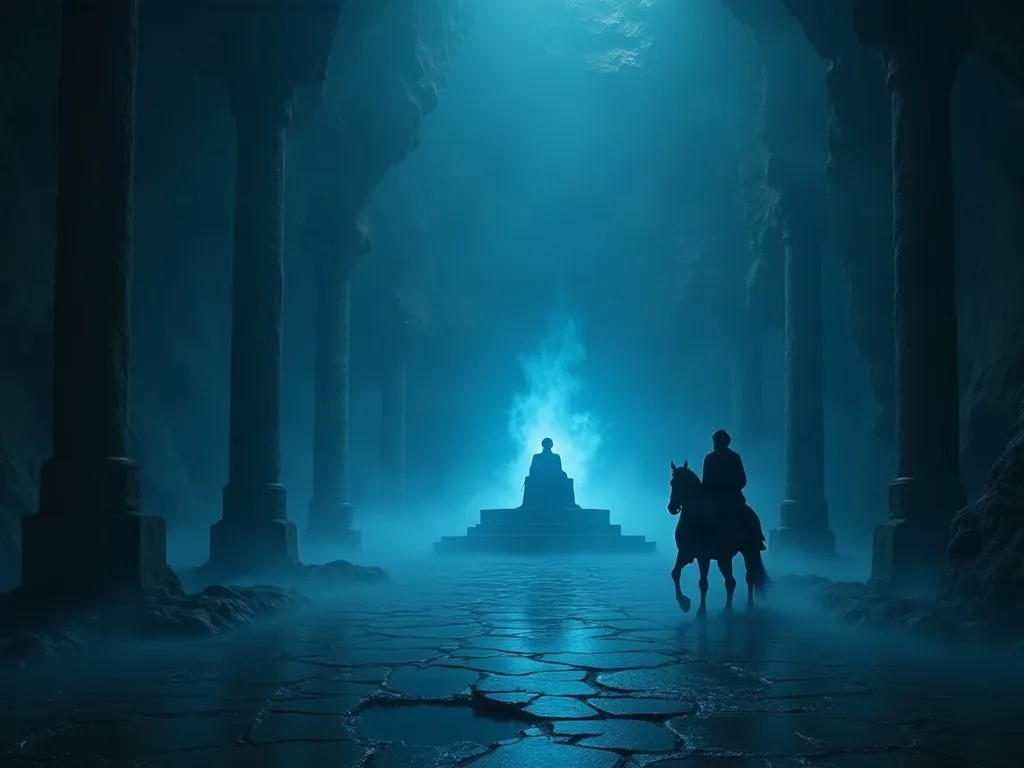
Odin's whisper at the pyre might hold the answer. If Odin has already been told by the völva in Baldrs draumar that Baldur will return after Ragnarok, then the whisper may be a message from father to son: "Wait. This is not the end." That reading transforms Baldur's time in Hel from tragedy into a kind of patience.
Baldur's Return: The World After Ragnarok
The Völuspá ("Prophecy of the Seeress"), one of the oldest and most important poems in the Poetic Edda, describes what happens after Ragnarok. The nine worlds burn. The sea swallows the land. The sky goes dark. Then:
A new earth rises from the water, green and growing. The surviving gods meet on the plain Iðavöllr. And among those who return is Baldur. He comes back from Hel, and with him comes Höðr, the blind brother who threw the fatal dart. Together, they inhabit the reborn world, joined by the handful of gods who survived Ragnarok: Víðarr, Váli, Móði, Magni.
This is the structural reason Baldur matters so much in Norse mythology. He is not simply a tragic victim. He is the guarantee of the world's second chance. His time in the land of the dead is not a punishment but a holding. The Völuspá says the fields will grow unsown, all evil will be gone, and Baldur will reign in peace. The light that shone from him in Asgard will return to a cosmos that has finally burned clean of everything that corrupted it.
That eschatological arc, the world-ending fire followed by a purified renewal led by a figure of light who endured death, has drawn obvious comparisons to Christian imagery, and scholars have long debated how much Snorri's Christian education shaped his telling. But the Völuspá predates Snorri's Prose Edda by centuries, and the core pattern of Baldur's death and restoration appears embedded in the pre-Christian tradition at a level that cannot be explained away as interpolation.
Baldur's Legacy in Literature, Art, and Modern Imagination
The 19th century found Baldur the shining god irresistible as a symbol. The English poet Matthew Arnold published Balder Dead in 1855, a long narrative poem that treated the myth with the gravity Arnold usually reserved for classical subjects. He used it as a meditation on grief and the limits of beauty in a violent world.
The Norwegian composer Johan Halvorsen wrote a Baldur's Dream tone poem in 1897. Richard Wagner, while better known for his treatment of the Nibelungenlied, was aware of the Baldur tradition. The 20th century saw Baldur appear in J.R.R. Tolkien's mythological consciousness: while Tolkien never directly transcribed Norse myths, the figure of Gandalf carries Odin's wanderer energy, and the grief over a beloved figure whose death reshapes the world echoes in the loss of characters like Boromir and, most pointedly, in Frodo's passage to the Undying Lands, a renewal narrative that rhymes with the Völuspá's final vision.
In contemporary fiction and gaming, Baldur has received explicit treatment. The video game God of War (2018) by Santa Monica Studio places Baldur, here called Baldr, as the primary antagonist. In this version, Frigg's protective spell backfires: Baldur cannot feel pain or pleasure and is consumed by a rage born from total sensory deprivation. The narrative inverts the Edda: the mother's love becomes the son's prison. Baldr dies by the hands of Kratos and Atreus, his death releasing the Fimbulwinter that precedes Ragnarok. The game stays faithful to the cosmological function of Baldur's death while radically reimagining his character.
This willingness to reinterpret while respecting the structural role of the myth is, arguably, the most honest way to engage with Norse tradition. The Eddas themselves were written versions of oral stories that had already shifted over centuries. The myth of Baldur the shining god was never a fixed monument. It was always alive, always capable of saying something new about light, loss, and the possibility that the world might one day start again.
Frequently Asked Questions About Baldur the Shining God
Frequently asked questions
Why did the mistletoe kill Baldur when everything else could not?
Frigg extracted oaths from every substance and creature in the nine worlds, but she skipped the mistletoe, thinking it too young and insignificant to matter. Loki discovered this gap through careful questioning and had the mistletoe dart shaped and used by Höðr. The Prose Edda is explicit: Frigg's oversight, not any supernatural quality of mistletoe itself, was the single flaw in an otherwise complete protection.
What did Odin whisper to Baldur at the funeral pyre?
No Norse source records the content of Odin's whisper. The question is posed as a riddle in the Prose Edda itself: Snorri writes that whoever can answer what Odin said has proven their wisdom. Most scholars read the whisper as Odin communicating the prophecy of Baldur's return after Ragnarok, drawn from the Völuspá and Baldrs draumar. The secrecy is part of the point: Odin alone knows the shape of the future.
Is Baldur a sun god in Norse mythology?
The Norse sources never explicitly label Baldur a sun deity. The sun is personified separately as Sol (Sól), a goddess driving the solar chariot. Baldur's radiance is described in terms of physical brightness and moral purity rather than astronomical function. Scholar Hilda Ellis Davidson argued in Gods and Myths of Northern Europe (1964) that a solar connection is plausible but not provable from the primary texts. He is better understood as a god of light in a broader, symbolic sense.
What happens to Baldur after Ragnarok?
According to the Völuspá, one of the oldest poems in the Poetic Edda, Baldur returns from Hel's realm after the world-ending catastrophe of Ragnarok. He and his brother Höðr are reconciled and join the surviving Aesir on the reborn earth. The Völuspá describes this new world as green and fertile, free of evil, with Baldur and the surviving gods presiding over it in peace. He functions as the symbol of renewal in Norse eschatology.
How does Saxo Grammaticus's version of the Baldur myth differ from Snorri's?
In Saxo Grammaticus's 12th-century Gesta Danorum, Balderus is a mortal warrior who competes with a rival named Høtherus for the love of Nanna. The story has saga-style human stakes: rival suitors, battle, death by a sword rather than mistletoe. The cosmological dimension and the failed rescue from the underworld are absent. Scholars debate whether Saxo preserved an older, less mythologised tradition or simply adapted the story for his courtly Latin audience. Most modern specialists treat both versions as valid regional variants rather than one being "correct."
Is Baldur's myth related to the Christian story of Jesus?
The structural echoes are real and have been noted since at least the 19th century: a beloved, morally pure figure who dies through treachery, whose death triggers universal mourning, and who is prophesied to return in a renewed world. Scholars like Rudolf Simek caution strongly against treating this as direct Christian influence on Norse myth, since the Völuspá's core content appears pre-Christian. A more nuanced position, held by researchers including John Lindow, is that Snorri's Christian education may have sharpened certain narrative details, but the fundamental structure of Baldur's myth belongs to the pre-Christian tradition.
Baldur and the Unresolved Question of the Dying God
The debate that keeps returning in Norse scholarship is not whether Baldur the shining god is a fascinating character (the evidence for that is overwhelming), but what kind of story his myth actually tells.
Frazer's dying-and-rising vegetation god framework, now largely discredited in its specifics, opened a genuine question: does Norse myth encode a cyclical theology, or a linear one? If Baldur returns after Ragnarok to a new and better world, the Norse cosmos is not simply cyclical (eternal return, the same world endlessly repeated) but genuinely teleological. Things move toward something. The burning of the old world is not a punishment but a clearing.
That is a surprisingly optimistic cosmology for a tradition often described in terms of heroic doom. Ragnarok is real, yes. The gods will fall. But Baldur's survival in Hel and his prophesied return suggest that the Norse mythological imagination held a quiet conviction: light that goes into the dark is not destroyed. It waits.
That image, a god of radiance sitting patiently in the hall of the dead while the world above him stumbles toward its end, is one of the most unusual in any mythological tradition. Most dying gods are rescued or resurrected within the arc of a single myth. Baldur's rescue fails. He stays. He endures. He returns only when the world itself has done the hard work of ending and beginning again.
His myth asks something of the reader that few mythological narratives do directly: not "what would you sacrifice for knowledge?" (that is Odin's question), not "how hard will you fight?" (that is Thor's question), but "what are you willing to wait for, in the dark, after everything has been taken?"
Free 25-page sample
Want the whole story?
Take the first 25 pages free. If it pulls you in, the full edition is yours as an instant PDF download, with a paperback on Amazon for selected titles.

Mythology
The World Mythology Book: The Gods, Heroes and Myths of Every Culture
The Gods, Heroes and Myths of Every Culture, in One Volume
The whole of world mythology in a single volume: Greek, Norse, Egyptian, Japanese, Hindu, Celtic, Slavic, Mesoamerican and African myths gathered side by side, each drawn from the primary sources.