
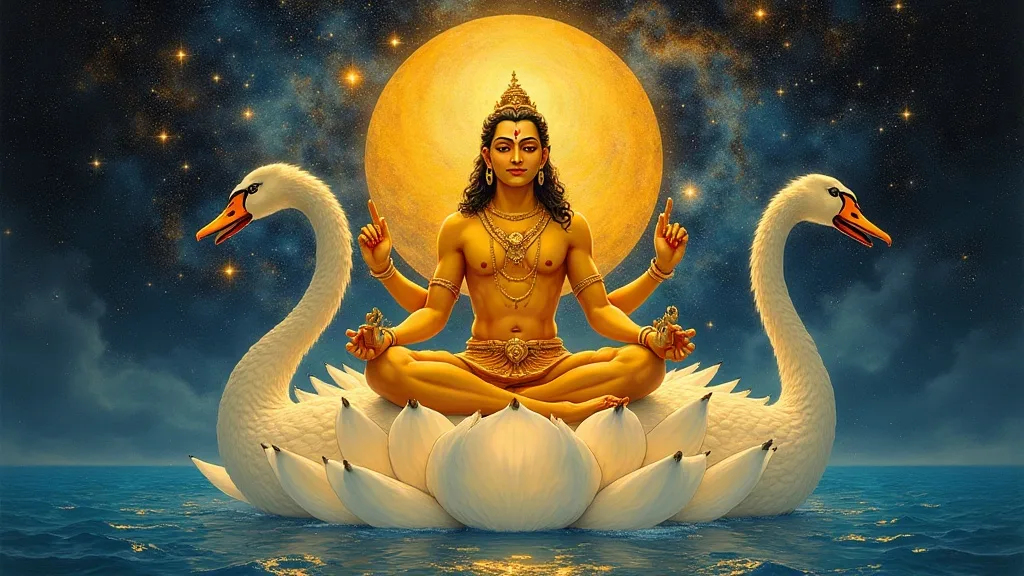
Brahma the Creator: The Four-Faced God Who Shaped Reality
Brahma the creator is the first god of the Hindu trinity, born from a cosmic lotus to bring the universe into being. Discover how the four-faced deity shaped reality, why he faded from worship, and what his myth reveals about creation itself.
Contents
In the moment before time existed, the ocean of creation lay still and silent. A golden lotus grew from the navel of Vishnu, the preserver god, and from that flower emerged Brahma, radiant and newborn. His first task was vast beyond measure: to shape matter into worlds, to breathe consciousness into void, to draft the blueprint of all that is. This is how Brahma the creator enters the cosmos.
The god carries four heads, each turned toward a cardinal direction, each containing a Veda (the four sacred texts of Hinduism). With four arms, he holds the tools of creation: a water pot (symbolizing life), prayer beads (symbolizing time), a scepter (symbolizing authority), and sacred texts (symbolizing knowledge). His skin glows white or red, and he rides a swan, a bird that symbolizes discrimination and the ability to separate truth from illusion.
Yet Brahma the creator is paradoxical. He is essential to cosmology, ancient in textual authority, and virtually absent from living Hindu temples. This god's story is not one of triumph but of contraction, a myth that teaches why creation itself moves beyond the creator's hand.
The Birth of Brahma and the Cosmic Lotus
Before the cosmos existed, only the Supreme Reality, known as Brahman, permeated all space. This is not Brahma the god, but rather the universal consciousness from which all gods emerge. When creation was willed to begin, Vishnu slept on the cosmic ocean, resting on a serpent named Shesha. From Vishnu's navel sprouted a lotus on a long stalk.
The Brahma Purana, one of the oldest Hindu texts, describes this moment. Brahma opened his eyes in confusion. He asked, "Who am I? Where do I come from?" He climbed the lotus stalk seeking its root, but could not find it. Eventually, he heard a voice from beyond telling him that he was born to create. This uncertainty at the moment of his own birth became a defining feature: Brahma the creator does not possess absolute authority; he is subordinate to the cycles of time and to Brahman itself.
In some versions, Brahma emerges from a golden egg (Hiranyagarbha) that floats on the primordial waters. This egg contains infinite potential. Brahma breaks it apart and uses its shell to create the sky and earth. The yolk becomes the sun; the white becomes the moon. Everything comes from his conscious will to separate and differentiate.
The Four Vedas and the Four Heads
One of the most distinctive features of Brahma the creator is his four heads. Each head represents one of the four Vedas, the foundational texts of Hindu wisdom. These texts are Rigveda (knowledge and hymns), Yajurveda (ritual and sacrifice), Samaveda (melody and chant), and Atharvaveda (prayers and spells).
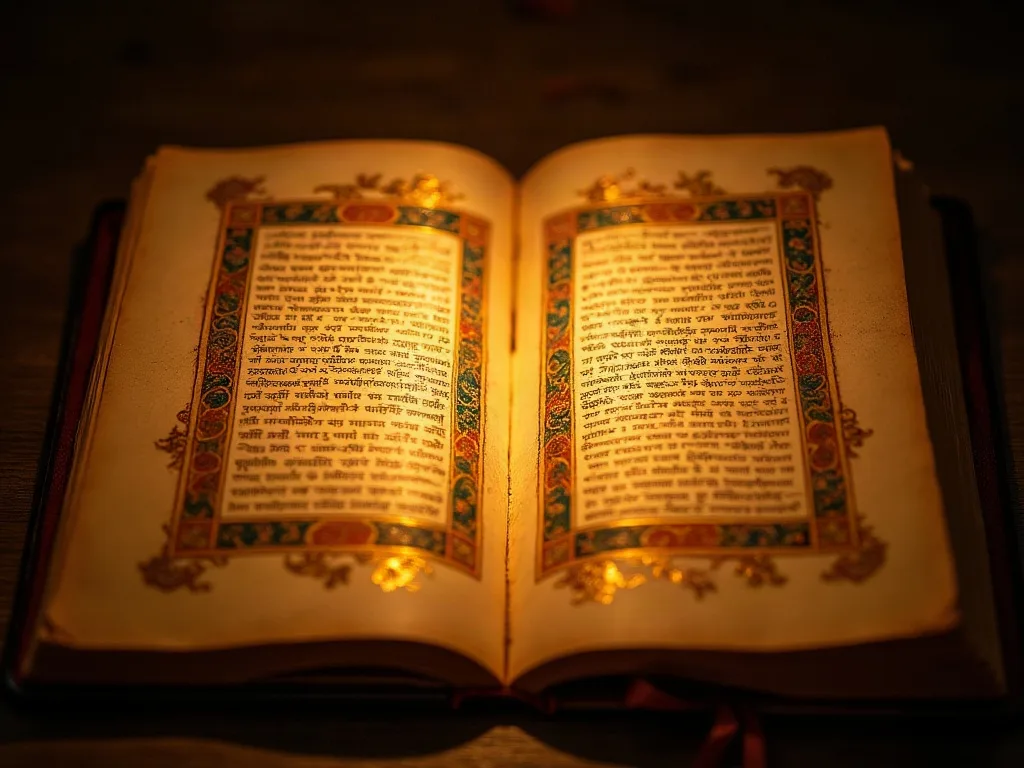
According to the Brahma Purana, when Brahma completed his work of creation, he began to recite the Vedas. Each word he spoke solidified into reality. The first words became the heavens, the next became the earth, then came light, then the beings. The four Vedas are thus not merely texts but the very sound-formula of creation itself, encoded in Brahma's speech.
The four heads also allow Brahma the creator to see in all directions simultaneously. He watches the unfolding of his creation, monitors cosmic order (Dharma), and ensures that cycles of time progress correctly. Some texts suggest that the fifth head was severed long ago (a story we will explore later), leaving him with four.
The Vedas are eternal and uncreated. This distinction is crucial: Brahma did not invent them; he channeled them into spoken form, allowing finite minds to access infinite knowledge. This makes Brahma less the ultimate originator and more the agent through whom creation happens.
The Cosmic Cycles and Creation's Rhythm
Hindu cosmology operates in vast cycles called Yugas (ages). The smallest cycle, the Chaturyuga, consists of four ages: Satya Yuga (the age of truth), Treta Yuga (the age of ritual), Dwapara Yuga (the age of doubt), and Kali Yuga (the age of darkness and conflict). One complete Brahma Day consists of 1,000 Chaturyugas, totaling 4.32 billion years in human time.
Brahma the creator oversees these cycles, though he does not control them. He creates during his day and rests during his night. When a cosmic day ends, Brahma withdraws the worlds back into himself. During his sleep (a Brahma Night, also lasting billions of years), the universe exists as potential within his mind. When he wakes, creation begins anew.
This cyclical model is radically different from linear creation myths. It proposes that the universe is neither eternally static nor created once and for all. Instead, it perpetually cycles: manifestation, duration, dissolution, rest, and rebirth. Brahma the creator is the agent of manifestation, but he is not the author of the cycle itself. Time itself is the true force, and Brahma operates within its rhythm.
Each Brahma Day, Brahma recreates the universe in slightly different forms. No two creations are identical. This introduces an element of variation and play (Lila) into cosmology; the universe is both ordered and open to infinite possibility.
The Trinity: Brahma, Vishnu, and Shiva
Hindu theology centers on the Trimurti, the trinity of three supreme manifestations. Brahma represents creation; Vishnu represents preservation and protection; Shiva represents dissolution and renewal.
The relationship between these three is hierarchical and paradoxical. In some texts, all three emerge from an undifferentiated unity. In others, one god is supreme and the other two are aspects of that god. The Upanishads, ancient philosophical texts, suggest that all three are ultimately manifestations of Brahman, the transcendent reality.
Brahma the creator is functionally dependent on Vishnu's cosmic sleep. He cannot act without Vishnu's will. And his creations eventually fall to Shiva's dissolution. This interdependence suggests that no single god possesses absolute power. Instead, the cosmos functions as a trinity of necessary forces held in dynamic balance.
Brahma's role, then, is not to establish eternal order but to initiate the phase of manifestation. His work is temporary by definition. This theological insight helps explain why Brahma receives far less worship than Vishnu or Shiva: in a universe of cycles, the creator's work is always finite and always followed by cessation.
The Curse of Saraswati and the Fading of Brahma
A striking feature of Hindu practice is that Brahma receives almost no worship despite his cosmic significance. This absence is explained by a myth involving Brahma the creator and his consort Saraswati, the goddess of knowledge and arts.
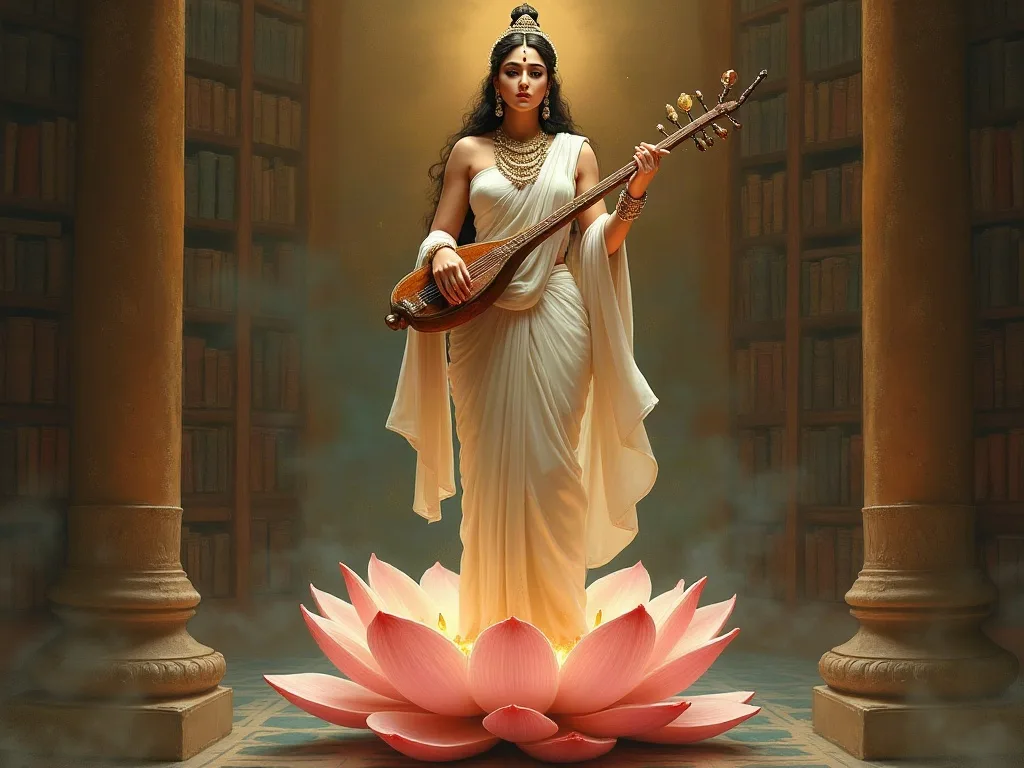
The story exists in multiple versions. In one, Brahma became infatuated with his own daughter, Saraswati, and created a fifth head to gaze upon her as she turned away. When she learned of his lust, she cursed him that he would never be worshipped. Some texts say she cursed him that his name would be forgotten on earth. In another version, Shiva severed that fifth head in punishment for Brahma's arrogance.
The Brahma Vaivarta Purana offers a different account: Brahma and Vishnu once argued about who was superior. To settle the dispute, Shiva manifested as a pillar of infinite light and declared that whoever could find its top or bottom would be supreme. Vishnu journeyed downward in humility; Brahma boasted that he would fly to the top. When he could not, Shiva punished him by declaring that no creature on earth would worship him.
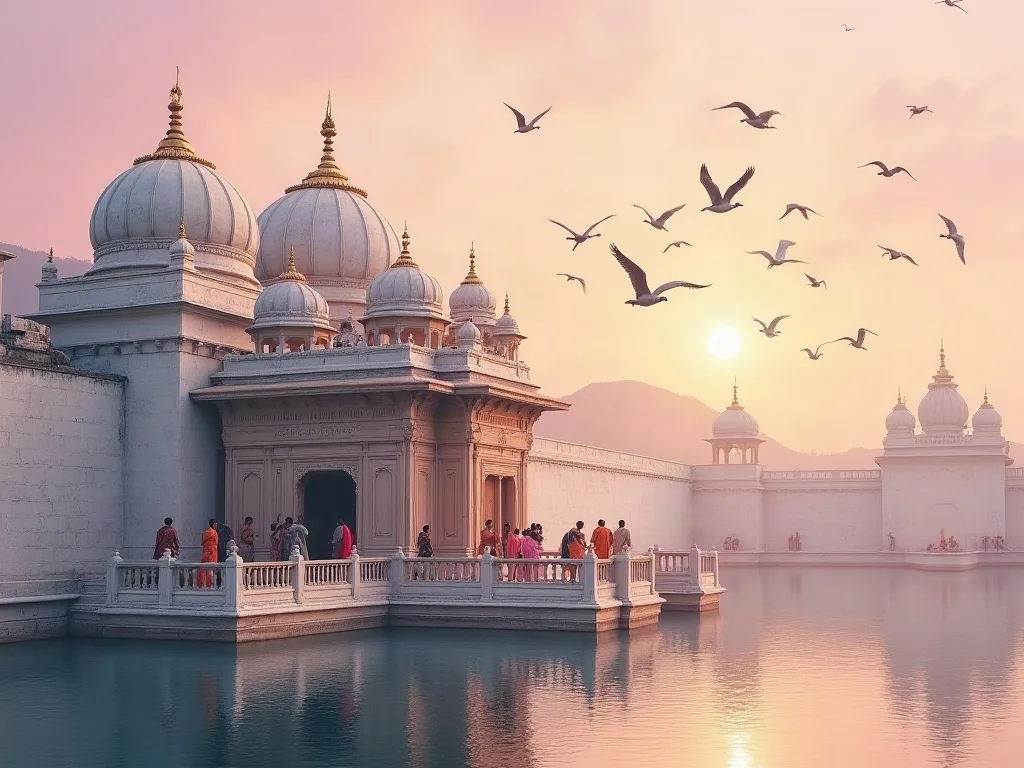
Whatever the mythological cause, the result is undeniable: Brahma the creator has virtually no temples dedicated to him in the Hindu world. The Brahma Temple in Pushkar, Rajasthan, is one of the few. Many Hindu homes contain images of Vishnu and Shiva but rarely an image of Brahma. This absence becomes theologically significant: it suggests that the work of creation, once completed, requires no ongoing maintenance of the creator's cult. Creation is not an eternal relationship but a completed act.
This paradox sits at the heart of Hindu philosophy: the most essential cosmic function receives the least religious attention. The invisible principle of time and cycle matters more than the face of the god who activates it.
Brahma in the Mahabharata and Ramayana
The two great epics of Hinduism, the Mahabharata and Ramayana, present Brahma the creator as an elder god who dispenses boons and blessings but whose power is limited by the unfolding of cosmic destiny.
In the Mahabharata, when the demon Hiranyaksha becomes invincible and ravages the cosmos, neither Brahma nor the other gods can defeat him. Vishnu must intervene in his avatar form as Varaha, the cosmic boar, to restore order. The implication is clear: Brahma can create, but he cannot restore what is broken. That role belongs to the preserver.
In the Ramayana, Brahma appears to grant boons to demons and heroes alike, but these boons always contain hidden conditions and limitations. When the demon Ravana asks for immunity from celestial weapons, Brahma grants it, but Ravana cannot think to protect himself against ordinary weapons or mortal cunning. When heroes receive blessings, they discover boundaries built into the blessing itself. This reflects Brahma's nature: he works within cosmic law; he does not supersede it.
Both epics treat Brahma with respect but keep him at a remove from the central action. His role is to authorize and bless; the real work of heroism and restoration falls to others. This reinforces the theological pattern: Brahma the creator initiates the game, but the game then plays itself out according to its own rules, beyond his direct control.
The Sacred Spoon and the Tools of Creation
Brahma's iconography reveals the specific nature of his creative power. He holds a water pot called a Kamandalu, which contains the waters of life from which all beings emerge. This is not mere decoration; it represents the material substrate of creation itself.
His prayer beads, called a Mala, contain 108 beads, a sacred number in Hinduism. These beads symbolize time itself; as Brahma counts them, the cycles of creation unfold. Some Hindu traditions hold that there are 108 names of Brahma, and chanting them invokes his creative presence.
The scepter he carries, the Danda, represents his authority to establish cosmic law and order. The sacred texts in his hand represent knowledge; creation without knowledge would be chaos, not cosmos.
His mount, the swan (Hamsa), is itself symbolic. In Hindu philosophy, the Hamsa is the ability to discriminate between the real and the illusory, between Brahman and Maya (the cosmic illusion). That Brahma rides the swan suggests his creative power operates through discernment and wisdom, not through raw force.
The color of Brahma's skin varies by region and text. In some depictions, he is red, suggesting creative energy and passion. In others, he is white, suggesting purity and transcendence. Some texts describe him as golden, linking him to light and illumination. These variations acknowledge that Brahma the creator cannot be pinned to a single image; he is multivalent, accommodating different regional and philosophical emphases.
Brahma and the Concept of Maya
One of the deepest Hindu philosophical ideas is Maya, often translated as "illusion" but better understood as "creative force" or "cosmic projection." The world we perceive is real in a functional sense, but it is not ultimately real in an absolute sense. It is a manifestation of Brahman, the transcendent reality, projected through Maya.
Brahma operates within Maya. His creative act is itself an act of Maya, the projection of infinite potential into finite forms. The universe he creates is real for the duration of a Brahma Day, but it is not eternally real. During each Brahma Night, all distinctions collapse back into undifferentiated Brahman.
This idea radically reframes what creation means. Brahma the creator is not making something from nothing in a literal sense. He is particularizing the infinite into the finite, organizing potential into actuality, projecting the eternal into the temporal. When he withdraws during the night of Brahma, the finite collapses back into the infinite, but neither is destroyed; both are always present.
This framework dissolves many Western theological puzzles about creation. There is no need to ask why God created a flawed world; the flaws are features of the temporal dimension itself. There is no problem of evil; good and evil are functions of the material cosmos, which is intentionally cyclic and imperfect. The goal is not to perfect the world but to escape the cycle through spiritual knowledge (Jnana) and reach Brahman itself.
Regional and Textual Variations
Hindu philosophy is not monolithic, and Brahma the creator appears differently in different traditions and texts.
In the Upanishads, particularly the older ones like the Aitareya Upanishad, Brahma is barely mentioned. The focus is on Brahman, the impersonal absolute, not on Brahma the personal god. This distinction is crucial: Brahman is the ultimate reality; Brahma is a secondary manifestation. Many Hindu philosophers argue that conflating the two is a fundamental error.
In the Puranas, particularly the Brahma Purana, Brahma Vaivarta Purana, and Markandeya Purana, Brahma is elevated and given detailed narratives and powers. These texts, composed over many centuries and compiled into their current form between the 4th and 15th centuries, establish the theological framework we have been exploring.
In South Indian Hindu tradition, particularly in Tamil Nadu, Brahma receives more attention than in North India. Some temples honor him alongside Vishnu and Shiva. The South has also preserved older Vedic traditions more continuously than the North, which may explain the greater presence of Brahma worship.
In Kashmir Shaivism, a philosophical school centered on Shiva, Brahma is often presented as subordinate to Shiva, the supreme consciousness. In contrast, in Vaishnavism (the tradition centered on Vishnu), Brahma's creations are understood as expressions of Vishnu's will, making Vishnu the ultimate source.
These variations show that Brahma the creator is not a fixed figure but one who occupies different positions within different theological frameworks. What remains constant is his association with creation and his paradoxical absence from popular worship despite his cosmic importance.
The Festival of Brahma and Contemporary Practice
Despite the rarity of Brahma temples, Hindu culture honors him during certain festivals. Brahma Jayanti, celebrated on the full moon day in the month of Vaishakha (April-May), marks his birthday. On this day, some Hindus make offerings, recite prayers, and reflect on the cosmos he initiated.
The Pushkar Fair, held annually in Rajasthan near the Brahma Temple, is one of India's largest camel fairs and a significant pilgrimage event. During the fair, devotees circumambulate the temple and make offerings. The temple itself, with its marble structure and four gates (representing the four Vedas), draws visitors from across India and the world.
In many homes and temples, a small image or sculpture of Brahma appears on altars, but it is typically secondary to images of Shiva or Vishnu. The Gayatri Mantra, one of Hinduism's oldest and most revered chants, honors a solar principle and is sometimes associated with Brahma, though interpretations vary.
Contemporary Hindu practice often emphasizes the impersonal Brahman over the personal Brahma. Meditation, yoga, and philosophical inquiry are understood as paths to realize Brahman directly, bypassing the need for devotion to individual deities. This shift reflects a modern intellectual turn toward abstract principles over mythological narratives.
Yet Brahma remains fundamental to Hindu cosmology. Without understanding his role in creation cycles, one cannot grasp how Hindus conceptualize time, change, and the relationship between the eternal and the temporal. His absence from worship becomes theologically meaningful: it teaches that creation is a completed act, that the cosmic machinery runs according to its own laws, and that spiritual liberation lies not in honoring the creator but in transcending the creation itself.
Cross-Cultural Echoes and Modern Reception
The figure of Brahma raises striking parallels to creator deities across world religions and mythologies. Like the Greek Kronos, Brahma oversees a cosmic order but is eventually displaced or rendered peripheral. Like the Mesoamerican Quetzalcoatl in some traditions, he is associated with wind, breath, and the word that brings worlds into being. Like the Norse Odin, he sacrifices an eye or in Brahma's case, a head, to gain knowledge.
However, Brahma differs crucially from most Western creator figures. He does not create from nothing; he manifests from void. He is not eternal; he is born and will die when the current cosmos ends. He is not omnipotent; he operates within the constraints of cosmic time and divine hierarchy. And his creative act, while celebrated as cosmic truth, is not the focus of spiritual practice or salvation.
In modern Western interpretations of Hinduism, Brahma is often presented as the "Indian God of Creation," placed in a category equivalent to the God of Abrahamic religions. This analogy is useful for introductory purposes but obscures the real theological distinctiveness of the Hindu concept. Brahma the creator does not demand worship; he requires understanding. His myth teaches that the universe is rational, cyclic, and ultimately impermanent. That message, more than any petition to the god himself, is what sustains Brahma's presence in Hindu thought.
Contemporary Hindu writers and philosophers have revisited Brahma's myths to explore themes of imagination, possibility, and the limits of creation itself. If Brahma can only create within the constraints of time and cosmic law, what does that say about freedom, determinism, and the nature of consciousness? These questions, implicit in ancient texts, have new resonance in modern discussions of artificial intelligence, digital worlds, and the nature of reality itself.
Frequently asked questions about Brahma the creator?
Frequently asked questions
Why does Brahma have four heads?
Each head represents one of the four Vedas (the sacred Hindu texts): Rigveda, Yajurveda, Samaveda, and Atharvaveda. These texts are understood not as writings Brahma invented but as eternal knowledge he channels into spoken form during creation. The four heads allow him to perceive and govern all cardinal directions simultaneously. Some texts reference a fifth head that was severed by Shiva as punishment for arrogance or lust, though this detail varies by source.
Why is Brahma barely worshipped if he is the creator?
Hindu theology teaches that creation is a completed act, one phase of an eternal cosmic cycle. Once the universe is manifested, the creator's role is finished. Worship and spiritual practice focus on realms the devotee can directly engage with: preservation (Vishnu's role), renewal (Shiva's role), or the pursuit of liberation from the cycle itself. Additionally, mythology recounts that Brahma was cursed by his consort Saraswati to never receive worship on earth, a story that reflects and justifies the historical absence of a popular Brahma cult.
Is Brahma the same as Brahman?
No, and this distinction is essential. Brahman is the impersonal, transcendent ultimate reality that underlies all existence. Brahma is a personal deity, one manifestation of divine power within the Hindu pantheon. Brahman is eternal and unchanging; Brahma is born and will eventually cease to exist. Many Hindu philosophers argue that conflating the two is a misunderstanding; the goal of spiritual practice is to realize Brahman, not to worship Brahma.
How long does Brahma live?
One day in the life of Brahma (a Brahma Day) lasts 1,000 cosmic cycles (Chaturyugas), or approximately 4.32 billion years in human time. A Brahma Night lasts equally long. Brahma's total lifespan is 100 Brahma Years, which equals 311 trillion human years. After his death, the entire cosmos dissolves back into Brahman and remains in potential until the next Brahma is born and creation begins anew.
What role does Brahma play in the Hindu trinity?
Brahma represents creation and manifestation; Vishnu represents preservation and protection; Shiva represents dissolution and renewal. The three are understood as complementary aspects of a single cosmic process. Brahma's role is to initiate the phase of manifestation, but he is functionally dependent on Vishnu's cosmic sleep and his work inevitably leads to Shiva's dissolution. No god acts alone; cosmic order depends on their dynamic balance.
Are there temples dedicated to Brahma?
Yes, though they are rare compared to temples of Vishnu or Shiva. The most notable is the Brahma Temple in Pushkar, Rajasthan, one of only a handful of major temples dedicated to Brahma in India. The annual Pushkar Fair, held near the temple, attracts pilgrims and celebrates Brahma Jayanti (Brahma's birthday). The temple's architecture features four entrances representing the four Vedas, and its marble structure reflects the purity associated with Brahma in Hindu thought.
The Paradox of the Creator: What Brahma's Absence Teaches
Brahma the creator stands at the threshold of Hindu theology. He is cosmologically essential and theologically peripheral, ancient and forgotten, powerful and constrained. This paradox is not a weakness in Hindu thought; it is the system's greatest strength.
By separating creation into a finite act performed by a subordinate god, Hindu philosophy protects the ultimate principle (Brahman) from the flaws inherent in any finite creation. It makes room for doubt, change, and the possibility of liberation. It refuses to solve the problem of evil by claiming creation is perfect; instead, it acknowledges that the temporal world is by nature imperfect and proposes that escape from the cycle, not perfection within it, is the true spiritual goal.
Brahma's absence from worship thus becomes a teaching. It tells the Hindu practitioner: do not cling to the creator or the creation. Look beyond to the transcendent principle that underlies both. Creation is magnificent and real, but it is not ultimate. That is Brahma's final gift: not temples and prayers, but wisdom about what matters and what does not.
The lotus that bore him still grows in Hindu imagination. The four Vedas still issue from his words. And across billions of years, in a rhythm as vast as the ocean itself, creation will continue to cycle: manifestation, duration, dissolution, rest, and birth anew. Brahma, absent and unforgotten, remains the eternal agent of that cosmic dance.
Free 25-page sample
Want the whole story?
Take the first 25 pages free. If it pulls you in, the full edition is yours as an instant PDF download, with a paperback on Amazon for selected titles.

Mythology
The World Mythology Book: The Gods, Heroes and Myths of Every Culture
The Gods, Heroes and Myths of Every Culture, in One Volume
The whole of world mythology in a single volume: Greek, Norse, Egyptian, Japanese, Hindu, Celtic, Slavic, Mesoamerican and African myths gathered side by side, each drawn from the primary sources.