

Frigg, Queen of Asgard: Goddess of Foresight, Fate, and the Silence That Holds the World
Frigg rules Asgard as Odin's equal, weaving fate on her loom while gods and mortals remain unaware. Learn who she truly is, what the Eddas say, and why she matters.
Contents
The hall goes quiet when Frigg, queen of Asgard, enters. Not because she commands silence the way a warlord does, but because her presence carries a different kind of weight. She sits beside Odin on the high seat Hliðskjálf, from which all nine worlds are visible at once, and she looks out across them with eyes that see what has already been decided. She says nothing. That silence is not ignorance. Snorri Sturluson, writing in his Prose Edda around 1220 CE, notes plainly: Frigg knows the fates of all beings, but she tells no one.
That single detail separates her from almost every other figure in Norse mythology. In a tradition that prizes loud prophecy, spoken curses, and shouted war-cries, the most powerful woman in the cosmos keeps her knowledge to herself. That choice, deliberate and absolute, shapes the whole arc of the Norse myths, from the binding of Loki to the death of her own son.
She is not a supporting character. She is the structural centre of Asgard's domestic and cosmic order, the one figure whose grief, when it finally breaks loose, tells us something true about what the Norse peoples believed fate really means.
Who Frigg Is: Name, Rank, and the Oldest Sources
Frigg (also spelled Frigga in later Germanic contexts) derives from the Proto-Germanic *Frijjō, meaning "beloved" or "free woman." The root is shared with the Old Norse verb fría, to love, and with the Modern English word "Friday," which in Old English is Frīgedæg, Frigg's day.
Her rank is unambiguous. The Prose Edda, Snorri's encyclopedic synthesis of Norse mythological tradition, lists her first among the ásynjur, the goddesses of the Aesir, and identifies her as Odin's wife. The earlier Poetic Edda, a collection of Old Norse poems probably drawn from oral traditions stretching back to the 9th and 10th centuries, confirms this picture. In the Lokasenna, the flyting poem where Loki hurls insults at each god in turn, he challenges Frigg directly, suggesting she and Odin share power over Asgard in a way that made Loki think her worth attacking.
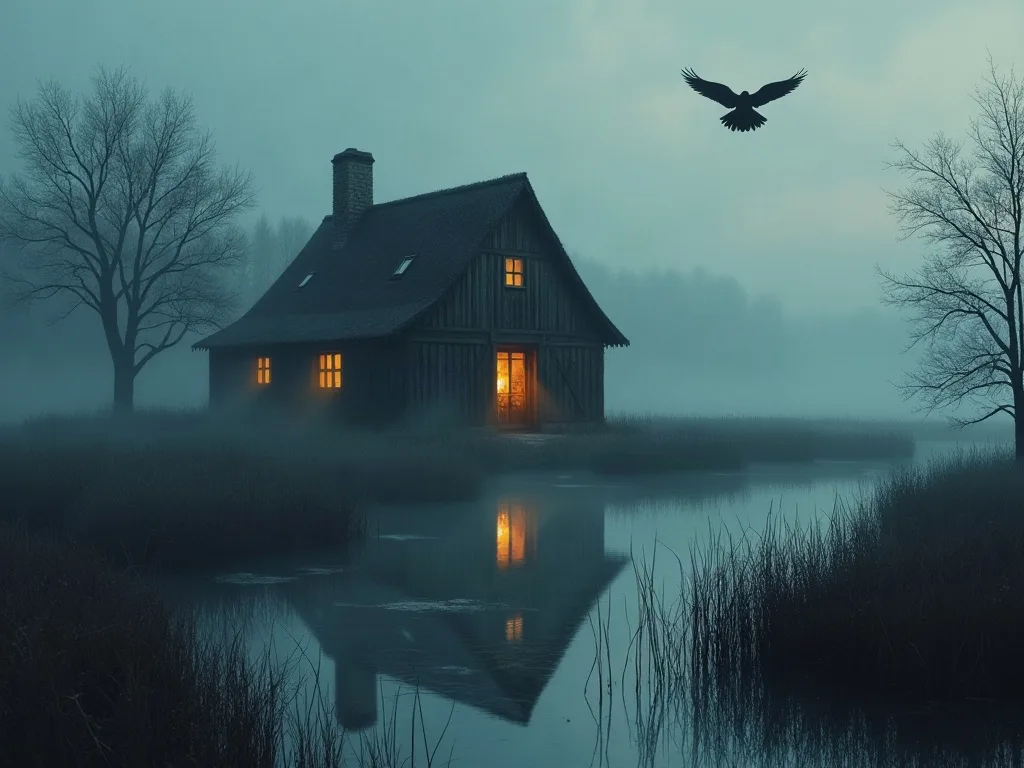
Her dwelling is Fensalir, "Fen Halls" or "Marsh Halls." The name is evocative: a low, watery, reed-edged place far from Odin's high throne of Valhöll. Where Odin rules sky and battle, Frigg governs threshold spaces, home, birth, and the deep ground that sustains life. This is not a lesser domain. In early Germanic cosmology, the hearth was the axis of the human world, and the woman who presided over it held real authority.
Frigg and Odin: A Partnership of Equals and Rivals
Norse myths record at least three stories in which Frigg and Odin openly clash or scheme against each other. This is unusual for a sky-father tradition: most ancient pantheons do not give the chief god's wife room to win.
The Gesta Danorum, written by the Danish historian Saxo Grammaticus around 1200 CE, preserves a story where Frigg steals gold from a statue of Odin to have a necklace made for herself. Odin is furious, leaves Asgard in disguise, and the pantheon falls into partial disorder until he returns. Snorri's account is different in detail but consistent in tone: Frigg is not passive, not decorative. She acts on her own interests.
A cleaner example sits in the Prose Edda's section called the Ynglinga saga and in the mythological tradition more broadly: Odin and Frigg bet against each other on the outcome of a mortal battle, each backing a different Germanic tribe. Frigg wins by waking early and arranging her people's position before Odin can intervene. The god of war loses to his wife before breakfast.
The Lokasenna in the Poetic Edda shows something harder. Loki accuses Frigg of sleeping with Odin's brothers Vili and Vé while Odin was away. She does not deny it directly, she redirects, and Loki moves on. Scholars debate what to make of this: is the accusation myth-historical (echoing a tradition in which Frigg, or an earlier version of her, had a more complex role), or is it simply Loki's malice at work? Either reading confirms that the Norse audience understood Frigg as a figure weighty enough to be worth attacking.
The Weaving of Fate: Frigg's Loom and the Cosmos
The image most consistently attached to Frigg across Germanic and Norse sources is the loom. She spins and weaves in Fensalir, and what she weaves, scholars across the 20th and 21st centuries have read as fate itself.
This is not unique to Norse mythology. The Greek Moirai (the Fates) spin, measure, and cut thread. The Roman Parcae do the same. In Baltic tradition, the goddess Laima weaves destiny. Frigg fits into a Pan-European stratum of weaving goddess figures that Hilda Ellis Davidson, one of the most respected scholars of Norse religion, traced across the continent in her 1998 work Roles of the Northern Goddess. Davidson argued that Frigg and the weaving-fate goddess archetype represent one of the oldest layers of European religious imagination, predating the Viking Age by centuries.
The Völuspá, the great prophetic poem that opens the Poetic Edda, describes three cosmic weavers, the Norns, who carve fate into wood at the foot of Yggdrasil, the world tree. Frigg is not one of the Norns, but her function overlaps. She sees what they have already set down. Her loom and their carvings describe the same cosmic truth from different angles: destiny is not chaos, it is structure, and the woman who understands that structure most deeply is the one who stays quiet about what she knows.

Frigg and Freyja: One Goddess or Two?
No question in Norse studies gets more classroom time than this one. Frigg and Freyja share a striking number of traits: both are associated with love, marriage, and spinning; both have links to seiðr (the Norse magical practice of perception and fate-working); both grieve a lost male consort. In Frigg's case it is Odin's periodic absences and, most devastatingly, the death of Baldr. In Freyja's case it is the vanishing of her husband Óðr, whose name is functionally identical to Odin's.
The 19th-century scholar Jacob Grimm, in his Deutsche Mythologie (1835), proposed that the two were originally one goddess who split into two distinct figures as Norse and Germanic traditions diverged. Later scholars have been more cautious. Rudolf Simek, in his authoritative Dictionary of Northern Mythology (1993), argues the evidence does not firmly support a merger: Frigg belongs to the Aesir while Freyja belongs to the Vanir, and the two divine clans had distinct cult practices and social associations.
A middle path exists. Both figures almost certainly descend from the Proto-Germanic *Frijjō, the beloved one. They may represent two specialisations of a common ancestor figure, one developing toward sovereign queenship and fate (Frigg), the other toward desire, magic, and war-dead gathering (Freyja). Neither interpretation requires the other to be wrong.
Frigg
Divine clan: Aesir (married into the ruling class of Asgard)
Consort: Odin, the Allfather, king of Asgard
Domain: Marriage, motherhood, fate-weaving, sovereign authority
Magical practice: Knows seiðr but is rarely described using it openly
Grief: The death of her son Baldr, foretold and unavoidable
Symbol: The distaff and loom; her hall Fensalir
Key source: The Prose Edda (Snorri Sturluson, c. 1220 CE)
Freyja
Divine clan: Vanir (joined the Aesir after the first divine war)
Consort: Óðr, whose identity overlaps mysteriously with Odin
Domain: Love, desire, fertility, battle-dead, gold
Magical practice: Taught seiðr to Odin; openly and repeatedly associated with its use
Grief: The perpetual disappearance of Óðr; she weeps tears of red gold
Symbol: The brísingamen necklace; her chariot drawn by cats
Key source: The Prose Edda and Skáldskaparmál (Snorri, c. 1220 CE)
The Death of Baldr: Frigg's Greatest Myth
Every thread in Frigg's story leads to this moment. Baldr, her son by Odin, begins to dream of his own death. The gods are disturbed. Frigg acts immediately: she travels through all nine worlds and extracts an oath from every substance, every creature, every force that they will not harm Baldr. Stone, fire, disease, iron, animals, plants, all swear. Baldr becomes functionally invulnerable, and the gods amuse themselves by hurling objects at him knowing nothing can land.
One thing never swears. Frigg, when recounting this to a disguised Loki, admits she skipped the mistletoe because it seemed too small and young to bother with. Loki goes to find it, crafts a dart, guides the blind god Höðr's hand, and Baldr falls. The Prose Edda's account in the Gylfaginning section is among the most precisely written passages in all of Norse mythology: grief spreads through Asgard like water across a floor, slow and total.
Frigg does not collapse. She asks who among the gods will ride to Hel, the realm of the dead, to plead for Baldr's return. She keeps moving. The god Hermóðr rides Odin's horse Sleipnir to Hel's gate and returns with a condition: if every being in the nine worlds weeps for Baldr, he will return. Almost everything does weep. One giantess named Þökk, widely understood to be Loki in disguise, refuses. Baldr stays in Hel until after Ragnarök.
The myth is devastating partly because Frigg did everything right. She saw the threat, she acted, she collected every oath she could. She failed not through ignorance or laziness but through a single, forgivable assumption about something small. The Norse mythological imagination is not kind: knowing fate does not let you escape it.
Frigg's Handmaidens: The Women Who Extend Her Domain
Snorri lists twelve handmaidens of Frigg in the Prose Edda, and each one reads like a facet of Frigg herself splintered into a separate divine figure. They are worth knowing because they reveal what the Norse tradition counted as Frigg's concerns.
- Fulla, who carries Frigg's casket and knows her secrets. She is the only handmaiden described as a goddess in her own right in some sources.
- Hlín, a protector of those Frigg wishes to spare from danger.
- Gná, who rides Frigg's horse Hófvarpnir across sky and sea as her messenger.
- Lofn, who smooths the path for forbidden or difficult love affairs, with Frigg's permission.
- Vár, who listens to oaths and contracts between men and women, and punishes those who break them.
- Sjöfn, who turns the minds of people toward love.
- Syn, who guards hall doors and speaks in defense of those on trial.
- Þrúðr, Hlín (second mention in some manuscripts), Snotra, Göndul - figures who extend Frigg's reach into wisdom, courtesy, and the supernatural.
Whether these were once independent local goddesses later absorbed into Frigg's entourage, or whether they were always understood as aspects of one deity, is debated. The structural point is clear: Frigg's domain is not a narrow specialty. She presides over the whole architecture of human social and emotional life.

Frigg in the Germanic World Beyond Scandinavia
Norse mythology as written down in Iceland in the 12th and 13th centuries represents only one branch of a much wider Germanic tradition. Frigg's presence in earlier, continental Germanic religion is harder to trace but not invisible.
The Roman author Tacitus, writing in his Germania around 98 CE, describes Germanic tribes worshipping a goddess he calls Nerthus, "Mother Earth," with ceremonies involving a wagon covered by cloth, a sacred lake, and strict ritual silence. Scholars debate whether Nerthus connects to Frigg or to Njörðr or to neither, but the ritual silence recalls Frigg's defining characteristic: the knowledge kept unspoken.
In Old High German texts, the figure Frija appears in one of the oldest written charms in the Germanic world, the Merseburg Charms (probably 9th century CE, though recording older oral material). In the second charm, Frigg (under her continental name) and a group of idisi, divine women, work together to loosen the bonds of a captive warrior. This is Frigg operating in magic: not passive, not merely domestic, but actively intervening with supernatural knowledge.
The Anglo-Saxons preserved her name in the day of the week but left fewer mythological accounts. Still, the Old English word frigedæg and the later Frīge suggest a goddess whose cult was widespread enough to mark time itself.
Frigg and Hera: A Cross-Mythological Reading
Readers coming to Norse mythology from Greek tradition will notice a surface similarity between Frigg and Hera, queen of Olympus. Both are married to the chief sky-god, both occupy the highest rank among divine women, and both have complicated relationships with their husbands that include rivalry, deception, and deep if difficult bonds.
But the differences matter more than the similarities. Hera in the Iliad and the Odyssey is frequently reactive: furious at Zeus's infidelities, scheming against his favorites, sometimes reduced to being tricked by him with a divine sleep. Her authority depends heavily on her relationship to Zeus's power.
Frigg's authority in the Eddas is more internal. She does not rage against Odin's wandering or his ravens or his secrets. She holds her own secrets larger than his. The Prose Edda suggests she knows things Odin does not, a remarkable inversion for a sky-father tradition. Where Hera's tragedy is exclusion, Frigg's tragedy is inclusion: she sees exactly what is coming for Baldr and cannot stop it.
The comparison also illuminates something about how different cultures imagine divine queenship. Greek tradition placed divine authority in explicit hierarchical rank and tied a goddess's power to her husband's status. Norse tradition, at least in the Eddic sources, granted Frigg independent legitimacy. She shares the high seat not as a concession but as a right.
Frigg's Lasting Shape in Modern Culture
The modern world has not been as generous to Frigg as it has been to other Norse figures. Thor and Odin have dominated popular revivals, from Richard Wagner's 19th-century operas (where Fricka, his version of Frigg, appears as a nagging wife demanding Wotan honour divine contracts) to Marvel's cinematic universe. Wagner's Fricka is the most influential modern interpretation of Frigg, and it is also among the least faithful to the Eddic sources: she is reduced to a jealous legalist while Odin is given the dramatic depth.
Recent scholarship has worked to correct this. Historians of Norse religion, including Carolyne Larrington in her 2017 revision of the Poetic Edda translation and John Lindow in his 2001 Norse Mythology: A Guide to Gods, Heroes, Rituals, and Beliefs, have insisted that Frigg's silence is a theological statement, not a narrative convenience. The goddess who knows all fates and speaks of none carries a philosophy inside that reticence: that some knowledge is too heavy to weaponise, and that holding it without acting is itself a form of power.
Contemporary writers of fantasy and speculative fiction have begun to recover this version. Neil Gaiman's American Gods (2001) briefly shadows her presence, and his non-fiction Norse Mythology (2017) treats Baldr's death as the emotional core of the mythology, which returns Frigg to her proper position as the figure whose loss sets the cosmos on its path toward Ragnarök.
Frequently asked questions about Frigg, queen of Asgard
Frequently asked questions
What is Frigg the goddess of, exactly?
Frigg presides over marriage, motherhood, fate-weaving, and the domestic order of Asgard. Snorri Sturluson's Prose Edda lists her as the foremost of the ásynjur, the Aesir goddesses, and emphasises her role as one who knows the fates of all beings. Her hall Fensalir, her loom, and her twelve handmaidens collectively describe a domain covering love, contracts, prophecy, protection, and the management of social bonds.
Are Frigg and Freyja the same goddess?
The question is genuinely open. Both names derive from the Proto-Germanic *Frijjō, and both goddesses share attributes including love, weaving, and grief over a lost male figure. Jacob Grimm proposed a single origin in 1835. Rudolf Simek and most modern scholars prefer to treat them as distinct figures who share a common ancestor, noting that Frigg belongs to the Aesir and Freyja to the Vanir, two divine clans with different cult histories. The honest answer is that the Norse sources do not merge them, but the underlying mythology may once have been less clearly divided.
Why did Frigg not warn Baldr about the mistletoe?
The Prose Edda does not give Frigg a clear internal explanation. She extracted oaths from every substance she could find, but skipped mistletoe because it seemed too young and small to pose a threat. Some scholars read this as a tragic irony built deliberately into the myth: even perfect foresight cannot protect against what seems trivially beneath notice. Others note that the Norse concept of fate, as expressed in the Norns' carvings at Yggdrasil, suggests Baldr's death was fixed regardless of what anyone did. Frigg's action and failure together may illustrate that knowing fate and preventing it are two entirely different things.
What is the connection between Frigg and Friday?
Friday comes from Old English Frīgedæg, meaning Frigg's day. This was itself a translation of the Latin Veneris dies, Venus's day (hence French vendredi), made because Germanic peoples equated Frigg with Venus as the presiding deity of love and marriage. The naming follows the interpretatio germanica, the practice of mapping Roman divine calendar slots onto equivalent Germanic figures. The equation was imperfect but widely accepted, and it gives us one of the most concrete traces of Frigg's cult in the English-speaking world.
What does Frigg's hall Fensalir mean, and why does it matter?
Fensalir translates as "Fen Halls" or "Marsh Halls." The name places Frigg in watery, liminal ground: marshes and fens in Germanic tradition were threshold spaces between the living world and the underworld, places where votive offerings were deposited, where bog bodies were found, and where fate was thought to be closest to the surface. That Frigg rules from such a place, rather than from a high mountain hall like Odin's Valhöll, tells us something about the distinct cosmological register she inhabits: not sky and glory, but depth, origin, and the quiet weight of what has already been decided.
Which primary sources mention Frigg most directly?
The richest sources are Snorri Sturluson's Prose Edda (composed around 1220 CE in Iceland), particularly the Gylfaginning section, which includes the Baldr narrative, and the Skáldskaparmál, which lists her attributes and heiti (poetic names). The Poetic Edda, compiled from older poems, includes the Lokasenna where she is directly addressed, and the Vafþrúðnismál where Odin consults her before a dangerous contest. The Merseburg Charms from continental Germany (9th century CE) give the earliest textual appearance of her continental counterpart Frija. Saxo Grammaticus's Gesta Danorum (c. 1200 CE) adds further, if Latinised and sometimes distorted, accounts.
What Frigg's Silence Teaches Us About Norse Fate
Pull back from the individual myths and a coherent philosophy comes into focus. Frigg, queen of Asgard, is not powerful despite her silence. She is powerful because of it. In the Norse cosmological system, where the Norns carve fate into the roots of Yggdrasil and the Völuspá's seeress prophesies the end of all things, knowledge is not the same as control. The universe is already written. What matters is how you hold that weight.
Odin responds to the knowledge of fate by seeking more knowledge, through sacrifice, through his ravens Huginn and Muninn (Thought and Memory), through hanging on Yggdrasil, through consulting the dead. He accumulates, restlessly. Frigg responds by staying still and keeping the hearthfire burning anyway. Both approaches are inside the same tradition, and the tradition does not declare one superior. It simply holds both, the king who hunts for more time and the queen who weaves what time remains into something worth having.
This is the version of Frigg that the surviving sources actually support, and it is more interesting than the nagging wife of Wagner's operas or the marginal figure of popular myth compilations. She is the still point around which Asgard turns, and when she breaks, at Baldr's death, the whole cosmos leans toward Ragnarök. That is not the role of a supporting character. That is the load-bearing wall of a mythology.
Free 25-page sample
Want the whole story?
Take the first 25 pages free. If it pulls you in, the full edition is yours as an instant PDF download, with a paperback on Amazon for selected titles.

Mythology
The World Mythology Book: The Gods, Heroes and Myths of Every Culture
The Gods, Heroes and Myths of Every Culture, in One Volume
The whole of world mythology in a single volume: Greek, Norse, Egyptian, Japanese, Hindu, Celtic, Slavic, Mesoamerican and African myths gathered side by side, each drawn from the primary sources.