

Heimdall: Guardian of the Bifrost and Watcher at the Edge of the World
Heimdall stands watch at the rainbow bridge with senses sharper than any god. Learn who he is, what the Eddas say, and why his final battle with Loki still matters.
Contents
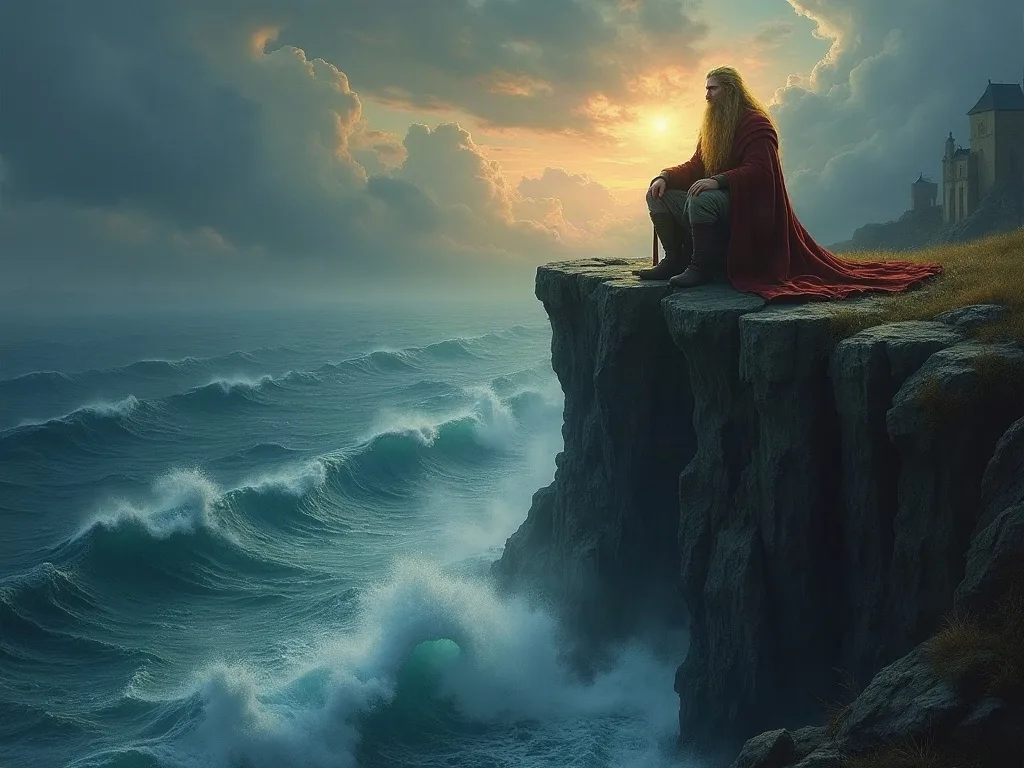
The horn hangs at his side, never blown. Not yet.
Heimdall, the shining god who never sleeps, stands at the edge where Asgard meets everything else. Beneath him the Bifrost hums in colors no human eye can fully name. Behind him the halls of the gods carry on with feasts and quarrels and the daily work of myth. Ahead of him is the long dark drop into the nine worlds, and the slow certainty that one day something will come across that bridge that should not.
He hears the grass growing in the meadows. He hears the wool growing on the sheep. His eyes work in pitch darkness. He needs less sleep than a bird. Every mythology has a threshold guardian, the figure posted at the door between order and chaos, but few traditions have drawn that archetype as precisely, as sensorially, as vividly as the Norse drew Heimdall, guardian of the Bifrost.
Who Is Heimdall? Origins and Identity in the Eddas
The name itself carries weight. Most scholars connect Heimdallr to the Old Norse roots for "world" (heim) and "great post" or "bright one." That second element is disputed. Some read it as related to dallr, meaning "gleaming." Others connect it to a proto-Germanic root for "horn" or "post." Whatever the etymology, the image is consistent: a shining pillar standing at the margin of the known.
The two main Old Norse sources that give us Heimdall are the Prose Edda and the Poetic Edda. The Prose Edda is Snorri Sturluson's systematic handbook of Norse mythology, compiled around 1220 AD partly to preserve skaldic poetry conventions. The Poetic Edda is an older collection of mythological and heroic poems, preserved chiefly in the Codex Regius, a manuscript copied around 1270 AD from texts that circulate in oral tradition several centuries earlier.
Snorri's Gylfaginning section of the Prose Edda gives the clearest portrait. Heimdall is listed among the twelve principal gods of Asgard. He lives in a hall called Himinbjorg, "Heaven's Cliffs," built right at the point where Bifrost meets the sky. He drinks fine mead there, on duty and comfortable at the same time.
His genealogy is unusual even by Norse standards, where unusual genealogies are common. He has nine mothers, named in the Völuspá hin skamma (a section sometimes appended to the Poetic Edda poem Hyndluljóð) as nine giantesses or wave-maidens: Gjalp, Greip, Eistla, Eyrgjafa, Ulfrun, Angeyja, Imðr, Atla, and Járnsaxa. All nine are associated with the sea. Some scholars, including John Lindow in his Norse Mythology: A Guide to the Gods, Heroes, Rituals, and Beliefs (2001), read this as Heimdall having a primordial aquatic origin that places him at the interface between primeval chaos (the sea) and divine order (Asgard).
His father, at least according to one reading, is Odin himself. The Rígsþula, a fascinating Eddic poem attached to the Poetic Edda but not in the Codex Regius (it survives in Codex Wormianus), presents him traveling under the name Rígr and fathering the three social classes of humanity: thralls, farmers, and nobles. This gives Heimdall a role that most readers miss. He is not only a guard. He is also the progenitor of human civilization as the Norse understood it.
The Bifrost: What the Bridge Actually Is
The word Bifröst breaks into bif, meaning "shimmering" or "trembling," and röst, a unit of distance, sometimes glossed as "league." In other sources it appears as Bilröst, from bil, "moment" or "weakness." That second form is actually significant: it suggests the bridge has an inherent fragility built in. It is designed to break.
The Prose Edda describes it plainly: the bridge is three colors, strongly built, made with "art and cunning more than any other construction." Red is the dominant color in depictions, often associated with fire. The Grímnismál, one of the great mythological poems in the Poetic Edda, says that the gods ride across Bifrost daily to hold their council under the world ash tree Yggdrasil, and that the bridge shakes and glows under the weight of their horses.
The fire built into Bifrost serves a purpose. Snorri explains it directly: the bridge burns so hot at its southern end that the frost giants cannot cross it on horseback, even if they wanted to. It is a deterrent as much as a road. And yet that deterrent will fail at Ragnarok, when the forces of Muspelheim, the fire realm, send their army under Surtr across it anyway, breaking the bridge in the process.
This is the structural irony at the heart of Heimdall's watch. He guards a bridge built to burn invaders, stationed precisely because the burning will not always be enough. He is the last line before the last battle.
Human astronomers in Scandinavia and Iceland would have watched the aurora borealis cut across winter skies in ribbons of red and green and white. It requires no great interpretive leap to see how that natural phenomenon and the mythological Bifrost fed each other. Both are vast, both are colored, both seem to connect sky and ground. The Prose Edda does not make the equation explicit, but modern scholars including Rudolf Simek (Dictionary of Northern Mythology, 1993) have noted the probable overlap.
Heimdall's Senses: The Theology of Vigilance
No attribute of Heimdall, guardian of the Bifrost, is more central than his perception. The Prose Edda lists it with unusual precision. He needs less sleep than a bird. He can see a hundred leagues by day or night. He can hear grass growing in the fields and wool growing on sheep.
That last detail is worth pausing on. Wool growing on sheep is not a sound. It is barely an event. Writing that Heimdall can hear it is a way of saying that no threshold of sensation exists below his awareness. He is perception itself, formalized as a god.
The Grímnismál backs this up. Snorri notes that Heimdall's senses are so acute he can even hear the approach of enemies while he sleeps, the implication being that consciousness and unconsciousness are the same to him when it comes to watch. Compare this to Odin, who sacrificed one eye to gain wisdom, trading sensory completeness for cognitive depth. Heimdall's power runs in the opposite direction: perfect sensory completeness, pure and uncompromised.
He is also associated with manna minni, translated as the memory or intelligence of men, suggesting a cognitive dimension that goes beyond raw perception. He knows things because he has watched long enough that the world has told him.
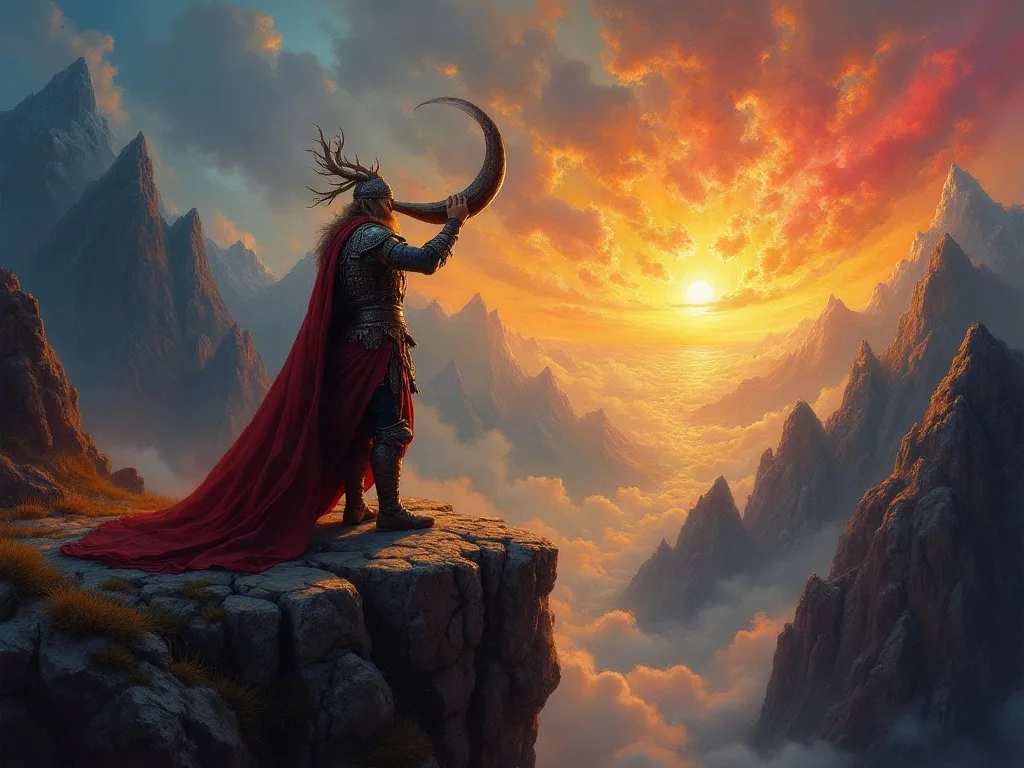
His horn, the Gjallarhorn, completes the picture. Gjalla means "to resound" or "to yell." The horn hangs near Mímisbrunnr, the well of Mimir, where Odin once gave an eye for a drink. The Völuspá, the great prophetic poem that opens the Poetic Edda, has the völva (seeress) describe Heimdall blowing Gjallarhorn as the signal that Ragnarok has begun. That single note is the loudest sound Norse mythology imagines.
Rígsþula: When the Watchman Became the Father of Humanity
The poem Rígsþula, whose title means "The Lay of Ríg," presents a version of Heimdall almost unrecognizable from the sentinel at the bridge. Here he walks the roads of the middle world as a traveler named Rígr, a name cognate with the Old Irish rí, meaning "king."
He visits three households. First, an old poor couple: Ái and Edda (Great-grandfather and Great-grandmother). He stays three nights, eats their rough bread, sleeps between them in the bed. Nine months later, Edda gives birth to Þræll, the Thrall, ancestor of all serfs. His description in the poem is pitiless: dark skin, coarse hands, crooked back, thick fingers, ugly. The poem reflects the social order of the Viking Age without apology.
Then Ríg visits a better household, Afi and Amma (Grandfather and Grandmother). Their child is Karl, the Farmer, red-cheeked and capable, ancestor of the free peasant class.
Finally, Ríg visits Faðir and Móðir (Father and Mother), people of refinement and wealth. Their son is Jarl, the Earl, blond, sharp-eyed, skilled in weapons and runes. Ríg later returns and teaches Jarl the runes personally, acknowledging him as a true son.
What does this poem tell us about Heimdall? It tells us the Norse associated him with the ordered structure of society itself. He is not just guarding the bridge between Asgard and the rest of existence. He is also the bridge between the divine and the human social order. He crossed into the world and, through three very human acts of hospitality and intimacy, created the conditions for civilization.
Scholars disagree on the poem's age. Some argue it is late, perhaps composed after Christianization began in Iceland around 1000 AD, and influenced by medieval Latin models of social origin stories. Others, including the mythologist Ursula Dronke, argue for older roots. Either way, it is attached to Heimdall, and it shapes how complete any reading of him must be.
Heimdall and Loki: The Oldest Enmity in Asgard
No portrait of Heimdall is complete without Loki. The two are linked by a mutual hatred that the Prose Edda records with surprising brevity: they are destined to kill each other at Ragnarok, and this is simply stated as a fact, the way you might note that summer follows spring.
Their antagonism has a mythological incident behind it. The Þrymskviða (the Lay of Thrym, in the Poetic Edda) does not involve Heimdall directly, but a related episode does: the theft of Freya's necklace, the Brísingamen. A prose summary, preserved in Skáldskaparmál (part of Snorri's Prose Edda), tells us that Loki stole the Brísingamen from Freya. Heimdall chased him. Both shapeshifted through multiple animal forms, seals being the most commonly cited in the skaldic kenning tradition. Heimdall recovered the necklace. Neither god forgave the other.
The shapeshifting duel is significant. It echoes the seal-battles of Celtic mythology and the transformation contests found in folk traditions across northern Europe. It shows that Heimdall is not merely static at his post. He is mobile, cunning, capable of pursuing across any boundary.
Loki operates as the mythological opposite of everything Heimdall embodies. Where Heimdall is transparent, Loki is opaque. Where Heimdall guards thresholds, Loki crosses them without permission. Where Heimdall's purpose is the preservation of the world's structure, Loki works toward its undoing. Their final mutual death at Ragnarok is the resolution of a long, structural conflict built into the cosmology.
The Völuspá names Heimdall among the gods who fall at Ragnarok. It does not dramatize his death in the same detail as, say, Thor's nine steps and death from the Midgard Serpent's venom, or Odin's swallowing by the wolf Fenrir. But the pairing is named: Heimdall and Loki destroy each other. The watchman's last act is to silence the thing that should never have been let into Asgard in the first place.
Threshold Guardians Across Cultures: Heimdall in Comparative Perspective
Every mythology builds a figure at the door. The pattern is consistent enough that the mythologist Joseph Campbell called it one of the universal elements of the hero's journey, though threshold guardians appear not just in hero tales but in cosmological structures.
Janus, the Roman god of doorways and beginnings, faces two directions simultaneously. He is the god of passages between states: past and future, war and peace, inside and outside. Like Heimdall, he is associated with transitions rather than with the power centers of his pantheon. Both occupy the margins so the center can function.
Anubis in Egyptian mythology guards the threshold between life and death, weighing hearts against the feather of Ma'at. His judgment is absolute. Heimdall does not judge; he watches and he warns. But both figures hold the border between one state of being and another.
In Hindu cosmology, Dvarapala temple guardians stand at the gates of sacred space, terrifying in form, preventing the impure from entering. The structural role is identical. The scale of Heimdall's post is simply cosmological rather than architectural.
Even Gabriel in Abrahamic tradition has been read through this lens: the archangel who announces, who sounds the horn at the end of days, who stands at the edge of the divine and communicates across it. The Gjallarhorn and the trumpet of judgment are not the same myth, but they rhyme.
What makes the Norse version striking is its precision. Heimdall's superhuman senses are not generic divine omniscience. They are specific, calibrated, almost technical. Wool growing on sheep. Grass growing in fields. This is not a god who sees everything from a distance. This is a god who is present at the threshold, physically, sensorially, committed to the ground-level work of keeping watch.

Kennings, Skalds, and the Poetic Evidence for Heimdall
One of the ways historians and mythologists confirm a god's importance is through the density of kennings attached to them in skaldic poetry. Kennings are Old Norse compound metaphors: Odin is called "raven-feeder" because ravens eat battlefield dead, and Odin commands ravens. They function like concentrated mythology, each one a miniature story.
Heimdall's kennings are revealing. He is called hvítastr ása, "whitest of the Aesir." He is called Vindhlér, sometimes interpreted as "wind-shelter" or "wind-sea," pointing back to his ocean-mother origin. A 10th-century skaldic poem called Húsdrápa by the poet Úlfr Uggason describes the shapeshifting conflict with Loki over the Brísingamen. This is one of the earliest attestations of that myth and confirms it was not invented by Snorri.
The kenning Rígr, used for Heimdall in the Rígsþula, may point to a very old stratum of cult. Some researchers note that rígr / rí is not a native Norse word; it is a borrowing from Celtic languages spoken by populations the Norse encountered in Ireland and Scotland. If true, this makes Heimdall one of the Norse gods with a traceable cross-cultural genealogy, shaped partly by contact with Celtic-speaking communities.
Snorri also includes Heimdall among the gods listed in Gylfaginning when High describes the twelve chief gods. The list reads almost like a roll call of cosmic functions, and Heimdall's entry is concise but unambiguous: foreknowledge, superhuman senses, the horn, the bridge.
The Silence Before the Horn: What Ragnarok Means for the Watchman
The Völuspá is the closest thing Norse mythology has to a complete cosmological narrative. The seeress, called völva, speaks from outside time, describing creation, the first war between gods, the present age, and the coming destruction. Heimdall appears near the end.
When the signs of Ragnarok begin to accumulate, when the wolf Fenrir breaks his chains and the serpent Jormungandr lifts from the ocean and the fire giant Surtr rides from Muspelheim, Heimdall blows Gjallarhorn. The blast wakes the gods. Odin rides to the well of Mimir for counsel. The gods arm and gather.
For the entire mythological cycle, Heimdall has been waiting for this moment. Every cup of mead in Himinbjorg, every night of listening to grass grow, every interaction with Loki at feasts and on the roads of Asgard, all of it has been the long patience before one single action.
He blows the horn. That is the moment.
The Völuspá does not spend long on him after that. He fights, he falls, Loki falls with him. The poem moves on to the death of Thor, the death of Odin, the burning of the world, and then, quietly, the re-emergence of a green earth from the water. The watchman's death is absorbed into the larger catastrophe.
But there is a strange dignity in that economy. Heimdall did his job. He watched the whole cycle of the world's middle age. He sounded the warning at exactly the right moment. He died fighting the thing he had spent an eternity watching for. There is no god in any mythology whose biography is so precisely shaped by a single function, held without complaint, across the entirety of time.
Frequently Asked Questions About Heimdall, Guardian of the Bifrost
Frequently asked questions
What are Heimdall's main powers according to the Eddas?
The Prose Edda credits Heimdall with superhuman sight that works in total darkness at distances of a hundred leagues, hearing so acute he can detect grass and wool growing, and the need for almost no sleep. He also has the gift of foresight, described in the Prose Edda as manna minni, the "memory" or "intelligence of men." He is the only one entrusted with Gjallarhorn, the horn that will signal Ragnarok.
Why does Heimdall have nine mothers?
The nine mothers are wave-maidens or giantesses named in the Völuspá hin skamma, all associated with the sea. Most scholars read this as pointing to a primordial aquatic origin for Heimdall, placing him at the boundary between the formless deep (sea = chaos) and the structured divine order of Asgard. The mythologist Hilda Ellis Davidson argued that the nine waves may represent a pre-Viking cosmological symbolism connecting sea, sky, and the margins of the world.
What is the Rígsþula and what does it say about Heimdall?
The Rígsþula, preserved in Codex Wormianus and usually dated to the 10th-13th century, tells how Heimdall traveled the world under the name Rígr and fathered the three social classes of humanity: thralls, farmers, and nobles. It presents him not just as a sentinel but as the divine originator of human social structure. Some scholars believe the name Rígr is borrowed from the Old Irish word for king (rí), suggesting contact between Norse and Celtic traditions shaped this aspect of his mythology.
Why are Heimdall and Loki enemies?
The Prose Edda confirms they are fated to kill each other at Ragnarok, and a prose section in Skáldskaparmál records an older conflict: Loki stole Freya's necklace Brísingamen, Heimdall pursued him, and both shapeshifted through animal forms (famously as seals) before Heimdall recovered the necklace. Structurally, their enmity reflects a fundamental opposition: Heimdall embodies and protects threshold integrity, while Loki's entire mythological career consists of crossing thresholds without permission and undermining the order Heimdall guards.
Is Bifrost a real astronomical phenomenon?
The Prose Edda does not make the equation explicit, but many scholars including Rudolf Simek (Dictionary of Northern Mythology, 1993) have noted the probable connection between the Bifrost and the aurora borealis, which was visible to Norse and Icelandic populations as a shimmering, colored arc across the sky. The name Bifröst ("shimmering road") and the description of three colors support this reading, though the mythological Bifrost is clearly a theological construct that goes beyond any single natural phenomenon.
Does Heimdall appear in modern adaptations of Norse mythology?
Heimdall appears in Marvel Comics and the Marvel Cinematic Universe, played by Idris Elba in the Thor films from 2011 onward. That portrayal keeps the core watchman function but adds dramatic action sequences absent from the Eddas. In video games, Heimdall appears in God of War: Ragnarok (2022, Sony Santa Monica) as a primary antagonist, a creative inversion that drew on his canonical arrogance, noted in the Prose Edda, while radically expanding his role for narrative purposes.
Heimdall's Afterlife in Art, Scholarship, and the Modern Norse Revival
The 19th century rediscovered Heimdall alongside the broader Romantic fascination with Norse mythology. The German-Danish mythologist Karl Müller and later the Norwegian scholar Sophus Bugge both wrote about him at length, though Bugge controversially argued that much Norse mythology was borrowed from early Christianity, a position largely rejected by 20th-century scholarship.
The artist Lorenz Frølich produced influential 19th-century illustrations of Norse myths, and Heimdall appears in them as an armored, gleaming figure on the bridge, a visual cue that has dominated Western depictions ever since. That image, shining god at rainbow bridge, passed directly into comics art and eventually into blockbuster film.
Scholarly attention in the 20th century sharpened the picture considerably. Georges Dumézil, the French comparative mythologist, placed Heimdall within his trifunctional theory of Indo-European religion, arguing that he belongs to the sovereignty function, the class of gods who maintain cosmic and social order. Dumézil's 1959 work Les Dieux des Germains engaged directly with the Rígsþula as evidence for this. Not everyone accepted Dumézil's framework wholesale, but his reading of Heimdall as a boundary-maintaining sovereignty figure has remained influential.
More recent scholarship has focused on the materiality of his watchman role. Anders Hultgård and other Scandinavian scholars have argued that watchtower rituals at settlement boundaries in Iron Age Scandinavia may have had Heimdall as a patron deity, making him a figure of practical, everyday religious significance rather than purely a cosmological symbol.
The modern Norse revival, sometimes called Asatru or Heathenry, has given Heimdall renewed devotional attention. Practitioners who work with him as a patron deity often emphasize his role in Rígsþula, the god who walks among humans and teaches them structure, rather than his more dramatic role at the end of the world. Both faces are present in the sources. Both remain active in contemporary practice.
He is still there, at the margin, listening to the grass grow.
Free 25-page sample
Want the whole story?
Take the first 25 pages free. If it pulls you in, the full edition is yours as an instant PDF download, with a paperback on Amazon for selected titles.

Mythology
The World Mythology Book: The Gods, Heroes and Myths of Every Culture
The Gods, Heroes and Myths of Every Culture, in One Volume
The whole of world mythology in a single volume: Greek, Norse, Egyptian, Japanese, Hindu, Celtic, Slavic, Mesoamerican and African myths gathered side by side, each drawn from the primary sources.