

Mimir the Wise Head: Odin's Oracle and the Price of Knowledge in Norse Myth
Mimir guards the well beneath Yggdrasil where all wisdom pools. Odin paid an eye to drink there. Then the Aesir sent Mimir's head back in pieces. Learn what happened next.
Contents
The severed head speaks. Mimir the wise head sits beside a well at the root of the World Tree, and even after the Vanir gods cut off Mimir's head and sent it back to Odin as an act of wartime contempt, the head kept talking. Odin rubbed it with herbs, sang galdr spells over it, and preserved it so he could consult it before every hard decision. That is not a metaphor. The Old Norse sources treat it as plain fact.
This is where Norse mythology gets uncomfortable in the best way. Wisdom, in the Norse cosmos, costs something irreplaceable. It lives inside things that rot and bleed and die. It cannot be taught in an afternoon. You pay for it, or you drink it, or you carry a dead man's head across the battlefield to ask it one more question.
Who Mimir Was Before the Beheading
The sources are tantalizingly thin on Mimir's origins, and scholars have argued about them for two centuries. What survives points in one clear direction: Mimir is ancient even by divine standards.
In the Prose Edda, Snorri Sturluson describes Mimir as a being of extraordinary wisdom who guards a well beneath the second root of Yggdrasil. That well, Mímisbrunnr (Mimir's Well), holds water that carries the memory of all things. Every morning, Mimir drinks from it using the horn Gjallarhorn. Note that the horn belongs to Mimir first, not to Heimdall; scholars such as John Lindow have pointed out that Snorri may be conflating several older traditions here.
The name Mímir comes from the Proto-Germanic root for "memory" or "remembrance," the same root that gives Old English mimor and eventually feeds into the Latin memoria through a parallel Indo-European branch. He is not merely wise. He is memory given a body, and then given a severed neck.
Some scholars, notably Rudolf Simek in his Dictionary of Northern Mythology (1993), argue Mimir is a nature spirit or a primordial giant rather than a member of any god-tribe. The Poetic Edda never calls him an Aesir. The Sigrdrífumál, a wisdom poem embedded in the Völsunga cycle, mentions him in passing as a figure who taught the runes. That lines him up with the deepest layer of Norse cosmology, the age before Odin's supremacy, when knowledge was not yet owned by anyone.

The Well That Swallowed an Eye
The episode most readers know is the eye. The Völuspá verse 28 states it bluntly: Odin laid his eye in the well as payment, and Mimir drinks mead from it every morning. The line is "Veit ek, at ek hékk vindgameið á, nætr allar níu" - wait, that is the hanging verse. The well verse reads: "Hittumk Óðinn, hugða ek, at ek þekkja skylda" - actually, the clearest statement comes from Völuspá 28-29 in the Bellows translation: Mimir drinks daily from the pledge Odin left behind.
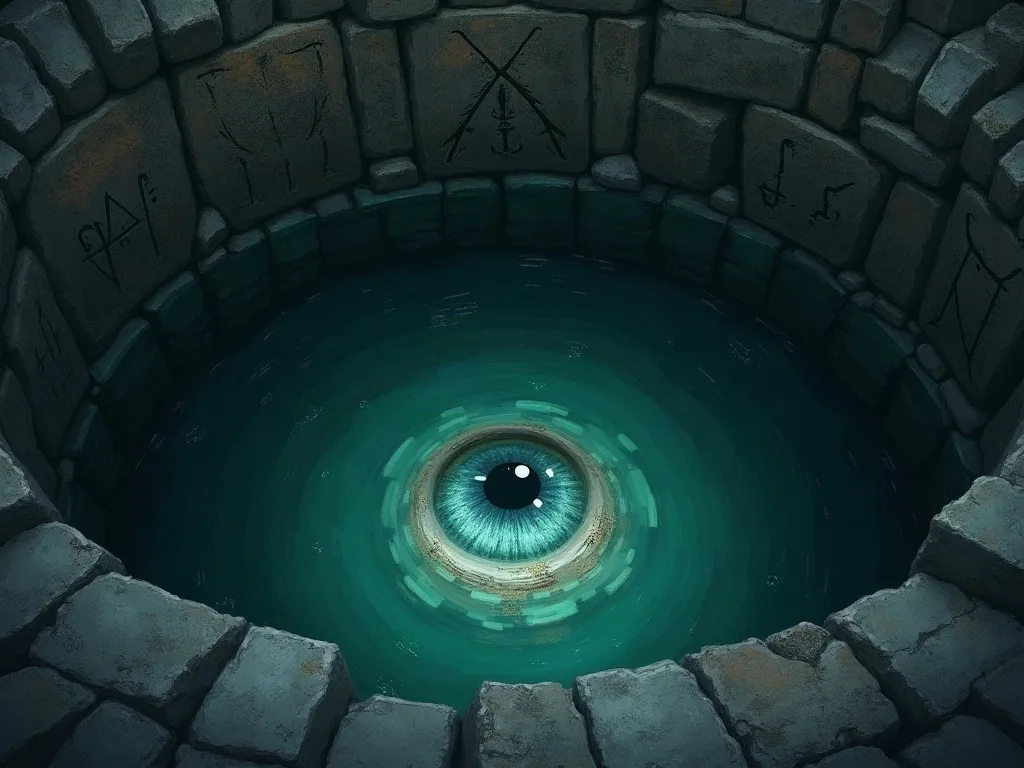
What did Odin want badly enough to blind himself in one eye? The Prose Edda says he asked for a drink from the well itself. Mimir refused unless Odin paid. Odin reached into his own skull, pulled out the eye, and dropped it into the water. Then he drank.
The eye sitting in the well is one of the most persistent images in Norse myth. The skaldic poets called the sun "Odin's eye" partly as a heiti (a poetic kenning), which some readers have taken literally: that Odin's sacrificed eye became the sun, or that it illuminates the well's depths. Most scholars treat the sun interpretation as a later poetic overlay. But the image survives because it is perfect. The god of wisdom blinded himself to see more clearly. He traded his physical sight for the kind of vision that reads the future.
This is not a paradox the Norse audience would have found strange. The Hávamál, the great poem of Odin's practical wisdom preserved in the Codex Regius, opens with 77 stanzas of hard-won social intelligence and continues into the self-hanging episode on Yggdrasil. The pattern is consistent: real knowledge requires that you damage yourself to get it. Odin hangs nine days, he loses an eye, he cuts himself for the runes. Mimir is the fixed point that Odin orbits, the source that makes every sacrifice worthwhile.
The Aesir-Vanir War and the Head That Came Back
The Ynglinga saga, Snorri's euhemerized prose history of the Norse gods as if they were ancient kings, gives the most detailed account of what happened to Mimir. The two divine tribes, the Aesir and the Vanir, had been at war. Neither side could win. They agreed to a hostage exchange, which was the Bronze Age diplomatic solution to exactly this kind of standoff.
Odin sent Mimir to the Vanir along with a figure named Hœnir. The Vanir received them well and appointed Hœnir as a chieftain. The problem was that Hœnir was not actually wise on his own. He depended entirely on Mimir's counsel. Whenever a question came up and Mimir was not beside him, Hœnir would say only: "Let others decide." The Vanir figured out what was happening. They felt they had been cheated in the exchange. In fury, they cut off Mimir's head and sent it to Odin.
This is a remarkable moment of mythological realism. The Vanir are not villains here. They made a rational decision based on evidence of deception. Odin's side had sent them a figurehead with no independent judgment, propped up by the real intelligence sitting next to him. When the prop was withdrawn, the fraud was obvious. The decapitation was diplomatic fury, not random violence.
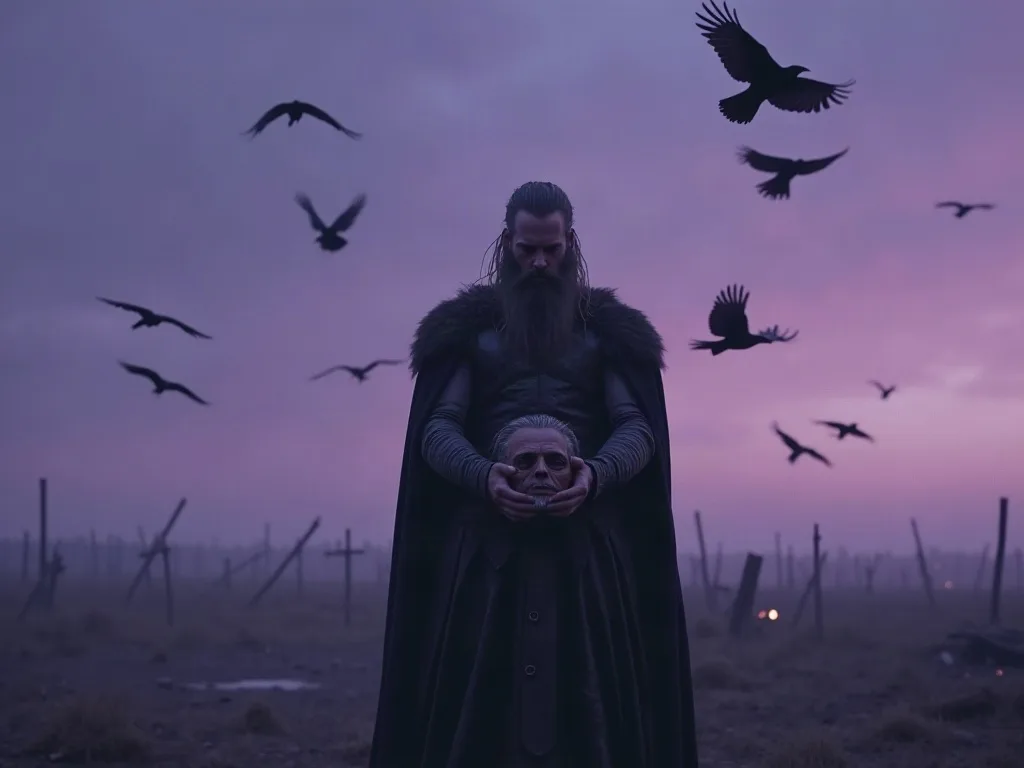
Odin's response is equally remarkable. He did not retaliate. He took the head, performed preservation rites, and turned a diplomatic catastrophe into a permanent oracle. The Ynglinga saga says he used herbs and spells, the same techniques a Norse practitioner of seidr (shamanic magic) might use. Anthony Faulkes, in his translation and commentary on Snorri's Edda (1987), notes that this episode sits at the boundary between Snorri's rationalized history and older mythological material that resists rationalization entirely.
What the Head Said: Mimir as Oracle and Advisor
After the preservation, Mimir became Odin's most private counselor. The Völuspá, in its description of Ragnarök's approach, says Odin goes to consult Mimir before the final battle. Verse 46 in the Dronke translation (Ursula Dronke's Poetic Edda, Vol. 2, 1997) describes Odin bending to the head, exchanging words in secret. The exact content of the conversation is never given.
That deliberate silence is part of the myth's power. Odin knows things he refuses to share. The Norse gods are not omniscient in a comfortable way; they are deeply anxious beings who must constantly gather information to stay ahead of Fate. Mimir's head is the intelligence apparatus of a paranoid pantheon.
The Sigrdrífumál adds another detail: runes were cut on Mimir's shield. This connects Mimir to the runic tradition, placing him in the same current as Odin's self-hanging and the transmission of written-magical knowledge. Odin did not invent the runes alone. He found them at the bottom of existence, and Mimir was already there.
The Eddic scholar Hilda Ellis Davidson, in Gods and Myths of Northern Europe (1964), argued that Mimir represents a very old stratum of Germanic religious thought, the idea that wisdom lives in liminal beings who exist between life and death. She draws a parallel to the practice of consulting skulls, which archaeology confirms in Iron Age Scandinavia and in Celtic Britain. The head is not merely a literary device. It echoes real ritual.
Mimir at Ragnarök: The Final Consultation
The Völuspá is structured around a völva (a seeress) telling Odin everything she knows about the beginning and end of the cosmos. Near the end, as Ragnarök approaches, the poem places Odin at Mimir's well one more time. This is described in Völuspá verse 46: "Then Odin goes to Mimir's well for a drink of wisdom for himself and his kin." Different translators render this differently, but the structure is consistent. On the eve of everything's destruction, the most powerful god in the Norse pantheon seeks counsel from a preserved head in a well.
What is he asking? What does Mimir tell him? The poem does not say. The gods lose Ragnarök anyway. Odin is swallowed by the wolf Fenrir. The well presumably survives into the new world that rises after, green and renewed, as the Völuspá describes in its final stanzas. Whether Mimir's head goes on speaking in the reborn world is a question the texts do not answer.
This ambiguity is characteristic of Norse eschatology. Ragnarök is not the Christian Last Judgment, a clean terminus with permanent winners and losers. It is more like a harsh winter that kills most things but not everything. Mimir's well endures. Memory endures. Whether anyone will be there to drink from it is left open.
Mimir in Comparative Context: Oracular Heads Across Traditions
Mimir the wise head is not the only talking decapitated oracle in world mythology, and the parallels are close enough to be worth examining seriously.
The most direct comparison is to the Welsh figure Bran the Blessed, whose story appears in the Mabinogion, a collection of Welsh myths written down around the 12th-14th centuries from much older oral material. When Bran is fatally wounded in Ireland, he instructs his followers to cut off his head. The head then accompanies them for 87 years, speaking, feasting, providing companionship, keeping perfect quality as if still alive. Bran's head is eventually buried in London as a protective talisman.
The parallels to Mimir are structurally precise: decapitation, preservation of intelligence after physical death, the head as a source of counsel and protection. Celtic and Germanic traditions share a common Indo-European ancestor culture, and oracular heads appear to be one of its deep inheritances.
Further afield, the Vedic tradition of South Asia preserves the story of Dadhyanch (also spelled Dadhici), a wise sage who possessed secret knowledge. In the Rigveda (10.48 and related hymns), the Ashvins (divine twin physicians) replace his head with a horse's head so he can share forbidden wisdom without technically breaking his oath. When the god Indra destroys the substitute head, the Ashvins restore the original. Wisdom, secrecy, a severed or transformed head: the elements cluster together across a vast geographic and cultural distance.
Even in Egyptian tradition, Osiris is dismembered and reassembled, his reconstituted body becoming an oracle and judge of the dead. The body-as-repository-of-knowledge, the idea that intelligence survives physical destruction if preserved correctly, appears to be one of humanity's oldest intuitions about the relationship between mind and matter.
The Price of Wisdom: Mimir's Theological Function
Pull back from the individual stories and Mimir reveals a consistent theological argument. Every Norse account of wisdom comes with a price tag printed on it, usually in blood.
Odin loses his eye. He hangs nine nights on the World Tree. He cuts himself for the runes. In each case, the price is not symbolic: it is the actual cost, paid in full, before the knowledge is transferred. Mimir enforces this economy. He sits at the well and does not hand out drinks freely. He waits until the seeker has identified what they are willing to lose.
This stands in interesting contrast to the Greek tradition, where Athena gives wisdom as a gift to heroes she favors, or to the Vedic tradition where wisdom can sometimes be transmitted through devotion and teaching. Norse wisdom is transactional in the oldest sense: you find something you cannot replace and you give it up. What you receive is proportional.
Mimir's theological function is to be the fixed cost of truth. His well does not bargain or adjust the price based on how much the seeker needs it. Odin needed it completely, and he paid completely. That is why the image of the eye in the well has survived a thousand years of retellings. It is not a pretty story. It is an honest one.
Mimir (Norse)
Wisdom lives in a physical well beneath the World Tree. Access costs an irreversible personal sacrifice. The oracle is a preserved corpse, permanently available but requiring Odin's own ritual to activate. Knowledge is secret, delivered privately before battle or catastrophe. The source is uncreated; Mimir predates the divine order.
Delphi Oracle (Greek)
Wisdom is channeled through a living priestess, the Pythia, at Apollo's sanctuary at Delphi. Access costs a fee and a ritual purification. The oracle speaks in riddles, ambiguous and open to interpretation. Knowledge is semi-public, delivered to kings, cities, and individuals who make the journey. The source is Apollo, a god with a defined mythology and history.
The Scholarly Debate: One Mimir or Several?
A persistent question in Norse studies is whether the Mimir of the well and the Mimir of the hostage exchange are actually the same figure. The sources treat them as one, but the stories fit together awkwardly.
If Mimir is a being of almost cosmic wisdom, why would Odin send him to the Vanir as a hostage? Hostages were typically people of value but not indispensability. And if Mimir has been guarding the well since before the Aesir existed, how can he simultaneously be a figure within the Aesir's political arrangements? John Lindow in Norse Mythology: A Guide to Gods, Heroes, Rituals, and Beliefs (2001) raises these questions without resolving them. He suggests Snorri may have merged two or three originally distinct figures, a guardian-spirit of the well, a wise counselor of the Aesir, and possibly a figure from a tradition that did not survive in full.
Ursula Dronke took a more unified position, reading all Mimir references as pointing to a single being whose story was simply transmitted in fragments across different genres (the Völuspá's compressed mythological verse versus Snorri's prose narrative). The fragments do not fully cohere, but that is true of most Norse mythological figures. The traditions were oral before they were written, and oral traditions accumulate variation the way glaciers accumulate layers.
What most scholars agree on: the name's connection to memory, the association with the well, and the speaking-head episode are all old. They predate Snorri's 13th-century writing by centuries. The Völuspá itself is generally dated to around 1000 CE, close to the end of the Viking Age, and it already treats Mimir as an established, recognizable figure requiring no introduction.
Frequently asked questions about Mimir the wise head
Frequently asked questions
Is Mimir an Aesir god or something else entirely?
The sources never clearly classify Mimir as an Aesir. The Prose Edda places him at Mimir's Well without assigning him to either the Aesir or Vanir tribes. Scholars such as Rudolf Simek and John Lindow suggest he may be a primordial being or nature spirit predating the divine tribal structure altogether. His name connects to the Proto-Germanic root for memory, which points to a cosmological function older than any particular god-group.
Why did Odin sacrifice his eye specifically, rather than some other payment?
The Völuspá does not explain Mimir's reasoning. Most scholars read the eye as an obvious symbol: physical sight traded for inner vision, the external world surrendered for access to hidden knowledge. Within Norse thought, the body is not separate from the self; losing an eye is losing a permanent part of your identity. The payment had to be irreversible, something Odin could never take back. Mimir's well operates on the logic that real knowledge requires real, permanent cost.
What happened to Mimir's well after Ragnarök?
The Völuspá describes a world reborn after Ragnarök, green fields, surviving gods, and a new human pair repopulating the earth. The text does not explicitly state what happens to Mimir's well. Because the well is described as sitting beneath one root of Yggdrasil, and Yggdrasil is said to survive Ragnarök (the dragon Níðhöggr gnaws it but cannot destroy it), many readers and scholars assume the well persists. Whether Mimir's head continues to speak there is a question the Eddas leave open.
What is the connection between Mimir and the horn Gjallarhorn?
In the Prose Edda, Snorri states that Mimir drinks from the well each morning using Gjallarhorn. In other passages, the horn is associated with Heimdall, who will blow it at Ragnarök to summon the gods. Scholars including John Lindow have noted this apparent inconsistency and suggest Snorri may have been working from multiple oral strands that assigned the horn differently. Some read it as evidence that Heimdall and Mimir were once more closely connected figures in an older layer of the tradition.
Are there real archaeological parallels to the idea of a speaking or oracular head?
Yes. Iron Age Celtic and Germanic sites have produced evidence of skull curation, skulls kept in special locations, sometimes with offerings placed nearby. The sanctuary at Roquepertuse in southern France (around 3rd century BCE) included stone pillars with carved niches that held human skulls. Diodorus Siculus and Livy both record that Celts preserved the heads of enemies as sacred objects. Hilda Ellis Davidson argued in Gods and Myths of Northern Europe (1964) that Mimir's head reflects a real ritual practice of consulting preserved remains.
How does Mimir relate to Odin's ravens, Huginn and Muninn?
Huginn (Thought) and Muninn (Memory) fly across the world each day and bring Odin news. The name Muninn shares its semantic root with Mimir: both connect to the Old Norse verb muna, to remember. Some scholars read Mimir and Muninn as two expressions of the same mythological idea, that memory is the foundation of intelligence and that Odin's power depends on never losing access to it. Whether this connection was intentional in the original tradition or is a modern observation based on etymology is debated.
Mimir in Modern Storytelling and What Gets Lost in Translation
Mimir's biggest moment in contemporary culture came with the God of War video game series, specifically the 2018 and 2022 instalments. The game preserves the core image: a talking severed head that Kratos carries around and consults. The game's Mimir is charming, witty, and helpful, which is tonally very different from the original sources, where the head is described with a kind of reverent dread.
That shift is worth naming. The Norse sources treat Mimir the wise head with the same gravity they reserve for the World Tree, the Norns, and the structure of Fate itself. Mimir is not comic relief. He is the cost of consciousness made visible, a reminder that the universe does not give away its secrets for free. When modern adaptations turn him into a wisecracking sidekick, they get the image right and the theology wrong.
Neil Gaiman's Norse Mythology (2017) handles Mimir more carefully. Gaiman preserves the basic structure of the Aesir-Vanir hostage exchange and the decapitation without turning it into adventure-novel plot mechanics. He lets the strangeness sit on the page without explaining it away.
The gap between what modern audiences want (wisdom as a personality trait, accessible and freely given) and what the Eddas describe (wisdom as a resource extracted at permanent cost from a cosmos that is fundamentally indifferent) is the real distance between us and the Norse worldview. Mimir, carried under Odin's arm, whispering before every catastrophe, is a portrait of what it means to know things in a world that does not care whether you survive the knowing.
The head still speaks. The well is still there. And the price has not changed.
Free 25-page sample
Want the whole story?
Take the first 25 pages free. If it pulls you in, the full edition is yours as an instant PDF download, with a paperback on Amazon for selected titles.

Mythology
The World Mythology Book: The Gods, Heroes and Myths of Every Culture
The Gods, Heroes and Myths of Every Culture, in One Volume
The whole of world mythology in a single volume: Greek, Norse, Egyptian, Japanese, Hindu, Celtic, Slavic, Mesoamerican and African myths gathered side by side, each drawn from the primary sources.