

Narcissus and Echo: The Full Myth, Its Sources, and What It Still Means
A hunter who falls in love with his own reflection. A nymph who can only repeat what others say. The myth of Narcissus and Echo is older, stranger, and richer than most retellings admit.
Contents
The boy was beautiful enough to ruin things. Every person who saw him wanted him, and every person he turned away left a little more hollowed out. That was the pattern of his life, season after season, until the day he knelt beside a clear pool to drink and saw, for the first time, a face that actually stopped him.
Narcissus and Echo is one of the oldest psychological portraits in Western literature. It is not simply a story about vanity. It is a story about the terror of connection, the cruelty of one-sided love, and what happens when the universe runs out of patience with a person who refuses to be known. Ovid told it most fully in his Metamorphoses, written around 8 AD, but the myth reaches back further, into fragments and variations that change the picture considerably.
The Two Traditions Behind the Myth
Before the story itself, it helps to know where it comes from. There are two main ancient sources, and they tell noticeably different tales.
Ovid, the Roman poet, gives the definitive account in Book III of the Metamorphoses. His Narcissus is the son of the river god Cephissus and the nymph Liriope. He is so beautiful at birth that the prophet Tiresias tells his mother he will live a long life "if he never knows himself." The phrase hangs over everything that follows.
The Greek geographer and traveler Pausanias, writing in the 2nd century AD in his Description of Greece, preserved a much older local tradition from Thespiae in Boeotia, the region where the myth was said to have originated. In his version, Narcissus had a twin sister, identical to him in appearance. When she died, he began sitting at a pool and staring at his own reflection, knowing rationally it was his own face, but using the image to grieve his sister. He was not deluded. He was heartbroken. He wasted away and died beside the pool, and a flower grew in his place.
These two versions do not cancel each other out. They illuminate the myth from different angles, and both deserve attention.

Echo Before Narcissus: The Nymph Who Lost Her Voice
Echo's story begins in a different divine household, and it begins with a punishment.
She was an Oread, a nymph of the mountains, and she had a gift for language. She spoke constantly, brilliantly, sometimes just to keep conversations going while Hera searched the hillsides for Zeus, who was, as usual, pursuing other nymphs in those exact hills. Whether Echo was complicit in covering for Zeus or simply chatty by nature, Hera eventually noticed the pattern. The goddess stripped her of original speech. Echo could only repeat the last words spoken to her. She became the last word, nothing more.
The cruelty of this punishment is precise. Echo had used language to connect, to fill silences, to keep company. Now language could only arrive at her, never originate from her. She heard everything. She could say nothing new.
When she encountered Narcissus hunting in the hills, she fell in love immediately. She followed him through the forest, hoping for a moment to speak. The scene Ovid constructs is almost comic in its awkwardness: Narcissus calls out, thinking he has heard a companion, "Is anyone here?" Echo answers, "Here." He says, "Come together." She answers, "Together," and steps forward to embrace him.
He recoils. His rejection is not gentle. He tells her, in Ovid's Latin, that he would die before she could have him. Echo retreats into the forests and caves. Her body fades. Her bones turn to stone. Only her voice remains, living in the walls of cliffs and valleys, repeating the ends of other people's sentences forever.
She is still there, technically. The Greek word echo simply means "sound" or "reverberation," and Ovid uses the myth to explain why sound bounces back from rock faces. But inside that etiological tidiness is a portrait of what happens to someone who is denied the ability to say anything first, anything original, anything of their own.
The Pool and the Prophecy
Narcissus continued hunting after Echo's retreat. Other nymphs had suffered similarly. One of them, or possibly a young man he had also rejected, sent a prayer to Nemesis, the goddess of righteous retribution, or in some accounts directly to the gods. The prayer was specific: let him love something he cannot possess.
Nemesis, whose name comes from the Greek nemein, meaning "to give what is due," listened.
Narcissus came upon a pool near Thespiae. The Metamorphoses describes it as remote, untouched, shaded from the sun. He knelt to drink, and the water was so still that he saw his own face with perfect clarity. What followed was not immediate recognition. That is the key point Ovid makes with care: Narcissus did not know he was looking at himself. He saw a face gazing back with what looked like longing, and he fell in love with it.
He reached toward the water. The image reached back, broke apart, reformed. He spoke to it. He wept over it. He called it beautiful, begged it to come closer, tried to understand why it retreated every time he reached forward.
The Greek word at the center of the myth is imago, the Latin equivalent of the Greek eidolon, meaning image, phantom, appearance. What Narcissus loves is not a person. It is not even a god. It is a surface. He has, in Tiresias's terms, finally "known himself," and the knowledge is destroying him.

The Death of Narcissus and the Flower
Narcissus could not leave the pool. He stopped eating. He stopped sleeping in the ordinary way. He lay at the edge of the water, talking to his reflection, grieving the impossibility of reaching it, and slowly fading.
Ovid's language at this point becomes elegiac and precise. Narcissus says, at one climactic moment, that he now understands what love is, and that it burns him not from a distance but from his own body. He has, in other words, grasped the absurdity of his situation without being able to do anything about it. Understanding did not save him.
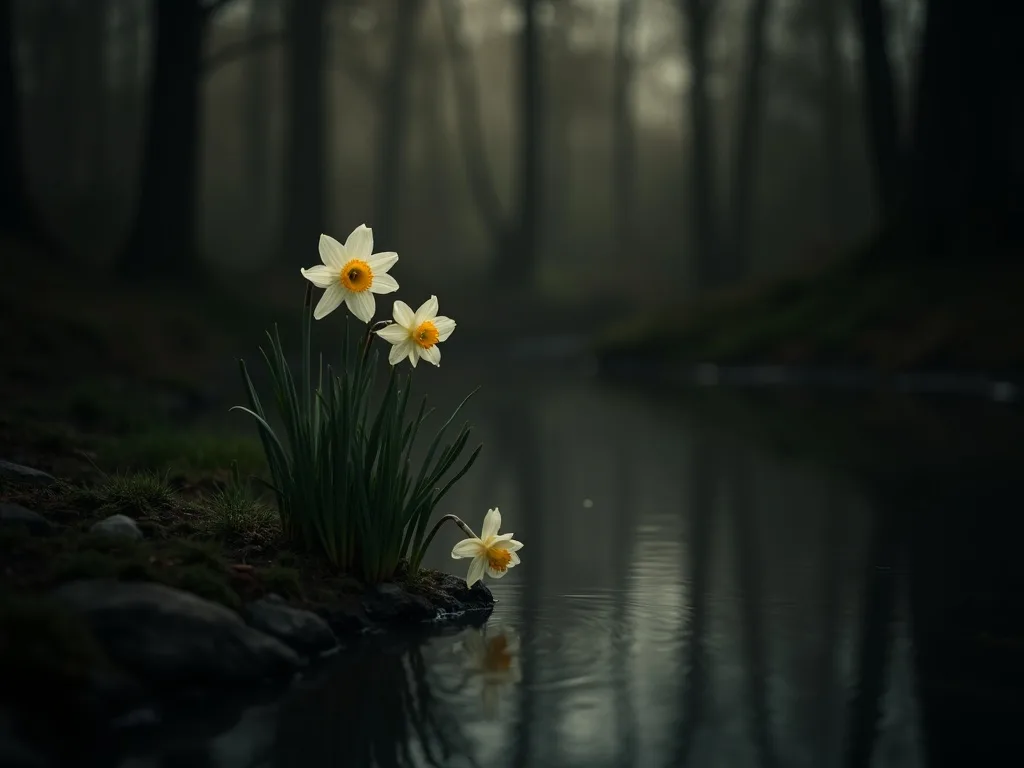
He died at the pool. When the water-nymphs, the Naiads, and the Oreads came to mourn him and prepare his body for burial, there was no body to find. In its place grew a flower: white petals surrounding a yellow center, bowing over water as if still looking down. The Greeks called it the narkissos, and it may refer to the plant we now call the narcissus or daffodil. The Greek root narke means numbness or torpor, which is also where the word "narcotic" comes from. The flower that makes you go still.
In Pausanias's older version, the grief is already present before the pool. Narcissus knows what he is looking at. He sits at the water because it is the only way to see his sister's face again. The flower grows from the same spot, but the emotional logic is different: this is a young man destroyed by loss, not by self-obsession. Both versions agree on the ending. The body vanishes. The flower remains.
What Tiresias Knew
The prophecy at the beginning of the myth ("he will live a long life if he never knows himself") has been interpreted in several ways, and the differences matter.
The surface reading: knowing himself means seeing his face in the pool, which is what kills him. Self-knowledge, in this reading, is literally fatal for Narcissus. He was safer in ignorance.
A deeper reading inverts this: Narcissus has been refusing to know himself for his whole life. He passes through crowds of people who love him, and he feels nothing in return. He is, in a meaningful sense, disconnected from his own emotional reality. The pool does not show him his physical face. It shows him his emotional condition: a person utterly absorbed in an image that cannot respond, cannot grow, cannot make demands. The pool is a mirror of his whole relationship pattern, compressed into one unbearable scene.
This second reading is the one most modern psychological commentators favor, and it is the one that makes the myth feel genuinely alive rather than merely cautionary.
The philosopher Plotinus, writing in the 3rd century AD in his Enneads, used the myth of Narcissus explicitly as a metaphor for the soul that becomes so entranced by its own material reflection that it loses touch with the higher intellectual reality it came from. For Plotinus, Narcissus was not vain in the common sense. He was metaphysically confused: he mistook the image for the real thing. That confusion, Plotinus argued, is the source of most human suffering.
Cross-Mythology Parallels: Mirrors, Doubles, and Fatal Self-Love
The Narcissus pattern shows up across multiple traditions, though never in quite the same form.
In Hindu mythology, the god Shiva meditates so intensely that he generates a blazing form of himself: the Virabhadra, a being of pure destructive energy that exists to act out what Shiva cannot. The idea that intense inner focus produces a kind of double that takes on its own life echoes the Narcissus pool, though Hindu cosmology frames this as generative power rather than tragic paralysis.
In Japanese tradition, mirrors are sacred objects (kagami) that reveal the divine self rather than the ego-self. The sacred mirror Yata no Kagami, one of the three imperial treasures, is kept at the Ise Grand Shrine and is said to reflect the soul's true nature. The act of looking is purification, not destruction. The contrast with Narcissus is instructive: in the Greek myth, the reflective surface is a trap; in Shinto thought, it is a tool for alignment with the divine.
Tezcatlipoca, the Aztec god whose name translates as "Smoking Mirror," carries a black obsidian mirror that shows the desires and sins of those who look into it. He is not destroyed by his mirror. He wields it as a weapon and a test. Where Narcissus cannot look away, Tezcatlipoca never looks in.
The Norse tradition offers the figure of Loki, whose shape-shifting is another kind of self-multiplication: he becomes others rather than becoming fixated on his own image. Where Narcissus collapses inward, Loki expands outward into endless transformation. Both are dangerous. Neither can stay in one form.
The Myth in Art: From Caravaggio to Freud
No image from the Narcissus myth has been more reproduced than the moment at the pool. Caravaggio painted it around 1597-1599, though attribution was debated for centuries. His Narcissus crouches over dark water, the reflection below him forming a near-perfect circle with his body, as if he and his image together make one complete shape. The painting is unusual in that it shows no landscape, no flowers, no nymphs. Just a boy and his double, alone in blackness.
Poussin painted the scene in 1628-1630 with Echo visible in the middle distance, already fading, a ghostly figure watching the boy destroy himself beside the pool. It is a more moralistic composition: cause and effect visible in the same frame.
The myth's modern life accelerated dramatically in 1914, when Sigmund Freud introduced the term narcissism in his paper "On Narcissism: An Introduction." For Freud, narcissism was a stage of psychosexual development in which libido turns back on the self rather than extending toward objects in the external world. Healthy development moves past this stage. Pathological narcissism means getting stuck there. Freud borrowed the myth's name while substantially changing its meaning: his narcissist is not beautiful or tragic. He is simply arrested.
The psychoanalyst Heinz Kohut expanded the concept in the 1970s, distinguishing between healthy self-regard and pathological narcissistic injury, and his work shaped what eventually became Narcissistic Personality Disorder in clinical psychiatry. The myth now has a diagnostic category named after it. That is a remarkable afterlife for a poem written two thousand years ago.
The philosopher Gaston Bachelard, in his 1942 work L'Eau et les Rêves (Water and Dreams), took a different approach. He argued that the Narcissus myth is fundamentally about water's power to draw the human imagination downward, toward reflection and reverie. Narcissus, for Bachelard, is not pathological. He is the first poet: the person who stares at the reflected world and finds it more vivid than the real one.
Echo's Revenge: What the Myth Leaves Behind
There is a quiet symmetry in the myth that is easy to miss. Echo loses her original voice. Narcissus loses his original body. Both are trapped in their own kind of repetition: she can only echo back, he can only circle back to the pool. Both waste away.
But Echo survives. Diminished, formless, scattered across stone, she is still there. Her voice persists. Narcissus, the one with the body and the beauty and the independence, disappears entirely. The flower is not him. It is what he left behind.
Some classical scholars, including the mythologist Karl Kerényi in his study of Greek myths, have suggested that Echo and Narcissus are two faces of the same problem. Echo is all reception, no emission. Narcissus is all emission, no reception. Each is broken in the opposite direction. A functional person, the myth implies, does both: speaks and listens, reaches out and takes in.
The word narcissus appears in ancient sources as the name of a plant associated with the underworld. Homer's Hymn to Demeter mentions it among the flowers that distracted Persephone before Hades took her. The narkissos is a flower of seduction, of distraction, of the moment before something irreversible happens. Its presence in the Narcissus myth is not accidental. The boy at the pool is already in a kind of underworld: a place with no exit, where time stops and all that exists is the loop of looking and not quite touching.
How the Myth Traveled Through Time
The myth's geography is specific. Thespiae, in Boeotia, was the town where Narcissus was said to have been born and died. Pausanias, visiting in the 2nd century AD, was told by locals that a spring near the city was the actual pool, and that a statue of Narcissus stood there. The mythographers call this the Narcissus spring, and it remained a local landmark into late antiquity.
The Romans absorbed the myth through Ovid, who transformed it from a regional Boeotian legend into something universal. Ovid's Metamorphoses, written around 8 AD, is one of the most influential books in Western literary history: its retellings of Greek myths became the source text for most medieval and Renaissance artists, who read Latin but rarely read Greek. Without Ovid, Caravaggio and Poussin would not have had Narcissus as a subject. Without the Metamorphoses, the myth might have stayed a footnote in Pausanias.
Medieval Christian allegorists read Narcissus as a figure for the sin of pride. Dante's Purgatorio references the image. The Roman de la Rose, a 13th-century French allegorical poem, begins with the narrator finding a garden with a pool where Narcissus died, and seeing the reflection of a rosebud in the water, which he falls in love with. The myth becomes, in that retelling, an allegory for desire itself: everyone who falls in love is, to some degree, in love with an image projected onto another person.
Shakespeare knew the myth. Milton referenced it. John Milton's Paradise Lost has Eve, newly created, looking into a pool and seeing herself before she sees Adam, a clear echo of the Narcissus structure, and Milton makes explicit that she would have stayed there forever if a voice had not redirected her attention.
Frequently Asked Questions About Narcissus and Echo
Frequently asked questions
What is the original source of the Narcissus and Echo myth?
The most complete version comes from Ovid's Metamorphoses, Book III, written around 8 AD. But the myth predates Ovid. The Greek geographer Pausanias, in his Description of Greece (2nd century AD), recorded an older local tradition from Thespiae in Boeotia that gave Narcissus a twin sister and changed the emotional meaning of the pool scene entirely. Conon, a Greek mythographer active around the 1st century BC, also collected a version. Ovid's genius was to fuse these strands into a single fluid narrative.
Did Narcissus know he was looking at his own reflection?
In Ovid's version, no. The tragedy depends on Narcissus believing he has found someone who loves him as much as he has wanted to be loved, without realizing the beloved is himself. In Pausanias's older version, Narcissus knows perfectly well it is his own reflection, but uses the image to keep seeing his dead twin sister's face. The two readings produce very different emotional tones: Ovid's Narcissus is tragic because of delusion; Pausanias's is tragic because of grief.
Why can Echo only repeat what she hears?
Ovid attributes this to a punishment by Hera. Echo had used her gift for extended speech to distract Hera with conversation while Zeus pursued other nymphs in the surrounding hills. Hera, realizing she was being stalled, cursed Echo so that she could no longer speak first or say anything original. She could only repeat the last words addressed to her. This made genuine communication impossible for the rest of her existence.
What flower grew where Narcissus died, and what does its name mean?
The flower is the narkissos, the plant we now call the narcissus or daffodil. The Greek root narke means numbness, torpor, or stupor, the same root that gives English the word "narcotic." The flower appears in earlier Greek literature as well: the Homeric Hymn to Demeter mentions it as one of the flowers that distracted Persephone before Hades took her. It was associated with death, seduction, and the moment before something irreversible happens.
How did the myth of Narcissus influence modern psychology?
Freud introduced the term narcissism in a 1914 paper as a clinical description of libido that turns back on the self rather than extending toward others. He borrowed the myth's name without fully replicating its moral complexity. Later psychoanalysts, especially Heinz Kohut in the 1970s, refined the concept into a developmental theory of self-regard. The result is Narcissistic Personality Disorder, a recognized clinical diagnosis whose name traces directly back to Ovid's retelling of a Boeotian legend. The myth now has diagnostic criteria.
Is Narcissus a villain in the original myth?
Not exactly. Ovid presents him as cold and dismissive toward those who love him, which causes real harm, particularly to Echo. But Ovid also gives him self-awareness at the end: Narcissus explicitly understands the absurdity of his situation before he dies. He is more a figure of tragedy than of moral failure. The philosopher Plotinus read him as a symbol of metaphysical confusion rather than moral wickedness. Modern psychological readings tend to frame his behavior as pathology rather than evil. The myth resists simple moral categorization, which is part of why it has lasted.
The Unresolved Question at the Heart of the Pool
Scholars have never fully settled whether the Narcissus myth is, at its core, a story about self-love or about the inability to love at all. The two readings point in opposite directions, and both have serious defenders.
If the myth is about excessive self-love, the lesson is clear: turn outward, be generous, do not place yourself at the center of your own world. This is the reading favored by moralists from Dante to the self-help industry.
If the myth is about the inability to love, the lesson is darker and more interesting. Narcissus is not overwhelmed by self-love. He has never successfully loved anything, including himself. What he sees in the pool is not his ego triumphant but his emotional life exposed for the first time, and the exposure kills him because he has no practice with feeling that much. He is destroyed not by vanity but by the sudden arrival of a vulnerability he spent his entire life avoiding.
The classicist Charles Segal, in his study Landscape in Ovid's Metamorphoses, argued that the pool scene is best read as a collapse of the boundary between self and world. Narcissus has kept that boundary rigid his whole life. The pool dissolves it. He cannot exist without the boundary, and so he ceases to exist.
Echo, meanwhile, has no boundary at all. She absorbs everything that comes at her. She cannot initiate. She has no surface that holds. And she survives, formless and distributed, in every cliff and canyon that bounces sound back at us.
The myth gives us two failure modes of human connection. One person is too closed. The other is too open. Between them is the space where actual relationship might happen, and neither of them can reach it. That gap, unnamed and unresolved in the myth, is what readers have been trying to fill for two thousand years.
Free 25-page sample
Want the whole story?
Take the first 25 pages free. If it pulls you in, the full edition is yours as an instant PDF download, with a paperback on Amazon for selected titles.

Mythology
The World Mythology Book: The Gods, Heroes and Myths of Every Culture
The Gods, Heroes and Myths of Every Culture, in One Volume
The whole of world mythology in a single volume: Greek, Norse, Egyptian, Japanese, Hindu, Celtic, Slavic, Mesoamerican and African myths gathered side by side, each drawn from the primary sources.