
Tezcatlipoca the Smoking Mirror: Aztec God of Night, Sorcery, and Fate
Tezcatlipoca the Smoking Mirror ruled night, sorcery, and human fate in Aztec belief. Learn who he was, what he destroyed, and why the Aztecs feared him above all others.
Contents
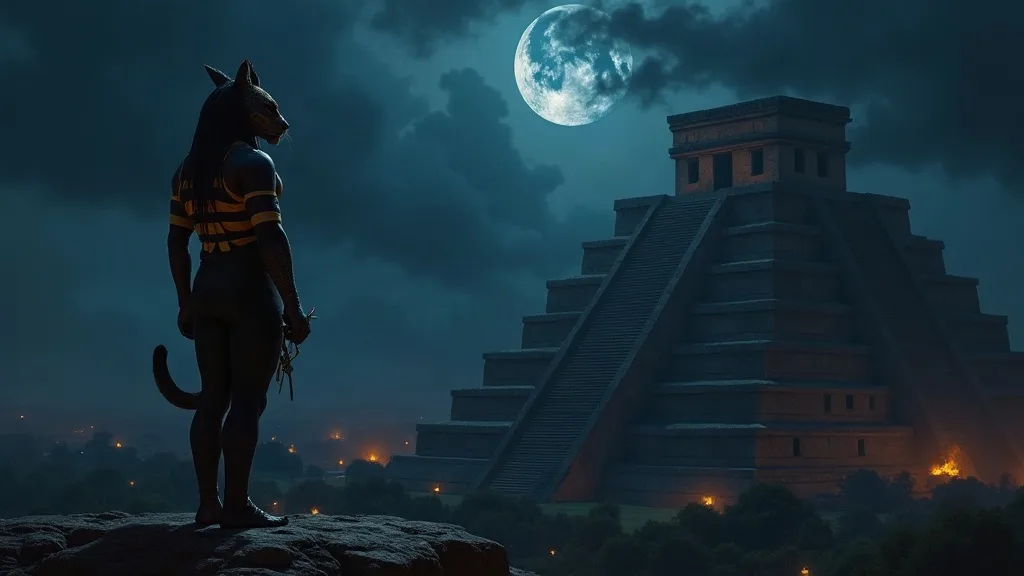
The obsidian mirror did not reflect faces. It showed fates. Hold it up, and you would see not yourself but the truth of what you were, stripped of every comfort. Tezcatlipoca the Smoking Mirror was the god who held that mirror, and in Aztec theology no figure was more dangerous, more unpredictable, or more alive with raw divine power.
He walked unseen through the night. He wore darkness as a garment. He brought plague, war, famine, and discord, yet the same traditions that described his cruelty also credited him with the creation of the present world. He was not simply "evil." He was complete, the way a storm is complete: beautiful, terrible, necessary.
His cult sat at the heart of the Aztec religious calendar, his festival among the most elaborate in Tenochtitlan, the Aztec capital on what is now Mexico City. The priests who served him fasted for a year, the young men chosen to represent him were pampered and then killed, and the smoke that rose from the braziers outside his temples drifted across a city of roughly 200,000 people who knew, without needing to be told, that this particular god was watching.
Who Was Tezcatlipoca in Aztec Cosmology
He belonged to the first generation. Before humans walked the earth, before the present sun lit the sky, the Aztec creation accounts placed Tezcatlipoca and his great rival Quetzalcoatl at the center of everything. Both were sons of the primal dual deity Ometeotl, the lord-and-lady of duality who existed before time began. The two brothers were cosmic opposites: Tezcatlipoca ruled shadow and discord; Quetzalcoatl ruled wind, learning, and the morning star.
But calling them simply "opposites" flattens the relationship. The Aztec sources, particularly the Leyenda de los Soles ("Legend of the Suns," a Nahuatl text preserved in the Bodleian Library) and the accounts gathered by Sahagún in his twelve-volume Florentine Codex, describe them as necessary to each other. Creation only moved forward through their conflict. They tore the world apart and rebuilt it. They agreed on almost nothing, and that friction was the engine of time.
Tezcatlipoca held several titles. He was called Titlacauan ("We Are His Slaves"), Yaotzin ("the Enemy"), Necoc Yaotl ("Enemy of Both Sides"), and Moyocoyani ("He Who Is Invented By Himself"), the last of which suggests that he needed no outside force to justify his existence. He simply was. This cluster of names appears across the Aztec manuscript tradition, including the Codex Borgia, a pre-Columbian ritual book whose vivid red-and-black imagery remains one of the most dramatic surviving windows into Aztec religious thought.
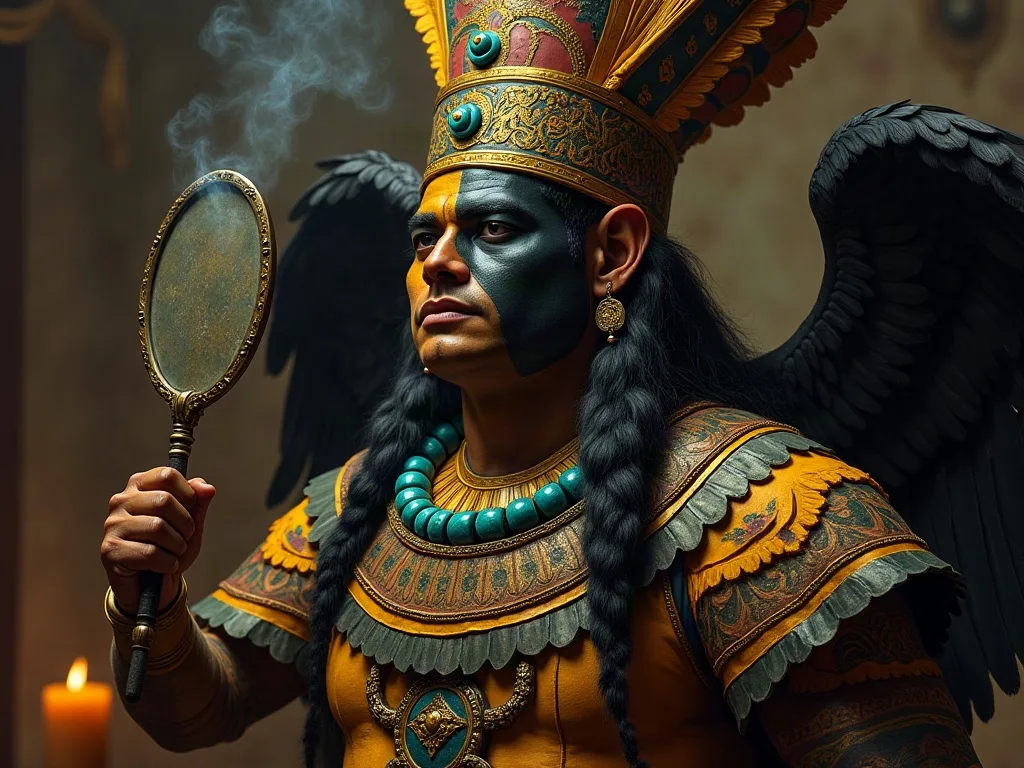
His body bore specific, recognizable markers. His right foot was always missing, replaced by a smoking obsidian mirror. His skin could be painted black or striped black and yellow. His left foot (the one that remained) sometimes wore a rattlesnake wrapped around it. He carried a shield hung with eagle down, and around his neck hung a necklace of human hands and hearts.
The Five Suns and the War That Built the World
The Aztec creation story was not a single act. The universe had been made and destroyed four times before the present world came into being, and each cycle, called a Sun, was associated with a different deity and a different catastrophe. Tezcatlipoca was the god of the first Sun.
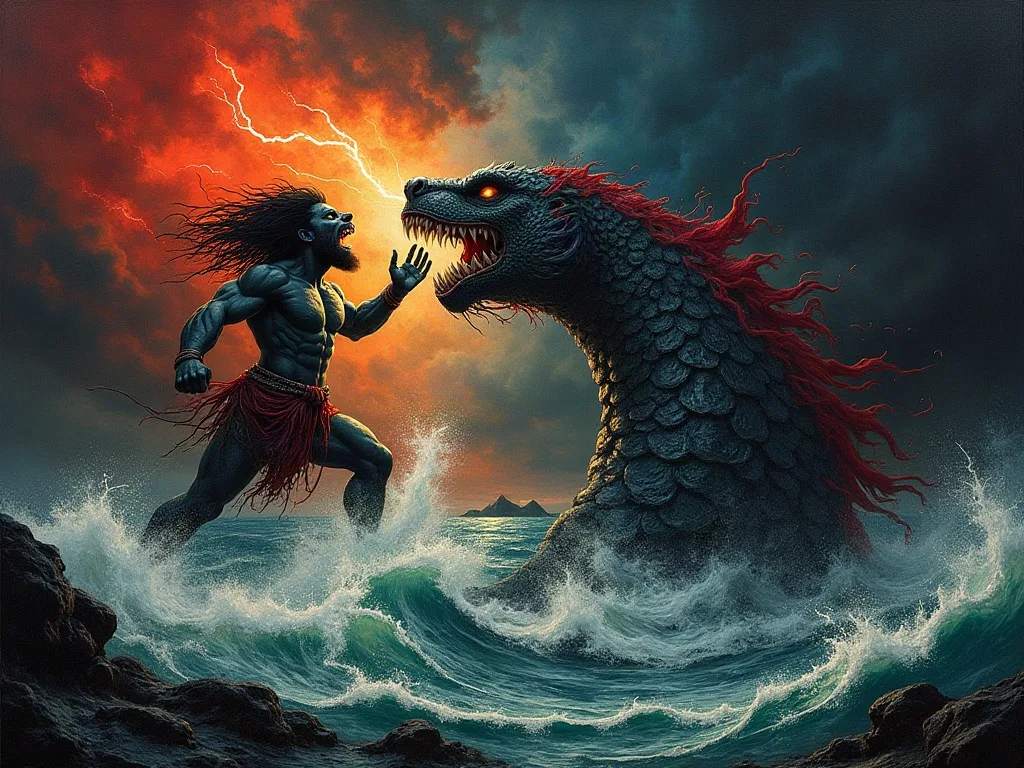
During that initial era, he served as the Sun itself, lighting the world with his smoking mirror. The people of that age were giants, and the food they ate was acorns. The age ended violently. Quetzalcoatl struck Tezcatlipoca with a great staff, knocking him out of the sky. He fell into the sea. From the water, furious and humiliated, he called up a flood of jaguars that ate every giant on earth. That is why the first Sun is called Nahui Ocelotl, "Four Jaguar": the jaguar was Tezcatlipoca's animal, his disguise when he chose to walk the earth unseen.
The second and third Suns followed with their own catastrophes. Each time, the rivalry between Tezcatlipoca and Quetzalcoatl pushed the story forward. The two gods are described in the Leyenda de los Soles as pulling the earth itself into existence: they wrestled a great sea monster named Cipactli out of the primordial ocean, splitting its body to form the land and sky. The earth goddess, born from that same body, was forever hungry, and blood sacrifice was the price paid to keep her fed.
This cosmological violence was not seen as tragedy. The Aztec ritual system was built on the understanding that the present Sun, the fifth, was fragile. It required constant maintenance. Blood, offered at the temples of gods like Tezcatlipoca, was not cruelty. It was fuel. Without it, the sun would stop moving and the world would end in darkness.
The Obsidian Mirror and the Power of Seeing Everything
The mirror was more than a symbol. In Aztec ritual practice, obsidian mirrors were genuine tools. Priests and diviners used polished obsidian discs to scry, to see events at a distance, to read the character of a person standing before them. The archaeological record confirms this: obsidian mirrors have been recovered from temple offerings at Tenochtitlan, and Spanish colonial sources describe indigenous specialists consulting them well into the sixteenth century.
Tezcatlipoca the Smoking Mirror held the ultimate version of this power. According to the Florentine Codex, his mirror could reveal the sins, desires, and hidden thoughts of anyone alive. Nothing was private in his presence. This omniscience made him the god most associated with tlahzolli, a Nahuatl concept often translated as "filth" but more precisely meaning moral pollution: the weight of transgression that accumulated in a person's life and could destroy them if not properly addressed.
He was therefore also invoked in confession. The Aztec ritual of tlahtlacolli, the public acknowledgment of serious sins before a priest of Tlazolteotl (the goddess who consumed filth), ran parallel to Tezcatlipoca's surveillance. People who felt his eye upon them, who believed he had seen something they would rather keep hidden, sometimes came forward voluntarily. His gaze was terrifying, but it also created the possibility of relief.
The mirror also made him a god of fate and time. The Aztec ritual calendar, the 260-day tonalpohualli, was deeply connected to Tezcatlipoca. The day-sign 1-Flint Knife belonged to him, and priests who specialized in reading this calendar, the tonalpouhque, consulted his influence when advising on births, marriages, war, and death.
How Tezcatlipoca Destroyed Quetzalcoatl's Kingdom
The most arresting story in the whole Aztec mythological tradition is the fall of the city of Tula. The historical Tula (modern Tula de Allende in the state of Hidalgo) was the Toltec capital, active roughly between 900 and 1150 CE. In Aztec memory, Tula became a mythological paradise, a golden age where Quetzalcoatl ruled as a priest-king and the fields produced colored cotton already grown, where birds sang in every garden, where no one went hungry.
Tezcatlipoca could not allow it to stand.
He arrived in Tula as a sorcerer, a stranger with a mirror. According to the Histoyre du Mechique and several sections of the Florentine Codex, he first approached Quetzalcoatl's palace and offered to show the god his own face. Quetzalcoatl, described in this tradition as a celibate priest who had never looked at himself, saw an old, ravaged face in the mirror and was horrified. Tezcatlipoca then applied a skin dye to make Quetzalcoatl look young and healthy, and in this disguise Quetzalcoatl was paraded before his people, who celebrated.
That was only the beginning. Using a series of tricks recorded in careful detail in the sources, Tezcatlipoca introduced pulque (fermented agave wine) to the court and got Quetzalcoatl drunk. In his drunken state, Quetzalcoatl slept with his own sister, breaking his priestly vows. He woke consumed by shame. He could no longer be the pure ruler Tula needed. He left the city, walking east toward the sea, and at the shore he either burned himself and transformed into the morning star Venus, or sailed away on a raft of serpents with a promise to return.
This story mattered to the Spanish conquistadors. When Hernán Cortés landed in 1519, some Aztec informants may have connected his arrival to the return of Quetzalcoatl from the east, though modern historians including David Carrasco (in his 1982 study Quetzalcoatl and the Irony of Empire) have argued that this "Quetzalcoatl connection" was largely a post-conquest construction. Either way, the myth of Tezcatlipoca's victory at Tula shaped how the Aztecs understood the cycles of power and how legitimate authority could be corrupted from within.
The Festival of Toxcatl: A God Made Flesh
Once a year, during the month of Toxcatl in the Aztec ritual calendar (falling in May by Spanish reckoning), the city of Tenochtitlan celebrated Tezcatlipoca with what was arguably the most elaborate ritual performance in Mesoamerica.
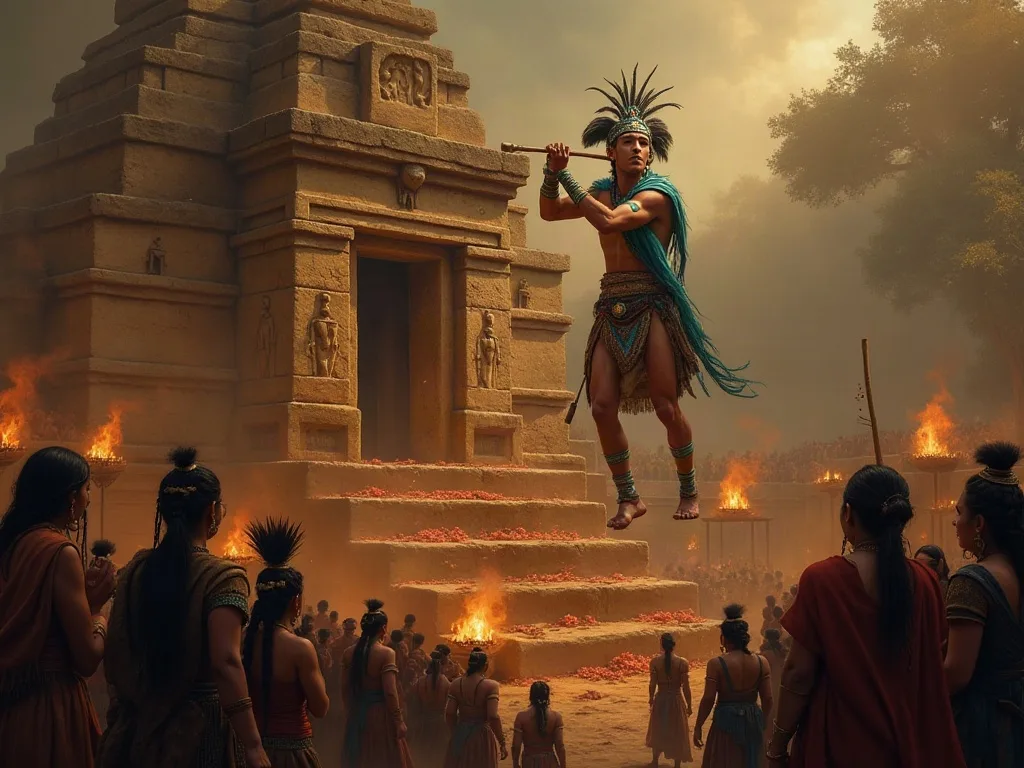
A year before the festival, priests selected a young captive warrior, physically perfect, without blemish or scar. For twelve months, this young man lived as Tezcatlipoca incarnate. He was dressed in the god's regalia: the obsidian mirror, the turquoise ornaments, the heron feather headdress. He walked freely through Tenochtitlan, playing a flute as he went, and the people he passed were required to bow to him. He was given four beautiful wives, named after goddesses, and for the final month he feasted and danced.
Then, on the day of Toxcatl, he walked up the steps of a small temple outside the city. He broke his flutes, one by one, on the steps as he climbed. At the top, the priests received him, and he died. His heart was offered to the sun.
Sahagún's Aztec informants told him that this ritual reminded everyone that life's abundance was temporary and that Tezcatlipoca owned the most beautiful things only so that he could take them away. The young man's fate was not presented as cruelty but as the nature of things: greatness ends, the god reclaims what was always his.
Tezcatlipoca's Roles Across the Mesoamerican World
The Aztec religious tradition did not develop in isolation. Tezcatlipoca appears in the Mixtec screenfold manuscripts, notably the Codex Borgia, under related iconographic guises. Scholars including Karl Taube have argued that elements of his mythology appear as far back as the Teotihuacan mural tradition (roughly 100-650 CE), where a great jaguar deity presided over darkness and military power.
Among the Maya, a figure sometimes identified as a distant cognate of Tezcatlipoca appears in the Dresden Codex and in the Popol Vuh, the K'iche' Maya creation text written down in the sixteenth century. The Popol Vuh's Lords of Xibalba, the Maya underworld, share Tezcatlipoca's habit of setting elaborate, fatal traps for human heroes. One lord specifically associated with night and black sorcery, Ah Puch (or Kisin in Yucatec Maya sources), echoes his function without being identical to him.
In the broader Aztec pantheon, Tezcatlipoca absorbed or merged with several older deities. Chalchiuhtotolin ("Jade Turkey") was one of his aspects, a god of plague and moral testing who was sent to afflict the righteous as a trial. Itztli ("Obsidian Knife") was another, connected to the sacrificial blade. These multiplied identities meant that Tezcatlipoca was not one thing but a cluster of dark powers that Aztec theology organized under a single, recognizable face.
His relationship with Huitzilopochtli, the Aztec solar war god, was complex. Huitzilopochtli needed the sun to move; Tezcatlipoca controlled the night through which the sun traveled invisibly between sunset and dawn. They were not enemies in the sources. They were consecutive, the way day and night are consecutive.
Tezcatlipoca After the Conquest: Survival and Transformation
The Spanish friars who arrived with Cortés spent decades interviewing Aztec priests and elders, trying to understand the religion they intended to dismantle. Their documents, especially Sahagún's Florentine Codex (compiled between 1545 and 1590) and Diego Durán's History of the Indies of New Spain (written in the 1570s-80s), are now among the most important sources for Aztec religion. Both authors were shocked by Tezcatlipoca and compared him directly to the Christian devil, which shaped European understanding of Aztec religion for centuries.
That comparison distorted as much as it revealed. The Christian devil is a rebel against God, permanently outside creation. Tezcatlipoca was inside creation. He co-made the world. He ran the present age alongside his rivals. He was consulted, propitiated, and genuinely feared, but never simply condemned. The moral logic of Aztec religion did not ask whether a god was "good" or "evil." It asked what the god required and how to survive his attention.
After the conquest, Tezcatlipoca's imagery went underground but did not disappear. Syncretized with Catholic figures, sometimes equated with Satan, sometimes quietly embedded in regional festivals and folk magic traditions, his presence persisted in central Mexican religious life in forms that scholars like Alfredo López Austin (in his 1988 The Human Body and Ideology) have traced through colonial-era documents into the ethnographic present. Some Nahua-speaking communities in the highlands of Puebla and Guerrero still tell stories about a dark sorcerer-figure who walks the roads at night, wearing a mirror, looking for people whose fates he has not yet decided.
Frequently Asked Questions About Tezcatlipoca the Smoking Mirror
Frequently asked questions
What does 'Tezcatlipoca' actually mean in Nahuatl?
The name breaks into three Nahuatl roots: tezcatl (mirror), poctli (smoke), and the nominal suffix -a. The full meaning is "Smoking Mirror" or "Mirror That Smokes." The specific mirror was made of polished black obsidian, a volcanic glass native to central Mexico, and in Aztec ritual it functioned as a scrying device through which the god could observe the moral state of every living person.
Why did Tezcatlipoca lose his foot?
Several Aztec sources, including the Leyenda de los Soles and passages in the Florentine Codex, explain that when Tezcatlipoca and Quetzalcoatl hauled the sea monster Cipactli out of the primordial ocean to form the earth, Cipactli bit off Tezcatlipoca's right foot before being subdued. He replaced the missing foot with his obsidian mirror, which became his most iconic attribute. The wound marked him permanently as a god who had literally given part of himself to create the world.
How was Tezcatlipoca different from Quetzalcoatl?
The two gods were cosmic rivals but not simple opposites. Quetzalcoatl governed wind, the morning star, priestly learning, and civilization; Tezcatlipoca governed night, sorcery, fate, and military power. Their myths often pit them against each other, most dramatically in the fall of Tula, but Aztec cosmology also required both of them to create and maintain the world. Without Tezcatlipoca's destructive force, creation could not renew itself. Scholars like David Carrasco and Cecelia Klein have described their relationship as a generative antagonism rather than a moral opposition between good and evil.
What primary sources describe Tezcatlipoca in detail?
The most detailed accounts appear in Bernardino de Sahagún's Florentine Codex (compiled 1545-1590), particularly Book 1 on the gods and Book 2 on the festivals. Diego Durán's History of the Indies of New Spain (1570s-1580s) adds narrative detail, especially regarding the Toxcatl festival. The Leyenda de los Soles and the Anales de Cuauhtitlan (both Nahuatl texts preserved in colonial manuscripts) describe his role in the creation cycles. The pre-Columbian Codex Borgia provides his visual iconography without text.
Did Aztec people actually fear Tezcatlipoca, or was he also worshipped positively?
Both. The Aztec relationship with Tezcatlipoca was closer to awe than to the simple fear a dangerous animal inspires. He was propitiated because he was powerful and his attention was dangerous, but his festivals involved music, dance, and the elevation of a chosen young man to divine status for an entire year. Priests addressed him with elaborate hymns recorded in Sahagún's sources that combined reverence, sorrow, and a kind of desperate intimacy. He was feared precisely because he was real and present in ways that more distant gods were not.
Is Tezcatlipoca connected to the jaguar?
Yes, directly. The jaguar was his primary animal form, and the first Sun he ruled is called Nahui Ocelotl (Four Jaguar) because it ended in a flood of jaguars. Warriors in the Aztec military who achieved high rank through capturing enemies could join the Jaguar warriors, an elite order associated with Tezcatlipoca's power. His night-black skin, his stealth, and his unpredictability all mapped onto the jaguar's qualities in Mesoamerican symbolic thought.
The Mirror That Still Smokes: Tezcatlipoca in the Modern Imagination
The obsidian mirror Tezcatlipoca carried is no longer only a mythological object. A polished obsidian disc now held in the British Museum in London was brought to Europe from Mexico in the sixteenth century and identified in an early English inventory as "the mirror of John Dee," the Elizabethan mathematician and royal advisor who used it for his own scrying practices. Whether Dee knew its origin is uncertain, but the fact that one of the most powerful sorcerer-symbols in Aztec religion ended up in the hands of England's most famous occultist is the kind of historical accident that reads like a myth in itself.
Tezcatlipoca the Smoking Mirror has attracted sustained attention from modern writers, artists, and scholars. His role in Aztec religion has been analyzed by historians of religion including Inga Clendinnen (in her 1991 Aztecs: An Interpretation) and David Carrasco, both of whom push back against the colonial-era reduction of Aztec sacrifice to simple barbarism. They argue that Tezcatlipoca's ritual system encoded a genuine theological logic: the world is unstable, the gods are not benevolent parents but dynamic forces, and human action (including costly action) is required to keep existence going.
In contemporary Nahua communities in central Mexico, echoes of his presence survive in the nahualismo tradition, the belief in human specialists who can transform into animal forms, particularly jaguars or coyotes, to harm or protect at a distance. The lineage from Tezcatlipoca's shape-shifting nature to these living practices is not direct or unbroken, but it is real, stretched and changed by five hundred years of colonial pressure, Catholic overlay, and indigenous resistance.
His mirror, it turns out, is still held up. The image it shows keeps changing, but the smoke never quite clears.
Read the full book
Want the whole story?
The complete edition is an instant PDF download here, with a paperback on Amazon for selected titles.
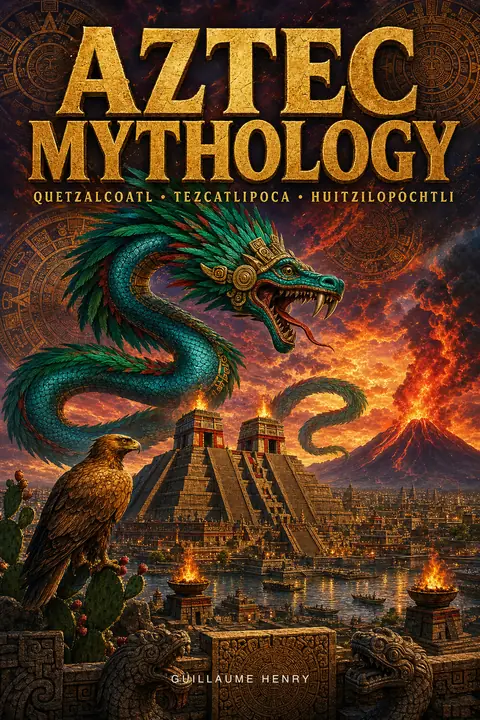
Aztec
The Aztec Mythology Book: Quetzalcoatl, Huitzilopochtli, Tezcatlipoca, and the Five Suns of the Mexica
Blood, Feathered Serpents, and the Cosmic Engine of Tenochtitlan
The gods, heroes, and sacred calendar of the Mexica civilization. From the feathered serpent Quetzalcoatl to the five world ages, the complete mythology of Tenochtitlan.
More from Aztec
All articles
Aztec
Tenochtitlan: The Sacred Aztec Capital
Tenochtitlan rose from an island in Lake Texcoco as the Mexica people's promised homeland, guided by their god Huitzilopochtli. Discover how this sacred city became the center of the Aztec Empire and why its temples, waterways, and ceremonial heart shaped an entire civilization.
Aztec
The Legend of the Fifth Sun: Why the Aztecs Believed Humanity Required Divine Blood
The Aztecs lived under a cosmological clock. They believed the world had been created and destroyed four times before. The fifth world, their world, could only survive if the gods received constant nourishment: human blood. Discover how mythology, astronomy, and ritual wove together in one of history's most misunderstood civilizations.

Aztec
Coatlicue: Mother of Gods and the Aztec Pantheon
Coatlicue, the serpent-skirted mother, bore the sun god and ruled over fertility, childbirth, and death in Aztec belief. Discover how the Aztecs honoured her as the generative force behind their entire pantheon and cosmos.

Aztec
Tlaloc: God of Rain and Fertility in Aztec Mythology
Tlaloc brought water to the Aztec world, but his gifts came with terror. Discover how the rain god shaped Mesoamerican religion, from mountain shrines to the sacred cenotes where thousands sought his blessing.