
The Odyssey Journey Home: Myth, Meaning, and the Long Road Back
Ten years of war. Ten more years of sea, monsters, and gods. Homer's Odyssey is the oldest and greatest story about the impossibility of going home unchanged.
Contents
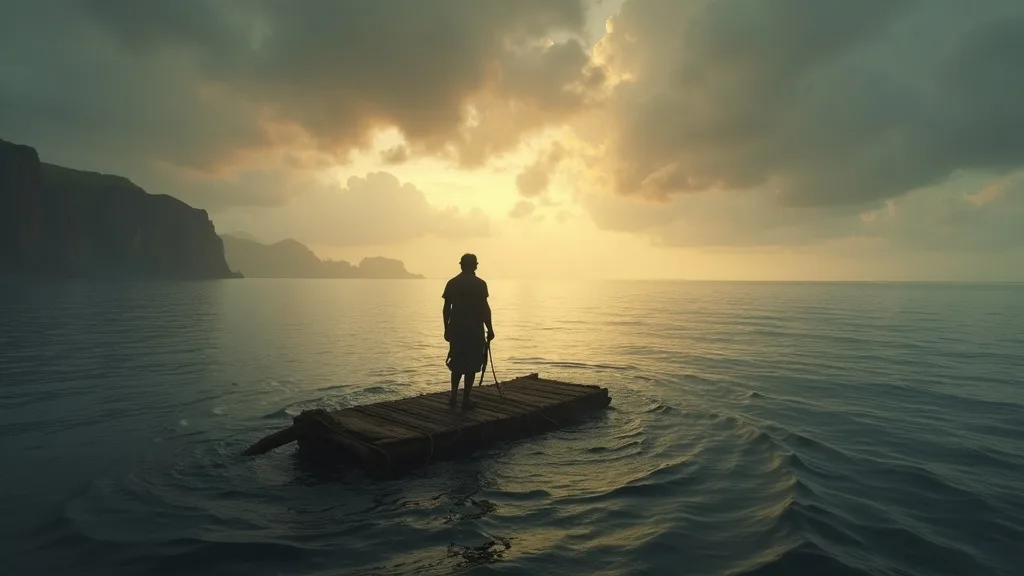
The ship is gone. The men are gone. Odysseus, king of Ithaca, sits on the edge of a rocky island and stares at the sea that will not let him leave. He has been here for seven years. Behind him, the nymph Calypso offers immortality. Ahead, somewhere past the horizon, is a wife who may have forgotten him, a son who never knew him, and a house full of strangers eating his food.
He chooses the sea.
That choice, repeated across ten years of storms and monsters and divine fury, is the entire soul of Homer's Odyssey, a poem composed sometime in the 8th century BC and still the most vivid travel story ever written. It is not simply a tale of adventure. It is a study of identity under pressure: who you are when everything that defined you, your army, your ships, your crew, has been stripped away. The Odyssey journey home is the longest, hardest, most human journey in ancient literature, and understanding it fully means following every current that carries the story forward.
Why Odysseus Was at Sea in the First Place
The backstory begins not with Odysseus but with a golden apple.
At the wedding of the sea-nymph Thetis, the goddess of discord, Eris, threw a fruit inscribed "for the fairest" into the crowd of gods. Three goddesses, Hera, Athena, and Aphrodite, each claimed it. The Trojan prince Paris was chosen to judge. Aphrodite offered him the most beautiful mortal woman alive. He chose her. The woman was Helen, already married to the Spartan king Menelaus.
Paris sailed to Sparta. He left with Helen. Menelaus called in every favor the Greek world owed him, and a thousand ships launched toward Troy.
Odysseus wanted no part of it. According to the Iliad and later mythographers, he feigned madness when the recruiting party arrived, plowing his fields with salt. When they placed his infant son Telemachus in the path of the plow, he swerved. The madness was exposed. He joined the war.
Ten years later, Troy was ash.
The fall of Troy was Odysseus's work. Not his sword, though he carried one well enough. His mētis, the Greek word for cunning intelligence, that quality the gods themselves respected. He conceived the wooden horse, a hollow gift left at the city gates while the Greek fleet pretended to sail home. The Trojans dragged it inside. That night, the soldiers inside opened Troy from within.
Victory, then, should have meant homecoming. For Odysseus it meant the beginning of a punishment that would last as long as the war itself.
The Wrath of Poseidon and the Shape of the Journey
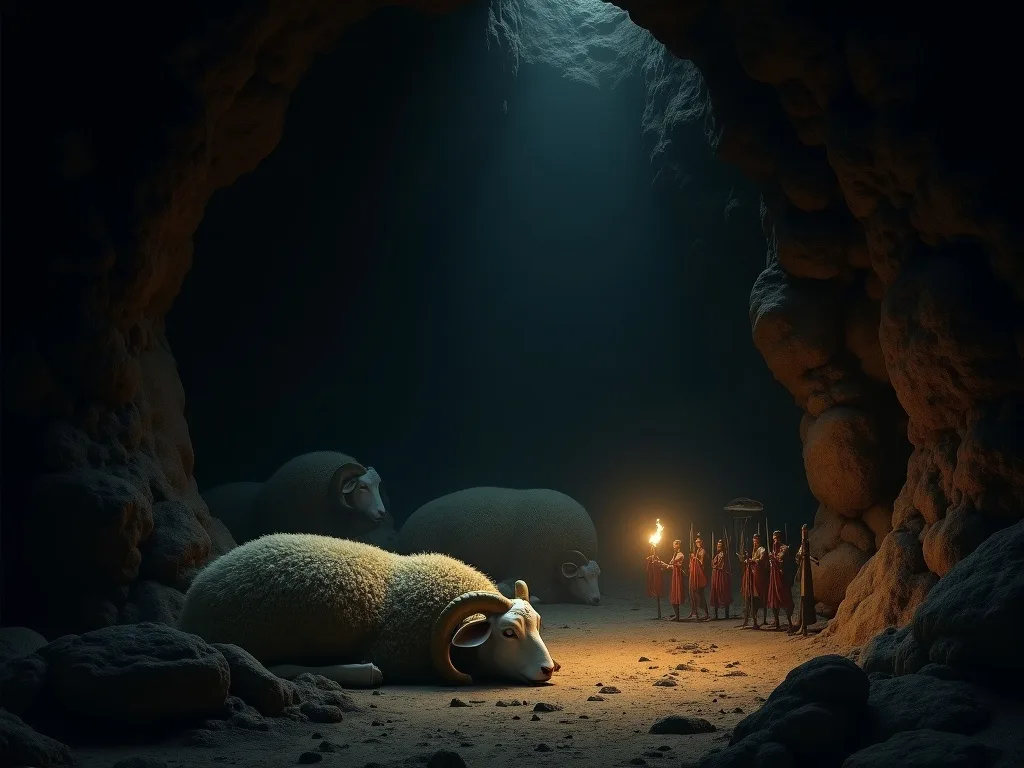
Poseidon hated Odysseus for one act committed before the poem even opens: the blinding of Polyphemus, the Cyclops who was also Poseidon's son.
Homer structures the Odyssey so that this backstory arrives in the middle of the poem, not at the start. The poem opens ten years after Troy, with Odysseus trapped on Calypso's island. His crew is dead. His home is under siege from over a hundred suitors who have moved into his palace and are competing to marry his wife Penelope, assuming the king will never return.
The structure is deliberate. Homer begins with the consequences, then works backward to the causes. This technique, which classical scholars call in medias res (Latin for "into the middle of things"), plunges the reader into crisis before explaining how the crisis began.
The broad shape of Odysseus's route, pieced together from the poem's own account:
- Troy (coast of modern Turkey) - the starting point
- Ismarus - raid on the Cicones, first disaster
- The land of the Lotus-Eaters - memory-erasing plants
- The island of the Cyclops - blinding of Polyphemus, triggering Poseidon's curse
- Aeolia - the island of Aeolus, keeper of the winds, who gives Odysseus a bag containing all contrary winds
- Laestrygonia - city of giant cannibals who destroy all but one ship
- Aeaea - the island of the witch-goddess Circe, who turns his men to pigs
- The Underworld - Odysseus descends alive to consult the dead
- Back to Aeaea, then past the Sirens, through Scylla and Charybdis
- Thrinacia - the island of the sun god Helios, where the crew makes a fatal mistake
- Ogygia - Calypso's island, seven years of captivity
- Scheria - the Phaeacians, who finally carry him home
- Ithaca
Each stop is not just geography. Each one tests a different aspect of what makes Odysseus who he is.
The Cyclops Episode: Where the Trouble Begins
The cave is dark. The sheep smell of wool and dung. Twelve men have followed Odysseus inside, curious about who lives here. What lives here is something outside the gods' normal order: Polyphemus, a Cyclops, one of the old pre-Olympian giants who herds sheep alone on his island and answers to no authority but his father Poseidon.
When Polyphemus rolls a stone across the cave mouth and begins eating the men two at a time, Odysseus resists the obvious solution. He cannot kill the Cyclops while asleep because no one but the Cyclops can move the stone. So he waits, sharpens a stake, gets the giant drunk on wine, and drives the stake into his single eye.
Then comes the moment that defines the whole story. As the blinded Polyphemus screams and his fellow Cyclopes ask who hurt him, Odysseus has already given a false name: Outis, meaning "Nobody." The neighbors hear "Nobody hurt me" and go back to sleep.
But as the Greeks escape clinging to the undersides of the sheep, Odysseus cannot help himself. He calls back his real name across the water. He needs Polyphemus to know who outsmarted him. Polyphemus prays to Poseidon with that name, and Poseidon hears.
That vanity, that need to be recognized, is the trait that drives the whole journey. It is also the trait that makes Odysseus fully human rather than heroic in the simple, Achilles-like way. He is brilliant. He is also reckless with his brilliance.
Circe, Calypso, and the Problem of Staying
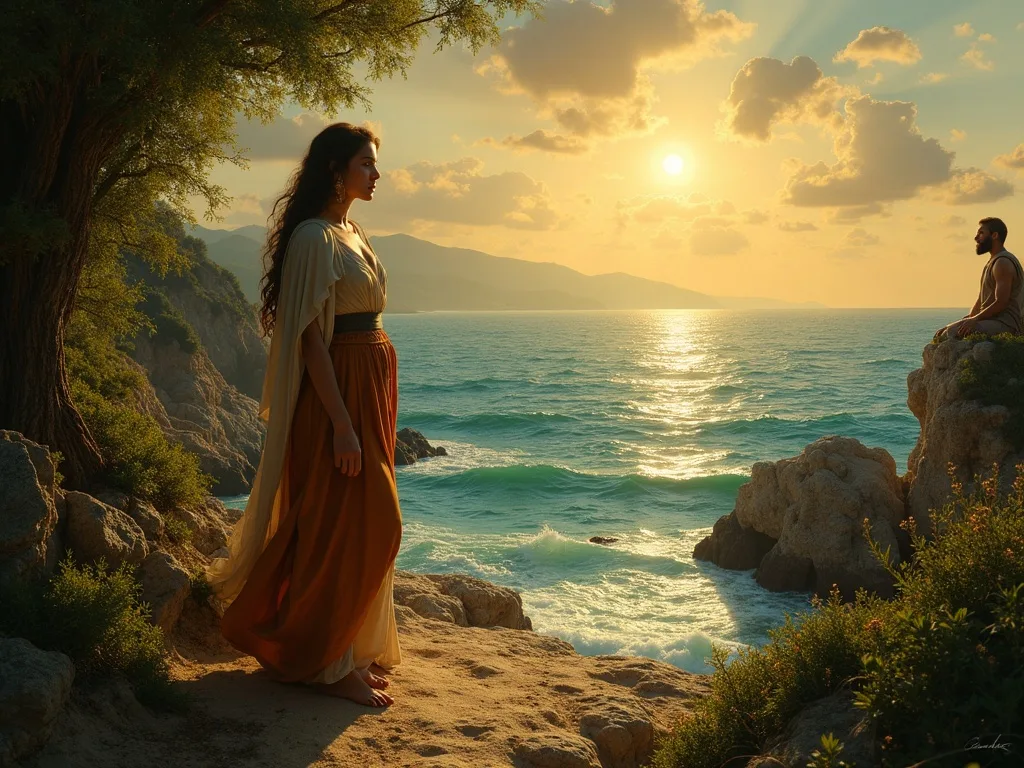
Two women in the Odyssey offer Odysseus exactly what a simpler hero might want: comfort, pleasure, and the end of the journey. Both are rejected. The rejection is the point.
Circe, the goddess-witch of the island Aeaea, turns his crew into pigs with a tap of her wand. Odysseus, protected by a herb called mōly that the god Hermes provides, resists her magic and forces her to restore the men. He then stays on her island for a year, possibly longer depending on which ancient commentary you follow. She becomes his lover. She gives him crucial navigation advice, including the instruction to descend to the Underworld.
Calypso on her island Ogygia is more complex. She loves Odysseus, genuinely and without manipulation, and she offers him immortality. Seven years he spends there. When Homer shows him at the poem's opening, he is weeping on the shore every day, longing for home, while accepting her hospitality at night. It is an uncomfortable picture: a man who stays, who is fed and loved, who cannot stop wanting something else.
What he wants is Ithaca. Not the island specifically; the word nóstos in Greek (the root of "nostalgia") means return home combined with the honor that comes with that return. He needs to be recognized as himself, in his own place, by the people who define him.
Neither Circe nor Calypso can give him that. Immortality without nóstos is just a very long exile.
The goddess Athena eventually persuades Zeus to order Calypso to let him go. She does, with tears. Odysseus builds a raft with his own hands and sails east.
The Descent into the Underworld
Of all the episodes in the Odyssey, the visit to the land of the dead, called the Nekyia in Greek, carries the most symbolic weight. Odysseus is, as far as ancient Greek tradition goes, the living hero who goes farthest into forbidden territory and returns.
Following Circe's instructions, he sails north to the edge of the known world, digs a pit, pours offerings of honey, milk, wine, and blood, and waits. The dead come.
He speaks with Tiresias, the blind prophet, who tells him the shape of his future: Poseidon's anger, the fate of his crew, and the troubles waiting at home. He speaks with his mother Anticleia, who died of grief while waiting for him. She tells him Penelope still waits, still weeps, still holds the suitors off. He tries three times to embrace her. She dissolves like smoke each time. The dead cannot be held.
He sees the great sinners of the mythological past: Tantalus straining forever for water and fruit that recede as he reaches; Sisyphus rolling his stone. He sees Achilles, his companion from Troy, who tells him that being the greatest shade in Hades is worse than being the lowest living slave on earth. The whole Homeric worldview is in that line: life, even a hard one, is worth more than any afterlife.
He flees before he can see the full weight of the dead press toward him.
Scylla, Charybdis, and the Cattle of the Sun
The narrowest passage in the Odyssey is the strait between Scylla and Charybdis. Scylla is a six-headed monster embedded in a cliff, fast enough to pluck six sailors at once from a passing deck. Charybdis is a whirlpool, a mouth that opens three times a day to swallow the sea and everything in it.
Circe told Odysseus to hug Scylla's cliff and accept the loss of six men rather than risk the entire ship in Charybdis. He does. He watches his men taken, screaming his name. He does not say he warned them. Homer doesn't let him speak at all.
Worse follows immediately. At Thrinacia, the island of the sun god Helios, the crew is stranded by contrary winds for a month. Odysseus makes them swear not to touch the sacred cattle of Helios. While he sleeps, hunger wins. The men slaughter several cattle.
Helios demands justice. Zeus sends a lightning bolt that cracks the ship in two. Every man dies. Odysseus alone survives, clinging to the mast.
This is the poem's structural crux. The crew's death is not random. It was prophesied by Tiresias in the Underworld, predicted by Circe, preceded by a sworn oath. They chose to eat. The gods chose to punish. Odysseus chose to sleep rather than keep watch. The Odyssey distributes its moral weight carefully: there is rarely one guilty party.
Penelope: The Other Hero
While Odysseus fights monsters and gods, Penelope wages a war of her own in Ithaca.
Over a hundred suitors, sons of the most powerful families in the islands, have occupied the palace for years. They eat the household's resources, pressure Telemachus, and compete to marry the queen. They assume Odysseus is dead. Penelope knows, or suspects, otherwise.
Her famous stratagem is the loom. She announces she will choose a husband when she finishes weaving a burial shroud for old Laertes, Odysseus's father. Every night she unravels what she wove during the day. Three years pass before a servant betrays her.
Some classical scholars, including the late American classicist W.B. Stanford in his study of the Odyssey published in 1954, have argued that Penelope is the poem's second protagonist, running a parallel intelligence operation in Ithaca while Odysseus runs one across the Mediterranean. Both use disguise. Both use delay. Both wait for the right moment.
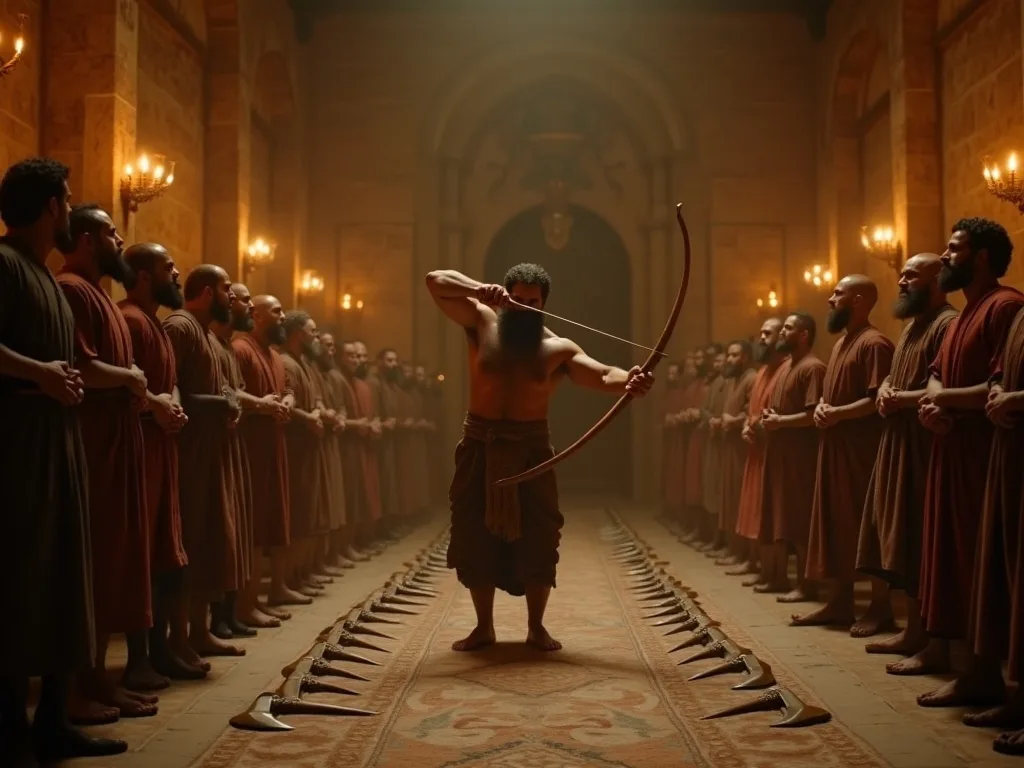
Her final test for the suitors, the contest of the bow, is almost certainly designed to fail them. She knows, because Homer's Odysseus told her when he left for Troy, that only Odysseus can string the great bow and shoot an arrow through twelve axes set in a row. No suitor succeeds. The ragged beggar who has just arrived, is allowed to try.
The Return: Disguise, Recognition, and Blood
Odysseus lands on Ithaca as a beggar. Athena has altered his appearance: aged, weathered, unrecognizable. His first encounter is with his old swineherd Eumaeus, a slave who turns out to be the most loyal man in Ithaca. He weeps for his absent master without knowing he is talking to him.
The recognition scenes that follow are among the most carefully paced sequences in all of ancient literature. Homer reveals Odysseus's identity to different characters at different moments, each recognition scored differently.
His son Telemachus, who has just returned from a journey to find news of his father, is the first to know. The reunion is raw. Telemachus has grown up in a house under siege, with no father to model himself on. He barely believes his eyes.
The old nurse Eurycleia recognizes Odysseus by a scar on his thigh, a wound from a childhood boar hunt on Mount Parnassus. Homer pauses the narrative completely here to tell the full story of that scar, going back thirty years. It is a remarkable structural move: the recognition of a body by the evidence of its history.
Argos, the dog Odysseus raised before leaving for Troy, recognizes him by scent alone. The dog is ancient now, neglected on a dung heap. He lifts his head, wags once, and dies. He held on long enough.
Penelope does not recognize him. Or does not say she does. Even after the bow contest, even after Odysseus has killed every suitor in a long, bloody hall filled with arrows and sword work, she tests him one more time. She instructs a servant to move the marriage bed outside the room. Odysseus erupts: the bed cannot be moved. He built it himself around a living olive tree rooted in the earth. Only Penelope knew that. Only her husband could know that.
The test is passed. The marriage is real. The journey is complete.
What Homer's Sources Were Working With
Homer did not invent Odysseus from nothing. Archaeological evidence from Mycenaean palace sites at Pylos and Tiryns, roughly 1200 BC, shows that the palace culture Homer describes, the great halls, the tribute systems, the heroic names, has a real, if distant, historical foundation.
The poet drew on a body of oral tradition called the Epic Cycle, a set of poems now mostly lost that covered the entire Trojan War from beginning to aftermath. Two fragments survive: the Nostoi (homecomings of the Greek heroes) and the Telegony (which continues Odysseus's story after the Odyssey ends). The mythographer Proclus, writing in the 5th century AD, summarized these lost poems, giving scholars a rough sense of what Homer selected and what he transformed.
The Odyssey also draws on a rich tradition of folklore older than any Greek text: the motif of the returning hero disguised at home appears in stories from Ireland to India. The scholar Walter Burkert, in his 1992 work The Orientalizing Revolution, traced several specific story patterns in the Odyssey to Near Eastern analogues, including episodes in the Epic of Gilgamesh where the hero is similarly offered immortality by a divine figure and refuses it, choosing mortal life and the chance of homecoming.
The Cyclops episode has particularly strong parallels in folklore documented by the scholar Albert Wesselski and later systematized in the Aarne-Thompson-Uther index (tale type ATU 1137), appearing across dozens of European and Middle Eastern oral traditions. Homer, or the tradition behind Homer, absorbed this motif and made it structurally central.
The God Behind the Journey: Athena's Role
No reading of the Odyssey is complete without understanding Athena's function in the poem.
She is Odysseus's divine patron. She argues for him before Zeus. She guides Telemachus on his own voyage to find news of his father. She disguises Odysseus on Ithaca. She holds back the dawn to give the reunited couple more time. At the poem's end, she stops the blood feud that the suitors' families are about to launch by coming down in the flesh and ordering everyone to stop.
Why Athena? Because she is the goddess of mētis, that cunning intelligence that Odysseus embodies. They are, as Homer makes explicit in Book 13 when Athena finally reveals herself to the returned hero, alike in kind. "Both of us know how to plot," she tells him. "You are by far the best of men in counsel and in speech; I among all the gods am famed for my craft and shrewdness."
This is an unusual relationship in ancient Greek religion. The god and the hero share a quality rather than a hierarchy. Athena does not protect Odysseus because he is pious or powerful. She protects him because he thinks the way she thinks.
Athena remains one of the most complex divine figures in the Greek pantheon, and her bond with Odysseus is one of the few places in Homer where a mortal and a god seem to operate as genuine equals in intelligence, if not in power.
Echoes Across Mythologies: The Universal Journey Home
The Odyssey does not exist in isolation. The same story pattern, a hero trying to return to his rightful place after a long ordeal, runs through mythologies worldwide.
In the Sanskrit epic the Mahabharata, the Pandava brothers spend twelve years in forest exile and one year in disguise before reclaiming their kingdom. The disguise year, called the Ajnatavasa, is structurally identical to Odysseus's disguised return: concealed identity, a palace under threat, a final test of recognition. The Pandavas even use the return to settle a score of cosmic proportions, as Odysseus does.
In Norse tradition, Odin wanders the world in disguise, a wanderer in a grey cloak and wide-brimmed hat, testing mortals who do not know they are being observed. The returning god in disguise and the returned king in disguise share a deep structural logic: the powerful must sometimes become invisible to see the truth of their world.
The Egyptian myth of Osiris tells a different version of the same anxiety: the legitimate ruler removed from his kingdom, scattered, reassembled, and restored. The kingdom without its true king is always a disordered place, full of usurpers. The return restores cosmic order.
What the Odyssey adds to this universal pattern is interiority. Homer's hero thinks out loud. He weighs options, talks to himself, feels shame and longing in the same breath. That psychological texture is what makes the Odyssey's homecoming story feel modern long after the palace culture that produced it has vanished.
The Odyssey's Long Life After Homer
The poem did not end at Ithaca. Ancient readers wanted more. The lost Telegony extended the story: Odysseus, after restoring peace in Ithaca, eventually sailed again, died accidentally at the hands of Telegonus (his son by Circe, who came to find his father), and was carried to Aeaea where Circe made all involved immortal. It is a deliberately unhappy epilogue, suggesting that Odysseus's restlessness was a kind of fate, not a phase.
Medieval Europe knew Odysseus mostly through Latin sources, chiefly Virgil's Aeneid, which portrays him (as Ulixes) as a schemer, almost a villain. Dante places Ulysses in Hell in Inferno Canto 26, not for his cunning but for his insatiable curiosity: he sailed past the Pillars of Hercules into the forbidden ocean and drowned.
The 20th century returned to Homer with new intensity. James Joyce's Ulysses (1922) maps one day in Dublin onto the entire Odyssey, chapter by chapter. Nikos Kazantzakis wrote a 33,333-line sequel poem called The Odyssey: A Modern Sequel (1938) in which Odysseus cannot rest in Ithaca and sets off again immediately. Madeline Miller's Circe (2018) retells the poem from the witch-goddess's point of view, centering the character Homer treats as a waystation.
In every century, artists return to this story because the story will not stay fixed. Each generation finds a different terror in the impossibility of going home, and a different kind of courage in the trying.
Frequently Asked Questions About the Odyssey Journey Home
Frequently asked questions
How long does Odysseus's journey home actually take in the Odyssey?
The total time from the fall of Troy to Odysseus's return to Ithaca is ten years. The Odyssey itself covers only the final forty or so days of active travel, framed by the seven years he spent as Calypso's reluctant guest on Ogygia. The ten-year span mirrors the ten years of the Trojan War, giving the poem a symmetrical shape that ancient audiences would have recognized immediately.
Is the route of Odysseus's voyage a real geographical path?
Ancient and modern scholars have debated this intensely. Strabo, the Greek geographer writing around 20 BC, argued that Homer intended real places. The ancient historian Thucydides believed the Cyclops island was Sicily. Modern classical geographers have proposed various identifications: the island of the Sirens as the Capri area, Charybdis as the Strait of Messina. The current scholarly consensus, represented by scholars like Stephanie West in A Commentary on Homer's Odyssey (1988), is that Homer's geography is primarily literary and mythic rather than navigational, drawing on sailors' tales without mapping to any single real route.
Why does Poseidon hate Odysseus so much?
The blinding of Polyphemus is the direct cause. Polyphemus is Poseidon's son, and Greek divine law treats harm to a god's offspring as harm to the god. But Homer frames it more specifically: Odysseus's fatal error was shouting his real name as he escaped. If he had stayed silent, Polyphemus could not have prayed to Poseidon with a name attached to the curse. The punishment is partly the natural consequence of Odysseus's own pride, a structural irony Homer uses carefully throughout the poem.
Does Penelope know Odysseus is back before the bow contest?
Homer leaves this deliberately ambiguous, and classicists have argued over it since antiquity. In Book 19, Penelope speaks at length with the disguised beggar (Odysseus) and describes a dream that clearly predicts the suitors' slaughter. She then immediately announces the bow contest. The ancient scholar Aristarchus argued she consciously recognized him; Eustathius, writing in the 12th century AD, agreed. Modern scholars like Pietro Pucci and Gregory Nagy have suggested Homer designed her recognition to be suspended, so readers can hold both readings at once.
What happens after the Odyssey ends?
Ancient tradition extended the story through the Telegony, a lost poem from the 6th century BC summarized by Proclus. In it, Odysseus eventually leaves Ithaca again, visits the island of the Thesprotians, and is killed accidentally by Telegonus, his son by Circe, who had come searching for his father. Circe then grants all parties immortality. Odysseus's death by a spear tipped with a stingray spine also appears in some traditions, fulfilling Tiresias's prophecy in the Odyssey that death would come "from the sea."
How does the Odyssey compare to other ancient homecoming myths?
The nóstos (homecoming) was a recognized genre in ancient Greek poetry. The Nostoi, a lost poem from the Epic Cycle, told the homecomings of other Greek heroes from Troy: Agamemnon was murdered on arrival, Menelaus was blown to Egypt, Ajax drowned by Poseidon. Compared to these, Odysseus's return is the most prolonged and the most triumphant, but also the most earned through repeated choice rather than luck. The contrast is intentional: Homer sets his hero against a gallery of failed homecomings to show what survives when someone is genuinely determined to get back.
What Odysseus Leaves Behind: The Open Question of Rest
Tiresias's prophecy in the Underworld does not end with Ithaca.
After the homecoming and the killing of the suitors, the blind prophet says, Odysseus must take an oar on his shoulder and walk inland, away from the sea, until he reaches a people who have never heard of salt, who will mistake the oar for a winnowing fan. There he must plant the oar in the ground and sacrifice to Poseidon. Only then will the sea god relent. Only then can Odysseus die peacefully, far from the water, in a prosperous old age.
It is one of the strangest codas in all ancient literature. The homecoming is not the end. There is one more journey, away from the sea that defined him, into a landlocked world where no one knows what he has done or who he is. He must become, at last, truly unknown.
Scholars have read this many ways. The classicist Charles Segal, in his 1994 study Singers, Heroes, and Gods in the Odyssey, saw it as an integration ritual: Odysseus must carry the instrument of his suffering (the sea, the oar) into a world without memory of it, and leave it there. The wandering king must become the planted king, rooted like the olive tree in the marriage bed.
Others read it as Homer's honest admission that some people cannot stop. The oar planted in foreign soil is not reconciliation with Poseidon alone. It is also the last restless act of a man who has traveled so long that stillness is a frontier too.
That ambiguity is why the Odyssey journey home remains alive. It is not a story about arriving. It is a story about what the act of returning costs, and whether anyone who has traveled that far can ever be truly, finally still.
The Trojan War that set everything in motion remains the defining catastrophe of Greek mythological imagination, and Odysseus stands at its intersection with the long, painful afterward. Hermes, who guided the hero past Circe's magic, and Zeus, whose will Athena repeatedly invoked to bring Odysseus home, form the divine architecture through which one mortal's stubbornness became the most enduring sea story ever told.
Free 25-page sample
Want the whole story?
Take the first 25 pages free. If it pulls you in, the full edition is yours as an instant PDF download, with a paperback on Amazon for selected titles.

Mythology
The World Mythology Book: The Gods, Heroes and Myths of Every Culture
The Gods, Heroes and Myths of Every Culture, in One Volume
The whole of world mythology in a single volume: Greek, Norse, Egyptian, Japanese, Hindu, Celtic, Slavic, Mesoamerican and African myths gathered side by side, each drawn from the primary sources.