
Ratatoskr the Gossiping Squirrel: Norse Mythology's Trickster of the World Tree
Ratatoskr scurries up and down Yggdrasil, carrying insults between the eagle at its crown and the serpent at its roots. Discover how this small creature embodies chaos, communication, and the tension that holds the Norse cosmos together.
Contents
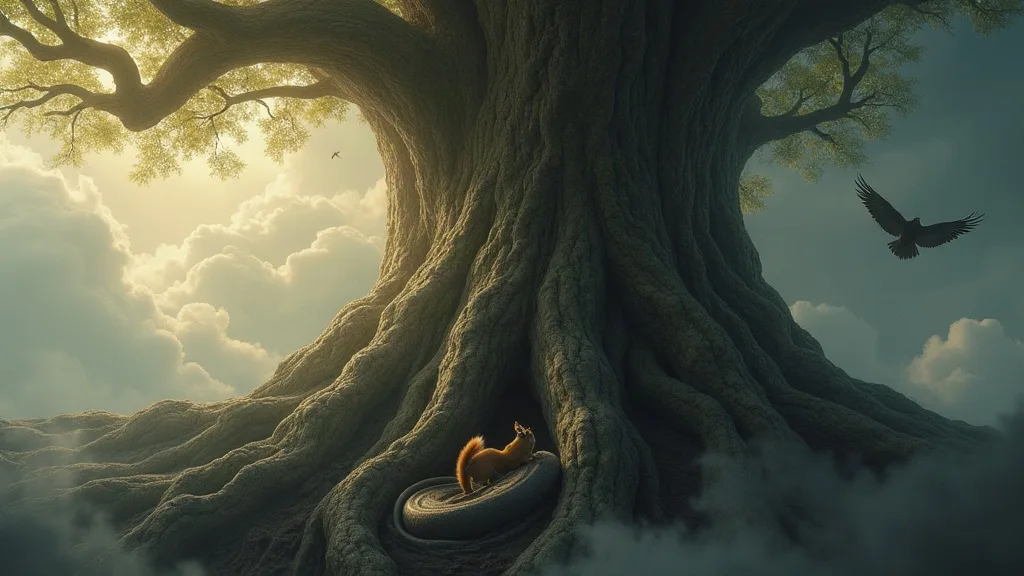
A tiny creature races up the bark of an enormous tree. Its claws scratch and scramble. Its teeth chatter. It carries no weapon, no magic, no divine power. Yet this small squirrel inflames the greatest beings in the Norse cosmos with anger. It tells the eagle what the serpent has said. It whispers the eagle's words to the serpent below. By the time the gods gather in Asgard, the whole cosmos simmers with resentment. This is Ratatoskr the gossiping squirrel, one of Norse mythology's most peculiar and potent creatures.
In the Norse imagination, chaos does not always arrive as a giant or a demon. Sometimes it comes as gossip. Sometimes it wears whiskers and a fluffy tail. Ratatoskr proves that small words can crack mountains, that a messenger can matter more than a king, and that in a universe held together by fragile truces, one creature's love of mischief can destabilize everything.
The Anatomy of the World Tree and Ratatoskr's Place Within It
To understand Ratatoskr, you must first stand beneath Yggdrasil, the World Tree of Norse cosmology. Yggdrasil is not a metaphor; it is the physical axis around which all nine realms spin. Its roots drink from different wells. Its branches hold the homes of the gods, the giants, humans, the dead, the frost-folk, and the fire-demons. The tree is vast beyond measure, older than memory.
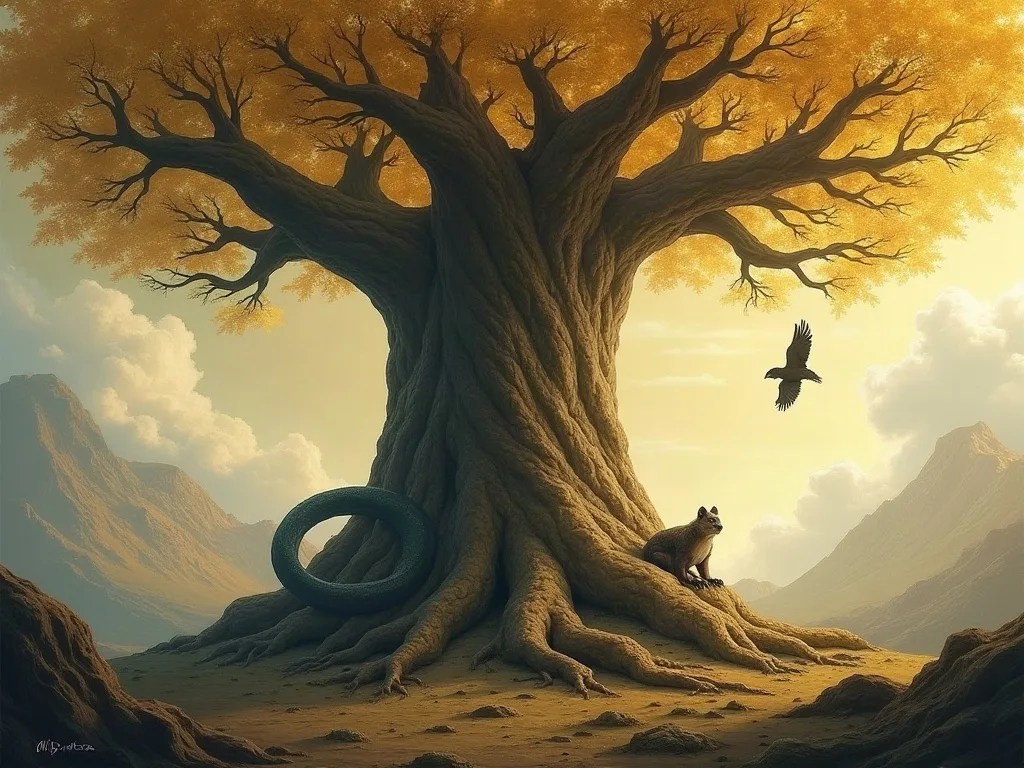
At Yggdrasil's crown perches a golden eagle, sharp-eyed and imperious, surveying all the worlds from its height. At the very base, coiled around the deepest root, lurks Nidhogg, a serpent of immense malice whose name means "curse-striker". Nidhogg gnaws at the roots of the tree, trying to topple it. Between them, running up and down the trunk with relentless energy, is Ratatoskr.
Ratatoskr is the tree's news-carrier, its messenger, its connector. But connection, in the Norse cosmos, is not always a blessing. The eagle and the serpent are natural enemies. They belong to different realms. They embody different principles: the eagle is sky, vision, and rule from above; Nidhogg is earth, corruption, and the hunger that devours from below. Neither speaks the other's language. Enter Ratatoskr, small enough to slip between them, bold enough to carry words that ought never to pass between them.
The Prose Edda, a 13th-century Icelandic text written by Snorri Sturluson, describes Yggdrasil in the poem called the Gylfaginning (Deceiving of Gylfi). In it, Snorri includes a brief but vivid mention of the squirrel: "A squirrel called Ratatoskr runs up and down the length of Yggdrasil; it carries malicious messages between the eagle and Nidhogg." That single sentence contains the entire mythology of this creature. Ratatoskr is defined not by strength or magic, but by its role as a bearer of ill-will.
What Ratatoskr Says: The Insults That Nearly Break the World
The Prose Edda does not tell us the exact words Ratatoskr carries. That silence is powerful. It allows us to infer that the squirrel's messages are personal, cutting, and designed to wound. In some retellings, preserved in folklore and later literary traditions, the squirrel reports that the eagle has insulted the serpent's intelligence or power. It whispers to Nidhogg that the eagle considers itself superior, that it looks down on everything below as beneath contempt.
Then Ratatoskr turns and races upward, claws scratching the bark in a blur. To the eagle, it carries Nidhogg's words: that the serpent finds the eagle's rule unjust, that from below, decay eats at the tree's foundations even as the eagle rests in comfort. That the eagle does nothing to stop the rot.
These are not factual reports. Ratatoskr is not a neutral messenger. It is a messenger with a poison tongue, one who knows that if it delivers only praise or neutral news, the job will end. Instead, it amplifies each party's deepest fears about the other. It reframes observation as insult. It turns distance into resentment.
What makes Ratatoskr's role so insidious is that its words are not lies. The eagle does hold dominion over the worlds below. Nidhogg does gnaw at the tree's roots. The squirrel simply frames these truths as insults, adding spin, context, and venom. This is the most effective kind of slander: it begins with fact and ends with hatred.
The Symbolism of the Gossiping Squirrel: Chaos Through Words
Ratatoskr the gossiping squirrel represents a principle the Norse understood deeply: that speech itself can be a weapon. The Old Norse language had a word, níð, which meant slander or reproach. Ratatoskr does not sling this níð at random; it does so with precision, targeting the one relationship that must remain balanced for the cosmos to hold together.
In many ancient cultures, trickster figures serve as boundary-crossers and chaos-bringers. Loki, the giant-born god of mischief, famously destabilizes the Aesir (the leading Norse gods). But Loki is divine; he walks among the gods, eats at their tables, knows their secrets directly. Ratatoskr does something equally subversive from a lower position: it does not have access to secrets, so it invents insinuation. It does not challenge the gods directly; it poisons the well of trust between cosmic powers that must coexist.
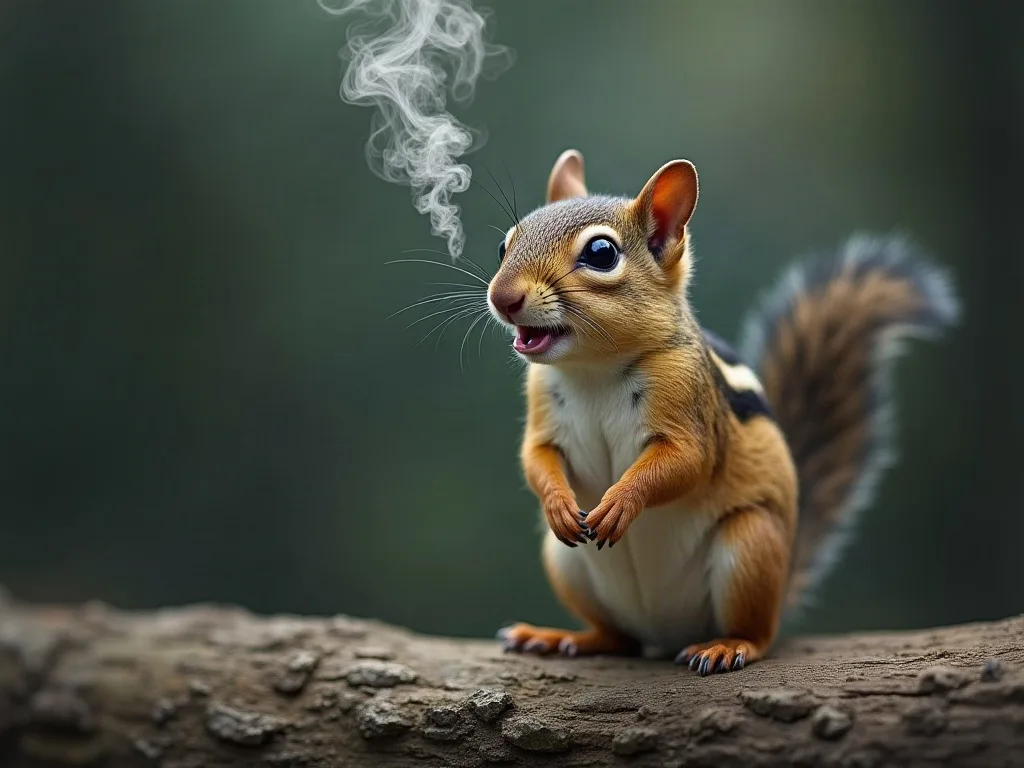
The squirrel's size is part of its power. Because Ratatoskr is small, it seems inconsequential. No one worries about the squirrel's plot. No one takes precautions against its voice. A giant might be watched, contained, bound with chains. A squirrel runs freely up and down the cosmic scaffold, its words trailing behind it like smoke.
The Norse were also acutely aware that the cosmos itself was unstable. Ragnarok, the twilight of the gods, is not a distant threat but an inevitable doom written into the fabric of existence. When Ragnarok arrives, Yggdrasil will shake. Nidhogg will break free and fly upward. The rainbow bridge will shatter. The stars will vanish from the sky. In this context, Ratatoskr's gossip is not a small annoyance; it is a symptom of the fundamental instability that will one day crack everything wide open.
Ratatoskr's Name and Etymology
The name Ratatoskr appears only in the Prose Edda; the older Poetic Edda, a collection of anonymous Old Norse poems probably composed between the 8th and 13th centuries, does not mention the squirrel by name. Scholars debate the etymology. The most common interpretation breaks the name into two parts: rata, meaning "to scratch" or "gnaw", and toskr, which may derive from "tusk" or relate to the Old Norse word for teeth or tusk-like projections.
Some scholars propose that toskr connects to the Proto-Indo-European root for "to gnaw" or "to bite". If so, Ratatoskr quite literally means "the one who scratches and gnaws" or "the scratcher-gnawer". This etymology fits perfectly with the creature's role: it gnaws at the peace of the cosmos, scratches away at trust, eats through the fabric of civility with relentless energy.
Other proposals link toskr to Old Norse words for "tooth" or "to thrust", making the name something like "scratcher-thruster". What all interpretations share is a sense of aggressive small-scale erosion: the gnawing, scratching, biting action of something tiny but persistent.
The Squirrel's Cosmic Role: A Necessary Evil?
One of the most intriguing questions is whether Ratatoskr the gossiping squirrel is truly evil or whether it fills a necessary function in the Norse cosmos. The tree must be climbed; messages must pass between the realms. The worlds cannot remain wholly isolated. Ratatoskr ensures that the eagle and the serpent are aware of each other, even if that awareness takes the form of mutual contempt.
Some scholars suggest that Ratatoskr represents the principle of entropy itself: the slow, inevitable process by which order breaks down. In a universe that must eventually fall to chaos, the squirrel's gossip is not an aberration; it is a law of nature. The squirrel does not cause Ragnarok, but it prefigures it. Every insult it carries is one small crack in the cosmic order, a foretaste of the shattering to come.
Other readers of the texts see Ratatoskr less as malicious and more as amoral. The squirrel is not trying to destroy the world. It is simply doing what squirrels do: carrying things, running, communicating in its own small way. The fact that it carries insults rather than compliments may say more about the nature of the message-bearing universe than about Ratatoskr's intent. After all, gossip is social currency. News is power. The squirrel understands this instinctively.
Historical Sources and Textual Evidence
Our knowledge of Ratatoskr comes from a narrow window of sources. The Poetic Edda, preserved in the Codex Regius manuscript (written around 1270), contains the old mythological poems but does not mention Ratatoskr by name. It does describe the World Tree and its inhabitants, including Nidhogg and the eagle, but leaves the squirrel unnamed.
The Prose Edda, compiled by Snorri Sturluson around 1220, provides the only named mention in medieval sources. Snorri's brief line is the locus classicus (the foundational text) for all later discussion of the creature. He presents Ratatoskr matter-of-factly, as if the squirrel's role in cosmic affairs were common knowledge. This suggests that oral tradition likely contained more elaborate versions of the squirrel's deeds, but those tales were not committed to the surviving manuscripts.
Icelandic sagas, which preserve much Norse lore, do not focus on Ratatoskr. The sagas concern themselves with human heroes and their deeds, not with the mythological creatures that inhabit the cosmos. This is a limitation of our sources: we know Ratatoskr through a single sentence in a 13th-century prose compilation, and we have pieced together much of its significance through inference and comparison with what we know of Norse cosmology more broadly.
Modern scholars, including the Germanicist Rudolf Simek and the historian of Norse religion Georges Dumézil, have discussed Ratatoskr in the context of World Tree mythology and Indo-European parallels. Simek notes that the squirrel's role as a connector between upper and lower realms echoes shamanic traditions, in which a small creature or spirit travels between the worlds. Dumézil traces the triadic structure of Norse cosmology and suggests that Ratatoskr represents the principle of discord that prevents any two of the three cosmic zones from achieving lasting harmony.
Ratatoskr in Comparative Mythology
The figure of a small creature that carries messages or trouble between cosmic powers is not unique to Norse mythology. In Hindu mythology, Hanuman, the monkey god of the Ramayana epic, serves as a messenger and trickster figure who moves between realms and stirs up chaos even as he carries out divine will. Like Ratatoskr, Hanuman is small in stature but enormous in significance.
In Mesoamerican mythology, Quetzalcoatl, the feathered serpent, functions as a boundary-crosser between the sky and the earth. And in some versions of the myth, a small bird or creature carries news between the separated halves of the cosmos, much as Ratatoskr does.
These parallels suggest that the archetype of the small messenger, the trickster that connects and divides, arises independently in cultures separated by geography and time. The Norse version is distinctive in its emphasis on malice; Ratatoskr is not a helpful messenger but a deliberate sower of discord.
The Squirrel in Modern Reception and Culture
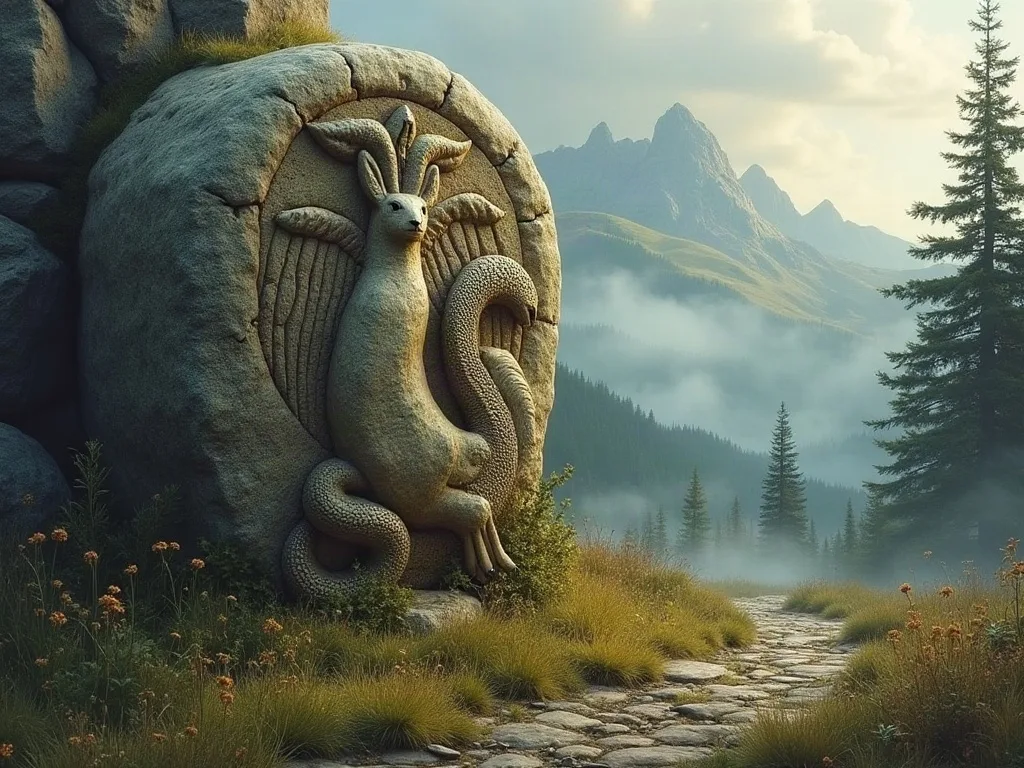
Since the rediscovery of Norse mythology in the 19th century, Ratatoskr has enjoyed a small but loyal following in literature, gaming, and visual art. The creature appears in Neil Gaiman's Norse Mythology (2017) as a gossipy, clever squirrel whose role in the world's unraveling is played for both humor and cosmic significance. Video games, particularly the God of War franchise, have featured Ratatoskr as an obstacle and a comic character, emphasizing its ability to move quickly and its penchant for stirring up trouble.
In contemporary fantasy, Ratatoskr has become a symbol of how small actions can have outsized consequences, and how information and communication can be weapons as potent as any blade. The squirrel appeals to modern sensibilities partly because it operates through subterfuge and words rather than through brute force. In an age of social media and viral information, the image of Ratatoskr the gossiping squirrel running between heights and depths, spreading news and discord, has gained new resonance.
The creature has also entered popular culture as a mascot of sorts in some gaming communities and fantasy forums, though these modern references often strip away the Norse cosmological context and reduce Ratatoskr to a generic trickster or chaos agent. The most respectful modern treatments preserve the squirrel's specificity: its role on Yggdrasil, its relationship to the eagle and the serpent, and its function as a harbinger of the cosmos's inevitable decay.
Why the Squirrel Matters: Ratatoskr and the Fragility of Order
Ratatoskr the gossiping squirrel endures as a figure in Norse mythology because it answers a fundamental question: what holds the cosmos together? The answer in Norse cosmology is not divine benevolence or cosmic justice. It is balance. Precarious, temporary balance. The eagle and the serpent are enemies, but they coexist. The gods are powerful, but they know they will fall. Yggdrasil is ancient and vast, but it is gnawed upon from below and will someday collapse.
Into this world of balanced tensions runs Ratatoskr, scratching and gnawing, carrying words that drive a wedge between powers that must remain in equilibrium. The squirrel does not start Ragnarok; the end of the world is already written. But the squirrel prefigures it, whispers it into being in incremental stages, through the erosion of trust and the spreading of discord.
This is a myth that speaks directly to anyone who has watched a small rumor escalate into a rift, or seen a community torn apart by words carried between factions. The Norse understood that cosmic order, like any social order, is vulnerable to the whisper, the half-truth, and the maliciously framed fact. They gave this understanding the form of a squirrel, small and swift, running up and down the spine of existence, scratching and gnawing and speaking its poison.
Frequently asked questions about Ratatoskr the gossiping squirrel
Frequently asked questions
Why does Ratatoskr carry insults instead of helpful messages?
Ratatoskr is not a neutral messenger; it is an instrument of chaos. The Prose Edda describes it as carrying "malicious messages," not news or useful information. The squirrel is drawn to discord the way water flows downhill. It feeds on conflict and spreads it wherever it goes. Some scholars argue this reflects the Norse understanding that speech is inherently divisive; words create meaning by drawing distinctions and creating hierarchies, and Ratatoskr simply makes this principle explicit by amplifying resentment.
Does Ratatoskr ever speak to the gods directly, or only to the eagle and Nidhogg?
The surviving texts mention Ratatoskr only in relation to the eagle and the serpent. There is no record of the squirrel carrying messages to or from the Aesir themselves. This suggests that Ratatoskr operates outside the main divine power structure, running on the World Tree as a semi-autonomous agent of disruption. Its role is to destabilize the cosmic order indirectly, through its effect on the eagle and Nidhogg, not through direct confrontation with the gods.
Does Ratatoskr survive Ragnarok and the end of the world?
The Prose Edda does not address what happens to Ratatoskr during Ragnarok. When the World Tree shakes and the cosmos dissolves, presumably the squirrel either falls with Yggdrasil or vanishes into whatever comes after. Since Ratatoskr exists as a function of the World Tree's stability, its existence likely depends on the tree's existence. When the tree falls, the squirrel's role ends.
Is Ratatoskr related to Loki or other trickster figures in Norse mythology?
Ratatoskr and Loki are both agents of chaos, but they operate differently. Loki is a god (or half-giant) who walks among the Aesir, eats at their tables, and eventually leads the forces of destruction during Ragnarok. Ratatoskr is a creature, small and external, whose chaos operates through gossip and communication rather than through direct action. Both embody the principle that the Norse cosmos is unstable and will eventually collapse, but they are distinct figures with different powers and spheres of influence.
What does the name Ratatoskr mean, and can we learn anything from its etymology?
The name breaks down as rata (to scratch or gnaw) and toskr (possibly from a root meaning tooth or tusk). Ratatoskr literally means something like "the scratcher-gnawer" or "the tooth-thrusting scratcher." This etymology reflects the creature's function: it gnaws at peace, scratches at trust, and bites into the fabric of cosmic order through relentless small actions. The name encodes the squirrel's nature in a single word.
Why did the Norse create a myth about a gossiping squirrel rather than a more fearsome chaos creature?
The choice reflects deep Norse insight into how order actually breaks down. A giant or demon can be fought, bound, or watched. But gossip is everywhere. Words move fast. A squirrel is small, innocent-seeming, and no one fears its tooth or claw. By embodying chaos in a creature so ordinary and swift, the Norse myth suggests that destruction does not always announce itself with thunder. Sometimes it arrives on tiny feet, carrying whispers.
Ratatoskr Beyond the Norse: Why This Squirrel Matters Today
Ratatoskr the gossiping squirrel has survived over a thousand years of cultural upheaval because it names something true about how the world works. Information is power. Communication can wound as deeply as any weapon. And small, persistent actions can destabilize even the largest structures.
The squirrel does not swing a sword or cast spells. It simply runs between heights and depths, carrying words. In a world of social media, viral rumors, and the constant flow of information between distant corners of the globe, Ratatoskr's ancient role feels strangely contemporary. The myth suggests that the Norse understood something we are only beginning to relearn: that the greatest threats to order are often invisible, swift, and dressed in small forms.
Free 25-page sample
Want the whole story?
Take the first 25 pages free. If it pulls you in, the full edition is yours as an instant PDF download, with a paperback on Amazon for selected titles.

Mythology
The World Mythology Book: The Gods, Heroes and Myths of Every Culture
The Gods, Heroes and Myths of Every Culture, in One Volume
The whole of world mythology in a single volume: Greek, Norse, Egyptian, Japanese, Hindu, Celtic, Slavic, Mesoamerican and African myths gathered side by side, each drawn from the primary sources.