
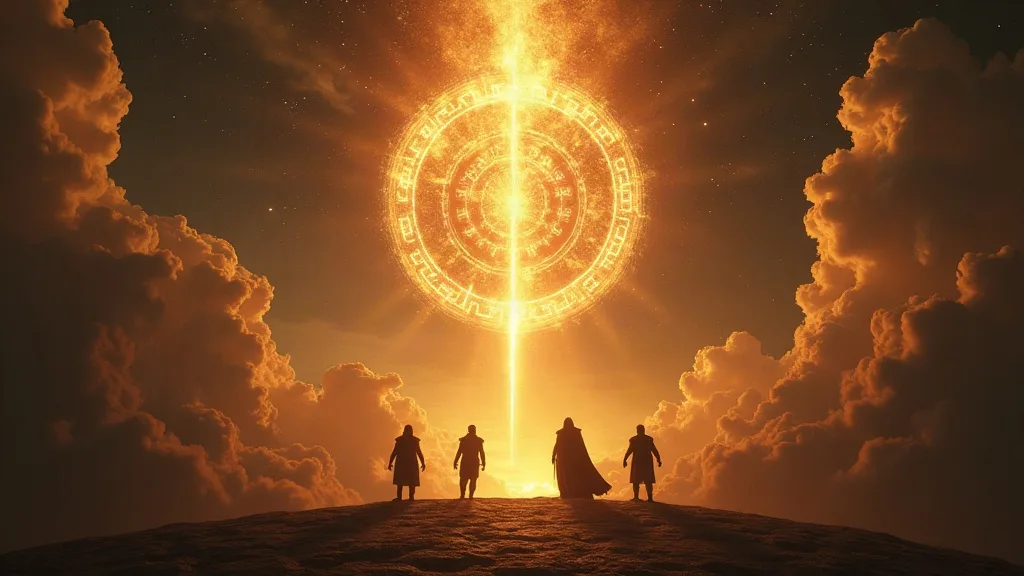
Record of Ragnarok Gods Explained: From Myth to Manga Combat
Record of Ragnarok reimagines pantheons across cultures as apocalyptic warriors. Discover which mythological gods fight for humanity's survival and how the manga transforms ancient traditions into high-octane narrative.
Contents
Thirteen gods step into an arena built at the edge of existence. Humanity stands accused. One last chance remains: thirteen champions will fight, one against one, and if humanity wins seven matches, the gods spare the human race from destruction. This is the premise of Record of Ragnarok, a manga series that began serialization in 2017 and has since captured audiences worldwide with its collision of mythologies, brutal fight choreography, and a question that cuts across every culture: what makes a god, and what makes us human?
The series draws fighters from every major world mythology. Norse gods like Odin and Thor stand alongside Greek legends like Poseidon and Zeus, Hindu titans like Shiva, and figures from traditions beyond the mainstream English-language canon. The manga's genius lies not in invention but in fusion: it respects the core mythology while asking what these immortal beings would be if they had to earn their divinity through combat against mortal heroes.
The Divine Fighters: Norse Gods Leading Heaven's Charge
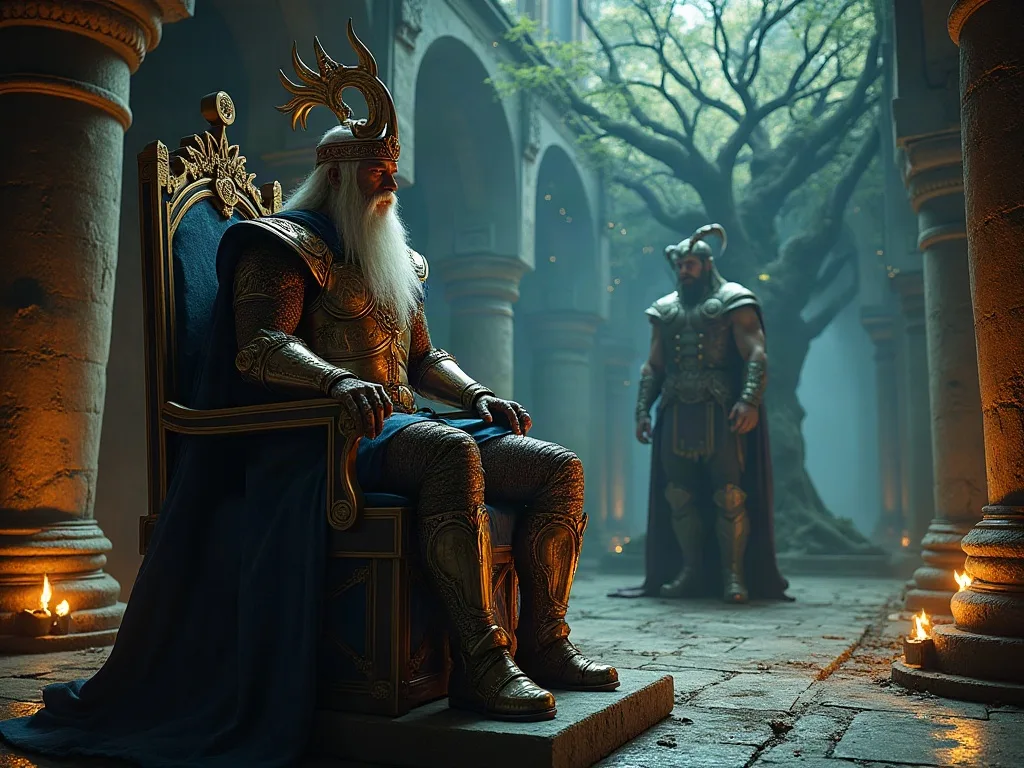
Odin, the All-Father, leads the gods' roster in Record of Ragnarok. In Norse mythology preserved in the Prose Edda and Poetic Edda, Odin is the god of war, wisdom, death, and poetry; he sacrificed his eye for knowledge and hung himself on Yggdrasil to master the runes. The manga shows him as ancient, deceptive, and utterly ruthless, wielding seiðr (Norse shamanic magic) and a spear that channels divine power. His fight against the human champion Nikola Tesla becomes a clash between mystical warfare and the raw creativity of a mind that rewired the world. Odin's portrayal respects the original mythology while adding a cruel pragmatism: he cheats, he schemes, he does whatever it takes to ensure the gods win.
Thor, Odin's son and the storm god, appears as raw physical dominance. In the Eddas, Mjolnir, the hammer forged by dwarves, is Thor's defining weapon; he spends his days fighting jotnar (giants) and serpents in defense of Asgard. Record of Ragnarok amplifies this. Thor is muscle, thunder, and the will to destroy. His opponent, Lu Bu, the legendary Chinese general known as the mightiest warrior in history, becomes a study in the limits of brute strength meeting something even more elemental. Thor's fight is visceral and immediate, stripped of subtlety. The god of lightning has no guile, only power. This mirrors the Eddic Thor: direct, strong, and ultimately tragic (destined to die fighting Jormungandr at Ragnarok in the original myths).
Loki, the trickster, never fights directly in the early arcs, but his influence spreads like a slow poison through the entire tournament. In Norse mythology, Loki is a shapeshifter and boundary-crosser, equally at home among the Aesir and their enemies. He engineers the death of Baldr, the most beloved of the gods, and ultimately breaks free from his chains beneath the earth to lead the giants against Asgard at Ragnarok itself. He is, in the most literal sense, the god whose choices end the world.
Record of Ragnarok preserves this role as agent of chaos, then deepens it. Loki mocks the proceedings from the sidelines, doubts the gods' certainty, and gradually reveals something the other gods refuse to admit: that humanity's stubborn refusal to die is, quietly, magnificent. Where Thor fights humans to crush them and Odin fights to prove his dominance, Loki watches them and begins to understand them. His relationship with humanity becomes the series' most quietly radical thread, suggesting that not all gods truly want the human race erased, and that the trickster who once broke the Aesir from within may be the figure most capable of saving both sides. The manga uses Loki's mythological duality (neither fully villain nor ally, neither fully god nor monster) as a narrative engine that keeps the moral stakes genuinely ambiguous long after the first blows are struck.
Greek Gods: Titanic Strength and Mortal Wounds
Zeus, king of the Olympians, is the most powerful god in the tournament. The Greek myths depict him as a wielder of thunderbolts, a shape-shifter, and a figure whose authority none of the other Olympians openly challenge. Record of Ragnarok keeps the power but strips away the seduction narrative; instead, Zeus becomes a force of absolute authority, a being so strong that watching him fight feels like watching a natural disaster choose to take humanoid shape. His fight against the human champion Adam is the series' most philosophically loaded match: the first man against the king of the gods, a contest of perfect mimicry against overwhelming force.
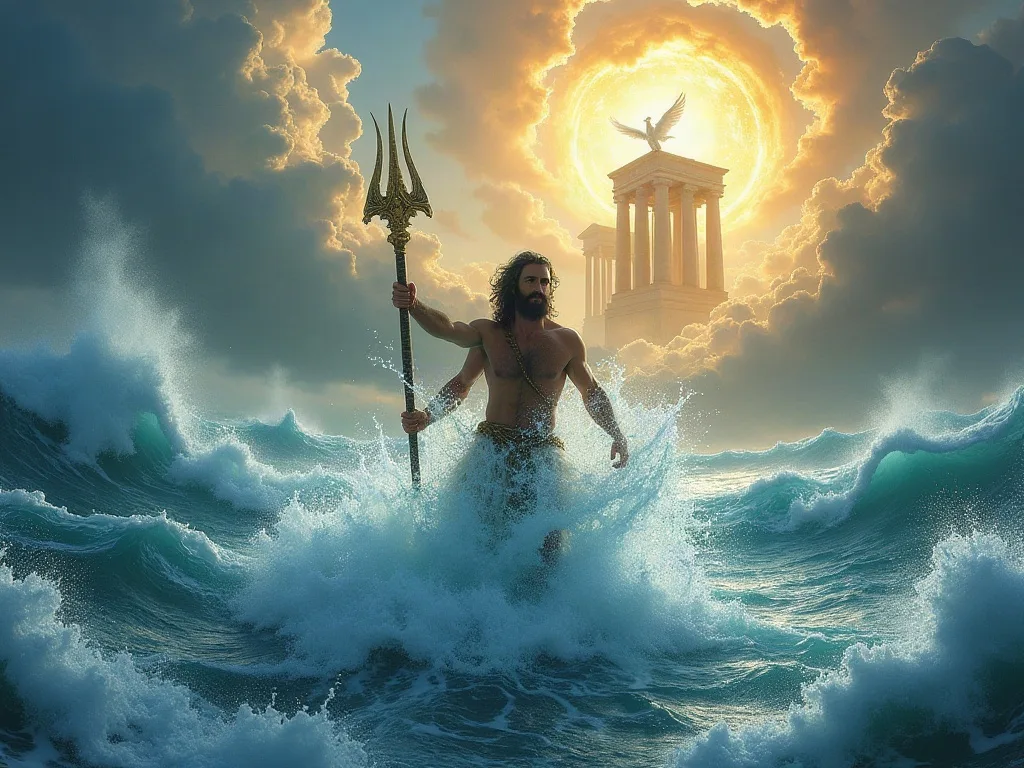
Poseidon, lord of the seas, appears as the antithesis of Zeus: prideful, distant, and bound by rigid honor codes. In Homer's Iliad and the myths, Poseidon is a secondary power, often overshadowed by his brother Zeus, though still capable of shaping the world through earthquakes, storms, and tidal waves. The manga elevates him to main-event status. Poseidon's fight against Sasaki Kojiro, a swordsman who never won a single duel in his mortal life, is the series' most psychologically intricate bout. Poseidon arrives expecting submission. Sasaki Kojiro gives him something far more dangerous: perfect composure. Armed with a technique built entirely from every defeat he ever suffered, Sasaki forces Poseidon to break his own rules, to fight at the edge of his divine form, and ultimately to confront the terrifying possibility that a man who mastered failure is more complete than a god who has never known it. His trident becomes a weapon of impossible precision, and his personality betrays a god insecure about his place in the hierarchy. This reimagining adds depth: Poseidon becomes tragic, a lesser god playing god.
Heracles (the Greek hero, not a god by birth, but deified after his impossible labors and eventual apotheosis) fights for humanity's side, not heaven's. His classical origin involves the Twelve Labors and a violent, grief-torn life that ended in divine fire on Mount Oeta. Here, he exists as a bridge between mortal and divine, embodying the series' central tension: are humans truly inferior, or does excellence transcend the immortal/mortal divide?
Hindu Deities: Cosmic Destruction and Divine Duty
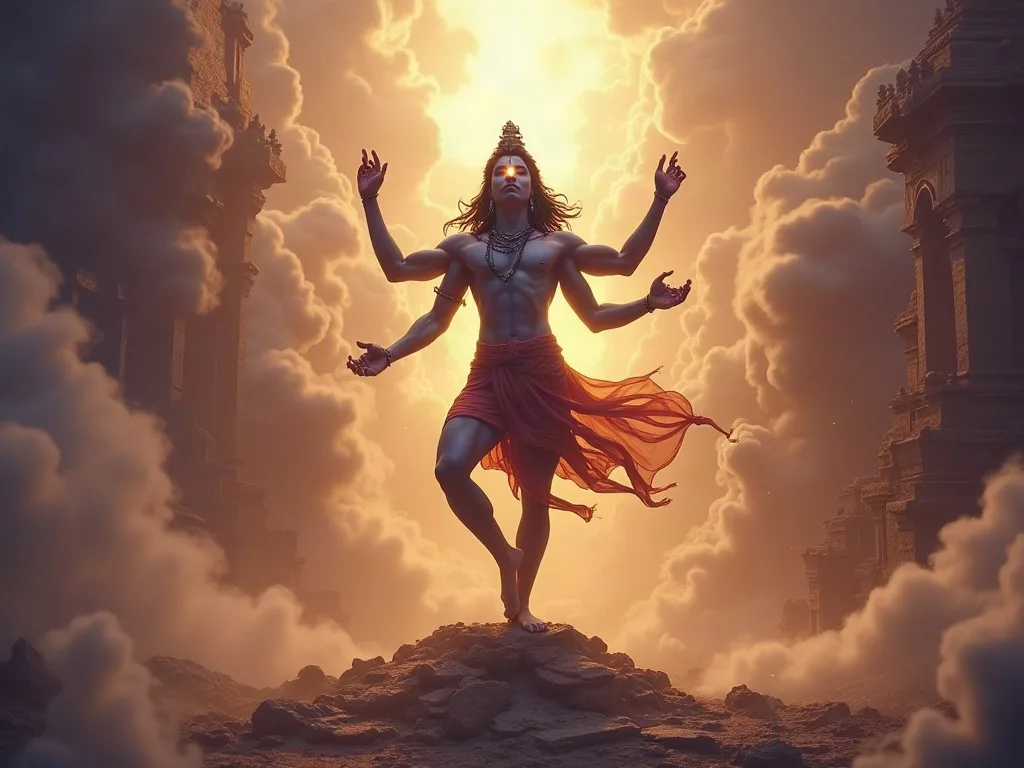
Shiva, the destroyer in the Hindu trinity, appears as a being of utterly alien power. The Rigveda, Upanishads, and later Puranas depict Shiva as the cosmic dancer whose movements create and destroy worlds, the god of meditation and ascetics, and the wielder of destructive fire. Record of Ragnarok takes this literally. Shiva's fight against Raiden Tameemon, the greatest sumo wrestler who ever lived, showcases abilities that feel almost supernatural even within the manga's universe: his movements blur causality. He does not strike so much as reshape space around his opponent. This captures the philosophical weight of Shiva in Hindu theology: a force beyond comprehension, indifferent to human concepts of fairness or mercy.
The manga's take on Shiva respects the Nataraja imagery (the cosmic dance that sustains and dissolves the universe) and the ascetic iconography of ash and meditation. However, it also strips away the meditative aspect and emphasizes pure destructive capacity. This is a stylistic choice for combat storytelling, but it risks flattening Shiva into a one-dimensional force. Readers familiar with the philosophical depth of Hindu theism, particularly the Shaiva Siddhanta tradition which reads Shiva as simultaneously destroyer and liberator, may feel the reduction keenly.
Buddhist and Other Eastern Traditions
Buddha fights not for the gods but for humanity. In Record of Ragnarok, he is a recent god, having been deified after his enlightenment, and he chooses to aid the human side. This choice is theologically loaded in ways worth unpacking clearly.
The historical Siddhartha Gautama (6th to 5th century BC) explicitly rejected the notion of eternal selves or creator deities. He was not offering a new god; he was offering a path out of suffering that required no god at all. The Dhammapada and the Pali Canon record a Buddha who refused divine status, who told his followers not to worship him but to test his teachings for themselves.
Mahayana Buddhism, which spread across East Asia and became the dominant form of the tradition in Japan (where Record of Ragnarok was created), developed a very different theological layer. In the Lotus Sutra, the Buddha is revealed as a cosmic, timeless being who has achieved enlightenment across infinite lifetimes and whose earthly appearance was itself a kind of compassionate performance for humanity's benefit. This is the theological tradition the manga draws on: the deified, celestial Buddha of Mahayana thought, not the historical teacher of the Pali texts. Within that framework, the manga's choice to have Buddha abandon the gods' side for humanity's is not absurd. It echoes the Mahayana concept of the bodhisattva, a being who delays their own final liberation to remain present for the suffering of others. Buddha in Record of Ragnarok is, in a sense, doing exactly that: choosing compassion over hierarchy. The series' inclusion of Buddha acknowledges Eastern belief systems too often overlooked in Western-centric action fiction, even if it compresses centuries of theological debate into a single arena choice.
The Unspoken Theology: Why Gods Fight Humans
At the heart of Record of Ragnarok lies a question older than any myth: what makes humanity worth saving? The manga suggests that the gods fight because they are bored, because humanity challenges their certainty, or because the original myths foresaw this moment. The Norse concept of Ragnarok (the twilight of the gods, the end of all things) becomes literal: the gods are genuinely threatened by extinction and will do anything to prevent it.
This inverts classical mythology's relationship to humans. In the Iliad and Odyssey, gods intervene in human affairs out of whim, vanity, or obligation to heroes. In the Eddas, gods and humans are often at odds, but their fates are intertwined by wyrd (fate, the woven destiny that even the Aesir cannot escape). In the Mahabharata, gods descend as avatars to restore cosmic order. Record of Ragnarok reimagines all of these as transactions: human excellence can move even the divine. A human swordsman can force Poseidon to break his own rules. A human scientist can outwit Odin. Humanity is not protected by gods; it survives gods through cleverness, strength, and will.
Design Philosophy: How the Manga Borrows and Transforms
The creative team behind Record of Ragnarok (writer Takumi Fukui and artist Ajichika) spent considerable care on mythological consultation. Gods' abilities echo their classical domains: Odin uses seiðr and wisdom, Thor wields storm and hammer, Poseidon commands water and earth-shaking, Shiva dances and destroys. Yet the manga adds a layer of science-fiction reasoning. Gods possess "divine form" abilities that are explained through mechanics (gravity, pressure, vibration) almost as if applying physics to mythology. This is not new (manga has long blended the mythic and the technological), but it is done with unusual consistency here.
The series also makes a bold choice: it treats all mythologies as equally real and equally present. Norse gods do not meet Hindu gods in some narrative friction; they simply coexist in the same arena. This is a post-modern approach to world mythology, one that Mythologis readers will recognize from comparative theology and syncretism studies. The effect is to elevate non-Western traditions to visual and narrative prominence in a way mainstream anime often fails to do.
Scholarly Debates: Accuracy vs. Storytelling
The question of mythological fidelity in Record of Ragnarok mirrors broader debates in fantasy worldbuilding. Classical mythologists and theologians might object that the manga:
- Strips gods of moral complexity (Poseidon's pride becomes his defining trait, his role as earthquake-god or protector of sailors fades)
- Reduces mythology to combat prowess (a god's value becomes measurable by physical strength, not cultural impact or theological depth)
- Erases the context that made ancient myths meaningful (Odin's sacrifices meant something in Norse cosmology; Thor's fights were battles against chaos; here, they are tournament matches)
Yet this is also the bargain of adaptation. The manga preserves enough of the original mythologies to be respectful while simplifying enough to tell a fast-paced, globally understandable story. A reader unfamiliar with Norse mythology will still learn that Odin is old, cunning, and dangerous. A reader of the Eddas will catch the echoes of the original Ragnarok in the tournament itself. The series does not pretend to be a religious text; it is entertainment that honors its sources.
Reception and Influence: How Modern Audiences Encounter Myth
Record of Ragnarok has become a gateway text for younger audiences encountering classical mythology. Social media discussions of the series often include people learning that Odin is real, that Thor and Poseidon are historical figures in human belief, that these are not Marvel inventions. This is a net positive for mythological literacy, even if the manga's versions are simplified or transformed.
The series has also influenced how other media (games, anime, webtoons) approach pantheon representation. It proved that audiences want to see gods as mortal (in the sense of fallible and defeatable), that multi-cultural mythological rosters are commercially viable, and that the tension between myth and modernity is narratively rich. This ripples into works like Genshin Impact, which also combines global mythological figures into a single world, and into webtoons like Lore Olympus, which reimagines Greek mythology through a contemporary emotional lens.
At the same time, the series' popularity has led to a subtle cultural confusion: younger fans sometimes mistake Record of Ragnarok's interpretations for the "true" myths. This is not the manga's fault (adaptations always face this), but it underscores the importance of literacy around sources. The original Eddas, the Iliad, the Upanishads, and the Mahabharata remain the primary texts; Record of Ragnarok is a conversation with them, not a replacement.
Unresolved Questions: What the Manga Leaves Open
As the series continues into its later arcs, new gods and humans enter the arena. The theological question deepens: if humanity keeps winning, does that mean the old religions were wrong? Does it mean humans and gods are not as different as we believed? The manga never fully answers this, and perhaps that is the point. Mythology has always been a way of asking unanswerable questions: Why do we suffer? What is our purpose? What do we owe each other?
Record of Ragnarok asks these through combat and narrative tension. It does not resolve them. Instead, it offers a vision where humans and gods meet as equals, not subjects and sovereigns, and where excellence transcends divinity. Whether that vision honors or betrays the original myths depends on what you bring to the reading.
Frequently asked questions about Record of Ragnarok gods
Frequently asked questions
Is Record of Ragnarok based on actual mythology?
The manga draws directly from real mythological traditions (Norse Eddas, Greek epics, Hindu Puranas, etc.), but reimagines them for the tournament premise. The characters, abilities, and basic attributes echo the originals, but the story is entirely fictional. It is adaptation and fan fiction rather than retelling.
Why does the manga use gods from so many different cultures in one story?
The series treats all mythologies as equally real within its universe. This reflects a modern, post-colonial approach: no single culture's gods are privileged. It also serves the practical narrative need of a 13-match tournament. The mixing itself is the story's boldest element.
Are the gods portrayed accurately compared to their original myths?
Partially. The manga preserves core traits (Odin's cunning, Thor's strength, Shiva's cosmic power) but simplifies motivation and removes much cultural context. A god's value in the manga is their combat prowess, whereas in the originals, their cultural and theological roles were equally important. It is a trade-off inherent to the medium.
Which mythology does Record of Ragnarok treat most respectfully?
This varies by reader background. The Norse elements feel most developed, partly because Ragnarok (the end of the gods) is the central metaphor. The Hindu representation, while visually stunning, is thinner; Shiva's philosophical and ascetic dimensions are mostly absent. The Greek gods are treated more as obstacles than complex beings. No tradition emerges unflattened.
Has Record of Ragnarok's success changed how manga and anime portray gods?
Yes. The series proved that global pantheons could coexist narratively and commercially. Many post-2020 anime and games now feature multi-cultural divine rosters, directly inspired by Record of Ragnarok's model. It has become a template for how pop culture now visualizes world mythology.
What is the significance of Loki's role in Record of Ragnarok?
Loki's refusal to fully commit to the gods' cause mirrors his role in the original Norse myths, where he is neither a villain nor a hero but a force of necessary disruption. In the manga, his growing sympathy for humanity makes him the series' most emotionally complex figure. He represents the possibility that the boundary between divine and mortal is not a hierarchy but a spectrum, and that the gods who understand humans best are the ones most likely to question whether destroying them was ever the right answer.
The Future of Myth in Pop Culture
Record of Ragnarok represents a moment in cultural history where classical mythology is no longer the exclusive domain of scholars and religious practitioners. It is raw material for storytelling, a language that resonates across cultures because it is rooted in how humans have always made sense of power, mortality, and the sacred. The manga does not settle the question of what these gods mean. It does something perhaps more important: it makes readers care enough to ask the question.
The series' greatest gift may be that it makes mythology matter to audiences who never attended a classics seminar. A reader of Record of Ragnarok might then pick up the Poetic Edda or the Bhagavad Gita or Robert Graves' retelling of Greek myth, each encounter richer for the knowledge that these stories still move us, still inspire creation, still ask us who we are when we stand against what we fear. That is not betrayal of the original myths. That is exactly how myths have always worked.
Free 25-page sample
Want the whole story?
Take the first 25 pages free. If it pulls you in, the full edition is yours as an instant PDF download, with a paperback on Amazon for selected titles.

Mythology
The World Mythology Book: The Gods, Heroes and Myths of Every Culture
The Gods, Heroes and Myths of Every Culture, in One Volume
The whole of world mythology in a single volume: Greek, Norse, Egyptian, Japanese, Hindu, Celtic, Slavic, Mesoamerican and African myths gathered side by side, each drawn from the primary sources.