
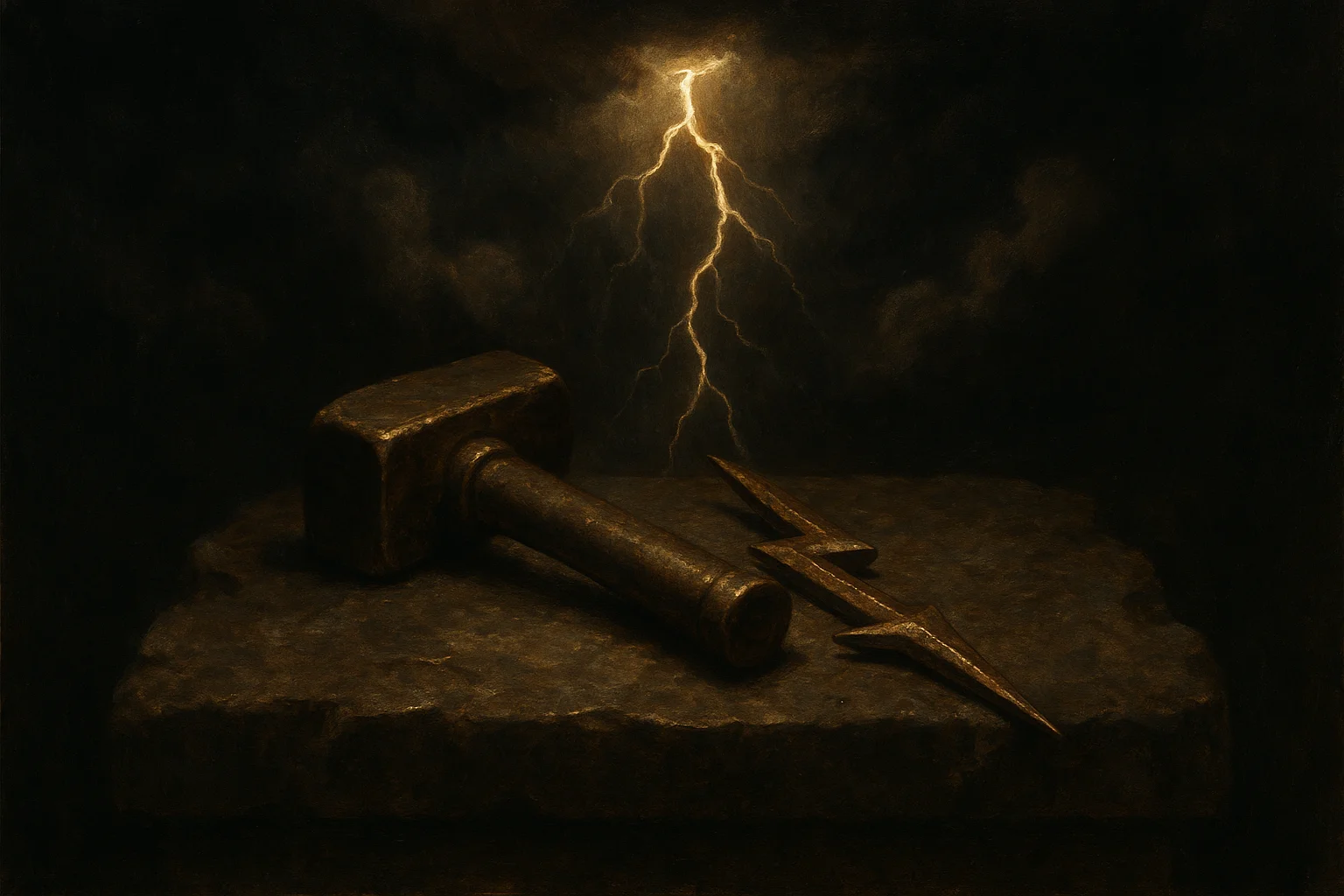
Thunder Gods Across Cultures
Thunder gods appear in nearly every pantheon. Why the pattern? From Zeus to Thor, Indra to Shango, a comparative look at storm deities and their roles.
Contents
Thunder gods appear in nearly every agricultural civilization because the sound of thunder announces rain, and rain determines survival. From Zeus in Greece to Thor in Scandinavia, Indra in India, Shango in Yorubaland, and Tlaloc in Mesoamerica, these deities embody the power that splits the sky and waters the earth. Their weapons vary, thunderbolt, hammer, vajra, double axe, but the pattern holds: the god who commands the storm commands the harvest.
Yet not all thunder gods are kings, and not all serve the same function. Some rule the cosmos. Others protect farmers or wage war on cosmic serpents. The differences tell us as much as the similarities, and the primary sources, Hesiod's Theogony, the Rigveda, Snorri's Prose Edda, the Popol Vuh, preserve those distinctions with precision.
Why thunder gods recur across unrelated cultures
The answer is agricultural. Societies that depend on seasonal rains to grow grain develop cosmologies in which the storm is divine intervention. Thunder is the audible proof that the sky has opened. Lightning marks where the god strikes. Rain follows, or it does not, and the difference is famine or plenty.
This is not metaphor. It is meteorology encoded as theology. The Rigveda calls Indra "the one who releases the waters." Hesiod's Theogony describes Zeus receiving the thunderbolt from the Cyclopes as payment for freeing them from Tartarus. In both cases, the god's power is transactional: he controls the weather, and mortals depend on his favour.
The pattern breaks down in hunter-gatherer and pastoralist cosmologies, where trickster gods and mother goddesses often hold more narrative weight. Thunder gods thrive where grain does.
Zeus: sovereignty and the thunderbolt
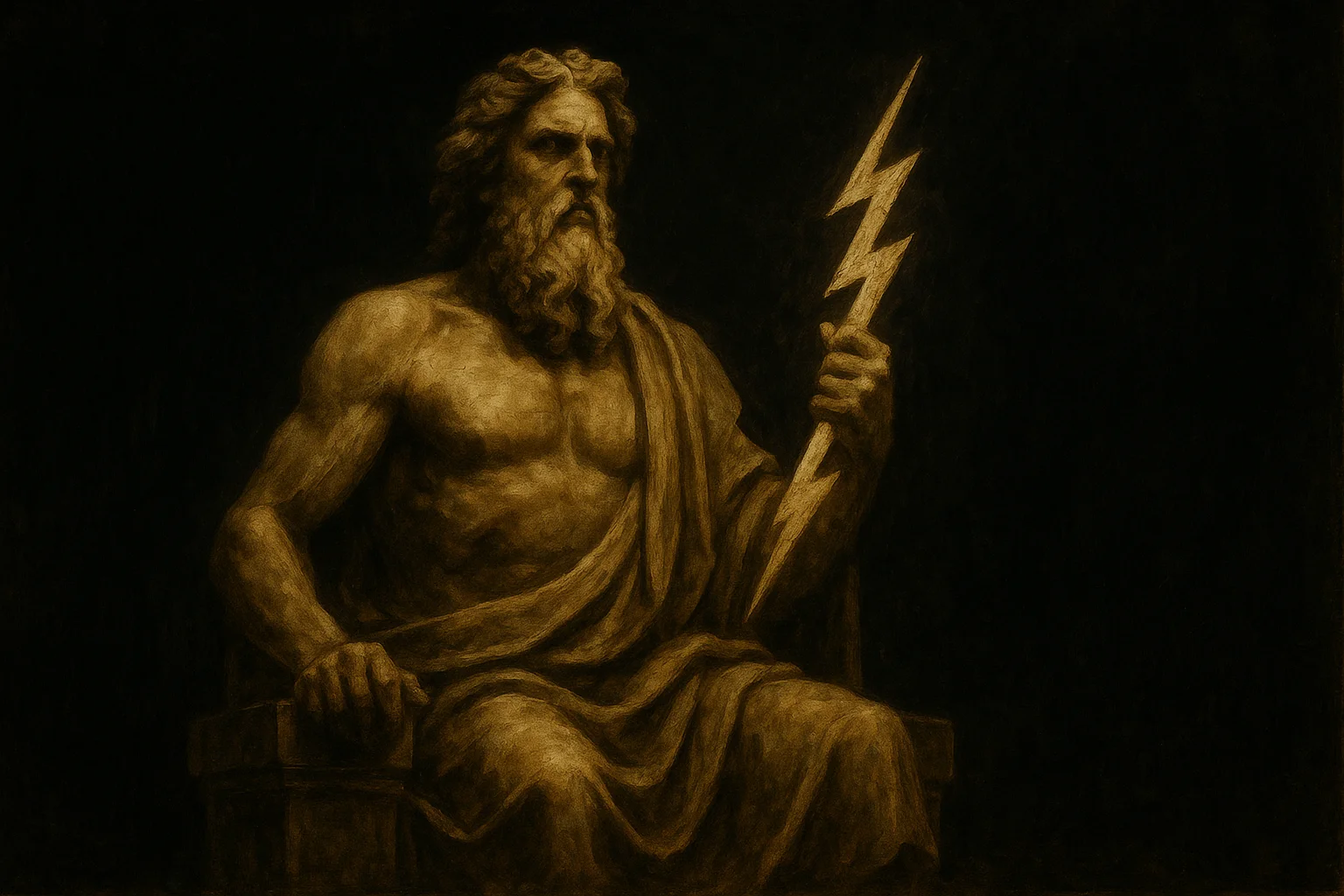
Zeus is both storm god and king of gods. Hesiod's Theogony (453–506) describes how Zeus overthrows his father Kronos and divides the cosmos with his brothers Poseidon and Hades. The thunderbolt, forged by the Cyclopes, becomes the symbol of his authority. It is not merely a weapon; it is the instrument of cosmic order.
Homer's Iliad (1.528–530) shows Zeus nodding his head to confirm an oath, and Olympus trembles. The thunderbolt enforces that nod. When mortals overstep, Salmoneus imitating thunder with bronze kettles, Ixion assaulting Hera, Zeus strikes them down. The bolt is judicial as much as meteorological.
Greek cult practice reinforces this. Sanctuaries to Zeus Kataibates (Zeus the Descender) mark places struck by lightning. The spots become sacred, not cursed. The god has touched the earth, and the earth remembers.
Thor: protector, not king
Thor wields Mjölnir, the hammer that returns to his hand after every throw. Snorri Sturluson's Prose Edda (Gylfaginning 21) describes Thor as the strongest of the Aesir, defender of Midgard and Asgard alike. But he is not their king. That role belongs to Odin.
The distinction matters. Thor's primary role is protection, not governance. He fights Jörmungandr, the world serpent, and will kill it at Ragnarök, though the serpent's venom will kill him nine steps later. He travels to Jotunheim to reclaim his stolen hammer. He blesses marriages and fields. He is the god farmers invoke, not the one kings claim descent from.
Zeus
King of gods, enforcer of cosmic law, distant from daily human concerns except when oaths or hubris are involved.
Thor
Protector of gods and humans, accessible, invoked in domestic rites, defender against chaos but not sovereign over it.
The Norse sources preserve a social structure in which storm power and political power are separate. Odin rules through wisdom and sacrifice. Thor rules through strength and reliability. One is the god of kings. The other is the god of everyone else.
Indra: warrior god and monsoon bringer
Indra dominates the early Vedic hymns. The Rigveda (1.32) recounts his battle with Vritra, the dragon who hoards the waters. Indra strikes Vritra with his vajra, a thunderbolt weapon, and the rivers flow again. The hymn is explicit: "He let loose to flow the seven rivers."
Indra is both warrior and rain-bringer. He drinks soma, the ritual intoxicant, and his strength multiplies. He is called "Shakra" (the Mighty) and "Vajrapani" (wielder of the vajra). His mythology is inseparable from the monsoon cycle. When the rains fail, Indra has been defeated. When they return, he has won.
Later Hindu texts demote Indra as Vishnu and Shiva rise in prominence, but the early Vedic corpus shows a thunder god at the center of the cosmos. He is king of the gods, drinker, fighter, and the one who makes the crops grow. The parallels to Zeus are structural, though the myths themselves diverge.
"I will declare the manly deeds of Indra, the first that he achieved, the thunder-wielder. He slew the serpent, then discharged the waters, and cleft the channels of the mountain torrents." , Rigveda 1.32.1, translated by Ralph T.H. Griffith
Shango: fire, justice, and royal lineage
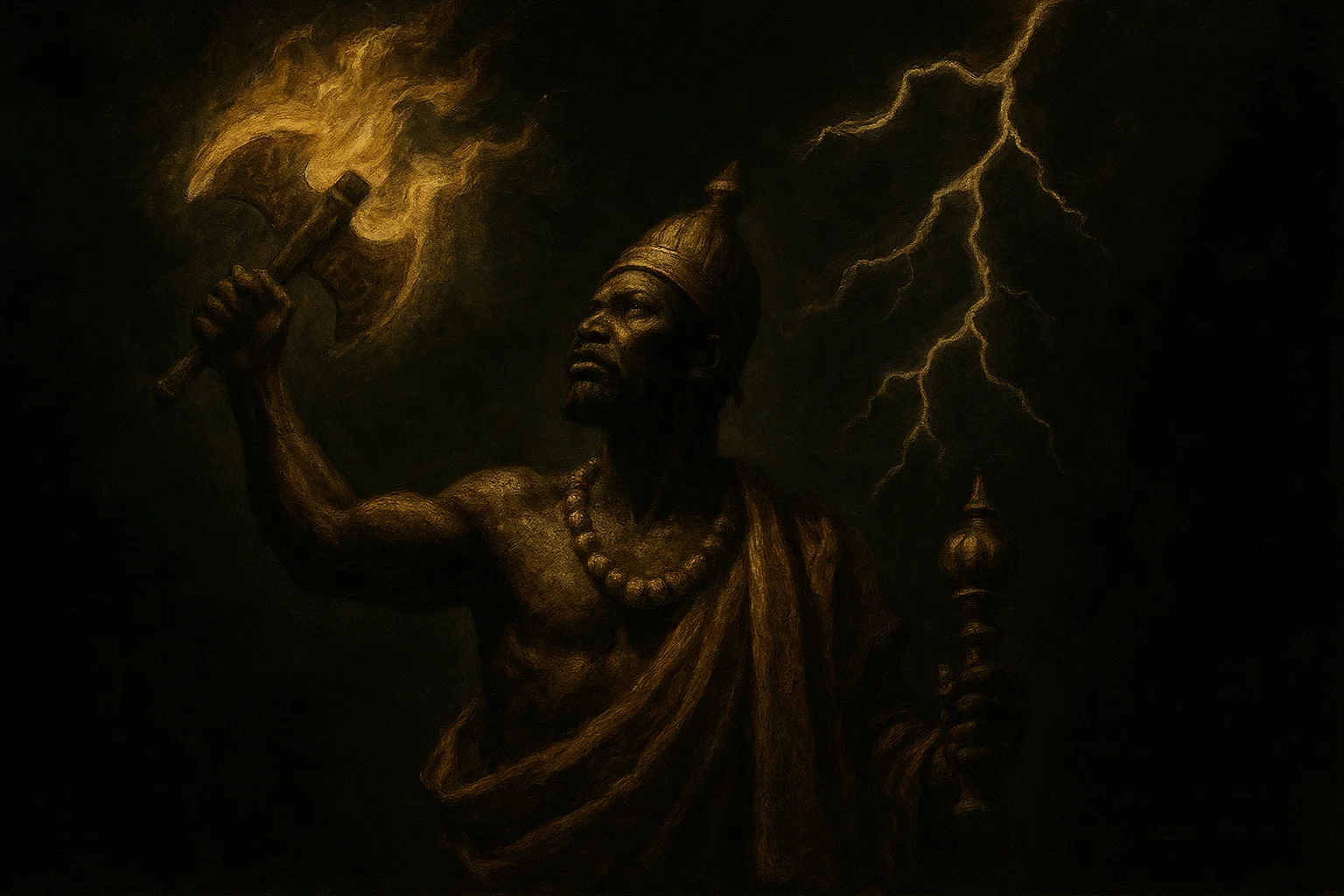
Shango is the Yoruba orisha of thunder, lightning, fire, and justice. Oral traditions, recorded by ethnographers in the nineteenth and twentieth centuries, describe him as a historical king of the Oyo Empire who became deified after his death. His weapon is the double axe, and his symbol is the thunderstone, prehistoric stone axes believed to fall from the sky during storms.
Shango's myths emphasize justice and royal authority. He punishes liars, thieves, and those who break oaths. His priests, in trance, speak verdicts. His festivals involve drumming, possession, and fire-eating. The thunder is both literal weather and moral enforcement.
The Yoruba diaspora carries Shango across the Atlantic. In Cuban Santería, he becomes Changó, syncretized with Saint Barbara. In Brazilian Candomblé, he is Xangô. The thunder god adapts, but the core remains: power, fire, and the sound that makes mortals look up.
Tlaloc, Chaac, and the rain-thunder complex in Mesoamerica
Mesoamerican rain gods blend thunder, lightning, and fertility into a single complex. Tlaloc, the Aztec rain deity, dwells in Tlalocan, a paradise for those who die by drowning, lightning, or water-related disease. His goggle eyes and fanged mouth appear on countless codices and temple friezes. The Popol Vuh (Part II), the K'iche' Maya creation myth, describes the gods shaping humans from maize after the rains make agriculture possible.
The Maya storm god Chaac wields a lightning axe and commands the rain clouds. His four aspects, one for each cardinal direction, water the earth in turn. Rituals to Chaac involve offerings in cenotes, the limestone sinkholes that provide water in the Yucatán. The thunder is the sound of his axe splitting the sky.
- Tlaloc controls rain, hail, frost, and lightning in Aztec cosmology
- Chaac's image appears in Classic Maya inscriptions as early as 250 CE
- Both deities receive child sacrifices in times of drought, documented in colonial-era sources
- Tlalocan, Tlaloc's paradise, contrasts with the underworld Mictlan, death by water is blessed
These gods do not rule the pantheon the way Zeus or Indra do. Quetzalcoatl and Tezcatlipoca occupy those roles in Aztec myth. But Tlaloc and Chaac control survival. Without rain, there is no maize. Without maize, there is no civilization.
Thunder goddesses and the gender of storm
Thunder deities are overwhelmingly male in the textual record, but female storm figures exist. They are rarer, and their roles often differ from their male counterparts.
Astrape and Bronte
Astrape (Lightning) and Bronte (Thunder) are Greek goddesses, daughters of Zeus in some accounts, personifications in others. They do not wield the storm; they embody it. Apollodorus' Library (1.2.1) lists them among the attendants of Zeus, not as independent agents. They are the sound and flash, not the will behind them.
Lei Gong and Dianmu
Chinese cosmology pairs Lei Gong, the male thunder god, with Dianmu, the goddess of lightning. Dianmu uses mirrors to direct the bolts; Lei Gong follows with the drumbeat of thunder. The division of labor is precise: she aims, he announces. Together they punish the guilty, a function similar to Shango's role in Yoruba tradition.
Dianmu's independence varies by source. Some texts make her Lei Gong's wife. Others grant her autonomous authority. The textual instability reflects broader patterns: female storm deities appear more often in local or oral traditions than in the literary canons that survive.
Patterns and divergences
The recurring features are clear. Thunder gods control rain. They wield weapons that return or strike from a distance. They fight serpents or dragons that hoard water or threaten cosmic order. They are invoked in oaths, and they punish perjury.
But the differences are equally instructive. Zeus and Indra are kings. Thor and Tlaloc are not. Shango is a deified ancestor. Chaac is a nature spirit. Some thunder gods are warriors who fight in apocalypse myths. Others are farmers' protectors who bless fields and marriages.
The gender imbalance is structural, not universal. Female thunder deities exist but are less likely to hold sovereignty. They personify the storm or direct its power rather than command it outright. The reasons are likely social: kingship and storm power are linked, and kingship in most of these societies is male.
I find it telling that thunder gods decline in prominence as societies urbanize. In later Greek philosophy, Zeus becomes an abstraction. In classical Hindu texts, Indra becomes a minor figure, even a comic one. The storm matters less when grain comes from trade, not rain. The gods follow the economy.
Frequently asked questions
Why are thunder gods so common across different mythologies?
Thunder gods are common because agricultural societies depend on seasonal rains, and thunder is the audible signal that rain is coming. Cultures that grow grain develop cosmologies in which the storm deity controls survival, making thunder gods central to religious practice. The pattern appears independently in Greece, India, Scandinavia, West Africa, and Mesoamerica because the environmental pressures are similar. Hunter-gatherer and pastoralist societies, by contrast, rarely emphasize thunder gods, focusing instead on trickster gods or mother goddesses.
What is the main difference between Zeus and Thor?
Zeus is both storm god and king of the gods, wielding the thunderbolt as a symbol of cosmic sovereignty and enforcing oaths and divine law. Thor, by contrast, is a protector deity who defends gods and humans from chaos but does not rule; Odin holds kingship in Norse cosmology. Zeus is invoked by kings and in matters of justice; Thor is invoked by farmers and in domestic rites. The distinction reflects different social structures: Greek myth centralizes power in a single sky-father, while Norse myth distributes authority among multiple gods.
Are there any female thunder deities?
Female thunder deities exist but are less common in surviving texts. Dianmu, the Chinese goddess of lightning, directs thunderbolts using mirrors while Lei Gong produces the thunder itself. Astrape and Bronte in Greek myth personify lightning and thunder but do not wield independent power the way Zeus does. The rarity of female thunder gods likely reflects the link between storm power and kingship, which was male-dominated in most ancient societies. Oral traditions may preserve more examples, but the literary canons emphasize male storm deities.
Why are thunder gods often associated with kingship?
Thunder gods are associated with kingship because they control rain, and control of rain means control of the food supply in agrarian societies. Kings who claim descent from or favor with the storm god legitimize their authority through the god's power over survival. Zeus, Indra, and Shango all combine storm power with political sovereignty, and their myths emphasize justice, oaths, and the punishment of wrongdoers. Thor is a notable exception: he protects but does not rule, and Norse kings claim descent from Odin instead.
How do thunder gods differ between agricultural and warrior cultures?
In agricultural cultures, thunder gods emphasize rain-bringing and fertility, as seen with Tlaloc and Chaac in Mesoamerica, where the storm deity's primary role is ensuring the maize harvest. In warrior cultures, thunder gods emphasize combat and the defeat of cosmic enemies, as with Indra slaying Vritra in the Rigveda or Thor battling Jörmungandr in Norse myth. Many thunder gods combine both roles: Zeus enforces cosmic order through violence, and Shango punishes injustice with lightning. The emphasis shifts depending on whether the society values the storm as life-giver or weapon.
Further reading on Mythologis
Read the full book
Want the whole story?
The complete edition is an instant PDF download here, with a paperback on Amazon for selected titles.
Mythology
The World Mythology Book: The Gods, Heroes and Myths of Every Culture
The Gods, Heroes and Myths of Every Culture, in One Volume
The whole of world mythology in a single volume: Greek, Norse, Egyptian, Japanese, Hindu, Celtic, Slavic, Mesoamerican and African myths gathered side by side, each drawn from the primary sources.