
Underworlds Compared: Hades, Duat, Hel, and Mictlan
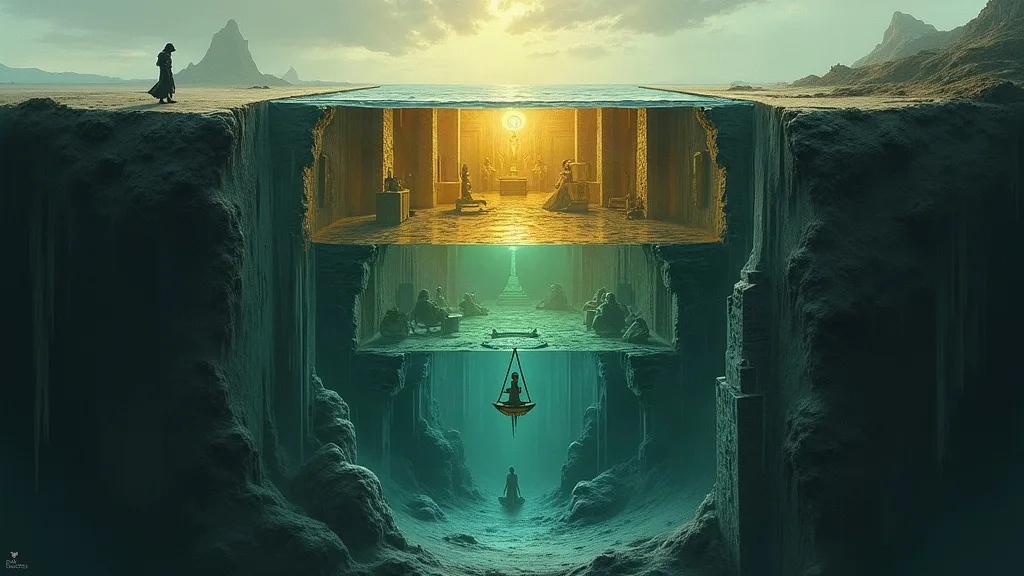
Four civilizations built four radically different afterlives. Comparing Hades, Duat, Hel, and Mictlan reveals what each culture truly feared, hoped for, and believed about death.
Contents
The dead had to go somewhere. Every civilization that left records made sure of that. But the place they imagined could not have been more different depending on where you stood on the earth, which gods your people prayed to, and what you feared most about dying.
A Greek shade drifting across a grey river. An Egyptian heart weighed against a feather. A Norse warrior walking into a cold, misty hall. An Aztec soul descending through nine treacherous levels guided only by the grave goods buried alongside the body. These are not variations on a single idea. They are four completely distinct answers to the oldest question humans have ever asked.
Underworlds compared across Hades, Duat, Hel, and Mictlan reveal something that no single tradition can show on its own: the architecture of death is always the architecture of life, reflected and inverted. What a civilization built underground tells you everything about what it built above ground.
The Greek Underworld: Hades and the Geography of Forgetting
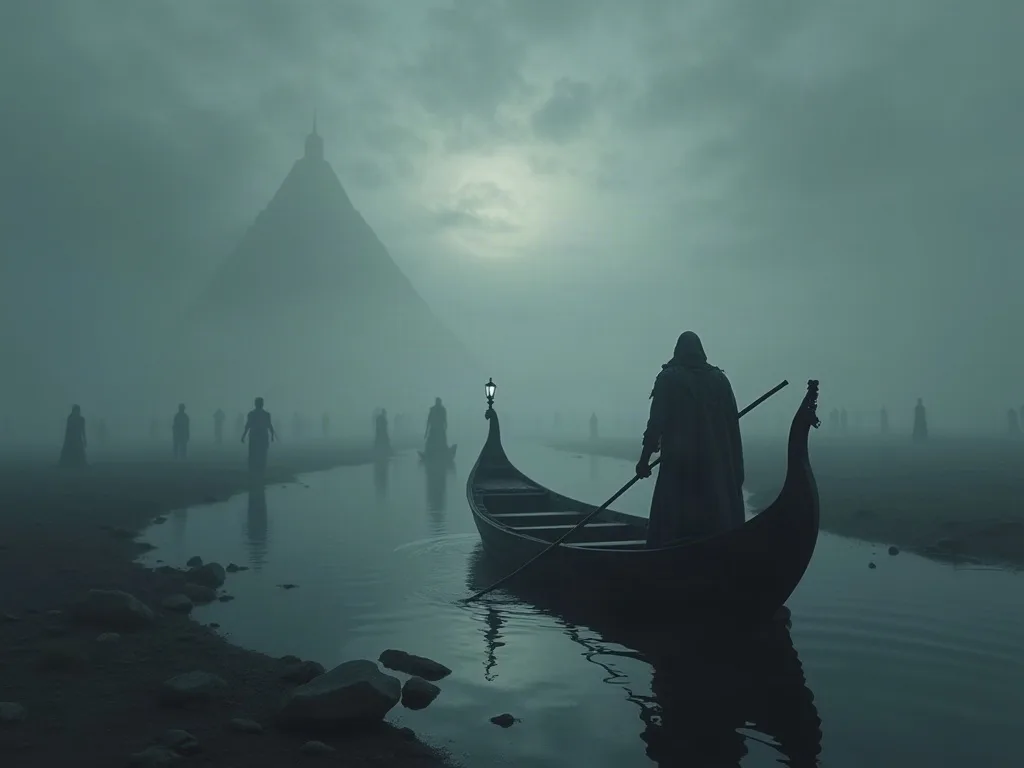
Hades (the place, not just the god who rules it) sits at the western edge of the known world or, depending on the text, directly beneath the earth. Homer's Odyssey, composed around the 8th century BC, describes it as a sunless region where the dead exist as thin, strengthless images of their living selves. They do not suffer as a rule. They simply persist, grey and muted, like smoke that has almost blown away.
To reach Hades, a newly dead soul crossed one of several rivers. The most famous is the Styx, whose name in Greek means "hatred" or "shuddering." The ferryman Charon collected a coin (an obolos) for passage. This is why the Greeks placed coins on the eyes or in the mouths of their dead. Souls who could not pay wandered the near shore for a hundred years before Charon would take them across for free. Death was expensive. Preparation mattered.
Guarding the entrance stood Cerberus, the three-headed dog who ensured that the dead stayed dead. He welcomed arrivals. He stopped returns.
Inside, Hades divided into regions. The Elysian Fields held heroes and the virtuous, bathed in perpetual sunlight and given a second chance at life through reincarnation if they chose it. The Asphodel Meadows held the vast majority of ordinary souls who had done neither great good nor great evil. They wandered, vague and indifferent, for eternity. The Tartarus region locked away the worst offenders: Tantalus standing chin-deep in water that receded each time he bent to drink, Sisyphus rolling his boulder, Ixion bound to a spinning wheel of fire.
Three judges presided over the dead: Minos, Rhadamanthus, and Aeacus, all former mortal kings distinguished by their earthly justice. The Republic of Plato (4th century BC) and Virgil's Aeneid (1st century BC) elaborate the court in detail. But the older Homeric picture is less systematic. Judgement in Homer applies mainly to spectacular sinners. For everyone else, the underworld is less a court than a warehouse.
The river Lethe, whose name means "oblivion," ran through Hades. Drinking from it wiped the soul's memory clean before reincarnation. The river Mnemosyne (memory) offered the opposite, and Orphic mystery cult texts inscribed on gold tablets told initiates to drink from the second spring, not the first. Knowledge of where to walk in the underworld was itself a form of power.
This detail signals something important: for the Greeks, the underworld was a place you could, in principle, navigate. Orpheus descended to retrieve his wife Eurydice, armed only with music. Heracles dragged Cerberus out on a leash as one of his labors. Odysseus called the dead up to the surface to question them. The boundary between life and death was permeable if you had the right gift or the right knowledge. Hades was immense, but it was not beyond reach.
The Egyptian Duat: The Weighing of Every Heart
Egypt's afterlife was not an underworld in the subterranean sense. The Duat (sometimes transliterated as Tuat) was a parallel realm that interpenetrated the physical world and the sky. The sun god Ra traveled through it every night in his solar barque, fighting the serpent Apep before emerging reborn at dawn. The dead traveled the same route, and the journey was anything but passive.
The earliest sources are the Pyramid Texts, carved inside Old Kingdom royal pyramids around 2400 BC, making them the oldest known religious texts in the world. They were followed by the Coffin Texts (used by non-royal Egyptians around 2000 BC) and eventually the Book of the Dead, a collection of spells assembled and customized for individual patrons from roughly 1550 BC onward.
Every soul who entered the Duat faced a sequence of twelve gates, each guarded by a deity who demanded the traveler know their name before passing. The Book of the Dead supplied these names as spells. A well-prepared Egyptian literally studied for death the way a modern student studies for an exam.
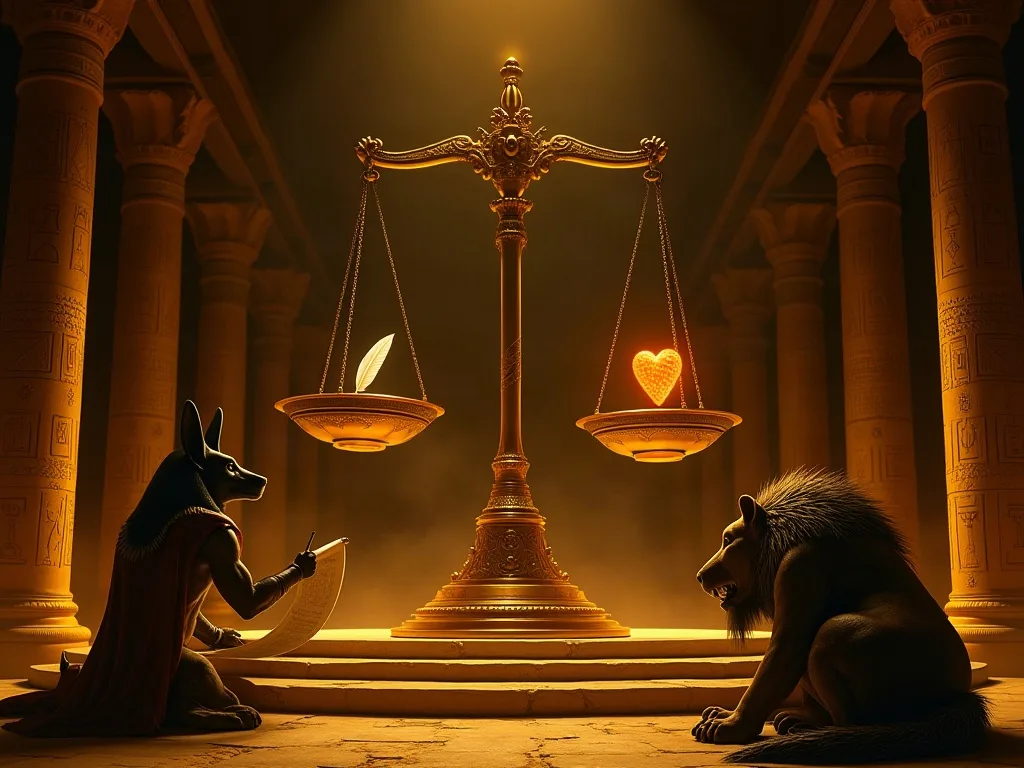
The culminating moment was the Weighing of the Heart, presided over by the jackal-headed god Anubis. The deceased's heart was placed on one side of a scale; on the other side sat the feather of Ma'at, the principle of truth, justice, and cosmic order. The ibis-headed god Thoth recorded the result. If the heart balanced against the feather, the soul passed into the Field of Reeds (Aaru), a paradise that looked precisely like the Nile Valley at its most fertile, where the deceased farmed and feasted and lived beside the gods.
If the heart was heavier than the feather, weighted down by wrongdoing, the monster Ammit waited beside the scale. Part lion, part hippopotamus, part crocodile, Ammit devoured the heart. This was the second death: total annihilation, not punishment in a dungeon but erasure from existence. For Egyptians who believed memory and name were the building blocks of selfhood, this was the worst fate imaginable.
The Duat was thus moral in a way Hades never quite was. Every soul, not just the conspicuously wicked, stood before the scale. The text known as the Negative Confession (Chapter 125 of the Book of the Dead) lists forty-two denials the deceased recited before the forty-two assessor gods: "I have not caused anyone to weep. I have not killed. I have not stolen food." The list is strikingly ethical, covering harm to other people, theft, dishonesty, arrogance, and even environmental damage like overhunting.
The Duat was also the most cosmologically complex of the four underworlds here. It contained geographical features, including lakes of fire, caverns, islands, and a vast river that mirrored the Nile. Different spells in the Book of the Dead correspond to different obstacles, some physical and some verbal. Osiris, the god of resurrection, presided over the whole realm, having been the first to die and be reassembled by Isis. His own myth gave every Egyptian hope that death was not the end of the body, only a transformation of it.
Hel: The Norse Underworld of Mist and Shadow
For many readers, Norse death mythology begins and ends with Valhalla, the glittering hall where Odin welcomed fallen warriors to train for Ragnarok. But Valhalla was an exception. Most of the Norse dead went to Hel.
The realm takes its name from its ruler, the goddess Hel, daughter of the trickster Loki and the giantess Angrboda. She appears in the Prose Edda written by the Icelandic scholar Snorri Sturluson around 1220 AD, drawing on older oral traditions and the Poetic Edda, a collection of mythological poems from roughly the same era. Odin cast Hel down into Niflheim, the primordial realm of ice and mist, and gave her authority over those who died of illness, old age, or any cause that did not involve combat glory.
Hel's appearance mirrors her domain. Snorri writes that half of her body is the normal color of living flesh; the other half is the blue-black of a corpse. She is neither malevolent nor welcoming. She is simply sovereign over a place where things go to persist without vitality. Her hall, also called Hel or Helheim, has a gate called Valgrind, a servant named Ganglati (meaning "slow moving") and another called Ganglöt, and food named Hunger served on a dish called Famine. Snorri builds the place through grim personification: every object there is suffering given a name.
The road to Hel ran north and down through dark valleys. When the beloved god Baldr died, shot by a mistletoe dart thrown by the blind god Höðr (with Loki's guidance), Odin's son Hermóðr rode the eight-legged horse Sleipnir down that road for nine days in darkness to beg Hel for Baldr's release. Hel agreed on one condition: every being in the world must weep for Baldr. One giantess (believed to be Loki in disguise) refused. Baldr stayed in Hel until after Ragnarok.
The crucial point about Hel is that its sorting principle is not moral. A warrior who died in bed of plague went to Hel. A man who died at sea, caught in a storm, might go to Ran, the sea goddess who dragged drowning sailors into her hall. A farmer who lived generously and died quietly of old age went to Hel. The moral weight resided in the manner of death, not the conduct of life. This reflects a warrior aristocracy's deepest anxiety: not wickedness, but a death that left no story worth telling.
Scholars like Rudolf Simek, in his Dictionary of Northern Mythology, note that the Norse conception shows traces of older Germanic beliefs in which the dead simply returned to the earth, often to hills and mounds near the living. The draugr, undead creatures that haunted burial mounds, suggest a fear that the dead were not fully elsewhere at all, but uncomfortably close.
Mictlan: The Aztec Underworld of Pure Endurance
The Aztec realm of the dead, Mictlan, operated on a completely different logic from the other three. The Florentine Codex, compiled by the Franciscan friar Bernardino de Sahagún in the 16th century from Nahua oral sources, and the slightly earlier Historia de los mexicanos por sus pinturas both describe a journey through nine distinct levels that took four years to complete.
Moral behaviour did not determine where an Aztec went after death. Destination was determined entirely by the manner of death. Warriors who died in battle or captives who died in sacrifice went to accompany the sun across the sky each morning, eventually reincarnating as hummingbirds. Women who died in childbirth (considered warriors in their own right, since they captured a new soul for the world) accompanied the sun in the afternoon. Victims of drowning, lightning, or diseases associated with water went to Tlalocan, a paradise ruled by the rain god Tlaloc. Children who died young went to a suckling paradise. Everyone else, the vast majority who died of illness or old age, descended into Mictlan.
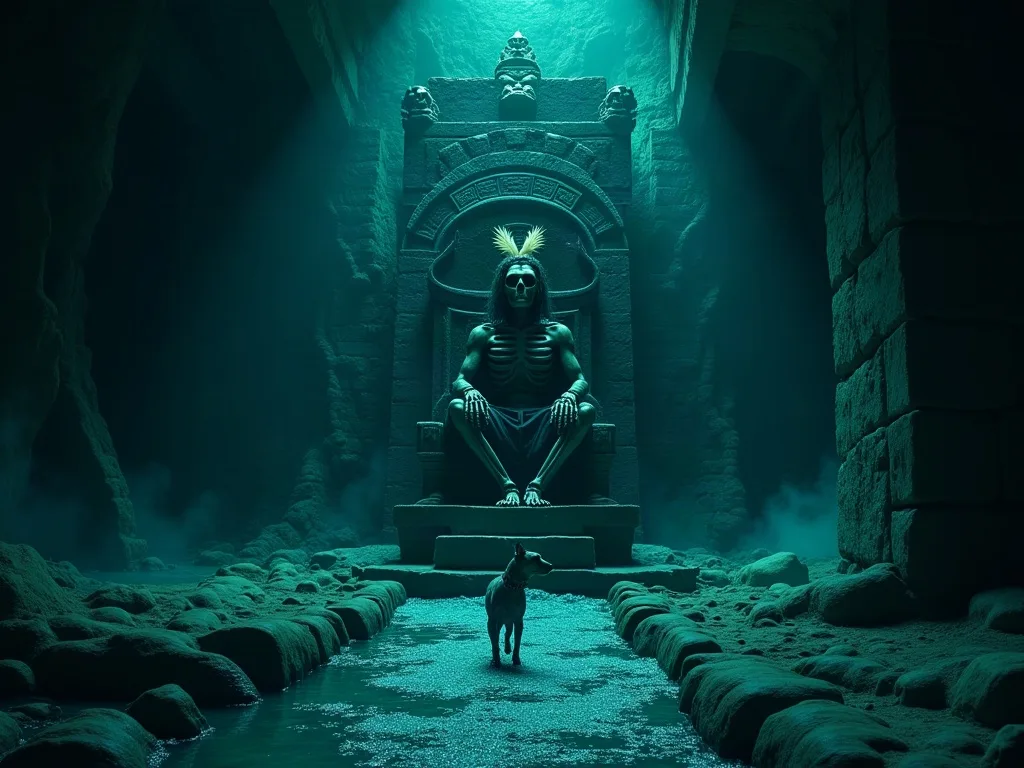
The ruler of Mictlan was Mictlantecuhtli, the Lord of the Dead, along with his consort Mictecacihuatl. He is typically depicted as a skeleton figure with eyes of obsidian, wearing a collar of eyeballs and a headdress of owl feathers. He did not judge souls. He simply received them.
The nine levels of Mictlan each presented a specific physical challenge. The soul had to cross a wide, cold river (with the help of a dog buried alongside the body), pass through clashing mountains, cross a field of cutting winds, traverse deserts, cross bodies of water, and navigate other obstacles whose exact nature varies between sources. At each transition, the dead person used offerings placed in their grave: food, tools, the dog companion, and a guide figure made of amaranth dough.
The journey lasted four years. At the end, the soul reached Chiconauhmictlan, the ninth level, and was received by Mictlantecuhtli. There, souls dissolved into the earth, the raw material from which the fifth age of the world was built. The Leyenda de los Soles, a pre-colonial mythological text preserved in colonial-era manuscripts, says that Mictlantecuhtli himself had hoarded human bones from previous ages of the world, and that Quetzalcoatl descended into Mictlan to steal them so that humanity could be created again.
This gives Mictlan a cosmological role that none of the other three underworlds quite match. It is not just a receptacle for the dead. It is a storehouse of the raw material of existence.
Four Rivers, Four Scales, Four Worlds: The Structural Comparison
Hades (Greek)
- Reached by crossing the river Styx by ferry
- Judgement applies mainly to exceptional cases (heroes, great sinners)
- Fate: Asphodel for most, Elysium for heroes, Tartarus for the wicked
- The soul retains identity but loses vitality and memory
- Permeable: living heroes could enter and sometimes return
- No creation role; purely a receptacle for the dead
Duat (Egyptian)
- Reached through twelve guarded gates requiring secret names
- Every single soul is judged by the Weighing of the Heart
- Fate: paradise (Aaru) or total annihilation (devoured by Ammit)
- The soul can be fully reconstituted; bodily resurrection is possible
- Not permeable in the same way; preparation through spells is key
- Ra's nightly journey through the Duat powers the sunrise
Laid side by side, the structural patterns become clear. Three of the four underworlds involve a body of water as the first barrier. Hades has the Styx. Mictlan has the great river crossed with a dog's help. The Duat has its underground Nile. Hel alone is primarily cold rather than wet, fitting the Norse climate and the primordial ice of Norse cosmogony.
Three of the four assign some form of moral or social judgement. Hades judges the rare extremes. The Duat judges everyone. Hel sorts by manner of death rather than moral conduct. Mictlan alone is morally neutral from start to finish: a purely physical ordeal with no tribunal.
The role of preparation also varies sharply. In Egypt, preparation was the entire point of mortuary culture: the spells, the amulets, the perfect mummification. In Mictlan, preparation meant burying the right objects with the body. In Hades, preparation meant having a coin and, for initiates, knowing which spring to drink from. In Hel, preparation was almost non-existent in the textual record. You arrived. You persisted.
The quality of the afterlife for ordinary souls differs just as much. The Elysian Fields for the Greek lucky few offered genuine happiness. The Egyptian Field of Reeds was paradise structured like home. Hel offered mere continued existence, drained of warmth. Mictlan, at its ninth level, offered dissolution rather than reward or punishment.
Animals, Guides, and the Problem of Getting There
Every tradition solves the same practical problem: the newly dead soul does not know where it is going. A guide is needed. The guides reveal what each culture thought the dead most required.
Hermes Psychopomp (the "soul-carrier") led Greek shades from the upper world to the entrance of Hades with his caduceus, the staff entwined with serpents. He was calm, fast, and neutral, carrying kings and slaves alike with the same efficiency. The Greek dead needed a messenger because the underworld was a foreign country.
Anubis weighed the heart and supervised mummification. He was not a guide through the terrain so much as the presiding officer of the judgement. The actual pathfinding in the Duat required the deceased to know the right spells. Knowledge replaced a personal guide. You navigated the Duat by studying it in advance.
Norse mythology provides Valkyries for the warrior dead: shield-maidens of Odin who chose the slain on the battlefield and carried them to Valhalla. For those destined for Hel, the road was walked alone through darkness. There is no psychopomp for Hel's population, which reinforces how little agency ordinary death was thought to grant.
In Mictlan, the guide was a hairless dog. Specifically, a Xoloitzcuintle, the same breed still living in Mexico today. The dog was buried with its owner specifically to help them cross the wide cold river. The dog knew the way; the human followed. This is perhaps the most touching of all the afterlife solutions: you die, and your dog is waiting to take you home.
What the Dead Eat (and Why It Matters)
Food in the underworld is either a comfort, a trap, a punishment, or an offering. The variation illuminates each tradition's deepest anxieties.
In Hades, eating the food of the dead bound you there. Persephone ate pomegranate seeds in the underworld, and that partial meal chained her to spend part of every year below the earth, which is how the Greeks explained the seasons. The Greek dead did not feast. They were fed only by blood offerings poured into pits by the living.
The Egyptian Field of Reeds was the opposite. The deceased farmed and ate abundantly. The papyrus of the scribe Ani (one of the best-preserved copies of the Book of the Dead, now in the British Museum) shows Ani harvesting grain in Aaru. Food in the Duat was a sign of prosperity and earned reward, not danger.
In Hel's hall, food was named Hunger served on a plate named Famine. This was not metaphor; it was Snorri's way of saying that the afterlife in Hel offered none of the satisfactions of living.
Mictlan's dead relied entirely on what their relatives buried with them or burned for them at regular intervals over the four-year journey. The obligation fell on the living. If the family neglected the offerings, the soul suffered the journey more harshly. Day of the Dead (Día de los Muertos) celebrations in modern Mexico preserve this ancient logic: the dead return annually, and the living must have food and flowers ready.
Rebellion, Return, and the Living Who Crossed Over
Every underworld tradition includes stories of the living who broke the boundary, at least for a while. These stories are not escapist fantasy. They probe the rules of death by showing what happens when those rules bend.
Orpheus descended to Hades for love and nearly succeeded. He charmed Charon, charmed Cerberus, and charmed Persephone herself with his music, winning Eurydice's release on one condition: he must not look back as she followed him out. He looked. The myth does not explain why. It does not need to. Every reader already understands.
Gilgamesh, not from the four traditions above but worth noting as the oldest comparable account (the Epic of Gilgamesh from ancient Mesopotamia, around 2100 BC), descended to find the secret of immortality and came back empty-handed.
In Norse myth, Hermóðr's ride to Hel to retrieve Baldr was technically successful in negotiation but failed in execution. The world could not universally weep. One being refused. The underworld kept what it had taken. The lesson: negotiation with the dead is possible but the living world will always betray it through division.
In Aztec tradition, Quetzalcoatl actually stole the bones of previous humanity from Mictlantecuhtli, though the Leyenda de los Soles notes that Mictlantecuhtli set a trap that caused the bones to break and crack before Quetzalcoatl escaped. This is why humans are different sizes, the myth explains; the bones were reassembled in pieces.
The motif is consistent across all four: the underworld is not impenetrable, but it always exacts a price. Something is lost on the way back, and the something is usually the original prize.
Frequently Asked Questions About Underworlds Compared
Frequently asked questions
Did ancient Greeks believe everyone went to Hades, or only some people?
In the oldest Greek sources, particularly Homer's Odyssey and Iliad (8th century BC), virtually all the dead went to Hades regardless of how they had lived. The sorting into Elysium, Asphodel, and Tartarus became more systematic in later writers like Plato and Virgil. Mystery religions, including Orphism and the Eleusinian Mysteries, promised initiates better fates, but mainstream Greek belief for most of its history placed everyone in the same grey middle ground.
Was the Egyptian Duat really underground, or was it considered part of the sky?
Both, in different contexts. The Duat was a liminal realm that overlapped with the night sky and the underearth simultaneously. Ra's solar barque traveled through it each night to emerge reborn at dawn, suggesting a sub-horizon route. But some Egyptian texts place the Duat among the stars, particularly the circumpolar stars that never set. Egyptian cosmology did not force a strict boundary between below-earth and beyond-sky: the Duat was simply wherever the sun went when living people could not see it.
Was Hel considered evil in Norse mythology?
No. The goddess Hel is not a villain in Norse sources. She is stern and cold, but she administers her realm according to the mandate Odin gave her. When Hermóðr rides to her hall to beg for Baldr's release, she listens respectfully and sets a reasonable condition. Snorri Sturluson describes her as grim-looking but not cruel. The later conflation of Hel with the Christian concept of hell comes from medieval Christian writers who borrowed the name and attached very different theology to it.
Did Aztec beliefs about Mictlan influence the modern Day of the Dead?
Yes, substantially, though the modern holiday is a syncretism. When Spanish missionaries arrived in the 16th century, they found existing Aztec festivals honoring the dead, including one presided over by the goddess Mictecacihuatl in the ninth month of the Aztec calendar. These were merged with the Catholic feasts of All Saints' Day and All Souls' Day (November 1 and 2), producing the current Día de los Muertos. The core idea, that the dead return annually and the living must feed and welcome them, comes directly from pre-colonial Nahua beliefs about the soul's need for continued offerings.
Which underworld was considered the most positive place for the dead?
Egypt's Field of Reeds (Aaru) comes closest to a universal paradise, but it was reserved only for those whose hearts balanced against Ma'at's feather. For the Greeks, Elysium was genuinely pleasant but reserved for heroes and the exceptionally virtuous. Norse Valhalla was joyful but limited to warriors chosen by Odin. In practical terms, most people in every tradition ended up in the neutral or difficult sections: Asphodel, Hel, or the nine levels of Mictlan. Universal paradise was an aspiration, not an expectation.
Are there common cross-cultural elements shared by all four underworlds?
Several. A body of water that must be crossed appears in Hades (the Styx), Mictlan (the great river), and the Duat (the underground Nile). A guardian figure at the entrance appears in Hades (Cerberus), the Duat (gate-keepers who must be named), and implicitly in Mictlan's successive challenges. The idea that the living can support the dead through offerings or grave goods runs through Egypt, Mictlan, and Norse practice. Scholars like Mircea Eliade, in his The Sacred and the Profane (1957), argue these patterns reflect universal human cognitive structures around liminality: the dead are neither fully gone nor fully present, and ritual is what keeps the boundary stable.
The Underworld as a Mirror: What These Myths Still Teach
The strongest argument for comparing these four traditions is not academic. It is this: each underworld is a moral document, and the morals diverge in illuminating ways.
The Duat says every soul is accountable to something larger than itself. The scale is impartial. The feather does not care if you were rich or powerful. This is a radical claim in a society built on hierarchy, and Egypt made it the center of its religious life for three thousand years.
Hades, in its oldest form, says death is the great equalizer not because of judgement but because of erasure. The king and the slave both drift through the Asphodel Meadows. What distinguished them in life no longer applies. Homer's Achilles, speaking from Hades in the Odyssey, says he would rather be a living slave than a dead king. That sentence redirects an entire culture's assumptions about glory.
Hel says: how you die shapes everything. Not how you lived. Not what you believed. The manner of death, whether it had dignity or narrative, was the sorting mechanism. This is a warrior culture being honest with itself about what it values, and that honesty is bracing.
Mictlan says: the cosmos does not care what you did. It needs raw material. You will become part of that material. The individual soul is not the point; the continuity of the age is the point. It is perhaps the most ecologically coherent of the four cosmologies, and the least comforting. But it places enormous weight on community obligation. The living must maintain the dead. The dead must sustain the living. The bond is material, not merely sentimental.
No single underworld gets death right, because death resists being gotten right. But together, Hades, the Duat, Hel, and Mictlan sketch the full spectrum of what death means to a thinking species. They cover judgement and erasure, isolation and community, moral weight and moral silence. Between them, they contain almost every answer humans have ever attempted to that oldest and most persistent of questions.
Free 25-page sample
Want the whole story?
Take the first 25 pages free. If it pulls you in, the full edition is yours as an instant PDF download, with a paperback on Amazon for selected titles.

Mythology
The World Mythology Book: The Gods, Heroes and Myths of Every Culture
The Gods, Heroes and Myths of Every Culture, in One Volume
The whole of world mythology in a single volume: Greek, Norse, Egyptian, Japanese, Hindu, Celtic, Slavic, Mesoamerican and African myths gathered side by side, each drawn from the primary sources.