
Nsamanfo: The Venerated Ancestors of Akan Belief
In Akan cosmology, the dead do not simply vanish. The Nsamanfo, the venerated ancestors, remain woven into daily life, guiding the living, enforcing moral order, and bridging the human world to the divine.
Contents
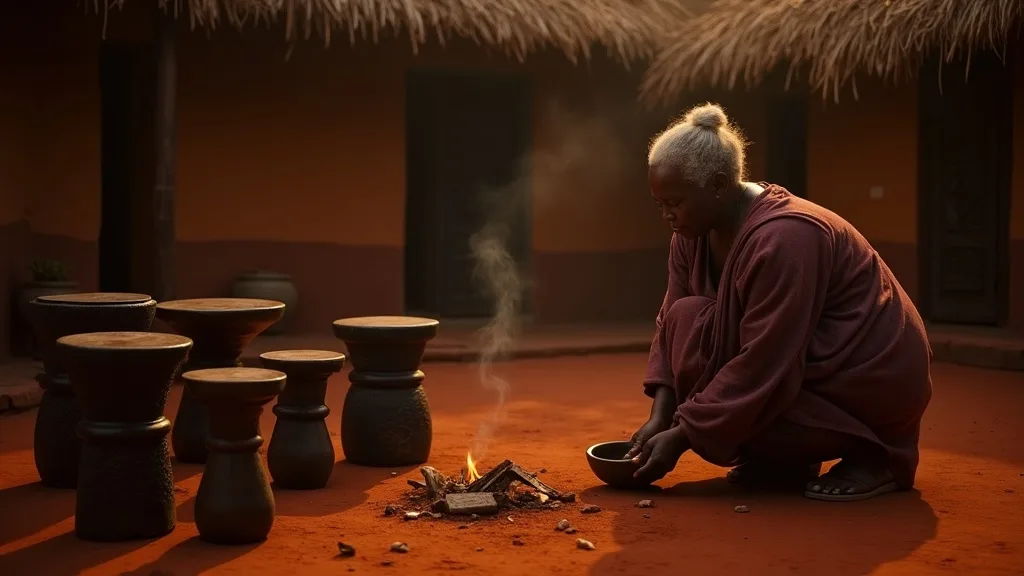
The libation pours before the elder speaks. A small clay vessel tips toward the earth, and the words rise in Twi: names of the dead, invoked as witnesses. This is not ceremony for ceremony's sake. In Akan communities across present-day Ghana and Côte d'Ivoire, the act acknowledges a truth the tradition has held for generations: the departed are still present, still listening, still capable of shaping the fates of those who remain.
Nsamanfo: The Venerated Ancestors sit at the structural center of Akan religion. They are neither gods in the abstract Greek sense, nor are they ghosts haunting the margins of life. They occupy a precise cosmological position, inhabiting Asamando, the realm of the ancestors, while retaining a living relationship with their lineage. To misread them as mere spirits of the dead is to miss the point entirely.
The Akan world is one of profound relational ethics. Every birth, illness, harvest failure, or unexpected fortune carries a genealogical dimension. The Nsamanfo watch. They reward. They withdraw protection when offended. Understanding who they are, how they become what they are, and what they demand of the living opens a window onto one of West Africa's most coherent and enduring metaphysical traditions.
How a Soul Becomes an Ancestor: Death, Rites, and Transition
Death in Akan thought is not a wall but a threshold. Every person carries several spiritual constituents. The Okra is the divine spark, the soul fragment given directly by Nyame, the supreme sky deity, at birth. The Sunsum is the personal spirit, the seat of personality, character, and emotional life. The Mogya, literally "blood," is the matrilineal substance inherited through the mother, binding a person to their abusua (matrilineal clan).
When someone dies, these constituents do not simply dissolve. The Okra returns to Nyame. The Sunsum, however, enters a liminal period. It must be guided through proper funerary ritual before it can settle in Asamando as a fully recognized Osaman. This is why Akan funerals, historically lasting several days and involving drumming, singing, speeches, and feasting, are not expressions of grief alone. They are cosmological maintenance work.
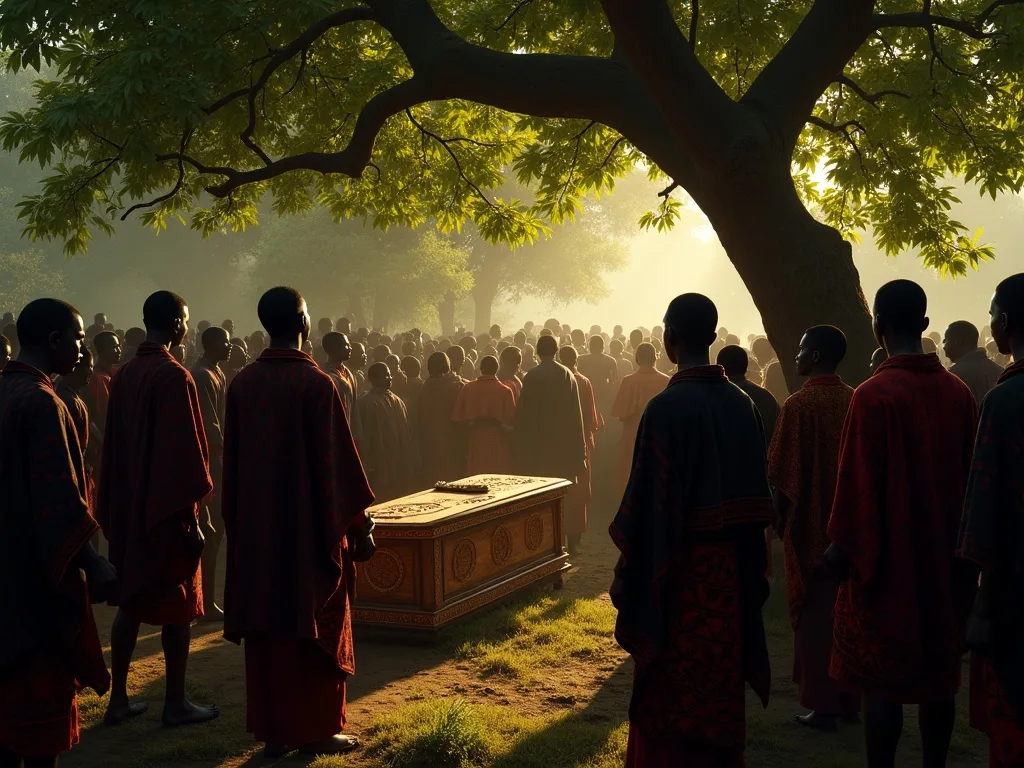
If the rites are incomplete, if a person dies far from home without proper ceremony, or if a death is considered "bad" (sudden, violent, or through certain illnesses historically classified as spiritually dangerous), the Sunsum may become a wandering, potentially harmful entity rather than a protective ancestor. The distinction matters enormously: the Nsamanfo protect their lineage precisely because they were brought into the ancestral community correctly.
Age is also a factor. Elders who have lived full lives, seen grandchildren, and accumulated wisdom are the most natural candidates for ancestorhood. Children and young adults who die prematurely occupy a different category, mourned but not typically addressed as ancestors in the formal ritual sense. The ancestor is a figure of completion.
The Moral Architecture of Ancestral Power
Nsamanfo: The Venerated Ancestors are not simply benevolent presences. They carry authority, and that authority is conditional. The Akan ethical framework connects directly to this: ancestors enforce the moral norms of the community because those norms were theirs when they lived. An elder who built her reputation on fairness, generosity, and proper conduct becomes, after death, a guardian of those same values in her abusua.
Neglect triggers consequences. If a family fails to pour libations, forgets to mention the ancestors' names at important transitions (births, marriages, the planting season, major disputes), the Nsamanfo are understood to withdraw their protection. Misfortune, illness, infertility, or a run of bad harvests may then be read through divination as a sign of ancestral displeasure. This is not punishment for its own sake; it is the relational logic of the system asserting itself.
The Okyeame, the royal linguist and ritual specialist found in Akan courts, often mediates between the living and the ancestral realm in formal contexts. Kings themselves, the Ohene, derive a significant portion of their legitimacy from their proximity to ancestors. The Sika Dwa Kofi, the Golden Stool of the Asante, is understood not merely as a seat of political power but as a vessel housing the Sunsum of the entire Asante nation, including all its Nsamanfo. To capture the Golden Stool would be to sever a people from their ancestral identity. This is why the British colonial campaign to seize it in 1900, provoking the War of the Golden Stool, struck so deeply: it was an assault on metaphysical continuity, not only political authority.
Asamando: The Geography of the Ancestral Realm
Asamando is situated, in most Akan accounts, beneath the earth or across a great body of water, sometimes identified with the setting sun in the west. It mirrors the living world in structure: the dead have communities, relationships, and activities. An ancestor continues to hold the status they earned in life. A chief in Asamando remains a chief.

The journey to Asamando requires passage across a river, and the dead must pay a ferryman-like figure. This is why it was historically common practice to bury a person with coins or valuables, practical provisions for a journey through a landscape the living cannot see but the tradition has mapped with confidence.
Communication between the two realms flows in both directions. The living reach the Nsamanfo through libation (nsã), through the invocation of names, through offerings of food and drink placed at shrines or at specific trees associated with the ancestors. The ancestors communicate back through dreams, through the outcomes of divination sessions conducted by a Okomfo (priest or priestess), and through the physical signs that experienced elders learn to read: the behavior of certain birds, the unexpected appearance of an animal at a meaningful moment, the strange timing of a wind.
Matrilineal Blood and Patrilineal Spirit: Who Belongs to Whom
One of the most intellectually intricate features of Akan ancestor veneration is how kinship lines determine which ancestors a person relates to, and in what way. The Akan reckon descent matrilineally: your abusua comes from your mother. Your primary ancestral community, the Nsamanfo you appeal to in personal matters, the ones whose blood literally runs in your veins via mogya, are your maternal ancestors.
Yet the father also matters. The Sunsum is transmitted patrilineally, meaning your personal spirit, your temperament, your creative and spiritual energy, is understood to carry something of your father's line. This creates a dual ancestral landscape: maternal ancestors for clan identity, social obligations, and most ritual contexts; paternal ancestors for personality, vocation, and certain personal rituals tied to one's ntoro (patrilineal spiritual group).
Maternal Ancestors (Abusua)
Linked through Mogya (blood). Determines clan membership, inheritance of property, and primary ritual obligations. The Nsamanfo invoked at major rites of passage, funerals, and disputes are typically the maternal ancestors. These are the figures a person is most accountable to across their entire life.
Paternal Ancestors (Ntoro)
Linked through Sunsum (spirit). Determines personal temperament, certain taboos, and the spiritual group one belongs to. Paternal ancestral identity shapes character and vocation but carries fewer of the collective social duties bound up in matrilineal identity. Both lines honor their ancestors; the contexts differ.
Ancestor Stools, Shrines, and the Blackened Seat of Memory
The physical anchor of ancestral veneration in Akan society is the stool. Every individual owns a personal stool, carved from a single piece of wood, used as a seat but also as a container of their Sunsum. When a significant elder or chief dies, their stool is not destroyed. It is blackened with a mixture of soot and egg and placed in the family's stool house (nkonuafieso), a sacred room or building that functions as the ancestral shrine.
Nsamanfo are present in these blackened stools. The stool house is not a museum. It is an address, a place where the Nsamanfo can be reached directly. Regular offerings of food and drink are placed before the stools. Festivals, particularly the Odwira (a purification and ancestral renewal ceremony held annually among the Asante and other Akan groups), bring the whole community into renewed relationship with the Nsamanfo. During Odwira, the blackened stools are washed, the ancestors' names spoken, and the social fabric between the living and the dead is re-stitched.
The scale of ancestral veneration at the royal level is considerable. The Asantehene's stool house in Kumasi holds the blackened stools of every Asante king stretching back to Osei Tutu I, who founded the Asante Confederacy in the late seventeenth century. To enter this space is to stand in the presence of three centuries of accumulated ancestral authority.
The Okomfo and the Art of Ancestral Communication
Not every living person can reliably access the Nsamanfo directly. While libation and daily acknowledgment are available to all, deeper communication, the kind needed to diagnose the cause of persistent misfortune or to consult an ancestor on a critical decision, requires the mediation of an Okomfo. This is the priest or priestess who has undergone rigorous initiation, often understood as being "chosen" by a spirit or deity (Obosom) who works alongside ancestral powers.
The Okomfo enters trance states during ritual possession. A deity or ancestral spirit speaks through them. The community brings its questions, its conflicts, its unexplained sufferings. The answers arrive through the medium's transformed voice and gesture, deciphered by experienced ritual participants. This is not performance. Within the Akan framework, it is one of the most serious and consequential social acts available, a direct consultation with those who have gone before and who still hold a stake in the living community's wellbeing.
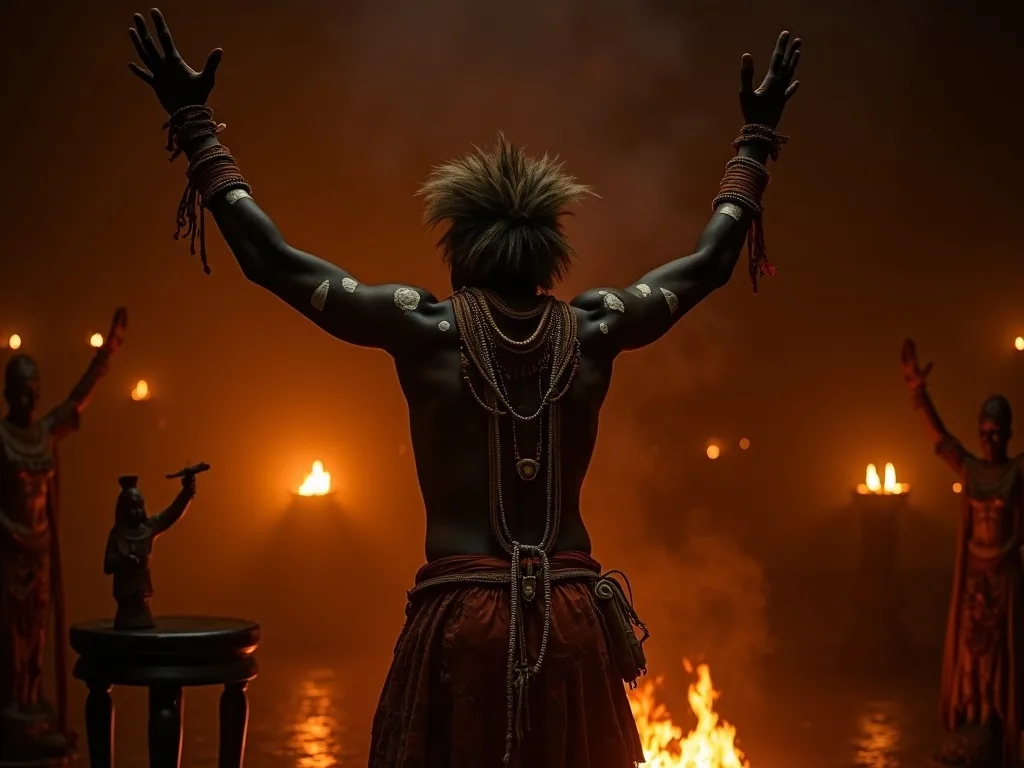
The Asante Okomfo tradition produced some of the most celebrated ritual specialists in West African history. Okomfo Anokye, the legendary priest associated with the founding of the Asante state around 1701, is said to have called the Golden Stool down from the sky, placing the Asante permanently under ancestral and divine protection. His story, preserved in oral tradition and recorded by later historians, sits at the intersection of ancestral power, royal legitimacy, and the cosmological contracts that Akan society has always understood to underpin political order.
Nsamanfo Across the Akan Diaspora: Atlantic Resonances
The transatlantic slave trade scattered Akan-speaking peoples across the Caribbean and the Americas, particularly in Jamaica, Suriname, and Trinidad. Akan religious concepts did not disappear; they adapted, merged with other African traditions and with Christianity, and persisted in sometimes unrecognizable but functionally continuous forms.
The Jamaican Kromanti religious tradition among the Maroons preserves Akan-derived ancestral practices, including spirit possession, the invocation of named ancestors in ceremony, and specific rhythmic patterns used to call the dead. Accompong Town in Jamaica, founded by Akan-descended Maroons in the eighteenth century, still holds an annual ceremony on January 6th that includes ancestral rites recognizably continuous with Ghanaian practice.
In the broader African Traditional Religion scholarship, the Akan Nsamanfo are compared productively with the Yoruba Egungun ancestors (masked ancestral spirits whose festivals bring the dead back into the community in visible, costumed form), the Kongo Bakulu (ancestral powers associated with the white clay of the earth and with rivers), and the Fon Tovodu (lineage ancestors tied to specific ritual objects). Each tradition maintains the same core logic: the dead remain constitutive members of the moral community, not peripheral presences.
This cross-tradition resonance has attracted considerable academic attention. Scholars like Kwame Gyekye, in his work on Akan philosophical anthropology, and John S. Mbiti, whose synthesis of African religious thought remains widely cited, both emphasize that ancestor veneration across sub-Saharan Africa reflects a relational ontology rather than a fear of death. The Nsamanfo are not feared. They are expected, as naturally as one expects a grandparent to have opinions about how the household is run.
The Living Debt: Ethics, Reciprocity, and Why the Ancestors Still Matter
The relationship between the living and the Nsamanfo: The Venerated Ancestors is reciprocal, never passive. The living honor the ancestors through remembrance, rites, and ethical conduct. The ancestors, in return, provide protection, intercede with Nyame and the Obosom on behalf of the living, and maintain the spiritual health of the lineage. Break the chain on either side, and the system falters.
This reciprocity is, at its root, a philosophy of intergenerational moral obligation. Every Akan person is understood to have been born into a community that stretches backward through the Nsamanfo and forward through children not yet born. The living are temporary custodians of something larger than themselves. Their choices, their conduct, their care of elders and the poor, their maintenance of ritual obligations, all of this is legible to ancestors who were once in exactly the same position.
There is something philosophically rigorous here that purely individualist ethical frameworks struggle to accommodate. The Akan system insists that personal identity is fundamentally relational. You are not primarily a discrete self; you are a node in a lineage network, responsible to those who came before and answerable for the conditions you leave to those who come after. The Nsamanfo are the living proof of this claim: they demonstrate, through their continued presence and influence, that persons persist in relationship.
Akan proverbs crystallize this. One well-known mmebusem (proverb) says: "Se wo were fi na wosankofa a yenkyi," often rendered as "It is not wrong to go back for what you forgot." The sankofa bird, one of the most recognized Adinkra symbols, faces backward while moving forward, an egg held in its beak. It is the visual emblem of this entire philosophy. The ancestors are not obstacles to the future. They are the resource the future requires.
Frequently Asked Questions About Nsamanfo in Akan Religion
Frequently asked questions
What distinguishes an ancestor (Osaman) from an ordinary spirit of the dead in Akan belief?
Not every deceased person becomes a Nsamanfo. Ancestorhood requires two conditions: a life marked by good character, seniority, and contribution to the community, and proper funerary rites conducted by the living after death. Those who die young, who lived selfishly, or whose rites were incomplete may become wandering spirits (Sasabonsam or similar entities) rather than protective ancestors. The distinction is moral and ritual, not simply biological.
How do the Akan communicate with the Nsamanfo in practice?
Daily communication happens through libation, the pouring of water, palm wine, or schnapps onto the earth while speaking the names of the dead. At critical life moments, a family may consult an Okomfo (ritual specialist) who enters trance possession to relay messages from the ancestors. The Odwira festival, held annually, provides the most formal collective renewal of the relationship between the living and the Nsamanfo.
What is the significance of the blackened stool in Akan ancestor veneration?
Personal stools hold a person's Sunsum (personal spirit) during their lifetime. After the death of a significant elder or chief, the stool is blackened with soot and egg and placed in the family's stool house, where it becomes the physical address of the ancestor. Offerings are made before it. The royal stool houses of Asante kings, housed in Kumasi, hold three centuries of blackened stools representing an unbroken ancestral lineage.
Is Akan ancestor veneration the same as ancestor worship?
Scholars generally avoid the term "ancestor worship" as it misrepresents the structure of the practice. The Nsamanfo are not worshipped in the way Nyame (the supreme deity) might be addressed. They are venerated, consulted, and maintained in relational respect. The distinction is similar to the difference between praying to a saint for intercession and worshipping God directly. Kwame Gyekye and other Akan philosophers have argued forcefully that ancestor veneration is a form of communal ethics rather than a devotional cult.
How did Akan ancestral beliefs survive the transatlantic slave trade?
Akan-speaking enslaved people carried the structural logic of their ancestral beliefs with them. In Jamaica, the Maroon Kromanti tradition preserves Akan-derived spirit possession and ancestor invocation. In Suriname, Maroon communities maintained Akan-influenced religious practices over centuries of relative isolation. The specific names and ritual forms adapted, blended with Fon, Yoruba, and other African religious traditions, and sometimes merged with Christianity, but the core relational logic of the Nsamanfo persisted in recognizable ways.
What role do the Nsamanfo play in Akan political authority?
Royal legitimacy in Akan states depends directly on ancestral authority. The Asante Golden Stool is understood to house the Sunsum of the entire Asante nation, including its Nsamanfo. The Asantehene governs not only the living population but serves as the primary custodian of the ancestral community. Chiefs at every level derive authority partly from their genealogical proximity to founding ancestors, and major political decisions are ideally made with ancestral consultation through ritual channels.
Sankofa: The Ancestors as a Technology for the Future
The concept that most clearly captures what the Nsamanfo mean to Akan thought is not grief, not fear, not nostalgia. It is continuity as a practical resource. Contemporary Ghanaian intellectuals, artists, and political thinkers have returned repeatedly to the ancestral framework not as a relic but as a living critique of what gets lost when communities abandon intergenerational accountability.
The Adinkra symbol tradition, developed among the Akan and still printed on cloth used at funerals and major ceremonies, encodes dozens of proverbs related to ancestry, wisdom, and the proper use of memory. Sankofa is the most internationally recognized, but others such as Nyame Dua (the tree of God, representing divine presence and protection), Dwennimmen (ram's horns, standing for humility and strength), and Funtunfunefu Denkyemfunefu (the double-headed crocodile sharing one stomach, representing unity despite difference) all map a world in which the living, the dead, and the divine are woven into a single moral fabric.
In academic discourse, the Akan Nsamanfo have become a key reference point in African philosophy debates about personhood, community, and the limits of liberal individualism. Kwasi Wiredu's work on conceptual decolonization, Gyekye's defense of moderate communitarianism, and Ama Ata Aidoo's literary explorations of the relationship between modern Ghanaian identity and traditional cosmology all circle back to the same question: what do we owe to those who made us?
The Nsamanfo do not ask to be worshipped. They ask to be remembered, honored, and continued. In that demand, they articulate something that every human culture has eventually had to confront: that the living are not the origin of anything. They are the latest iteration of something older and larger, obligated to carry it forward with enough care that those who come after will be able to say the same.
Read the full book
Want the whole story?
The complete edition is an instant PDF download here, with a paperback on Amazon for selected titles.
Akan
The Akan Mythology Book: Anansi, Nyame, and the Gods of West Africa
Anansi, Nyame, and West Africa
From the Ashanti and the gold coast of Ghana: Nyame the sky god, Asase Yaa the earth, the abosom spirits, and Anansi the spider, the trickster who bought all the world’s stories from the sky and whose tales crossed the Atlantic with the enslaved.
More from Akan
All articles
Akan
Odwira Festival: Purification and Ancestral Rites in Akan Tradition
The Odwira Festival is Akan Ghana's ceremonial cleansing where communities honor ancestors and gods, purging the year's sorrows before harvest. Rooted in sacred kingship and the bond between living and the dead, Odwira binds generations through ritual fire, feasts, and the renewal of covenant.

Akan
Sasabonsam: The Forest Monster of Akan Lore
In the dense forests of Ghana and Ivory Coast, the Sasabonsam stalks the darkness. This powerful forest creature from Akan mythology embodies the dangers lurking beyond the village boundary.
Akan
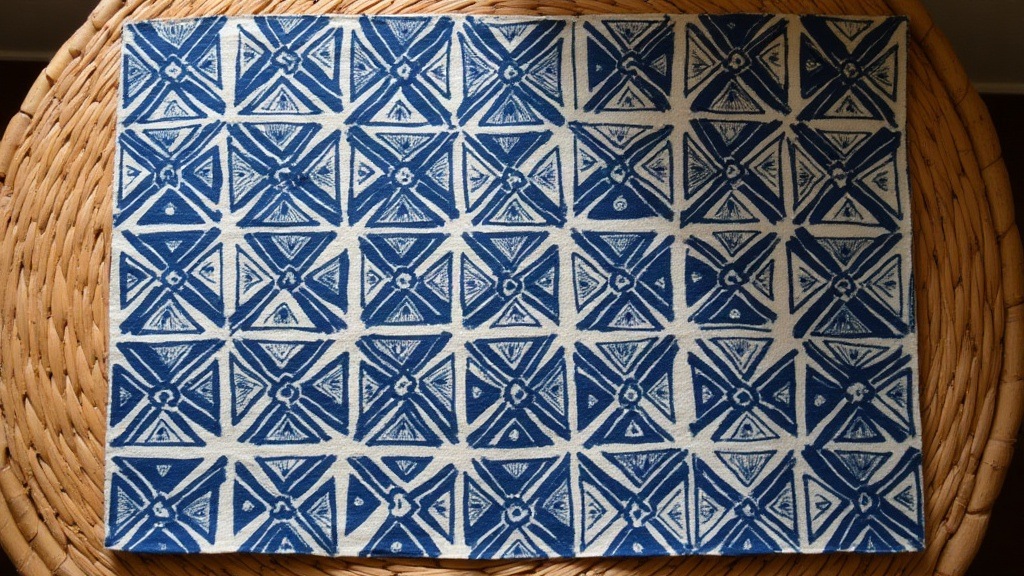
Adinkra Symbols: Visual Proverbs of Akan Wisdom
Adinkra symbols encode centuries of Akan thought into geometric patterns, each a visual proverb that teaches virtue, warns against folly, and connects the living to ancestral wisdom. Discover the stories and spiritual power behind these iconic marks.
Akan
Okomfo Anokye: Legendary Priest and Nation-Builder
Okomfo Anokye unified the Ashanti people through spiritual authority and political vision. Discover how a legendary priest transformed fragmented chiefdoms into a continental empire that challenged European powers.