

Sasabonsam: The Forest Monster of Akan Lore
In the dense forests of Ghana and Ivory Coast, the Sasabonsam stalks the darkness. This powerful forest creature from Akan mythology embodies the dangers lurking beyond the village boundary.
Contents
Deep in the forest of West Africa, where the canopy thickens and sunlight fractures into scattered pools, something moves through the branches. It is neither wholly animal nor human. The Akan peoples of Ghana and Ivory Coast have known this creature for generations: the Sasabonsam, a forest monster whose name alone carries the weight of ancient caution.
The Sasabonsam is not a god. It occupies a stranger space in Akan cosmology, a being that embodies the wilderness itself. It hunts. It kills. It tests the boundaries between the settled world and the untamed bush. For centuries, Akan hunters, merchants, and families have passed down stories of this creature, teaching children where danger lives and why the forest must always be treated with respect.
The Form and Nature of the Sasabonsam

The Sasabonsam appears as a massively tall humanoid creature, often described as standing higher than the tallest trees. Its body is lean and powerful, with long, spindly limbs that seem to stretch beyond natural proportion. The most distinctive feature is its legs: they curve backward at the joints, bending in a way no human legs can bend. This gives the creature an unnatural, predatory gait, perfectly adapted for movement through dense forest.
The creature's face varies in descriptions, though most accounts emphasize its hunger and intelligence. It has a powerful jaw and forward-facing eyes that pierce the darkness with unnatural sight. Some accounts describe its skin as dark and leathery, often covered in moss or forest matter that helps it blend into the trees. Its hands are described as having long, grasping fingers, capable of ripping and tearing with ease.
What separates the Sasabonsam from simple beasts is its deliberate malice. This is not an animal acting on instinct alone. The creature is intelligent, cunning, and patient. It stalks its prey. It understands human behavior. In some traditions, it is even said to speak, or at least to communicate through sounds that mimic human voices. This intelligence makes the creature far more dangerous than any ordinary predator.
The Sasabonsam is primarily a nocturnal hunter. It descends from the upper canopy after dark to search for prey. Akan tradition holds that the creature can see in complete darkness, giving it an overwhelming advantage against humans. Some accounts suggest it feeds on blood; others claim it hunts humans specifically, dragging victims back into the forest to devour them. The creature's appetite is legendary and apparently insatiable.
Habitat and Hunting Grounds
The Sasabonsam is not found everywhere in the forest. According to Akan lore, the creature inhabits the deepest, most remote sections of the bush, where human settlement is sparse and the wilderness remains largely untouched. Certain locations are known to be particularly dangerous. Deep water holes. Ancient grove sites. Areas where the forest grows so thick that daylight barely penetrates.
The creature has a special association with rivers and water sources. Some accounts place the Sasabonsam as a water spirit as well as a forest creature, emerging from deep pools or living in riverside caves. This dual nature ties the creature to both the terrestrial and aquatic domains, making the forest ecosystem itself a potential threat. A hunter drawing water from a remote stream faces not just thirst, but predation.
The Sasabonsam is territorial. Stories suggest that the creature maintains a domain within the forest, attacking or driving away anything that enters its space. Hunters who stray too far from known paths risk crossing invisible boundaries. Villages built too close to Sasabonsam territory report more attacks, more disappearances, a slow erosion of safety. The creature is patient enough to wait for mistakes, for the moment a hunter lowers his guard.
Sasabonsam in Akan Oral Tradition
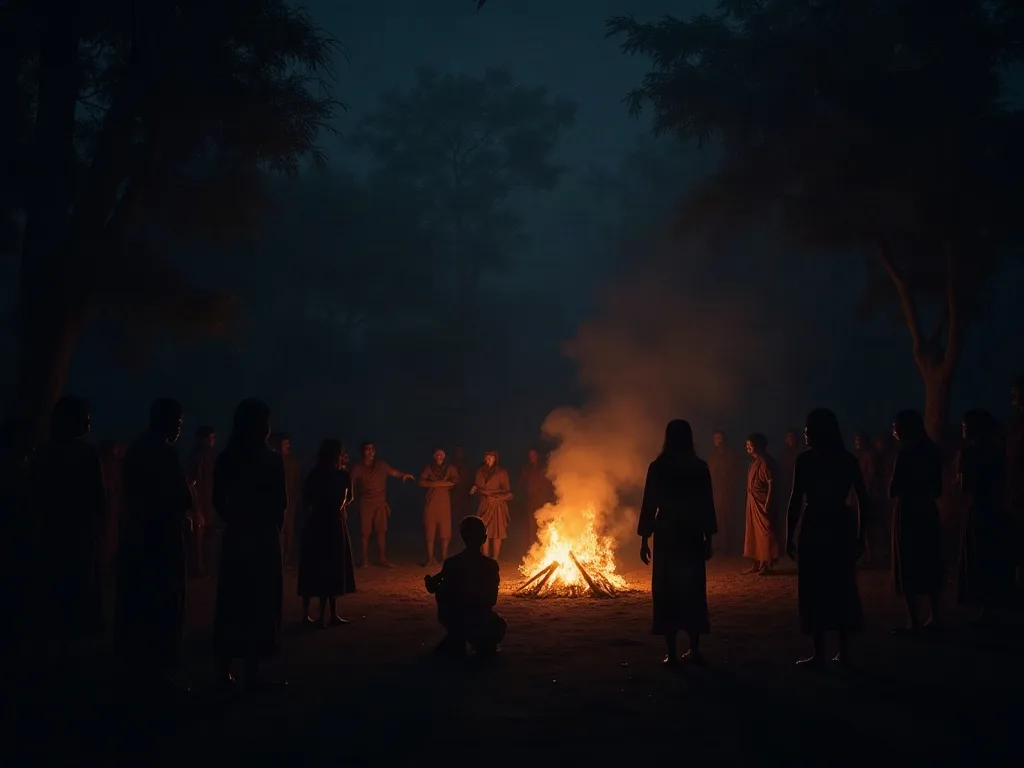
The creature appears frequently in Akan folk tales and cautionary narratives. These stories serve multiple purposes: they entertain, but they also educate. They teach hunters the rules of the forest. They explain why certain areas should be avoided. They remind people that the wilderness is not a human space, and entering it requires preparation, respect, and humility.
In many tales, the Sasabonsam is encountered by a solitary hunter or traveler who has ventured too far from safety. The hunter may have ignored warnings. He may have hunted at twilight or stayed in the forest after dark. The encounter is typically brief and catastrophic. The creature emerges with terrible speed. The hunter fights or flees. Death often follows. A lucky few survive by quick thinking, running toward water or rushing back toward the village.
Other narratives focus on the creature's intelligence and cunning. The Sasabonsam is described as capable of learning from experience, improving its hunting tactics, and adapting to human countermeasures. If hunters place traps, the creature may avoid them or even turn them against its hunters. If villages organize night watches, the creature may change its hunting time or strategy. This adaptability elevates the Sasabonsam beyond the status of a mere monster into something closer to a cunning adversary.
Some tales suggest that the creature can be bargained with or tricked. A clever protagonist might use the creature's own hunger or pride against it. A gift of food left at the forest boundary might satisfy the creature and prevent attack. These stories explore themes of negotiation with the wild, the possibility that not all danger can be eliminated but some can be managed through wisdom and respect.
The Sasabonsam also appears in tales where it serves as punishment for human transgression. A hunter who violates forest customs, who takes more game than needed, who wastes meat, or who shows disrespect to the forest spirits may find himself hunted by the creature. The Sasabonsam becomes an instrument of justice, enforcing the moral and ecological boundaries that Akan tradition maintains. Disrespect the forest, and the forest's guardian may exact a price.
The Sasabonsam and Wider Akan Cosmology
The Sasabonsam occupies a specific place within the broader Akan spiritual universe. The Akan peoples recognize multiple categories of non-human beings: deities (abosom), ancestral spirits (nananom), nature spirits tied to specific locations or phenomena, and creatures like the Sasabonsam that seem to defy easy classification.
The creature is not a god and is not typically addressed through formal worship or shrine offerings. Instead, it is a hazard to be avoided and negotiated with, much like a dangerous animal, but with the added dimension of intelligence and malevolence that pushes it beyond the purely animal realm. It exists in the margins of the spiritual world, powerful but not sacred, feared but not venerated.
Some scholars suggest that the Sasabonsam may represent an older, pre-Akan layer of forest belief, tied to the indigenous peoples who inhabited West African forests before the Akan expansion. The creature's connection to remote forest regions and its role as a boundary guardian aligns with beliefs found across many forest-dwelling cultures. Whether the Sasabonsam originated with the Akan or was adopted and adapted from neighboring traditions, it now represents a distinctly Akan way of understanding wild danger.
The creature also relates to broader Akan concepts of taboo and transgression. The forest has rules. Hunters have obligations. The Sasabonsam enforces these rules through violence. In this role, it serves a function similar to sacred laws and prohibitions found in many African traditions, though expressed through the creature's teeth and claws rather than through priestly pronouncement.
Modern Sightings and Persistence

Even in contemporary Ghana and Ivory Coast, accounts of Sasabonsam sightings persist. While formal belief in the creature may have declined in urban centers and among younger generations, the stories remain alive. Hunters still speak of it. Remote villages still maintain caution against forest creatures matching the Sasabonsam description. Folklore enthusiasts and anthropologists continue to collect and study accounts passed down through families.
Some modern accounts describe encounters with large, unusual primates (possibly forest chimpanzees or other great apes) that people interpret through the lens of Sasabonsam tradition. Whether the creature is purely mythological, based on misidentified animals, or the product of archetypal fears projected onto wilderness encounters, the tradition persists as a living part of Akan culture.
The Sasabonsam has also entered contemporary African literature and popular culture. Ghanaian and Ivorian writers reference the creature in novels and short stories. It appears in discussions of African mythology alongside more widely known figures. This cultural afterlife ensures that the creature remains part of the living conversation about what Akan tradition means in a modern context, even if the immediate danger it represents has diminished with deforestation and changing patterns of forest habitation.
The Psychology of the Sasabonsam
The Sasabonsam can be understood not merely as entertainment but as a psychological and social tool. The creature embodies real dangers: predators, disease, accident, the genuine hazards of entering unfamiliar territory without proper preparation. By giving these dangers a specific, named form, Akan tradition makes them comprehensible and potentially manageable.
Fear of the unknown is diffuse and paralyzing. Fear of the Sasabonsam is specific and actionable. Stay on known paths. Hunt with companions. Return before dark. Respect the forest. Follow these rules, and you reduce the likelihood of encountering the creature. The creature becomes a vehicle for transmitting practical survival knowledge.
The Sasabonsam also serves as a symbol of human limitation. The forest is vast. Humans are small. However clever or skilled, a lone person in deep wilderness is vulnerable. The creature represents this vulnerability made manifest. It is a humbling presence, a reminder that nature is not human-scaled and that human dominion over the land has limits.
Frequently Asked Questions About Sasabonsam: The Forest Monster
Frequently asked questions
Is the Sasabonsam a deity in Akan religion?
No. The Sasabonsam is not a god and is not formally worshipped. It occupies a different category in Akan cosmology: a powerful, dangerous being associated with the wild forest, but not one that receives religious devotion or shrine offerings. It is feared and respected, but not venerated as a divine entity.
What is the Sasabonsam's relationship to hunting and hunters?
The creature is both a threat to hunters and, in some stories, a enforcer of hunting ethics. Hunters who over-hunt, waste meat, or violate forest customs may find themselves hunted by the Sasabonsam. The creature embodies the principle that the forest's resources are not infinite and that hunters have obligations to the land they depend on.
Are there other West African creatures similar to the Sasabonsam?
Many West African forest cultures have stories of powerful, dangerous forest beings. These creatures often share characteristics: unusual physical form, intelligence, connection to water or deep forest, and a role as boundary guardians or enforcers of taboo. The Sasabonsam is distinctly Akan, but it reflects widespread forest-dwelling anxieties about the dangers lurking in untamed wilderness.
What practical purpose do Sasabonsam stories serve in Akan culture?
The stories transmit practical knowledge about forest survival: where danger is greatest, why night hunting is perilous, why hunters must travel in groups, and why respect for the forest's autonomy is essential. The creature makes abstract ecological principles concrete and memorable, using fear as a teaching tool.
Can the Sasabonsam be defeated or killed?
Akan tradition does not emphasize the creature's defeat in the way some mythologies might emphasize a hero slaying a monster. Instead, the focus is on avoidance and respect. The Sasabonsam cannot be reasoned with permanently or defeated outright. It can only be evaded or negotiated with temporarily. This reflects a worldview in which the wild is not conquered but coexisted with.
Why does the Sasabonsam have backward-bending legs?
The backward bend is described as an adaptation for movement through the forest canopy and dense vegetation. It gives the creature extraordinary agility and grace in environments where humans are clumsy and slow. The unusual anatomy also marks the creature as fundamentally non-human, unsettling to encounter and impossible to mistake for anything civilized.
The Sasabonsam and Human Boundaries
The Sasabonsam ultimately represents the frontier between human order and wild autonomy. It stands at the point where the Akan village ends and the forest begins. It enforces that boundary through violence and fear. To understand the creature is to understand how the Akan people have conceptualized their relationship with the land they inhabit: as inhabitants and users of resources, yes, but not as masters.
The persistence of Sasabonsam stories across centuries and the creature's continued presence in modern Akan imagination testify to the enduring power of this symbolism. Even as the actual forest shrinks and encounters with large wild creatures become rarer, the creature remains a cultural anchor, a way of remembering what the forest means and what respect it demands. In this sense, the Sasabonsam is as much a teacher as it is a monster.
Read the full book
Want the whole story?
The complete edition is an instant PDF download here, with a paperback on Amazon for selected titles.
Akan
The Akan Mythology Book: Anansi, Nyame, and the Gods of West Africa
Anansi, Nyame, and West Africa
From the Ashanti and the gold coast of Ghana: Nyame the sky god, Asase Yaa the earth, the abosom spirits, and Anansi the spider, the trickster who bought all the world’s stories from the sky and whose tales crossed the Atlantic with the enslaved.
More from Akan
All articles
Akan
Odwira Festival: Purification and Ancestral Rites in Akan Tradition
The Odwira Festival is Akan Ghana's ceremonial cleansing where communities honor ancestors and gods, purging the year's sorrows before harvest. Rooted in sacred kingship and the bond between living and the dead, Odwira binds generations through ritual fire, feasts, and the renewal of covenant.

Akan
Adinkra Symbols: Visual Proverbs of Akan Wisdom
Adinkra symbols encode centuries of Akan thought into geometric patterns, each a visual proverb that teaches virtue, warns against folly, and connects the living to ancestral wisdom. Discover the stories and spiritual power behind these iconic marks.
Akan
Okomfo Anokye: Legendary Priest and Nation-Builder
Okomfo Anokye unified the Ashanti people through spiritual authority and political vision. Discover how a legendary priest transformed fragmented chiefdoms into a continental empire that challenged European powers.

Akan
Asase Ya: Earth Goddess and Mother of the Dead
Asase Ya sustains the living through soil and grain, then welcomes the dead into her body. Meet the Akan earth mother whose dual power over fertility and the afterlife makes her the most essential force in West African cosmology.