Akan
Explore the rich spiritual world of the Akan people of Ghana and Ivory Coast, from Nyame the sky god to the Nsamanfo ancestors who guide the living
Browse Akan
The Akan people of present-day Ghana and Ivory Coast have sustained one of West Africa's most sophisticated religious and philosophical systems for centuries. Unlike mythologies preserved primarily in ancient texts, Akan belief remains a living tradition, woven into festivals, proverbs, art, and daily ritual. At its heart lies a cosmology that balances the authority of a distant creator god with the intimate presence of ancestors, lesser deities, and spirits who inhabit the natural world.
This is not a mythology frozen in time. Akan religious thought has absorbed influences from Islam and Christianity while retaining its structural integrity, a testament to the flexibility and depth of its core concepts. Understanding Akan mythology means engaging with a worldview in which the spiritual and material realms interpenetrate, where every river, tree, and crossroads may harbor divine presence, and where the dead remain active participants in the lives of their descendants.
The Akan People and Their Cultural Landscape
The Akan constitute a major ethnic and linguistic group in West Africa, comprising the Asante, Fante, Akuapem, Akyem, Kwahu, and other subgroups. Their languages belong to the Kwa branch of the Niger-Congo family. Historically, the Akan established powerful states, most famously the Asante Empire, which dominated the region from the late seventeenth century until British colonization. The Golden Stool of the Asante, believed to house the soul of the nation, remains the supreme symbol of Akan political and spiritual unity.
Akan society is matrilineal. Inheritance, succession, and clan identity pass through the mother's line, a structure that profoundly shapes religious practice. The abusua (matrilineal clan) forms the basic unit of social and spiritual organization. Each clan venerates its own ancestors and observes specific taboos. The ntoro, inherited from the father, contributes spiritual characteristics but does not determine lineage. This dual system creates a complex web of obligations and protections, both human and supernatural.
Geographically, the Akan heartland spans the forested interior and coastal plains of southern Ghana and southeastern Ivory Coast. The forest itself holds sacred significance. Groves, rivers, and mountains serve as dwelling places for the abosom (lesser gods), and certain trees are never felled without ritual propitiation. The land is not mere backdrop but an active participant in the mythological drama.
Cosmology: The Structure of Reality
Akan cosmology divides existence into overlapping realms. At the apex stands Nyame (also Onyame, Onyankopon), the sky god and supreme creator. Nyame is omnipotent, omniscient, and fundamentally benevolent, yet remote from daily human affairs. The name Onyankopon translates roughly as "the one who alone is great" or "the shining one above." Nyame created the universe, established moral law, and delegated the governance of earthly matters to subordinate powers.
Beneath Nyame exists Asase Ya (also Asase Yaa), the earth goddess. She is Nyame's wife in some accounts, his complement in others. Asase Ya embodies fertility, agriculture, and the moral order rooted in the land. Thursday is sacred to her; farmers traditionally refrain from working the fields on that day. The earth itself is her body, and to harm it without permission invites her wrath. Oaths sworn upon the earth carry absolute binding force because they invoke her witness.
Between sky and earth move the abosom, a diverse class of deities associated with natural phenomena. Rivers, lakes, the ocean, and certain mountains each have their presiding obosom (singular). These gods possess distinct personalities, preferences, and spheres of influence. They are not omnipotent but powerful, capable of blessing or cursing those who approach them. The abosom serve as intermediaries between Nyame and humanity, more accessible than the distant creator yet more formidable than human ancestors.
The Nsamanfo (ancestors) occupy a crucial position in Akan religious life. Death does not sever the bonds of kinship. The deceased continue to watch over their living descendants, offering guidance, protection, and occasionally punishment for moral failings. Ancestors who lived virtuously and died at an appropriate age become nsamanfo, honored in household shrines and invoked at family gatherings. Those who died badly, violently, or prematurely may become restless spirits, requiring special rituals to pacify them.
Finally, the Akan recognize various lesser spirits and forces: asuman (charms and talismans imbued with spiritual power), sasabonsam (malevolent forest spirits), and mmoatia (dwarfish trickster beings). The world teems with unseen agencies, and navigating it safely requires knowledge, ritual expertise, and moral rectitude.
Nyame: The Supreme Creator
Nyame stands at the center of Akan theology, yet paradoxically remains peripheral to everyday worship. This is not a god who demands temples or daily sacrifice. Instead, Nyame's presence is acknowledged through proverbs, oaths, and the structure of the cosmos itself. The Akan say, "If you want to speak to Nyame, speak to the winds," recognizing the creator's omnipresence and inscrutability.
Several myths explain Nyame's withdrawal from direct contact with humanity. In one widespread account, Nyame once lived close to the earth. An old woman pounding fufu (a staple food) with her pestle repeatedly struck the sky, annoying Nyame, who retreated higher and higher until the present distance was established. The story encodes a theological principle: the sacred must maintain separation from the profane, and human actions have cosmic consequences.
Nyame's attributes include justice, wisdom, and life-giving power. The Akan attribute the gift of rain to Nyame, and drought is understood as divine displeasure. Yet Nyame does not micromanage. The creator established laws, both natural and moral, and expects humans to navigate them with intelligence and respect. Violations bring consequences, but these often manifest through the abosom or ancestors rather than direct divine intervention.
Interestingly, Akan religious thought does not posit a cosmic antagonist to Nyame. There is no devil figure, no primordial evil locked in eternal struggle with the good. Evil exists, but it arises from human choices, spiritual imbalance, or the capricious actions of lesser beings. This theological optimism contrasts with dualistic systems and reflects the Akan emphasis on harmony, balance, and the restoration of proper relationships.
Asase Ya: The Earth Goddess and Moral Foundation
If Nyame governs the heavens, Asase Ya governs the earth, and with it, the moral and agricultural life of the Akan. She is mother, judge, and witness. The earth provides sustenance, but it also demands respect. Farmers pour libations to Asase Ya before planting, thanking her for fertility and asking permission to disturb her body. At harvest, they offer the first fruits in gratitude.
Asase Ya's role extends beyond agriculture. She is the ultimate arbiter of truth. Oaths sworn while touching the ground invoke her as witness, and perjury committed in her name brings swift retribution. Murderers who spill blood upon the earth offend her directly, and the land itself may become barren until proper atonement is made. This belief underpins Akan jurisprudence and conflict resolution, embedding legal practice within a sacred framework.
Thursday, as noted, belongs to Asase Ya. On this day, the earth rests. Traditional farmers avoid tilling, planting, or harvesting. The prohibition extends to certain ritual activities as well. Violating the taboo risks crop failure, illness, or other misfortunes. The practice reinforces the cyclical nature of time and the necessity of periodic rest, a rhythm that mirrors the earth's own regenerative processes.
Myths surrounding Asase Ya often emphasize her patience and her limits. She tolerates much from humans, but when boundaries are crossed, her response is inexorable. Unlike the abosom, who may be appeased with offerings, Asase Ya's justice is structural. The earth remembers. Blood seeps into the soil. The dead are buried in her embrace. She is both nurturing mother and implacable judge, a duality that defines the Akan relationship with the land.
The Abosom: Gods of River, Forest, and Sea
The abosom are Nyame's children, agents, or messengers, depending on the account. Each presides over a specific domain and possesses a distinct personality. They are not omnipotent, but within their spheres, they wield considerable power. Humans approach them through priests and priestesses, who undergo rigorous training and initiation to serve as intermediaries.
Tano, the river god, is among the most prominent. The Tano River, flowing through Ghana, is his physical manifestation. Tano is associated with healing, fertility, and justice. His priests, known as akomfo, enter trance states to deliver oracles and perform rituals. Shrines to Tano dot the riverbanks, and devotees bring offerings of eggs, sheep, and cloth. Tano's festivals involve drumming, dancing, and ritual purification in the river's waters.
Bosomtwe is the deity of the sacred lake of the same name, a crater lake in the Ashanti region. The lake is considered the resting place of the souls of the dead before they journey to the afterlife. Fishing is permitted only from wooden planks, never from boats, and certain species are taboo. Bosomtwe is a gentler deity, associated with rest, reflection, and the transition between life and death.
Bia, another river god, governs the Bia River and is known for his fierce temperament. Bia punishes oath-breakers and those who violate ritual prohibitions. His worship involves more stringent taboos and more dramatic possession rituals. The abosom are not interchangeable; each has preferences, dislikes, and a unique relationship with the communities that honor them.
The ocean, too, has its deity, often called Bosompo or Nana Bosompo. Coastal Akan communities, particularly the Fante, maintain shrines to the sea god. Fishermen offer prayers and libations before setting out, asking for safe passage and abundant catches. The ocean is powerful and unpredictable, and Bosompo reflects these qualities: generous to those who respect him, deadly to those who do not.
Priests and Possession
The akomfo (priests and priestesses of the abosom) occupy a crucial role in Akan religious life. They are not born into their positions but called by the gods, often through illness, dreams, or sudden behavioral changes. The initiation process is lengthy and demanding, involving seclusion, instruction in ritual, and the cultivation of the ability to be possessed by the deity.
During possession, the okomfo (singular) becomes the mouthpiece of the god. The deity speaks through them, delivering judgments, prophecies, and instructions. The possessed priest may exhibit superhuman strength, speak in archaic language, or perform feats of endurance. This is not theater but genuine religious experience, understood by participants as direct divine communication.
The akomfo also prepare charms, perform healing rituals, and mediate disputes. They are compensated for their services, but their authority derives from the god, not from wealth or political power. A priest who loses the god's favor, through moral failing or ritual error, loses their position. The system is self-regulating, grounded in the belief that the gods themselves enforce standards of conduct.
Ancestors: The Nsamanfo and the Living Dead
Ancestor veneration is the most pervasive aspect of Akan religious practice. The nsamanfo are not distant figures but immediate presences, involved in the daily lives of their descendants. They are consulted in times of crisis, thanked for blessings, and reproached when things go wrong. The boundary between living and dead is permeable, maintained through ritual, memory, and moral behavior.
Not all dead become honored ancestors. To join the nsamanfo, one must have lived a good life, fulfilled social obligations, and died at an appropriate age. Those who die young, violently, or in childbirth may become asaman bɔne (bad spirits), restless and potentially harmful. Special rituals are required to pacify them or guide them to the proper realm. The Akan funeral is thus not merely a farewell but a transformation, a process of turning the deceased into an ancestor.
Funerals are elaborate, expensive, and socially obligatory. They involve drumming, dancing, feasting, and the recitation of the deceased's lineage and accomplishments. The body is washed, dressed in fine cloth, and displayed for mourners. Libations are poured, and offerings are made to ensure the deceased's safe passage to Asamando, the land of the dead. The funeral is also a moment of social reckoning, when debts are settled and inheritances distributed.
Once established as an ancestor, the deceased is honored in household shrines. These are simple affairs: a blackened stool, a pot, or a designated corner where libations are poured. On important occasions, the family gathers to "feed" the ancestors with offerings of food, drink, and prayer. The ancestors, in turn, are expected to protect the family, ensure fertility, and provide guidance through dreams or divination.
The Blackened Stool
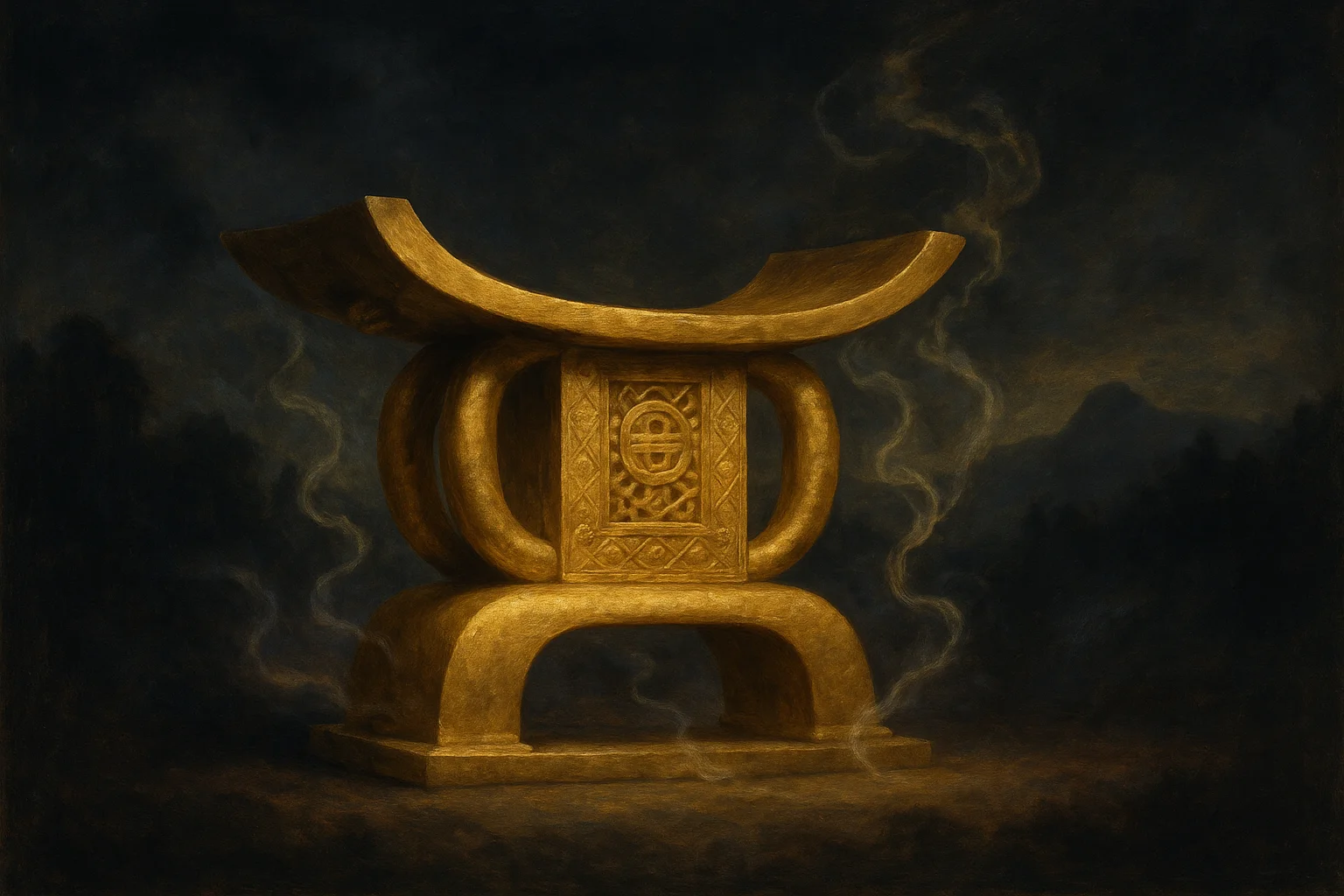
The stool is the supreme symbol of Akan political and spiritual authority. Chiefs are not crowned but "enstooled," seated upon the stool of their office. When a chief or important elder dies, their stool is blackened with soot and egg yolk, transforming it into a shrine for their spirit. The blackened stool is kept in a special room, the nkonwafie (stool house), and honored at annual festivals.
The most famous example is the Golden Stool of the Asante, believed to have descended from the sky in the early eighteenth century during the reign of Osei Tutu. The priest Okomfo Anokye summoned it, and it landed on the king's lap, signifying divine approval. The Golden Stool is not sat upon; it is the soul of the Asante nation, and its capture or desecration would mean the end of the people. When the British attempted to seize it in 1900, the result was the War of the Golden Stool, a fierce resistance that underscored the stool's sacred significance.
Creation Myths and Cosmogonic Narratives
Akan creation narratives are less concerned with the mechanics of cosmic origins than with the establishment of order and relationship. Nyame creates the world, but the focus is on what comes after: the separation of sky and earth, the delegation of authority to the abosom, and the creation of humanity.
One account describes Nyame creating the first humans from clay, shaping them and breathing life into them. Another tells of humans emerging from holes in the ground, led by the ancestors of the various clans. These narratives are not mutually exclusive; Akan mythology is comfortable with multiple versions of the same story, each emphasizing different aspects of truth.
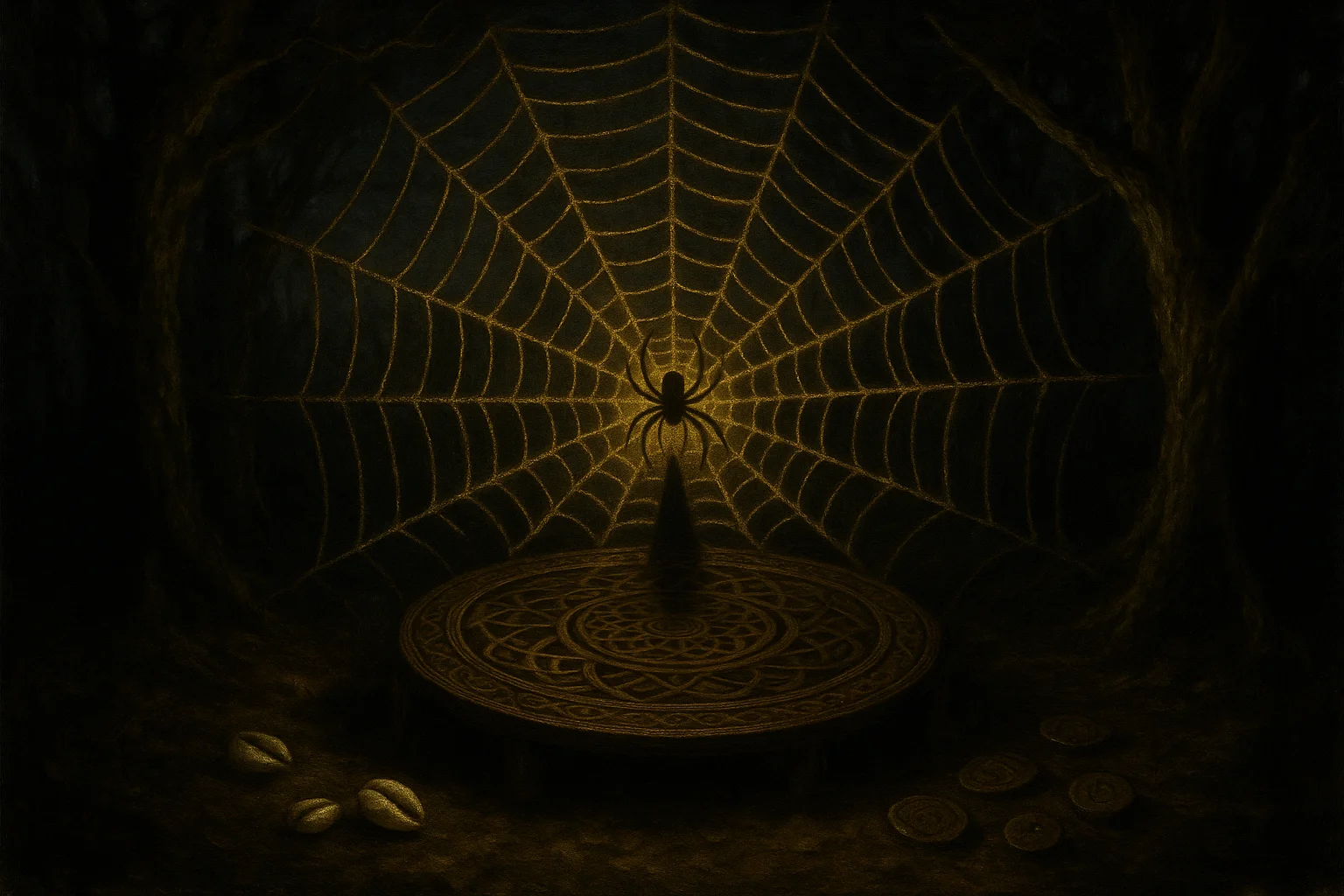
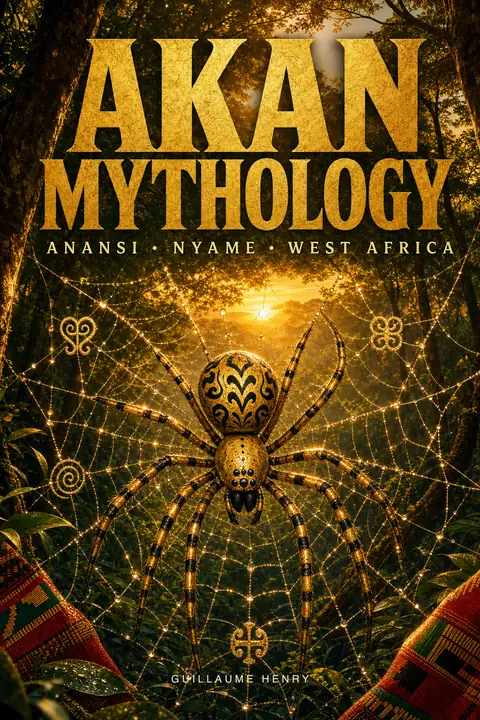
The spider god Anansi appears in many Akan narratives, though he is more trickster than creator. Anansi is clever, greedy, and amoral, using his wits to outsmart stronger opponents. In one famous cycle, Anansi tricks Nyame into giving him all the world's stories, which is why tales are called "spider stories" (Anansesem). Anansi's exploits are humorous and instructive, teaching lessons about intelligence, cunning, and the consequences of overreaching.
Anansi's role in Akan mythology is complex. He is not a god in the strict sense but a liminal figure, part human, part animal, part spirit. His stories are told for entertainment, but they also encode moral and social lessons. Anansi embodies the ambiguity of cleverness: it can save you or destroy you, depending on how it is used. His popularity spread throughout the African diaspora, where he became a symbol of resistance and survival under oppression.
Rituals, Festivals, and the Ritual Calendar
Akan religious life is structured by a complex ritual calendar. The most important festival is Adae, held every 21 days (following the Akan calendar cycle). Adae is a day of rest and ancestor veneration. Chiefs and family heads pour libations, offer food to the blackened stools, and recount the deeds of the ancestors. It is a moment of renewal, when the living reaffirm their connection to the dead and seek their blessings.
The Odwira festival, celebrated annually by the Asante and other Akan groups, is a time of purification and renewal. It marks the harvest and the beginning of the new year. During Odwira, the blackened stools are brought out, cleaned, and honored. Disputes are settled, debts are forgiven, and the community is ritually cleansed. The festival culminates in a grand durbar, where the chief appears in full regalia, surrounded by elders, priests, and subjects.
Other festivals honor specific abosom. The Tano festival involves processions to the river, ritual bathing, and offerings. Devotees dress in white, the color of purity, and the akomfo enter trance states to deliver oracles. These festivals are not merely religious observances but social events, reinforcing community bonds and collective identity.
Libation, the pouring of water or alcohol onto the ground, is the most ubiquitous Akan ritual. It accompanies every significant event: births, marriages, funerals, business transactions, and political gatherings. The one who pours the libation invokes Nyame, Asase Ya, the abosom, and the ancestors, asking for their presence and blessing. The ritual is simple but profound, a constant reminder that the living do not act alone.
Akan Mythology in the Modern World
Akan religious practice has proven remarkably resilient. Despite centuries of contact with Islam and Christianity, and despite the disruptions of colonialism and modernization, core beliefs and practices persist. Many Akan people identify as Christian or Muslim while continuing to honor their ancestors and consult traditional priests. This is not syncretism in the sense of blending distinct systems but a layered identity, where different modes of religious engagement coexist.
The Akan diaspora, particularly in the Caribbean and the Americas, has preserved and transformed these traditions. In Jamaica, Suriname, and other regions, Akan religious concepts merged with those of other African peoples and with European influences, giving rise to new forms such as Kumina and Winti. Anansi stories remain popular throughout the Caribbean, adapted to local contexts but retaining their core character.
In Ghana and Ivory Coast, traditional festivals continue to draw large crowds, and the authority of chiefs, grounded in their spiritual role, remains significant. The Asante king, the Asantehene, is not merely a ceremonial figure but a living embodiment of the nation's spiritual and political unity. His enstoolment, his participation in festivals, and his mediation of disputes all reflect the ongoing vitality of Akan religious thought.
Contemporary Akan intellectuals and artists engage with their mythology in new ways. Writers draw on Anansi stories, visual artists depict the abosom, and musicians incorporate traditional rhythms and themes. The mythology is not a relic but a living resource, continually reinterpreted to address contemporary concerns. Issues of environmental degradation, for instance, are framed in terms of offenses against Asase Ya, and calls for ecological responsibility invoke traditional concepts of balance and respect.