

Asase Ya: Earth Goddess and Mother of the Dead
Asase Ya sustains the living through soil and grain, then welcomes the dead into her body. Meet the Akan earth mother whose dual power over fertility and the afterlife makes her the most essential force in West African cosmology.
Contents
The Akan peoples of Ghana and Côte d'Ivoire pour libations onto bare earth every morning. Water touches soil before it touches any other god's altar. This is not custom for courtesy's sake. This is survival recognizing its source. Asase Ya, the earth goddess, is the force that feeds, holds, and ultimately claims every living thing. She requires no grand temples, no priests in ceremonial cloth. She requires acknowledgment: the spilled drink, the spoken name, the knee bent to the ground itself.
In the pantheon of Akan religion, Asase Ya sits beneath everything. Not below in rank, but foundational in the deepest sense. The sky god Nyame may command thunder and ordain fate. The lesser spirits may inhabit rivers and groves. Yet without Asase Ya, no seed germinates, no corpse finds peace, no ancestor can rest in the soil that bore them. She is the premise on which all other divinity operates.
Origins and the Akan Cosmos
The Akan understanding of creation places Asase Ya not as a newcomer to an empty void, but as an original principle of existence. The earth was not made. The earth is. From the Akan oral tradition, preserved and studied by anthropologists like R.S. Rattray in the early twentieth century, we learn that the cosmos contains several strata. Nyame, the sky god, dwells above and initiates motion. Below him exist layers of spirit and substance, anchored always by the earth itself. Asase Ya is not separate from matter; she is matter made conscious, the soil given will and power.
Some Akan accounts suggest that Asase Ya and Nyame are paired in eternal complementarity, rather like husband and wife, though not in the jealous or subordinate sense Western ears might assume. Each governs a sphere. Nyame brings the rains, declares the seasons, assigns fates. Asase Ya receives what falls, transforms it, and returns it as life. Her dominion is complete transformation: the dead leaf becomes soil; the soil becomes food; the food becomes flesh; the flesh returns to soil. This is her cycle, endless and inevitable.
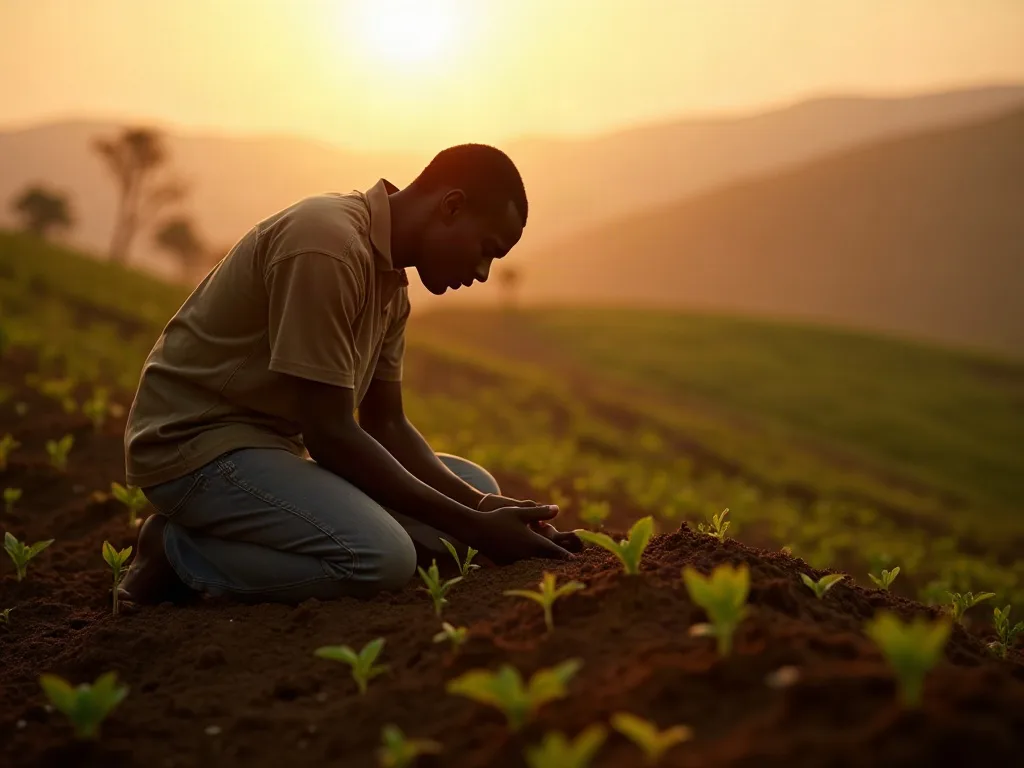
The Akan recognize Asase Ya as both giver and taker. This is not cruelty on her part. It is the condition of existence in a world where nothing is wasted, where every ending is a beginning in different form. She does not punish by taking life. She merely completes what is. Her justice is embedded in the turning of seasons.
Asase Ya as Fertility and Sustenance
Before Asase Ya becomes the mother of the dead, she is the mother of the living. Every grain of millet, every yam pulled from the earth, every palm oil extracted from soil-grown trees is her gift. The Akan farmer does not see farming as conquest or domination of nature. The farmer is in conversation with Asase Ya, asking permission through ritual, accepting what she grants, and offering gratitude in return.
The most visible form of this relationship appears in agricultural rituals. Before planting season, the Akan conduct ceremonies that honor Asase Ya directly. Some groups perform Apo, a purification rite in which the earth goddess is invoked to cleanse the land of harmful spirits and prepare it for new growth. Farmers pour palm wine or water onto bare ground, speaking her name: "Asase Ya, we ask your blessing. Accept this libation. Let our fields be fertile." The gesture is specific. The address is direct. There is no intermediary between the person and the goddess of the soil beneath their feet.
The Akan say that hunting is a relationship with the spirits of the forest and the sky. Fishing is a pact with the waters. But farming is a covenant with Asase Ya. She owns the fields. Humans tend them as stewards, not proprietors. A man who clears land without proper invocation to Asase Ya risks her displeasure: the soil may refuse to yield, or yield only hardship. A woman who plants without speaking to the earth may find her crops consumed by blight or drought. This is not superstition in the sense of irrational fear. This is the encoding of sustainable relationship into spiritual language.
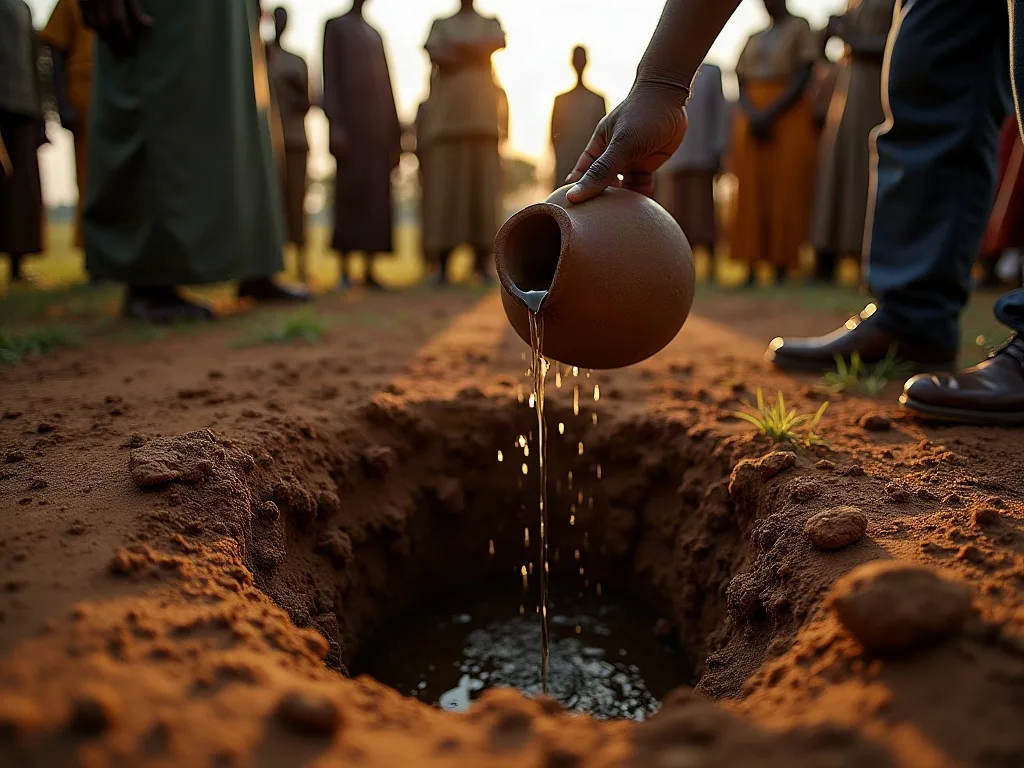
The abundance Asase Ya grants is abundant precisely because it is managed with respect and reciprocity. The Akan do not strip a field bare year after year. They rotate crops, let land rest, and thank Asase Ya for her patience. In this way, the goddess's power over fertility becomes inseparable from wisdom about land use and long-term survival.
Asase Ya and the Realm of the Dead
Where Asase Ya becomes most powerful, most fearful, and most essential is in her role as guardian of the dead. When an Akan person dies, their body returns to earth. But the relationship between the deceased and Asase Ya continues in the spiritual realm. The earth does not simply consume the body as a grave consumes waste. The earth receives the ancestor, shelters them, and holds their connection to the living world.
The Akan believe that the dead do not vanish. They enter into a different mode of existence, one in which they remain bound to their living relatives through complex spiritual ties. The ancestors watch, advise, and sometimes intervene in the affairs of the living. Yet they can only do so if they are properly settled in the realm of Asase Ya. A person who dies without proper burial, or whose grave is desecrated, becomes a restless spirit, unable to find peace in the earth that should receive them. This is not ghosts haunting out of malice. This is spirits in distress, seeking the shelter that Asase Ya alone can provide.
Funeral rites in Akan culture are therefore acts of negotiation with Asase Ya. The ceremony is not addressed to the deceased alone, but to the earth goddess who will receive them. Libations are poured. Prayers acknowledge that the body is returning to its source. The grave is prepared with care because it is sacred ground, a threshold between the living world and the realm where Asase Ya maintains the dead in peace.
Some Akan traditions hold that Asase Ya herself determines the fate of the dead based on how they lived. A person who lived with integrity, who honored Asase Ya through proper farming and respect for the earth, may find ready welcome in her domain. One who violated the earth, who deceived in business, or who shed blood wrongfully may find the soil resistant, cold, unwelcoming. In this way, Asase Ya becomes a moral arbiter, not through judgment from above but through the very nature of the earth's acceptance or rejection.
Rituals and Invocations
The practical devotion to Asase Ya differs markedly from how many West African peoples approach other deities. She receives no animal sacrifices, at least not in any Akan tradition widely documented. The reason is simple: she is not hungry for blood. She feeds on what the earth produces; she returns to herself what dies naturally. A libation of water, palm wine, or gin, poured directly onto bare soil, is the appropriate offering.
The timing of these libations matters. Many Akan groups perform them at dawn, when the earth is still cool and the spirits are closest to the waking world. The person libating may speak extemporaneously, without fixed words, or may follow a traditional formula taught within their family or clan. Common invocations include requests for fertility (of land, of family, of endeavor), for safe passage of the dead, for protection of children, or for forgiveness if one has violated the earth through careless action.
Some Akan towns observe an annual Apo ceremony, a wider community ritual in which the earth goddess is honored collectively. During this time, quarrels are settled, old debts forgiven, and communal land is cleansed and rededicated to her care. The ceremony resets the relationship between the people and Asase Ya, acknowledging that another year has passed, that the earth has been walked upon, worked, and will now receive the new season's weight.
Certain days are sacred to Asase Ya. In many Akan communities, Thursday is her day, though this varies by region and clan. On that day, one does not dig the earth unnecessarily, does not pour waste onto her surface, and makes a special point to acknowledge her with a libation if the day allows it. This is not absolute prohibition. It is a way of maintaining heightened awareness of the goddess's presence, of preventing the casual taking of the earth for granted.
The Position of Asase Ya Among Akan Deities
To understand Asase Ya is to understand that the Akan religious universe is not a hierarchy of powerful gods competing for human attention. Rather, it is a cosmos of interlocking forces, each sovereign in their domain. Nyame, the sky god, is often called the supreme being, but this supremacy operates in a specific register: he is supreme as the initiator, the one who sets the structure of fate and the seasons. Yet Nyame cannot feed anyone. He cannot house the dead. He cannot do the work that Asase Ya does daily, without rest, without ceremony, with absolute constancy.
The abosom, the spirits of particular places (rivers, hills, forests), are powerful and must be respected. They can bless hunters, grant fertility of specific kinds, and punish those who violate their sacred spaces. Yet the abosom themselves are embedded in Asase Ya's domain. The river spirit dwells in the river that flows across Asase Ya's body. The forest spirit guards trees that grow from her soil. Asase Ya is the substrate on which all other divinity operates.
This has profound implications for how the Akan relate to the cosmos. It means that proper relationship with Asase Ya is non-negotiable. You can neglect the lesser spirits if you keep clear of their territory. You can maintain a distant respect toward Nyame while going about your business. But you cannot neglect Asase Ya. Every step you take is a contact with her. Every meal you eat comes from her. Every grave you dig opens her body. The goddess of the earth cannot be ignored because existence itself is impossible without her.
Asase Ya in Historical and Contemporary Practice
When enslaved Africans arrived in the Americas, they brought the memory of Asase Ya with them. In some Afro-Caribbean and African diaspora traditions, particularly those influenced by Akan spiritual heritage, a goddess analogous to Asase Ya appears under different names, incorporated into syncretic systems. However, the direct worship of Asase Ya persists most vividly in Ghana and Côte d'Ivoire, where Akan culture remains a living, practiced tradition.
In modern Ghana, the earth goddess retains her importance even in communities touched by Christianity and Islam. A grandmother may pour a libation to Asase Ya before breakfast, not as a violation of monotheistic faith, but as an acknowledgment of the local powers that govern the physical world. This coexistence is not new. It reflects a long history in which Akan people have integrated new beliefs without abandoning the fundamental recognition that the earth beneath their feet requires respect.
Scholars of African religion, including John Mbiti and Kwame Gyekye, have emphasized that Akan spirituality centers on relationship rather than dogma. Asase Ya exemplifies this perfectly. She is not worshipped because a scriptural text commands it. She is respected because farmers know from direct experience that the soil responds to how they treat it, that the dead rest more peacefully when properly buried, that the earth itself seems to have a will and a memory.

Contemporary Akan communities continue traditional invocations, particularly around planting season and during funeral rites. In some areas, young people who migrate to cities find themselves returning to these practices when they face uncertainty or when they wish to honor dead parents. The gesture of pouring libation to Asase Ya becomes a way of maintaining connection to ancestral land and to the forces that made survival possible for countless generations.
The Duality of Asase Ya: Life and Death
One of the most distinctive aspects of Asase Ya's power is that she embodies what might seem like a contradiction. She is the giver of life and the taker of life. She is fertile and fallow. She is the beginning and the ending. But this is not contradiction in Akan thought. It is completeness. A god or goddess who could only give would be unbalanced. A force that could only take would be monstrous. Asase Ya is balanced because she does both, and she does both justly, with the same eternal patience.
The Akan say that a person who fears Asase Ya fears what cannot be avoided. The goal is not to fear her, but to respect her. There is a difference. Respect acknowledges that a force is real, consequential, and worthy of proper address. Fear in the sense of dread is what remains when respect is absent or broken. A farmer who cares for the soil, who honors Asase Ya through ritual and sustainable practice, does not fear her. A person who violates the earth or forgets to acknowledge her may find themselves facing the consequences of that negligence, and then fear becomes appropriate.
This balance extends to how Akan people understand death itself. Death is not punishment or accident. It is the moment when a person's particular story ends and their eternal story begins. The person moves from the realm of the living into the realm of Asase Ya. This is not a tragedy. This is a transition. The living grieve, yes. But the grief is not rage at an unjust god. The grief is love recognizing that a presence has changed form, not vanished.
Asase Ya in Akan Proverbs and Philosophy
The wisdom of the Akan people about their earth goddess is embedded in their proverbs and sayings. To speak about Asase Ya is to speak about what is real, what endures, what cannot be moved or negotiated with. "Asase Ya does not rush," the elders might say, meaning that patience and long-term thinking are aligned with the nature of the earth itself. To farm without patience is to farm against Asase Ya's rhythm.
Another saying captures her dual power: "The earth receives all." This acknowledges both her generosity in receiving the seed planted and her inevitability in receiving the dead. There is no escape from Asase Ya. There is only the choice to approach her with honor or with negligence.
The proverbs also contain warnings. A person who lives dishonestly is said to be "building on sand" or "planting in stone," images that suggest that Asase Ya herself will not cooperate with falsehood or greed. The earth's refusal is not spoken as magical punishment. It is portrayed as natural consequence. If you treat the land with disrespect, the land will not yield. If you exploit and deceive, eventually you will find yourself unsupported, standing on nothing solid.
These are not merely moral tales. They reflect genuine ecological and social observation: communities that care for their soil prosper; communities that exhaust their land fail. Asase Ya's "justice" is the justice of natural law, built into the structure of the physical world.
The Scholar's Understanding of Asase Ya
Anthropological and religious studies on the Akan have accumulated over more than a century, beginning with scholars like R.S. Rattray, who lived among the Ashanti in the 1920s and conducted extensive interviews about spiritual beliefs and practices. Later scholars including Eva Meyerowitz, Kwame Asare Opoku, and Ivor Wilks have added layers of interpretation and cross-cultural comparison.
From these sources, a consistent picture emerges: Asase Ya is not a peripheral or optional deity. She is central to Akan cosmology, agriculture, mortuary practice, and ethics. Her power is expressed through daily practice rather than grand mythology. There are fewer elaborate narratives about Asase Ya than about Nyame or various abosom. But her presence is more constant, more inescapable, more woven into the texture of ordinary life.
Some scholars note that the Akan conception of Asase Ya may have roots in earlier Neolithic agricultural practice, when the shift from hunter-gatherer societies to farming communities made the earth itself a force requiring reciprocal relationship. If this is true, then Asase Ya is not only a goddess but a conceptual framework that has allowed the Akan to farm sustainably for millennia, treating the earth as a conscious partner rather than an inert resource to be mined.
Asase Ya and Modern Ecological Thought
In recent decades, scholars and theologians have noticed something striking: the Akan conceptualization of Asase Ya as a conscious, reciprocal partner in land use aligns remarkably with contemporary ecological ethics. Indigenous land management practices, including crop rotation, polyculture farming, and the maintenance of fallow periods, embed the recognition that the earth is not a machine to extract from but a living system to tend.
This is not to say that Akan farming was "perfect" or that every Akan person adheres to these principles at all times. Humans are humans; they make mistakes, act greedily, and sometimes damage the earth they depend on. But the theological framework provided by Asase Ya, the conviction that the earth has consciousness, will, and the power to reward respect or withhold abundance from those who do not respect it, serves as a cultural brake on unlimited exploitation.
Some contemporary African thinkers have drawn on ideas like Asase Ya's in constructing responses to climate change and environmental degradation. If the earth is not property but a living being deserving respect, then the question "How do we extract maximum profit?" becomes "How do we live in respectful relationship?" The shift is not sentimental. It is practical. It acknowledges that the earth's boundaries are real, that overuse has consequences, and that survival requires harmony rather than domination.
Frequently Asked Questions About Asase Ya
Frequently asked questions
Is Asase Ya the same as other African earth goddesses?
Asase Ya shares structural similarities with earth mothers in other African traditions (like Ala among the Igbo of Nigeria or Nomkhubulwane among the Zulu), but she is distinct. Each earth goddess is rooted in a specific language, landscape, and cultural practice. Asase Ya is specifically Akan: her rituals, her relationship to the living, and her role in the afterlife reflect Akan philosophy and agricultural reality. Comparing them enriches understanding but doesn't erase the differences.
Do contemporary Akan people still invoke Asase Ya?
Yes, absolutely. In Ghana and Côte d'Ivoire, libations to Asase Ya remain common, particularly during planting season, before meals, at funerals, and before important undertakings. Even in urban areas and among Christians, pouring libation to Asase Ya is practiced as a cultural acknowledgment rather than a contradiction to monotheistic faith. The practice has changed form in some contexts but persists as a living tradition.
Did the Akan have written myths about Asase Ya's origins?
The Akan did not have a written script before European contact, so their religious knowledge was maintained orally. This means no primary texts exist in Akan language. What we know comes from oral tradition recorded by anthropologists in the twentieth century, combined with inference from ritual practice and proverbs. This is typical of many African religions: they are "religions of the word" that live in speech and practice rather than scripture.
How does Asase Ya relate to Nyame, the sky god?
Nyame and Asase Ya are understood as complementary rather than hierarchical. Nyame initiates through the sky (rain, fate, seasons), while Asase Ya transforms and sustains through the earth. Some Akan say they are paired, like husband and wife, though this should not be read through European notions of male dominance. Each is sovereign in their domain, and together they complete the cosmos.
Can you offer a libation to Asase Ya if you're not Akan?
Libation practices vary widely, and some Akan communities welcome outsiders who approach with genuine respect; others see it as culturally specific practice. The most respectful approach is to learn from Akan sources directly, understand the meaning behind the gesture, and ask permission from elders in a community where you might practice. Adopting another culture's sacred practices without knowledge or relationship is appropriation; learning from source is different.
Asase Ya Beyond the Grave
The enduring power of Asase Ya lies partly in what she is not. She is not a god of war, demanding spectacular sacrifice. She is not a distant sky-dweller requiring priestly mediation. She is not a capricious spirit playing with human fate. She is the earth itself, given consciousness and will. She is there, always, patient and inexorable. You can pour a libation to her while standing barefoot in a city, because the soil beneath concrete remains hers. You can invoke her in a hospital as a loved one dies, because the body that is slipping away will soon return to her care.
The Akan say that every person who lives will eventually know Asase Ya. This is not metaphor. This is fact. She will receive their body. She will hold their ancestor in the realm beneath the surface of the living world. The question is not whether Asase Ya will take you. The question is whether you will have honored her while you had the chance. That choice determines not your fate, Asase Ya does not bargain, but your peace. A life lived in respect of the earth, in gratitude for what it provides, and in preparation for what it ultimately means to return to it: this is a life aligned with Asase Ya's power, and this alignment is the closest thing to safety the Akan cosmos offers.
Read the full book
Want the whole story?
The complete edition is an instant PDF download here, with a paperback on Amazon for selected titles.
Akan
The Akan Mythology Book: Anansi, Nyame, and the Gods of West Africa
Anansi, Nyame, and West Africa
From the Ashanti and the gold coast of Ghana: Nyame the sky god, Asase Yaa the earth, the abosom spirits, and Anansi the spider, the trickster who bought all the world’s stories from the sky and whose tales crossed the Atlantic with the enslaved.
More from Akan
All articles
Akan
Odwira Festival: Purification and Ancestral Rites in Akan Tradition
The Odwira Festival is Akan Ghana's ceremonial cleansing where communities honor ancestors and gods, purging the year's sorrows before harvest. Rooted in sacred kingship and the bond between living and the dead, Odwira binds generations through ritual fire, feasts, and the renewal of covenant.

Akan
Sasabonsam: The Forest Monster of Akan Lore
In the dense forests of Ghana and Ivory Coast, the Sasabonsam stalks the darkness. This powerful forest creature from Akan mythology embodies the dangers lurking beyond the village boundary.

Akan
Adinkra Symbols: Visual Proverbs of Akan Wisdom
Adinkra symbols encode centuries of Akan thought into geometric patterns, each a visual proverb that teaches virtue, warns against folly, and connects the living to ancestral wisdom. Discover the stories and spiritual power behind these iconic marks.
Akan
Okomfo Anokye: Legendary Priest and Nation-Builder
Okomfo Anokye unified the Ashanti people through spiritual authority and political vision. Discover how a legendary priest transformed fragmented chiefdoms into a continental empire that challenged European powers.