
Anansi the Spider: Trickster and Culture Hero
Anansi, the Akan spider trickster who won the sky god's stories. Explore his origins, cunning exploits, and transformation across the Atlantic.
Contents
Anansi is a spider-trickster and culture hero in Akan mythology, originating among the Asante people of present-day Ghana, who won ownership of all stories from Nyame the sky god through cunning and daring, and whose tales spread across the Atlantic during the transatlantic slave trade to become a central figure in African diaspora folklore. R. S. Rattray's Akan-Ashanti Folk-Tales (1930) documents more than sixty oral narratives featuring Anansi, establishing him as one of the most extensively recorded figures in West African oral tradition. His enduring presence in both African and Caribbean storytelling reflects the resilience of cultural memory under conditions of forced migration and cultural suppression.
Most popular accounts reduce Anansi to a lovable rogue or conflate him with his Caribbean descendants without acknowledging the cosmological weight he carries in Akan Mythology. The spider's role in Asante thought is more complex than simple mischief. He operates at the boundary between divine and mortal realms, between order and chaos, teaching through transgression.
Origins in Akan Cosmology
Anansi emerges from a cosmological framework in which the sky god Nyame presides over creation but delegates interaction with humanity to intermediary beings. J. B. Danquah's The Akan Doctrine of God (1944) describes this hierarchy as a tiered system where lesser divinities, spirits, and exceptional beings mediate between the supreme deity and the everyday world. Anansi occupies an ambiguous position in this structure, neither fully divine nor entirely mortal, a liminal figure whose spider form marks him as belonging to multiple categories at once.
The Asante Oral Tradition
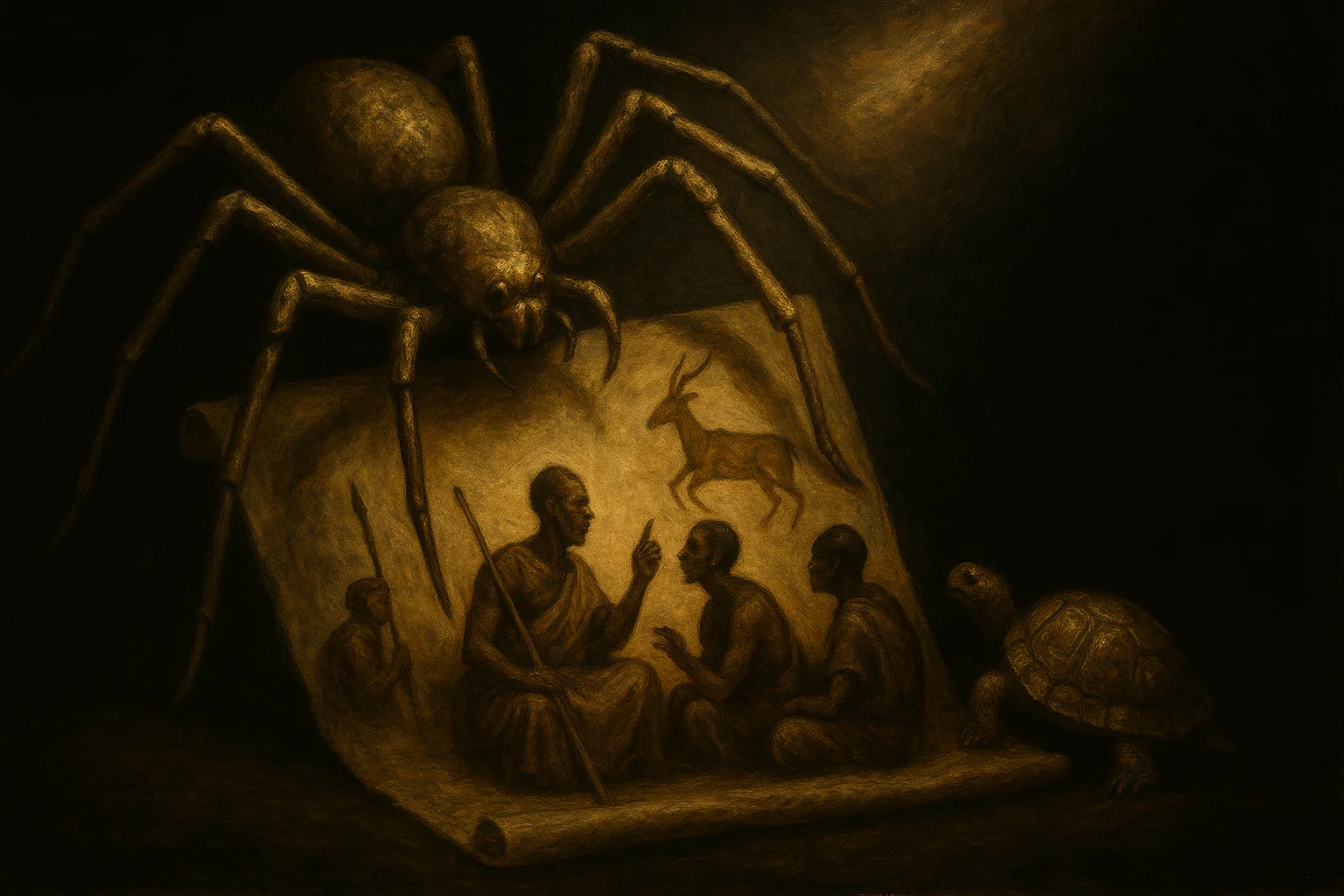
The Asante people of the Akan cultural group maintain the most extensive corpus of Anansi narratives. Rattray, working as a colonial anthropologist in the Gold Coast during the 1920s, recorded these tales directly from Asante storytellers, preserving not only plot but performance context. The stories were told at night, often by elders, with audience participation expected. Call-and-response elements punctuated the narratives, and the spider's name itself became a ritual invocation opening the storytelling session.
Harold Courlander's The Hat-Shaking Dance and Other Ashanti Tales from Ghana (1957) adds crucial detail about regional variation. Different Asante communities emphasize different aspects of Anansi's character. Some cycles present him as primarily foolish, undone by his own greed. Others cast him as a clever survivor who outwits stronger opponents through intelligence alone.
Anansi and Nyame the Sky God
The relationship between Anansi and Nyame structures much of the spider's mythology. Nyame controls the fundamental elements of existence: rain, fertility, cosmic order. Anansi, by contrast, thrives in disorder and improvisation. Yet the two are not antagonists in the simple sense. Nyame sets challenges that Anansi must meet, tests that reveal both the spider's cunning and his willingness to risk everything for knowledge or status.
Peggy Appiah's Tales of an Ashanti Father (1967) notes that Nyame sometimes appears amused by Anansi's schemes, suggesting a cosmology in which cleverness itself holds value, even when directed against divine authority. This differs markedly from mythological systems where defiance of the gods invites only punishment.
How Anansi Won All the Stories
The foundational Anansi narrative explains why all stories bear his name. Originally, all tales belonged to Nyame, who kept them in the sky. Anansi desired these stories for himself and approached the sky god with an offer to purchase them. Nyame, skeptical that a mere spider could afford such a price, set four seemingly impossible tasks: capture Onini the python, Osebo the leopard, Mmoboro the hornets, and Mmoatia the invisible forest spirit.
Anansi succeeded through cunning rather than strength. He tricked the python into measuring itself against a pole, binding it in the process. He dug a pit for the leopard and feigned concern when the beast fell in, offering a bent tree as escape only to use it as a catapult. He pretended to argue with his wife near the hornets' nest about whether it would hold water, provoking the insects to enter a gourd to prove him wrong, then sealed it. He carved a wooden doll, covered it with sticky latex, and placed it where Mmoatia would find it; when the spirit struck the unresponsive figure, she became trapped.
"Nyame said: 'I have been paid. From this day forward, all stories belong to Anansi. Whenever a man tells a story, he must acknowledge that it is Anansi's tale.'"
This attribution appears across multiple versions collected by Rattray and establishes Anansi as the master of narrative itself. The stories are called Anansesem in Twi, literally "spider stories," acknowledging his ownership.
Trickster, Culture Hero, or Both?
The question of Anansi's classification troubles neat taxonomies. He shares traits with trickster figures across mythologies, yet his role extends beyond mere disruption. He brings benefits to humanity even when acting from selfish motives, a pattern more typical of culture heroes who steal fire or knowledge from the gods.
The Dual Nature of the Trickster
Philip M. Peek and Kwesi Yankah's African Folklore: An Encyclopedia (2004) argues that West African tricksters often combine functions that European folklore keeps separate. Anansi embodies this synthesis. He is greedy, vain, and frequently humiliated by his own schemes. Yet he also introduces agriculture, teaches humans to sow grain, and in some versions creates the sun, moon, and stars when Nyame withdraws them in anger.
Anansi as Trickster
Motivated by hunger, status, or sexual desire; schemes often backfire; teaches through negative example; disrupts social order for personal gain; frequently punished or humiliated.
Anansi as Culture Hero
Brings stories, wisdom, and agricultural knowledge to humanity; mediates between gods and mortals; accomplishes tasks impossible for humans alone; establishes precedents for social behavior.
Anansi as Teacher and Troublemaker
The pedagogical function of Anansi tales operates on multiple levels. Children learn animal behavior, social norms, and linguistic play through the stories. Adults find commentary on power, justice, and survival. The spider's failures teach caution; his successes validate intelligence over brute force.
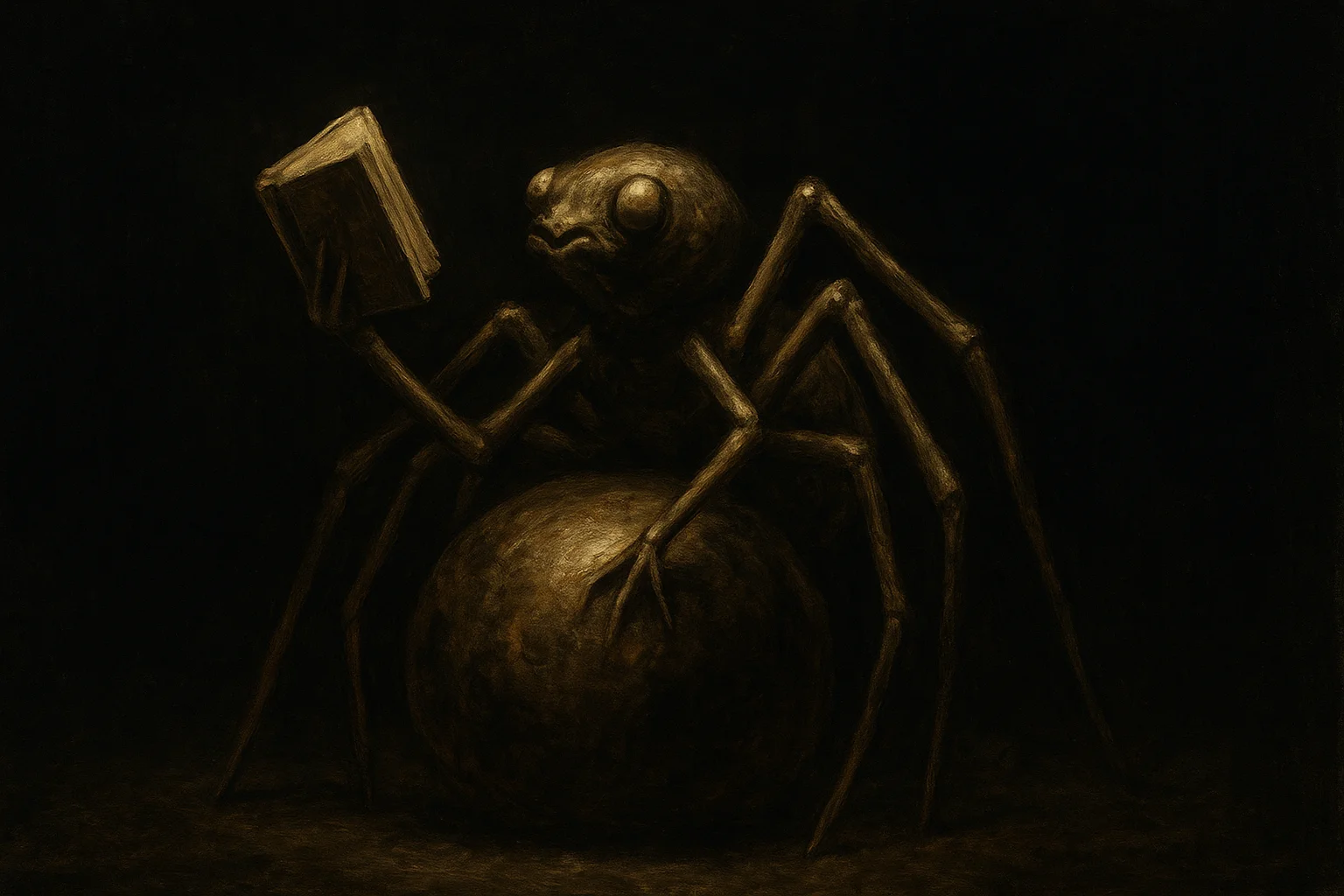
One cycle of tales shows Anansi attempting to hoard all the world's wisdom in a pot, intending to hide it at the top of a tall tree. As he climbs with the pot tied to his belly, his young son Ntikuma suggests he tie it to his back instead. Realizing even a child possesses wisdom he does not, Anansi drops the pot in frustration, scattering knowledge across the world. The story validates collective wisdom over individual hoarding while simultaneously mocking Anansi's pretensions.
Anansi's Exploits and Signature Tales
The Anansi corpus includes hundreds of distinct narratives, but certain plot structures recur with variation. These signature tales reveal the spider's characteristic methods and the moral frameworks within which the stories operate.
The Tar Baby and Other Traps
The tar baby motif, in which Anansi becomes stuck to a figure made of sticky substance, appears in Akan tradition long before its more famous appearance in African American folklore. In the Asante version, Anansi creates the tar figure himself to catch a thief stealing from his garden. When he discovers the thief is his own son, he must choose between punishment and family loyalty, a dilemma that exposes the tension between justice and kinship.
Other trap narratives show Anansi both as trapper and trapped. He digs pits for others and falls into them himself. He sets snares that catch him. This reciprocity suggests a cosmological principle: cleverness without wisdom leads to self-entrapment.
Anansi and the Distribution of Wisdom
Several tales address how knowledge came to be distributed unevenly among creatures. In one, Anansi convinces the other animals to give him their eyes for safekeeping while they sleep. He returns only one eye to each, keeping the extras for himself, which explains why spiders have multiple eyes. The story operates as both origin myth and cautionary tale about trusting the untrustworthy.
Courlander records a version in which Anansi attempts to buy common sense from Nyame. The sky god agrees but sets the price impossibly high, forcing Anansi to trick others into contributing. The spider succeeds but keeps the common sense for himself, which explains why he often acts foolishly despite his cleverness: he possesses common sense but refuses to use it.
- Anansi and the distribution of wisdom among animals
- Why Anansi has a narrow waist (tied too tightly waiting for multiple dinner invitations)
- How Anansi brought stories down from the sky
- Why spiders live in corners and dark places (hiding from those he tricked)
- Anansi's competition with other animals for the hand of the chief's daughter
Transformation Across the Atlantic
The transatlantic slave trade forcibly transported millions of West Africans to the Caribbean and Americas between the sixteenth and nineteenth centuries. Among the cultural practices that survived this trauma was the Anansi tradition, which adapted to new contexts while retaining core elements.
Caribbean Adaptations
In Jamaica, Anansi becomes Anansi or Nancy, and the stories shift emphasis toward resistance and survival under slavery. The spider's victories over larger, stronger opponents take on new political meaning. His ability to talk his way out of trouble, to manipulate authority figures, and to survive through wit rather than confrontation provided both entertainment and encoded instruction for enslaved populations.
The Jamaican Anansi loses some connection to the divine realm. Nyame rarely appears in Caribbean versions; instead, Anansi contends with plantation owners, overseers, and other earthly authorities. The cosmological framework collapses into social realism, though the spider retains his supernatural ability to shift between human and arachnid form, joining other creatures that blur human and animal form in world mythology.
Anansi in the Americas
Anansi tales reached the southern United States, particularly South Carolina and Georgia, where they merged with other African and European narrative traditions. The character sometimes appears as Aunt Nancy, a human woman, or as a rabbit, contributing to the Br'er Rabbit cycle. This transformation from spider to rabbit reflects adaptation to local fauna and audience expectations, though the trickster's essential methods remain consistent.
The tar baby story, recorded by Joel Chandler Harris in the late nineteenth century, derives directly from Akan sources but relocates the action to an American plantation context. Scholarly debate continues about the extent to which Harris understood or acknowledged his African sources, but the narrative structure matches Rattray's earlier Asante recordings closely enough to confirm transmission.
Anansi in Contemporary Culture
Anansi has experienced a renaissance in contemporary literature, appearing in novels, comics, and television adaptations that reintroduce him to global audiences. Neil Gaiman's American Gods (2001) and Anansi Boys (2005) present the spider as an African deity struggling with relevance in modern America, a narrative that resonates with diaspora communities negotiating multiple cultural identities.
These contemporary versions often emphasize Anansi's role as storyteller and survivor, themes that connect to ongoing conversations about cultural preservation and adaptation. The spider appears in children's literature, where his trickster qualities are softened but his cleverness remains central. He features in Afrocentric educational materials that seek to connect African American children with West African heritage.
The character's flexibility allows for continued reinterpretation. Some versions present him as a hero of resistance; others emphasize his moral ambiguity. Unlike sphinx or mythological creatures whose forms and functions remain relatively fixed across retellings, Anansi adapts while retaining core attributes: intelligence, cunning, and the ability to talk his way into and out of trouble.
Academic interest in Anansi has grown alongside popular adaptations. Folklorists trace transmission patterns across the African diaspora. Literary scholars analyze how the character functions in postcolonial narratives. Anthropologists study contemporary Akan communities to document how the tradition continues in its source culture, finding that Anansi remains vital in Ghana even as global adaptations proliferate.
Frequently asked questions
Who is Anansi in Akan mythology?
Anansi is a spider-trickster and culture hero in Akan mythology who originates from the Asante people of present-day Ghana, where he functions as an intermediary between the sky god Nyame and humanity, winning ownership of all stories through cunning and appearing in hundreds of oral narratives that teach moral lessons through his exploits and failures. His character combines trickster traits like greed and vanity with culture-hero functions such as bringing knowledge and stories to humanity. The name Anansesem, meaning "spider stories" in Twi, acknowledges his ownership of all tales in the Akan tradition.
How did Anansi become the owner of all stories?
Anansi became the owner of all stories by completing four impossible tasks set by Nyame the sky god, who originally kept all tales in the sky: capturing Onini the python, Osebo the leopard, Mmoboro the hornets, and Mmoatia the invisible forest spirit. The spider accomplished these feats through cunning rather than strength, tricking each creature into traps using deception and psychological manipulation. After Anansi presented all four captives, Nyame declared that all stories would henceforth belong to the spider and must be acknowledged as Anansesem whenever told.
What is the difference between a trickster and a culture hero?
A trickster disrupts social order through selfish schemes, often motivated by hunger, lust, or vanity, and frequently suffers humiliation when plans backfire, teaching through negative example, while a culture hero brings essential knowledge, tools, or customs to humanity, often by stealing from or outwitting the gods, establishing precedents that benefit society despite personal risk. Anansi embodies both functions simultaneously, which distinguishes West African trickster figures from their European counterparts. His selfish schemes sometimes accidentally benefit humanity, and his victories over divine authority bring stories, wisdom, and agricultural knowledge down from the sky realm.
How did Anansi's character change in the Caribbean and Americas?
Anansi's character shifted from a cosmological figure mediating between sky god and humanity in West African tradition to a symbol of resistance and survival under slavery in Caribbean adaptations, where his victories over stronger opponents took on political meaning and Nyame largely disappeared from the narratives. In Jamaica he became Anansi or Nancy, retaining supernatural shape-shifting abilities but contending with plantation owners rather than deities. In the southern United States, the character sometimes transformed into Aunt Nancy or merged with rabbit trickster figures, adapting to local fauna while maintaining core methods of outwitting authority through clever speech.
What are the most famous Anansi stories?
The most famous Anansi stories include his winning of all stories from Nyame by capturing four impossible creatures, his attempt to hoard all wisdom in a pot only to drop it and scatter knowledge across the world, the tar baby tale in which he becomes stuck to a figure he created to catch a thief, and the origin of his narrow waist caused by tying himself too tightly while waiting for multiple dinner invitations. These narratives appear across multiple collections by Rattray, Courlander, and Appiah with regional variations. Each tale combines entertainment with moral instruction, often showing Anansi's cleverness leading to both triumph and humiliation.
Why is Anansi depicted as a spider?
Anansi is depicted as a spider because the Akan word ananse, meaning spider, shares a root with the verb nsa meaning "to weave" or "to spin," linking his physical form to his narrative function as the one who spins tales and weaves plots. The spider's ability to create elaborate webs from its own body parallels Anansi's ability to construct complex schemes and stories. His multiple eyes, explained in one tale as stolen from other animals, represent his ability to see opportunities others miss, while his small size emphasizes that intelligence and cunning matter more than physical strength in his cosmology.
Further reading on Mythologis
Read the full book
Want the whole story?
The complete edition is an instant PDF download here, with a paperback on Amazon for selected titles.
Akan
The Akan Mythology Book: Anansi, Nyame, and the Gods of West Africa
Anansi, Nyame, and West Africa
From the Ashanti and the gold coast of Ghana: Nyame the sky god, Asase Yaa the earth, the abosom spirits, and Anansi the spider, the trickster who bought all the world’s stories from the sky and whose tales crossed the Atlantic with the enslaved.