
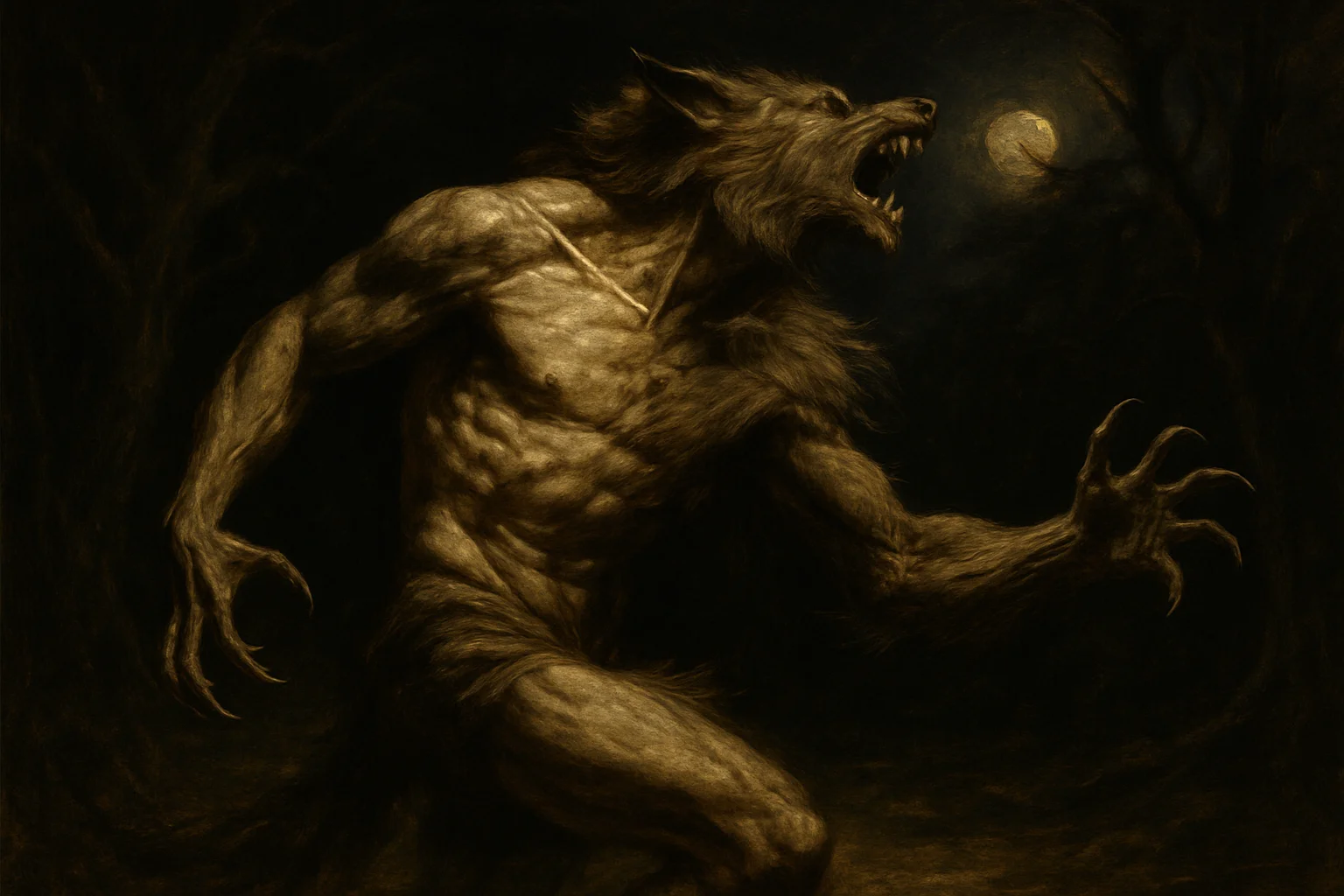
Werewolf: Myth, History & Transformation Legends
From Greek myth to Norse sagas and medieval witch trials, discover the werewolf's dark origins, chilling transformation legends, and what primary sources really say.
Contents
A werewolf is a human being who transforms, either voluntarily or involuntarily, into a wolf or wolf-like creature, retaining varying degrees of human consciousness depending on the tradition. The concept appears across Greek, Norse, Slavic, and Western European cultures, each framing the transformation differently: as divine punishment, warrior ecstasy, medical delusion, or demonic possession. The modern image of the werewolf, a cursed figure who changes under the full moon and fears silver, is a relatively recent invention that obscures a far older and more varied set of beliefs.
The transformation from human to wolf is not a single story but a cluster of related anxieties. In ancient Greece it was a warning about hubris. In medieval France it became evidence in criminal trials. In Norse sagas it marked the boundary between man and beast, civility and rage. What follows is an attempt to trace those threads without flattening them into a single myth.
What the Werewolf Is
The werewolf occupies a liminal space between human and animal, reason and instinct. Unlike dragon or sphinx, which are wholly fantastic creatures, the werewolf begins as a person. The transformation is the point. It asks what happens when the boundary between civilisation and wilderness collapses, when a man becomes the predator his ancestors once feared.
The term itself comes from Old English: wer (man) and wulf (wolf). Other languages preserve similar compounds. The Greeks called it lykanthropos, from lykos (wolf) and anthropos (human). The transformation might be triggered by a curse, a full moon, a wolf-skin cloak, or simple madness. Some traditions allow the werewolf to retain human thought. Others strip it away entirely.
Shapeshifting appears in many mythologies, but the werewolf is distinct. A god or trickster who takes animal form does so by choice and returns at will. The werewolf is trapped, cursed, or compelled. The transformation is rarely a gift.
The Greek Roots: Lycaon and Divine Punishment
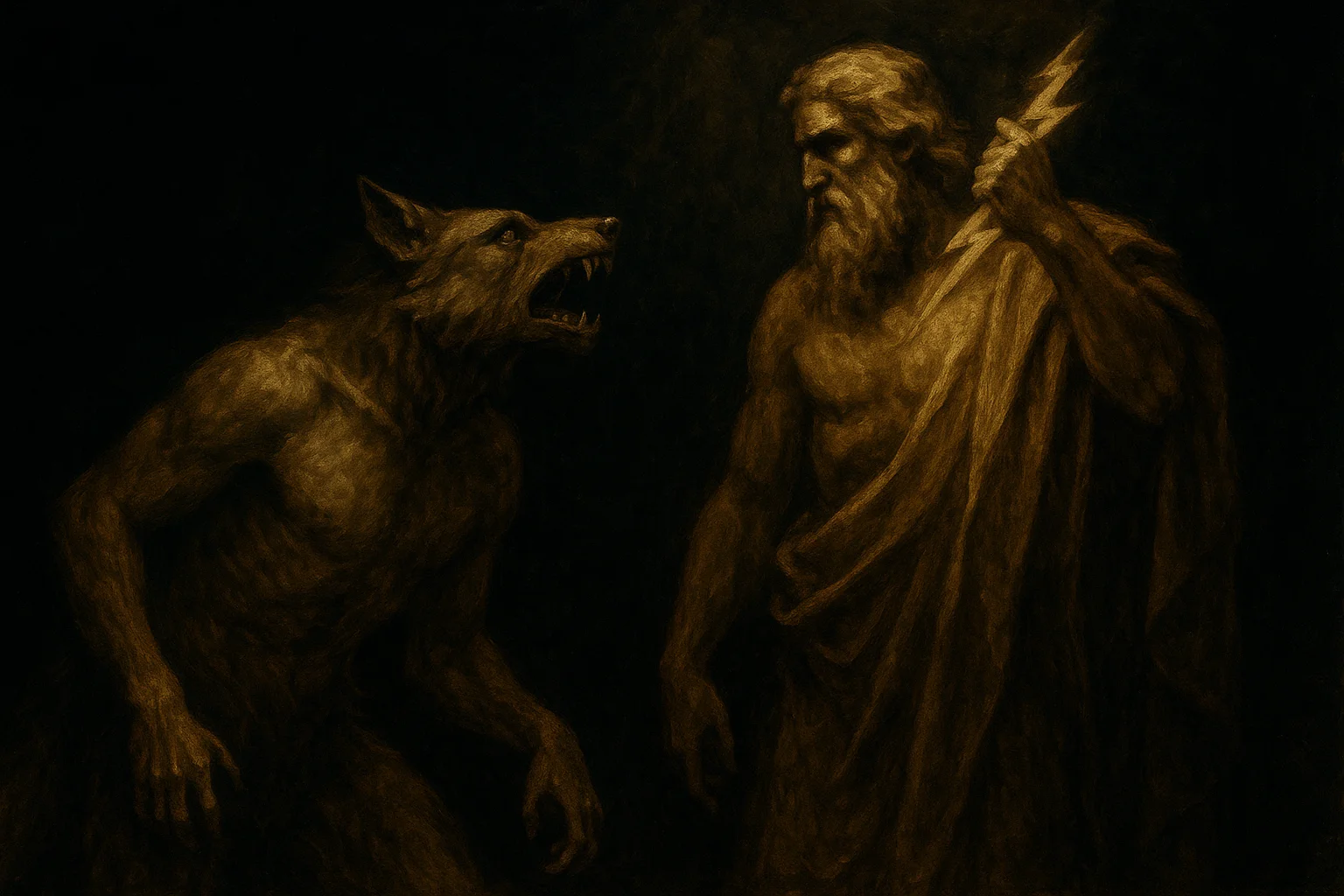
The oldest surviving werewolf narrative in Western literature comes from Ovid's Metamorphoses, written in the first century CE. King Lycaon of Arcadia, skeptical of Zeus's divinity, serves the god a meal of human flesh to test him. Zeus, recognising the crime, transforms Lycaon into a wolf. The punishment is precise: Lycaon retains his cruelty, his hunger, but loses his human form.
Ovid's Metamorphoses and the First Transformation
"He fled in terror, and reaching the silent fields howled aloud, attempting speech in vain. Foam gathers at his mouth; he turns his lust for slaughter against the flocks, delighting still in blood. His clothes become shaggy hair, his arms turn into legs. He is a wolf, yet he retains some traces of his former shape." Ovid, Metamorphoses, Book I, lines 232-239
Ovid's account is literary, but it draws on older Arcadian cult practices. Pausanias, writing in the second century CE, reports that Zeus Lycaeus was worshipped on Mount Lycaeus in Arcadia, and that a festival there involved human sacrifice. According to local belief, anyone who tasted the sacrificial meat would become a wolf for nine years. Pausanias treats the story with caution, noting that "the Arcadians say" rather than endorsing it himself.
Pliny the Elder, in his Natural History, records a similar tradition: a member of the Anthus family was chosen by lot, led to a lake in Arcadia, hung his clothes on a tree, swam across, and lived as a wolf for nine years. If he refrained from eating human flesh, he could return, swim back, and reclaim his clothes. Pliny dismisses the story as Greek credulity, but he preserves it.
Lycanthropy as Medical Condition
By the Roman period, lycanthropy had also become a medical diagnosis. Greek and Roman physicians described patients who believed themselves to be wolves, wandering at night, howling, and avoiding human contact. The second-century physician Marcellus of Side lists lycanthropy among forms of melancholy. The symptoms included pale skin, dry eyes, an absence of tears or saliva, and a compulsion to haunt graveyards.
This clinical lycanthropy persisted into the medieval period. It was understood not as actual transformation but as a delusion, a failure of the humours. The patient was not a wolf but believed he was, which in practical terms produced similar behaviour.
Norse and Germanic Traditions: The Ulfhednar and Berserkers
In Norse tradition, the line between man and wolf is crossed not by curse but by choice. The ulfhednar, or wolf-coats, were warriors who wore wolf pelts and fought in a trance-like fury. They appear alongside the better-known berserkers, who wore bear skins. Both groups served Odin, god of war, poetry, and death, and both were believed to channel animal ferocity in battle.
The Volsunga Saga and Sigmund's Wolf Skin
The Volsunga Saga, a thirteenth-century Icelandic text preserving older oral traditions, includes one of the clearest examples of voluntary wolf transformation. Sigmund and his son Sinfjotli discover two men sleeping beneath wolf skins. The skins are enchanted: anyone who wears them becomes a wolf for ten days and cannot remove the skin until the period ends. Sigmund and Sinfjotli don the skins and rampage through the forest, killing men and animals alike. They howl to communicate. They lose control.
The saga treats the transformation as temporary and reversible, but dangerous. When Sinfjotli is wounded, Sigmund must wait for the enchantment to lift before he can help him. The wolf skin grants power but at the cost of reason. It is a tool, not a curse, but a tool that can consume its user.
Warrior Cults and Animal Transformation
The ulfhednar were likely historical. Tacitus, writing in the first century CE, describes Germanic warriors who fought naked or in animal skins, working themselves into a frenzy before battle. Later Scandinavian sources refer to men who "went berserk," a state in which they became immune to pain, bit their shields, and fought with reckless abandon. Some scholars, including Bruce Lincoln, interpret these accounts as evidence of warrior initiation rites in which young men symbolically became animals, crossing the boundary between human society and the wild.
Greek Lycanthropy
Transformation as divine punishment for hubris or crime; the victim loses human form and reason as penalty for transgression against the gods.
Norse Ulfhednar
Transformation as voluntary warrior practice; the fighter dons a wolf skin to channel animal fury in service of Odin, retaining purpose if not full control.
The connection to Jörmungandr and other monstrous figures in Norse apocalypse traditions is indirect but thematic. The wolf Fenrir, who will devour Odin at Ragnarok, represents the ultimate collapse of order into chaos. The ulfhednar walk that line deliberately, harnessing the wolf's power without becoming Fenrir.
Medieval Europe: Trials, Confessions, and the Beast of Gévaudan
By the sixteenth century, the werewolf had become a criminal. Across France, Germany, and Switzerland, men and women were tried, tortured, and executed for transforming into wolves and killing livestock, children, and travellers. The trials followed the same legal procedures as witchcraft prosecutions. Confession was extracted under torture. Execution was by burning or beheading.
The Werewolf Trials of the Sixteenth and Seventeenth Centuries
Peter Stumpp, executed in 1589 near Cologne, is among the most documented cases. Stumpp confessed, under torture, to wearing a belt given to him by the Devil that allowed him to transform into a wolf. In wolf form, he claimed to have killed and eaten fourteen children and two pregnant women over twenty-five years. He was broken on the wheel, beheaded, and burned. His daughter and mistress were also executed.
The trial records, published as a pamphlet in multiple languages, describe Stumpp as a serial killer who used the werewolf legend as cover. Modern historians debate whether he was guilty of any crime or simply a scapegoat during a period of social panic. The confessions are unreliable, extracted under extreme duress, but they reveal what people believed was possible.
Other trials followed similar patterns. In 1598, the Gandillon family in the Jura region of France was accused of transforming into wolves and attacking children. All were killed by a mob before formal trial. In 1603, a fourteen-year-old boy named Jean Grenier confessed to killing and eating children while in wolf form. The court, unusually, ruled him insane rather than demonic and sentenced him to life in a monastery.
The Beast of Gévaudan and the Silver Bullet
The Beast of Gévaudan terrorised the former province of Gévaudan in south-central France between 1764 and 1767, killing between sixty and one hundred people, mostly women and children. Witnesses described a wolf-like creature larger than any normal wolf, with reddish fur and a broad chest. The attacks were brutal: throats torn out, heads removed, bodies partially eaten.
King Louis XV sent professional wolf-hunters. Thousands of men participated in organised hunts. Several large wolves were killed, but the attacks continued. In 1767, a local hunter named Jean Chastel shot and killed a large wolf. The attacks stopped. According to later legend, Chastel used a silver bullet blessed by a priest. No contemporary account mentions silver. The detail appears in nineteenth-century retellings, likely influenced by the same Gothic literature that popularised the full-moon transformation.
The Beast was probably a wolf, possibly a hybrid, possibly more than one animal. But the legend it generated became inseparable from werewolf folklore. The silver bullet, absent from earlier traditions, became canonical.
Slavic and Eastern European Variants
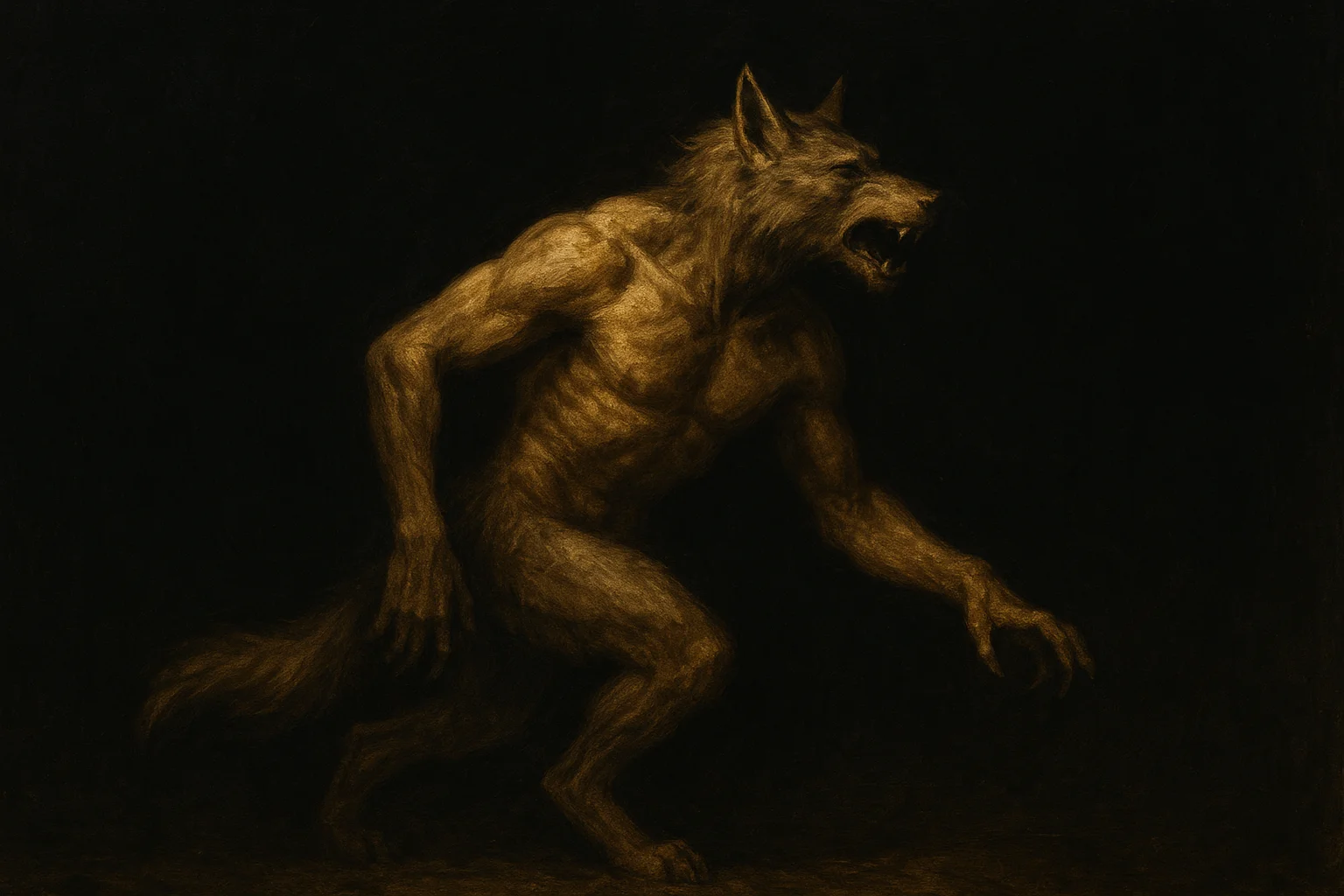
Slavic traditions distinguish between voluntary and involuntary werewolves. The vukodlak (South Slavic) or wilkołak (Polish) might be a living person who transforms, a sorcerer who takes wolf form to harm enemies, or a revenant, a dead person who rises as a wolf-like creature. The boundary between werewolf and vampire is porous in these traditions. Both are undead or cursed, both prey on the living, both are destroyed by decapitation or burning.
In some accounts, a child born with a caul or teeth is destined to become a werewolf. In others, a person who eats the flesh of a sheep killed by a wolf will transform. Transformation might be permanent or cyclical, tied to the moon or to specific holy days. The werewolf might retain human intelligence or become fully bestial.
Russian folklore includes the oboroten, a shapeshifter who can become a wolf, bear, or other animal. Unlike Western European werewolves, the oboroten is not necessarily evil. Some are protectors of the forest, others are tricksters. The moral valence depends on the story.
The Rougarou and New World Adaptations
French settlers brought werewolf beliefs to North America, where they adapted to new environments. The rougarou of Louisiana and Quebec is a werewolf-like creature that punishes those who break Lent or fail to observe Catholic rituals. It prowls the bayous and forests, sometimes described as wolf-headed, sometimes as a hybrid creature closer to Bigfoot in appearance.
The rougarou serves a social function: it enforces community norms, particularly among children. Parents warn that the rougarou will come for those who misbehave or stray too far from home after dark. The creature is less a monster than a disciplinary tool, though some accounts describe genuine terror and violence.
Indigenous North American traditions include their own shapeshifters, distinct from European werewolves but sometimes conflated in later folklore. The Navajo yee naaldlooshii, or skinwalker, is a witch who dons animal pelts to transform, a practice considered deeply evil. The skinwalker is not a werewolf, but European settlers and later popular culture often blurred the categories.
The Modern Werewolf: From Folklore to Film
The werewolf of contemporary fiction is a twentieth-century invention. The full-moon trigger, the vulnerability to silver, the tortured protagonist who transforms against his will: these elements coalesce in Gothic novels and horror films, not in medieval trial records or ancient texts. The 1941 film The Wolf Man, starring Lon Chaney Jr., established the template. The werewolf became a tragic figure, a man cursed through no fault of his own, struggling against an inner beast.
This version of the werewolf is more sympathetic than its predecessors. It reflects modern anxieties about identity, control, and the unconscious. The transformation is no longer divine punishment or warrior ecstasy but a metaphor for repressed violence, addiction, or trauma. The werewolf becomes a hero's journey in reverse: instead of integrating the shadow, the protagonist is consumed by it.
Contemporary fiction has multiplied the variations. Some werewolves form packs with complex social hierarchies. Others are lone predators. Some transform painfully, bones breaking and reshaping. Others shift seamlessly. The rules are no longer fixed because there is no single tradition to draw from. The werewolf has become a narrative tool, adaptable to whatever story the writer wants to tell.
Frequently asked questions
Where does the werewolf legend originate?
The werewolf legend originates in ancient Greece, specifically in the myth of King Lycaon of Arcadia, who was transformed into a wolf by Zeus as punishment for serving human flesh at a banquet, a story preserved in Ovid's Metamorphoses and referenced by Pausanias and Pliny. The concept of human-to-wolf transformation appears independently in other cultures, including Norse warrior traditions and Slavic folklore, each with distinct causes and meanings. The Greek version frames transformation as divine punishment for hubris, while Norse traditions associate it with voluntary battle frenzy.
What is the difference between a werewolf and a shapeshifter?
A werewolf is a specific type of shapeshifter who transforms into a wolf or wolf-like creature, usually involuntarily or as a result of a curse, whereas a shapeshifter is a broader category that includes any being capable of changing form at will, such as gods, tricksters, or sorcerers who might become any animal or object. Werewolves typically lose control during transformation and are bound by specific triggers like the full moon or wearing an enchanted pelt, while shapeshifters retain agency and can revert to human form whenever they choose. The werewolf transformation is almost always portrayed as dangerous or tragic, whereas shapeshifting in mythology is often a sign of power or cunning.
Did people really believe they could turn into wolves?
Yes, both as a medical delusion and as a supernatural belief: Greek and Roman physicians diagnosed lycanthropy as a mental illness in which patients believed they had become wolves, exhibiting symptoms like howling, avoiding daylight, and haunting graveyards, while medieval Europeans prosecuted accused werewolves in criminal trials, extracting confessions under torture that described actual physical transformation. The Volsunga Saga and other Norse texts describe warriors wearing wolf skins to channel animal fury, suggesting ritual practices that may have involved altered states of consciousness. Whether these beliefs reflected genuine psychological conditions, religious experiences, or coerced false confessions varies by case, but the belief itself was widespread and taken seriously across multiple cultures and centuries.
What are the Norse berserkers and how do they relate to werewolves?
Norse berserkers were warriors who fought in a trance-like fury, often wearing bear skins, and were closely related to the ulfhednar, or wolf-coats, who wore wolf pelts and similarly channelled animal ferocity in battle, both groups serving Odin and believed to temporarily take on the characteristics of their animal totems. The Volsunga Saga describes Sigmund and Sinfjotli donning enchanted wolf skins that forced them to become wolves for ten days, unable to remove the pelts or fully control their actions, suggesting that the transformation was understood as both literal and psychological. Unlike the cursed werewolves of later European tradition, the ulfhednar transformation was voluntary, a warrior practice rather than a punishment, though it carried significant risk of losing oneself to the animal state.
Why was silver believed to kill werewolves?
The belief that silver kills werewolves appears to originate in eighteenth-century France, specifically in legends surrounding the Beast of Gévaudan, where later retellings claimed the creature was killed with a blessed silver bullet, though no contemporary account from the 1760s mentions silver at all. Silver's association with purity and its use in religious objects likely contributed to its adoption as a werewolf-killing agent in Gothic fiction, where it became a standard element by the nineteenth century. Earlier werewolf traditions, including Greek, Norse, and medieval trial records, do not mention silver as a weapon; those werewolves were killed by ordinary means like beheading, burning, or conventional weapons.
How did werewolf trials work in medieval Europe?
Werewolf trials in sixteenth- and seventeenth-century Europe followed the same legal procedures as witchcraft prosecutions: the accused were arrested on suspicion of transforming into wolves and committing murders or attacks on livestock, tortured until they confessed to receiving demonic aid or wearing enchanted belts or pelts, and then executed by burning, beheading, or breaking on the wheel. The trial of Peter Stumpp in 1589 near Cologne is among the most documented, with a published pamphlet describing his confession to twenty-five years of killings while in wolf form, though modern historians recognise that confessions extracted under torture are unreliable. Some courts, like the one that tried fourteen-year-old Jean Grenier in 1603, ruled the accused insane rather than demonic, sentencing them to confinement instead of death, but such outcomes were rare.
Further reading on Mythologis
Read the full book
Want the whole story?
The complete edition is an instant PDF download here, with a paperback on Amazon for selected titles.
Mythology
The World Mythology Book: The Gods, Heroes and Myths of Every Culture
The Gods, Heroes and Myths of Every Culture, in One Volume
The whole of world mythology in a single volume: Greek, Norse, Egyptian, Japanese, Hindu, Celtic, Slavic, Mesoamerican and African myths gathered side by side, each drawn from the primary sources.