
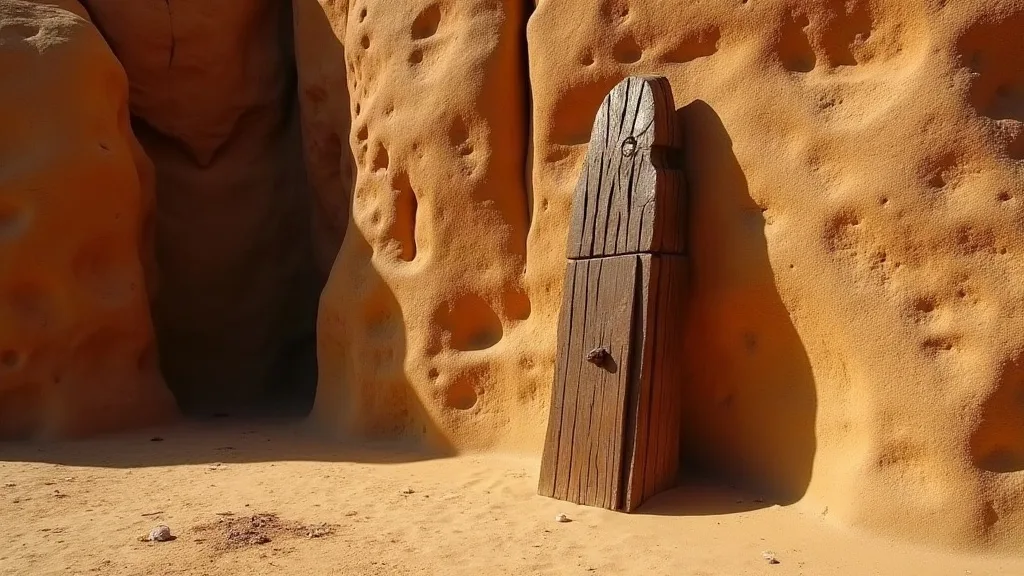
The Binu Shrines: Sacred Altars to Ancestral Spirits in Dogon Tradition
The Binu Shrines are sacred wooden altars where the Dogon people of Mali honor their ancestors and the primordial water spirits that shaped their world. Built into cliff dwellings and family homes, these shrines connect the living to the dead through ritual, offering, and careful ceremonial action.
Contents
Deep in the sandstone cliffs of the Bandiagara Escarpment in Mali, wooden shrines stand hidden in shadow. These are not grand temples. They are small, carved altars made from a single piece of wood, rough and darkened by centuries of ritual use. The Dogon people call them binu shrines, and they are doorways between worlds: places where the living speak to the dead, where ancestral spirits are fed, where the entire web of kinship stretches across the boundary between this life and the next.
To understand the Binu Shrines is to understand how the Dogon conceive of death not as an ending but as a transformation. A person does not disappear when they die. They become an ancestor. They take a new form, a new agency, a new hunger. And their descendants must feed them.
The Architecture of Dwelling and Spirit: How Binu Shrines Are Built
A binu shrine is usually carved from a single log, often stored vertically in a family home or cliff sanctuary. The wood itself matters profoundly. It is not treated as a raw material to be shaped by human will alone. Rather, the wood is seen as alive, as carrying within it the capacity to hold spiritual presence. The Dogon recognize certain trees as particularly suited to hold ancestors; the choice of wood is theological, not merely practical.
The shrine itself is compact, spare, sometimes no more than three feet tall. What gives it power is not size but intentionality. The object may be carved with a simple anthropomorphic form: a head, shoulders, sometimes a seated posture with knees drawn up. Other binu shrines are more abstract, their meaning residing in the vertical axis itself and in the patina of use rather than in representational detail.
The shrines are kept in specific places within Dogon settlements. Some stand in the family compound, near the hearth or in a private chamber. Others are sheltered in collective shrines built into the cliff face itself. The Dogon cliff villages, with their stacked adobe and stone architecture clinging to the Bandiagara Escarpment, were designed in part to create spaces for these shrines. The vertical topography mirrors the spiritual cosmology: the shrines point upward, connecting earth-dwelling humans to the realm of ancestors above.

The Cosmology Behind the Shrine: Water Spirits and First Deaths
To grasp why the Binu Shrines hold such power in Dogon life, one must understand the Dogon creation narrative and their theology of water. The Dogon speak of Nummo, primordial water spirits that existed before dry land itself. The Nummo are not gods in the monotheistic sense; they are fundamental forces, ambiguous and generative. They are the masters of water, of fluidity, of the liminality between states.
According to Dogon tradition, the Nummo once lived on earth alongside humans. The first human deaths were transformations into water spirits. When a person died, the nyama (the life force, the double, the shadow) would travel downward into water, into the underworld of the ancestors. The binu shrine became a way to anchor that journey, to provide the ancestor with a dwelling place, a point of contact.
The Dogon maintain that the Nummo taught them how to make these shrines, how to conduct the rituals that keep ancestors fed and placated. The shrines are not idols in the Western sense. They are not representations meant to capture the essence of a deity or ancestor. Rather, they are conduits. They are listening posts. They are tables set for the unseen visitors.
Ethnographer Marcel Griaule, who lived among the Dogon from the 1930s onward, documented extensive conversations with Dogon elders about the meaning of binu shrines. According to Griaule's notes, the Dogon explained that each binu shrine serves as a resting place, a seat, a body for an ancestor who might otherwise wander. The shrine gives the ancestor form, in a sense, or at least a recognized place to be present in the living world.

Ritual Feeding and Seasonal Ceremonies
The power of a binu shrine depends entirely on what is offered to it. The shrine without offerings is an empty seat. With offerings, it becomes a living focal point of family religious life.
The Dogon make offerings of grain, flour, sometimes beer or millet porridge. These offerings are not elaborate feasts but small, regular practices. A handful of grain poured into a depression carved into the shrine's surface. A libation of water. The ritual is intimate and everyday, conducted by family members with no elaborate priest-craft required.
The most significant ceremonies involving binu shrines occur at seasonal transitions and at moments of grief. When a person dies, the shrine is activated in new ways. The family conducts rituals to guide the nyama into the shrine and onward into the realm of ancestors. These are not solemn funeral rites alone; they are initiatory moments. The newly dead must be instructed. They must understand their new status, their new responsibilities, and their continuing bonds to the living family.
Griaule and his colleague Germaine Dieterlen recorded accounts of a ceremony called the dama, a funeral dance and celebration that could last days and involve the entire village community. The dama is not merely mourning. It is a farewell performance, a celebration of the deceased's life, and a formal acknowledgment of their transition into the community of ancestors. The binu shrines feature prominently in these ceremonies, receiving offerings and being spoken to directly by family members.
The Dogon year is punctuated by ceremonies tied to agricultural cycles: planting, growth, harvest, and rest. At each turning point, binu shrines may receive renewed offerings. The shrine is a calendar of grief, too: anniversaries of death are marked by approaches to the shrine.
The Binu Shrine and Dogon Social Order
The binu shrines are not random or individually owned in a purely private sense. Rather, they map onto the Dogon kinship system. Each extended family (a gida, or household) maintains binu shrines for its senior ancestors. The shrine is a visible, physical anchor for genealogy. It says: this ancestor belonged to this line. This spirit guards this family's welfare. This person is still here.
The Dogon are organized into named lineages, each with its own origin narrative and ritual responsibilities. A man inherits his relationship to certain binu shrines from his father. A woman inherits connections through her mother's line. When a person marries, their relationship to their spouse's family shrines is carefully negotiated. To offer to a binu shrine is to declare kinship, to assert membership in a collective, to invoke protection and blessing.
The oldest man in a lineage often holds primary responsibility for conducting rituals at the major family binu shrines. This is not a formal priesthood but a deference to age, knowledge, and the assumption that elderly men stand closer to the ancestor realm themselves. A man's spiritual authority grows as he ages, and by the time he is very old, he is already half-present to the ancestors.
The Controversy of Interpretation: What Western Scholars Saw
When European and American anthropologists first encountered the Binu Shrines, they often misunderstood them. Early observers called them "idols" or "fetishes," terms freighted with the bias that non-Western people practiced false or primitive religion. Marcel Griaule's work was revolutionary partly because he treated the binu shrines as serious theological objects deserving careful, respectful interpretation.
Yet Griaule himself became a controversial figure. Late in his career, he published "Conversations with Ogotemmeli," based on interviews with a blind Dogon elder. The book revealed a cosmological system of extraordinary complexity: intricate calculations involving the orbit of Sirius B (a white dwarf star not visible to the naked eye), mythology encoding astronomical knowledge, and a rigorous philosophy of order, balance, and spiritual power. Scholars have debated whether Griaule's account was accurate or whether he and Ogotemmeli co-created a narrative that confirmed European expectations of African wisdom.
The truth about the binu shrines likely lies in the space between these debates. They are objects of genuine spiritual significance to the Dogon. They do embody cosmological principles. But their meaning shifts with context, with the person speaking about them, with the specific shrine and the specific ancestor it honors. A scholar cannot compress a living tradition into a single explanation.
What remains clear is that the shrines are not static art objects. They are functional, dangerous, alive. To neglect a binu shrine is to risk the displeasure of the ancestor it houses. To make an improper offering can bring misfortune. The shrines demand respect, not curiosity alone.
The Binu Shrines Today: Continuity and Change
The Dogon plateau is no longer isolated. Young people migrate to Mali's cities and beyond. Radio, mobile phones, and Islamic and Christian missionary activity have all touched Dogon life. Yet the binu shrines persist. Many families continue to maintain them, to make offerings, to conduct ceremonies.
Some Dogon scholars and cultural preservationists have begun to document shrines, to teach younger generations about their significance. The shrines are increasingly recognized as part of Dogon cultural heritage, worthy of protection and study. The Bandiagara Escarpment was designated a UNESCO World Heritage Site in 1989, and the architectural traditions of the Dogon, including the cliff dwellings that house the shrines, are acknowledged as masterpieces of human adaptation and design.
At the same time, the shrines face genuine threats. Climate change has made water scarcer and farming less predictable, altering the economic base of Dogon life. Political instability in Mali has made some regions unsafe. Some Dogon families, especially those who have converted to Islam, may cease to maintain traditional shrines, though syncretism is also common; Muslim Dogon often incorporate ancestor veneration alongside Islamic practice.
The resilience of the binu shrine tradition is remarkable. Even as material circumstances change, families return to them. The shrines are repositories of genealogy, of belonging, of a kind of spiritual insurance. They connect a person to the long web of kinship extending back through time. They say: you are not alone. Your ancestors watch. You are part of something larger than yourself.
How the Binu Shrines Reflect Fundamental Dogon Beliefs
The binu shrines are visual theology. They embody the Dogon conviction that the boundary between living and dead is permeable. They express the belief that kinship is not broken by death but transformed. They insist that the material world and the spiritual world are not separate; they interpenetrate. A wooden object, carefully made and regularly fed, becomes a place of presence.
The shrines also reflect the Dogon emphasis on order, structure, and the correct performance of ritual. The Dogon cosmos, as they conceive it, is inherently orderly. Creation resulted from the god Amma speaking the world into being through divine breath. But that order must be maintained. Human beings have a role in keeping the cosmos aligned. Offerings to the binu shrines, ceremonies at the right times, the maintenance of proper genealogical memory: these are not optional. They are the Dogon's part in the contract between the human and divine worlds.
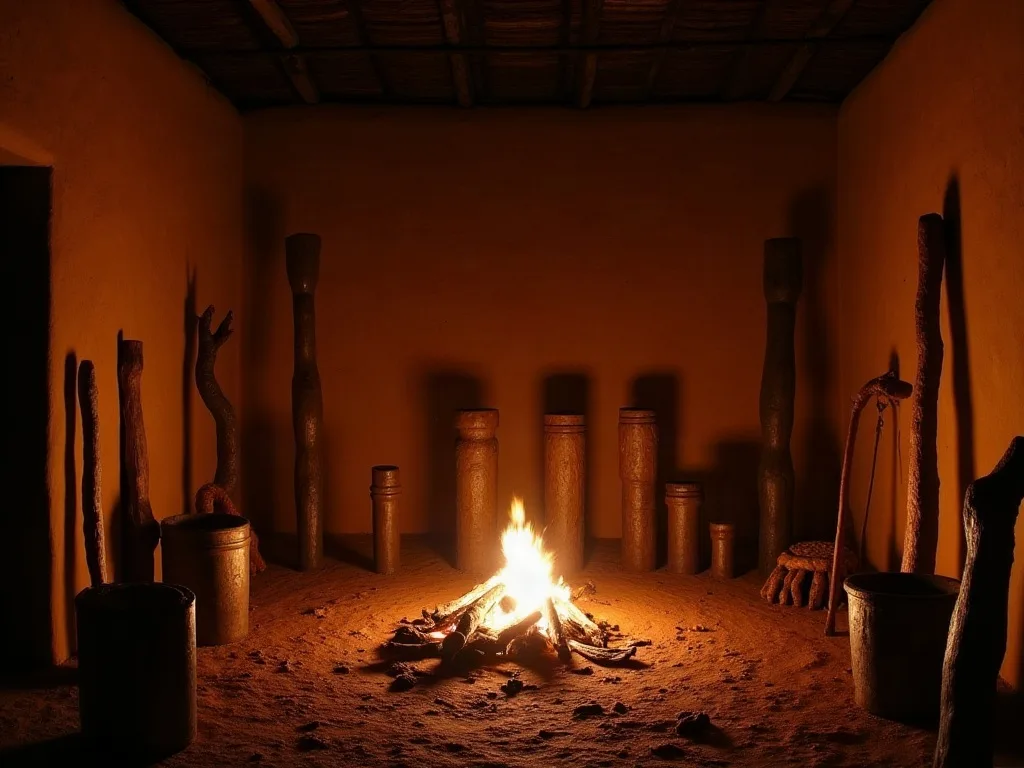
Frequently asked questions about the Binu Shrines
Frequently asked questions
What is the difference between a binu shrine and a personal altar in other African traditions?
The binu shrine is specifically tied to genealogy and water-spirit theology in Dogon cosmology. While many African traditions maintain ancestral altars, the Dogon binu shrine emerged from their particular creation narrative involving Nummo water spirits and the concept of nyama (life force). The shrine is a family collective asset, not an individual's personal devotion object, though individuals conduct rituals at it.
Do Dogon people still use binu shrines, or are they now only museum pieces?
Many Dogon families continue to maintain and use binu shrines, particularly in rural areas of the Bandiagara Escarpment. While younger people and urban-dwelling Dogon may engage with them less intensively, the shrines remain active in family religious practice. Some have been collected by museums, which has raised concerns about cultural preservation and the proper stewardship of sacred objects.
How often are offerings made to a binu shrine?
Offerings vary by family and context. Regular maintenance might involve small offerings of grain or water during daily routines. Seasonal ceremonies tied to the agricultural calendar bring more elaborate offerings. The death anniversaries of specific ancestors and major family events trigger renewed ritual attention. There is no universal schedule; practice depends on the family's understanding of the ancestor's needs and temperament.
Can women conduct rituals at binu shrines?
Women play important roles in maintaining binu shrines, particularly in preparation of offerings and in some ceremonial contexts. However, the most senior ritual roles (leading major ceremonies, speaking directly to the oldest ancestors) have traditionally been held by senior men. This reflects broader Dogon gender hierarchies, though these are not absolute and vary between families and regions.
Where did the Dogon learn to make binu shrines?
According to Dogon oral tradition, the practice was taught by Nummo, the primordial water spirits. The shrines emerged from the Dogon's encounter with the Nummo and their understanding of the nyama's journey after death. The exact historical origins are lost, but the practice is deeply embedded in Dogon cosmology and appears in some form across the broader Manding-speaking peoples of West Africa.
The Binu Shrine as Window into Dogon Philosophy
The binu shrines are more than objects of religious practice. They are a window into how the Dogon conceive of time, memory, community, and the nature of being itself. In the shrine, the past is not past. The ancestor is not gone. Death has changed their form, not their presence or their agency. The living remain in conversation with them.
This is a philosophy radically at odds with modern Western materialism, which tends to see death as an absolute ending and the material world as inert. But it is not unusual in human history. Countless cultures have maintained similar convictions: that the dead continue, that they require nourishment, that neglect brings consequences. The Dogon have refined these convictions into a systematic theology and embedded it in practice.
The wooden shrine, carved and darkened by time, is the meeting point. It is humble. It does not announce itself. But for the Dogon families who tend to it, it is the most important piece of furniture in the house.
Free 25-page sample
Want the whole story?
Take the first 25 pages free. If it pulls you in, the full edition is yours as an instant PDF download, with a paperback on Amazon for selected titles.
Dogon
The Dogon Mythology Book: Amma, the Nommo, and the Mystery of Sirius
Amma, the Nommo, and Sirius
The cosmology of a people who carved their villages into a cliff in Mali, and who, some claim, knew of an invisible companion star to Sirius. The creator Amma, the amphibious Nommo, the cosmic egg, and one of anthropology’s great controversies.
More from Dogon
All articles
Dogon
The Nommo: Ancestral Water Spirits and Culture Heroes of the Dogon
The Nommo are the Dogon people's ancestral water spirits who brought civilization, language, and moral order to humanity. Descended from the sky god Amma, they shaped the world through sacrifice and remain central to Dogon ritual, art, and identity today.
Dogon
The Dogon Mask Tradition: Kanaga, Sirige, and Ritual Performance
The Dogon people of Mali have preserved one of Africa's most intricate mask traditions for centuries. Kanaga and Sirige masks embody cosmology, death, and the animate power of wood in ceremonies that bind the living to ancestors.
Dogon
The Dama Funeral Rites: Guiding the Dead to Ancestorhood
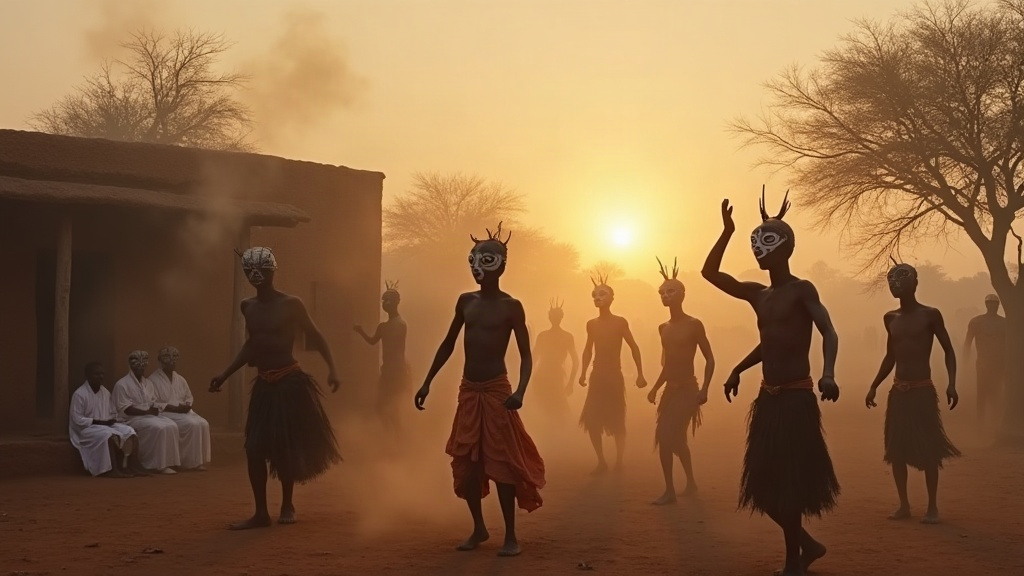
The Dama is the Dogon people's most sacred ceremony, a multi-stage funeral rite that transforms the dead into protective ancestors. Masked dancers, secret societies, and months of ritual guide the soul through the spirit world while honoring the body's return to earth.
Dogon
The Sigui Festival: The Dogon's 60-Year Renewal Ceremony
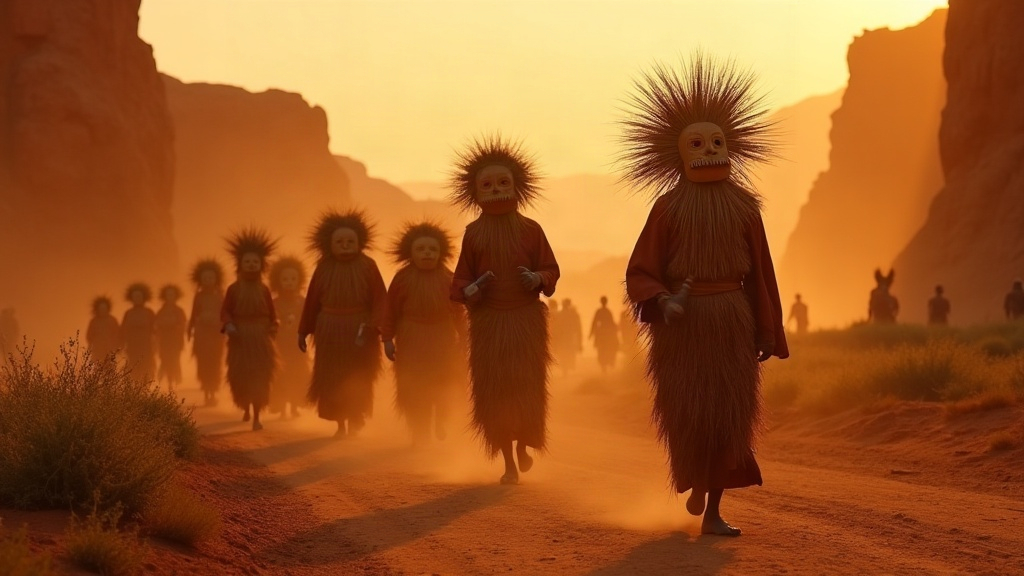
The Sigui Festival marks every 60 years when the Dogon people of Mali gather to renew their covenant with the Nommo, sacred water spirits, through masked dances, sacred narratives, and a pilgrimage that echoes creation itself. Discover why this rare ceremony transforms villages and reshapes identity.