
The Dama Funeral Rites: Guiding the Dead to Ancestorhood
The Dama is the Dogon people's most sacred ceremony, a multi-stage funeral rite that transforms the dead into protective ancestors. Masked dancers, secret societies, and months of ritual guide the soul through the spirit world while honoring the body's return to earth.
Contents
Among the Dogon people of Mali, death is not an ending. It is a transition. When a person dies, the community gathers for a ritual that can stretch across months and demand the participation of hundreds. The Dama funeral rites are the most elaborate and sacred ceremonies in Dogon religious life, a complex sequence of masked dances, songs, and symbolic acts that prepare the deceased for a new existence among the ancestors.
The Dama exists to accomplish something vital: it must guide the soul safely from the world of the living to the world of the dead, stabilize the deceased's new status as an ancestor, and restore balance to a community disrupted by loss. Without the Dama, the Dogon believe, a soul cannot rest. It may wander, confused and grieving, or worse, return to trouble the living.
This ceremony reveals how the Dogon understand death, kinship, and the invisible forces that shape daily life. To witness or study the Dama funeral rites is to enter the heart of Dogon cosmology, where every movement of a masked dancer carries meaning, where the dead speak through the living, and where community and cosmos are woven together.
The Dogon Cosmos and the Place of the Dead
The Dogon worldview begins with creation and cosmology. According to Dogon teaching, the universe was created by Amma, the supreme god, through a series of transformations and divine births. The cosmos contains multiple realms: the world of the living, the sky realm where the stars and celestial beings dwell, the underworld, and the realm of the ancestors. These worlds are not separate; they overlap and communicate.
Within this cosmos, the Dogon people occupy a specific place. They trace their identity to primordial ancestors and to sacred knowledge given to them by celestial beings. The most important of these beings is Nommo, a water spirit and culture-giver associated with speech, organization, and the order of society. The Dogon say that Nommo taught them how to live, how to speak, and crucially, how to conduct their dead properly.
When a Dogon person dies, their status begins to shift immediately. The living body is no longer simply a person; it is now a bridge between two worlds. The soul (or multiple spiritual aspects, since the Dogon conceive of the person as containing several) must be helped to detach from earthly ties and establish itself in the ancestral realm. Until this transition is complete, the deceased remains vulnerable and somewhat dangerous. The Dama funeral rites manage this danger and facilitate the transition.
The ancestors themselves are not remote or forgotten. They remain powerful presences in Dogon life. They watch over their descendants, receive offerings of food and drink, and can bless or curse depending on whether they are properly honored. An ill-conducted funeral, or a failure to complete the Dama, can result in an angry or restless spirit.
Structure and Timing of the Dama
The Dama funeral rites do not happen in a single day. They unfold in stages, often spanning weeks or months, sometimes occurring even years after a death. The timing depends on family resources, the season, and the age and status of the deceased. A respected elder or initiated person typically receives an elaborate, lengthy Dama. A child may receive a shortened version.
The ritual complex has several distinct phases. The first phase begins immediately after death, with the preparation and washing of the body. The corpse is treated with care and ritual precision. It is washed, wrapped in cloth, and laid in a grave that has been specially prepared. In some Dogon regions, the burial takes place quickly, within a day or two. The soul, however, is not yet complete in its journey.
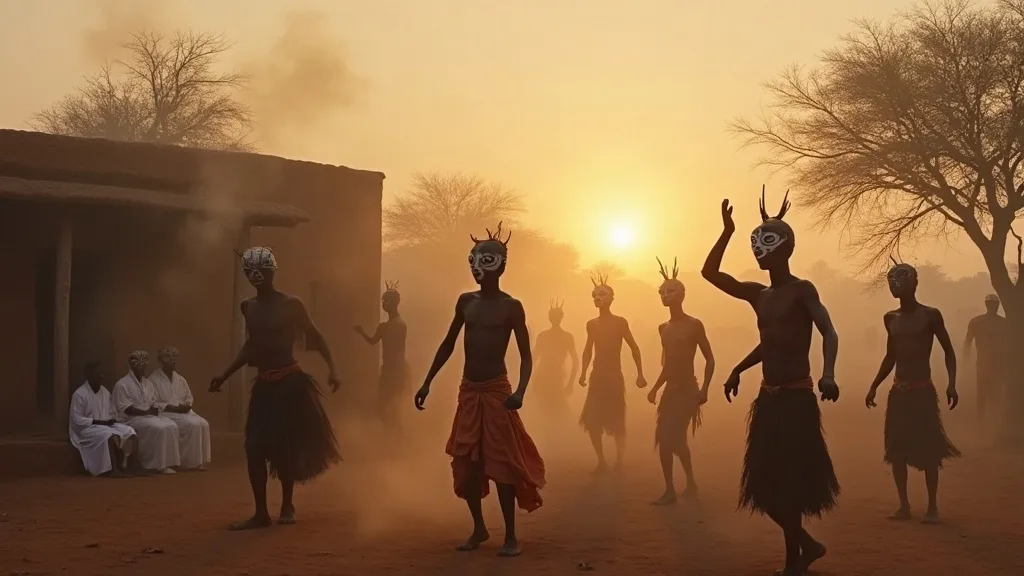
The second phase, called the dama proper by some scholars, can begin days or weeks later. This is when the community gathers for the most visible and dramatic ceremonies. Masked performers appear. Singing and drumming fill the village. The living enact sacred stories and honor the deceased through an elaborate performance that is at once theatrical, religious, and therapeutic.
A third phase may extend over many months. The Dogon conduct periodic gatherings in which food and libations are offered to the dead. These acts nourish the soul and help it to forget its attachment to its former home. Gradually, the deceased becomes an ancestor.
The entire sequence is overseen and conducted by members of secret societies, particularly the Awa society, which controls the use of masks and the performance of masked dances. Not all Dogon participate in these societies, but those who do shoulder responsibility for the spiritual welfare of the community.
The Masks and Masked Dancers
The most visible and iconic element of the Dama funeral rites is the appearance of masks and masked dancers. To outsiders, these performances can seem like entertainment or art. To the Dogon, they are serious spiritual work. The masks are not costumes; they are conduits for spiritual power.
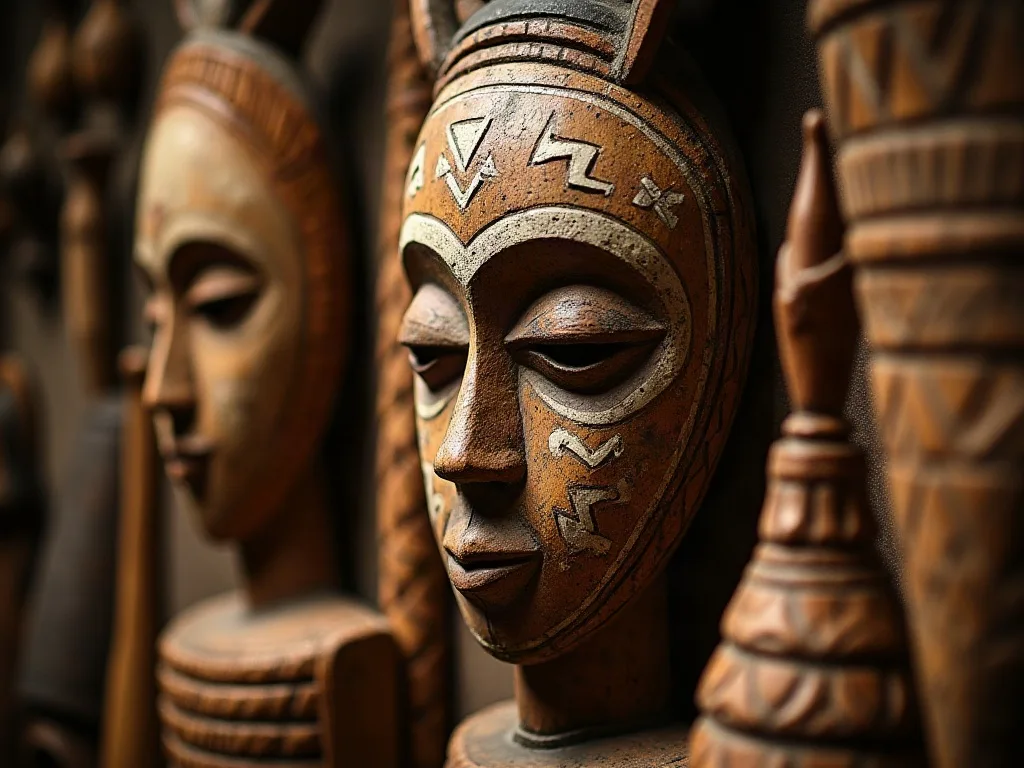
Each mask has a name, a history, and a symbolic meaning. The kanaga mask is one of the most recognized, with a soaring geometric design that represents a bird, or in some interpretations, the universe itself. The sirige mask, even taller and more elaborate, depicts a woman and embodies fertility and spiritual authority. The satimbe mask represents the first woman and is connected to the feminine principle. Each mask is carved from wood, often shaped to resemble an animal, a human face, or an abstract form.
The mask itself is alive, in the Dogon understanding. A man who dons a mask becomes something other than human. He is no longer simply an individual; he has become a conduit for ancestral or spiritual force. His movements are prescribed by tradition. He dances in patterns that are recognizable and repeated, yet each performance is an improvisation within these boundaries.
When masks appear at a Dama, they may arrive unexpectedly. They come to dance on the roof of the deceased's house, to perform in the village square, to visit the grave. Their presence is both a comfort to the bereaved and a powerful spiritual act. The masks acknowledge the death, honor the dead, and demonstrate the continuity between the living and the ancestral realm. Through the masked dancers, the ancestors themselves seem to be present, watching over the ceremony.
The performance of masked dances is dangerous knowledge. Only initiated men are permitted to wear or even touch the masks. Women and uninitiated men are excluded from many of the secret aspects of the Dama. This secrecy is not arbitrary; it reflects the Dogon belief that some knowledge and some spiritual power must be controlled and transmitted carefully.
The Role of Secret Societies
The Dama funeral rites are managed and conducted largely by members of the Awa society, also known as the mask society. The Awa is one of several overlapping secret societies among the Dogon, each with its own initiations, knowledge, and responsibilities. Membership in the Awa is restricted to men, and initiation into the society is a significant life event.
The Awa society maintains the masks, preserves the knowledge of ritual performance, and ensures that the Dama funeral rites are conducted properly. Members of the Awa are responsible for dancing, singing, and orchestrating the ceremonies. They also hold sacred knowledge about the cosmos, the nature of death, and the relationship between the living and the dead.
Other societies also participate in the Dama. The Hogon, the spiritual leader of the Dogon village or section, presides over the ceremonies and may conduct certain ritual acts. The Imina society, which focuses on the affairs of women and fertility, may have a role in certain aspects of the funeral rites. The Sigi so society, connected to the Sigi ceremony that celebrates the Dogon's mythological origins, may also be involved.
These overlapping organizations create a complex structure of authority and knowledge. No single person controls the Dama; rather, it is the collective responsibility of the initiated. This collective structure serves multiple purposes. It ensures that the ritual is performed correctly, according to ancestral wisdom. It also strengthens the bonds of the community, as men from different families work together toward a common sacred goal.
Songs, Speech, and the Power of Words
The Dogon understand that words have power. To speak a name is to invoke presence. To sing is to call out to the unseen world. During the Dama funeral rites, singing and speech are not mere accompaniment; they are central acts.
Professional bards and family members compose and perform songs that recount the deeds of the deceased. These songs may praise the person's character, recount memorable events, or provide genealogical information. The songs serve to keep the memory of the deceased alive and present in the minds of the gathered community. They also function as a form of address to the dead person, speaking to them directly, sometimes urging them to release their attachment to home and family.
The Dogon language itself is full of ritual formulas and special speech. During the Dama, certain words must be spoken at certain times. Prayers are offered to guide the soul. Invocations call on the ancestors to receive the newcomer. The Hogon and other ritual specialists may speak in a heightened or ceremonial language, in an archaic form of Dogon speech, or in phrases that carry layers of meaning.
Words are also used to establish the deceased's new status. By speaking certain phrases and conducting certain rituals, the community officially recognizes the person as dead and begins the process of transforming them into an ancestor. Without this speech and acknowledgment, the transition cannot occur.
Food Offerings and Sustenance for the Dead
A critical component of the Dama funeral rites involves the preparation and offering of food. The Dogon believe that the dead continue to need nourishment, though the kind of nourishment is different from that of the living. The dead consume the essence or spiritual dimension of food.
During the funeral ceremonies, specific foods are prepared and laid out as offerings. Millet porridge, grains, and other staple foods are common. Alcoholic beverages, such as millet beer, are also offered. These offerings are placed near the grave, left in the deceased's house, or consumed by the assembled community in a ritual meal.
The provision of food serves multiple purposes. It ensures that the deceased is cared for and honored. It provides a tangible way for family members to express their grief and continuing love. It also feeds the soul and helps it to be satisfied, so that it does not return to trouble the living. Some Dogon say that if the dead are not fed, they may become restless and cause illness or misfortune in the village.
The sharing of food also creates community. During the Dama, the bereaved family often provides a feast for the gathered people. This act of generosity is a sign of respect for the deceased and for the community that comes to support the family. The eating together, and the presence of ritual specialists and village members, affirms that the individual's death is a communal event, not a private one.
The Journey of the Soul
Central to the Dama funeral rites is a theological understanding of what happens to the soul after death. The Dogon conceive of the person as containing multiple spiritual aspects or souls. These must be properly disentangled and guided.
The immediate aftermath of death is a confused time. The person's life force or vital essence must be released from the body. The social ties that bound the person to family, to place, to role, must be gradually loosened. The Dama accomplishes this loosening through repeated rituals and symbolic actions.
The masked dancers, in some interpretations, represent guides or conductors for the dead. Their appearance and movement through the village enact the soul's journey. The masked figures move between the grave and the house, between the cemetery and the settlement, tracing the path the soul must take. The dances and processions are a kind of sacred geography, mapping the route from the world of the living to the world of the ancestors.
Over the course of weeks and months, as the ritual progresses, the deceased's ties to the living world weaken. Family members stop calling the person's name in the way they did while grieving. The offerings continue, but their character changes. Gradually, the deceased becomes less a presence in the village and more a presence in the ancestral realm.
The point at which the transformation is complete varies. Some Dogon mark it with the final gathering or feast. Others say it takes a full year, or until the rainy season returns. But the end result is the same: the dead has become an ancestor, a being of power and presence in the spiritual realm, who watches over the living and can be called upon for blessing or aid.
Age, Status, and Variations in the Dama
Not all Dogon receive the same funeral rites. The scale and complexity of the Dama funeral rites depend on the deceased's age, gender, social status, and lineage. An elder of high standing may receive an elaborate Dama lasting many weeks and drawing participants from neighboring villages. A child, by contrast, may receive a shortened version.
Women and men have different roles in the Dama, and some scholars suggest that the funeral rites for a woman may emphasize different symbolic elements than those for a man. Initiated men receive more elaborate masked performance ceremonies. A Hogon or other ritual specialist may receive ceremonies of exceptional complexity and sacredness.
The Dogon are not a monolithic people. Different Dogon regions and sections have variations in ritual practice. The Dogon of the Bandiagara Escarpment, in the central region, have certain practices. The Dogon of Timbuktu region may conduct ceremonies with local variations. Over time, and especially with modernization, some Dogon communities have modified or simplified the Dama funeral rites, while others have maintained them with minimal change.
The Dogon Dama and Comparative Funeral Rites
The elaborate and prolonged funeral ceremonies of the Dogon share some features with funeral and mourning practices in other African cultures and beyond. Many African societies, from the Yoruba to the Zulu to the Igbo, conduct elaborate funerals that last days or weeks and involve music, dance, feasting, and gifts. These ceremonies reflect a shared African understanding of death as a transition, not an ending, and of the ongoing importance of relationship between the living and the dead.
Elsewhere in the world, other cultures have also developed complex funeral rites. The Tibetan sky burial and related death rituals involve specific ways of disposing of the body and guiding the consciousness of the dead. Hindu cremation and post-funeral rites, particularly the shraddha ceremony, involve regular offerings to sustain and honor the departed. The Jewish Kaddish prayer and the year of mourning similarly extend the family's relationship with the dead over time.
What distinguishes the Dama funeral rites is the particular synthesis of masked performance, secret society knowledge, extended timing, and cosmological meaning. The Dogon have created a ritual system that addresses grief, manages spiritual danger, honors the dead, and maintains the integrity of the community simultaneously.
The Dama in Dogon Life and Identity
To understand the Dama is to understand what the Dogon believe about community and belonging. The funeral rite is one of the most important rituals in Dogon life because it touches on the deepest questions: Who am I? What is my place in the cosmos? What happens after death? How do I belong to my family and my village?
The Dogon's elaborate funeral rites reflect their belief that individual death is a communal and cosmic event. When a person dies, the entire village is affected. The balance of the village is disrupted. The cosmos itself needs to be reordered. The Dama is the instrument through which this reordering happens.
For families, the Dama is also a way of honoring and remembering the deceased. It is an occasion to gather relatives, to recite genealogies, to strengthen kinship bonds. It is a time to publicly express grief and, through the activities and feasting, to experience collective support. The burden of loss is shared and ritually contained.
For the broader Dogon society, the Dama funeral rites are one of the primary ways that sacred knowledge is transmitted. Young men learn by participating in the ceremonies. They see how elders conduct ritual, how masked dancers move, how songs should be sung. This learning is not formal; it happens through repetition and participation. The Dama is one of the great teaching events of Dogon culture.
Modern Changes and Continuity
In recent decades, like many indigenous societies, the Dogon have experienced significant changes. Some Dogon have converted to Islam or Christianity. Some have migrated to cities. Some have access to modern education and media. Yet the Dama funeral rites continue to be practiced, often with considerable elaboration and expense.
In some cases, modernization has altered the Dama. Some families may conduct a shorter or simplified version, especially if the deceased has lived for many years far from the village. Some Dogon Christian communities may blend Christian funeral practices with elements of the traditional Dama. Others maintain the ceremonies much as their ancestors did, seeing them as essential to proper respect for the dead and to the health of the village.
The Dama remains one of the most significant public performances and ritual events in Dogon society. It is an occasion for family reunion, an expression of identity and tradition, and a powerful spiritual practice. For the Dogon, the Dama funeral rites are not a relic of the past but a living practice, continually renewed and reinterpreted in each generation.
Frequently asked questions about the Dama funeral rites?
Frequently asked questions
How long does the Dama ceremony last?
The Dama can unfold over weeks or even months, sometimes years after the initial death. The timing depends on family resources, the season, and the status of the deceased. Initial burial happens quickly, but the masked dances and ritual gatherings may continue over an extended period. Some Dogon conduct annual gatherings to continue honoring the dead until the transformation to ancestorhood is complete.
Why are masks so important in the Dama funeral rites?
In Dogon belief, masks are not costumes but conduits for spiritual power. When a man wears a mask, he becomes a vehicle for ancestral or divine presence. The masked dancers guide the soul of the deceased through its transition, enact sacred stories, and demonstrate the connection between the living and the ancestral realm. The masks are considered alive and must be treated with great respect and secrecy.
Can women participate in the masked dances of the Dama?
No. The masked performances of the Dama are restricted to initiated men. Membership in the Awa, the mask society that controls the masks and conducts the dances, is exclusive to men. Women play other important roles in the funeral ceremonies, particularly in the preparation of food, the singing of songs, and the mourning process, but they are excluded from the masked dances and many of the secret aspects of the ritual.
What happens if the Dama is not properly conducted?
The Dogon believe that a soul cannot rest and move fully into the ancestral realm without a proper Dama. A poorly conducted funeral may leave the deceased restless or confused. The spirit might remain attached to the living world or become a source of trouble, causing illness or misfortune in the village. Proper conduct of the Dama funeral rites is understood as essential to both the welfare of the dead and the well-being of the community.
Are there different Dama ceremonies for different types of people?
Yes. The Dama is scaled according to the deceased's age, status, gender, and lineage. An honored elder receives an elaborate ceremony involving many participants and extended duration. A child may receive a simplified version. Those initiated into the secret societies may receive more complex ritual elements. The basic structure remains consistent, but the degree of elaboration and the particular emphasis varies significantly.
The Dama as a Mirror of Dogon Philosophy
The Dama funeral rites are not simply a practical response to death. They embody the Dogon's deepest understanding of how reality is organized. They reveal a culture that sees death not as a rupture but as a transition. They demonstrate a people who believe that the world of the living and the world of the dead are in constant communication, that ancestors are present and powerful, and that proper ritual can bridge the visible and invisible worlds.
The Dama also reveals the Dogon's commitment to community and collective knowledge. The ritual is not something a family can do alone; it requires the participation of secret societies, ritual specialists, musicians, and the broader village. It demands time, resources, and the transmission of knowledge across generations. In this way, the Dama funeral rites are not only about the dead; they are also about how the living maintain their culture and their bonds with one another.
For researchers and outsiders seeking to understand the Dogon, the Dama is invaluable. It is one of the most visible and accessible of Dogon rituals, yet it also reveals the deeper structures of Dogon thought and society. To witness or study the Dama is to encounter a complete philosophy: what it means to be human, what it means to belong, and what persists after death.
Free 25-page sample
Want the whole story?
Take the first 25 pages free. If it pulls you in, the full edition is yours as an instant PDF download, with a paperback on Amazon for selected titles.
Dogon
The Dogon Mythology Book: Amma, the Nommo, and the Mystery of Sirius
Amma, the Nommo, and Sirius
The cosmology of a people who carved their villages into a cliff in Mali, and who, some claim, knew of an invisible companion star to Sirius. The creator Amma, the amphibious Nommo, the cosmic egg, and one of anthropology’s great controversies.
More from Dogon
All articles
Dogon
The Nommo: Ancestral Water Spirits and Culture Heroes of the Dogon
The Nommo are the Dogon people's ancestral water spirits who brought civilization, language, and moral order to humanity. Descended from the sky god Amma, they shaped the world through sacrifice and remain central to Dogon ritual, art, and identity today.
Dogon
The Dogon Mask Tradition: Kanaga, Sirige, and Ritual Performance
The Dogon people of Mali have preserved one of Africa's most intricate mask traditions for centuries. Kanaga and Sirige masks embody cosmology, death, and the animate power of wood in ceremonies that bind the living to ancestors.
Dogon
The Binu Shrines: Sacred Altars to Ancestral Spirits in Dogon Tradition
The Binu Shrines are sacred wooden altars where the Dogon people of Mali honor their ancestors and the primordial water spirits that shaped their world. Built into cliff dwellings and family homes, these shrines connect the living to the dead through ritual, offering, and careful ceremonial action.
Dogon
The Sigui Festival: The Dogon's 60-Year Renewal Ceremony
The Sigui Festival marks every 60 years when the Dogon people of Mali gather to renew their covenant with the Nommo, sacred water spirits, through masked dances, sacred narratives, and a pilgrimage that echoes creation itself. Discover why this rare ceremony transforms villages and reshapes identity.