Dogon
Cosmology, creation, and the Nommo in Dogon tradition. A clear account drawn from ethnographic sources and oral testimony, minus the speculation.
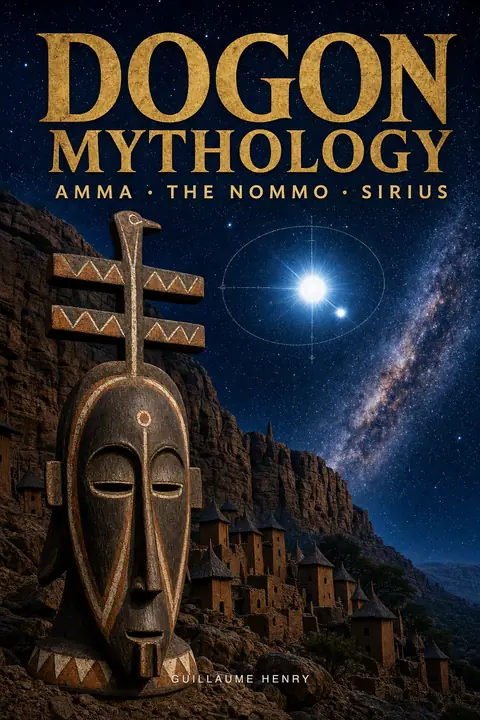
Dogon mythology is the cosmological and ritual system of the Dogon people of Mali's Bandiagara Escarpment, centered on the creator god Amma, the cosmic egg from which the universe emerged, and the Nommo, amphibious ancestral beings who brought order and knowledge to humanity. The primary ethnographic sources are Marcel Griaule's Conversations with Ogotemmêli (1948) and Germaine Dieterlen's Le renard pâle (1965), both based on decades of fieldwork with Dogon elders. The tradition has been distorted by decades of pseudoscientific speculation about Sirius, but the oral narratives themselves describe a coherent system linking creation, sacrifice, and the structure of human society.
The challenge with Dogon cosmology is separating what the elders told Griaule from what later interpreters wanted to hear. The ethnographic record is dense, sometimes contradictory, and always embedded in specific ritual contexts. What follows is an account grounded in the sources that exist, not the myths about the myths.
Who the Dogon Are
The Dogon inhabit the Bandiagara Escarpment in central Mali, a sandstone plateau that rises abruptly from the surrounding plains. Population estimates range from 400,000 to 800,000, spread across hundreds of villages built into cliff faces and along the plateau. The terrain is harsh, the farming season short, and the architecture adapted to defense and ritual.
The Dogon language belongs to the Dogon language family, itself part of the larger Niger-Congo group. Oral tradition places their arrival in the escarpment around the 14th or 15th century, though archeological evidence suggests human occupation stretches back much further. They displaced or absorbed the Tellem people, whose cliff dwellings and granaries remain visible today.
Social organization revolves around patrilineal clans, age-grade societies, and the authority of the Hogon, a spiritual leader who undergoes years of initiation and maintains ritual purity. Agriculture, particularly millet cultivation, structures the calendar. Ritual life is public, communal, and inseparable from the cosmology.
The Sources: Griaule, Dieterlen, and the Ethnographic Record
The Sources: Griaule, Dieterlen, and the Ethnographic Record
Nearly everything written about Dogon mythology traces back to Marcel Griaule, a French ethnographer who worked in the region from 1931 until his death in 1956. His most famous work, Conversations with Ogotemmêli, records 33 days of instruction from a blind elder named Ogotemmêli Agoundou Dolo in 1946. The book presents a systematic cosmology: creation, the Nommo, the granary, the eight ancestors.
Griaule's collaborator, Germaine Dieterlen, expanded the work in Le renard pâle (The Pale Fox), published in 1965. This text goes deeper into the role of Ogo, the trickster figure, and the symbolic systems linking myth to ritual practice. Both works claim to present esoteric knowledge revealed only after years of trust-building.
Controversy arrived in the 1990s. Anthropologist Walter van Beek conducted fieldwork in Dogon villages and published findings in Current Anthropology (1991) arguing that many elements of Griaule's cosmology were unknown to ordinary Dogon and possibly co-constructed during the interviews. Van Beek found no widespread knowledge of Sirius B, no unified creation narrative, and significant regional variation in ritual and belief.
The debate is unresolved. Some scholars argue Griaule was shown genuine initiatory knowledge. Others suggest he shaped the material through leading questions and European expectations. What remains clear is that Griaule and Dieterlen produced the only detailed written record of a specific oral tradition, and that tradition, whatever its origins, has influenced Dogon self-representation ever since.
Amma and the Cosmic Egg
The First Act of Creation
Amma is the creator, the god who exists before anything else. He is remote, singular, and associated with the sky. In the beginning, Amma creates a cosmic egg, a structure containing all the elements and potentialities of the universe. The egg is not inert; it vibrates with internal movement, with seeds and signs and the blueprint of what will come.
Amma places within the egg four pairs of twin Nommo, amphibious beings who mediate between worlds. Each pair is male and female, complementary, complete. The egg also contains the eight seeds of grain, the eight ancestors, and the structure of the future world. Creation is not improvisation. It is architecture.
But the egg must break for the universe to unfold. Amma intends a controlled emergence, a sequence. What happens instead is rupture.
Ogo, the Pale Fox, and Disorder
One of the male Nommo, called Ogo, breaks out of the egg prematurely. He is impatient, incomplete, and without his twin. His escape tears a piece of the placenta from the egg, and he descends with it into the void. This stolen fragment becomes the earth, but it is barren, disordered, impure.
Ogo wanders the earth seeking his twin, but she is not there. He mates with the piece of placenta, an act of incest that introduces impurity into creation. Amma, seeing the disorder, transforms Ogo into the Pale Fox, a creature of the wilderness, forever restless, forever incomplete. The fox's tracks in the sand become a form of divination, a way to read the residue of disorder.
Ogo's rebellion introduces death, disorder, and incompleteness into the world. It also makes the world dynamic. Without Ogo, creation would be static, perfect, and lifeless. His error is the condition for human existence.
The Nommo: Amphibious Ancestors
Who the Nommo Are
The Nommo are the opposite of Ogo. They are complete, paired, and aligned with Amma's plan. Griaule describes them as fish-like or amphibious, beings who exist between categories, equally at home in water and on land. They are green, associated with rain, fertility, and the life-giving properties of water.
The Nommo are not gods in the sense of distant powers. They are ancestors, intermediaries, teachers. They descend to earth to repair the damage Ogo caused, to bring order, speech, and the knowledge necessary for human survival. They are culture heroes, but they pay a price.
The Sacrifice and Resurrection of Nommo
To purify the earth and restore balance, Amma sacrifices one of the Nommo. The details vary across retellings, but the structure is consistent: the Nommo is dismembered, scattered across the earth, and from his body come the plants, animals, and elements necessary for life. His blood becomes rain. His bones become stones. His flesh becomes soil.
But the Nommo does not remain dead. Amma resurrects him, and he ascends back to the sky, transformed. This cycle of sacrifice, death, and resurrection becomes the template for human ritual. The Dama ceremony, the mask dances, the agricultural calendar all echo this original act.
"The Nommo's sacrifice is the model for all sacrifices. When we kill an animal, we repeat what Amma did. When we plant millet, we repeat the scattering of the Nommo's body." Ogotemmêli, as recorded in Griaule's Conversations with Ogotemmêli
The Nommo's resurrection is not a one-time event. It recurs in ritual, in the seasonal return of rain, in the cycles of planting and harvest. The cosmos is not a machine that runs on its own. It requires human participation, ritual maintenance, and the memory of what the Nommo gave.
The Structure of the Universe
The Structure of the Universe
The Granary of Amma
After the Nommo's sacrifice, Amma constructs a granary in the sky, a cosmic storehouse containing everything humanity will need. The granary has eight compartments, one for each of the eight seeds of grain, and it descends to earth like a basket lowered on a rope. Inside are the eight ancestors, male and female pairs, who will establish human society.
The granary is not just a container. It is a blueprint. Its structure mirrors the ideal village, the ideal family, the ideal cosmos. The four sides represent the cardinal directions. The central pillar represents the axis linking earth and sky. The compartments represent the divisions of society, the clans, the age grades.
When the granary lands, the ancestors emerge and begin the work of organizing the world. They teach agriculture, metallurgy, weaving, and speech. They establish the rules of kinship, marriage, and ritual. They are not distant founders. They are present in every properly constructed house, every properly planted field.
The Eight Ancestors
The eight ancestors are the progenitors of the eight Dogon clans. Each ancestor is associated with a specific craft, a specific organ of the body, a specific grain, a specific direction. The system is elaborate, and Griaule and Dieterlen spent years mapping the correspondences.
- The first ancestor is associated with millet and the head.
- The second with fonio and the chest.
- The third with beans and the stomach.
- The fourth with rice and the genitals.
- The fifth with sorrel and the arms.
- The sixth with onions and the legs.
- The seventh with groundnuts and the liver.
- The eighth with wheat and the gall bladder.
Each ancestor also corresponds to a type of speech, a stage of initiation, and a mask type. The human body, the village, the cosmos, and the ritual calendar are all versions of the same structure. To understand one is to understand all.
Ritual, Masks, and the Dama Ceremony
Dogon ritual life centers on masks. There are more than 70 mask types, each representing an ancestor, an animal, a force, or a stage of the cosmos. Masks are carved from wood, painted, and worn by members of the Awa, the mask society, during public ceremonies. The most important of these is the Dama, a funeral ceremony held every few years to honor the dead and guide their spirits to the afterlife.
The Dama can last several days. Masked dancers perform in the village square, moving in choreographed sequences that reenact the cosmogony, the descent of the granary, the sacrifice of the Nommo. The masks include the Kanaga, a cross-shaped mask representing the creator; the Sirige, a towering plank mask representing the multi-story house of the ancestors; and the Satimbe, representing the first woman.
The purpose is not entertainment. It is maintenance. The dead must be properly sent off, or they linger and cause trouble. The living must be reminded of their place in the cosmic order. The masks are not costumes. They are creatures that guard thresholds, mediating between the visible and invisible worlds.
Masks are stored in caves outside the village, tended by the Awa, and never touched by women or the uninitiated. The knowledge of how to carve them, how to dance them, how to interpret their movements is passed down through initiation. To wear a mask is to become the thing the mask represents. It is transformation between human and animal form, between individual and ancestor.
The Sirius Question
In 1976, Robert K.G. Temple published The Sirius Mystery, claiming the Dogon possessed ancient knowledge of Sirius B, a white dwarf star invisible to the naked eye and not discovered by Western astronomers until 1862. Temple argued this proved contact with extraterrestrial visitors. The claim spread through New Age circles and remains a fixture of alternative history.
The evidence is thin. Griaule and Dieterlen mention Sirius in their work, specifically a companion star they call po tolo, said to orbit Sirius and be extremely heavy. Temple seized on this as proof of advanced astronomical knowledge.
Walter van Beek's fieldwork found no widespread knowledge of Sirius B among the Dogon he interviewed. He suggested the information might have come from European visitors, from Griaule himself, or from post-contact reinterpretation. Griaule worked in the region for decades, and the French colonial presence included schools, missionaries, and military personnel, any of whom might have discussed astronomy.
The Sirius controversy has overshadowed the actual cosmology. It reduces a complex oral tradition to a single claim and ignores the richness of the creation narratives, the ritual system, and the social structure. The Dogon do not need to have known about Sirius B for their mythology to be worth attention.
Living Tradition and Contemporary Practice
Dogon mythology is not a museum piece. Masks are still carved, the Dama is still performed, and the Hogon still undergoes initiation. But the tradition exists in a changed context. Tourism has become a major economic force in the Bandiagara region, and performances are sometimes staged for visitors. Islam has spread through many villages, creating tension with older practices.
Some scholars worry that the ethnographic record has become prescriptive, that Dogon communities now perform the cosmology Griaule described because outsiders expect it. Others argue that oral traditions have always been flexible, adapting to new circumstances while maintaining core structures.
The Dogon themselves are not monolithic. There are Christians, Muslims, and practitioners of the older traditions, often within the same family. The masks continue to be powerful symbols of identity, even for those who no longer believe in the cosmology behind them. The Dama remains a communal event, a moment when the village gathers, remembers, and reaffirms its continuity.
Griaule's Account (1946)
Presents a unified, systematic cosmology revealed through initiation, with detailed correspondences between myth, ritual, and social structure. Emphasizes the Nommo, the cosmic egg, and the eight ancestors as core elements.
Van Beek's Findings (1991)
Reports significant regional variation, limited knowledge of the esoteric cosmology among ordinary Dogon, and no confirmation of the Sirius B claim. Suggests Griaule's account may reflect co-construction or elite knowledge not widely shared.
What persists is the sense that the world is not random, that human action matters, and that the past is present. Whether the cosmology is ancient or recent, whether it was revealed or invented, it has shaped Dogon life for generations. It continues to do so.
Frequently asked questions
What is the Dogon creation story?
The Dogon creation story begins with Amma, the creator god, forming a cosmic egg containing all the elements of the universe, including four pairs of twin Nommo, amphibious ancestral beings. One male Nommo, called Ogo, breaks out prematurely and steals a piece of the egg's placenta, creating the disordered earth. Amma then sacrifices another Nommo to purify the earth, and from the Nommo's dismembered body come plants, animals, and the elements necessary for life. Amma constructs a granary in the sky containing eight ancestors who descend to establish human society, agriculture, and ritual practice.
Who are the Nommo in Dogon mythology?
The Nommo are amphibious ancestral beings created by Amma within the cosmic egg, described as fish-like or serpent-like creatures associated with water, fertility, and rain. They are paired, male and female, and represent order and completeness in contrast to Ogo, the rebellious Nommo who became the Pale Fox. One Nommo is sacrificed by Amma to restore balance to the earth after Ogo's premature escape, and from his body come the elements of life. The Nommo are resurrected and serve as intermediaries between Amma and humanity, teaching agriculture, speech, and ritual.
What role do masks play in Dogon ritual life?
Masks in Dogon ritual life are not costumes but embodiments of ancestors, animals, and cosmic forces, worn by members of the Awa mask society during ceremonies, particularly the Dama funeral rite. There are more than 70 mask types, each representing a specific element of the cosmology, and they are used to guide the spirits of the dead to the afterlife and to reenact the creation narrative. Masks are stored in sacred caves, carved and maintained by initiated men, and their dances serve to maintain cosmic order and remind the community of its place in the universe. The performance is ritual maintenance, not entertainment, and the masks mediate between the visible and invisible worlds.
Did the Dogon really know about Sirius B before modern astronomy?
The claim that the Dogon possessed ancient knowledge of Sirius B, a white dwarf star invisible to the naked eye, originates from Marcel Griaule and Germaine Dieterlen's ethnographic work and was popularized by Robert K.G. Temple's 1976 book The Sirius Mystery. However, anthropologist Walter van Beek's fieldwork in the 1990s found no widespread knowledge of Sirius B among the Dogon he interviewed, and he suggested the information may have come from European contact, including Griaule himself or colonial-era visitors. The evidence for pre-contact astronomical knowledge is weak, and the controversy has overshadowed the actual richness of Dogon cosmology, which does not require extraterrestrial contact to be valuable.
How is Dogon mythology practiced today?
Dogon mythology continues to be practiced through mask ceremonies, particularly the Dama funeral rite, and through the authority of the Hogon, a spiritual leader who maintains ritual purity and oversees communal observances. However, the tradition exists in a changed context, with tourism, Islam, and Christianity all influencing contemporary practice, and some ceremonies are now performed for visitors. The masks remain powerful symbols of identity even for those who no longer adhere to the older cosmology, and ritual life continues to adapt while maintaining core structures. There is ongoing debate about whether the ethnographic record has become prescriptive, shaping practice to match outsider expectations.