
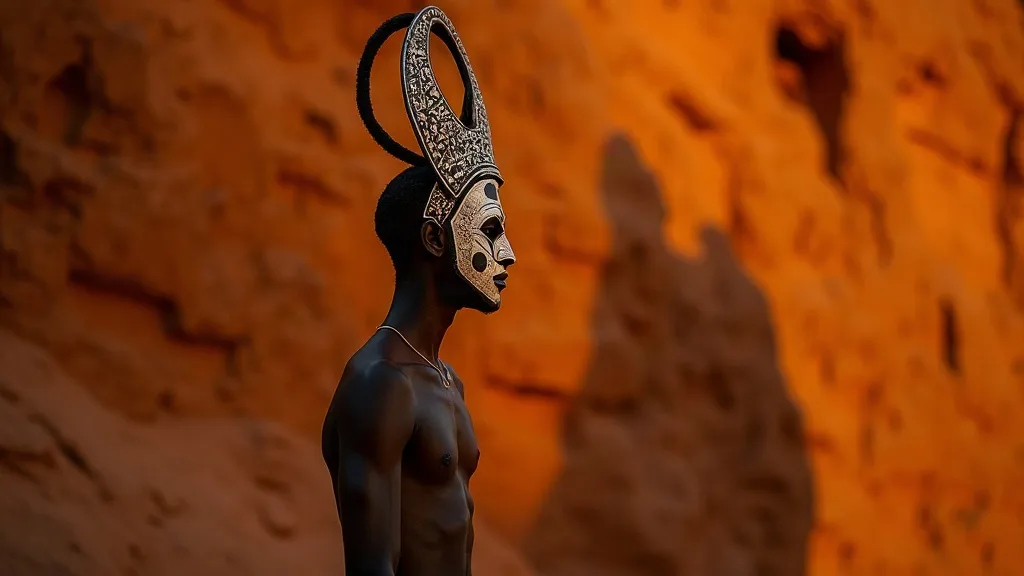
The Dogon Mask Tradition: Kanaga, Sirige, and Ritual Performance
The Dogon people of Mali have preserved one of Africa's most intricate mask traditions for centuries. Kanaga and Sirige masks embody cosmology, death, and the animate power of wood in ceremonies that bind the living to ancestors.
Contents
In the cliffsides of Bandiagara in Mali, when a Dogon man dies, the village does not mourn in silence. Instead, masked figures emerge from the darkness. They leap and spin, their wooden heads impossibly tall, their voices transformed by the thickness of carved timber. These are the Dogon masks, the physical form of spirits and ancestors, and their appearance marks the boundary between one world and another. For the Dogon people, masks are not costumes; they are conduits. They are wood made animate, and when worn, they carry the dead forward into memory.
The Kanaga mask leads this tradition. Its design is stark: a cross of wood crowned with a larger geometric head, often painted in bold blacks and whites. Dancers wearing Kanaga move with violent grace, lunging and striking the ground, their bodies a percussion against earth. The Sirige mask stands taller still, a soaring construction sometimes reaching eight feet high, topped with a sculptural form that suggests antelope horns or a bird in flight. These masks do not express individual personality. Instead, they express cosmos, cosmology, and the Dogon understanding of how the universe is ordered and who holds power within it.
This is a living tradition, not a museum exhibit. Every few years, when drought or death demands it, the masks return. Dogon sculptors still carve them by hand, using specific wood species and techniques passed down through generations. The masks carry names, histories, and spiritual authority. To understand them is to glimpse how a community manages death, regulates social order, and keeps the invisible world present in the visible one.
The Origin and Cosmology Behind Dogon Masks
The Dogon did not invent masks in isolation. They arrived in the Bandiagara region, in what is now Mali, sometime between the 11th and 15th centuries, migrating from the west and settling on the cliffsides where they found refuge from hostile neighbors. The mask tradition they developed was shaped by this landscape, by the dry savanna, by the rhythm of millet harvests and the awareness that death was never far away.
Central to Dogon cosmology is the concept of Nommo, the primordial water spirit and the force of life itself. The Dogon describe creation through a complex narrative preserved in oral tradition and recorded by anthropologists like Marcel Griaule in the mid-20th century. In this narrative, the universe began as a spiral. The high god, Amma, shaped the world. The Nommo emerged as beings of water and language, creatures who brought order and speech to chaos. When the first Nommo died, the Dogon believe, the institution of masks arose as a way to honor that death and to allow the community to commune with the spiritual force that Nommo represented.
The masks are therefore not simply objects. They are instruments of cosmic balance. When a man wears a mask, he steps outside himself. He becomes a channel for forces larger than individual will. The mask grants him authority that no unmasked person possesses. For a few hours or days, he is not a farmer or a hunter or a trader. He is an ambassador between the human world and the realm of spirits, ancestors, and the foundational forces that hold society together.
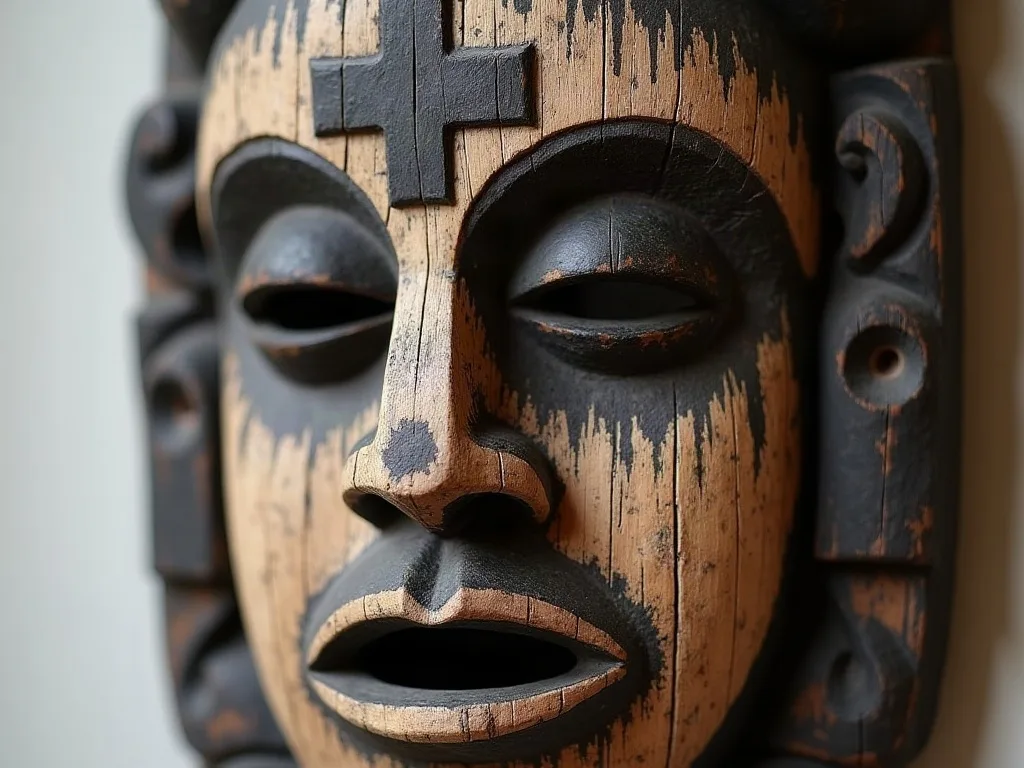
The Kanaga, with its geometric simplicity, is said to represent the descent of spirit into matter. The cross motif echoes the four directions and the meeting of sky and earth. The mask's forehead area is often carved with a downward-pointing angle, a chin-piece that can resemble a bird's beak or a plow blade. Different Dogon communities carve Kanaga masks with subtle variations. In some villages, the mask is painted white with black accents. In others, the colors are reversed. These variations tell a regional story, but the essential form remains: the cross, the geometric head, the suggestion of something both aggressive and sacred.
The Sirige, by contrast, is a monument. It rises like a tower. The base is a full human face, carved with naturalistic features. Above it, a series of geometric sections stack upward, sometimes crowned with a carved form that may suggest a tall bird or an abstract geometric shape. Some Sirige masks incorporate carved patterns that scholars have interpreted as representing granaries, the cylindrical storage structures central to Dogon agricultural life. Others emphasize a soaring verticality that seems to push upward toward the spirit world. The Sirige is reserved for the eldest and most honored dancers. To wear one requires strength and experience. The mask's height and weight make it difficult to balance and move. Only a dancer who has studied the tradition can make it dance without stumbling or falling.
The Dama Ceremony: Theater of Death and Transition
The primary context in which Dogon masks perform is the Dama, a funeral ceremony that can last several days or even weeks. The Dama is not a simple funeral. It is a elaborate performance, a ritual theater in which the community collectively processes the death of one of its members and ensures that the deceased's spirit transitions safely to the realm of ancestors.
When a Dogon dies, the body is prepared and buried. But the funeral rites do not end there. The family enters a period of mourning. They cannot work. They cannot engage in normal social activities. The village enters a liminal space, a threshold zone between the presence of the living person and their final absence.
Then, on a day chosen by elders, the masks emerge. The Dama begins. Men and women gather. The masked dancers appear, moving through the village, dancing in front of the deceased's house, performing at the family compound. The masks enact the journey of the dead. They perform the chaos that death introduces into social order. They mime hunting, warfare, fertility, and the force of nature. Through their movement and form, they externalize what cannot be spoken directly: the terror of death, the power of the deceased, the need for the community to reabsorb the loss and move forward.
The Kanaga dancers are often the most dynamic and visible. They move with intensity, striking the ground with their feet, their torsos lurching forward and back in a rhythm that seems almost involuntary. Observers have described the movement as violent, trance-like, hypnotic. The music is provided by drummers and singers. The songs often reference the deceased, their deeds, their character. Some songs are mourning songs. Others are energetic, almost celebratory. The overall effect is a kind of controlled chaos, a sanctioned space in which grief, laughter, aggression, and reverence all occupy the same moment.
The Sirige dancers move differently. Their height requires a more measured, stately performance. The Sirige dancers often move in procession, leading the way to specific locations within or outside the village. They may visit the fields of the deceased, the market where they traded, the houses of relatives. The Sirige performance is more ceremonial, more processional. Yet it carries a parallel meaning: the tall vertical reach of the Sirige is said to represent the ascent of the spirit, the deceased's journey upward into the realm of Nommo and the ancestors.
The Dama concludes when the family and community have reached a collective sense of closure. This may take days or weeks. When it ends, the masks are removed and stored. They are wrapped carefully and placed in a secure location, often a family shrine or a specialized mask house. They are not stored casually. They are treated as sacred objects with power and agency. Many Dogon communities forbid women and uninitiated men from seeing the masks when they are removed. The masks must rest until they are needed again.
Kanaga: The Cross of Life and Death
The Kanaga mask is arguably the most widely recognized Dogon mask in the outside world. It has been photographed, sketched, and analyzed in countless books and exhibitions about African art. Yet its symbolic meaning is not fully settled, even among scholars who have studied the Dogon for decades.
The most common interpretation of the Kanaga is rooted in the geometric cross. The cross is said to represent the cosmic order: the vertical axis linking earth and sky, the horizontal axis linking west and east, the four cardinal directions, the balance of opposing forces. The cross is also the shape made by a human body with arms outstretched. When the mask is worn and danced, the dancer's body extends the cross further, multiplying its symbolic potency.
The lower section of the Kanaga, the mask face itself, is typically simplified and geometrical. The eyes are often carved as simple oval or rectangular openings. The nose is sometimes a sharp triangular protrusion. The mouth, when represented, is a horizontal line or a small opening. This stylization serves a function: it removes facial individuality. The wearer is not performing as themselves. The mask erases personal identity in favor of archetypal presence.
Some Dogon elders have described the Kanaga as representing the first person, the primordial human being. Others have interpreted it as a representation of the bird, particularly a bird of prey or a stork, animals central to Dogon hunting and agricultural symbolism. The form can be read multiple ways simultaneously. This multiplicity of meaning is not a weakness. For the Dogon, masks are intentionally polysemous. They operate on multiple registers at once: the literal (the mask is carved wood), the symbolic (the mask represents cosmic order), the spiritual (the mask channels ancestral presence), and the social (the mask grants the wearer authority and transforms their role in the community).
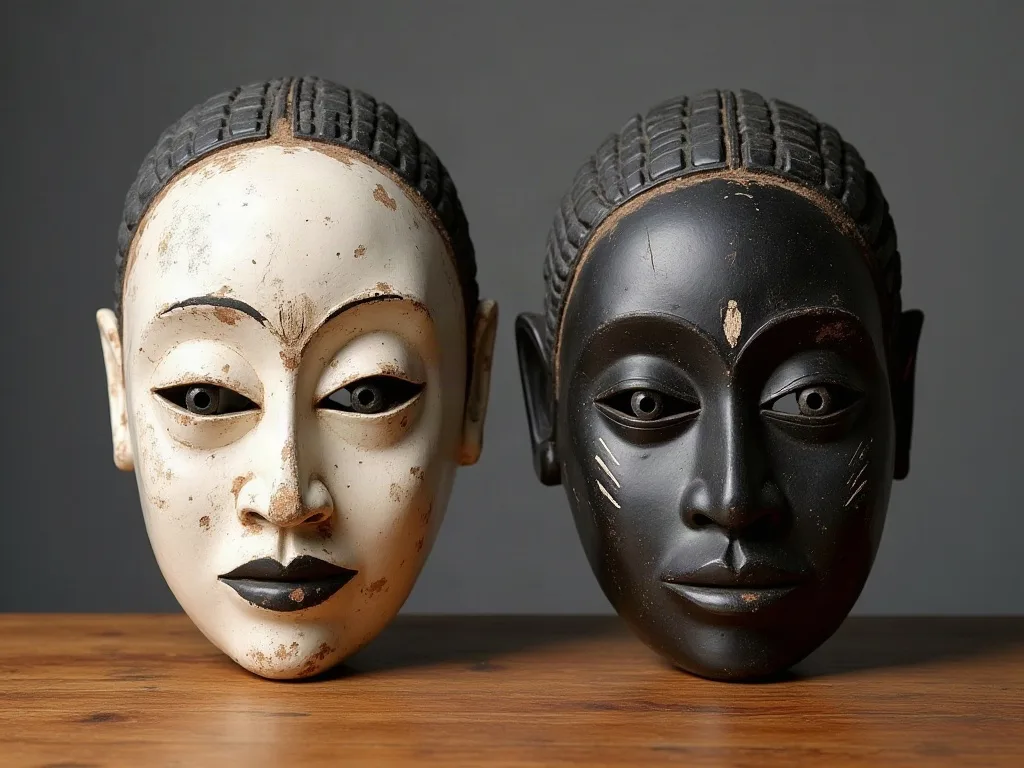
The colors of the Kanaga are often stark and deliberate. Black and white dominate. Some masks incorporate red ochre or brown tones. The black may represent the fertile earth, the realm of agriculture and growth. The white may represent bone, ash, death itself. The paint job is not merely decorative. It carries symbolic weight. A Kanaga painted predominantly white suggests a connection to the spiritual realm. A Kanaga painted predominantly black suggests a connection to the productive and fertile earth. Dogon artists have refined these color choices across centuries. They are not arbitrary.
The movement of the Kanaga dancer adds further layers of meaning. The violent lunging motion, the striking of the ground, the forward and backward rocking can be interpreted as the struggle between life and death. The mask is engaged in a kind of cosmic wrestling match, a performance of the tension between opposing forces. Some dancers have described the movement as almost involuntary, as if the mask itself is driving the motion. This dissolution of the boundary between dancer and mask is considered desirable. The ideal performance is one in which the individual ego recedes and the mask's power is fully transmitted.
Sirige: The Tower and the Ascent
If the Kanaga represents the cosmic cross, the Sirige represents the ascent, the vertical reach toward the spirit world. The Sirige is less frequently performed than the Kanaga. It requires a dancer with strength, balance, and extensive training. The mask is heavy and tall. A poorly executed Sirige performance can result in injury. Yet in villages where the Sirige tradition is strong, the appearance of a Sirige dancer at a Dama ceremony is considered a particular honor for the deceased and a demonstration of the family's spiritual authority.
The Sirige's structure is vertical and architectonic. The base is a human face, sometimes realistic and sometimes stylized. Above this face rises a series of geometric sections, often rectangular or trapezoidal, stacked one atop the other. The proportions vary, but a Sirige typically rises six to eight feet above the ground. At the top, a carved element crowns the structure. This crown may be a pair of horns (suggesting an antelope or a cow), a bird form, an abstract geometric shape, or a combination of these elements.
Some scholars, including the ethnographer Marcel Griaule, have interpreted the Sirige as a representation of the granary, the cylindrical or square storage structure used by the Dogon to hold millet and other grains. This interpretation rests on the observation that the Sirige's stacked sections resemble the stacked floors of a granary. If this reading is correct, the Sirige carries a profound economic and spiritual meaning: the granary is the heart of survival, the container of food and therefore of life itself. The Sirige, as a granary-mask, becomes a prayer for abundance and a representation of the community's dependence on the harvest.
Other interpretations suggest that the Sirige represents a sacred tree or a connection between earth and heaven. The verticality of the form creates a visual bridge between the ground and the sky. When a Sirige dancer moves, the height of the mask creates a dramatic silhouette against the sky or in firelight. The effect is striking and disorienting. The viewer must look up to see the full mask. This physical act of looking upward may be intentional, a way of orienting the observer toward the spirit realm during the ceremony.
The performance of the Sirige is typically slower and more processional than the Kanaga. The dancer moves carefully, sometimes with attendants at the sides to help maintain balance. The pace is deliberate and stately. The music may be different: instead of the rapid drumming that accompanies the Kanaga, the Sirige may be accompanied by slower, deeper drums and by singing. The effect is one of solemnity and authority. The Sirige is not frivolous. It is not entertainment. It is a formal, weighty assertion of cosmic and social order.
The Mask House and the Transmission of Knowledge
Dogon mask-making is not an unregulated craft. It is embedded in a system of initiation and apprenticeship. Not every Dogon man can carve masks. Not every man can wear them. The knowledge is guarded and transmitted selectively within families and professional groups.
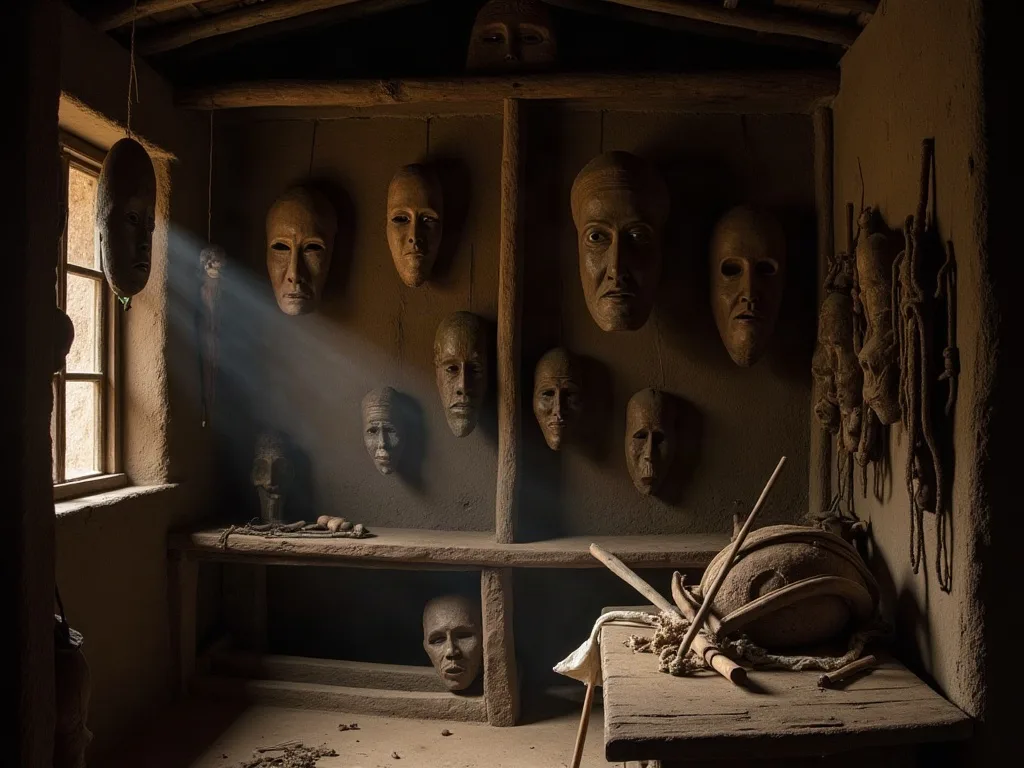
In many Dogon villages, there exists a mask house, a specialized structure where masks are stored and where mask-making techniques are taught. These houses are sometimes restricted spaces. Women and uninitiated men may be forbidden to enter. The mask house is considered sacred. It is where the masks rest between ceremonies, where they are maintained and repaired, and where young men are initiated into the mysteries of mask performance and meaning.
The carving of masks begins with the selection of wood. Different woods are used for different masks. The wood must be dry and straight-grained. The sculptor works with hand tools: axes, adzes, chisels, scrapers. The process of carving a single mask can take weeks or months. The sculptor must be patient and attentive to the wood's grain and structure. A mistake in carving cannot easily be reversed. The wood must speak to the sculptor, revealing the form that lies within it.
The choice of which man becomes a mask sculptor is typically hereditary. If a man's father was a renowned carver, he is likely to learn the craft from him. Yet talent and inclination also matter. A young man who shows aptitude for carving may be apprenticed to a master carver, even if he is not a direct descendant. The apprenticeship lasts many years. The apprentice learns not only the technical skills of carving, but also the symbolic meanings embedded in the mask's form, the proper ceremonies for blessing a newly carved mask, and the restrictions and taboos that govern mask-making.
In recent decades, Dogon mask-making has faced pressure from multiple directions. Tourism has created a market for masks intended for sale to outsiders. Some artisans have adapted their work to meet the demands and tastes of collectors. Mass production techniques have begun to enter the region. Yet the traditional mask-making process persists, particularly in villages where the Dama ceremony remains a central ritual practice. Older sculptors continue to train younger men. Families continue to commission masks for their ancestors. The tradition is dynamic but not abandoned.
The Gender Dynamics and Social Hierarchy in Mask Performance
The wearing of masks in traditional Dogon society is almost exclusively the prerogative of men. Women do not wear the major masks like the Kanaga or Sirige. This gender restriction is not accidental. It is embedded in Dogon cosmology and social organization.
The Dogon understanding of gender distinguishes sharply between male and female principles. The male principle is associated with the sky, with order, with formal ritual authority. The female principle is associated with the earth, with fertility, with the production and nurturing of life. The masks, as objects that mediate between the earthly and spiritual realms, are coded as male. To wear a mask is to perform maleness, to assert authority, to take on the formal responsibilities of social order.
Yet women are not passive in mask ceremonies. They participate as observers, singers, and sometimes as ritual specialists. In some Dama ceremonies, women may lead specific songs or perform specific gestures that complement the masked performance. The women's role may be less visible, but it is not less essential. The ceremony depends on the participation of both men and women, each acting according to their prescribed role.
Age also structures mask performance. Younger men may wear certain masks, but the most prestigious masks are reserved for elder men who have demonstrated wisdom and spiritual authority. The Sirige, in particular, is often danced by the oldest and most respected men in the community. To see an elder man wearing a Sirige is to see age and social position made manifest in wood and movement.
The Dogon Mask and the Outside World
For much of human history, Dogon masks remained relatively unknown outside West Africa. European explorers and traders had contact with the Dogon, but the masks were not a focus of early ethnographic attention. This changed in the mid-20th century.
In the 1930s and 1940s, the French ethnographer Marcel Griaule conducted extensive fieldwork among the Dogon. His work, particularly his monograph "Masques dogons" and his multi-volume study "Le Renard Pale", brought detailed knowledge of Dogon cosmology and mask traditions to a European academic audience. Griaule's work was groundbreaking. Yet it has also been criticized in recent decades for being selective and for interpreting Dogon ideas through a European lens.
The circulation of Dogon masks through international art markets has had complex effects. On one hand, it has created economic opportunities for Dogon artisans and has raised the global profile of Dogon art. On the other hand, it has disrupted traditional patterns of mask ownership and use. Masks created for sale to tourists or collectors are divorced from their original ritual context. They become aesthetic objects rather than spiritual instruments. Some anthropologists worry that this has begun to erode the tradition itself, as fewer younger Dogon men are willing to undergo the long training required to become master mask carvers when they could earn money more quickly by producing masks for the tourist market.
Dogon masks have also become symbols of African cultural authenticity in global artistic and spiritual movements. They have been displayed in major museums in Europe and North America. They have inspired modern artists. In the 1960s, Picasso and other modernist artists explicitly drew inspiration from African masks, though they often generalized African art as a monolithic tradition rather than recognizing the distinct traditions of specific peoples. The Dogon mask has thus been appropriated, reinterpreted, and sometimes misrepresented in ways that both honor and obscure its original significance.
The Meaning of Masks in Death and Memory
To understand the Dogon mask fully, one must think about what happens in the mind of a mourner when they see a masked figure emerge during a Dama ceremony. The observer knows that behind the mask is a person they recognize. Yet the mask transforms that person. The transformation is not complete disguise; it is more like a channeling or a translation. The mask-wearer becomes a vessel for forces larger than themselves.
The mask allows the living to see the dead. Not literally; the deceased does not appear in physical form. Rather, the mask allows the community to acknowledge and address the deceased's continued presence in a structured, ceremonial way. The masked dancers mime actions and emotions. They represent the deceased's power and the chaos that death has introduced. Through the mask performance, the community collectively processes the loss and moves toward acceptance and integration of that loss into ongoing social life.
The masks also serve a pragmatic social function. The Dama ceremony, through its masked performances, reaffirms the social bonds that hold the community together. Everyone is mourning the same person. Everyone gathers to witness the ceremony. The shared experience of the ritual reinforces collective identity and mutual obligation. The masks, in this sense, are instruments of social cohesion.
Finally, the masks preserve memory. When a renowned sculptor or a powerful hunter dies, the masks that appear at their Dama ceremony become associated with their memory. Years or decades later, when elders recall that funeral, they remember the beauty of the mask performance, the precision of the dancers, the songs that were sung. The masks become historical markers, points of reference that structure collective memory and genealogy.
The Sirige in Contemporary Dogon Life
In some Dogon villages, the Sirige tradition has weakened or disappeared. In others, it remains vigorous. The continuation of the tradition depends on multiple factors: the presence of experienced mask carvers, the willingness of families to commission new masks, the continuation of the Dama ceremony as a central social ritual, and the commitment of young men to undergo the training required to become Sirige dancers.
In villages where the Sirige persists, the appearance of a Sirige dancer at a major ceremony remains an event of considerable moment. The family that commissions a Sirige must possess the resources to do so. The sculptor must be of sufficient skill and reputation. The dancer must be an elder of standing in the community. The Sirige, in this sense, is a mark of status and spiritual authority. To participate in a Sirige performance, whether as a dancer or as a family member of the deceased, is to participate in one of the most prestigious and demanding acts in Dogon ritual life.
The masks are also repositories of historical knowledge. A master mask carver can often identify a mask by its style and execution and can date it approximately by the wood type and the carving technique. Old masks are preserved and sometimes displayed in villages. They serve as tangible connections to the past, to the generations of sculptors and dancers who preceded the current generation.
The Animate Power of Wood
One concept central to Dogon thinking about masks is the idea that wood itself possesses a kind of life or agency. The Dogon do not view a carved mask as simply an object made from inert material. Rather, they understand the wood as carrying a potential for animation. The carver's work releases this potential. The paint and adornment further activate it. When a person wears the mask, they intensify this animation. The mask becomes not an extension of their will, but a partner, almost an autonomous entity acting through them.
This animistic understanding is not unique to the Dogon. Many African traditions ascribe agency and spiritual presence to carved objects. Yet the Dogon articulate this understanding with particular clarity and have developed it into an elaborate aesthetic and spiritual practice. To see a mask as animate is to see it as capable of holding and transmitting power. It is to accord the sculptural object a kind of consciousness or spiritual agency that most Western secular thought would deny.
This animistic ontology shapes how masks are handled and treated. A mask is not a simple prop. It must be approached with respect and ritual caution. It may require protective rituals or cleansing ceremonies. In some cases, a mask may be felt to be angry or troubled, requiring special intervention by ritual specialists to calm or redirect its power. The mask is alive, in the Dogon understanding, in a way that Western analytical categories (alive vs. dead, animate vs. inanimate) cannot fully capture.
Frequently asked questions about the Dogon mask tradition?
Frequently asked questions
What is the primary purpose of the Kanaga and Sirige masks in Dogon culture?
The Kanaga and Sirige masks serve primarily as instruments in the Dama funeral ceremony, a ritual that allows the community to process death and guide the deceased's spirit to the realm of ancestors. Both masks channel spiritual presence and authority, allowing the wearer to step outside individual identity and speak on behalf of cosmic and social forces. They are not entertainment; they are sacred objects that structure mourning and reaffirm community bonds.
Why are masks restricted to men in traditional Dogon society?
In Dogon cosmology, masks are coded as male because they mediate between earthly and spiritual realms in ways that align with male-associated principles of order, authority, and formal ritual power. Women participate in mask ceremonies through singing, observation, and complementary ritual roles, but the wearing of major masks like Kanaga and Sirige is reserved for men. This gender restriction reflects broader Dogon concepts of male and female principles rather than representing a simple exclusion of women from spiritual life.
How is the Dogon mask tradition transmitted from one generation to the next?
Mask-making knowledge is typically transmitted through apprenticeship, often within families of established sculptors. Young men undergo years of training to learn carving techniques, symbolic meanings, and ritual protocols. The knowledge is guarded selectively; not all men are initiated into mask mysteries. Training occurs in the mask house, a sacred space where masks are stored and ritual knowledge is preserved. The continuation of the tradition depends on this deliberate, careful transmission of both technical and spiritual knowledge.
How have tourism and the global art market affected the traditional Dogon mask practice?
Tourism has created new economic opportunities for Dogon artisans but has also introduced pressures that can erode tradition. Masks created for sale to collectors are divorced from their original ritual context and become aesthetic objects rather than spiritual instruments. Some younger Dogon men may choose to produce masks for the tourist market rather than undergo the lengthy apprenticeship required for traditional practice. However, in villages where the Dama ceremony remains central to social life, traditional mask-making and performance continue, suggesting that the tradition has resilience alongside adaptability.
What does it mean to say that Dogon masks are animate or alive?
In Dogon thought, a carved mask is not inert matter but a vessel for spiritual agency and power. The carver's skill and intention release a latent vitality in the wood. The painted finish and ritual blessing further animate it. When worn, the mask acts through the dancer in ways that are not fully under individual control. The mask is understood as a partner or an autonomous entity, capable of channeling ancestral presence and cosmic forces. This animistic ontology shapes how masks are treated, stored, and ritually maintained.
How do modern scholars interpret the symbolism of the Kanaga mask's geometric cross?
The cross represents multiple layers of meaning simultaneously. It embodies cosmic order, with the vertical axis linking earth and sky and the horizontal axis linking the four cardinal directions. It also mirrors the human body with arms outstretched. Some scholars argue that the cross represents balance between opposing forces; death and life, earth and sky, individual and community. Others emphasize the cross as the meeting place of earth and water, reflecting the primordial Nommo spirits in Dogon cosmology. The multiplicity of interpretations reflects the Dogon understanding that masks are intentionally polysemous, operating on multiple symbolic registers simultaneously.
The Scholarly Debates and Ethnographic Complexities
The study of Dogon masks has a complex history in anthropology and art history. For decades, Marcel Griaule's work was the primary source for Western knowledge of Dogon cosmology and mask traditions. Yet recent scholarship, particularly by scholars like Paul Stoller and Alma Gottlieb, has questioned some of Griaule's interpretations and methods. Griaule conducted interviews with a small circle of Dogon elders, primarily men, and interpreted their responses through a particular ethnographic lens. Some of the cosmic narratives that Griaule recorded may have been elaborated or adapted specifically in response to his questions. The degree to which Griaule's account represents an authentic, complete account of Dogon knowledge, or represents instead a particular interpretation influenced by the ethnographer's own theoretical frameworks, remains contested.
More recently, scholars have emphasized the importance of understanding Dogon masks not as static museum pieces but as dynamic, living practices embedded in particular historical moments. The tradition has changed over time. Colonialism, the imposition of Islam, modernization, and tourism have all influenced how masks are made, used, and understood. Contemporary Dogon mask practice is not identical to the practice of a century ago or five centuries ago. Recognizing this historical change is essential for avoiding the romanticization of African traditions as timeless or unchanging.
Additionally, there is debate about the relationship between public mask performances and the secret or esoteric knowledge associated with masks. Some of what is performed publicly in Dama ceremonies is also the subject of restricted, initiated-only knowledge. Not everything known about the masks is appropriate to share with outsiders, women, or uninitiated men. When anthropologists and tourists observe mask ceremonies, they see the public face of the tradition. The deeper layers of meaning and ritual practice remain restricted. This layering of public and secret knowledge is important to acknowledge when discussing the tradition; what is visible to outsiders is not the whole of the tradition.
The significance of the Dogon mask extends beyond the Dogon themselves. For scholars of African religion, artistic practice, and social organization, Dogon masks offer a rich case study in how communities use material culture and performative ritual to address existential questions: How do we acknowledge death? How do we maintain connections between the visible and invisible worlds? How do we structure social authority and transmit knowledge? These questions are not uniquely Dogon; they are universal human concerns. The Dogon mask tradition offers one particularly refined and sophisticated set of answers."
Free 25-page sample
Want the whole story?
Take the first 25 pages free. If it pulls you in, the full edition is yours as an instant PDF download, with a paperback on Amazon for selected titles.
Dogon
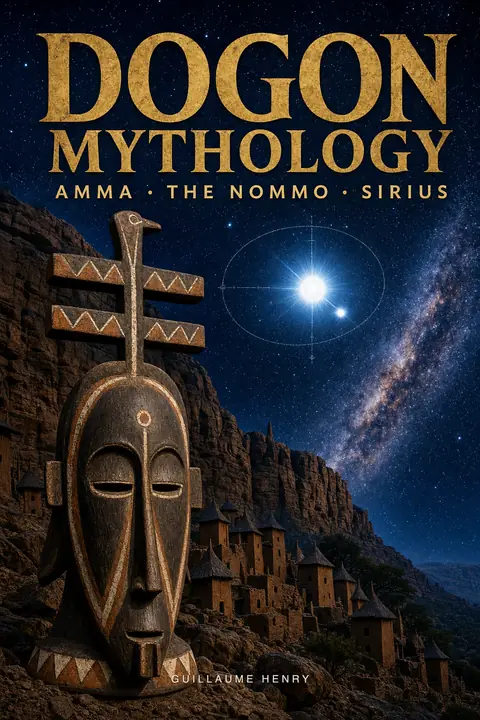
The Dogon Mythology Book: Amma, the Nommo, and the Mystery of Sirius
Amma, the Nommo, and Sirius
The cosmology of a people who carved their villages into a cliff in Mali, and who, some claim, knew of an invisible companion star to Sirius. The creator Amma, the amphibious Nommo, the cosmic egg, and one of anthropology’s great controversies.
More from Dogon
All articles
Dogon
The Nommo: Ancestral Water Spirits and Culture Heroes of the Dogon
The Nommo are the Dogon people's ancestral water spirits who brought civilization, language, and moral order to humanity. Descended from the sky god Amma, they shaped the world through sacrifice and remain central to Dogon ritual, art, and identity today.
Dogon
The Binu Shrines: Sacred Altars to Ancestral Spirits in Dogon Tradition
The Binu Shrines are sacred wooden altars where the Dogon people of Mali honor their ancestors and the primordial water spirits that shaped their world. Built into cliff dwellings and family homes, these shrines connect the living to the dead through ritual, offering, and careful ceremonial action.
Dogon
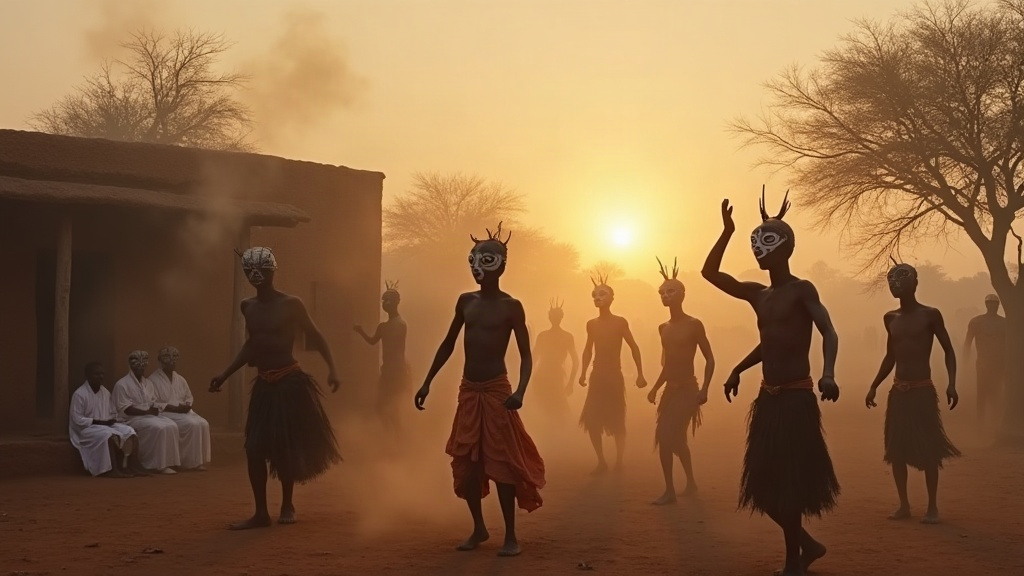
The Dama Funeral Rites: Guiding the Dead to Ancestorhood
The Dama is the Dogon people's most sacred ceremony, a multi-stage funeral rite that transforms the dead into protective ancestors. Masked dancers, secret societies, and months of ritual guide the soul through the spirit world while honoring the body's return to earth.
Dogon
The Sigui Festival: The Dogon's 60-Year Renewal Ceremony
The Sigui Festival marks every 60 years when the Dogon people of Mali gather to renew their covenant with the Nommo, sacred water spirits, through masked dances, sacred narratives, and a pilgrimage that echoes creation itself. Discover why this rare ceremony transforms villages and reshapes identity.