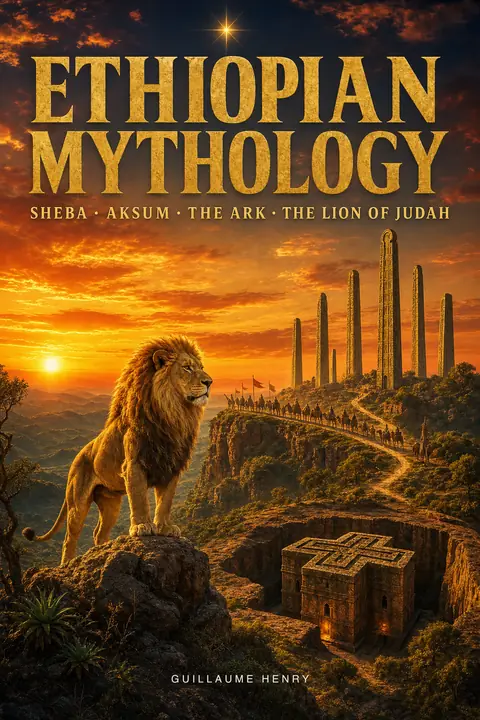

Ethiopian
From the sky-god Waaqa of the Oromo to the serpent-kings of Axum, Ethiopian mythology weaves together one of Africa's oldest and most layered sacred traditions. Discover its gods, heroes, and living cosmologies.
Ethiopian mythology is not a single, unified system. It is a living mosaic of traditions shaped by the highlands and lowlands of the Horn of Africa, by ancient Cushitic cosmologies, by the Semitic kingdoms of Axum and Sheba, by centuries of Orthodox Christian overlay, and by the persistent memory of indigenous belief systems that never fully surrendered to any empire or scripture. To speak of Ethiopian mythology is to speak of multiplicity: of the Oromo, the Amhara, the Tigrinya, the Sidama, the Gurage, the Somali borderlands, and dozens of other peoples whose stories have shaped this remarkable corner of the world.
The Cushitic Cosmos: Waaqa and the Sky Above
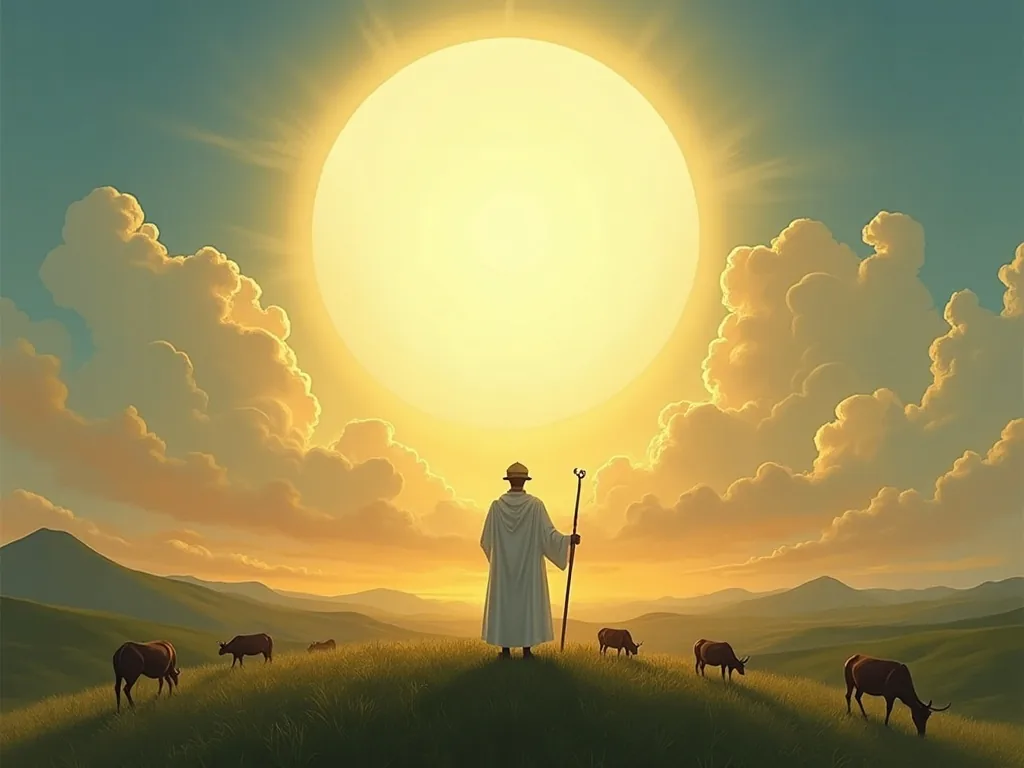
The Oromo people, who number among the largest ethnic groups in Ethiopia and the wider Horn of Africa, carry one of the continent's most theologically sophisticated indigenous traditions. At its center stands Waaqa (sometimes spelled Waaq or Waqqa), the supreme sky deity whose name literally means "sky" or "god" in the Oromo language. Waaqa is not a distant or indifferent creator. He is immanent, ever-present, and deeply entangled with the moral lives of human beings.
Waaqa created the world and all living things through an act of sovereign will. He first made the sky and the earth, then populated the earth with animals, plants, and finally humanity. Crucially, Waaqa also created Ayyaana, a spiritual force or divine grace that flows through every living being. Ayyaana is not merely a soul in the Western sense; it is an active, relational energy that connects a person to Waaqa and to the community of the living. When a person's Ayyaana is strong and aligned, they flourish. When it is disturbed, illness, misfortune, and social rupture follow.
The Role of the Qallu
Mediating between Waaqa and the human world is the Qallu, a hereditary priest-prophet figure of extraordinary sacred authority. Qallu lineages trace their descent directly from Waaqa and serve as living conduits of divine grace. Their role is not merely ceremonial; they adjudicate disputes, bless the Gadaa assemblies (the Oromo system of democratic age-grade governance), and communicate oracular messages from the sky deity. The institution of the Qallu is so ancient and so embedded in Oromo identity that it survived the arrival of Islam and Christianity, adapting without disappearing.
The Cushitic religious substratum also includes veneration of Atete, a goddess associated with fertility, women, rain, and the generative power of the earth. Atete's rituals, performed largely by women, involve offerings of butter, milk, and grain. She stands as the feminine counterpart to Waaqa's celestial authority, grounding the divine in the rhythms of birth, harvest, and sustenance. Among the Sidama people, a closely related goddess figure called Magano occupies a similarly supreme position, demonstrating the spread of sky-deity veneration across Cushitic-speaking cultures.
Zar: The Spirit World Between Heaven and Earth
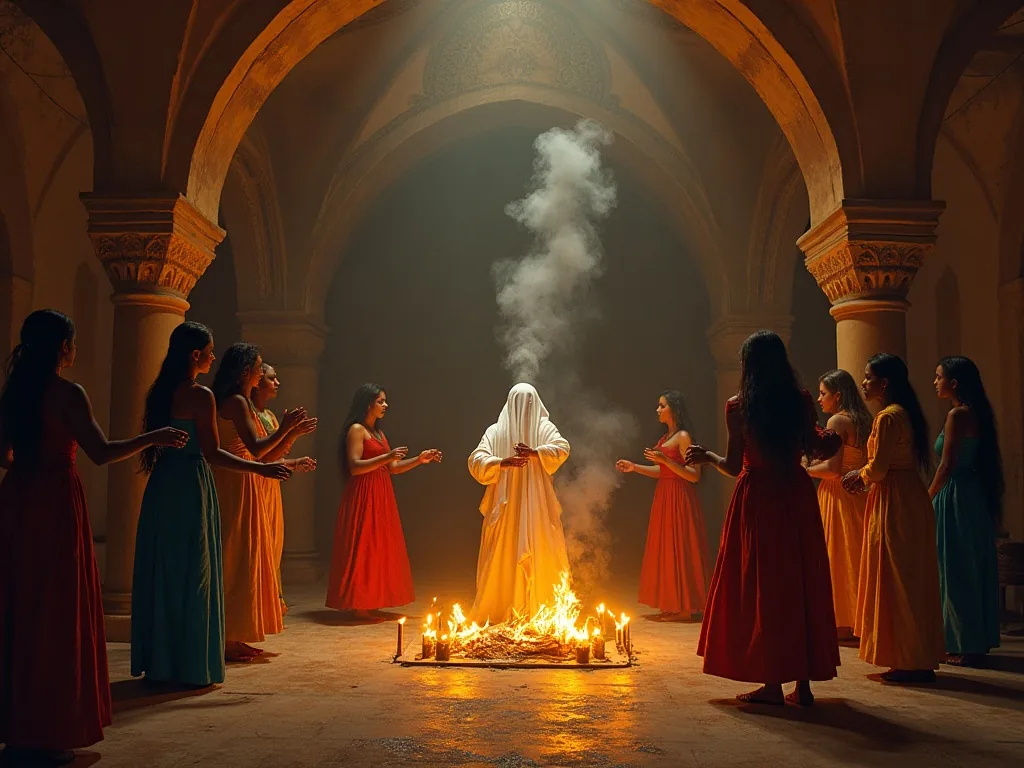
Across much of Ethiopia and into Sudan, Somalia, and Egypt, a class of beings known as Zar (also spelled Zaar or Zar) inhabit a liminal space between the divine and the mundane. Zar are spirits, neither angels nor demons in any strict theological sense, though centuries of Christian and Islamic interpretation have pushed them toward the demonic end of the spectrum. In their original conception, Zar are capricious, powerful, and above all, hungry for recognition.
Zar possess human hosts, usually women, and the possession manifests as illness, erratic behavior, or prolonged misfortune. The remedy is not exorcism but negotiation. A specialist called the Zar doctor or Balazar conducts elaborate rituals involving drumming, incense, specific clothing, and offerings of animal blood. The afflicted person, rather than being cleansed of the spirit, enters into a covenant with it. The Zar is acknowledged, appeased, and given a name and a regular tribute. In exchange, it agrees to stop tormenting its host.
This negotiated cosmology reflects a deeply pragmatic view of the spirit world: the unseen is not purely malevolent, only neglected. Zar cults have historically provided Ethiopian women with spaces of social power and communal solidarity largely unavailable through formal religious institutions. The rituals persist today, especially in urban centers like Gondar, where Zar ceremonies have been documented by ethnographers well into the twenty-first century.
Buda: The Evil Eye and the Ironsmith's Curse
Closely related to Zar belief is the widespread Ethiopian concept of Buda, the evil eye. In Ethiopian folk tradition, Buda is not merely a glance of envy but a transformative power associated with specific castes, particularly ironsmiths and potters. These artisan groups, known by different names across regions (Fuga among the Gurage, Watta among the Oromo), occupy a socially marginal yet spiritually charged position. They are believed capable of transforming into hyenas at night, prowling graveyards, and causing illness through their gaze.
This belief system encodes deep social anxieties around transformation, boundary-crossing, and the dangerous creativity of craft. The ironsmith who reshapes raw metal, the potter who transforms earth into vessel: these are people who meddle with the fundamental categories of nature. That power is awe-inspiring and therefore terrifying.
The Queen of Sheba and the Solomonic Mythos
No element of Ethiopian mythology carries more weight on the global stage than the story of Makeda, the Queen of Sheba. The Ethiopian royal chronicle, the Kebra Nagast ("Glory of Kings"), compiled in its present Ge'ez form around the fourteenth century but drawing on far older oral and written sources, presents Makeda's visit to King Solomon in Jerusalem not as a diplomatic curiosity but as the founding event of a civilization.
According to the Kebra Nagast, Makeda travels to Jerusalem drawn by Solomon's legendary wisdom. She converts to the God of Israel during her stay. On the night before her departure, Solomon tricks her into sleeping with him, having earlier extracted a vow that she would take nothing from his house without permission; when she reaches for a cup of water in the night, he claims the debt. From their union is born Menelik I, who will become the first emperor of Ethiopia and the progenitor of the entire Solomonic dynasty that ruled, with interruptions, until Emperor Haile Selassie's deposition in 1974.
Menelik and the Ark of the Covenant
The Kebra Nagast does not stop at royal genealogy. It makes an audacious cosmological claim: that Menelik, upon visiting his father Solomon as a young man, returned to Ethiopia accompanied by the firstborn sons of Israel's priests, and that these companions secretly carried the Ark of the Covenant from Jerusalem to Axum, where it resides to this day in the Church of Our Lady Mary of Zion.
This is not treated in Ethiopian tradition as legend but as sacred history. The Ethiopian Orthodox Church maintains that the original Ark, the chest containing the tablets of the Ten Commandments, is housed in Axum and guarded by a single monk who holds the title of Guardian for life. The Ark is never displayed publicly. Its presence is felt, not seen. Every Ethiopian Orthodox church contains a replica called a Tabot, which is processed publicly during the festival of Timkat (Epiphany), reenacting the sacred journey of the Ark through the world.
Serpents, Dragons, and the Sacred Landscape

Ethiopian mythology is dense with serpentine beings. The most prominent is Arwe, the giant serpent-king said to have ruled over the kingdom of Axum before the arrival of the legendary hero Angabo and later the Solomonic line. In some versions of the myth, Arwe demands a monthly tribute of young women fed to him; in others, he controls the rainfall and must be propitiated to ensure the harvest. He is slain eventually by a figure linked to the divine mandate of the new Axumite order, establishing a pattern common across world mythology: the serpent as primordial power that must be overcome for civilization to begin.
The serpent also appears in a more protective guise. Household snakes in rural Ethiopia are often treated with reverence rather than fear, regarded as ancestral spirits inhabiting the body of the snake, watching over the compound and its inhabitants. This protective serpent ancestor, sometimes called Achre in certain regional traditions, bridges the gap between the chthonic and the domestic.
Mountains as Mythic Axis
The Ethiopian highlands themselves function as sacred geography. Amba Geshen, a flat-topped mountain in the Wollo region, was historically used as a prison for the younger sons of emperors, kept there to prevent dynastic usurpation. Over centuries it acquired an almost mythic quality, a mountain-kingdom suspended between earth and heaven, inhabited by princes who were simultaneously royal and exiled. The sacred mountain Zuqualla, south of Addis Ababa, is home to a crater lake venerated by both Orthodox Christians and practitioners of indigenous religion, its waters believed to possess healing power.
Ethiopian Orthodox Hagiography as Living Mythology
It would be a mistake to treat Ethiopian Orthodox Christianity as merely the historical suppression of indigenous myth. In Ethiopia, the Church became a myth-making engine of extraordinary productivity. The lives of saints, particularly those of the Nine Saints who arrived from the Byzantine world in the fifth and sixth centuries and spread Christianity through the highlands, take on mythological dimensions.
Gebre Meskel Lalibela, the twelfth-century king who commissioned the famous rock-hewn churches of Lalibela, is said to have been shown the design of those churches by angels during a visionary journey to Jerusalem. Tekle Haymanot, the fourteenth-century monk and patron saint of Ethiopia, is depicted in iconography with six wings, the result of thirty-five years of standing in prayer on one leg until the other fell off. His severed leg miraculously sprouted wings, lifting him toward heaven. These are not merely pious legends; they are cosmological statements about the permeability of the boundary between human and divine, earth and heaven, a boundary that Ethiopian sacred tradition has always treated as thin and negotiable.
Rastafari: Ethiopian Mythology Transformed and Globalized
Any account of Ethiopian mythology that ends at the borders of Ethiopia misses one of the twentieth century's most remarkable mythological transformations. The Rastafari movement, born in Jamaica in the 1930s, took the figure of Ras Tafari Makonnen (Emperor Haile Selassie I) and wove around him a theology dense with Ethiopian imagery, Solomonic genealogy, and a reimagined African Eden.
For Rastafari, Ethiopia is Zion, the promised land and the primordial home of humanity. Haile Selassie is identified with the biblical Lion of Judah and revered as a divine or messianic figure. The Ethiopian flag's colors (red, gold, and green) became global symbols of liberation and spiritual return. The Kebra Nagast, once the preserve of Ethiopian ecclesiastical scholars, became scripture for Jamaican and diaspora communities who had never set foot in the highlands.
This is mythology doing what mythology does best: traveling, transforming, and finding new communities for whom it speaks with urgent personal truth. The Solomonic narrative that legitimized Axumite kings in the first millennium became, a thousand years later, the cosmological backbone of an African diasporic faith. Ethiopian mythology did not stay in Ethiopia. It never does.
Sacred Speech, Oral Tradition, and the Living Archive
Ethiopian mythological knowledge has always been held primarily in speech: in the Oromo oral epic tradition, in the liturgical Ge'ez of the Church, in the sung genealogies of griots and court poets, in the incantations of Zar doctors, in the blessing-words of Qallu priests. The Gadaa system itself, now recognized by UNESCO as an Intangible Cultural Heritage of Humanity, is simultaneously a political institution, a calendar system, and a mythological framework in which human life is structured according to a cosmic order established at creation.
Oral transmission means the tradition is alive and variable. Different Oromo clans tell different stories about Waaqa's first acts. Different communities maintain different lists of Zar spirits. The Kebra Nagast itself exists in multiple manuscript traditions with significant variations. This variability is not a weakness. It is evidence of a tradition that continues to breathe, to respond to new circumstances, and to generate new meaning.
Ethiopian mythology, in all its plurality, remains one of the world's great living archives of the human imagination.