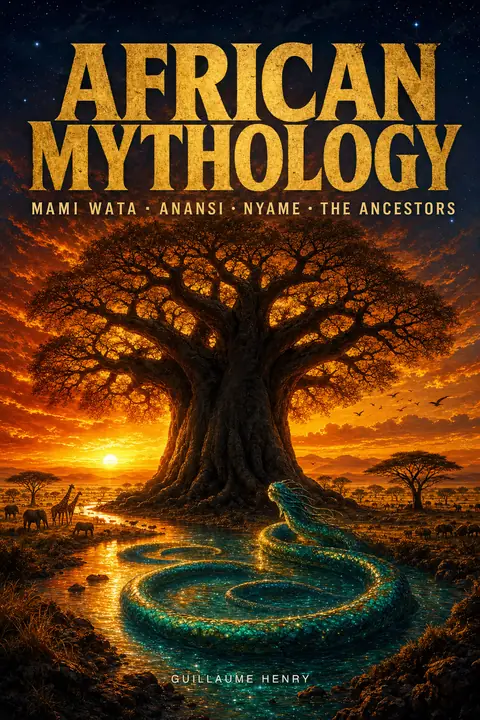
African
African Mythology: Explore the diverse mythological traditions of Africa, including Yoruba orishas, Zulu cosmology, and continent-wide trickster tales
African mythology is not one story but thousands, each rooted in the soil of specific peoples, languages, and landscapes. From the rainforests of West Africa to the savannas of the east, from the Sahara's edge to the southern cape, the continent's mythological traditions reflect an extraordinary diversity of human experience. These are living traditions, still shaping ritual, art, and identity across Africa and its diaspora, yet they share recurring themes: the relationship between sky and earth, the role of ancestors in daily life, the cunning of trickster figures who expose human folly, and the presence of divinities who remain intimately involved in mortal affairs.
This guide surveys the major mythological systems of sub-Saharan Africa, examining their cosmologies, pantheons, and narrative patterns. While no single volume can capture every tradition, we focus on those that have left the richest textual and ethnographic records: the Yoruba and their orishas, the Dogon star knowledge, the Zulu creation epics, the Akan spider tales, and the many regional variations that demonstrate both Africa's internal diversity and its underlying unity of vision.
The Nature of African Mythological Traditions
African mythologies developed primarily through oral transmission, preserved by griots, priests, and elders who adapted stories to changing circumstances while maintaining core structures. Unlike the fixed texts of Mediterranean antiquity, African myths remained fluid, responsive to historical events, migrations, and cultural exchanges. This oral nature does not indicate absence of sophistication. The Dogon cosmology, for instance, contains astronomical knowledge that puzzled Western scholars when first documented in the 1930s by Marcel Griaule, while Yoruba Ifa divination poetry comprises a vast corpus of verses requiring years of memorization.
Most African cosmologies position a supreme creator deity at the apex, often withdrawn from daily affairs after establishing cosmic order. Beneath this high god operate numerous intermediary spirits, ancestors, and nature deities who interact directly with humans. The Yoruba call these intermediaries orishas, the Akan refer to abosom, the Zulu speak of amadlozi (ancestors). This hierarchical structure allowed African religions to absorb new influences without abandoning core beliefs, a flexibility that proved crucial during centuries of cultural contact and disruption.
The continent's mythological landscape shows clear regional patterns. West African traditions emphasize elaborate pantheons and divination systems. Central African myths often center on forest spirits and the relationship between hunters and the wild. East African cosmologies incorporate cattle culture and age-grade systems into their sacred narratives. Southern African traditions developed complex origin stories explaining clan relationships and territorial claims. Yet these regional differences coexist with pan-African themes: the trickster who mediates between gods and humans, the cosmic serpent or rainbow deity, the importance of twins, and the belief that spiritual power resides in words, objects, and natural phenomena.
Yoruba Mythology and the Orisha Pantheon
The Yoruba of southwestern Nigeria and Benin developed one of Africa's most elaborate and influential mythological systems. At its center stands Olodumare (or Olorun), the supreme deity who created the universe but delegates authority to the orishas, divine intermediaries who govern specific domains of existence. The number of orishas varies by account, with some traditions recognizing 401 or even 1,700, though a core group receives primary devotion.
Yoruba creation mythology begins with Obatala, tasked by Olodumare to create solid land on the primordial waters. Descending on a chain with a snail shell full of sand, a hen, and a palm nut, Obatala scattered the sand to form earth, which the hen spread by scratching. The palm nut grew into the first tree, providing food and shelter. In some versions, Obatala became drunk on palm wine and created deformed humans, explaining physical disabilities and establishing Obatala as patron of those born different. Oduduwa, another orisha, completed the creation work, founding the sacred city of Ile-Ife, considered the birthplace of humanity in Yoruba cosmology.
Among the major orishas, Eshu (or Elegba) holds particular importance as divine messenger and trickster figure. Guardian of crossroads and interpreter between humans and gods, Eshu embodies the principle that communication requires mediation and that chaos serves cosmic purposes. Devotees propitiate Eshu first in any ritual, acknowledging his power to facilitate or obstruct divine favor. His trickster nature appears in countless tales where he exposes hypocrisy, tests virtue, or simply sows confusion for his own amusement.
Shango, orisha of thunder and former king of Oyo, represents royal power and masculine vitality. His myths tell of a ruler whose experiments with magical lightning destroyed his palace and family, leading to his suicide and subsequent deification. Oshun governs rivers, fertility, and feminine beauty, while Oya commands winds, storms, and the marketplace. Ogun, master of iron and warfare, cleared the first paths through primordial forest, making civilization possible. Each orisha possesses distinct personality, preferences, and ritual requirements, creating a pantheon as complex as any in world mythology.
The transatlantic slave trade carried Yoruba religion to the Americas, where it evolved into Santeria in Cuba, Candomble in Brazil, and Vodou in Haiti. These diaspora traditions preserved core Yoruba concepts while adapting to new environments and incorporating Catholic elements as protective camouflage. Today, Yoruba mythology influences not only religious practice but also contemporary African and Afro-Caribbean literature, music, and visual arts.
Akan Mythology and Anansi the Spider
The Akan peoples of Ghana and Ivory Coast developed mythological traditions centered on Nyame, the sky god, and a rich corpus of animal tales featuring Anansi (or Ananse), the spider trickster. Akan cosmology describes a universe with multiple realms: the visible world of humans, the sky realm of Nyame, and the underworld of ancestors and spirits. Between these realms move various abosom (nature spirits) associated with rivers, trees, and sacred sites.
Anansi stories form one of Africa's most widespread narrative traditions, traveling throughout West Africa and crossing the Atlantic to become Aunt Nancy tales in the American South and Anancy stories in the Caribbean. These tales typically show Anansi using cunning to overcome stronger opponents, acquire resources, or escape punishment. In one famous cycle, Anansi desires to own all the world's stories, currently held by Nyame. The sky god sets seemingly impossible tasks: capture the python, the leopard, the hornets, and the fairy. Through clever tricks rather than strength, Anansi succeeds at each task, and Nyame grants him ownership of all stories, which become known as "spider stories."
The Akan also developed sophisticated concepts of the human soul, describing it as composed of multiple elements. The okra represents the individual's life force and destiny, received directly from Nyame. The sunsum constitutes personality and character, shaped by earthly experience. The ntoro comes from the father's lineage, while the mogya (blood) derives from the mother's clan. This complex psychology informed Akan ethics, law, and social organization, demonstrating how mythology provided frameworks for understanding human nature.
Dogon Cosmology and the Nommo
The Dogon people of Mali's Bandiagara Escarpment preserve one of Africa's most intricate cosmological systems, documented extensively by French anthropologist Marcel Griaule between 1931 and 1956. Dogon mythology describes Amma, the supreme creator, who made the universe from a cosmic egg containing the seeds of all existence. The first beings Amma created were the Nommo, androgynous water spirits who brought order, language, and culture to humanity.
Dogon creation accounts detail how Amma first attempted to unite with the earth, but the termite mound (representing the earth's clitoris) interfered, producing the jackal Ogo, a flawed and rebellious being. Amma's second union produced the Nommo twins, perfect and complementary. The Nommo descended to earth in an ark containing the essentials of civilization: grain seeds, animals, tools, and sacred knowledge. They taught humans agriculture, weaving, smithing, and the proper conduct of ritual.
Controversy surrounds certain aspects of Dogon cosmology, particularly claims that their traditional knowledge included information about Sirius B, a white dwarf star invisible to the naked eye and unknown to Western astronomy until the nineteenth century. Griaule's informants described Sirius as accompanied by a small, heavy companion star with a fifty-year orbit, details that match astronomical facts. Skeptics argue this knowledge entered Dogon tradition through contact with Western education, while others see it as evidence of sophisticated indigenous astronomy. Regardless of this debate, Dogon mythology demonstrates the philosophical depth African traditions achieved in explaining cosmic origins and human purpose.
Zulu and Southern African Traditions
The Zulu and related Nguni peoples of southern Africa developed mythologies centered on uNkulunkulu, the "old old one" who emerged from reeds and created humanity. Zulu cosmology emphasizes the role of ancestors (amadlozi) as intermediaries between the living and the divine. These ancestral spirits require regular propitiation through ritual and sacrifice, and they communicate with descendants through dreams, possessions, and divination.
The Zulu creation narrative describes how uNkulunkulu broke off pieces of reed to create the first man and woman, then sent a chameleon to announce that humans would live forever. The chameleon moved slowly, and uNkulunkulu changed his mind, sending a lizard with a message of mortality. The lizard arrived first, establishing death as humanity's fate. This myth explains not only mortality but also the Zulu ambivalence toward chameleons, seen as bearers of bad news despite their colorful beauty.
Southern African traditions also feature the lightning bird (impundulu), a creature that serves witches and can take human form, and the tokoloshe, a mischievous and sometimes malevolent dwarf spirit. The rainbow serpent appears in various southern African mythologies as a powerful water deity, sometimes benevolent, sometimes dangerous, always demanding respect. These beings populate a spiritual landscape where natural phenomena carry sacred significance and human actions have cosmic consequences.
The Xhosa, neighbors of the Zulu, preserve the tragic historical myth of Nongqawuse, a teenage prophetess who in 1856 claimed ancestral spirits instructed the Xhosa to kill their cattle and destroy their crops. The ancestors would then rise, drive out European colonizers, and restore Xhosa prosperity. The resulting cattle-killing movement led to mass starvation and the death of thousands, demonstrating how mythological belief systems intersect with historical trauma and colonial pressure.
Central African Forest Traditions
The peoples of central Africa's rainforest belt developed mythologies reflecting their environment's dense vegetation, hidden dangers, and abundant resources. Pygmy groups including the Mbuti and Baka describe the forest itself as a divine being, simultaneously mother, father, and home. Their supreme deity often takes the form of a forest spirit who provides game, mediates disputes, and punishes those who violate hunting taboos.
The Kuba kingdom of the Congo region preserved elaborate origin myths explaining their royal dynasty's divine mandate. According to Kuba tradition, the culture hero Woot led the people to their current homeland, established social institutions, and taught essential crafts. Woot's incestuous relationship with his sister produced the first Kuba king, a scandalous origin that nonetheless legitimized royal authority by placing it outside ordinary moral constraints. The Kuba also developed sophisticated creation myths involving a supreme deity, Mboom, who vomited the sun, moon, stars, and eventually nine children who became the first humans and animals.
Central African traditions often emphasize the relationship between hunters and forest spirits. The Mitsogho of Gabon describe encounters with Bwiti, forest spirits who initiated humans into sacred knowledge through the consumption of iboga, a powerful hallucinogenic plant. These initiation myths provided the foundation for the Bwiti religion, which combines traditional beliefs with Christian elements and remains influential in contemporary Gabon.
East African Mythologies
East African peoples developed diverse mythological traditions reflecting the region's mix of Bantu, Nilotic, and Cushitic cultures. The Maasai, pastoralists of Kenya and Tanzania, describe Enkai (or Engai), a dual-natured deity who appears as both black (benevolent) and red (vengeful). Maasai mythology explains how Enkai lowered cattle from the sky on a leather rope, giving them exclusively to the Maasai, which justified (in Maasai eyes) raiding other peoples' herds as merely recovering stolen property.
The Kikuyu of Kenya trace their origins to Gikuyu and Mumbi, the first man and woman, who received land at the foot of Mount Kenya (Kirinyaga) from Ngai, the supreme deity. Gikuyu and Mumbi produced nine daughters, and Ngai provided nine husbands for them, establishing the nine Kikuyu clans. This origin myth served not only religious purposes but also political ones, legitimizing the clan system and territorial claims.
Ethiopian traditions blend indigenous beliefs with Semitic influences, creating unique mythological hybrids. The Kebra Nagast (Glory of Kings), compiled in the fourteenth century, narrates how the Queen of Sheba visited Solomon, bore his son Menelik, and how Menelik brought the Ark of the Covenant to Ethiopia. While drawing on biblical sources, this myth established Ethiopian royal legitimacy and the nation's special covenant with God, functioning as both mythology and political charter.
Common Themes and Comparative Perspectives
Despite Africa's immense diversity, certain mythological themes recur across the continent. The distant creator deity appears in most traditions: the Yoruba Olodumare, the Akan Nyame, the Zulu uNkulunkulu, the Dogon Amma. This deity typically creates the world but withdraws, leaving daily governance to intermediary spirits and ancestors. This pattern may reflect social realities where supreme rulers delegated authority to subordinates, or it may represent theological sophistication, distinguishing between ultimate causation and proximate agency.
Trickster figures pervade African mythology, from Anansi to Eshu to the hare of East African tales. These tricksters serve multiple functions: they entertain, they teach moral lessons through negative example, they explain how disorder entered an ordered cosmos, and they provide psychological outlets for questioning authority. The trickster's ambiguity, neither wholly good nor evil, reflects African philosophical traditions that embrace paradox and reject simplistic moral binaries.
Twins hold special significance throughout African mythologies. The Dogon Nommo are twins, Yoruba tradition venerates twins (ibeji) as spiritually powerful, and many African cultures developed elaborate rituals around twin births. This twin symbolism often represents cosmic duality: sky and earth, male and female, order and chaos, the complementary opposites that generate existence.
Water deities and serpent spirits appear across African traditions, from the Yoruba Oshun to the rainbow serpent of southern Africa to the Fon deity Ayida-Weddo. These beings typically govern fertility, wealth, and the boundary between human and natural realms. Their serpentine form may reflect the python's actual importance in African ecosystems, or it may symbolize the flowing, transformative nature of water and life force.
African Mythology in Contemporary Context
African mythologies remain living traditions, not museum artifacts. Across the continent, people continue to consult diviners, propitiate ancestors, and interpret events through mythological frameworks. Yoruba Ifa divination attracts practitioners in Lagos and New York. Zulu sangomas (traditional healers) incorporate ancestral guidance into their practice. New religious movements like Bwiti in Gabon and various Zionist churches in southern Africa blend traditional mythology with Christian elements, creating dynamic hybrid traditions.
The African diaspora preserved and transformed these mythologies under slavery's brutal conditions. Yoruba orishas became Catholic saints in Cuba's Santeria, Akan Anansi became the trickster hero of Caribbean and African American folklore, and Kongo cosmology influenced Haitian Vodou. These diaspora traditions demonstrate mythology's resilience and adaptability, maintaining core concepts while responding to new circumstances.
Contemporary African literature draws heavily on mythological themes. Chinua Achebe's novels explore the collision between traditional Igbo worldviews and colonial Christianity. Wole Soyinka's plays reimagine Yoruba mythology for modern audiences. Ben Okri's magical realist fiction brings spirit worlds into contemporary Lagos. These writers demonstrate how African mythologies provide not nostalgic escapism but vital resources for understanding present realities and imagining future possibilities.
African mythology also influences global popular culture, though often in simplified or distorted forms. The Marvel film "Black Panther" drew on various African mythological elements, introducing worldwide audiences to concepts like ancestral planes and animal totems, albeit filtered through Hollywood conventions. This popularization raises questions about cultural appropriation, authenticity, and who controls the interpretation of African traditions in global contexts.