
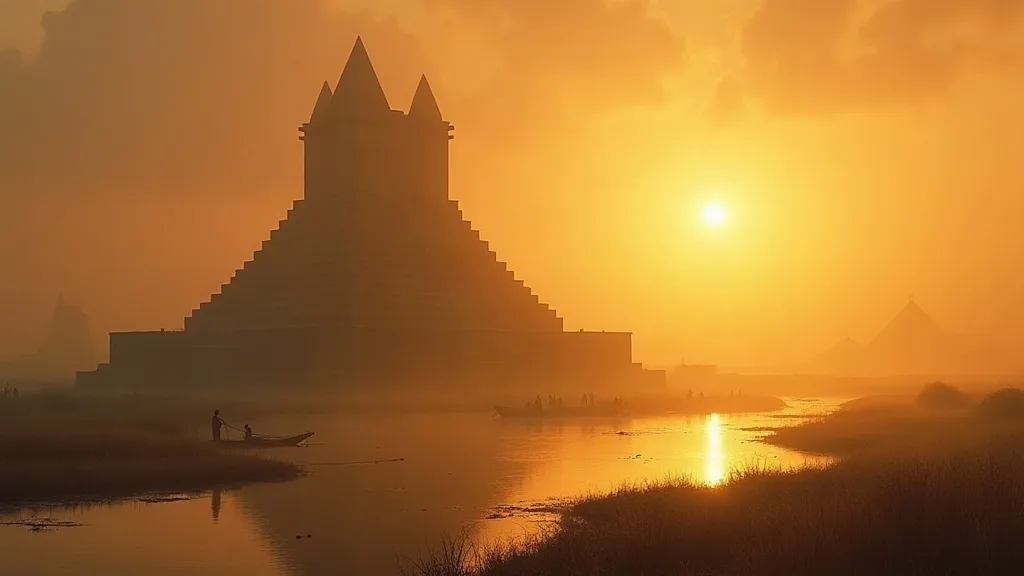
Eridu: The First City and Sacred Center of Sumerian Civilization
Eridu was the oldest city on Earth, where the Sumerians believed civilization itself began. Archaeologists have found temples, artifacts, and evidence of the world's first urban settlement here, where gods and humans first mingled.
Contents
A shepherd tends goats near the mouth of the Euphrates. It is sometime in the 6th millennium BC, and the land beneath his feet will become the most sacred place in Sumerian memory. Eridu stands here, rising from marshland and reed, the place where the Sumerians believed the gods first descended to teach humans the art of civilization itself.
Today, Eridu is an archaeological mound in southern Iraq called Abu Shahrain. But five thousand years ago, this city was legendary. The Sumerians spoke of Eridu as the seat of the first city and sacred center where kingship itself was lowered from heaven and where water, earth, and divinity converged in a temple that reached toward the sky.
The World's First Urban Settlement
Eridu was not imagined into existence by poets. The Sumerian King List, an ancient chronicle written on clay tablets, names Eridu as the first city to which kingship descended from heaven. "After the kingship was lowered from heaven, the kingship was in Eridu." Archaeological layers tell the same story, though in the patient language of shards and foundations.
When excavators first dug at Abu Shahrain in the 1940s, they uncovered evidence of continuous human habitation stretching back to around 5400 BC. The earliest layers contain not sprawling palaces but simple reed huts and fishing camps. The Euphrates flowed differently then, closer to the city, and the inhabitants lived by water and by trade. Yet even these early levels show something remarkable: ritual spaces, altars, objects placed with intentional care.
By 4000 BC, Eridu had transformed. A proper temple stood here, the Apsû, a structure dedicated to Enki, the god of fresh waters and wisdom. This was no small shrine. The temple grew and was rebuilt repeatedly over centuries, each generation adding their own stone, their own reverence. Archaeologists counted at least seventeen superimposed temple layers at the Apsû, a physical record of unbroken spiritual devotion spanning nearly two thousand years.
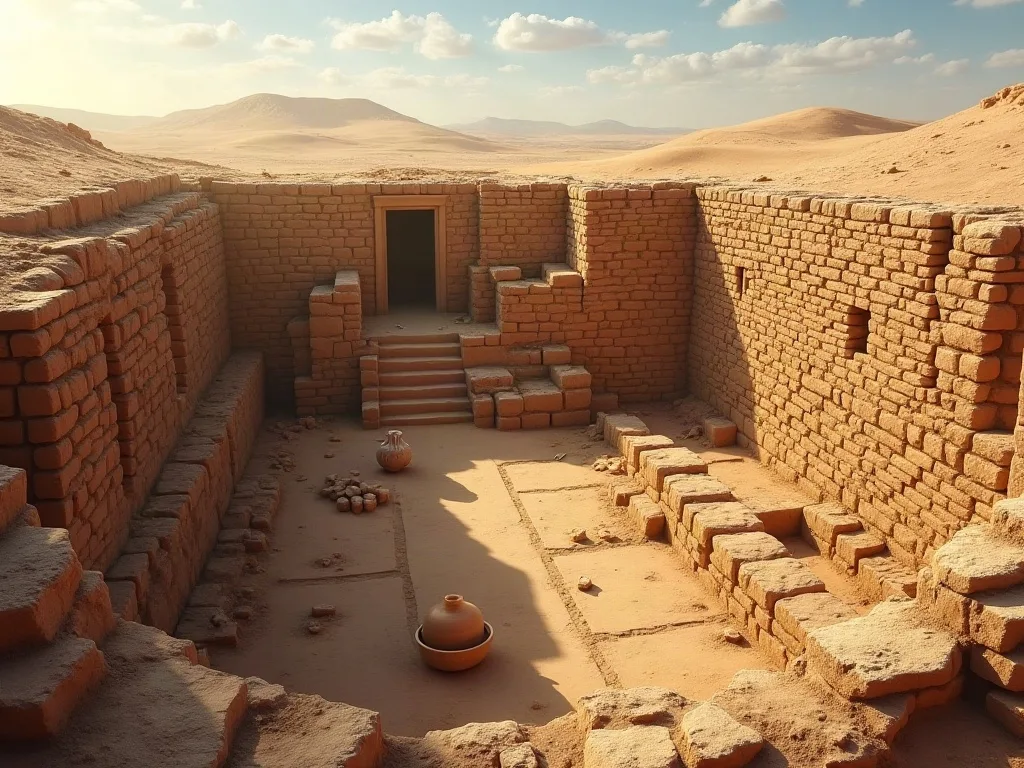
The city sprawled across about 18 acres at its height, a modest footprint by later standards but revolutionary for its time. Pottery workshops, storage areas, and residential quarters clustered around the temple precinct. Merchants from the Indus Valley traded goods here. People living in Eridu knew the names of distant lands. They were no longer purely hunters and herders; they were craftspeople, administrators, priests, traders. This is what cities do. They teach humans to be more than they were.
Eridu and Enki: The God Who Gave Wisdom
Every great city needs its god. Eridu was the earthly seat of Enki, the deity who governed the abzu, the freshwater depths beneath the world. While Anu ruled the sky and Enlil commanded the air and storm, Enki dwelt in waters that flowed beneath all things. He was the god of intelligence, craft, magic, and the secret powers hidden in nature.
The Sumerians composed a myth called "Enki and Ninhursag," in which Enki explores a fertile island called Dilmun and creates vegetation through his divine vitality. But Eridu was where this god actually lived, in daily relation with his priests and worshippers. The temple was his house. The city was his domain.
In the Atrahasis myth, preserved in Babylonian texts that drew on Sumerian sources, Enki appears as the god who teaches humans agriculture and animal husbandry, the crafts that turn survival into civilization. He is crafty, sometimes deceptive, always protective of human welfare. When Enlil sends a great flood to destroy humanity, it is Enki who warns the wise man Atrahasis and enables survival. The god of fresh waters, appropriately, holds the power over the deluge.
Eridu's priests would have understood Enki not as a distant sky-ruler but as their intimate patron. The temple was the interface where his power flowed into human hands, where ritual and irrigation, ceremony and agriculture, the sacred and the practical, became indistinguishable.
The Flood Myth and Eridu's Sacred Authority
The Sumerians possessed a different understanding of time than we do. They did not divide history into "before" and "after" a single catastrophe. Instead, they understood the Great Flood as a boundary marker, a moment of cosmic renewal. And it was Eridu that anchored this memory in human geography.
The Sumerian King List states that kingship was interrupted by the flood. The document reads: "And a flood swept over. After the flood had swept over, and the kingship was again lowered from heaven, the kingship was in Kish." This was not a local inundation but a cosmic event, a reset of human order.
Archaeological evidence supports the Sumerians' folk memory. Excavations across southern Mesopotamia have found layers of silt deposited by massive floods, dating to around 2900 BC. Some scholars believed one such event inspired the later myths. But the Sumerians saw in these floods something deeper: evidence of the gods' power to reshape the world. And Eridu, having survived these events and remained sacred, became proof that the oldest city was also the most blessed.
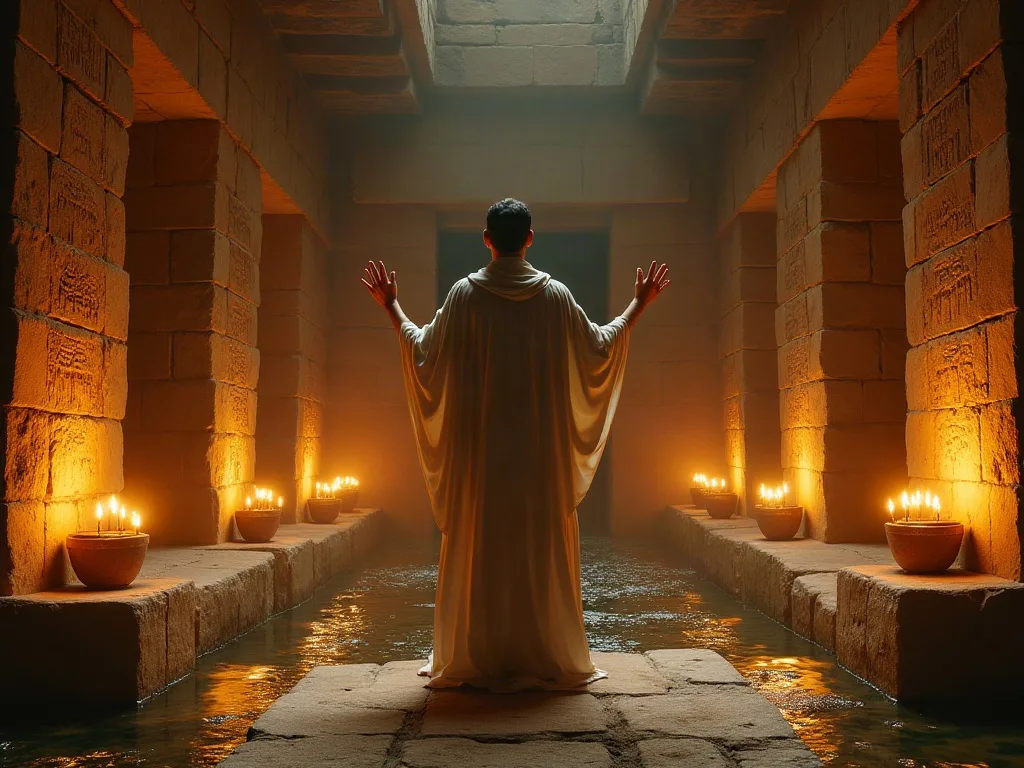
The temple at Eridu persisted. It was destroyed and rebuilt, rebuilt and destroyed again. Yet the site itself never lost its numinous character. Even as political power shifted to Ur, Lagash, and Babylon, Eridu retained its status as the origin-place, the mythical center from which all civilization flowed.
Eridu as the Navel of the World
In later Mesopotamian cosmology, sacred cities were understood as cosmic nexuses, points where the divine and human realms touched. Babylon would eventually claim this role in its own age, but Eridu held it first.
The Eridu as a sacred center operated on multiple registers. Geographically, it was a real city with real trade and agriculture. Cosmologically, it was the pillar point of the world, the place where Enki's abzu (the abyss of fresh waters) met the earthly realm. Theologically, it was the original seat of kingship, the proof that human order was not an invention but a gift from the gods.
Sumerian scribes composed hymns to Eridu that celebrate this multiplicity:
"Eridu, city of high walls, resting place of Enki..." "The city adorned with great things, resting place of Enki..."
The hymns emphasize elevation (walls, height) and rest (a dwelling place, a foundation). The city is simultaneously a fortress of civilization defending against chaos and a sanctuary where the sacred comes to rest in the human world.
The Archaeology of Myth
Modern excavations have revealed Eridu's physical reality in ways that neither confirm nor contradict the myths, but instead reveal how myths and reality co-create each other. The Apsû temple, with its seventeen rebuilding phases, is a literal monument to continuity. Each layer is a generation's affirmation that this spot matters, that the gods dwell here.
The pottery shards tell stories of contact. Indus Valley seals have been found in Eridu's soil, suggesting merchants from the Indus trading in the shadow of Enki's temple. The tools, the fish bones, the grain residue all point to a working city, not a mythical phantom. Yet this ordinariness is what makes the myth so powerful. The Sumerians did not invent Eridu's importance; they observed it. They saw a place where people flourished, where crafts developed, where order persisted, and they attributed this to divine presence.
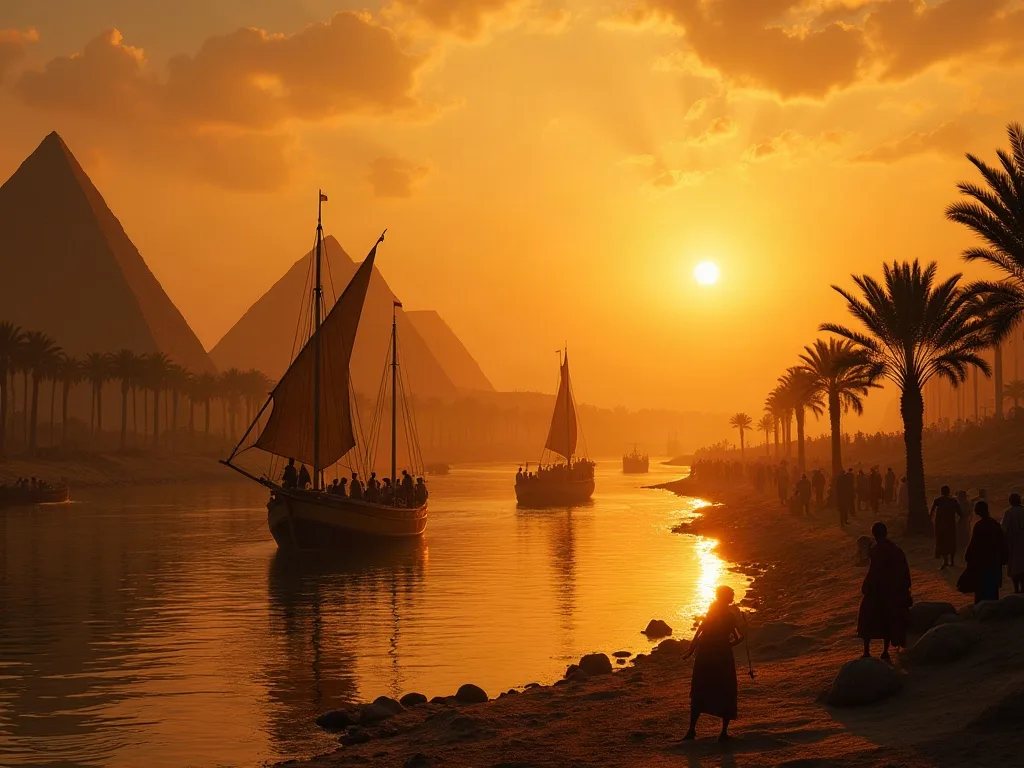
The layers of the Apsû are a kind of archaeological scripture. Read carefully, they tell the history of devotion, the history of human labor in service of the sacred. Each rebuilt temple is a prayer in stone and brick.
Eridu's Decline and Eternal Presence
By the 3rd millennium BC, Eridu's importance as a political and economic center had waned. The Euphrates shifted its course, moving inland. Trade routes changed. Ur rose to prominence. Other cities eclipsed Eridu's power.
Yet it never disappeared from the Sumerian imagination. Eridu remained the touchstone, the proof of priority, the link to origin. Kings from later dynasties would make pilgrimages to Eridu's temple to legitimize their rule, to place their hand where Enki's hand had once rested.
This pattern reveals something true about how humans relate to sacred space. Physical power and commercial importance can shift. But if a place has been a center of ritual, if generations have gathered there and affirmed its holiness, then it becomes sacred precisely because it is old, because it is remembered, because it endures. Eridu became more sacred, not less, as its political power declined.
Eridu Across Cultures and Time
The Babylonians inherited the Sumerian reverence for Eridu, though they centered their own mythology on Babylon and its patron god Marduk. Yet even the Babylonian creation myth, the Enuma Elish, acknowledges the deep antiquity and spiritual authority of Sumerian civilization. Eridu lives in that inheritance.
Later traditions would echo Eridu's role as the first city. In Islamic tradition, which dominated this region after the 7th century AD, the concept of sacred geography continued. Pilgrimages, temples reimagined as mosques, the continuity of devotion across centuries and faiths. The spiritual weight of Eridu, though its name faded, persisted in the landscape's holiness.
Frequently Asked Questions About Eridu
Frequently asked questions
Was Eridu really the first city in the world?
Archaeologically, Eridu is among the oldest urban settlements, with continuous habitation dating to around 5400 BC. Other sites like Çatalhöyük in Anatolia were earlier as settlements, but Eridu shows the development of organized temple-centered civic life and proto-urban characteristics that make it the first true city in the Mesopotamian sense. The Sumerians' claim to Eridu's primacy reflects both historical memory and mythological truth-telling.
What was the Apsû temple, and why was it rebuilt so many times?
The Apsû was the temple of Enki at Eridu. Archaeologists found seventeen superimposed temple structures at the same location, spanning nearly two thousand years. Each rebuilding likely marked a renewal of devotion, structural damage from flooding or time, or a new priest-king's wish to honor the god with a fresh edifice. The repetition itself is meaningful: continuous reconstruction proves unbroken commitment.
How do we know about Eridu if it's no longer inhabited?
The Sumerian King List, cuneiform inscriptions, hymns, and myths all name Eridu as the first city. Archaeologists excavated Abu Shahrain, the modern name for Eridu's ancient mound, beginning in 1946. The excavations revealed temple foundations, pottery, tools, and occupational layers that match the textual claims. Together, written sources and physical evidence create a full picture.
Was Eridu destroyed or did it simply lose importance?
Eridu's decline was gradual, not catastrophic. The Euphrates river's course shifted over centuries, and political power moved to cities like Ur and Lagash. Eridu remained sacred and important spiritually but ceased to be a major economic center. Kings continued to visit its temple to legitimize their rule, but the bustling city of traders and fishermen gave way to a smaller, more purely sacred settlement.
What role did Eridu play in later Mesopotamian civilization?
Eridu became a touchstone of legitimacy. Later kings claimed authority by visiting Eridu's temple and affirming continuity with the first kingship. In myth and memory, Eridu was the proof that civilization was not a human invention but a divine gift, lowered from heaven by the gods at the world's beginning.
The Eternal Myth of Origin
Eridu endures in human consciousness precisely because it is real. We can walk its ruins. We can read the clay tablets that name it. We can hold the pottery shards in our hands. Yet the reality makes the myth more powerful, not less. The Sumerians were not inventing symbolism when they declared Eridu the first city; they were reading truth from the ground itself.
Every culture searches for its origin point, the place where time began. For the Sumerians, that place was Eridu, where Enki taught humans to farm and build, where the temple grew in layers like the rings of a tree, where kingship was lowered from heaven and civilization began. The city's archaeology proves the ancient memory true: humans did gather here, did build here, did recognize the sacred here. The fact that we can excavate Eridu's truth does not diminish its myth. It grounds it in earth and bone and brick, making it eternal.
Read the full book
Want the whole story?
The complete edition is an instant PDF download here, with a paperback on Amazon for selected titles.
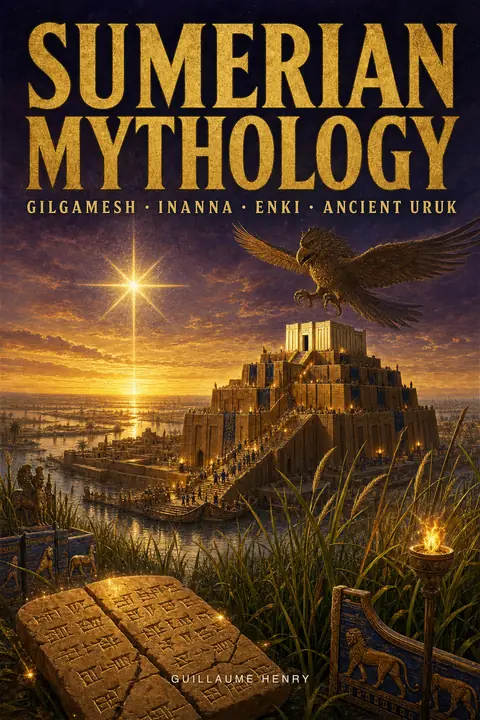
Sumerian
The Sumerian Mythology Book: Gilgamesh, Inanna, Enki, and the World's Oldest Sacred Stories
Gilgamesh, Inanna, and the world's oldest written myths
The earliest written myths on earth, preserved on clay tablets four thousand years ago. Gilgamesh seeking immortality, Inanna descending to the underworld, Enki shaping the cosmos. Here is what survived.
More from Sumerian
All articles
Sumerian
Enki: God of Wisdom, Water, and Creation
Enki shaped human intelligence and filled the rivers with life. This Sumerian god of wisdom, water, and cunning stands at the heart of creation itself, bending the rules when justice demands it. Meet the architect of civilization.
Sumerian
Inanna: Goddess of Love, War, and the Planet Venus
Inanna commands both ecstasy and carnage: a Sumerian goddess who embodied love, war, and the morning star. Her descent to the underworld remains literature's oldest recorded myth of transformation and return.
Sumerian
The Me: Divine Powers and Cosmic Order in Sumerian Mythology
The Me were not objects but fundamental laws of existence itself. Sumerian texts reveal how goddesses stole them, gods hoarded them, and the whole universe bent to their will.
Sumerian
An: The Sky God and Father of the Gods
An ruled the Sumerian heavens as the oldest god in the pantheon - remote, absolute, and sovereign. Learn how this sky father shaped every deity, ritual, and royal claim in ancient Mesopotamia.