
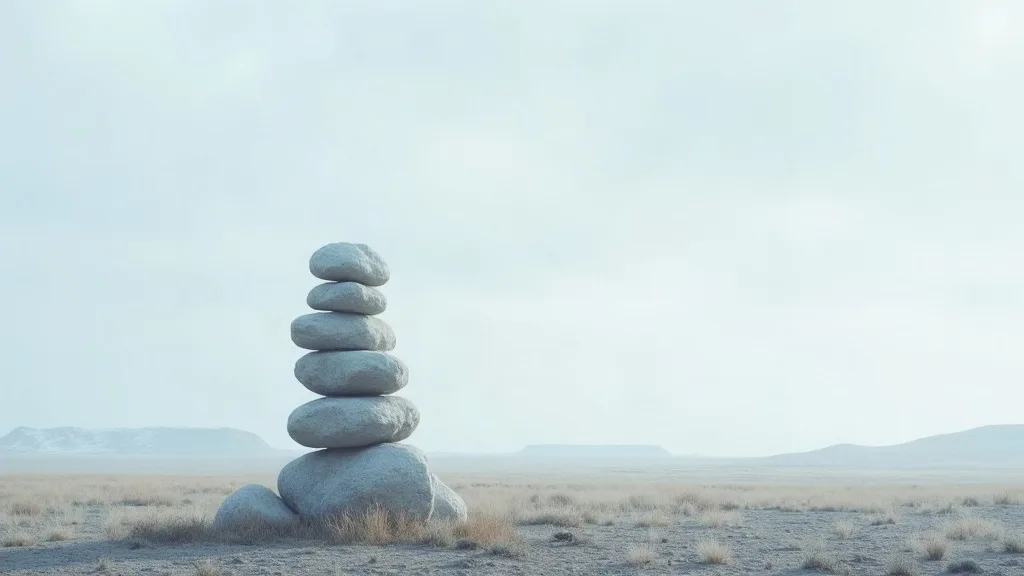
Inuksuk: Stone Markers of the Arctic Landscape
The Inuksuk stands as a silent guardian across the Arctic: stacked stones shaped by Inuit hands to guide hunts, mark sacred places, and embody the spirit of community. Learn how these markers bridge the visible and spiritual worlds.
Contents
The Stones Stand Watch
A hunter walks across the treeless expanse of Nunavut, the horizon empty in every direction. Snow stretches flat and featureless for miles. Then, ahead, something breaks the monotony: a human shape built entirely of stone. Two legs braced wide, an arm pointing west, a head crowned with smaller rocks. This is the Inuksuk, and to the Inuit who shaped it, it is not merely a marker. It is a presence, a promise that someone has walked this land before, and someone trusted others enough to leave a message written in the most permanent language the Arctic offers.
The word "Inuksuk" comes from Inuktitut, the language of Inuit peoples across Alaska, Canada, and Greenland. Inuk means "person," and the suffix -suk implies "acting like" or "being in place of." An Inuksuk is literally "acting like a person" or "in the place of a person." For millennia, these stone figures have served the Inuit as navigational guides, territorial markers, navigation aids during hunts, and spiritual anchors in a landscape that offers few fixed features. They are geometry made sacred, silence given shape.
In 1994, the Inuksuk became the symbol of the upcoming 1996 Summer Olympics in Atlanta, then reappeared as the central emblem of the 2010 Winter Olympics in Vancouver. But the symbol's power long predates modern sport. It emerges from thousands of years of Arctic life, where survival depends on reading the land, trusting in community, and understanding that stones, once stacked with intention, carry a human voice across seasons and generations.
Origins and Purpose in Arctic Life
The oldest Inuksuk remain undated, hidden in the permafrost and oral tradition. Archaeological evidence suggests that Inuit peoples have constructed stone markers for at least 1,500 to 2,000 years, though the practice likely extends deeper into antiquity among their ancestors. The harsh Arctic environment left few materials for building: no trees tall enough for landmarks, no earth soft enough to carve, only rock, ice, and sky. Stone became the alphabet of survival.
Historically, Inuksuk served multiple practical functions across Inuit territories. The most vital role was as a navigation aid during caribou hunts. Hunters would construct long lines of Inuksuk across the tundra, creating a narrowing corridor that guided migrating caribou herds toward specific locations where hunters waited. The animals, spooked by the stone figures (which resembled human silhouettes), would funnel down this gauntlet, increasing the hunters' chances of a successful kill. This required precise knowledge of seasonal animal routes, weather patterns, and topography. An Inuksuk built in the wrong location wasted effort; built correctly, it meant the difference between a thriving community and starvation.
Inuksuk also marked travel routes and safe passages across featureless terrain. A wanderer caught in Arctic fog or darkness could navigate by moving from one stone marker to the next, as if following stepping stones across invisible ground. Some Inuksuk pointed toward important destinations: a fishing site, a seasonal camp, a shelter. Others signaled warning, indicating dangerous territory ahead, thin ice, or areas claimed by other communities. In this sense, they became a form of landscape-wide communication, a system of consent and caution written without words.

Territorial markers carved with specific ownership symbols told outsiders which hunting grounds belonged to which family or clan. These symbols, called toonik (plural toonit), were often small pictographs chiseled or arranged within the stone structure itself. A hunter stumbling upon such a marker knew to move on, to respect the boundary. The Inuksuk enforced social order in a region where law enforcement and written deeds could not reach.
Spiritual Significance and Connection to the Animate Landscape
For Inuit peoples, the landscape itself is alive. This animism forms the foundation of Inuit spirituality and cosmology. The land, the sea, the animals, and even significant stones possess inua, a spiritual essence or soul. An Inuksuk, then, is not merely a pile of rocks; it is an animate being, a person-shaped spirit stationed in the landscape to serve specific purposes.
Shamans and spiritual leaders played a central role in determining where and how Inuksuk should be built. Before construction began, rituals were performed to request permission from the spirits of the place and to ensure that the new stone person would carry protective and communicative power. The careful stacking of each stone was not casual work but a form of prayer, a conversation with the hidden forces that govern the Arctic.
Some Inuksuk were built as cairns for remembrance, marking the place where a respected hunter or community member died. These became shrines of sorts, places where the deceased's presence lingered and could be acknowledged. Family members would add stones over time, letting the pile grow as a physical record of grief and honor. In a landscape where the body might be consumed by animals or buried under deep snow, the Inuksuk became a fixed memorial, a way of ensuring that the dead were not forgotten.
Others were constructed as spiritual guardians, positioned to watch over hunters, fishers, or travelers. The figure itself was believed to carry the consciousness or blessing of those who built it, extending their protection into realms they could not physically reach. When a hunter passed such a marker, he would often place an extra stone on top or touch it in acknowledgment, a small ritual that reinforced the connection between the human and spiritual worlds.
The concept of the Inuksuk also reflects the Inuit understanding of community and reciprocity. When one hunter built a marker for another, he was performing an act of service that asked for nothing in return except the continuation of the system itself. The marker said, in effect, "I have been here, I have learned this land, and I offer you this knowledge freely." It embodied the Inuit principle of sharing and mutual survival. To ignore an Inuksuk or to dismantle it deliberately was to break faith with that community, to reject the offer of help.
Forms and Variations Across Arctic Regions
The shape of an Inuksuk varies by region and function, but certain archetypal forms recur across Inuit territories.
The human-shaped Inuksuk (also called inukshuk) is the most iconic. It typically stands on two legs braced apart for stability, with a torso formed by larger rocks stacked vertically, a head, and often outstretched arms pointing in specific directions. The figure suggests both strength and vulnerability: it is unmistakably human in its proportions, yet built to endure wind, cold, and time in a way that flesh cannot. This contrast between form and substance carries symbolic weight. The Inuksuk is what a human leaves behind, the trace of will and presence after the body has returned to the land.
The directional Inuksuk uses the shape of its arms or the alignment of its stones to indicate a specific heading. An arm pointing northwest might guide travelers toward a known camp. A series of stones arranged in a line can mark a path, each stone a waypoint on a larger journey. These require not just physical construction but intimate knowledge of geography and astronomy; builders used stars, landmarks, and magnetic intuition to align them correctly.
Cairns are mound-like piles of stacked stones without a human silhouette. These are often smaller and may be built over shorter periods by multiple hands adding one or two stones at a time. They mark spiritual sites, burial grounds, or simply affirm presence and claim.
Foxes, seals, and fish shapes carved into larger stone faces served as spiritual markers, calling upon the animal powers relevant to hunters in that region. An Inuksuk carved with a caribou outline spoke directly to the hunters who relied on that species; a seal-marked stone blessed those who hunted the sea.
The construction of a large, elaborate Inuksuk was a communal undertaking. It required planning, labor, and time. Stories tell of hunters gathering in autumn to build markers that would serve the community through the hunting season and beyond. The act of construction itself was ceremonial: songs were sung, stories shared, the work punctuated by periods of rest and reflection.

Archaeological Evidence and Scholarly Understanding
Western archaeologists first documented Inuksuk in detail during the 19th and 20th centuries, though early accounts often treated them with condescension, regarding them as mere curiosities rather than sophisticated systems of Arctic knowledge. This bias persisted until Indigenous scholars and Arctic researchers began to properly contextualize them within Inuit ecology, navigation systems, and spiritual worldviews.
Excavations in locations like the Canadian Arctic Archipelago have revealed clusters of Inuksuk strategically positioned across hunting routes and coastal areas. The placement is rarely random. Sites showing concentrations of markers often align with known animal migration corridors or locations where seasonal camps were established. Some markers have been carbon-dated to between 1,500 and 3,000 years ago, though many are likely older and their precise age remains uncertain.
The arrangement of stones within Inuksuk shows engineering logic. Builders understood balance, weight distribution, and the effects of Arctic weather. The wide-legged stance provides stability against strong winds. The layering of stones accounts for frost heave and settling. Vertical stones are oriented to shed meltwater. These are not accidental details but evidence of knowledge accumulated across generations and refined through trial and observation.
Modern Inuit archaeologists and cultural specialists have reframed the Inuksuk as a sophisticated navigation and communication technology, comparable in its scope and intention to the star paths of Polynesia or the songlines of Aboriginal Australia. Each is a culturally specific system for encoding and transmitting knowledge about landscape, movement, and community obligation. Each reflects a philosophy that the land itself is not dead but participant in human survival.
Scholars working with Inuit elders have documented that many Inuksuk built in recent centuries (the 19th and 20th centuries) are still remembered and their original purposes still known. This oral tradition, maintained through family teaching and storytelling, provides crucial context that archaeology alone cannot recover. An elder might point to a distant stone figure and say, "My grandfather's grandfather built that to mark the place where seals always come ashore in spring," or "That one warns of a tidal channel where hunters can be swept away." This living knowledge transforms the Inuksuk from an artifact into a text still being read.
The Inuksuk in Spiritual Cosmology
In Inuit cosmology, the boundary between the physical and spiritual worlds is permeable. Shamans (angakkuq in Inuktitut) could move between these realms, and certain locations and objects facilitated such crossing. The Inuksuk, in its humanoid form, occupied this liminal space. It was solid stone, undeniably material, yet it carried agency and intention. It could see, in a metaphorical sense. It could communicate. It could protect.
The Inuit concept of sila is central to understanding the Inuksuk's spiritual role. Sila refers to the weather, the air, the sky, the fundamental forces of the Arctic environment, and also to wisdom or consciousness. It is not personified in a single deity but understood as an intelligent, animate force that encompasses the entire natural world. Building an Inuksuk was an act of aligning human intention with sila, of participating in the landscape's larger intelligence. The marker became a focal point where human will and natural force met and reinforced each other.
Stories and songs speak of Inuksuk as intermediaries between hunters and the animals they pursue. By building a marker at a specific location and offering it proper respect, a hunter was not forcing caribou or seals to come. Rather, he was asking permission, acknowledging the animals' autonomy and power. The Inuksuk became a way of negotiating with other-than-human persons, a gesture that said, "I recognize you, I honor your presence here, and I hope you will allow me to hunt you so that my family may live." This reciprocal worldview is fundamental to Inuit hunting practices and to the spiritual logic of the Inuksuk.
Comparison with Other Cultures' Wayfinding Markers
The impulse to stack stones or carve permanent marks onto the landscape appears in many cultures facing navigation challenges in featureless terrain. The similarities and differences reveal how universal human problems generate culturally specific solutions.
Cairns in Celtic lands (particularly Scotland and Ireland) served similar wayfinding purposes to Arctic Inuksuk, but they developed different spiritual associations. Celtic cairns became sites of Christianization, with legends of saints and holy wells. The form remained functional but was reinterpreted through a different religious lens.
Japanese gomishin are stone stacks sometimes left by pilgrims as offerings at mountain shrines. They share with Inuksuk a sense that individual stones, stacked by human hands, carry spiritual weight. Yet the Japanese practice emphasizes Buddhist impermanence and the idea that these stacks may wash away, returning to chaos. The Inuksuk, by contrast, was designed to endure and to maintain its communicative function across seasons.
Polynesian stone anchors and temple platforms (heiau) also served navigation and spiritual functions in ocean and island environments. But Polynesian wayfinding also involved star knowledge and canoe routes, a different technology altogether, though equally sophisticated.
Inuksuk
Built to guide hunters and travelers; maintained as functional navigation aids; interpreted through Inuit animism where the stones themselves possess presence and agency.
Celtic Cairn
Built as burial markers and boundary stones; often incorporated into Christian sacred sites; reinterpreted as sites of spiritual devotion rather than practical guidance.
What sets the Inuksuk apart is the depth of spiritual personhood attributed to it. It is not merely a marker or a memorial; it is treated as a being with agency, consciousness, and the ability to communicate across time. This reflects the broader Inuit philosophy that personhood extends beyond the human and that the landscape itself is populated with other-than-human persons with whom humans must maintain respectful relationships.
The Inuksuk in Modern Arctic Culture and Global Recognition
For contemporary Inuit peoples, the Inuksuk remains a living symbol, not merely a historical artifact. Communities continue to build them for traditional purposes: marking trails, honoring the dead, securing territorial boundaries. At the same time, the Inuksuk has been appropriated and reinterpreted in global contexts, with both positive and problematic consequences.
The selection of the Inuksuk as the logo for the 2010 Vancouver Winter Olympics brought unprecedented international visibility to the symbol. The five interlocking Inuksuk figures represented the Olympic rings and carried a message of hospitality and Indigenous presence. For many Inuit, this was a moment of recognition and pride. Yet the appropriation also sparked debate: had the sacred meaning been diluted by commercialization? Had the symbol been lifted out of its cultural context and made generic?
Contemporary Inuit artists have engaged directly with these questions. Some have created modern artistic interpretations of the Inuksuk, placing stone figures in urban galleries, photographs, and mixed media works that force viewers to reconsider what the symbol means in a globalized world. Others have emphasized the Inuksuk's role in environmental activism, using the image to highlight climate change, Arctic sovereignty, and the rights of Indigenous peoples to their ancestral lands. The stone marker, originally a tool for survival in an extreme environment, has become a symbol of resilience and resistance.
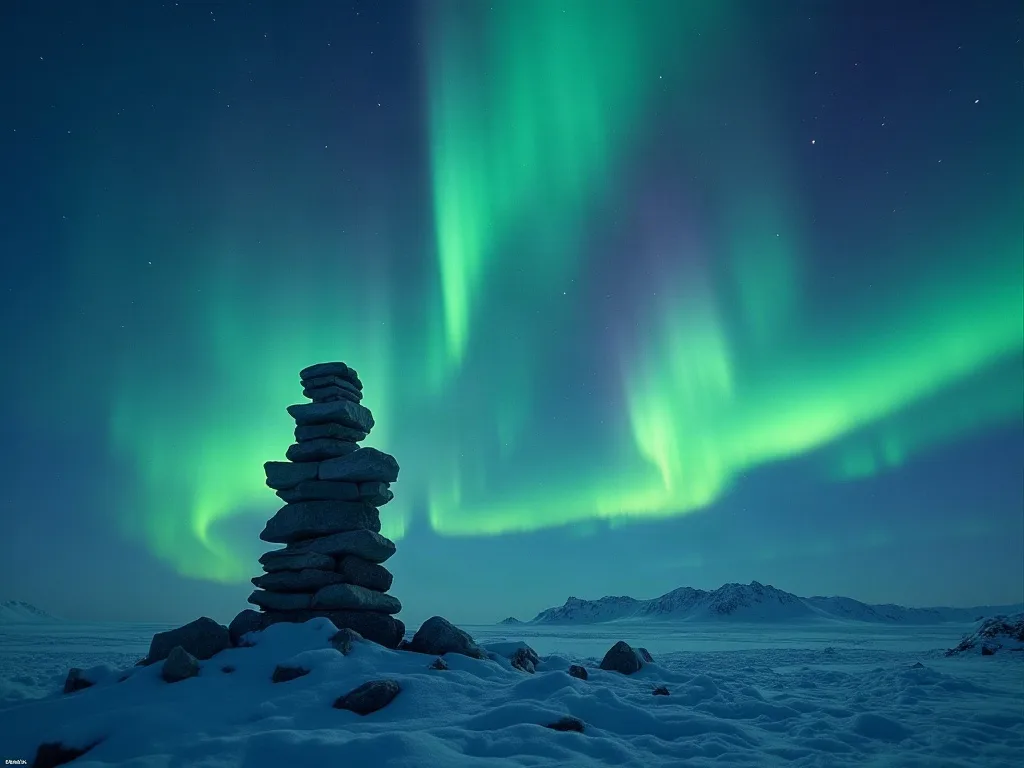
Inuit-led cultural organizations in Canada, Greenland, and Alaska have worked to document and preserve Inuksuk sites, to prevent vandalism or accidental destruction, and to pass knowledge of their significance to younger generations. This work is especially urgent as climate change accelerates permafrost thaw, erosion, and landscape transformation. Some ancient Inuksuk are literally disappearing as the ground beneath them shifts.
Language revitalization initiatives in Inuit communities have also centered the Inuksuk as a touchstone of cultural identity. Young people learning Inuktitut encounter the word early, and with it, the constellation of meanings it carries: guidance, presence, community, the dialogue between human and land. In this sense, the Inuksuk serves as a bridge between traditional knowledge and contemporary Inuit self-determination.
Unresolved Questions: What Do Stones Remember?
Scholars continue to debate precisely how ancient Inuksuk networks functioned, how information was encoded and decoded, and how they evolved over centuries. Did patterns of stones form a kind of lexicon, with specific arrangements meaning specific things? Or was the meaning more intuitive, understood through embodied knowledge passed between generations? Likely, both operated simultaneously, but the nuances remain largely lost to us.
There is also the question of continuity and change. How much of contemporary Inuksuk practice represents direct transmission from pre-contact times, and how much represents adaptation and reinvention in the face of colonial pressures, climate change, and modernization? Inuit elders insist that the essential meaning and purpose endure, but scholars recognize that all living traditions evolve.
The relationship between the physical Inuksuk and its spiritual double also remains mysterious. Inuit spiritual practitioners speak of Inuksuk as having an energetic presence that extends beyond the stone itself, radiating outward into the landscape. How this presence works, how it is activated or diminished, and whether it persists when the physical structure crumbles or is dismantled remains a matter of spiritual knowledge that cannot be fully captured in academic language.
These open questions are not gaps to be regretted but invitations. They acknowledge that the Inuksuk, though studied by archaeologists and celebrated in global media, remains rooted in living Inuit practice and knowledge systems. The marker continues to do what it has always done: it stands silent, waiting for those with eyes to read it.
Frequently asked questions about Inuksuk and Arctic stone markers?
Frequently asked questions
What does the word Inuksuk actually mean?
Inuksuk comes from Inuktitut, the language of Inuit peoples. Inuk means "person" and -suk means "acting like" or "in the place of." So Inuksuk literally means "acting like a person" or "in the place of a person." The stone marker is understood as a human-like presence stationed in the landscape to serve specific functions and carry spiritual agency.
How old is the oldest known Inuksuk?
Archaeological evidence suggests that Inuit peoples have constructed Inuksuk for at least 1,500 to 2,000 years, with some markers possibly dating back 3,000 years or more. Many are undated and remain embedded in oral tradition. The practice likely extends deeper into antiquity among ancestors of modern Inuit peoples, but precise dating is challenging in Arctic conditions.
Were Inuksuk always spiritual markers, or were they purely practical?
Inuksuk were both practical and spiritual, and this distinction would not have been meaningful to Inuit peoples. A marker that guided hunters also carried spiritual significance; a boundary stone was simultaneously a legal claim and a communication with the land's spiritual forces. The Inuit worldview sees the physical and spiritual as integrated, not separate.
Why did the Inuksuk become the symbol of the 2010 Vancouver Olympics?
The Inuksuk was chosen because it represents hospitality, guidance, and Indigenous presence on Arctic lands where the Winter Olympics reflect the global celebration of winter sports. The organizers intended to honor Inuit culture and acknowledge that the event took place on traditional territories. For many Inuit, this was a moment of recognition, though it also sparked debate about whether commercialization altered the symbol's meaning.
Can anyone build an Inuksuk, or is it specific to Inuit peoples?
Historically, Inuksuk were built by Inuit peoples in Arctic regions as part of their specific cultural and survival practices. Today, people of many backgrounds build stone stacks inspired by the Inuksuk form, often as art or tribute. However, Inuit communities emphasize that the authentic cultural practice and spiritual significance belong to Inuit peoples, and that building Inuksuk should be done with respect and understanding of their origins and meaning.
How does climate change threaten Inuksuk?
Permafrost thaw and accelerated erosion in the Arctic are causing ancient Inuksuk to shift, collapse, or be buried. Rising temperatures also change the landscape itself, making some traditional markers less relevant to modern travel and hunting routes. Inuit communities are working to document and preserve important sites before they are lost, treating this as a form of cultural heritage protection in an era of rapid environmental change.
The Inuksuk in an Age of Rapid Change
The Inuksuk endures as a symbol of Arctic resilience and Indigenous presence precisely because it adapts without losing its essential meaning. It guides hunters across the tundra today as it did five hundred years ago, yet it also appears in contemporary art galleries, climate activism, and global media as a marker of Inuit identity and sovereignty.
The stone marker's greatest power may lie in its simplicity and silence. It makes no arguments, offers no sales pitch, makes no claims except for its own stubborn presence. For anyone who has walked into an empty landscape and suddenly felt less alone upon sighting a distant figure of stacked stones, the Inuksuk's message is immediately clear: you are not the first to pass this way, and you are not alone. Someone built this out of care for the future, out of faith that someone would come and benefit from their labor.
In a world of competing information and competing claims on truth, the Inuksuk offers something rare: a system of knowledge and communication that worked for thousands of years, that required no written words, no centralized authority, no technology beyond stone and intention. It stands as a reminder that some of humanity's most sophisticated systems of guidance and community are built not from complexity but from clarity, care, and a deep understanding of place.
Today, as Inuit communities continue to maintain and build Inuksuk, and as climate change transforms the Arctic landscape in unprecedented ways, the stone marker takes on new urgency. It becomes not just a navigation aid or spiritual anchor, but a defiant insistence that Inuit knowledge, Inuit presence, and Inuit ways of knowing the land matter and will endure.
Read the full book
Want the whole story?
The complete edition is an instant PDF download here, with a paperback on Amazon for selected titles.
Inuit
The Inuit Mythology Book: Sedna, Sila, and the Sacred Stories of Ice, Hunger, and the Sea-Goddess at the Bottom of the World
Shamans, Spirits, and Survival in the Arctic
The mythology of the Arctic peoples: Sedna at the ocean floor, Sila in the wind, and the angakkuq shamans who flew between worlds. Drawn from primary sources.
More from Inuit
All articles
Inuit
The Moon Man and Sun Sister: Cosmic Pursuit Myth
In Inuit cosmology, the Moon Man chases his sister, the Sun, across the sky in an endless celestial pursuit born from darkness and shame. Discover how this myth explains the rhythm of day and night, and why it still echoes in Arctic cultures today.

Inuit
Sila: The Breath of Life and Weather Spirit
Sila is the Inuit spirit of weather, breath, and life force itself, a boundless presence that moves through air and water, sustaining hunters and demanding respect. Discover how Arctic peoples understood this invisible power that controlled their survival.

Inuit
Angakkuit: Inuit Shamans and Spirit Mediators
Angakkuit are the shamans and spirit mediators of Inuit cultures, channeling power from the animal and spirit worlds to heal, guide, and maintain balance between the human and sacred realms. Discover how these intermediaries shaped Arctic survival and cosmology.

Inuit
The Legend of Sedna: How an Inuit Girl Became Ruler of the Depths
Sedna rules the ocean from the seafloor, her fingers transformed into seals and whales. Discover how a betrayed girl became the most powerful being in Inuit cosmology, and why hunters still honor her with rituals tied to survival itself.