
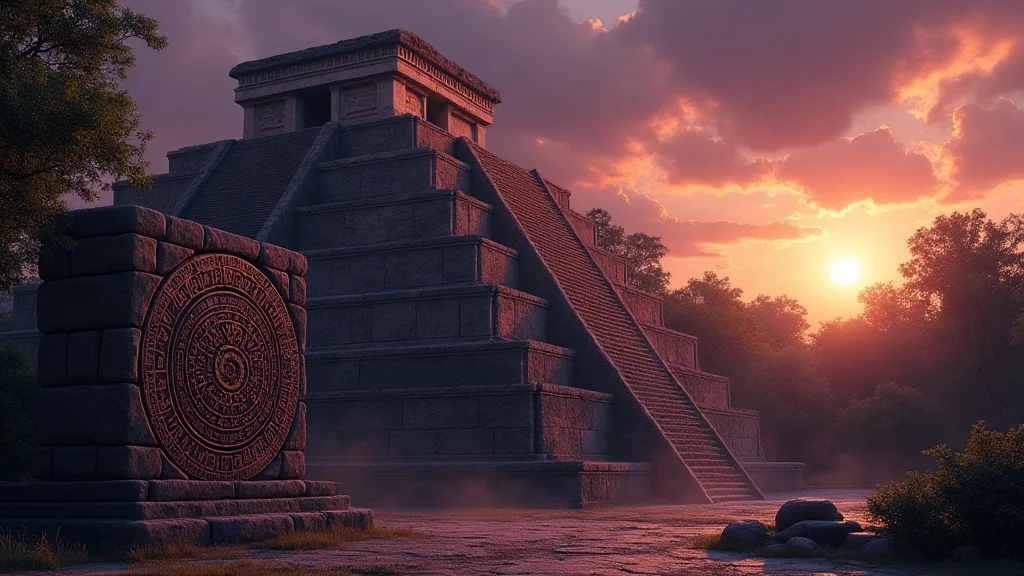
The Mayan Calendar System: Tzolk'in and Haab' Explained
The Mayan calendar tracks time across multiple overlapping cycles: the 260-day Tzolk'in and the 365-day Haab' align every 52 years in a sacred pattern. Discover how the Maya read the cosmos in numbers.
Contents
The Maya did not measure time as a line stretching toward an end. They saw it as wheels within wheels, interlocking cycles that turned together like gears carved from the fabric of creation itself. The Mayan calendar system was not invented to organize a year or schedule harvests, though it did both. It was a tool for reading destiny, tracing the will of the gods through mathematical patterns that linked the human world to the cosmos.
Two calendars formed the backbone of this system: the Tzolk'in, a 260-day ritual calendar, and the Haab', a 365-day solar year. Neither stood alone. Together, they created a master cycle that repeated only once every 52 years, a span the Maya called the Calendar Round. Within those numbers lay the structure of reality itself.
The Tzolk'in: The Divine Calendar
The Tzolk'in (also spelled Tzolkin) moves to a rhythm that feels foreign to modern ears. Twenty days. Thirteen numbers. Multiply them and you get 260. This is the heartbeat of Mayan timekeeping, the calendar that governed ceremony, divination, and the destiny of human beings.
The name Tzolk'in comes from the Yucatec Maya language and means "the count of days." Each day bore a name, drawn from a list of twenty: Imix, Ik', Ak'bal, K'an, Chicchan, Cimi, Manik', Lamat, Muluc, Oc, Chuen, Eb, Ben, Ix, Men, Kib, Kaban, Etznab, Kawak, and Ajaw. Some of these mean animal; others refer to natural forces. Imix was the primordial sea; Chuen was the monkey; Kawak was the storm cloud.
Alongside the day names ran the numbers one through thirteen, repeating in an endless cycle. A day might be "1 Imix," followed by "2 Ik'," then "3 Ak'bal." When the numbers reached 13, they reset to 1, while the day names advanced one step. After thirteen Imix days (at positions 1, 14, 27, 40, 53, and so on), the number 1 returned and paired with Ik'. This two-wheel mechanism meant that any given combination like "7 Manik'" would not repeat for 260 days.

The 260-day cycle almost certainly did not emerge from the solar year or the lunar month. Scholars have proposed that it reflects the human gestation period or the agricultural cycle of maize, the staple crop that the Maya viewed as sacred. In the creation narrative preserved in the Popol Vuh, the sacred Mayan text written down in the 16th century but preserving pre-Columbian material, the gods create human beings from maize after failed attempts with other materials. The 260 days might echo this sacred crop cycle, linking human life and the cycles of cultivation to the divine calendar.
Each Tzolk'in day carried symbolic weight. The day Kawak, associated with thunder and abundance, was considered auspicious for requests of water and crop. The day Ajaw (or Ahau), meaning lord or sun, was reserved for rulers and ceremonies. A child born on a particular day inherited traits and duties associated with that day name. A person born on K'an (yellow, the color of maize) was thought to inherit the warmth and generative power of the maize god.
The Maya used the Tzolk'in for divination and medical practice. A healer consulting the calendar might determine whether a particular day was favorable for administering medicine or performing a ritual cure. The day also influenced decisions about warfare, trade, and diplomatic travel. To undertake a journey or sign a treaty on an inauspicious day was to invite cosmic imbalance.
The Haab': The Vague Year
If the Tzolk'in mapped the sacred calendar, the Haab' anchored the Maya to the actual seasons. The Haab' (from the Yucatec word hab, meaning year) comprised 365 days, divided into eighteen months of twenty days each, plus a short month of five days called Wayeb', the "unlucky days" or "days outside the year."
The eighteen months had names that reflected the agricultural and ritual life of the Maya: Pop, Uo, Zip, Zotz, Tzec, Xul, Yaxkin, Mol, Ch'en, Yax, Sak, Keh, Mak, K'ank'in, Muwan, Pax, K'ayab, and Kumk'u. Some names meant practical things: Uo signified a ceremony for broken bones; Mol meant to gather.
The year did not begin on the first day but on the zero day. The months were numbered 0 through 19, and within each month the days ran from 0 to 19 (in the Mayan system, which used zero as a placeholder long before the Hindu-Arabic numeral system brought zero to Europe). A date in the Haab' might be written as "0 Pop" or "15 K'ank'in."
This 365-day year does not match the actual solar year (approximately 365.2425 days). The Maya were not unaware of this discrepancy. Some scholars argue that the five-day Wayeb' period reflected a correction or acknowledgment of the gap. The Wayeb' days were considered unlucky and dangerous, a threshold between years when the world was vulnerable and the boundaries between the divine and human realms grew thin. Rituals performed during Wayeb' were meant to ensure that the world would continue into the next year. Fire ceremonies were kindled; offerings were made.
The Calendar Round: When the Wheels Align
The genius of the Maya lay not in perfecting a single calendar but in coordinating two distinct systems. When the Tzolk'in and Haab' were used together, they created a larger cycle called the Calendar Round, or Xiuhtolkin in Nahuatl (the language of later Mesoamerican peoples like the Aztec).
Here is how it worked. Any given day could be named in both systems simultaneously. It might be "7 Manik' in the Tzolk'in" and "5 K'ayab in the Haab'" on the same date. Because the Tzolk'in repeats every 260 days and the Haab' every 365 days, the two cycles take 18,980 days to return to the same pairing. This equals exactly 52 Haab' years or 73 Tzolk'in cycles.

The 52-year cycle held immense significance for Mesoamerican peoples, including the Maya and their later neighbors the Aztec. The completion of a Calendar Round was not merely a numerical milestone; it was a moment of cosmic renewal and danger. Some Mesoamerican cultures believed that the world might end at the close of a 52-year period. Ceremonies called the Xiuhmolpilli, or "New Fire Ceremony," were performed to ensure that the sun would rise again and time would continue.
For the Maya, reaching the end of a Calendar Round was an occasion for major architectural and ritual renewal. Important buildings might be renovated; monuments (called stelae) commemorating the completion were carved and erected. The dates on these monuments, inscribed in Maya hieroglyphics, often recorded the Calendar Round date alongside a longer count of time called the Long Count.
The Long Count: Measuring Cosmic Ages
Beneath the interlocking Tzolk'in and Haab', the Maya developed a third system for tracking vastly longer stretches of time. The Long Count measured days elapsed since a mythological creation date that scholars calculate as August 13, 3114 BCE in the Gregorian calendar (though there is scholarly debate about this conversion).
The Long Count breaks time into units: 1 day (kin); 20 days (uinal); 18 uinals or 360 days (tun); 20 tuns (katun); and 20 katuns (baktun). A Long Count date looked like this: 12.19.6.15.10, read from left to right as 12 baktuns, 19 katuns, 6 tuns, 15 uinals, and 10 kins.
The significance of the Long Count emerged from its use in Maya hieroglyphic inscriptions. Carved on stone monuments, painted in codices (bark-paper manuscripts), and recorded in architecture, Long Count dates allowed the Maya to position historical events within a cosmic timeline. A ruler's accession, a military victory, or the dedication of a temple could be fixed in time not just within a 52-year cycle but within the larger arc of creation.
The Long Count demonstrates that the Maya conceptualized time on scales that dwarf most human frameworks. The completion of a baktun (13 baktuns) would take approximately 5,125 years. The Maya themselves probably did not view the ending of a baktun as an apocalyptic event, contrary to popular modern misinterpretation. Rather, it marked a transition to a new era, a resetting of time's grand wheel. The 13th baktun ended on December 21, 2012, in the Gregorian calendar, but the system continued seamlessly into the 14th baktun.
The Architecture of Maya Time
What unified these three systems (Tzolk'in, Haab', Long Count) was a philosophical conviction that time itself was cyclical and divine. The Maya did not experience time as a line running from past to future. They lived within nested cycles, each one resonating with others, each one repeating but never precisely returning, like a spiral that circles but never closes.
This worldview infused every aspect of Maya society. Kings were not simply rulers but participants in cosmic cycles. The accession of a new ruler synchronized with specific Tzolk'in dates. Warfare followed the calendar; certain days favored victory. Even personal names encoded calendar dates, linking individuals to the moment and season of their birth.
The numbers themselves held sacred meaning. Thirteen was auspicious, associated with the thirteen layers of the heavens. Twenty reflected the twenty day-signs and the twenty digits of the Maya counting system (which included zero). Fifty-two was the perfect number, the least common multiple of the two primary calendars, the moment when creation and human time aligned again.
Reading the Calendar: Maya Astronomy and Mathematics
The sophistication of the Mayan calendar system rested on deep astronomical observation. The Maya tracked Venus with precision rivaling modern measurements. The cycle of Venus as morning star and evening star follows a pattern of roughly 584 days. The Maya correlated this cycle with the Tzolk'in and Haab', observing that every five Venus cycles (2,920 days) aligned almost perfectly with eight Haab' years.
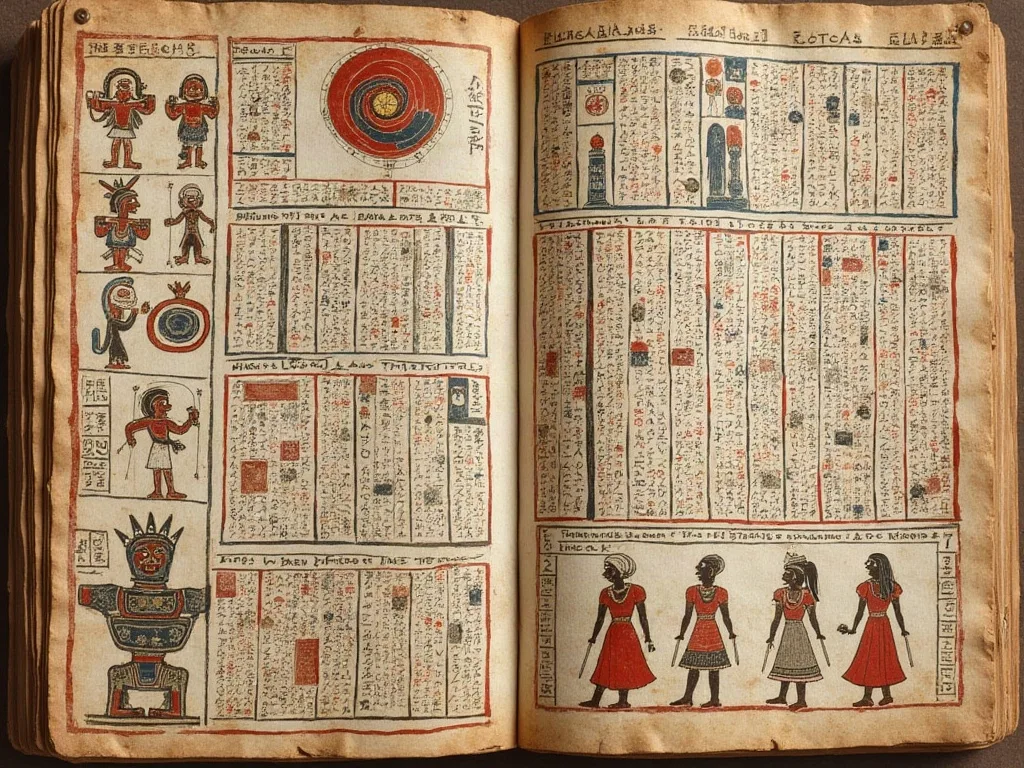
This astronomical precision appears in the Dresden Codex, one of four surviving pre-Columbian Maya manuscripts. The Dresden Codex contains elaborate tables predicting Venus positions, allowing priests to synchronize religious ceremonies with the planet's rising and setting. The same manuscript includes eclipse predictions, showing that Maya astronomers could forecast when the sun or moon would be obscured by shadow.
The achievement was not accidental. It required systematic observation over centuries, the development of a mathematical system capable of handling large numbers, and the conviction that the heavens and human time were expressions of the same sacred order. When a ceremony aligned with both a Tzolk'in date and a Venus rising, the Maya believed they were participating in an event woven into the structure of creation.
The Fall of Knowledge and the Survival of the Calendar
Spanish conquest in the 16th century devastated Maya civilization. Books were burned. Temples were demolished. Priests who understood the calendar were killed or forced to abandon their tradition. The Long Count ceased to be recorded. Much knowledge was lost.
Yet the Tzolk'in and Haab' did not disappear entirely. In remote highland communities in Guatemala, Maya peoples continued to observe the Tzolk'in in secret and in the open, blending it with Christian practices. The daykeeper traditions survived. Even today, in villages across the Maya region, the 260-day Tzolk'in is maintained by ritual specialists who continue to calculate ceremonial dates and divine through the calendar, much as their ancestors did.
The scholarly recovery of this knowledge began in the 19th century, as linguists and archaeologists deciphered Maya hieroglyphics and read the inscriptions on ancient monuments. The calendar's complexity stunned researchers. Here was mathematical sophistication comparable to any ancient civilization, embedded in a worldview radically different from the European tradition.
Frequently asked questions about the Mayan Calendar System: Tzolk'in and Haab'
Frequently asked questions
Why did the Maya create a 260-day calendar instead of using a solar year?
The origins of the Tzolk'in remain debated by scholars. The 260 days approximately match human gestation or the maize growing cycle, suggesting deep agricultural and biological roots. For the Maya, the Tzolk'in was not a practical tool but a sacred map: each day carried spiritual meaning and determined personal destiny. The Haab' handled the solar year and seasons; the Tzolk'in governed the divine and ritual dimensions of life.
Did the Maya believe the world would end on December 21, 2012?
Modern internet culture misinterpreted the end of the 13th baktun in the Long Count as a doomsday prediction. The Maya did not view the completion of a baktun as apocalyptic. It marked a transition, a resetting of the cosmic counter, much like January 1 marks a new year on the Gregorian calendar. The Maya calendar system is designed to continue indefinitely, cycling through baktuns without end.
How accurate was the Mayan astronomical prediction?
Remarkably accurate. The Maya calculated the Venus cycle to within a few hours of the modern scientific measurement. They predicted solar and lunar eclipses using mathematical tables in the Dresden Codex. This precision arose from centuries of systematic observation and a mathematical system (including the concept of zero) that enabled complex calculations. No other ancient civilization outside the Old World matched this astronomical sophistication.
Is the Tzolk'in still used by modern Maya peoples?
Yes. In highland Guatemala and other Maya communities, daykeepers (called aj k'ij in Yucatec Maya) continue to maintain the 260-day Tzolk'in calendar and use it for divination and ceremonial guidance. The tradition survived conquest and colonization, often by integrating with Christian practices. Contemporary Maya peoples view the calendar as central to their cultural identity and spiritual practice.
What is the difference between the Tzolk'in and Haab' calendars?
The Tzolk'in is a 260-day ritual calendar built from 20 day-signs and 13 numbers, used for divination and determining destiny. The Haab' is a 365-day solar calendar divided into 18 months of 20 days plus a 5-day period, used to track agricultural seasons and the passing year. Neither is complete without the other; together they form the Calendar Round, which repeats every 52 years.
Why did the 52-year cycle matter so much to Mesoamerican cultures?
The 52-year cycle represented the least common multiple of the Tzolk'in and Haab', the moment when the two calendars returned to the same pairing of dates. This alignment was believed to signify cosmic renewal and potential danger. Mesoamerican peoples, including the Aztec, performed the New Fire Ceremony at the end of each 52-year cycle to ensure that the sun would rise again and the world would continue into the next era.
The Calendar as Cosmology
The Mayan calendar system reveals a civilization that understood time not as a neutral container but as a living force, patterned by divine will and human participation. The interlocking wheels of the Tzolk'in and Haab' were not merely administrative tools. They were maps of a cosmos in which the gods, the stars, the earth, and human beings moved in synchronized patterns.
To read a date in the Maya calendar was to know not only when an event occurred but what it meant. A battle fought on a particular Tzolk'in date inherited the qualities of that day. A ruler who took the throne on an auspicious Calendar Round date was believed to have been chosen by the cosmos itself.
The calendar survived conquest because it was woven into the texture of Maya identity. It was not a system imposed from above but a tradition carried in memory and practice, taught from parent to child, from daykeeper to apprentice. In this way, knowledge that colonizers tried to erase lived on, hidden in plain sight, embedded in the rhythm of seasonal life and ceremonial practice.
Today, the Mayan calendar system continues to intrigue scholars and inspire contemporary spirituality. It stands as a testament to intellectual achievement and to a radically different way of experiencing time: not as an arrow but as a spiral, not as possession but as participation, not as something that happens to us but as something we move through, guided by numbers that the gods themselves are said to have given.
Read the full book
Want the whole story?
The complete edition is an instant PDF download here, with a paperback on Amazon for selected titles.
Mayan
The Mayan Mythology Book: Hunahpu, Xbalanque, Kukulkan and the Sacred Stories of the Rainforest Mathematicians
The Popol Vuh, Xibalba, and the Cosmos Calculated in 13s and 20s
The Hero Twins descend to Xibalba. Kukulkan returns at equinox. Itzamna writes the first books. The complete mythology of the Maya who calculated the cosmos and left us the Popol Vuh.
More from Mayan
All articles
Mayan
Ixchel: Goddess of the Moon and Childbirth in Maya Mythology
Ixchel ruled the night sky and the sacred threshold where life enters the world. As the aged moon goddess and divine midwife of the Yucatan, she embodied both the gentleness of birth and the ferocity of storms.
Mayan
Bloodletting Rituals: Sacred Sacrifice in Mayan Religion
Mayan bloodletting rituals were not acts of violence but profound spiritual transactions. Kings pierced their own bodies to feed the gods, sustain the cosmos, and commune with ancestors in ceremonies that shaped civilizations for over two thousand years.

Mayan
The Maize God: Symbol of Life and Resurrection in Mayan Mythology
The Maize God embodies the Mayan cycle of death and rebirth through corn, the lifeblood of Mayan civilization. Discover how this deity shaped creation myths, ritual, and the Mayan understanding of existence itself.
Mayan
Hunahpu and Xbalanque: The Hero Twins Who Defeated the Lords of Death
Discover how the Hero Twins outwitted the Lords of Xibalba and reshaped the Maya cosmos. Their triumph over death itself becomes the foundation of human existence.