
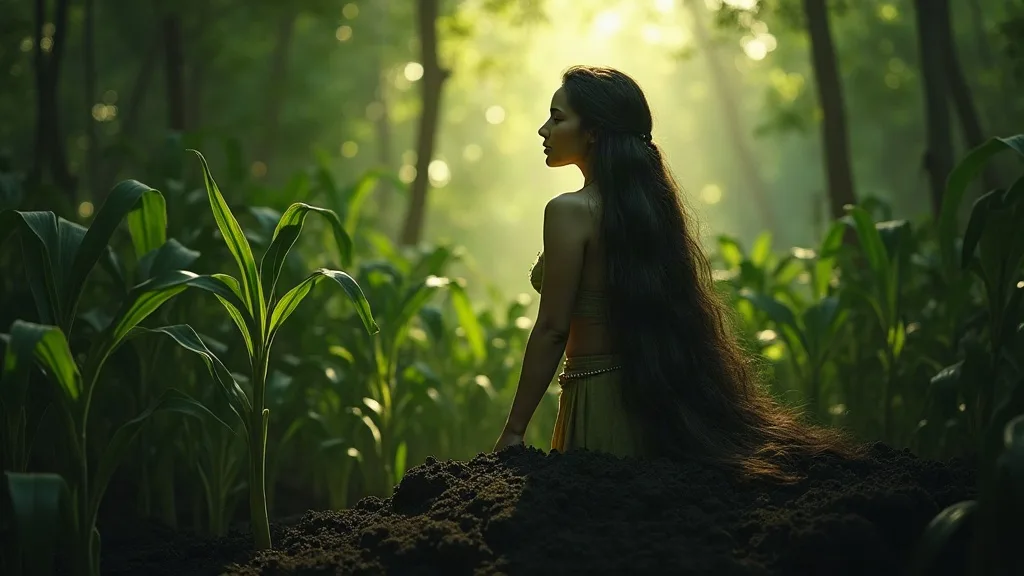
The Maize God: Symbol of Life and Resurrection in Mayan Mythology
The Maize God embodies the Mayan cycle of death and rebirth through corn, the lifeblood of Mayan civilization. Discover how this deity shaped creation myths, ritual, and the Mayan understanding of existence itself.
Contents
Corn does not grow in the Petén jungle by accident. In Mayan belief, it grows because the Maize God sacrificed himself so that humanity could eat. He died and was reborn, again and again, in the kernels. He was the god who made civilization possible.
The Maize God, known in Classical Mayan as Ixim or Hun Hunahpu (depending on the region and time period), stood at the absolute center of Mayan religious life. Not a distant, forbidding deity but a familiar presence: in every harvest, every tortilla, every ears of corn a farmer bound and brought to the temple. His death and resurrection were not historical events consigned to sacred time. They happened in the milpa, the cornfield, every single year.
The Birth of the Maize God and the Creation of Maize
The Maize God did not exist from the beginning. The Popol Vuh, the sacred book of the Quiché Maya written down in the 16th century, tells how the gods tried four times to create humanity before they succeeded. First they made people of mud, but they dissolved. Then wood, but they had no souls. Then animals, but the animals could not speak or honor their makers. Only in the fourth attempt did the gods get it right, and they did it using maize.
The creator gods ground white maize and yellow maize. They mixed it with water. From this dough, they shaped the first true humans. Humanity was born from corn, quite literally. Blood and flesh were secondary; the essential substance was maize.
This is why the Maize God was not merely one god among many. He was the material from which human life was made. To eat corn was to consume the god's own body and to participate in the mystery of existence itself. When a Mayan person ate, they were eating the Maize God. When they planted, they were planting him. When they harvested, they were resurrecting him.
In the earliest Mayan art, dating from the Preclassic period (1500 BCE onward), the Maize God appears as a young, beautiful figure with a corn stalk or maize ear sprouting from his head. He is often shown with an elongated skull (perhaps meant to resemble the shape of a corn cob), delicate fingers, and a serene expression. In some carvings, he emerges from the split shell of a cosmic turtle, the surface of the Earth itself, as if being born from the planet's generative body.

By the Classic period (250-900 CE), when the great city-states flourished, the Maize God had become standardized in art and ritual. His youthful beauty was emphasized. He was shown with aquiline features, often wearing elaborate headdresses made of woven materials and feathers, sometimes with jade ornaments. Artists rendered him with a composed, almost meditative expression, as if he knew what was coming.
The Death and Sacrifice of the Maize God
The heart of the Maize God mythology is sacrifice. The god did not simply feed humanity through passive growth. He died deliberately, repeatedly, to keep the world in balance.
The narrative appears in multiple versions across Mayan texts and artwork. In the Popol Vuh, the story is told of Hun Hunahpu and his brother Vucub Hunahpu, both associated with maize fertility. They were defeated by the lords of Xibalba, the Mayan underworld, in a ball game. The lords killed Hun Hunahpu and buried his head in a calabash tree (a gourd tree). That head became a source of life; it spit upon the goddess Xquic, impregnating her, and she gave birth to the hero twins Hunahpu and Xbalanque.
Later, the hero twins themselves descended into Xibalba, played the ball game again, and this time they won. They resurrected their father Hun Hunahpu. He emerged from the earth, reborn, just as corn is reborn each planting season.
Mayan priests and rulers ritually enacted this cycle. Human sacrifice, which became central to Mayan religion from the Classic period onward, was understood as a re-enactment of the Maize God's voluntary descent. The victim, often a captive or young person selected for honor, was understood to follow the path of the Maize God into the underworld. Blood spilled on the altar or on the ball court was maize; it nourished the gods and kept the cosmos turning.
The most elaborate version of the Maize God mythology comes from the painted vessels and stelae of the Classic Maya. Scenes show the god in a kind of cosmic cycle: he is shown whole and alive, then broken apart or cut into pieces, then reconstructed and reborn from the surface of the primordial waters. On some vases, the Maize God reclines like a ruler in the underworld, accompanied by skeletal attendants; on others, he dances with other deities, alive and restored.
These cycles were not mere mythology. They were templates for the Mayan calendar and for the rituals that marked time. The Mayan Long Count calendar, which tracked vast ages of creation and destruction, embodied the principle of the Maize God: ages died; ages were reborn.
The Maize God in Mayan Cosmology and the Sacred Calendar
To the Maya, time was not a straight line. It moved in circles, each cycle ending in destruction and recommencing in renewal. This cyclical understanding was inseparable from the Maize God mythology.
The 260-day ritual calendar, the Tzolk'in, tracked the Maize God's journey through the underworld and back. Each day had a name and a number. The day Corn, or Ixim, was sacred; it occurred once every 20 days and was marked by rituals of planting, growth, and remembrance. The Maize God was born (metaphorically) at certain points in the calendar and died at others. Farmers timed their planting to these sacred days.
The seasonal cycle of maize defined the ritual year. In spring, seeds were planted; this was the Maize God's death, his descent into the dark underworld of the soil. In summer, the plant grew; this was the god's journey through Xibalba. In fall, the harvest came; this was the god's resurrection and triumph. In winter, the fields lay fallow; the god rested, recovering strength for another cycle.
Mayan rulers incorporated the Maize God mythology into their own royal portraits and genealogies. Kings presented themselves as embodiments or representatives of the Maize God. They wore maize-cob headdresses. They were shown dancing with the god. In some texts, the king was literally identified with the Maize God: his bloodshed in ritual combat or sacrifice was understood as the god's bloodshed, maintaining cosmic order.
The great city of Palenque has yielded some of the richest depictions of Maize God mythology. On the Temple of the Foliated Cross, there is a relief showing a stylized maize plant with a human face in its ear, clearly representing the merging of the god and the grain. On painted vessels from the city, the Maize God is shown in scenes of divine council, being honored by other deities and by the king.
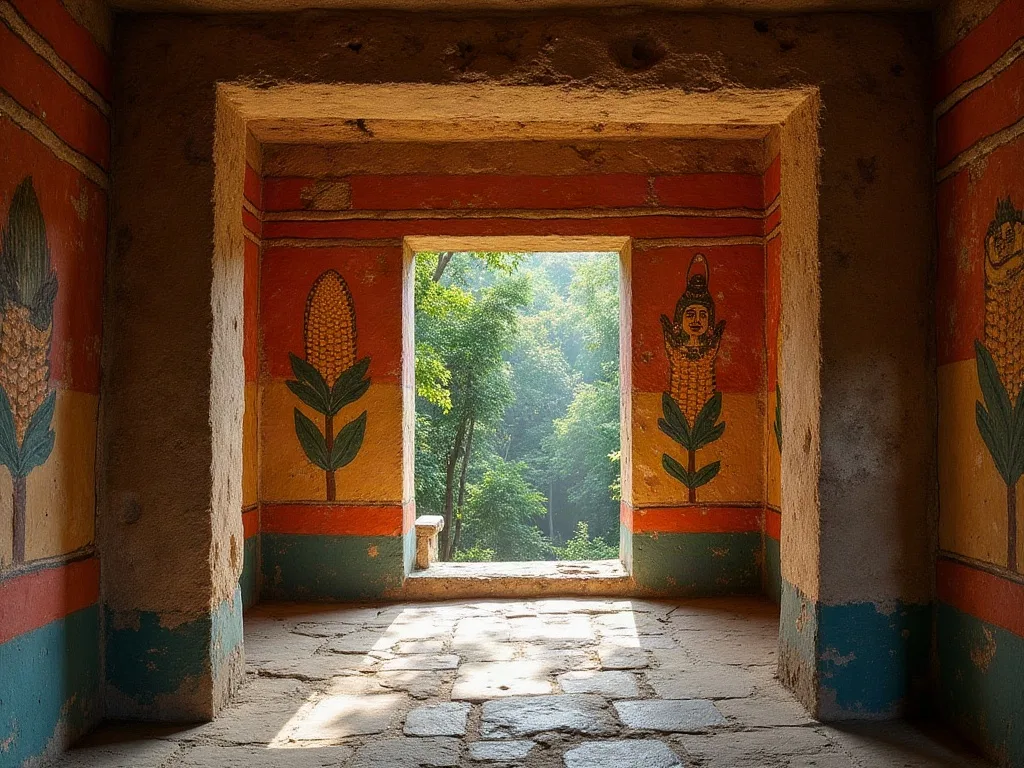
The Maize God was so woven into Mayan thought that he appeared not only in creation myths but in narrative cycles. The Popol Vuh, which was preserved by a Quiché Maya named Diego Ximénez in the 1600s (and his manuscript was later discovered), devotes much of its attention to the hero twins Hunahpu and Xbalanque, who are the sons of Hun Hunahpu and thus intimately connected to Maize God mythology. Their defeat of the lords of Xibalba and their resurrection of their father mirror the Maize God's own triumph and rebirth.
Depictions and Attributes: How the Maya Rendered the Maize God
In Mayan art, the Maize God is one of the most identifiable deities because of his distinctive visual markers. Artists were meticulous in their depiction, and we can recognize him across centuries and different regions.
The most consistent marker is the maize plant or maize ear sprouting from the god's head or scalp. Sometimes it is a single ear of corn with its silk flowing like hair. Sometimes it is a full plant. The stalk itself might be integrated into an elaborate headdress, with jade ornaments, feathers, and woven materials creating a crown of fertility.
The Maize God is typically rendered as youthful and beautiful. He has delicate, almost feminine features in many Classic period carvings, with a graceful posture. His skin is often depicted as pale green or white, possibly intended to evoke the color of the corn plant or the pale seed inside the kernel. His face is serene, often with a slight smile or a meditative expression, even when he is shown undergoing death or transformation.
In some images, the Maize God is shown with a distinctly flattened or elongated cranium. Scholars have long debated whether this was artistic convention, ritual cranial modification (which the Maya did practice), or a symbolic reference to the shape of a corn cob. All three explanations may be partly true. The Maize God was depicted as possessing a head that was itself quasi-maize-like, emphasizing the sacred identity between the god and the grain.
Mayan artists often showed the Maize God in poses of vulnerability or transformation. He might be depicted bound or wrapped in cloth, suggesting sacrifice or ritual restraint. He might be shown as a corpse or skeleton, particularly in Xibalba scenes. But even in these images, there is a kind of dignity and grace. The Maize God is not a figure of horror. He is embracing his role in the cosmic order.
One of the most striking depictions comes from a vase in the Princeton Art Museum, dated to the Classic period. The Maize God is shown reclining in the underworld, attended by servants and figures with skeletal characteristics. He is still adorned, still noble, still beautiful, but he is clearly dead or in the liminal space between death and life. This image captures the essential meaning of the Maize God mythology: even in the underworld, even in death, the god is performing his necessary function.
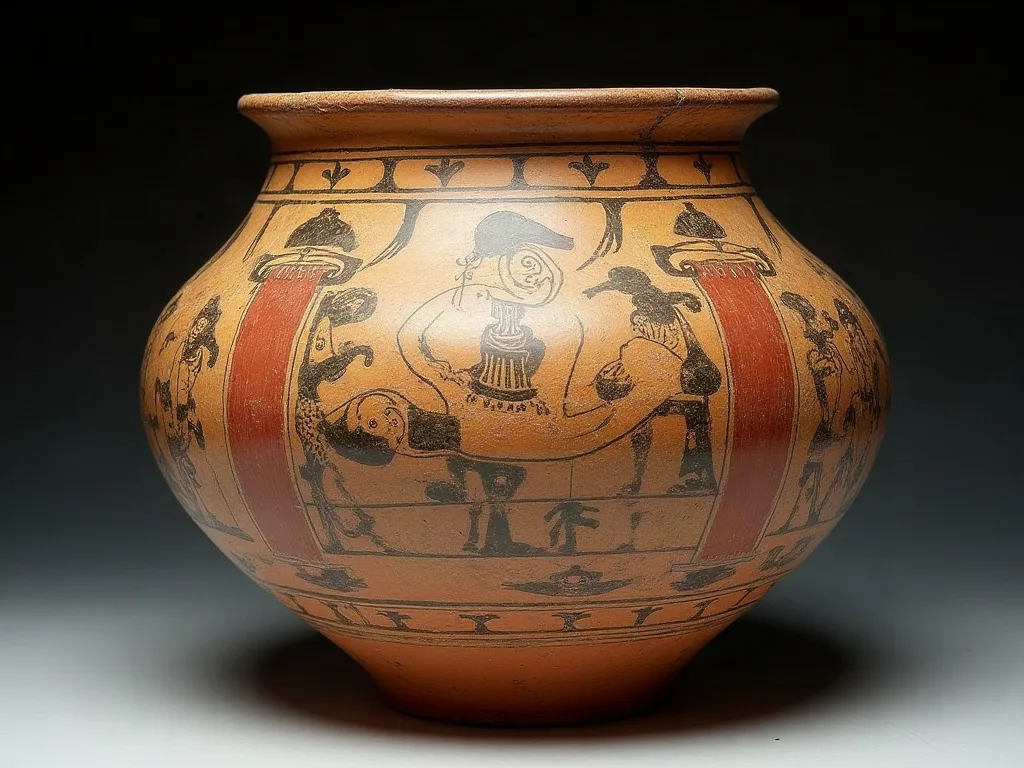
The Maize God sometimes appeared alongside other deities. He might be shown with Chaac, the rain god, who brings the water necessary for corn to grow. He might appear with Ixchel, the moon goddess and goddess of fertility and childbirth, whose cycles paralleled the cycles of the maize year. In some scenes, he dances with deities of the underworld, moving between realms.
In Post-Classic Mayan texts and manuscripts (after 900 CE), the Maize God continued to be venerated, though the emphasis shifted somewhat. In the Popol Vuh and in the Dresden Codex (a Maya bark-paper book preserved from before the Spanish conquest), the Maize God appears as part of larger mythological narratives involving the hero twins and their adventures. But the core identity remained: he was the god of corn, of fertility, of the necessary cycle of death and rebirth.
Sacrifice and the Maize God in Mayan Ritual Practice
The mythology of the Maize God was not abstract theology. It directly informed how the Maya carried out their most solemn rituals.
Mayan priests understood human sacrifice as a re-enactment of the Maize God's sacrifice. The victim was often decorated to resemble the Maize God before being killed. Some victims wore maize-cob headdresses or were painted to evoke the god's appearance. The moment of sacrifice was framed as the god descending into the underworld, just as corn is planted beneath the earth.
The ball game, called pok-ta-pok, held profound ritual significance that was directly tied to Maize God mythology. The ball court was understood as a representation of the cosmic arena where the Maize God and the hero twins played against the lords of Xibalba. Actual games, played between rival cities or during festivals, reenacted this mythological contest. The losing team (or sometimes the winning team, accounts vary) might be sacrificed, their deaths understood as reenactments of the Maize God's defeat and descent.
Mayan farmers performed rituals tied to the maize cycle, invoking the Maize God at each stage. Before planting, ceremonies asked the god to accept the soil as his underworld dwelling. During growth, rituals thanked the god for his resurrection and the rain god for his necessary complement. At harvest, ceremonies of gratitude and consumption directly incorporated the god's body into the community through eating the corn.
In some texts and artistic depictions, there are hints of human sympathetic magic tied to the Maize God. If a human was sacrificed in the exact manner of the Maize God's mythological death, the thought seems to have been that the sacrifice would guarantee the god's rebirth and the following year's harvest. Blood spilled on the maize fields was believed to nourish both the spiritual and physical dimensions of the crop.
The Spanish conquest in the 16th century disrupted these practices, but the spiritual identification between the Maize God and corn was so deep that it survived, transformed. In modern Maya communities, corn continues to hold sacred significance. The rituals have been Christianized on the surface, but the underlying framework of the Maize God's death and resurrection persists in harvest festivals, in the blessing of seeds, in the careful and respectful handling of maize.
The Maize God's Role in Creation and the End of Ages
The Maize God was not only a god of seasonal cycles. He was intimately involved in the creation of the world itself and in the apocalyptic cycles that frame Mayan cosmology.
According to the Popol Vuh, before humanity, the world was incomplete. The first three attempts at creation failed. Only when the gods used maize as the material for human flesh did creation succeed. This means the Maize God was present from the moment of humanity's conception. He was not a later addition to the pantheon but foundational.
Moreover, in the Popol Vuh's account of Mayan history, the Maize God appears as an ancestor figure. Hun Hunahpu, the version of the god associated with maize in the Popol Vuh, was the father of the hero twins. These twins defeated Xibalba and resurrected their father. Their story became the template for Mayan kingship: each king was expected to embody the qualities of Hunahpu and Xbalanque, to descend into the underworld (metaphorically through ritual or literally through death), and to be reborn.
The Mayan understanding of cosmic time included the concept of world ages. The Long Count calendar tracked these ages. Each age was created, flourished, and then was destroyed. The current age (from the Mayan perspective) began, according to the Long Count, on August 13, 3114 BCE. It was expected to end on December 21, 2012 CE (a date that became famous in popular culture as a doomsday prediction, though the Maya understood it simply as a cycle turning). After the end of an age, a new creation would begin.
The Maize God was the deity most directly associated with creation itself, so his mythology informed how the Maya thought about these apocalyptic cycles. If the world could be destroyed and remade, it was because the Maize God could die and be reborn. The god provided the cosmic template for destruction and renewal.
Some scholars have argued that the collapse of the Classic Maya civilization in the 9th century CE (when the great city-states of the southern lowlands were suddenly abandoned) was interpreted by the Maya themselves as a kind of death of the Maize God, a necessary darkness before a new creation. The Post-Classic period that followed (900-1500 CE) saw a shift in Mayan religious practice and the rise of new religious centers, but the Maize God remained central.
Cross-Cultural Echoes: The Maize God in Mesoamerica
The Maize God mythology was distinctively Mayan, but maize and corn deities were venerated across Mesoamerica. The Aztecs, who dominated central Mexico from the 14th century until the Spanish conquest, also had a complex theology of maize and corn deities.
The Aztec god Cinteotl was the Aztec version of the Maize God. Like his Mayan counterpart, Cinteotl embodied the cycle of death and rebirth through maize. But the Aztec emphasis was somewhat different. Cinteotl was often depicted as a maize ear with a human face, sometimes beautiful and sometimes monstrous or corpse-like. The Aztecs incorporated Cinteotl into a larger system of agricultural deities, including the rain god Tlaloc and the goddess Xilonen.
The Olmec, who flourished in Mesoamerica from roughly 1500 to 400 BCE, also seem to have venerated corn and maize figures. Some scholars have detected precursors to the Mayan Maize God in Olmec art, particularly in the "baby face" figures that some researchers believe represent an early corn deity. The transmission from Olmec to Maya to Aztec shows how deeply rooted maize theology was in Mesoamerican civilization.
The reason is ecological and economic: maize was the staff of life in Mesoamerica, as it remains today. A civilization that depended on corn for survival would naturally develop sophisticated religious explanations for the crop's growth and failure. The Maize God mythology provided a framework that made sense of drought, blight, and abundance. It also provided a moral framework: just as the god sacrificed himself, so humans were expected to make sacrifices to keep the cosmos in balance.
This is a stark contrast to Old World mythologies. In ancient Greece or Rome or India, the grain gods existed but were not as central. In Mesoamerica, the maize god was paramount. This reflects the absolute dependence of Mesoamerican civilization on maize as its food base.
Scholarly Debates and Interpretations
Modern scholars have approached the Maize God from multiple angles, and there is lively scholarly debate about details.
One question concerns the relationship between different names and versions of the god. The Popol Vuh calls him Hun Hunahpu. Later Spanish colonial texts, particularly those written by Maya scribes in the 16th century, sometimes use the name Ixim, which is the Mayan word for maize. Inscriptions on Classic period stelae and vases sometimes refer to a deity with the glyph often read as Ixim or Corn God. Are all these the same god? Are some regional variants? Scholars debate whether what we call the "Maize God" is a unified concept or a cluster of related deities.
Another debate concerns the significance of the Maize God's femininity or lack thereof. In many Classic period depictions, the god is shown with delicate or androgynous features. Some scholars have suggested that the Maize God was understood as having both masculine and feminine aspects, or that gender categories were more fluid in Mayan thought than in Western tradition. Others argue that the youthful appearance simply reflects the god's vitality and that "masculine" and "feminine" are imprecise terms to impose on Mayan theology.
There is also debate about human sacrifice and its relationship to the Maize God mythology. Some scholars see sacrifice as a direct reenactment of the god's death, essential to cosmic order. Others suggest that sacrifice was a later development (perhaps Post-Classic), and that earlier Maize God veneration was more purely agricultural. The truth likely lies between: maize sacrifice certainly existed in the Classic period, and it was understood in light of Maize God mythology, but the relationship evolved over time.
Finally, scholars debate the extent to which the Maize God mythology survived the Spanish conquest and continued in Maya communities. The Catholic Church worked to eliminate indigenous religious practices, but maize held such deep cultural and spiritual significance that some form of veneration persisted, often hidden within Catholic festivals or transformed into Christian saints' days. In modern Maya communities, corn is still treated with reverence, and some scholars detect continuities with pre-Conquest Maize God mythology in contemporary rituals.
The Maize God's Legacy in Modern Culture
The Maize God has experienced something of a cultural renaissance in the past few decades. As interest in Pre-Columbian Mesoamerican civilizations has grown, and as Maya communities have reclaimed and reinterpreted their own heritage, the Maize God has become a symbol of indigenous identity and spiritual continuity.
In contemporary Maya communities, particularly in Guatemala and southern Mexico, the Maize God mythology is being revived and reinterpreted. Some indigenous leaders and spiritual practitioners explicitly reference the god in prayers and ceremonies related to corn cultivation. The mythology is taught in schools and presented as a source of pride in Maya cultural heritage.
The Maize God has also entered global popular culture and academic consciousness through books, exhibitions, and art. The Metropolitan Museum of Art and other major museums have featured Mayan artifacts related to the Maize God, bringing the imagery to millions of viewers. Scholars of comparative religion have used the Maize God as an example of how deeply a civilization's theology can be rooted in its economic foundation.
Some contemporary artists, both Maya and non-Maya, have drawn on Maize God imagery in their work. The god's combination of beauty, suffering, and cosmic significance resonates with modern audiences. The mythology speaks to perennial human concerns: how do we survive? What are we willing to sacrifice? How do we understand cycles of death and rebirth?
Frequently asked questions about the Maize God and Mayan mythology
Frequently asked questions
Was the Maize God the same as Hun Hunahpu in the Popol Vuh?
There is significant overlap, but scholars debate whether they are identical or closely related. Hun Hunahpu is definitely associated with fertility and maize in the Popol Vuh, and he embodies the sacrifice-and-rebirth pattern central to Maize God mythology. However, Hun Hunahpu is also depicted as a specific ancestor figure in Mayan genealogy, while the Maize God appears in more abstract cosmological contexts. It's safest to say they are expressions of the same mythological principle, possibly with regional or temporal variations.
Did the Maya actually eat human beings in sacrifice?
Yes, human sacrifice was practiced by the Maya, particularly during the Classic period and beyond. However, it is important to understand it in its cultural context. For the Maya, sacrifice was not viewed as murder or barbarism but as a necessary cosmic ritual, understood in relation to myths like that of the Maize God. Victims were often captives, but sometimes they were volunteers or individuals selected for honor. The practice was shocking to Spanish conquistadors, and it was one of the justifications they used for conquest, but it was deeply embedded in Mayan religious understanding.
How do we know what the Maya believed about the Maize God if the Spanish destroyed so many texts?
Our knowledge comes from multiple sources. The Popol Vuh survived because a Spanish priest, Diego Ximénez, transcribed it in the 1700s and his manuscript was preserved. Maya bark-paper codices (pictorial manuscripts), some of which survived the conquest, contain depictions of the Maize God and related myths. Thousands of stelae, vases, and sculptures from the Classic period bear carved or painted images and glyphic inscriptions that describe the Maize God. Modern scholars have also learned to read Mayan glyphs, allowing us to decipher ancient texts. The combination of these sources gives us a rich, if incomplete, picture.
Is the Maize God worshipped today by Maya people?
In some form, yes. Modern Maya communities continue to hold maize in high spiritual regard. Some communities have revived explicit worship of the Maize God as part of a broader reclamation of indigenous spirituality. Many Maya farmers still perform ceremonies related to planting and harvest that echo the ancient mythology, though they are often adapted to incorporate Catholic elements. The veneration is often quiet and local rather than public, but it continues.
Why was corn so important to the Maya if they had other food sources?
Maize was the primary carbohydrate staple of the Mayan diet, making up perhaps 70% of caloric intake. Without maize, Mayan civilization as it developed could not have existed. The Maya also cultivated beans, squash, and other crops, but maize was the foundation. This economic reality translated into religious reality: the god of maize was the most important god because maize was the most important thing. The mythology made sense of this reality by framing the relationship between humans and corn as sacred and reciprocal.
What does the flattened head of the Maize God represent?
Scholars offer several interpretations. Some argue it resembles a corn cob. Others suggest it reflects the Mayan practice of cranial modification, where the skull was deliberately flattened during infancy as a mark of beauty or status. Some believe it is simply artistic convention. The most likely explanation is that multiple meanings were layered: the elongated skull evoked both the corn cob (literal) and the practice of cranial modification (ritual), creating a visual metaphor that connected the god, the grain, and human transformation.
The Eternal Cycle: Death and Rebirth in the Maize Field
To understand the Maize God fully is to recognize how thoroughly the Maya integrated their most essential survival need into their deepest spiritual beliefs. The god was not a distant figure in the sky but present in every seed, every sprout, every ear of corn. He was present in the farmer's hands as he planted. He was present in the hunger of the people waiting for harvest. He was present in the moment of consumption, when the corn became the human body.
The mythology of the Maize God answered fundamental questions: Where did we come from? (From corn, from the god's body.) Why do good things die? (Because death is necessary; it is transformation, not ending.) What do we owe to the gods? (The same sacrifice they give us; the same willingness to die and be reborn.) What happens to us after death? (We may be reborn, like the god, if we are worthy.)
These are not primitive questions or answers. They are the deep questions of human meaning, expressed through the idiom of a civilization whose survival depended on understanding the cycles of growth and decay. The Maize God was Mayan theology at its most profound and most practical at once.
Read the full book
Want the whole story?
The complete edition is an instant PDF download here, with a paperback on Amazon for selected titles.
Mayan
The Mayan Mythology Book: Hunahpu, Xbalanque, Kukulkan and the Sacred Stories of the Rainforest Mathematicians
The Popol Vuh, Xibalba, and the Cosmos Calculated in 13s and 20s
The Hero Twins descend to Xibalba. Kukulkan returns at equinox. Itzamna writes the first books. The complete mythology of the Maya who calculated the cosmos and left us the Popol Vuh.
More from Mayan
All articles
Mayan
Ixchel: Goddess of the Moon and Childbirth in Maya Mythology
Ixchel ruled the night sky and the sacred threshold where life enters the world. As the aged moon goddess and divine midwife of the Yucatan, she embodied both the gentleness of birth and the ferocity of storms.

Mayan
The Mayan Calendar System: Tzolk'in and Haab' Explained
The Mayan calendar tracks time across multiple overlapping cycles: the 260-day Tzolk'in and the 365-day Haab' align every 52 years in a sacred pattern. Discover how the Maya read the cosmos in numbers.
Mayan
Bloodletting Rituals: Sacred Sacrifice in Mayan Religion
Mayan bloodletting rituals were not acts of violence but profound spiritual transactions. Kings pierced their own bodies to feed the gods, sustain the cosmos, and commune with ancestors in ceremonies that shaped civilizations for over two thousand years.
Mayan
Hunahpu and Xbalanque: The Hero Twins Who Defeated the Lords of Death
Discover how the Hero Twins outwitted the Lords of Xibalba and reshaped the Maya cosmos. Their triumph over death itself becomes the foundation of human existence.