
Bloodletting Rituals: Sacred Sacrifice in Mayan Religion
Mayan bloodletting rituals were not acts of violence but profound spiritual transactions. Kings pierced their own bodies to feed the gods, sustain the cosmos, and commune with ancestors in ceremonies that shaped civilizations for over two thousand years.
Contents
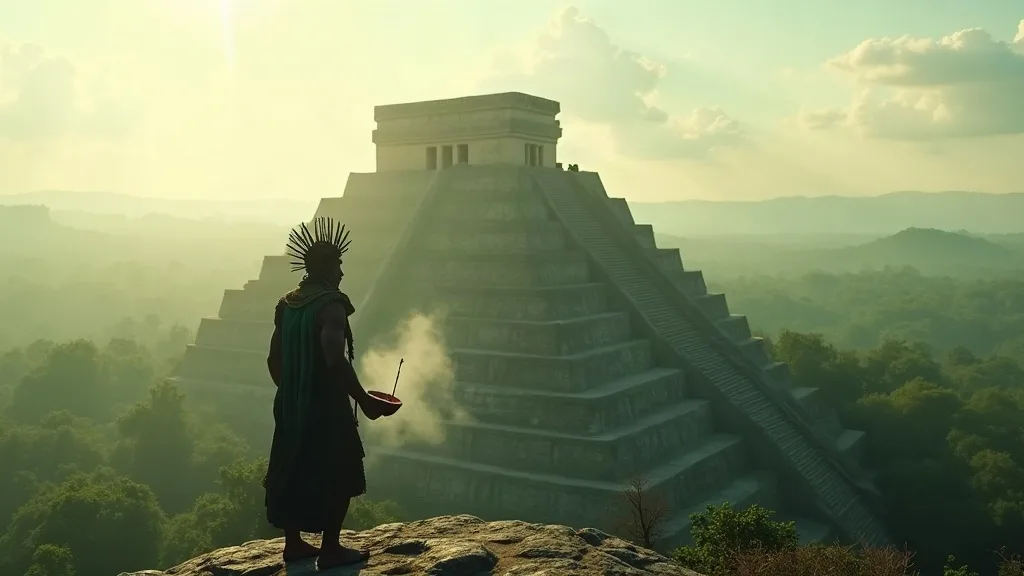
Blood fell like rain into stone bowls. A king stood at the pyramid's peak, a stingray spine drawn across his tongue or penis, and watched the dark liquid pool at his feet. Around him, the court held their breath. This was not torture or cruelty. This was k'inich, the life-force that kept the sun moving across the sky, that prevented the world from collapsing into chaos. This was the most sacred act a Mayan ruler could perform.
For over two thousand years, bloodletting rituals formed the beating heart of Mayan religious life. They were ceremonies of debt repayment, cosmic maintenance, and royal authority. A Mayan king who did not bleed was no king at all. The ritual was so central that the very word for bloodletting, cha'c, echoes in the names of gods and the architecture of temples. To understand the Mayan worldview is to understand why a ruler would voluntarily wound himself at the altar.
Why Bloodletting Mattered in the Mayan Cosmos
The Mayan universe operated on a principle of reciprocal obligation. The gods had created humans from corn and blood in the Popol Vuh, the sacred Mayan creation epic. That gift demanded repayment. Every dawn, Kinich Ajaw, the sun god, had to journey through the underworld to be reborn. He needed fuel. That fuel was human vitality, essence, the precious liquid the Maya called ch'ulel or ik', the breath-soul that inhabited blood.
The relationship was not one-directional servitude. It was commerce. When a ruler bled, he was not degrading himself. He was performing a sacred exchange. His blood ascended to the heavens as incense and nourishment. In return, the gods granted him power, prosperity, and the divine right to rule. The ritual reinforced the cosmic order: without human sacrifice of blood or life, the sun would not rise, crops would not grow, and the world would slide back into the primordial void.
This belief pervaded every level of Mayan society. Kings understood it as their solemn duty. Nobles competed to demonstrate piety through bloodletting. Even commoners participated in smaller, community-level ceremonies. The practice was not marginal. It was the central religious technology, the mechanism by which humans steered the cosmic machinery.
The Ritual Itself: Instruments, Technique, and Timing
The instruments of bloodletting were as ritually charged as the blood itself. Mayan craftspeople fashioned blades from obsidian, flint, or stingray spines. These materials mattered. Obsidian, black and volcanic, was believed to carry divine fire. Stingray spines, sourced from the sea (itself a liminal realm where the underworld touched the living world), carried the dangerous power of the ocean. A ruler who chose a stingray spine was invoking aquatic deities and the chaos of the underworld itself.
The site of the cut depended on the ritual's gravity and the king's intent. Most commonly, the blade drew blood from the tongue. A king would kneel in full regalia, tongue extended over a stone or ceramic bowl, and draw the obsidian spine across the fleshy organ. The pain was immense but controlled. The blood pooled in the vessel below.
For more elaborate ceremonies, kings pierced the genitals. This was reserved for the most profound occasions: the accession of a new ruler, a drought that demanded extraordinary intervention, or a defeat in battle that required cosmic realignment. The practice is documented in limestone stelae, carved monuments that recorded royal deeds. At Yaxchilan, a border site between the rainforest and river valleys, stelae show kings suspended in ritual posture, blood streaming from their penises into strips of bark paper that would be burned as an offering to the gods.
The bloodletting was never private. The king performed before the court, often on specific calendrical occasions tied to the Mayan Long Count, the intricate 260-day and 365-day cycles that governed ritual time. A ruler might perform the ritual at the k'atun ending, every 20 years, or during a tzolk'in day associated with a particular deity. The ceremony was timed to align the human action with divine cycles, to synchronize human will with cosmic rhythm.
After the blood was drawn, the liquid was absorbed into strips of bark paper. These papers would be burned, sending the essence skyward as smoke and flame. Sometimes the blood was smeared onto idols or artifacts. At other times, it was mixed with tree sap or incense. The goal was transformation: to render the human vital force into a form that could ascend and nourish the gods.
Royal Bloodletting: The Duty of Kings
A Mayan king's authority was not automatic. It was proven through bloodletting. The ritual marked the transitions of power. When a new king acceded to the throne, he would undergo a dramatic public bloodletting to demonstrate his readiness to serve as intermediary between the human and divine worlds. His blood was proof of his piety, his resolve, his worthiness to wear the jade diadem and rule in the name of the gods.
The inscriptions on carved monuments, called stelae and altars, recorded these royal bloodlettings with genealogical precision. At Copán, in present-day Honduras, archaeologists have deciphered calendrical notations linking specific bloodletting ceremonies to astronomical events. A king might shed blood on the day when Venus rose as morning star, or when the Long Count reached a significant numerical threshold. The connection was not superstitious. It reflected a sophisticated understanding of celestial mechanics combined with theological purpose: the cosmos was a unified system, and ritual bloodletting was one of the levers by which humans could adjust its movements.
Kings also bled in response to crisis. During droughts, when the rains failed and the corn withered, a ruler would perform a grand bloodletting ceremony to petition the rain god, Chaac, for relief. The bloodletting was a plea and a demonstration of commitment: the king was willing to suffer on behalf of his people. It was also a statement of power. A ruler who could command cosmic forces through his own body was a ruler worth obeying.
Women, Warriors, and Communal Bloodletting
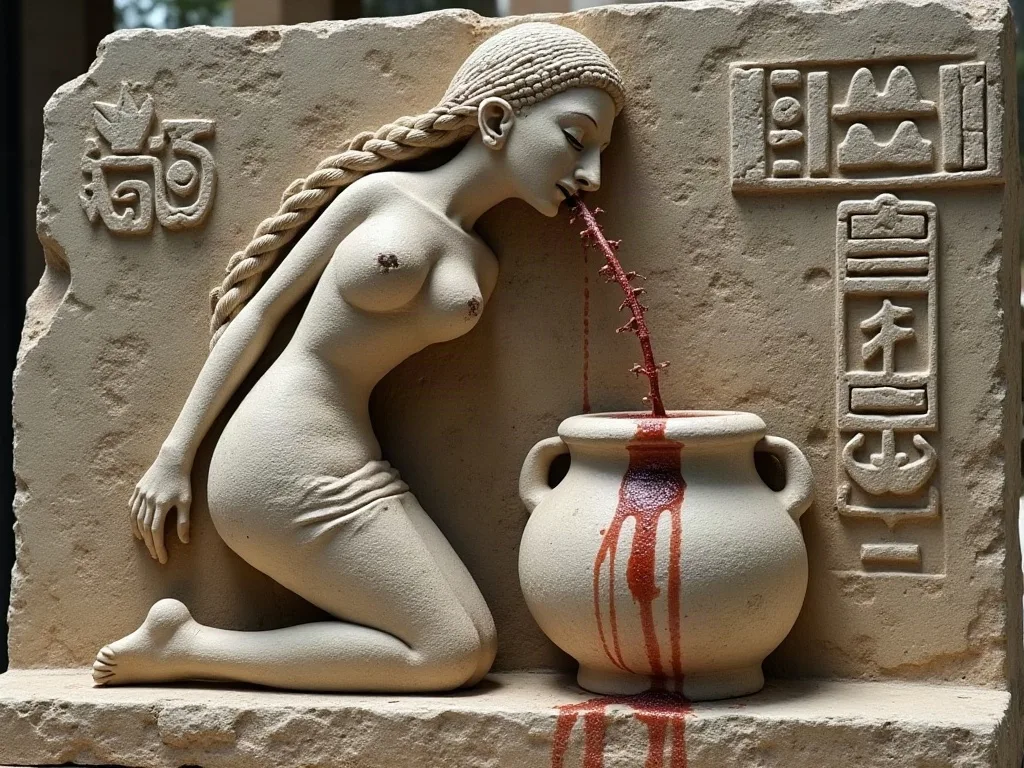
While kings performed the most elaborate ceremonies, bloodletting extended far beyond the royal court. Elite women engaged in the ritual, as documented in limestone reliefs and ceramic vessels. These images show noble women holding bloodletting implements or displaying the evidence of ritual scarification. At Yaxchilan, Lady K'ab'al Xook, the wife of Shield Jaguar, is depicted kneeling in a private vision quest, drawing a rope embedded with thorns through her tongue. Blood streams downward from her mouth into a stone bowl. Her expression is calm, focused. She is communing with the ancestors, channeling the strength of her lineage.
Warriors performed bloodletting before and after battles. A soldier might pierce his ears or lips before combat to invoke the war god's favor. After victory, warriors would bleed again in gratitude. The practice bound martial prowess to cosmic order: war was not mere political calculation but a ritual act that aligned human conflict with divine pattern.
Commoners participated in smaller, community-level ceremonies. Archaeological evidence suggests that village leaders or shamans would perform bloodletting rituals during harvest festivals or to mark the transition of seasons. These ceremonies were less elaborate than royal performances but followed the same logic: the offering of blood to maintain cosmic balance and ensure communal prosperity.
The Objects of Bloodletting: Bark Paper and Burning
The context in which blood was presented to the gods shaped its efficacy. Bark paper, made from the inner fiber of the fig or mulberry tree, was the preferred medium. A Mayan craftsworker would fold this paper into intricate designs and smear it with blood. The paper was then burned, the smoke carrying the transformed essence toward the heavens.
The burning itself was ritualized. A priest or noble would chant prayers or invoke divine names. The smoke was thought to open a channel between the human and divine realms. In the Popol Vuh, the hero twins Hunahpu and Xbalanque use smoke and blood to outwit the death gods of Xibalba. The logic is the same: blood and smoke are transformative mediums, capable of traversing boundaries that would otherwise be impenetrable.
Jade objects were also central to bloodletting ceremonies. A jade blade or an ornamental jade earflare might be presented to the gods alongside blood offerings. Jade was the most precious material in Mesoamerica, more valuable than gold. The Maya associated it with water, vegetation, and the precious soul-stuff that sustained life. When blood was offered alongside jade, the ritual gained additional resonance.
Bloodletting and Vision Quests: Communing with the Other World
Bloodletting often occurred in the context of ritual vision quests. A ruler would fast, consume mind-altering substances like the venom of the bufo toad or extracts from the morning glory plant, and then perform bloodletting while in an altered state of consciousness. The combination of physical pain, sensory deprivation, and chemical alteration could produce vivid hallucinatory experiences. The Maya understood these visions as encounters with divine beings, with ancestors, with the gods themselves.
Stone monuments depict these experiences. At Yaxchilan again, an altar shows Shield Jaguar kneeling before a vision emerging from a serpent's mouth. The serpent was likely a vision serpent, a liminal being that existed partly in the human world and partly in the divine realm. The bloodletting ritual had opened a doorway for the serpent to emerge. Through it, the king could receive messages, guidance, or simply confirmation that the cosmic order remained intact.
The scholar Michael Coe, writing about Mayan iconography, noted that vision quests resulting from bloodletting were central to royal ideology. A king who could bleed and then report a vision was demonstrating a direct pipeline to divine counsel. His authority was reinforced not just by political power but by claimed communion with the gods themselves.
Bloodletting and Human Sacrifice: Where They Differ
It is important to distinguish bloodletting from human sacrifice. The two were related but distinct. Bloodletting was often self-inflicted and voluntary. A ruler bled himself. A noble pierced her own tongue. The blood was the gift, and the giver controlled the offering.
Human sacrifice, by contrast, typically involved the death of a captive or victim. The sacrifice might be a prisoner of war, sometimes a child, sometimes an adult. The victim was killed, often by removal of the heart, and the body was disposed of in specific ritual ways. Human sacrifice was more common in certain periods and certain cities. It reached its apex during the Late Classic period and was associated particularly with the militaristic city-states of the final centuries before the Spanish conquest.
Both practices coexisted in the Mayan religious system, but bloodletting was far more prevalent in daily ritual. Most ceremonies involved bloodletting rather than execution. The practice was democratizing in a way: any person with a sharp blade and the will to endure pain could participate. Human sacrifice, by contrast, was more exclusive, more closely tied to warfare and the capture of enemies.
Symbols of Bloodletting: The Bloodletter, The K'inich Glyph, and Cosmic Water
The Maya developed a sophisticated iconographic vocabulary for bloodletting. The "bloodletter" glyph appeared on ceramic vessels and stone monuments. It depicted a supernatural being or deity presiding over the ritual moment. The bloodletter was often an aged shaman or a god associated with sacrifice or fertility.
The K'inich glyph, depicting the sun god's face or a solar symbol, frequently appeared in scenes of bloodletting. This was deliberate. The association reinforced the theology: human bloodletting was a transaction aimed at sustaining the sun's daily journey. Without human blood, the sun would fall. The cosmos would descend into chaos. The K'inich glyph served as a visual reminder of the stakes.
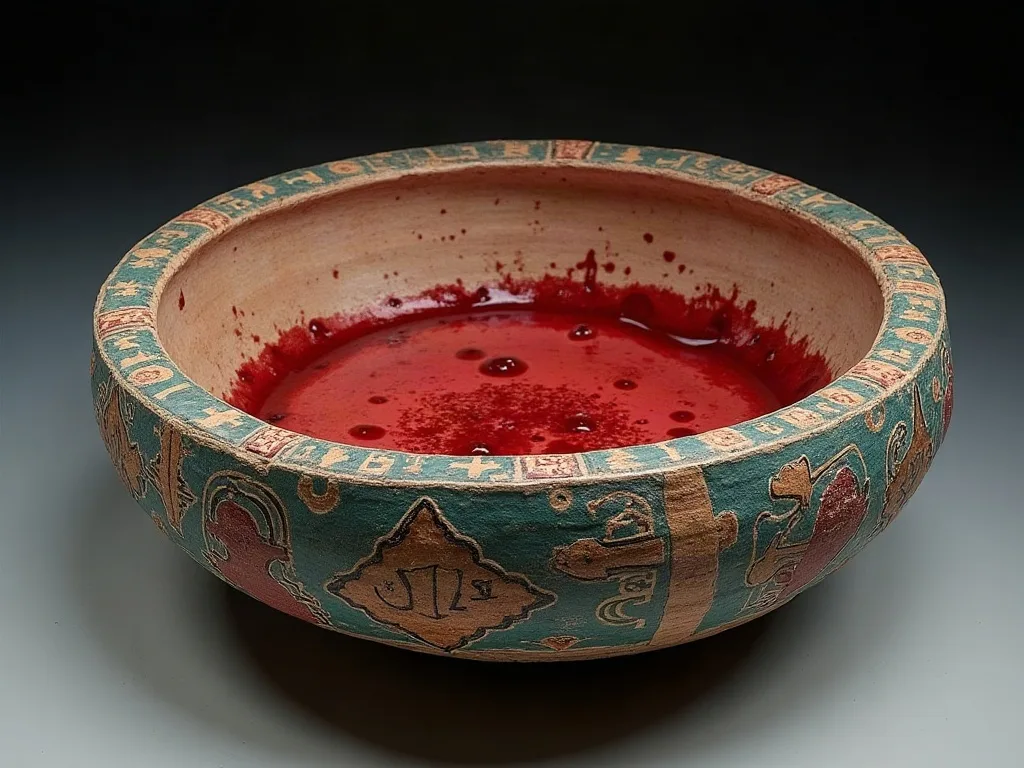
Water also featured prominently in bloodletting imagery. Stone vessels used to collect blood often had water symbolism carved into their rims. Waterlilies, fish, and waves adorned them. This was not incidental decoration. The Maya understood blood as a form of sacred fluid, equivalent in potency to water itself. Water was necessary for life and agriculture. Blood was necessary for cosmic maintenance. The visual overlap reinforced their spiritual equivalence.
Archaeological Evidence: What the Stones Tell Us
Limestone carved during the Classic Maya period (roughly 250 to 900 CE) preserves detailed records of bloodletting practices. Stelae at sites like Yaxchilan, Piedras Negras, and Dos Pilas show individual rulers in the act of bloodletting, often accompanied by dates and the names of gods invoked. These are not artistic elaborations. They are historical documents, as precise as royal charters in medieval Europe.
Ceramic vessels painted with scenes of royal courts show bloodletting ceremonies in detail. A king reclines while attendants hold bloodletting implements. Supernatural beings or gods appear in the sky above. The artistic conventions are consistent: certain pose indicate ritual action. Certain tools indicate bloodletting rather than other activities. By deciphering these visual codes, epigraphers and art historians have reconstructed the ritual calendar and identified the ceremonies tied to specific historical events.
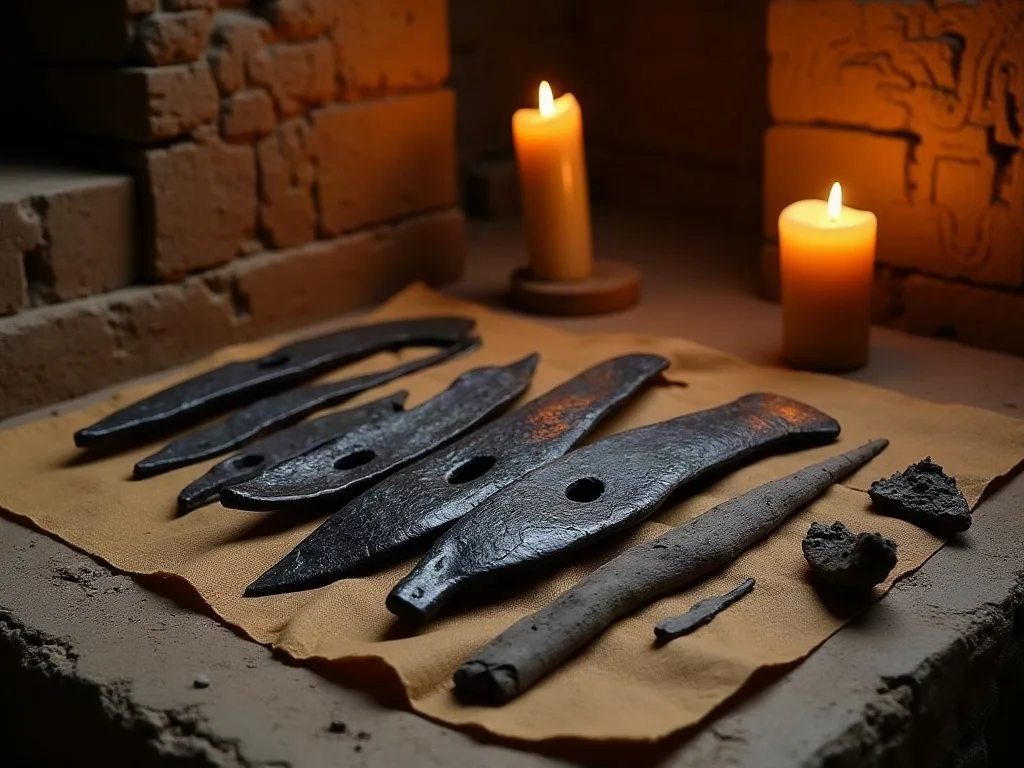
Physical evidence also survives. Archaeological excavations at royal palaces have uncovered obsidian blades, stingray spines, and bark paper fragments. These artifacts confirm the textual and pictorial evidence. Bloodletting was not theoretical. It was practiced, repeatedly, in specific locations with dedicated tools.
Bloodletting in the Creation Myth: The Debt from the Beginning
The Popol Vuh, the Quiche Maya creation epic recorded in alphabetic text after the Spanish conquest, explains the theological foundation of bloodletting. In the text, the gods attempt to create humans from mud, wood, and corn. Only the corn creation succeeds. The new humans are grateful. But the creation itself was costly. The gods bled and sweated to bring the world into being. Human bloodletting is thus a reciprocal debt, a payment for the gift of existence.
The Popol Vuh also records the story of the hero twins, Hunahpu and Xbalanque. In their struggle against the death gods of Xibalba, the underworld, the twins must use bloodletting and trickery. They bleed and burn bark paper. They demonstrate mastery over the boundary between life and death. By doing so, they ensure that the sun rises each dawn. Their victory is achieved not through warfare alone but through ritual action, specifically through bloodletting.
This mythological template shaped historical practice. A living ruler was understood as an avatar of Hunahpu or Xbalanque, re-enacting the hero twins' struggle against chaos. When a king bled, he was not merely performing a ceremony. He was re-entering the cosmic drama recorded in the creation myth. He was ensuring that the sun would rise and the world would continue.
The Decline: Bloodletting Under Spanish Pressure
When Spanish conquistadors arrived in the Yucatan in the early sixteenth century, bloodletting was still central to Mayan religion. But colonization transformed the practice. Spanish friars, viewing the rituals through the lens of Christian theology, condemned them as demonic. Bloodletting was forbidden. Temples were destroyed. Mayan nobles were pressured to convert to Catholicism.
Some Mayan communities abandoned the practice. Others continued in secret, sustaining bloodletting ceremonies in remote locations far from Spanish oversight. In some cases, the ritual survived by merging with Christian forms. Blood spilled during Holy Week or on feast days for saints was sometimes understood through the old theological framework: a precious offering to sustain cosmic order, now Christianized but still fundamentally Mayan.
In rural communities of Guatemala and Mexico, echoes of bloodletting persisted into the twentieth century. Ethnographers documented indigenous shamans performing ritual bloodletting during curing ceremonies or to mark important transitions. The theological framework had shifted, but the practice endured. Blood remained a medium of transformation and communion with the sacred.
Bloodletting and Modern Mayan Revival
In recent decades, as Mayan communities have reasserted cultural pride and indigenous identity, there has been renewed scholarly and cultural interest in bloodletting rituals. Contemporary Mayan religious practitioners and cultural leaders have studied the ancient texts and artifacts to better understand their heritage. Some have incorporated knowledge of bloodletting into cultural education programs.
However, the practice itself has not been revived in its classical form. Modern Maya tend to understand bloodletting through historical and spiritual frameworks rather than attempting to recreate the ritual in its entirety. The scholarly study of bloodletting has become a way of reclaiming knowledge that colonialism attempted to erase.
Frequently asked questions about bloodletting rituals in Mayan religion?
Frequently asked questions
Did bloodletting cause serious injury or infection?
Most bloodletting ceremonies involved piercing the tongue, lips, or ears, which healed relatively quickly. Genital bloodletting, performed on rare occasions, carried greater risk. The Maya did not have antibiotics, so infection was a genuine concern, though the ritual use of copal resin and other plant materials may have had some antiseptic properties. The ceremonies were performed by priests or nobles trained in the practice, which likely minimized complications. Historical records do not suggest widespread reports of death or permanent disability from bloodletting alone, though the rituals took place in a broader context of warfare and sacrifice where mortality was common.
How does Mayan bloodletting compare to other cultures' sacrificial practices?
Bloodletting was unique to Mesoamerica. The Aztecs performed ritual bloodletting alongside human sacrifice, but the Aztecs emphasized heart extraction more prominently. In ancient Egypt, ritual animal sacrifice was central to temple religion, but self-inflicted bloodletting was rare. In ancient Greece and Rome, animal sacrifice (particularly bulls) was the primary ritual offering to the gods. The Mayan emphasis on voluntary, often self-inflicted bloodletting, combined with the theological framework of cosmic debt repayment, makes it distinctive.
What role did bloodletting play in Mayan gender and power dynamics?
Bloodletting reinforced royal authority regardless of gender. Both kings and queens performed the ritual. Elite women's bloodletting ceremonies are documented on monument and ceramic vessels. The ritual was a demonstration of piety and divine connection available to anyone with status and access to ritual specialists. However, records suggest that the most elaborate and politically consequential ceremonies were performed by kings. This may reflect the fact that kingship itself was more exclusively male, though succession could sometimes pass through the female line.
Is there archaeological evidence that bloodletting actually occurred, or is it only depicted in art?
The evidence is both artistic and physical. Carved monuments preserve detailed scenes of bloodletting. The glyph for bloodletting appears repeatedly in hieroglyphic texts. Ceramic vessels depict the practice with anatomical specificity. Beyond artistic representation, archaeologists have uncovered obsidian blades, stingray spines, and fragments of bark paper that match the materials shown in artistic depictions. Stone basins designed to collect blood have been identified. The combination of multiple types of evidence (artistic, textual, archaeological, and physical) makes it clear that bloodletting was a real, widely practiced ritual.
Why were stingray spines and obsidian chosen as bloodletting instruments?
Both materials carried symbolic weight. Obsidian was volcanic glass, believed to contain divine fire. Stingray spines came from the sea, a liminal realm in Mayan cosmology where the underworld and living world touched. Each material connected the bloodletting ceremony to specific domains of power and danger. The choice of implement may have also depended on the purpose of the ritual. A bloodletting ceremony to honor the sun god might use obsidian (associated with fire and divine power). A ceremony tied to water deities or the underworld might employ stingray spines.
Bloodletting as Theology and Technology: What We Still Debate
Scholars continue to debate the precise cosmological and political functions of bloodletting. Was it primarily a mechanism for maintaining cosmic order, as the theological framework suggests? Or was it a technology of political power, a way for rulers to monopolize communication with the divine and justify their authority?
The answer is likely both. The ritual operated simultaneously on theological and political registers. A king who demonstrated piety through bloodletting was reinforcing both cosmic order and his own political legitimacy. The two functions were not separate but interwoven. The ritual worked because the Maya believed it was necessary for cosmic survival. It also worked because it visibly demonstrated the ruler's commitment and willingness to suffer on behalf of the realm.
Some scholars, like Stephen Houston and David Stuart, have emphasized the role of bloodletting in establishing networks of reciprocal obligation between rulers and gods, between rulers and their subjects. The ritual created a symbolic language through which political relationships could be expressed and renewed.
Others have focused on the phenomenological dimensions: the pain, the altered consciousness, the vision-quests that bloodletting facilitated. From this perspective, the ritual was as much about personal spiritual experience as about cosmic maintenance. A ruler who bled and then reported a vision was advertising direct access to divine knowledge. Whether or not the vision "really" occurred, the claim was politically powerful.
The debate remains open and productive. New archaeological discoveries, newly deciphered hieroglyphic texts, and continued ethnographic work among Maya communities will likely refine our understanding further. What remains certain is that bloodletting was central to Mayan civilization for over two millennia, and that it shaped everything from royal ideology to agricultural calendars to the very structure of the cosmos as the Maya understood it.
Read the full book
Want the whole story?
The complete edition is an instant PDF download here, with a paperback on Amazon for selected titles.
Mayan
The Mayan Mythology Book: Hunahpu, Xbalanque, Kukulkan and the Sacred Stories of the Rainforest Mathematicians
The Popol Vuh, Xibalba, and the Cosmos Calculated in 13s and 20s
The Hero Twins descend to Xibalba. Kukulkan returns at equinox. Itzamna writes the first books. The complete mythology of the Maya who calculated the cosmos and left us the Popol Vuh.
More from Mayan
All articles
Mayan
Ixchel: Goddess of the Moon and Childbirth in Maya Mythology
Ixchel ruled the night sky and the sacred threshold where life enters the world. As the aged moon goddess and divine midwife of the Yucatan, she embodied both the gentleness of birth and the ferocity of storms.

Mayan
The Mayan Calendar System: Tzolk'in and Haab' Explained
The Mayan calendar tracks time across multiple overlapping cycles: the 260-day Tzolk'in and the 365-day Haab' align every 52 years in a sacred pattern. Discover how the Maya read the cosmos in numbers.

Mayan
The Maize God: Symbol of Life and Resurrection in Mayan Mythology
The Maize God embodies the Mayan cycle of death and rebirth through corn, the lifeblood of Mayan civilization. Discover how this deity shaped creation myths, ritual, and the Mayan understanding of existence itself.
Mayan
Hunahpu and Xbalanque: The Hero Twins Who Defeated the Lords of Death
Discover how the Hero Twins outwitted the Lords of Xibalba and reshaped the Maya cosmos. Their triumph over death itself becomes the foundation of human existence.