
Kukulkan: The Feathered Serpent God of Wind and Wisdom
Kukulkan, the Feathered Serpent, stands as one of Mesoamerica's most powerful deities: a god of wind, creation, and knowledge who arrived from the sky as both destroyer and culture-bringer. Discover how this shape-shifting serpent shaped Mayan civilization and echoed across Mesoamerican cultures for centuries.
Contents
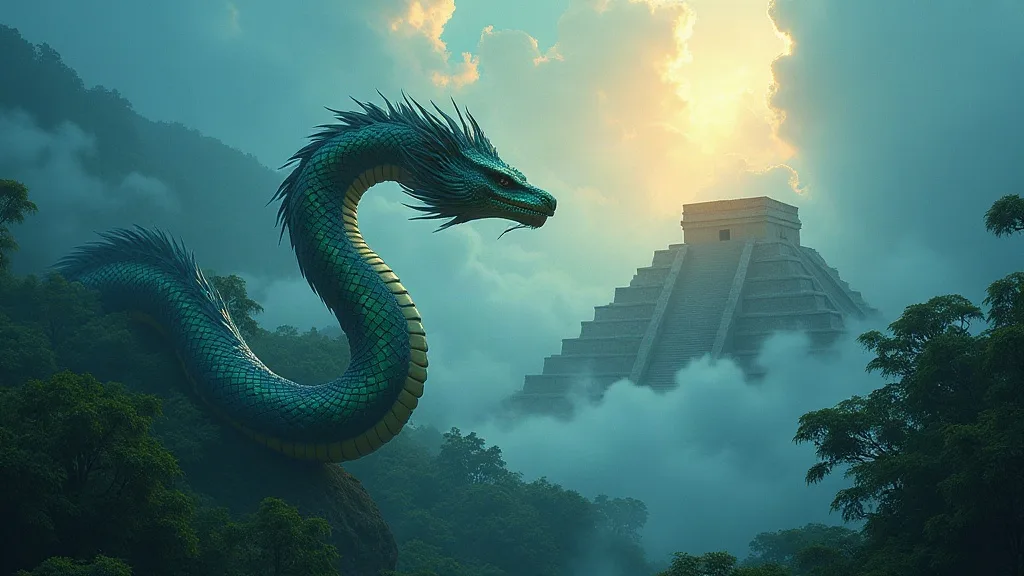
A feathered serpent descends from the sky. Its scales shimmer green and blue as it coils through clouds, bringing wind and rain to the parched earth below. Wings fold against its serpent body. Ancient Mesoamericans saw divinity in this impossible creature, and they named it Kukulkan: "feathered snake" in the Yucatecan Maya language.
Kukulkan: The Feathered Serpent represents far more than a hybrid monster. He embodies transformation itself: the union of sky (the quetzal bird) and earth (the serpent). He moves between worlds. He speaks in thunder and teaches humans the sacred arts. Over more than a thousand years, from the Classic Maya period through the conquest, Kukulkan evolved from a distant sky god into a messiah-like figure, a conquering culture-hero, and the patron of the wind. His story interweaves with the largest story Mesoamerica had to tell: the creation of the world, the survival of civilization, and the perpetual balance between chaos and order.
Origins and Early Appearances in the Classic Maya Period
The roots of Kukulkan stretch deep into Maya history, though the deity's name and precise attributes shifted as kingdoms rose and fell. In the Classic Maya period (roughly 250 to 900 CE), inscriptions and painted pottery reveal a god sometimes called the "Principal Bird Deity" or the "Itzamna aspect": a figure associated with creation, sky, and cosmic order. He was not yet the conquering hero of later myths, but rather a celestial serpent whose breath moved the clouds and whose presence stabilized the four corners of the world.
The Classic Maya codices and temple carvings show serpents with avian features adorning pyramid facades and ritual vessels. These are not crude monsters but intricately rendered beings: feathers rendered with precise lines, serpent fangs undercut by beaked faces. Scholars like Karl Taube have traced the deity's iconography through centuries of Maya art, noting how the serpent's symbolism, renewal, moisture, cyclical time, merged with avian imagery of heavenly ascent and divine sight.
The name Kukulkan itself appears more prominently in the later Postclassic period (900-1500 CE), when the northern Yucatan was the dominant center of Maya power. By then, the deity had absorbed new layers of meaning, influenced by contact with central Mexican cultures, particularly the Toltecs. The Yucatecan Maya inherited and reshaped an older Mesoamerican archetype: the feathered serpent already venerated by the Olmec, the Toltecs, and others. Each civilization reimagined the god for its own moment.
The Toltec Transformation and the Arrival of a Culture-Hero
The great turning point in Kukulkan's mythology comes from the legend of Topiltzin Quetzalcoatl, the Toltec king-priest who ruled the city of Tollan (in the Valley of Mexico) around 900-1000 CE. His story, preserved in Nahuatl codices and later Spanish chronicles, became the template for how the Maya would later understand Kukulkan.
Quetzalcoatl (the Nahuatl form of "feathered serpent") was said to be a wise ruler who brought the arts, agriculture, and civilization to humanity. He ended human sacrifice and taught people to cultivate maize. But he was tricked into drunkenness, humiliated, and driven from his city. In shame, he sailed east across the sea, vowing to return. Over centuries, this narrative merged with Maya cosmology. The Yucatecan Maya saw themselves as the inheritors of this god's wisdom. Kukulkan became not merely a celestial force but a historical being who had walked among humans, taught them, and would someday come again.
The Popol Vuh, the Maya creation narrative recorded in Kiche dialect after the Spanish conquest, does not name Kukulkan explicitly in its earliest chapters. Yet the god's influence permeates the text: the concept of a feathered serpent creator, the idea of divine wisdom emerging from the sky, the notion that civilization itself is a gift from the gods. When the Popol Vuh describes the Hero Twins descending into the underworld and their miraculous return, it echoes a pattern Kukulkan embodied: descent, transformation, ascent, and triumphant return.
Kukulkan in the Postclassic Yucatan: The Itza and Chichen Itza
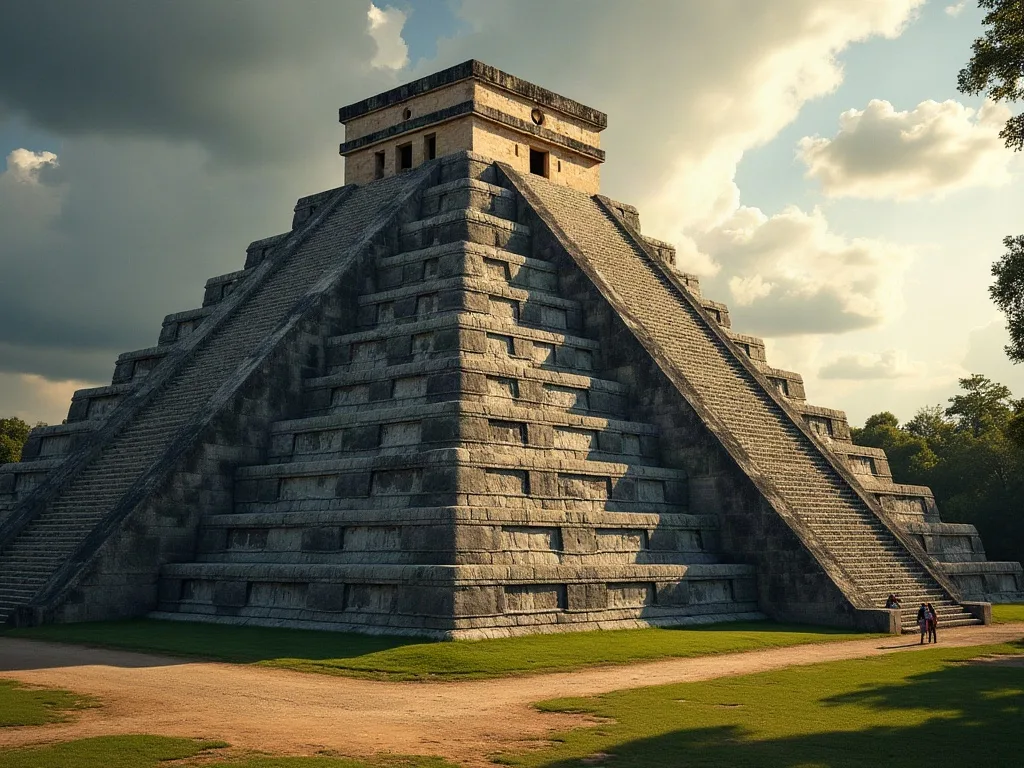
By the time Chichen Itza rose to dominance in the Yucatan around 1000 CE, Kukulkan had become the patron deity of the Itza people. The great city's architecture, art, and ceremonies revolved around him. The most famous image is the great pyramid, the Castillo, where twice yearly (at the spring and autumn equinoxes) the setting sun casts a shadow shaped like a descending serpent along the pyramid's western face. This optical effect is almost certainly intentional: Kukulkan, visible to every citizen, descends from heaven to bless the earth.
Inside Chichen Itza's temples, murals and stelae show Kukulkan coiled around the sky band, his feathered body marking the boundaries of the cosmos. He appears in the Temple of Warriors as part of a procession of cosmic forces. In the Sacred Cenote (the great sinkhole), archaeological evidence suggests the Itza performed ceremonies calling on Kukulkan to bring rain, dropping offerings and sometimes human sacrifices into the water. The wind, the rain, the creative and destructive forces of nature: all were Kukulkan's domain.
The Book of Chilam Balam texts, written by Yucatecan Maya in the 16th and 17th centuries after Spanish contact, describe Kukulkan's movements through time in prophetic language. He arrives in year Can ahau and stays thirteen years, then departs. He is both harbinger of good harvests and warning of upheaval. The texts suggest that Kukulkan's cycles were understood as waves of transformation, eras in which the god's presence intensified and then withdrew.
Attributes, Powers, and Sacred Associations
Kukulkan: The Feathered Serpent commanded an extraordinary range of divine powers and resonated with multiple sacred symbols.
Wind and breath: Kukulkan's most fundamental association was with ik, the wind. The wind was understood not as mere air but as the breath of the divine, the force animating creation. Offerings to Kukulkan were made at crossroads and at times of seasonal change, when the wind shifted. A temple dedicated to him often had a rounded, tower-like structure called an ehecatl-temple, designed so that wind rushed through its passages and the god's voice could be "heard" by worshippers.
Maize and agriculture: As a culture-bringer, Kukulkan was associated with the maize plant, the foundation of Mesoamerican civilization. In several origin myths, the gods created humans from maize flour and water. Kukulkan, as the first teacher, showed humanity how to cultivate this sacred crop. Maize kernels were offered to him at harvest time.
Venus and the morning star: In some versions of Kukulkan's mythology, he is associated with the planet Venus, the brightest object in the night sky after the moon. The Dresden Codex, a pre-Columbian Maya astronomical manuscript, contains detailed records of Venus's cycles, and scholars debate whether Kukulkan or the god Chac Xib Chac governed Venus's movements. The morning star, rising just before dawn, symbolized resurrection and the return of light.
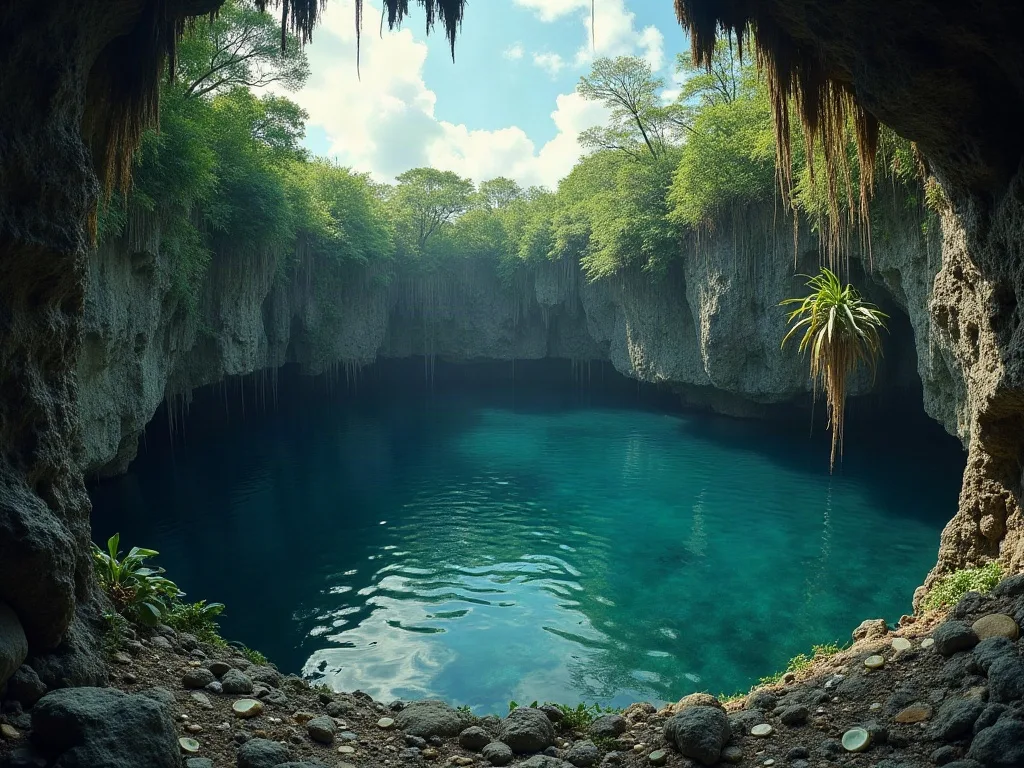
Water and cenotes: The sacred sinkholes of the Yucatan, called cenotes, were portals to the underworld and sources of rainfall. Kukulkan was called upon in times of drought. The water level in cenotes seemed to rise and fall mysteriously; the Maya understood this as Kukulkan breathing, inhaling and exhaling the earth's moisture. Jade, shells, and human offerings were placed in cenotes as gifts to the god.
The number thirteen: In Maya numerology, thirteen held sacred weight. The Popol Vuh speaks of thirteen heavens above and nine underworld levels below. Kukulkan was said to rule in cycles of thirteen years, and the calendar itself was divided into thirteen-day weeks. This association with thirteen linked Kukulkan to cosmic order and the rhythms by which time itself was measured.
The Feathered Serpent Across Mesoamerica: Quetzalcoatl, Kukulkan, and Gucumatz
The feathered serpent was not exclusively Maya. Across Mesoamerica, from the Olmec to the Aztecs, variations of this god appeared under different names. Understanding Kukulkan means understanding a shared Mesoamerican religious language, a common mythological alphabet.
Among the Toltecs and Aztecs of central Mexico, the feathered serpent was called Quetzalcoatl (from Nahuatl: quetzal, the iridescent bird, and coatl, serpent). Quetzalcoatl was a god of wind, learning, and creation. The legendary king Topiltzin Quetzalcoatl, described above, may have been a historical ruler who claimed descent from or identification with the god. After his exile, the myth developed that he would return from the east, sailing across the sea. When Spanish conquistadors arrived in the 16th century, the Aztec emperor Montezuma initially wondered if they might be Quetzalcoatl and his returning host, a tragic misunderstanding with historical consequences.
The Kiche Maya, who lived in the Guatemalan highlands, knew a version called Gucumatz (meaning "feathered serpent" in their language). The Popol Vuh describes Gucumatz as one of the creator gods who brought the world into being, working alongside Tepeu (the "Maker") and Ixmucane (the "Grandmother"). Gucumatz rises from the primordial waters and, through thought alone, makes mountains and valleys appear. He is consciousness itself, the power of intention and cosmic imagination.
These were not separate gods but versions of a single archetype, adapted to local contexts and historical moments. A merchant traveling from the Yucatan to the Valley of Mexico might recognize Kukulkan and Quetzalcoatl as the same divine being, wearing different masks, speaking different languages, but embodying the same cosmic principle.
Kukulkan (Yucatecan Maya)
God of wind, rain, and agricultural fertility; patron of Chichen Itza and the northern cities; associated with the morning star and the cycles of Venus; culture-hero who taught maize cultivation and the calendar.
Quetzalcoatl (Aztec)
God of wind, learning, and creation; legendary king-priest of Tollan; associated with the wind temple and breath itself; brought the arts and civilization; vowed to return from across the sea.
Kukulkan in the Creation Myth and the Structure of the Cosmos
The Yucatecan Maya understood the cosmos as a five-chambered space: four cardinal directions (north, south, east, west) and a center. Kukulkan moved through all five zones, his feathered serpent body stretching across the sky like a living axis mundi. The Book of Chilam Balam of Chumayel describes how Kukulkan descended during the creation, establishing the four corners of the world and setting the cosmic order in place.
In the Popol Vuh, which blends Kiche Maya and Mesoamerican cosmology, the creation unfolds in stages. First comes primordial chaos, the dark waters before time. Then the gods speak creation into being. They attempt to make humans three times, failing each time, until finally they discover that maize is the perfect substance from which to fashion humanity. This act of discovery, of teaching, reflects Kukulkan's role as the god who enables civilization. He is present not as the sole creator but as the shaper, the one who transforms raw potential into actual form.
One of the most striking features of Mesoamerican cosmology is its cyclical view of time. The current world age (the age of maize humans) is not eternal. The Maya kept detailed astronomical records and believed the world operated in great cycles: each 13 baktun cycle (roughly 5,125 years) would bring completion, destruction, and renewal. Kukulkan was understood as the force governing these transitions. When one world age ended and another began, Kukulkan descended to destroy and cleanse, then rose again to create anew. He was Shiva and Brahma in one being: destroyer and creator, simultaneously.
Kukulkan's Relationship to Other Maya Deities
Kukulkan did not stand alone in the Maya pantheon. He existed within a complex web of relationships with other gods, some complementary, some tense.
Chac, the rain god, was sometimes Kukulkan's ally, sometimes his rival. Chac ruled the lightning bolts and the rain itself, often depicted with a prominent hooked nose and a axe in hand. Where Kukulkan was the wind that carried the clouds, Chac was the force that broke them open. Farmers prayed to both, understanding their powers as interdependent.
Itzamna (meaning "iguana house"), the creator god and lord of the sky, was sometimes conflated with Kukulkan and sometimes distinguished from him. In some myths, Itzamna was the supreme deity, while Kukulkan served as his regent or manifestation. The relationship varied by region and time period; Maya theology was always more a conversation among deities than a rigid hierarchy.
Xibalba, the underworld, was ruled by death gods who tested mortals and demanded honor. Kukulkan's cyclical nature meant he moved between Xibalba and the sky, carrying offerings down and blessings up. The Hero Twins of the Popol Vuh descend into Xibalba, face its lords, and return transformed. This journey mirrors Kukulkan's own pattern of descent and resurrection.
The relationship between Kukulkan and the Hero Twins is particularly interesting. The twins in the Popol Vuh perform a ball game in the underworld, demonstrate their magical knowledge, allow themselves to be sacrificed, and then resurrect themselves. Scholars suggest that the twins' journey echoes Kukulkan's own mythology: the god who descends, appears to be defeated, and returns victorious. In later Yucatecan thought, Kukulkan may have been understood as the god who validated this heroic cycle, blessing those mortals who could replicate it through ritual and endurance.
Ritual, Ceremony, and Worship
The Itza of Chichen Itza observed elaborate ceremonies honoring Kukulkan, timed to astronomical events and the Maya calendar.
The spring and autumn equinoxes (around March 20 and September 22) were marked by rituals at the Castillo. Priests in full regalia processed up the pyramid. The shadow cascade, where the setting sun's light created the illusion of a serpent sliding down the western face, was the visual climax. Flutes were played, made in serpent form so that when blown they produced a hissing sound like Kukulkan's own breath. Offerings of copal incense, maize, and sometimes blood were made. The ceremony was both calendar-keeping and theology: it confirmed that Kukulkan still moved through the sky, still blessed the earth, still maintained the cosmic order.
Wind temples (ehecatl-temples) were round or oval structures with distinctive conical roofs, designed so that the wind created a perceptible effect inside. Worshippers would enter to "speak" with Kukulkan through the movement of air, leaving offerings of flowers, food, and woven cloth. These temples are found not only at Chichen Itza but throughout the Yucatan and central Mexico, suggesting a widespread and continuous cult.
The tzolkin, the sacred 260-day calendar, was divided into periods, some of which were considered Kukulkan's days or weeks. On these occasions, special foods were prepared: tamales made with maize that had been blessed by priests. The fire was rekindled in rituals called the "new fire ceremony," an act of cosmic renewal that summoned Kukulkan's power to rejuvenate the world.
Human sacrifice, while part of Maya religious practice more broadly, was particularly associated with water gods and sky gods. Cenotes received human offerings during droughts, the idea being that a human life, the most precious offering, would move Kukulkan to bring rain. The victims (often prisoners or young people from tributary communities) were understood not as mere deaths but as messengers, sent to the gods with the prayers of the people bound to their hearts.
The Legacy of Kukulkan: From Conquest to Modernity
The Spanish conquest of Mesoamerica in the 16th century shattered the organized worship of Kukulkan and other Maya gods. Temples were destroyed or repurposed as Christian churches. Codices (painted bark-paper books) were burned by zealous friars. The priesthood that had maintained the tradition was killed or dispersed.
Yet Kukulkan did not vanish. In the centuries after conquest, the Maya syncretized their gods with Christian saints. Kukulkan merged with aspects of Jesus Christ: the crucified god who descends to the underworld (or in Christian terms, Hell) and rises again. Some scholars have noted that the equinox ceremony at Chichen Itza, suppressed as pagan during the colonial period, was never entirely abandoned. It continued in small ways, in family rituals and private ceremonies, until the 20th century when it was revived as a public spectacle and cultural symbol.
The Yucatecan Maya, descendants of the Itza, maintained oral traditions about Kukulkan even through centuries of Spanish rule. The Book of Chilam Balam texts, written down in the 16th-18th centuries, preserved prophecies attributed to Kukulkan, mixing pre-Columbian and Christian theology in ways that suggest the god never truly left. Contemporary K'iche', Yucatec, and other Maya communities acknowledge Kukulkan as an ancestor god and a symbol of Maya cultural continuity, even if direct worship has largely ceased.
In the 20th and 21st centuries, Kukulkan became a symbol of indigenous identity and pre-Columbian heritage. Scholars, artists, and spiritual practitioners have drawn on Kukulkan's mythology to create contemporary narratives about Maya wisdom, ecological balance, and the resilience of indigenous peoples. The equinox celebration at Chichen Itza, now a major tourist event, attracts thousands who witness the shadow serpent and consider what it might mean for Kukulkan to return, to descend, to bless the earth once more.
The god also appears in popular culture, from science fiction (as an alien guide) to fantasy literature and video games. While these modern interpretations often strip Kukulkan of his theological depth, they attest to the power and persistence of his image: a feathered serpent descending from the sky remains captivating, mysterious, suggestive of wisdom hidden in plain sight.
Kukulkan and the Question of History: King, God, or Both?
One of the most debated questions in Mesoamerican scholarship is whether Kukulkan/Quetzalcoatl was originally a historical figure who was later deified, or a god who was later given a human biography.
Some scholars, following the 16th-century Spanish chronicle writer Sahagún, have argued that Topiltzin Quetzalcoatl was a real Toltec king, possibly a reformer who opposed human sacrifice, and whose later legend was embellished by the Aztecs. Others contend that Quetzalcoatl was always a god, and the legend of Topiltzin was a mythological narrative (like the Heracles or Arthur stories) invented to explain the god's qualities through a human frame.
The truth may be more complex. Mesoamerican cultures did not always distinguish sharply between history and myth. A great king might be understood as an incarnation or earthly form of a god. A god might be said to have "walked the earth" in ancient times. Kukulkan, whether or not he had a historical human avatar, served the function both the Aztecs and Maya needed: a god whose wisdom had been tested in the world, whose teachings bore fruit, whose return was promised. He was myth and history woven together, and that fusion is itself his defining characteristic.
Frequently asked questions about Kukulkan: The Feathered Serpent
Frequently asked questions
Why is Kukulkan called the Feathered Serpent?
The name combines two animals: the quetzal bird (a tropical bird with iridescent green feathers) and the serpent (a symbol of earth, water, and cyclical renewal). The feathered serpent represents the union of sky and earth, of the divine and the earthly. Kukulkan's body is a serpent, but his feathers mean he can fly, transcending the boundaries between cosmic zones. This hybrid form embodied the god's role as a mediator between heaven and the material world.
Did the Maya actually believe the equinox shadow at Chichen Itza was Kukulkan descending?
Most scholars believe the equinox shadow effect was intentional, designed by the Itza architects to create a visible sign of Kukulkan's presence. Whether the Maya understood it literally as the god physically descending or more as a powerful symbolic reminder of his cosmic power is debated. Either way, the ceremony confirmed that the order of the cosmos remained intact and that Kukulkan continued to bless the earth. The event unified the community in witnessing something both astronomical and sacred.
Is Kukulkan the same as Quetzalcoatl?
Kukulkan and Quetzalcoatl are both feathered serpent deities sharing the same core mythology, but they developed in different regions and languages. Quetzalcoatl is the Nahuatl (Aztec) version, while Kukulkan is the Yucatecan Maya version. Both are said to be culture-bringers who taught civilization, both are associated with wind and the morning star, and both have legends of departure and promised return. They are versions of the same archetype, adapted to local theologies, though they were worshipped as distinct deities by their respective peoples.
What offerings did the Maya leave for Kukulkan?
Offerings to Kukulkan included copal incense (a sacred resin that produces fragrant smoke), maize (kernels or prepared foods), woven cloth, flowers, jade, shells, and cacao. In times of severe drought, human sacrifices were made at cenotes, with the belief that Kukulkan would answer with rain. The choice of offering reflected the supplicant's means and the urgency of the need. Incense and maize were the most common daily gifts; elaborate offerings were reserved for seasonal ceremonies and times of crisis.
What happened to Kukulkan worship after the Spanish conquest?
Spanish conquistadors and Catholic missionaries systematically suppressed Maya religious practice, destroying temples and burning codices. However, Kukulkan did not disappear entirely. The Maya syncretized their gods with Christian theology, seeing parallels between Kukulkan's descent and resurrection and Jesus's crucifixion and resurrection. In isolated communities, oral traditions preserved Kukulkan's stories. Today, his image endures as a symbol of Maya cultural identity and pre-Columbian heritage, and the equinox ceremony at Chichen Itza has been revived as both a cultural and tourist event.
Why was Kukulkan associated with both creation and destruction?
Mesoamerican cosmology understood time as cyclical, not linear. Each world age or creation had a beginning, a span, and an end. Kukulkan, as the cosmic force governing these transitions, was both creator and destroyer. When one world age completed, destruction was necessary to clear the way for renewal and a new creation. This dual nature reflects the Maya understanding that life and death, order and chaos, are not opposites but partners in an eternal dance. Kukulkan embodies the truth that nothing persists without change, and that ending enables beginning.
Kukulkan in the Eyes of Scholars and the Modern Quest for Continuity
Contemporary scholarship on Kukulkan draws from multiple disciplines: epigraphy (reading ancient Maya inscriptions), iconography (interpreting visual symbols in art), ethnohistory (combining indigenous texts with Spanish colonial records), and ethnography (studying living Maya communities today).
Epigraphers like David Stuart and Stephen Houston have deciphered Maya inscriptions on stelae and temple walls that mention Kukulkan and trace his appearances through centuries. These texts confirm that the god was known in the Classic period and evolved significantly in the Postclassic. Iconographers like Karl Taube have mapped the visual grammar of Kukulkan's representation, showing how his feathered serpent form was rendered consistently across different cities and periods, even as details and emphasis shifted.
Ethnohistorians like Munro Edmonson have translated the Books of Chilam Balam, mining them for insights into Maya thought and prophecy. These texts reveal a people trying to make sense of conquest, syncretism, and cultural survival through the language of Kukulkan's cycles and returns. They suggest that the Maya did not passively accept Spanish rule but sought ways to honor and preserve their ancestral gods.
Living Maya communities, particularly in the Yucatan and Guatemala, are engaged in a broader project of cultural reclamation and revival. Organizations like the Maya Heritage Foundation work to restore sacred sites, teach the calendar system, and re-establish ceremonies that honor the ancestral pantheon. While these efforts are not literal resurrections of pre-Columbian practice (that past cannot be recovered), they represent a conscious effort to allow Kukulkan and other deities to remain alive in collective memory and identity.
The equinox celebration at Chichen Itza, drawing tens of thousands annually, has become a flashpoint in this conversation. Some see it as a vital reclamation of Maya astronomy and spirituality. Others worry it has been commercialized and sanitized. Few deny that it serves a real psychological and cultural purpose: it gives Kukulkan a public stage and reminds the world that the Maya did not vanish at conquest. They endured, adapted, and continue to honor the gods who shaped their ancestors.
This is Kukulkan's modern paradox: a god stripped of his priesthood and temples in the 16th century, yet never truly forgotten; a symbol of indigenous resistance and continuity; a figure whose image and mythology have survived conquest, colonization, and radical cultural change. When the shadow of the serpent appears on the Castillo each equinox, it is simultaneously an ancient ritual re-enacted and a modern statement of cultural persistence. Kukulkan descends once more, not to destroy or demand sacrifice, but to remind his descendants that the cosmos still moves in cycles, that wisdom endures, and that the feathered serpent, for all that has been taken from him, remains alive in the hearts of those who remember.
Read the full book
Want the whole story?
The complete edition is an instant PDF download here, with a paperback on Amazon for selected titles.
Mayan
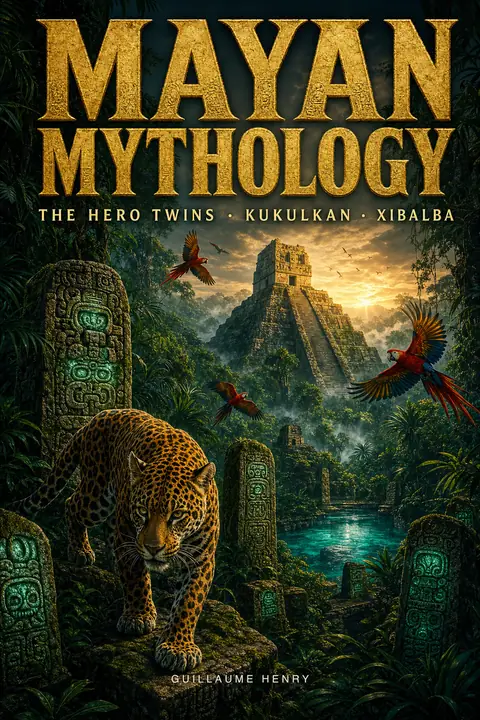
The Mayan Mythology Book: Hunahpu, Xbalanque, Kukulkan and the Sacred Stories of the Rainforest Mathematicians
The Popol Vuh, Xibalba, and the Cosmos Calculated in 13s and 20s
The Hero Twins descend to Xibalba. Kukulkan returns at equinox. Itzamna writes the first books. The complete mythology of the Maya who calculated the cosmos and left us the Popol Vuh.
More from Mayan
All articles
Mayan
Ixchel: Goddess of the Moon and Childbirth in Maya Mythology
Ixchel ruled the night sky and the sacred threshold where life enters the world. As the aged moon goddess and divine midwife of the Yucatan, she embodied both the gentleness of birth and the ferocity of storms.

Mayan
The Mayan Calendar System: Tzolk'in and Haab' Explained
The Mayan calendar tracks time across multiple overlapping cycles: the 260-day Tzolk'in and the 365-day Haab' align every 52 years in a sacred pattern. Discover how the Maya read the cosmos in numbers.
Mayan
Bloodletting Rituals: Sacred Sacrifice in Mayan Religion
Mayan bloodletting rituals were not acts of violence but profound spiritual transactions. Kings pierced their own bodies to feed the gods, sustain the cosmos, and commune with ancestors in ceremonies that shaped civilizations for over two thousand years.

Mayan
The Maize God: Symbol of Life and Resurrection in Mayan Mythology
The Maize God embodies the Mayan cycle of death and rebirth through corn, the lifeblood of Mayan civilization. Discover how this deity shaped creation myths, ritual, and the Mayan understanding of existence itself.