
Wendigo: The Cannibalistic Spirit of the Northern Forests
A towering, skeletal creature born from starvation and taboo, the Wendigo haunts Algonquian folklore as the price of eating human flesh. Explore the origins, psychology, and lasting terror of this primal hunger-spirit.
Contents
The deep Canadian woods in winter hold a particular quiet. Snow settles thick on spruce and birch. Hunger eats at the belly long before it eats at reason. In that silence, the Algonquian peoples knew, something waited. Not a wolf or bear. Something worse: a transformation that began in the stomach and ended in the loss of everything human.
The Wendigo was not an external monster that could be hunted or avoided. It was a possession, a curse, a sickness that started when starvation broke the most sacred taboo. To eat the flesh of your own kind meant becoming the Wendigo itself. The creature was not separate from the forest; it was the hunger of the frozen north given shape and terrible appetite.
The Spirit Born from Transgression
The Wendigo emerges from Algonquian tradition as a spirit bound to one specific crime: cannibalism. Unlike the spirits and beings of other Native American mythologies, the Wendigo was not created in a distant time by the great powers. It formed whenever a human crossed the ultimate line during the starving time of winter.
The Ojibwe, the Cree, the Innu, and other Algonquian nations across the boreal forest, from present-day Quebec to the Great Lakes, all recognized this hunger-spirit as the ultimate consequence of survival gone wrong. The name itself, wendigo, has no single agreed-upon origin in the linguistic record, though scholars suggest it may derive from Ojibwe or Cree roots meaning "evil spirit" or "cannibal."
What made the Wendigo unique among creatures and spirits was its direct link to human choice. You could not be born a Wendigo. You became one. The transformation was not instantaneous. Instead, the Wendigo was a process: starvation weakened the mind, taboo was broken, and the breaking itself triggered a supernatural sickness that rewrote the body and the soul.
The Anatomy of Hunger: What the Wendigo Looked Like
Descriptions of the Wendigo vary across the nations that spoke of it, but certain features recur in the oral traditions recorded by ethnographers and elders. The creature was humanoid but grotesquely distorted by its hunger.
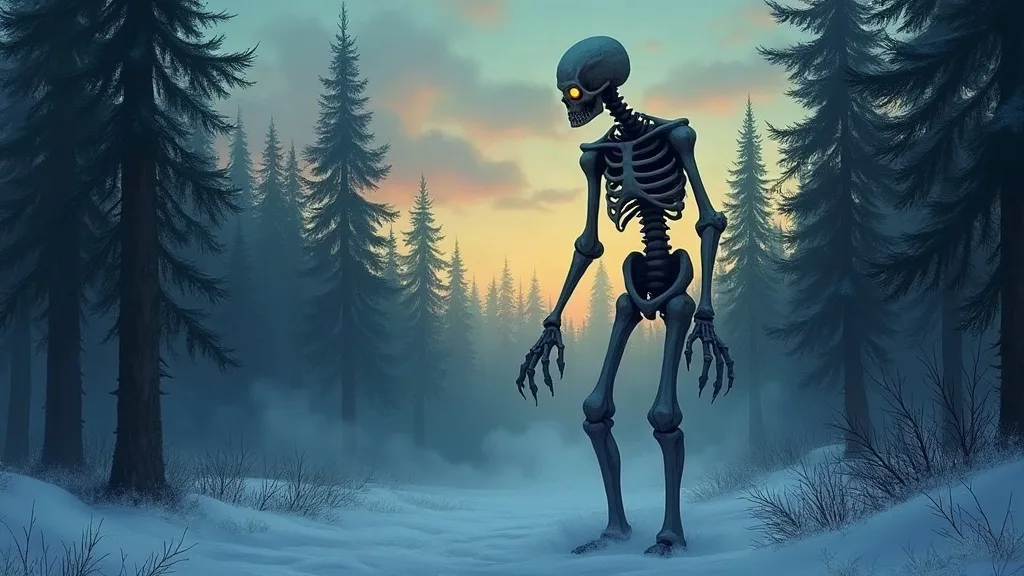
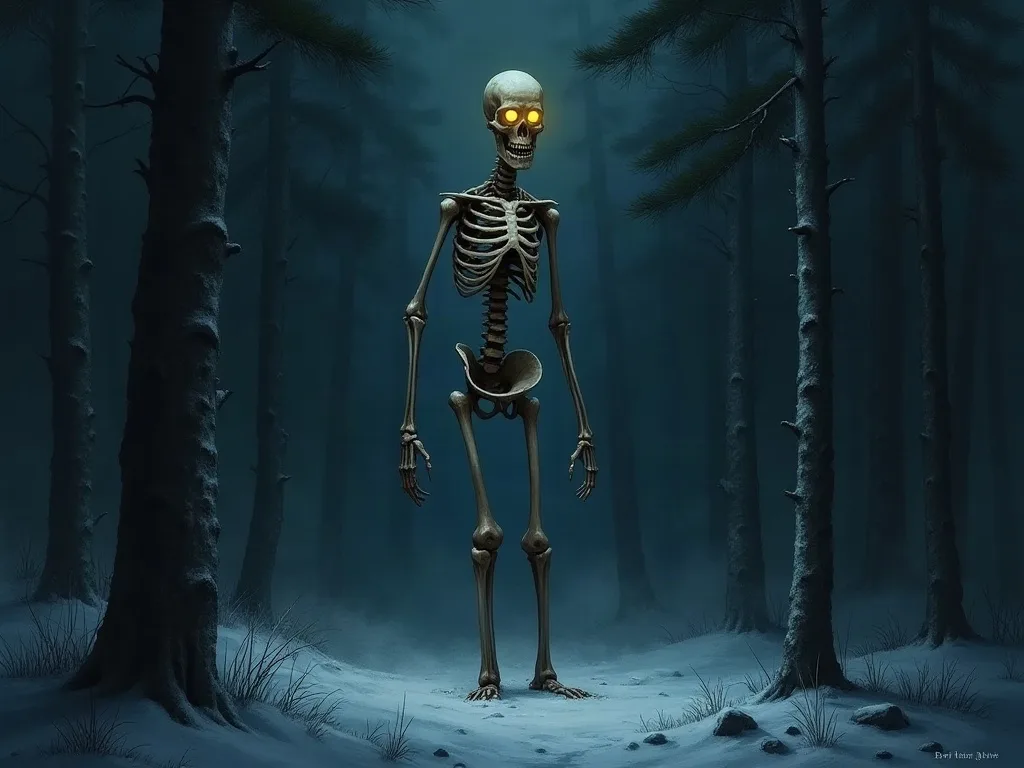
A Wendigo stood tall, often described as skeletal or gaunt beyond the reach of normal starvation. The body was emaciated, the skin pulled tight over the bones, sometimes said to be ash-gray or yellowed. The ribs jutted forward. The joints seemed too large, the limbs too long. In some accounts, the creature's body was covered in coarse hair or matted fur. The face was skull-like: sunken cheeks, eyes that glowed with an amber or yellow light, a mouth stretched too wide, filled with teeth that pointed inward like a trap.
The Wendigo gave off a foul stench, carrion mixed with the rot of something that had died in the cold. Its breath froze the air around it. Some accounts say it left no footprints, or prints that burned the snow where it stepped. Others claim the Wendigo moved without sound, or with a scraping, dragging gait that spoke of joints that no longer bent correctly.
Most chilling was the Wendigo's hunger. It was never satisfied. Even after feeding, the creature was compelled to hunt and eat more. The hunger was not physical need; it was a spiritual curse, an endless wanting that defined its existence.
The Price of Breaking Taboo
Starvation alone did not make a Wendigo. Cannibalism did. But the tribes understood this as more than a physical act, it was a spiritual transgression so grave that it rewrote your nature.
In the long winters of the north, food could vanish. Hunting failed. Stores ran out. People froze and starved. The record of European encounters with Algonquian nations documents these desperate winters clearly. Survival often required choices that had no good option.
If a person ate human flesh during such a crisis, whether the body of someone already dead, or worse, a living member of the band, the act did not simply feed the body. It broke something sacred. It severed the person from the human community and from the spirits that protected it. And in that severing, the hunger-spirit claimed them.
The transformation could be gradual. A person might feel an overwhelming craving for human meat. They would hunt and kill members of their own group. They would become cunning, operating in darkness, dragging victims into the forest. The body would begin to change. They might flee the village, unable to bear the presence of the living. And in the forest, alone, the final transformation would complete itself: they became fully Wendigo, trapped in a form driven by an appetite that could never be satisfied.
Some traditions held that if the transformation were caught early, the cannibal could be killed before becoming fully Wendigo. A shaman might perform a healing ritual. Fire might purify them. But once the change was complete, there was no cure. The Wendigo was a permanent curse, and the only mercy was death.
The Wendigo in the Forest
The Wendigo was not a creature of distant mythology. It was believed to walk the forests in real time, a consequence of real transgression. Oral traditions record specific Wendigo encounters, named individuals who succumbed to the hunger, whose bodies were found or whose presence was tracked.
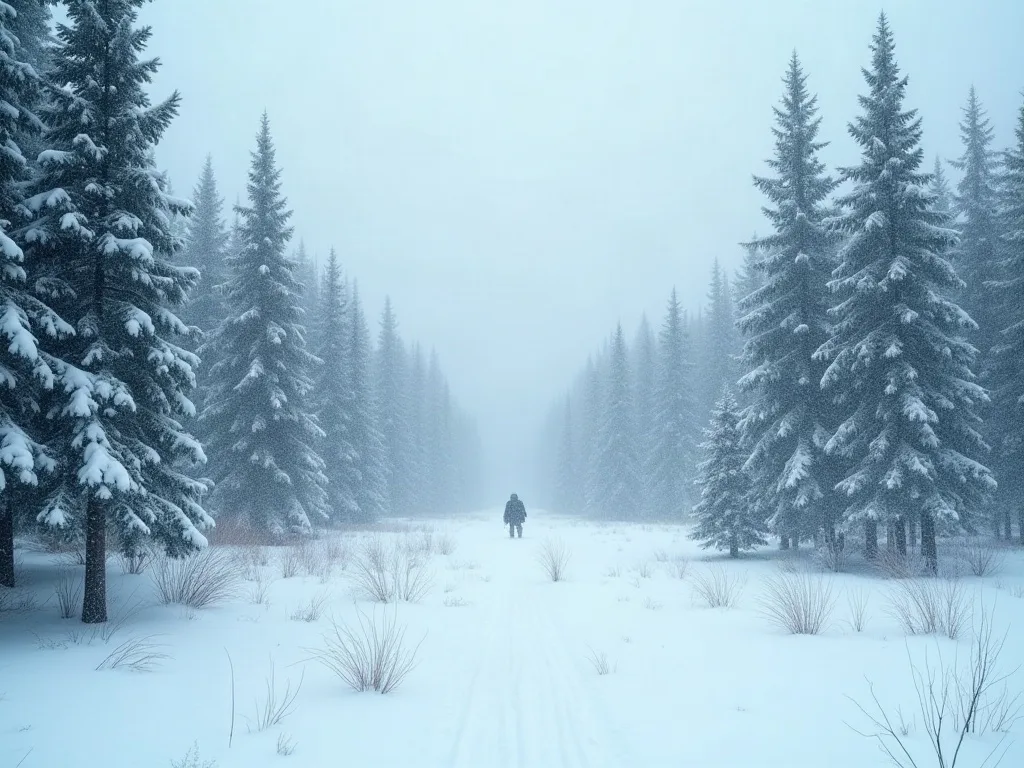
In winter, when food was scarce and fear crept through the villages, hunters and travelers reported sightings: a figure moving between the trees. A sound like screaming mixed with laughter. The smell of rot on the wind. Sometimes a Wendigo would approach a camp at night, calling out in a voice almost human, trying to lure people out into the darkness.
The fear of the Wendigo served a psychological function. It was a cautionary tale with teeth: this is what happens if you break the sacred law. It was also a way of understanding the psychological reality of starvation and desperation. Anthropologists studying the Algonquian traditions have noted that "Wendigo psychosis", a condition in which a person began to crave human flesh, to believe they were becoming the creature, was documented among northern peoples. The spirit was a way of naming and containing a real horror: the possibility that hunger and isolation could destroy the mind and turn a human into something unrecognizable.
Variations Across the Nations
The Ojibwe, Cree, Innu, and other Algonquian peoples each had their own understanding of the Wendigo, shaped by their specific territories and experiences.
The Cree of the northern boreal forest, living in some of the harshest conditions, spoke of the Wendigo with particular dread. Their stories emphasized the creature's speed and cunning. A Cree hunter might hear the creature's call at night and know that it was already circling, cutting off escape routes.
The Ojibwe traditions, recorded by anthropologists like A. Irving Hallowell and William Jones, portrayed the Wendigo as a more individualized being, specific Wendigos with particular hunting territories and behaviors. Some accounts describe Wendigos as capable of speech, even bargaining with humans. In rare cases, a shaman or a particularly powerful person might negotiate with a Wendigo, offering it food (animal flesh) in exchange for the creature leaving a territory.
The Innu peoples of present-day Labrador and Quebec had their own inflection on the Wendigo myth. In Innu tradition, the creature could sometimes be reasoned with, especially by someone with spiritual power. But this made the Wendigo unpredictable and therefore more frightening: you could never be certain whether mercy or hunger would win out.
What all versions shared was the core: the Wendigo was the physical and spiritual manifestation of a broken taboo, and it posed a real threat to survival.
The Historical Record and European Encounter
When French and English settlers arrived in North America, they encountered Algonquian peoples and learned of the Wendigo. What happened next was a collision between two worldviews.
To the settlers, the Wendigo became a monster in the most literal sense: a physical creature that could be hunted and killed, isolated from the moral and spiritual framework that gave it meaning in Algonquian thought. They recorded accounts of Wendigo sightings and attacks. Some settlers began to see Wendigos as a rational explanation for any unexplained death or disappearance in the northern forests.
More troublingly, the Wendigo concept was sometimes used by European colonizers to justify suspicion and violence toward the Algonquian peoples themselves. If the Wendigo was a real monster, then perhaps the people who spoke of it were either complicit with monsters or were themselves monstrous.
Historical records from the 17th and 18th centuries contain accounts of Algonquian communities being accused of Wendigo-related crimes. In some cases, documented by historians like Konrad Helbig and Richard White, these accusations were used to justify raids and executions. The Wendigo became a tool of colonial fear, stripped of its original moral and spiritual purpose.
The Wendigo as Hunger Itself
Modern scholars of Native American tradition interpret the Wendigo as a sophisticated articulation of psychological and spiritual horror. The creature was not primarily a physical threat; it was a metaphor made manifest.
The Wendigo embodied several interlocking fears. First, it was the fear of starvation itself, not just death from hunger, but the process of becoming inhuman through need. Second, it was the fear of isolation, of being trapped alone in a vast wilderness where normal human bonds no longer held. Third, it was the fear of transgression: the knowledge that certain acts, once committed, could not be undone or forgiven.
The Wendigo also represented the darkness within community itself. The cannibal was not an outsider; they were someone you knew. They might have been driven to cannibalism by desperation, not malice. This made the Wendigo particularly unsettling: it was a failure of community, not a failure of nature.
In this sense, the Wendigo was a teaching. It taught that survival had boundaries. Beyond a certain point, survival itself became meaningless if it meant the destruction of the human collective. The Wendigo was the warning: there are lines you do not cross, because crossing them makes you less human, not more alive.
The Wendigo in Modern Culture
In the 20th and 21st centuries, the Wendigo entered wider popular culture. It appears in horror fiction, video games, and films, often stripped of its original context and transformed into a generic monster.
Stephen King's 1992 novella "The Wendigo" (loosely based on Algonquian tradition) portrayed the creature as a primal hunger-force that consumed its victims physically. The novella is effectively terrifying, but it moves the Wendigo away from its roots as a metaphor for human transgression and toward a more conventional monster narrative.
Video games and films have followed a similar path. The Wendigo becomes a creature to be fought and defeated, divorced from any moral dimension. This is not inherently wrong, but it does obscure the original function of the myth: not to provide a monster for entertainment, but to articulate a culture's deepest fears about the cost of survival and the fragility of human community.
In recent years, there has been a movement among some artists and writers to return the Wendigo to its Algonquian context, to center Native American voices in how the creature is understood and portrayed. This includes graphic novels, academic work, and contemporary fiction written by Indigenous authors that reclaims the Wendigo as a teaching story rather than a commodity.
Frequently Asked Questions About the Wendigo
Frequently asked questions
Was the Wendigo a real creature or purely spiritual?
In Algonquian belief, the Wendigo was real in the same way that spiritual forces were real, it had effects in the physical world, could kill people, and demanded spiritual responses. However, modern scholars suggest that the Wendigo often functioned as a way of understanding psychological states caused by extreme starvation and isolation. A person suffering from what is now called "Wendigo psychosis" would experience genuine cravings and behavioral changes, which the tradition explained through the framework of spirit possession.
Could a Wendigo be killed?
Yes. Algonquian traditions held that a Wendigo could be hunted and killed, though doing so was extremely dangerous and usually required a shaman or a person with exceptional spiritual power. Some accounts describe hunters driving a Wendigo into a trap or luring it into fire. The key was that the creature, though dangerous and seemingly invincible, was not unkillable, it had a physical body that could be destroyed.
Did other Native American peoples have similar creatures?
While the Wendigo is specific to Algonquian tradition, other Native American cultures had their own hunger-spirits or monsters associated with cannibalism and transgression. The differences often reflected the specific ecology and challenges of each region. Arctic and subarctic peoples had particularly developed traditions around starvation and survival, which shaped their spirit beings.
What does the name Wendigo actually mean?
The etymology is uncertain and debated by linguists. It may derive from Ojibwe witiko or Cree wiindig, which some scholars translate as "evil spirit" or "cannibal." Other proposed etymologies connect it to words meaning "lone wanderer" or a being that is "self-serving" or "greedy." The term likely predates written records by centuries, and its original meaning may have been lost or transformed over time.
Why did the Wendigo legend persist after colonization?
The Wendigo remained culturally significant because it addressed perennial human anxieties: hunger, isolation, the fear of losing one's humanity. Even as the colonial period disrupted Indigenous life, the story continued to circulate, to warn, to teach. In the 20th century, the Wendigo was absorbed into mainstream horror fiction, which gave it new life as a generic monster, though this often divorced it from its original moral and spiritual purpose.
The Wendigo's Unresolved Power
The Wendigo persists in contemporary consciousness not because we have solved it or explained it away, but because the questions it raises remain unanswered. What does it mean to be human? At what point does survival become destruction? Can a person who has committed an unforgivable act ever be reintegrated into community, or are they permanently transformed?
The Algonquian peoples did not frame the Wendigo as a monster to be defeated once and for all. Instead, it was a danger that returned whenever the conditions were right: isolation, desperation, the breakdown of community bonds. In this sense, the Wendigo is not a creature of myth that belongs to the distant past. It is a possibility that haunts every winter, every famine, every situation in which humans face the choice between self-preservation and collective humanity.
The creature endures because it speaks to something true about the human condition. We are all capable of transgression. We are all vulnerable to desperation. And we all depend on the consent and compassion of our communities to remain fully human. The Wendigo is the warning: break that covenant, and you become something else.
Free 25-page sample
Want the whole story?
Take the first 25 pages free. If it pulls you in, the full edition is yours as an instant PDF download, with a paperback on Amazon for selected titles.
Native American
The Native American Mythology Book: Raven, Coyote, Spider Woman, and the Sacred Stories of Turtle Island
From Pacific Raven to Atlantic Glooscap
The unbroken pre-contact mythology of North America: Raven stealing light, Coyote's tricks, Spider Woman weaving creation, Sedna beneath the ice, and the kachina spirits of the mesa.
More from Native American
All articles
Native American
The Vision Quest: Rite of Passage and Spiritual Revelation
The vision quest stands at the heart of many Native American spiritual traditions: a solitary journey into wilderness where seekers fast, pray, and await contact with the sacred. Discover how this ancient ceremony marks the threshold between boyhood and manhood, illness and healing, confusion and purpose.

Native American
The Sun Dance: Plains Ceremony of Renewal and Sacrifice
The Sun Dance stands as the most sacred communal ceremony of the Great Plains nations, a multi-day ritual of piercing, fasting, and prayer where participants offer their bodies to restore balance and healing to their people. We trace its origins, structure, and enduring power across Lakota, Cheyenne, Arapaho, and Shoshone traditions.
Native American
The Medicine Wheel: Sacred Symbol and Ceremonial Structure
The Medicine Wheel represents the interconnected nature of existence across countless Native American traditions. Discover how this ancient symbol functions as both spiritual map and healing practice, grounded in real ceremonies that still guide communities today.

Native American
Sedna: Inuit Goddess of the Sea and Marine Animals
Sedna rules the Arctic depths as the Inuit goddess of the sea and marine animals. Her story begins with betrayal and transformation: a fallen maiden becomes the sovereign of the ocean, controlling the seal, whale, and fish that sustained Arctic peoples for millennia. Discover how her myth shaped survival, hunting ritual, and the spiritual bond between humans and the sea.