
Wakan Tanka: The Great Spirit and the Supreme Being in Native American Spirituality
Wakan Tanka, the Lakota name for the Great Spirit, represents a profound concept of ultimate sacred power that flows through all existence. Discover how this supreme being differs radically from Western monotheism and shaped indigenous worldviews across North America.
Contents
The sky stretches in every direction. A Lakota elder sits on the prairie and speaks not of a god sitting on a distant throne, but of a presence woven into the earth itself, the air that moves, the creatures that walk, the stones that hold memory. This presence has no single form. It is not one thing, yet it contains all things. The Lakota call it Wakan Tanka, a name that translates as "Great Spirit" or "Great Mystery," and it represents one of the most sophisticated theological concepts in world spirituality: a supreme being that is utterly unlike the patriarchal god of European monotheism.
Wakan Tanka is not unique to the Lakota. Similar concepts appear across indigenous North American cultures under different names: the Anishinaabe speak of Gitche Manitou, the Cherokee honor a Great Spirit often called Unetlanvhi, and the Haudenosaunee (Iroquois) recognize the Creator in ceremonies that echo the same theology. Yet Wakan Tanka has become the most widely known name for this universal principle, preserved in Lakota records and anthropological literature with remarkable clarity. To understand Wakan Tanka is to glimpse a radically different way of conceiving the sacred than the religions that came from the Mediterranean, Middle East, and Europe.
The Name and Core Meaning
The word itself resists simple translation. Wakan carries meanings that English struggles to contain: sacred, powerful, mysterious, holy, strange, wonderful. Tanka means great, vast, immense. Together they name something that cannot be fully named, a paradox that sits at the heart of Native American theology.
When the Lakota say Wakan Tanka, they do not mean a being with a human form who speaks in sentences and makes deals. They speak of an intelligence, a force, a presence that pervades all existence. The 19th-century ethnographer James R. Walker, who lived among the Lakota and recorded their spiritual teachings, wrote that Wakan Tanka is not just the creator but the creative principle itself, the power that makes all creation possible. It is both transcendent (beyond all things) and immanent (within all things simultaneously).
This theology emerged from lived experience on the Great Plains. The Lakota observed the rhythms of seasons, the behavior of buffalo, the patterns of storms, the movements of stars. They noticed that all living things possessed a kind of power or intelligence. Grass knew when to grow. Water found its path. Eagles could see farther than humans. Rather than reducing all this variety to a single ruling mechanism, Lakota philosophy integrated it into a vision of Wakan Tanka as a unified force expressing itself through infinite particulars.
The Nature of Wakan Tanka: Not a Single Entity
One of the most crucial misunderstandings in Western encounters with Native American spirituality comes from imposing monotheistic categories onto traditions that do not fit them. Early Christian missionaries assumed that Wakan Tanka was equivalent to the Christian God, a supreme ruler and judge. This assumption flattened the actual theology into something it was never meant to be.

Wakan Tanka is not a single entity with a unified will and voice. Instead, it is more accurate to say that Wakan Tanka manifests through what the Lakota call wakan beings, powerful entities and forces that are all expressions of the same ultimate principle. These include spirits of natural elements (wind, thunder, water), animal powers, the spirits of ancestors, and the fundamental energies that animate the cosmos. None of these is separate from Wakan Tanka; all are its expression, its hands and voices in the world.
This resembles panentheism (the view that divinity pervades creation while transcending it) more than traditional monotheism. It also echoes systems in other traditions. Hindu philosophy's concept of Brahman as the ultimate reality that manifests through countless deities shares structural similarities, as does the Sufi Islamic notion of divine presence flowing through all creation. Yet the Lakota did not borrow these concepts; they arrived at them through their own contemplation of the world.
The Lakota ceremonial system reflects this understanding. When they perform the Pipe Ceremony, they acknowledge the presence of Wakan Tanka, but they also honor specific spirits that embody different aspects of creation. The ceremony itself becomes a conversation with the sacred, not a petition to a distant ruler.
Wakanicity: The Quality of Being Wakan
To grasp Wakan Tanka fully, one must understand a concept that has no direct English word: wakanicity, the quality or degree of being sacred and powerful. The Lakota understood that some things, places, and beings possessed more wakan than others. A sacred mountain held more wakan than an ordinary hill. A skilled healer's hands held more wakan than untrained hands. A vision granted in ceremony carried more wakan than casual thoughts.
This was not arbitrary. Wakanicity came from alignment with the fundamental order of creation. A person who lived in balance with natural rhythms, who honored obligations to their people, and who listened to the teachings of elders embodied more wakan. A place where many people had prayed, grieved, or healed became more wakan over time. The concept created a universe that was not divided between sacred and profane, but ranged along a spectrum. Everything possessed some degree of wakan. The greatest concentration of it was found in moments of harmony, in disciplined prayer and vision, and in the presence of those who had achieved wisdom.
This had profound practical consequences. It meant that a young person seeking to live a good life did not simply obey external commandments handed down from above. Instead, they sought to cultivate wakan through right action, through learning, through participation in ceremonies, and through paying attention to the teachings encoded in the natural world. A person's integrity, their alignment with the great power that moved through all things, became the foundation of ethics.
Four Great Spirits and the Structure of Creation
While Wakan Tanka represents the ultimate unified principle, Lakota spirituality recognizes what might be called four primary manifestations or aspects. These are not separate gods but rather different channels through which Wakan Tanka becomes knowable and workable in the world. The Lakota sometimes speak of them as the Four Great Spirits or the Four Directions, each associated with specific qualities and responsibilities.
The spirit of the West, associated with thunder and storm power, brings purification and necessary destruction. The spirit of the North, connected to wisdom and clarity, embodies the mind and intellectual power. The spirit of the East brings illumination and new beginnings, the power of awakening. The spirit of the South nurtures growth, compassion, and the power of bringing things to fruition. Together, these four dimensions create a balanced cosmos. When ceremonies move in a circle honoring these directions, they acknowledge that creation operates through these complementary forces.
This is not polytheism in the conventional sense. A Western observer might catalog these as four gods and declare the Lakota system polytheistic. But a Lakota understanding would be: Wakan Tanka is one. Its power flows through these four channels. Honoring them is honoring the different faces of a single sacred reality.
Other indigenous nations developed parallel but distinct understandings. The Anishinaabe recognize Gitche Manitou as the source of all power, while honoring both spirit helpers and the powers of the four directions in their own ceremonial systems. The Cherokee tradition centers on balance between complementary forces like the Upper World and the Lower World, all ultimately expressions of creative power. These variations show that the fundamental concept of a supreme being beyond personality, expressed through multiple channels, is not peculiar to the Lakota but represents a widespread Native American theological principle.
The Four Virtues and Living in Alignment with Wakan Tanka
Because Wakan Tanka is not a lawgiver in the anthropomorphic sense, Lakota ethics were not based on commandments written in stone. Instead, they emerged from a deep observation of how the universe naturally operates. This produced what contemporary Lakota teachers often call the Four Virtues, principles that align human behavior with the way Wakan Tanka expresses itself through creation.
Courage meant not the absence of fear but the willingness to face difficulty in service of something greater than yourself. A warrior who rode into battle was courageous, but so was a woman who endured the pain of childbirth to bring new life into the world. Honesty was not merely the avoidance of lies; it meant living in truth, letting your outer actions reflect your inner commitment to the sacred. Generosity recognized that all resources came from Wakan Tanka and flowed through individuals only temporarily; holding onto them harmed both the individual and the community. Respect encompassed not just courtesy but profound recognition of the sacred presence in all beings, all relationships, all things.
These virtues were not abstract principles but were taught through stories, through example, and through the consequences of living well or poorly. A person who accumulated wealth and refused to share would lose the respect of their community and gradually become isolated. A person who lied would find that no one trusted their words. A person who faced hardship with courage would be strengthened by that experience and inspire others. The universe itself, understood as Wakan Tanka expressing itself, reinforced right behavior through the natural consequences of actions.
Vision Quests and Direct Encounter with Wakan Tanka
For the Lakota and many other Native American nations, the most direct way to encounter Wakan Tanka was through the vision quest, a structured ceremony in which a person (usually a young adult on the threshold of a new life phase) went to a sacred place, fasted, prayed, and waited for a vision. This was not a passive meditation or a retreat into solitude. It was an active reaching out to the sacred, a willingness to be vulnerable and receptive, an act of courage.
A vision seeker might cry out to Wakan Tanka directly, acknowledging their smallness and asking for guidance, for healing, for a direction in life. The response came not in the form of a voice from the sky but as an encounter: an animal appeared, an image burned into the mind, a profound shift in understanding occurred. A young man might see a white buffalo or an eagle and receive knowledge about his future role. A woman might experience a vision of her people's welfare and receive the responsibility to work for it.
These visions were not considered hallucinations or psychological delusions. They were recognized as real encounters with spirit, with the active presence of Wakan Tanka speaking through symbols and direct knowing. The person who received a vision carried its teachings for the rest of their life. The vision might guide practical decisions, reveal healing methods, or clarify spiritual calling. The community acknowledged and honored these visions because they understood that Wakan Tanka communicated through them.
This direct access to the sacred stands in marked contrast to traditions that place intermediaries between the individual and the divine. A Lakota person did not need a priest or a sacred text to connect with Wakan Tanka. They needed discipline, sincerity, and willingness to listen. The sacred was not confined to temples or books but pulsed through the living world.
Sacred Symbols and Wakan Tanka's Expression in the Physical World
Because Wakan Tanka expressed itself through all creation, certain objects and symbols became vehicles for recognizing and honoring that presence. The pipe, particularly the peace pipe or ceremonial pipe, became one of the most sacred objects in Lakota spiritual practice. The pipe itself was understood as a connection between the world above (the sky, the spiritual realm) and the world below (the earth, the manifest world). When someone smoked the pipe in ceremony, they were not merely smoking tobacco; they were sending prayers through smoke to Wakan Tanka and inviting Wakan Tanka to flow through that connection.
The buffalo was understood as a gift from Wakan Tanka, a being that gave its entire body for the sustenance and survival of the people. To hunt a buffalo respectfully, with ceremony and gratitude, was to recognize Wakan Tanka's generosity. To waste the buffalo or to kill without need was to dishonor Wakan Tanka. This created an ethical framework around hunting that prevented overexploitation.
The four directions, the four colors (typically associated with white for the north, red for the east, yellow for the south, and black for the west, though variations exist), the four seasons, and the four stages of human life all echoed the sacred structure through which Wakan Tanka operates. Every circle brought ceremony, every ceremony reinforced connection to the great power, and every individual life unfolded through these cycles.
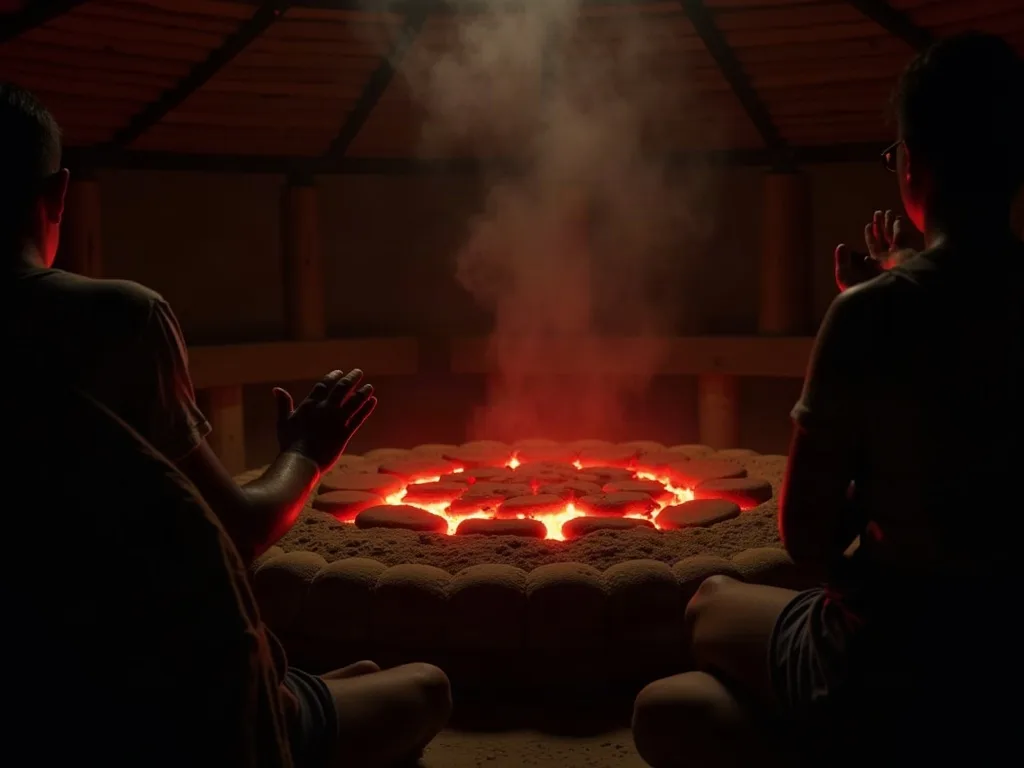
The sweat lodge, or ini tipi, served as a physical space where Wakan Tanka's presence could be intensely felt. The heated stones brought the fire from above; the water poured on them created steam that purified and opened the participant to spiritual reception. Inside the lodge, the air became thick with sacred presence. Participants emerged reborn, their spirits refreshed, their sense of connection to Wakan Tanka renewed.
Wakan Tanka in the Context of Catastrophe
The arrival of European settlers and the subsequent colonization of Native American lands created a theological crisis. How could Wakan Tanka, understood as the power that sustained all existence and upheld the natural order, permit the near-extinction of the buffalo, the forced removal from sacred lands, the suppression of ceremonies, and the killing of thousands? Some Native Americans abandoned their spirituality, concluding it had failed. Others deepened their practice, understanding that spiritual power had been disrupted but not destroyed, and that restoration required even greater discipline and faith.
This period produced some of the most important Native American spiritual teachers of the modern era. Black Elk, an Oglala Lakota who lived through the hardest years of colonization and reservation confinement, articulated a vision of Wakan Tanka that did not deny suffering but integrated it into a larger understanding of spiritual purpose. He taught that each person, each people, and each nation had a role to play in a great sacred drama that transcended what any single individual or culture could see. Wakan Tanka's presence was not diminished by historical tragedy; it remained available to those who sought it with sincerity.
This resilience reveals something essential about the theology of Wakan Tanka. Unlike traditions built on the promise of divine reward and punishment in a future afterlife, or on the guarantee of material prosperity for the faithful, Lakota spirituality is grounded in relationship and presence. Wakan Tanka does not promise comfort. It offers connection, meaning, and the possibility of living well within whatever circumstances arise.
Comparative Echoes: Wakan Tanka and Other Supreme Being Concepts
When scholars of world religion encounter Wakan Tanka, they recognize structural parallels with spiritual systems across the globe. In Hinduism, Brahman represents the ultimate, formless reality that underlies all existence; the gods and goddesses that populate Hindu mythology are understood as expressions or manifestations of Brahman. In Daoism, the Tao is described as the source and process of all reality, something beyond naming or grasping through intellect alone. In African traditions like those of the Yoruba, Olodumare (or Olorun) is the source of all power and being, while the orishas are powerful spirits through whom Olodumare's energy flows into the world.
What distinguishes Wakan Tanka from these traditions is not the structure but the cultural context. The Lakota arrived at their theology not through urban civilization, written philosophy, or the kind of institutional religion that emerged in settled agricultural societies. Instead, it emerged from intimate knowledge of the natural world, from close attention to animal behavior, seasonal cycles, and the psychic phenomena of dreams and visions. This grounding in direct experience rather than in texts or dogmas gives Lakota spirituality a distinctive flavor.
Wakan Tanka in the Contemporary World
In the 20th and 21st centuries, Native American spiritual traditions that center on Wakan Tanka have experienced a remarkable revival. Young people separated from their cultures by boarding schools and assimilation policies have sought to reconnect with their traditions. Elders who maintained the knowledge through decades of suppression have begun teaching openly again. Ceremonies that were forced underground are now performed openly on reservations and in urban Native communities.
This revival has not been nostalgic or static. Contemporary Lakota teachers speak of Wakan Tanka in ways that address modern life. A spiritual leader might explain how the principles of balance and harmony that governed traditional society apply to environmental protection, social justice, and mental health. The Four Virtues are reframed as guides for navigating a complex world. The vision quest, adapted for contemporary circumstances, remains a powerful practice for young people seeking direction and meaning.
The concept of Wakan Tanka has also begun influencing non-Native people drawn to indigenous wisdom. Some of this engagement is respectful and reciprocal. Other encounters have been appropriative, with outsiders adopting indigenous symbols and practices without understanding their deep context or without honoring the nations from which they come. Lakota and other Native teachers have become increasingly clear about the difference between respectful learning and cultural theft.
What remains constant is the power of the teaching itself. Wakan Tanka, understood as the great mystery and unified power that moves through all existence, offers a corrective to Western assumptions about the nature of the sacred. It suggests that the ultimate reality might not be a judge or ruler but a presence. It implies that spirituality might be found not in escape from the material world but in deepened attention to it. It proposes that human beings are not separate from nature but woven into it, responsible for maintaining balance, and capable of direct connection to the sacred through vision, ceremony, and right action.
Frequently asked questions about Wakan Tanka and the Great Spirit
Frequently asked questions
Is Wakan Tanka the same as the Christian God?
No. While missionaries often used the term Wakan Tanka to translate "God" when teaching Christianity to the Lakota, the underlying concepts are quite different. Wakan Tanka does not judge, reward, or punish in an afterlife. It is not personified with human emotions or desires. It expresses itself through natural forces and spirits rather than through a single, unified will and voice. However, some Native Americans have found ways to integrate their understanding of Wakan Tanka with Christian belief, creating syncretic traditions.
Can someone from a non-Native background connect with Wakan Tanka?
Wakan Tanka is understood by the Lakota as a universal principle available to all beings, not exclusively to Native people. However, the traditional practices through which people encounter Wakan Tanka, ceremonies, the pipe, vision quests, sacred sites, are culturally specific and carry protocols and teachings developed over centuries. Many Native teachers welcome sincere students of other backgrounds who approach with respect and humility, but appropriating these practices without proper teaching or attempting to participate in sacred ceremonies without permission is seen as disrespectful and harmful.
How does Wakan Tanka differ from polytheistic gods in systems like Greek or Roman mythology?
Greek gods like Zeus or Athena are distinct individuals with separate personalities, competing interests, and human-like emotions. Wakan Tanka is not personified in this way. The spirits that embody different aspects of creation, thunder beings, water spirits, animal powers, are understood as expressions of Wakan Tanka, not as independent gods. This is closer to how Hindu deities relate to Brahman or how Islamic angels relate to Allah than it is to how Aphrodite relates to Zeus.
What is the primary source for understanding Wakan Tanka in Lakota tradition?
There is no single written text equivalent to the Bible or Quran. Instead, the teachings are preserved through oral tradition, through ceremonial practice, and through the writings of Lakota people like Black Elk and contemporary teachers like Arvol Looking Horse. James R. Walker's early 20th-century anthropological work, "Lakota Belief and Ritual," documents teachings shared by Lakota elders, though scholars note that any translation filtered through a non-Native researcher involves interpretation. The most authentic source remains living elders and the ceremonies that continue to be practiced.
How does the vision quest provide direct connection to Wakan Tanka?
In a vision quest, a person goes to a sacred place, fasts, and prays for a specified period, opening themselves to spiritual encounter. The vision that comes is understood not as a hallucination but as a direct meeting with spiritual reality, with Wakan Tanka speaking through symbols, animals, or direct knowing. The person returns with teachings and often with a clear sense of purpose or direction. This reflects the Lakota understanding that Wakan Tanka is not distant but accessible to anyone who approaches with sincere commitment.
The Living Presence: Wakan Tanka Beyond Translation
Wakan Tanka resists final definition because it names something that transcends the limits of language. Yet that very impossibility is part of the teaching. A reality that could be fully captured in words would be smaller than the words themselves. Wakan Tanka, as the Lakota understand it, is vaster than any description, more intimate than any concept, present in the eagle's flight and the quiet of a sleeping child, in the thunder that makes the earth shake and in the still moment when breath and heartbeat align in prayer.
The Great Spirit concept represented by Wakan Tanka offers something increasingly necessary in a world fractured by competing certainties. It suggests that the ultimate reality might be profound enough to hold multiple traditions, that the sacred might be found in natural beauty and community relationship rather than only in doctrine, and that human beings possess the capacity to sense and respond to forces larger than themselves. This is not primitive superstition awaiting replacement by scientific materialism. It is a sophisticated theology grounded in centuries of careful observation and spiritual discipline.
When a Lakota person says "Mitakuye Oyasin," closing a prayer or ceremony with the phrase that means "all my relations," they are acknowledging connection to all beings, all forces, all existence. They are affirming that everything participates in the same sacred reality. They are recognizing Wakan Tanka flowing through the visible and invisible worlds. In this moment, the Great Spirit is not a distant concept but a living presence, known and honored through the commitment to live well, to maintain balance, and to see the sacred in all things.
Free 25-page sample
Want the whole story?
Take the first 25 pages free. If it pulls you in, the full edition is yours as an instant PDF download, with a paperback on Amazon for selected titles.
Native American
The Native American Mythology Book: Raven, Coyote, Spider Woman, and the Sacred Stories of Turtle Island
From Pacific Raven to Atlantic Glooscap
The unbroken pre-contact mythology of North America: Raven stealing light, Coyote's tricks, Spider Woman weaving creation, Sedna beneath the ice, and the kachina spirits of the mesa.
More from Native American
All articles
Native American
The Vision Quest: Rite of Passage and Spiritual Revelation
The vision quest stands at the heart of many Native American spiritual traditions: a solitary journey into wilderness where seekers fast, pray, and await contact with the sacred. Discover how this ancient ceremony marks the threshold between boyhood and manhood, illness and healing, confusion and purpose.

Native American
The Sun Dance: Plains Ceremony of Renewal and Sacrifice
The Sun Dance stands as the most sacred communal ceremony of the Great Plains nations, a multi-day ritual of piercing, fasting, and prayer where participants offer their bodies to restore balance and healing to their people. We trace its origins, structure, and enduring power across Lakota, Cheyenne, Arapaho, and Shoshone traditions.
Native American
The Medicine Wheel: Sacred Symbol and Ceremonial Structure
The Medicine Wheel represents the interconnected nature of existence across countless Native American traditions. Discover how this ancient symbol functions as both spiritual map and healing practice, grounded in real ceremonies that still guide communities today.

Native American
Sedna: Inuit Goddess of the Sea and Marine Animals
Sedna rules the Arctic depths as the Inuit goddess of the sea and marine animals. Her story begins with betrayal and transformation: a fallen maiden becomes the sovereign of the ocean, controlling the seal, whale, and fish that sustained Arctic peoples for millennia. Discover how her myth shaped survival, hunting ritual, and the spiritual bond between humans and the sea.