
The Emergence Myth: The Journey from the Underworld
From underground darkness into sunlit earth: the Emergence Myth traces humanity's climb through layered worlds in Hopi, Navajo, and Pueblo traditions. Learn what this sacred journey really means.
Contents
The earth opened, and the people came out.
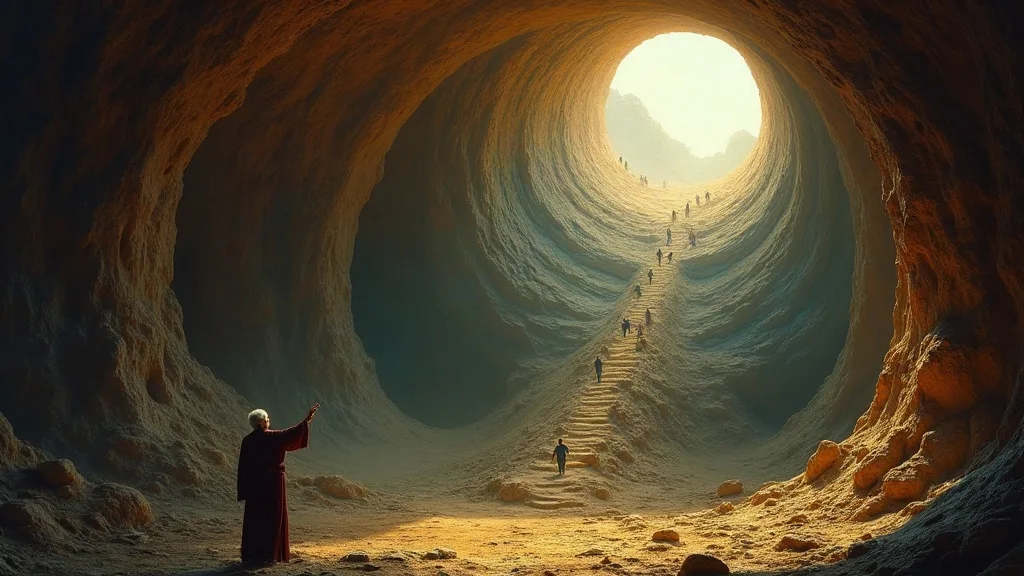
Not from the sky, not from the sea, not from the body of a slain giant. From below. From the deep interior of the world itself, through narrow passages, up through successive underground chambers, until they emerged blinking into the light of the present world. This is the Emergence Myth, one of the most geographically widespread and spiritually precise creation narratives in all of North American tradition. It belongs, above all, to the peoples of the American Southwest and the adjacent Great Plains: the Hopi, the Navajo, the Zuni, the Tewa, the Acoma Pueblo. Each nation carries its own version. Yet every version shares a structure so consistent it reads like a memory.
The story is not a simple "once upon a time." It is a cosmological map. The worlds below the present earth are not metaphors for the human subconscious or poetic invention, though scholars have read them that way. For the cultures that hold them sacred, those underground worlds are real places that real ancestors passed through, places with their own skies, their own plants, their own failures that made the journey necessary.
The Shape of the Story: Layered Worlds and the Road Upward
Most versions of the Emergence Myth begin not at a moment of creation but at a moment of crisis. The world below has been good. People and animals live together. But something goes wrong.
In the Hopi account, recorded by ethnographer Frank Waters in "The Book of the Hopi" (1963) and corroborated by Alexander Stephen's earlier field notes from the 1890s, the first world is called Tokpela, meaning "Endless Space." It is pure and harmonious at first. People know the Creator, whom the Hopi call Taiowa, through a direct inner vibration. But they forget. They begin to quarrel, to live selfishly, to ignore the song that holds things together. The first world ends not in flood or fire alone but in a kind of spiritual cooling. A few people, warned by Sotuknang (Taiowa's nephew, the architect of the worlds), are gathered and led into the second world inside the earth. The second world, Tokpa, is darker, simpler. The same pattern repeats: people are given another chance; they fail again. A third world, Kuskurza, follows. There, civilization rises high, very high; people build cities and fly through the air in craft called patuwvotas, a detail that delighted twentieth-century theorists but that Hopi elders treat as simply factual. Again, corruption. Again, a remnant is saved and led further, deeper, before emerging upward into the fourth world, Tuwaqachi, the present earth.
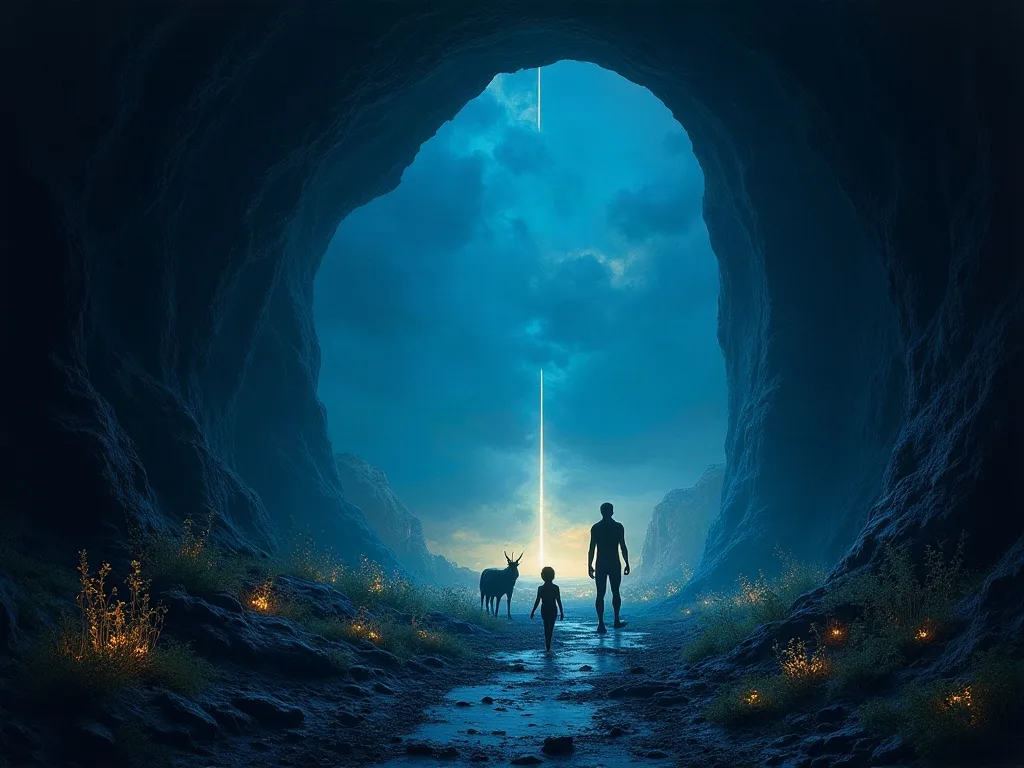
The Navajo account, preserved most fully in Washington Matthews's landmark 1897 study "Navaho Legends," uses the same ladder structure but with distinct imagery. The first world, Nihodilhil (the Black World), holds only insect-like beings and four holy persons, the Holy People who will later shape the human world. A conflict over adultery among the insect people drives them upward. Each subsequent world has its own color: blue, yellow, glittering. Each is left because of some moral rupture, some violation of the relational laws that hold communities together. At each transition, the people find a passage: a hollow reed, a hole in the sky-floor of the world above. They climb or are carried. Water sometimes rises behind them, pushing them on.
The Reed, the Spider, and the Guides
No one makes the climb alone.
This is one of the Emergence Myth's quieter insistences. Guides appear at every transition. In Hopi tradition, Spider Grandmother (Kookyangwso'wuuti) is among the most constant presences. She is ancient, almost impossibly small, and she knows the way. She does not do the work for the people, but she gives them what they need for each passage: the right songs, the right knowledge, the right understanding of what the new world will ask of them. To a Hopi listener, Spider Grandmother is not symbolic; she is a specific, named, historically active being who intervened at the beginning of the present age.
The hollow reed appears in versions from the Hopi, the Zuni, the Acoma Pueblo, and others. It is a physical passage: a plant stalk tall and wide enough to carry people from one world's ceiling to the next world's floor. The reed is always described with botanical precision. This is not a metaphor dressed in plant-clothing. It is the structure through which the transition happens. Among the Tewa Pueblo people, whose accounts were gathered by Alfonso Ortiz in "The Tewa World" (1969), the passage is guarded by figures called the Towa e, a set of spiritual mediators who stand at the boundary between underground and surface. They test the people before they can emerge. Only those who meet the conditions pass.
Animals, too, travel with the people or scout ahead. In many Navajo accounts, the locust (or sometimes the badger) is sent ahead into the world above to prepare it, or to negotiate with whatever beings already live there. The locust in the Navajo story has a special power: it is immune to the arrows of the water beings who initially resist the people's arrival. It holds its ground. The people are allowed through.
Spider Grandmother appears across many Pueblo and Hopi stories, not only in the Emergence Myth but in accounts of world-making and human guidance. Her presence links the Emergence to a much wider web of Southwest cosmological thought.
Why the People Left: Moral Failure and the Logic of Migration
This is the part that separates the Emergence Myth from most other creation traditions.
In the Babylonian Enuma Elish, the world is made from a slain body. In Genesis, a god speaks light into being. In the Norse Eddas, the world is carved from the corpse of Ymir after a cosmic battle. These are creation-from-outside stories. The world is made by an act of power, usually violent, usually imposed from above.
The Emergence Myth works differently. The world below already existed. Humanity already existed. The present earth is not the first world but the latest world, and the reason people live here is that they failed to maintain the ones before it. This is a radical ethical premise. It says the cosmos is not stable by default. It requires ongoing maintenance, right relationship, ceremony, song. The creation is not finished. It is a project in progress, and human behavior is one of its primary variables.
Emergence Myth (Hopi/Navajo)
Humanity begins underground, in a world that pre-exists the current one. The move to the present earth is earned through survival of moral failures. Multiple worlds have been inhabited and abandoned. The earth is the latest stage, not the original gift.
Genesis Creation (Hebrew)
Humanity begins in a garden created specifically for them. The expulsion is a punishment for disobedience. There is one previous world (Eden), not multiple underworlds. The earth-as-exile is the result of a single original fall.
Frank Hamilton Cushing, who lived among the Zuni in the 1880s and became the first outsider to be initiated into a Zuni society, described the Emergence as a story about maturation as much as migration. The people in the lower worlds are not fully formed. They have webbed fingers, tails, soft eyes not yet fit for the sun. The journey upward is also a journey toward becoming human in the full sense. Each world strips away an animal remnant. By the time they emerge, they are recognizably themselves.
Sipapu: The Navel of the World
The place where the people came out has a name.
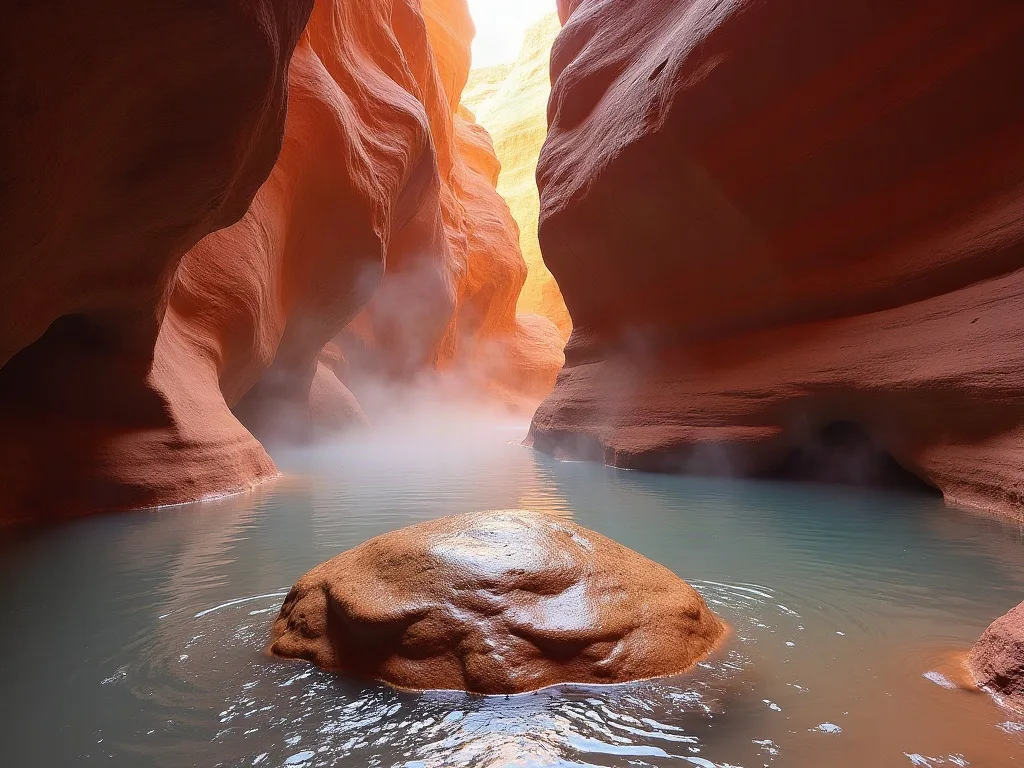
Among the Hopi, it is called Sipapu (also spelled sipaapuni), a Hopi word referring to the hole of emergence, the point where the present world received its first human inhabitants. The physical location most commonly associated with this event is a domed travertine mound deep inside the Little Colorado River Gorge in northern Arizona. The site is sacred and not a tourist destination. Hopi elders have spoken publicly about the need to protect it from dam projects and recreational rafting that would disturb its waters.
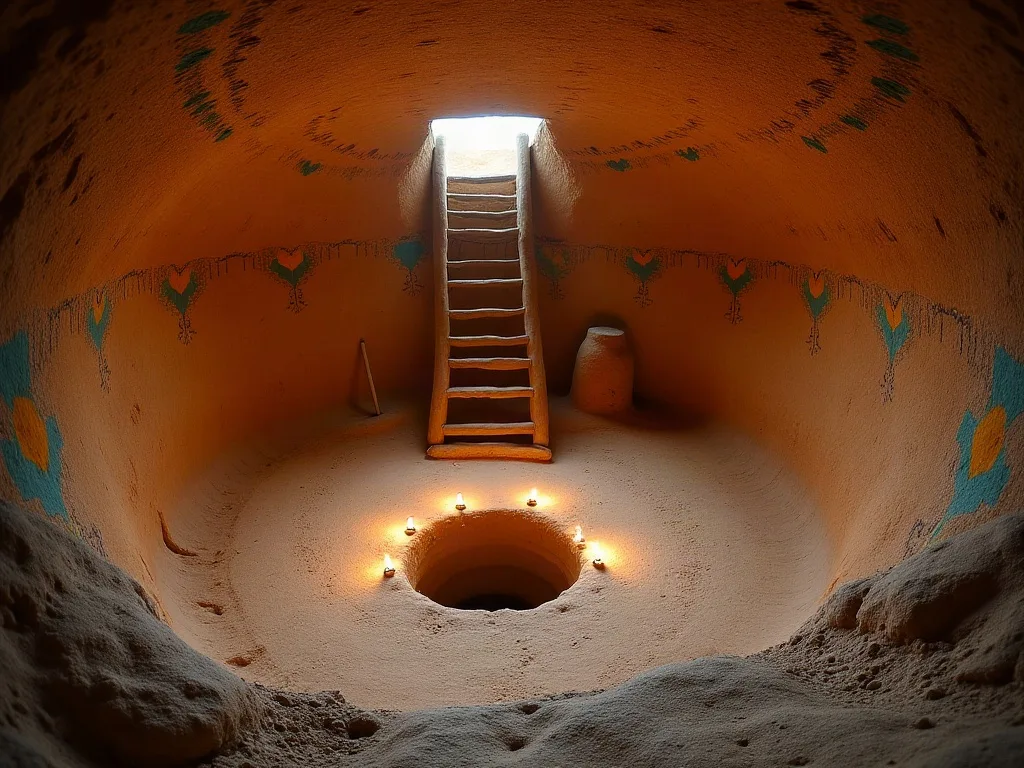
But Sipapu is also a ritual concept. Inside every Hopi kiva (the underground ceremonial chamber, circular and dug into the earth), there is a small hole in the floor. That hole is also called Sipapu. It symbolizes the original emergence point and connects the ceremony being performed above it to the worlds below. When Hopi men descend into the kiva for ritual purposes, they are symbolically re-entering the underworld to renew the relationship between this world and those that came before. The architecture is a theology.
The Navajo equivalent is less a fixed geographical point and more a directional principle. The emergence point in Navajo cosmology opens to the east, the direction of new beginnings, and is associated with the first dawn of the present world. The Navajo creation narrative holds that the Holy People, Diyin Dine'e, arranged the present world carefully after the emergence, placing the sacred mountains at the four cardinal directions to hold the world in place.
The Four Sacred Mountains and the World Above
When the people emerged, they did not find an empty world waiting to be claimed.
In the Navajo tradition, the surface world already had features: rivers, mountains, an existing geography. The Holy People set about arranging it. They placed Sisnaajiní (Blanca Peak, in Colorado) to the east, dressed in white shell and dawn. Tsoodził (Mount Taylor, in New Mexico) to the south, turquoise and blue. Dook'o'oosłííd (the San Francisco Peaks, in Arizona) to the west, wrapped in abalone. Dibé Nitsaa (Hesperus Peak, in Colorado) to the north, dressed in jet black and darkness. These four mountains are not symbolic decorations. They are the posts that hold the sky up and define the Navajo homeland, Dinétah. To be Navajo, in traditional understanding, is to live within them.
This geographical precision is one of the strongest arguments against reading the Emergence Myth as "merely" symbolic. The people did not emerge onto a generic landscape. They emerged onto a specific, named, physically locatable piece of the Colorado Plateau. The myth is anchored in place.
The Acoma Pueblo people tell a version in which two sisters, Iatiku and Nautsiti, lead the people out of the underworld. Matthew W. Stirling's 1942 report "Origin Myth of Acoma and Other Records" preserves this account in close detail. The two sisters are given a basket of seeds and images of the animals and plants they will need. One sister is more careful with the basket; one is more reckless. From their different temperaments, different peoples of the world emerge, a narrative device that accounts for human diversity without hierarchy, neither sister's path being simply "right."
Ceremony as Re-Enactment: Keeping the Story Alive
The Emergence Myth is not stored in libraries. It is performed.
Among the Hopi, the great ceremonial cycle revolves in large part around the events of the emergence and its aftermath. The Kachina season (from winter solstice through midsummer) involves the return of Kachinas, spirit beings who were part of the original migration from the underworld. The dances performed during this season re-enact the relationships formed during the emergence journey. They are petitions for rain, for continued good corn, for the health of children, but they are also the ongoing maintenance of the world that the emergence made possible.
The Hopi Kachina tradition teaches that if the ceremonies are allowed to lapse, the world will end. This is not a metaphor about cultural preservation. It is a literal cosmological claim: the present world is the fourth world, it requires active human participation to continue, and ceremony is that participation.
Among the Navajo, the Blessingway ceremony (Hózhóójí) calls on the events of the emergence and the actions of the Holy People to restore a person to hózhó, a Navajo concept meaning beauty, harmony, balance, and right relationship simultaneously. It is not a word that has a single English equivalent. A person who is sick, troubled, or out of balance undergoes the Blessingway to re-align with the original order established when the Holy People arranged the world after the emergence. The myth, in this context, is medicine.
Cross-Cultural Echoes: Emergence Myths Beyond the Southwest
The structure of emergence from underground is not exclusive to Southwestern peoples, though they have developed it most elaborately.
The Iroquois creation myth describes Sky Woman falling from a world above onto a water-covered earth, which is a reversal of the Southwestern pattern (descent rather than ascent) but shares the idea of multiple layered worlds. The Lakota have accounts of the Buffalo Nation emerging from underground caves, particularly associated with Wind Cave in the Black Hills of South Dakota, a real cave whose unusual air currents were interpreted as the breath of something living within. Wind Cave is still considered sacred by Lakota and related peoples.
Further afield, the Kogi people of the Sierra Nevada de Santa Marta in Colombia tell of their ancestors emerging from a great Mother (Aluna) who existed before the material world; the Kogi describe nine worlds, with the present one sitting in the middle. The Andean Pacha concept, in which worlds are layered vertically (upper world, middle world, inner world), maps onto a similar cosmological grammar even without a specific emergence narrative.
None of this reduces the Southwestern accounts to a "universal archetype." These are distinct traditions with distinct moral frameworks, distinct geographies, distinct ceremonial obligations. The parallel structure is worth noting precisely because it suggests that emergence cosmology is a serious intellectual response to the experience of living on a specific piece of earth, with caves below it, sky above it, and the knowledge that people did not simply appear but came from somewhere.
Scholarly Debates: Memory, Migration, or Revelation?
Anthropologists have argued for over a century about what the Emergence Myth "really" records.
The migration hypothesis holds that the story preserves a memory of real prehistoric population movements, possibly the spread of Ancestral Pueblo peoples across the Colorado Plateau between roughly 700 and 1300 CE, or even earlier movements from Asia across the Bering land bridge. The underground worlds, in this reading, are earlier homelands. The passage through a reed is the narrow channel of a canyon route or a mountain pass. The floodwaters that sometimes rise to drive the people on are actual floods.
Alfonso Ortiz, a Tewa anthropologist who held a PhD from the University of Chicago and was himself an initiated member of his own people's ceremonial life, pushed back firmly against this kind of reduction. In his 1969 work "The Tewa World," Ortiz argued that the Emergence Myth functions as a social charter, establishing the proper relationships between human groups, between humans and animals, between the living and the dead, all within a framework the people themselves understand as literally true history. Translating it into a veiled memory of migration, he said, imports a Western preference for material causation into a tradition that has no need for it.
The spiritual reading, favored by many Native scholars and traditionalists, holds that the underworlds are genuinely other realms, accessible in ceremony and vision, and that the emergence was a real event in sacred time, the kind of time that does not run linearly but can be re-entered through ritual. This reading is not incompatible with the story also preserving ecological memory. Both can be true simultaneously, and insisting that only one can be "the real meaning" is itself a product of a particular cultural assumption about how reality is organized.
What all serious scholars agree on: the Emergence Myth is not a primitive or naïve story. It is a sophisticated cosmological and ethical system, worked out across centuries of oral transmission and ceremonial practice, precise in its geography, consistent in its moral logic, and still actively maintained by the peoples who hold it.
Frequently Asked Questions about the Emergence Myth
Frequently asked questions
Which Native American peoples tell the Emergence Myth?
The Emergence Myth is most fully developed among the peoples of the American Southwest and adjacent regions: the Hopi, Navajo (Diné), Zuni, Acoma Pueblo, Tewa Pueblo, Laguna Pueblo, and several other Pueblo communities. Related emergence themes appear in Lakota tradition (associated with Wind Cave in the Black Hills) and in various Plains and Great Basin cultures. Each community holds its own version, with distinct characters, world-names, and moral emphases.
How many worlds do the Hopi and Navajo describe in their emergence accounts?
The Hopi tradition recorded by Frank Waters and corroborated by earlier ethnographic sources counts four worlds below the present earth, making the current world the fifth. The Navajo account in Washington Matthews's 1897 "Navaho Legends" describes four underworlds (sometimes expanded to five in other tellings), each with its own color: black, blue, yellow, and glittering or white. The present world is the one above all of these.
What is Sipapu and where is it located?
Sipapu is the Hopi term for the point of emergence, the hole through which the people entered the present world. The most commonly cited physical location is a travertine mound inside the Little Colorado River Gorge in northern Arizona, a site Hopi leaders consider sacred and actively protect. The term also refers to the small ritual hole in the floor of every Hopi kiva (underground ceremonial chamber), which symbolically reconnects the ceremony above to the underworlds below.
Why did the people leave the underworlds according to these myths?
In virtually every version, the primary cause is moral failure within the community: quarreling, sexual misconduct, neglect of ceremony, or a general loss of the right relationship between people and the forces that sustain them. This distinguishes the Emergence Myth sharply from flood myths or creation myths where destruction is imposed from outside. Here, the people themselves create the conditions that make the world uninhabitable, then are given another chance in the world above.
Are these myths still active in living communities?
Yes. Hopi, Navajo, Zuni, and Pueblo communities continue to maintain the ceremonial cycles that re-enact and re-activate the emergence story. Hopi Kachina ceremonies, Navajo Blessingway (Hózhóójí) rites, and Pueblo winter and summer solstice observances are all tied to the cosmological framework the Emergence Myth establishes. For these communities, the myth is not historical documentation but an ongoing relationship with the worlds and beings encountered during the original journey.
Has archaeology found any connection to the Emergence Myth?
Archaeologists note that the kiva, the underground ceremonial chamber used across Ancestral Pueblo and present-day Pueblo cultures, appears to formalize the cosmological geography of the Emergence Myth in architecture. Kivas are dug into the earth, entered from above through a hole in the roof (mirroring the emergence from below), and contain the sipapu hole in the floor. Some scholars suggest the spread of the kiva form across the Colorado Plateau between 700 and 1300 CE may track the spread of emergence-based ceremonialism, though the connection between architecture and myth is not simple or linear.
The Emergence Myth in a Changing World: Continuity, Threat, and Resilience
The Little Colorado River Gorge has been proposed as a site for a gondola tourist attraction. Wind Cave, sacred to the Lakota, sits inside a national park that regulates access on its own terms. The San Francisco Peaks, sacred in Navajo and Hopi cosmology as one of the four directional mountains, have been the subject of legal battles over a ski resort's use of reclaimed wastewater for artificial snow, a substance Navajo and Hopi plaintiffs argued would desecrate a holy place. The U.S. Ninth Circuit Court of Appeals ruled against them in 2008.
These are not abstract cultural debates. They are direct conflicts between the cosmological world the Emergence Myth describes and the legal, economic, and spatial assumptions of the modern American state. For a Hopi or Navajo practitioner, the four sacred mountains are not scenic landmarks; they are structural elements of the present world, equivalent in function to load-bearing walls. Damaging them is not desecration in the sense of offending a sentiment. It is, within the logic of the tradition, structurally destabilizing.
The Emergence Myth survives because the communities that hold it have survived, through centuries of colonial pressure, forced schooling, land loss, and legal marginalization. The oral transmission did not break. The ceremonies continued, many of them in secret when authorities banned them in the late nineteenth and early twentieth centuries. The emergence is, in this sense, not only a story about the distant past. It is a pattern that the people who carry it have re-enacted in their own historical lives, finding the passage upward, maintaining the song in the dark.
What the Emergence Myth asks of its listeners, native and non-native alike, is the same thing Spider Grandmother asked of the people at each transition: that they pay attention, carry only what they genuinely need, and understand that the world above is not a reward but a responsibility. The journey does not end at the surface. It begins there.
Free 25-page sample
Want the whole story?
Take the first 25 pages free. If it pulls you in, the full edition is yours as an instant PDF download, with a paperback on Amazon for selected titles.
Native American
The Native American Mythology Book: Raven, Coyote, Spider Woman, and the Sacred Stories of Turtle Island
From Pacific Raven to Atlantic Glooscap
The unbroken pre-contact mythology of North America: Raven stealing light, Coyote's tricks, Spider Woman weaving creation, Sedna beneath the ice, and the kachina spirits of the mesa.
More from Native American
All articles
Native American
The Vision Quest: Rite of Passage and Spiritual Revelation
The vision quest stands at the heart of many Native American spiritual traditions: a solitary journey into wilderness where seekers fast, pray, and await contact with the sacred. Discover how this ancient ceremony marks the threshold between boyhood and manhood, illness and healing, confusion and purpose.

Native American
The Sun Dance: Plains Ceremony of Renewal and Sacrifice
The Sun Dance stands as the most sacred communal ceremony of the Great Plains nations, a multi-day ritual of piercing, fasting, and prayer where participants offer their bodies to restore balance and healing to their people. We trace its origins, structure, and enduring power across Lakota, Cheyenne, Arapaho, and Shoshone traditions.
Native American
The Medicine Wheel: Sacred Symbol and Ceremonial Structure
The Medicine Wheel represents the interconnected nature of existence across countless Native American traditions. Discover how this ancient symbol functions as both spiritual map and healing practice, grounded in real ceremonies that still guide communities today.

Native American
Sedna: Inuit Goddess of the Sea and Marine Animals
Sedna rules the Arctic depths as the Inuit goddess of the sea and marine animals. Her story begins with betrayal and transformation: a fallen maiden becomes the sovereign of the ocean, controlling the seal, whale, and fish that sustained Arctic peoples for millennia. Discover how her myth shaped survival, hunting ritual, and the spiritual bond between humans and the sea.