
The Six Realms of Samsara: Buddhist Cosmology and Rebirth
Buddhist cosmology maps existence across six realms of rebirth, from heavens where joy becomes suffering to hells where torment teaches detachment. Discover how this ancient map of consciousness shapes Buddhist ethics and practice.
Contents
A being dies in agony and is reborn as a tortured ghost, unable to eat or drink. Another, having lived with generosity and discipline, awakens in a celestial palace where time itself moves differently. A third finds itself in a battlefield, locked in endless conflict, consumed by pride and jealousy. A fourth simply tends crops in a quiet village, unaware that all of this is happening simultaneously, in different realms, to beings just like them.
This is samsara, the Buddhist cycle of existence. Not a theory, but a lived map that Buddhists say plays out across six distinct realms of rebirth. These are not merely poetic metaphors or punishment systems invented to frighten followers. Rather, they form a complete cosmology that explains how consciousness works, why suffering arises, and what kinds of existence the mind can generate through its own confusion and craving. Understanding the Six Realms means grasping one of Buddhism's most practical teachings: that the worlds we inhabit are not fixed, but shaped by our own habits of thinking.
How Buddhist Texts Describe the Six Realms
The Buddha himself spoke of these six realms in sutras preserved across Theravada, Mahayana, and Vajrayana traditions. The Samyutta Nikaya, a canonical text of early Buddhist teachings, lists the six paths of rebirth that beings can take based on their karma, the accumulated weight of their actions. Other texts, like the Abhidharma philosophical systems, elaborate in precise detail: exactly what kind of suffering defines each realm, how long beings spend there, what sensory experiences they undergo, and crucially, what actions lead to rebirth in each one.
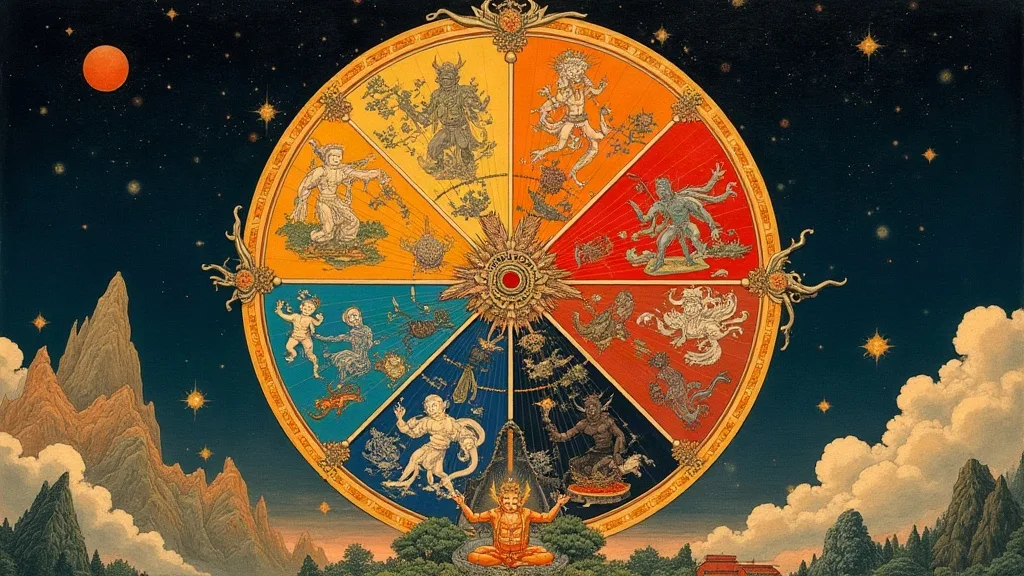
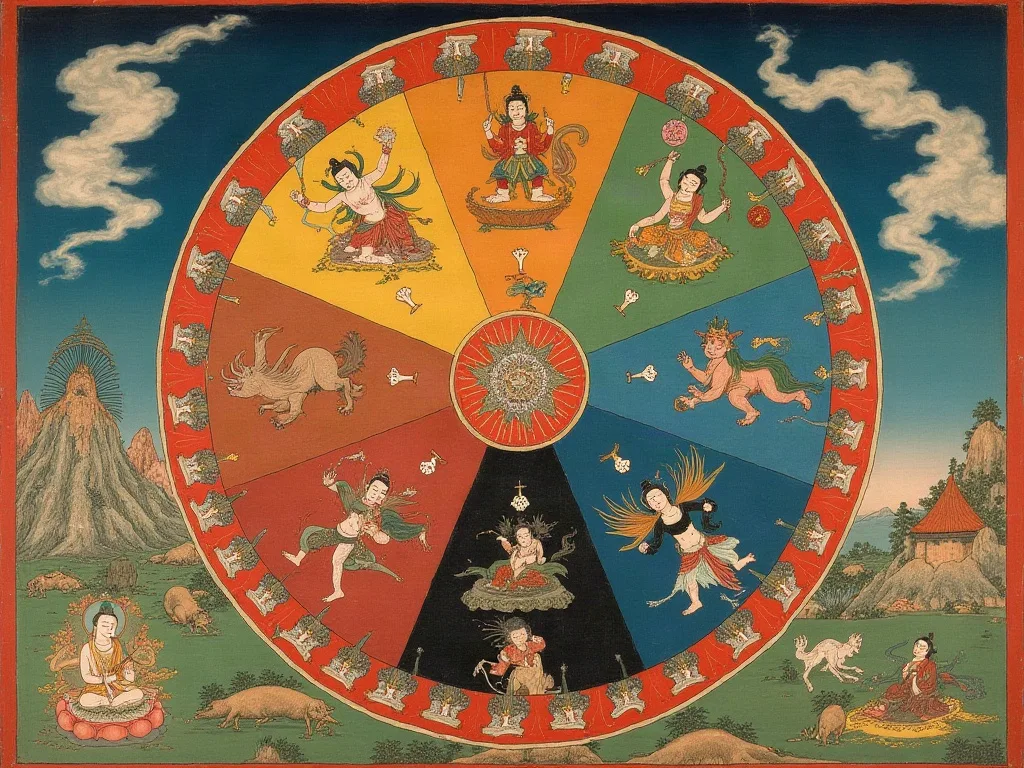
The Tibetan Buddhist tradition visualises these realms in a single image called the Bhavachakra, or wheel of life. A fearsome cosmic protector holds the wheel at its rim. Inside, six segments spread like petals, each populated with beings in different states. Pilgrims study this wheel as a map of their own mind, seeing past incarnations and future possibilities. It is neither cosmography nor punishment; it is psychology rendered visible.
The Buddha did not invent these realms to control his followers. Rather, his teachings grew from within an already ancient Indian worldview that assumed rebirth and multiple planes of existence. What the Buddha innovated was the explanation: rebirth is not willed by a creator god, but emerges automatically from karma, from the quality of one's intentions. This shift is revolutionary. You are not sent to any realm by judgment. You gravitate there by the weight of what you have cultivated in your own mind.
The Realm of the Gods: Heaven and its Hidden Suffering
At the top of the wheel sits the realm of the gods, depicted in gold, inhabited by celestial beings who live in palaces of light and enjoy pleasures that seem endless. A being born here has exhausted the merit accumulated by great generosity, compassion, or discipline in a previous life. They spend eons (sometimes measured in human centuries) indulging in every sensory satisfaction: celestial music, amrit (nectar), gardens that bloom perpetually, lovers who never age or fail them.
Yet this realm holds a sharp secret: it too is part of samsara. The gods are not eternal. They are not exempt from suffering. The Buddha teaches that after a certain span, even celestial pleasure begins to cloy. A god's life energy flickers toward its end, and the dread sets in. Some texts say celestial beings receive omens: flowers that wilt, heavenly beings who no longer want to be near them. The god's former allies drift away. The music becomes tiresome. And when death comes, the accumulated karma that brought them here is exhausted. They tumble back into lower realms, sometimes into hunger or torment, all the more shocked because they had believed their happiness was permanent.
This is why in Buddhism, the realm of the gods is not presented as the ultimate escape. Enlightenment is not "get to heaven and stay." The Dalai Lama has emphasized that a being reborn as a god might spend millions of years in bliss, only to be reborn as a tortured animal the moment that karma depletes. The gods themselves, according to Buddhist texts, sometimes come down from heaven to ask the Buddha for teachings, desperate to learn how to escape the cycle altogether.
The Realm of the Asuras: Pride and Envy Perpetual
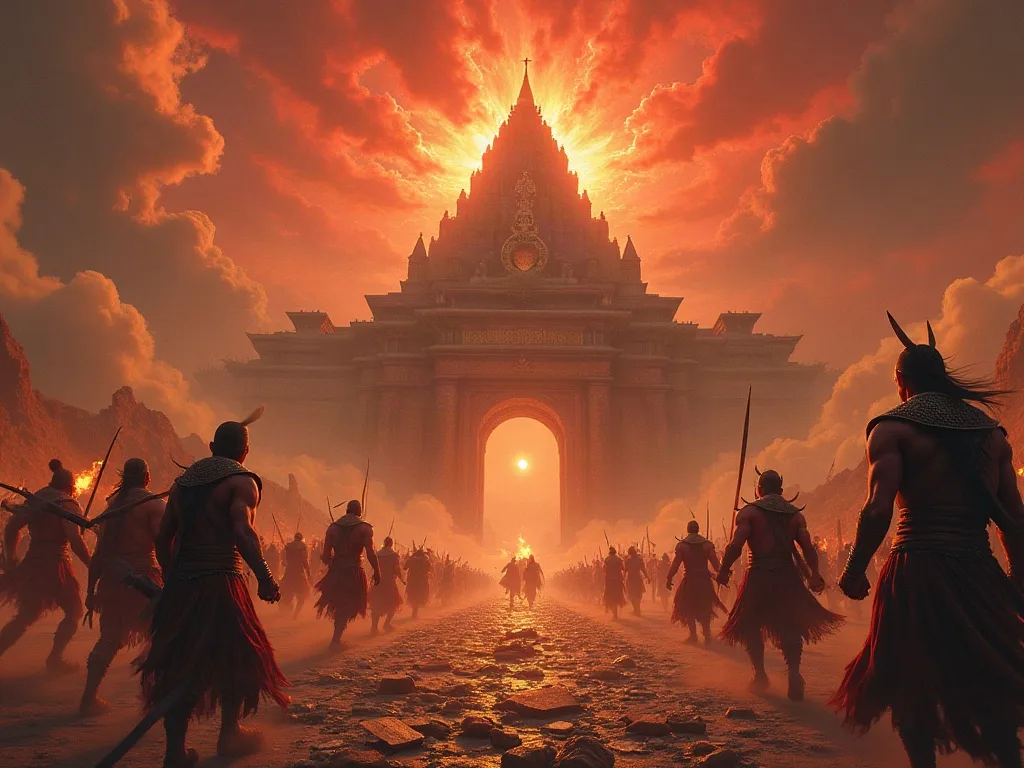
Below the gods, but not exactly hell, exists the realm of the asuras, often depicted in shades of red and orange. The asuras are powerful beings, sometimes called titans or jealous gods. They possess wealth, intelligence, and strength that rivals the gods themselves. Yet they are consumed by envy and pride.
In Buddhist cosmology, asuras are locked in perpetual conflict. They covet the gods' realm. They wage endless wars against each other and against the celestial deities. Their realm is full of luxury, but that luxury is always threatened, always fought over. An asura might possess a magnificent palace one moment and see it destroyed in battle the next. They have weapons, allies, treasures, but no peace. They experience a particular torment: the frustration of desire that cannot be satisfied, ambition that can never rest.
The asura realm is sometimes placed on the same level as the human realm in alternate versions of the wheel, suggesting that the asura condition is close to human life. A being reborn as an asura often did good deeds in a past life, which brought them rebirth in a realm of power and ability, but was also driven by jealousy, anger, and the craving to dominate. Thus the asura realm teaches a hard lesson: power without wisdom is its own prison.
The Human Realm: The Precious Opportunity
In the middle of the wheel sits the human realm, the realm we inhabit now. To Buddhist eyes, this is paradoxically the most valuable place to be born. Humans occupy a unique position: we experience enough suffering that we are motivated to seek liberation, yet we retain enough free will and capacity for reflection that liberation is within reach.
This is a crucial point. The Buddha himself was born human. So was every historical figure who achieved enlightenment in Buddhist texts. The gods, trapped in pleasure, rarely feel the urgency to study the dharma (Buddhist teachings). Animals are too caught in instinct and fear to develop spiritual practice. Hungry ghosts are too desperate, hell-beings too tormented. But a human can sit quietly, contemplate, choose discipline over indulgence, and work toward freedom over many lifetimes. Buddhists call human birth a precious human rebirth, and the texts encourage practitioners to regard their current existence as a rare gift.
The human realm is depicted with villages, fields, mountains, and cities where beings pursue ordinary lives. Some humans cultivate kindness and wisdom and eventually ascend to the god realm or toward enlightenment. Others accumulate hatred and delusion and descend toward lower realms. The human realm is the realm of maximum choice, maximum moral weight. What you do here ripples through your future incarnations.
The Animal Realm: Instinct and Powerlessness
The realm of animals sits lower on the wheel. Animals are reborn here when their karma reflects delusion, stupidity, or harmfulness in past lives. In Buddhist cosmology, this does not mean the everyday creatures we see: birds, deer, insects. Rather, it refers to beings caught in deeply limited consciousness, driven purely by appetite, fear, and base instinct.
An animal in this Buddhist sense experiences a specific form of suffering: the inability to understand or escape one's condition. An animal works for food without understanding why. It reproduces without wisdom about the consequences. It flees predators without learning. It may live its entire span without ever grasping that its suffering could end, that another mode of existence exists. The suffering is not primarily physical; it is spiritual stupor.
Crucially, animals are depicted as numerous in Buddhist cosmology. The Buddha taught that delusion is the most common affliction. Far more beings are born as animals than as humans or gods, because ignorance is far more common than wisdom.
The Realm of Hungry Ghosts: Desire Without Satisfaction
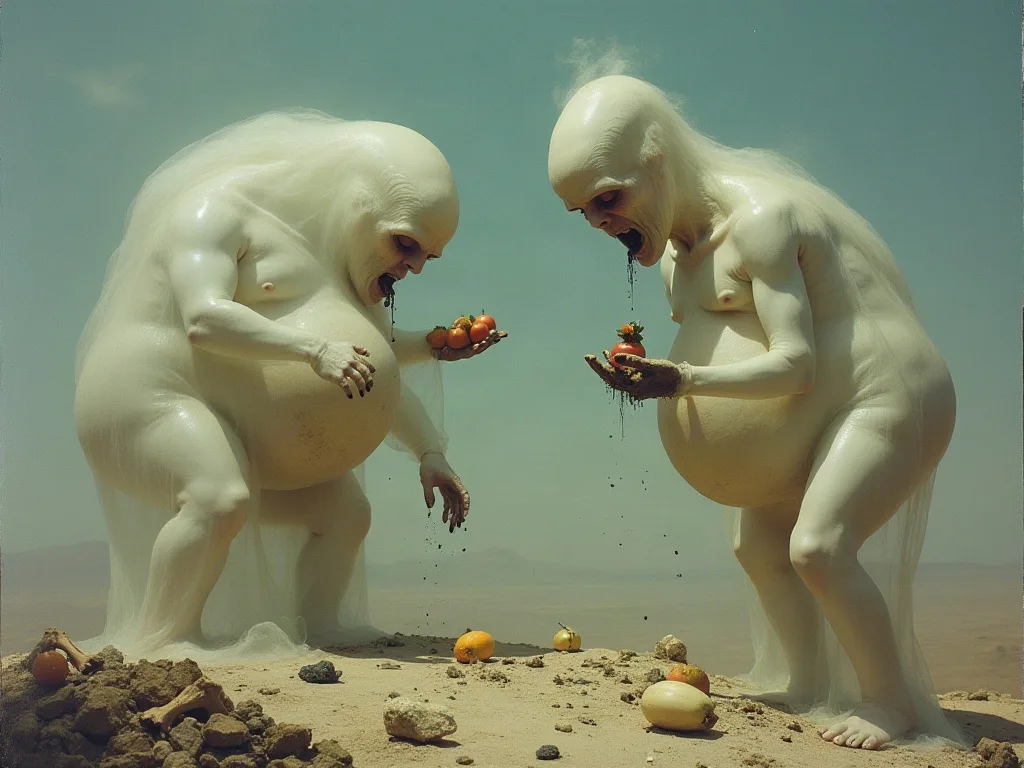
Below the animals, the wheel shows the realm of hungry ghosts, called preta in Sanskrit. This realm arises from karma of miserliness, greed, or intense craving. Hungry ghosts are depicted with hollow bellies and impossibly thin necks, unable to take nourishment. In some depictions, they carry burning coals or rot; food they approach turns to ash or molten metal.
The hungry ghost realm is not literal starvation. It is the suffering of eternal unmet desire. A hungry ghost might be drawn to a river, hoping to drink, only to find the water dries up upon arrival. Or their own desperation warps what they perceive: they see a feast and rush toward it, but the food transforms into gravel before they can swallow. The specific torture reflects the specific craving: one might hunger for wealth, another for approval, a third for sensory pleasure.
Hungry ghosts can sometimes perceive the living world but cannot interact with it. They haunt the living not out of malice, but out of their own desperate hunger for connection or sustenance. This realm teaches that those who are miserly, envious, or trapped in endless wanting may find themselves reborn into a state where getting is impossible. The suffering is entirely self-generated: they cannot let go of desire, and so desire consumes them.
The Hell Realms: Suffering as Teacher
At the bottom of the wheel, the darkness deepens into hell realms, sometimes depicted as cold, sometimes hot, sometimes a mixture. Unlike the Christian or Islamic hells that may be eternal, the Buddhist hell realms are temporary. A being's karma eventually exhausts itself, and even the most tormented soul will eventually be reborn into a higher realm. But the duration in hell can be extraordinarily long. Buddhist texts speak of beings spending eons in torment.
The hot hells are filled with fire, boiling liquid, and beings who torment one another endlessly. The cold hells feature ice, wind, and unendurable numbness. Yet the Buddha's emphasis is precise: these torments are not inflicted by judges or demons wielding external punishment. The torment is what the being's own mind and karma create. A being reborn in a hell realm carries the weight of serious harm done: murders, torture, betrayal of trusted teachers, or intense craving and hatred accumulated over lifetimes.
What is crucial to understand is the Buddhist philosophical point: suffering in any realm, including hell, is pedagogical. The Buddha taught that even in hell, a being can hear dharma teachings and plant seeds of virtue that may eventually lead to liberation. Some Buddhist stories tell of bodhisattvas (enlightened beings) visiting hell realms to teach. The torment itself, if witnessed clearly, becomes a teacher of impermanence and the futility of harm.
The hell realms represent not eternal damnation, but a phase of karmic consequences. The being descends, experiences the bitter fruit of their actions, and in time (which may be millions of years), the karma is exhausted. A being can then be reborn higher, carrying the hard-won wisdom learned in suffering.
How Karma Determines Rebirth in the Six Realms
The mechanism that assigns a being to one realm or another is karma, a Sanskrit word meaning action or deed. In Buddhist thought, karma is not fate or determinism. It is a precise law: the quality of one's intentions shapes the texture of one's consciousness, which in turn shapes the realm one is drawn toward after death.
The Buddha taught that intention is the root of karma. A person who acts from generosity, compassion, and wisdom accumulates karma that ripens into rebirth in higher realms or toward enlightenment. A person driven by greed, hatred, or ignorance accumulates karma that ripens into lower realms. Importantly, the karmic ripening happens not because someone is punishing you, but because intention shapes consciousness. If you cultivate rage, your mind becomes hot, agitated, prone to seeing threats everywhere. That very quality of mind, when it reaches the moment of death, naturally orients toward a realm where such a mind belongs.
The Tibetan Buddhist texts describe this process in detail. At the moment of death, consciousness experiences a dissolution of the elements: earth dissolves into water, water into fire, fire into air, air into space. A being loses all sensory perception. In that gap, the dying person's consciousness is magnetized toward the realm that matches their deepest habits and aspirations. If a being has cultivated purity and compassion, the consciousness naturally gravitates toward higher realms. If a being has strengthened greed and anger, consciousness is drawn toward the asura realm or lower.
This is not a punishment administered from outside. It is a consequence as natural as a seed becoming a tree.
The Wheel of Life Thangka: Reading Buddhist Cosmology
The Tibetan Buddhist visualization of the Six Realms is the Bhavachakra, or wheel of life, a sacred image called a thangka. This wheel has been painted for over a thousand years and remains the most direct visual map of Buddhist cosmology.
The wheel itself is divided into six colored segments, each representing one realm. At the very center is a small circle containing three animals: a pig (representing ignorance), a rooster (representing greed), and a snake (representing hatred). These three animals chasing each other's tails symbolize the three poisons that fuel all samsara. Around them, the wheel divides into sections of light (representing karma that leads upward) and darkness (representing karma that leads downward).
The rim of the wheel contains twelve segments depicting the law of dependent origination, the Buddha's teaching that everything arises interdependently. The fearsome figure holding the wheel, often Yama the lord of death, reminds viewers that no one can hide from the consequences of their karma. Yet his presence is not meant to terrify; it is meant to awaken urgency. If death is inevitable, and rebirth follows karma, then right now, in this precious human life, is the moment to practice.
Meditating on the wheel is not an intellectual exercise. A Buddhist practitioner is meant to look at the wheel and recognize themselves in it. "I see the realm of the gods and remember my own moments of pride and pleasure that crumbled. I see the asura realm and recognize my jealousy. I see the hell realms and am grateful I am not there now, and determined not to create the karma that would send me there."
Rebirth Across Lifetimes: The Continuity of Consciousness
A fundamental Buddhist premise underlies the Six Realms: consciousness does not vanish at death. It continues. The Dalai Lama and other teachers describe this as a stream of consciousness, like water flowing. When a body dies, that stream does not stop; it flows toward a new body, a new life, shaped by the karma accumulated in the life just ended.
This is not the soul as described in Western traditions. Buddhism explicitly rejects the idea of an unchanging, permanent soul. Rather, consciousness is a process, a flow of moments of awareness, each conditioned by causes and conditions, including the karma of past actions.
The texts describe how, after death, consciousness enters a state called the bardo (in Tibetan), an intermediate state. During the bardo, a being may see visions, feel attraction or revulsion, and gradually gravitate toward rebirth. Some traditions say the bardo lasts up to 49 days. Others say time is different there, unmeasured by clocks. But the point is consistent: the mind, still carrying its accumulated habits and karma, moves toward a womb or a rebirth situation that matches it.
This understanding transforms how Buddhists view ethics. You are not being good to please a god or avoid punishment. You are being good because you understand that cruelty, theft, or lies are hammering away at your own consciousness, shaping a future existence you will have to endure. Conversely, discipline, generosity, and wisdom are not duties imposed from outside; they are investments in the texture of your mind and the realm you will inhabit next.
The Asuras and Gods: A Closer Look at the Upper Realms
While the human realm is called the most precious, the upper realms deserve deeper examination. The realm of the gods (deva in Sanskrit) is not monolithic. Tibetan Buddhist cosmology describes multiple heavens, with different types of celestial beings, each with different spans of life and different experiences.
The lowest heavens are inhabited by the Four Great Kings, powerful beings who protect the world. Above them dwell the Thirty-Three Gods, ruled by Indra (sometimes called Shakra in Buddhist texts), a figure inherited from Hindu mythology but recontextualized. The highest gods dwell in states of pure absorption, experiencing joy so subtle and refined that it approaches what outsiders might mistake for what enlightenment sounds like. Yet even these gods eventually die.
The asura realm exists in a strange middle position. Some texts place asuras outside the six realms, or suggest they occupy a seventh category. They are not gods, yet they possess great power. Asuras are often described as former gods who fell due to pride, or beings born with great wealth and strength but tormented by jealousy. In some Mahayana texts, asuras are depicted as waging war against the gods, a cosmic battle that mirrors internal conflicts between pride and other afflictions.
The asura realm is thus a cautionary realm. It shows that power without wisdom, and desire without contentment, cannot produce happiness. An asura might rule a kingdom, possess armies, and control treasure, yet live in constant fear of loss and insatiable wanting.
Parallels and Variations Across Buddhist Traditions
The Six Realms framework is shared across Theravada Buddhism (the oldest school), Mahayana Buddhism (which emphasizes enlightenment for all), and Vajrayana Buddhism (the Tibetan form). However, details vary.
Theravada texts, preserved in Pali, speak of the six realms but emphasize them as natural consequences of karma rather than cosmic geography. The Pali sutras focus on the fact of rebirth and its causal mechanism; they are less concerned with elaborate descriptions of heavenly palaces or demon torturers.
Mahayana traditions, especially in Tibet, elaborate the realms into rich visual and narrative detail. The Tibetan Buddhist texts give names to specific hells, describe the weapons and tortures specific to each, and explain the lengths of time beings spend in each place. This is not morbid sensationalism; it is pedagogical precision. A meditator is meant to contemplate these details not to become fearful, but to be moved to serious practice.
The Mahayana tradition also adds an important reframe: the Six Realms are not completely separate. The bodhisattva, an enlightened being on the path to Buddhahood, can be reborn deliberately in any realm to help beings there. Avalokiteshvara (the bodhisattva of compassion) can appear as a human, an animal, a god, or a hungry ghost, whatever form best reaches those who are suffering. This suggests that the realms are not prisons from which beings must escape alone, but places where enlightenment actively works to reduce suffering.
The Six Realms in Art and Ritual
The Bhavachakra thangka, described earlier, is not merely a diagram. In Tibetan monasteries, large versions are painted on walls or created as tangible murals. Pilgrims circumambulate the wheel. Some versions include short prayers or teachings inscribed in Tibetan script around the rim. During Buddhist festivals, monks construct temporary mandalas of the Six Realms in colored sand, meditate on them, and then sweep them away, symbolizing the impermanence of all realms.
Sculptures of the wheel also exist, sometimes three-dimensional, sometimes in relief. Amulets show a simplified version. In some temples, the wheel is painted inside the entrance, reminding all who enter of the framework of rebirth they are embedded in.
The artistic tradition serves a practical purpose. By visualizing the wheel, a Buddhist practitioner trains the mind to grasp the structure of samsara directly. The wheel becomes not a doctrine to believe, but a reality to see and remember. When a practitioner faces a moment of temptation or pride, the wheel can flash into memory. "If I give in to this greed, which realm am I sowing seeds for? The hungry ghost realm, or the asura realm? Is that what I choose?"
The Modern Interpretation and Psychological Reading
Contemporary Buddhist teachers and scholars sometimes interpret the Six Realms not literally as actual cosmic realms, but as psychological states that humans move through in a single lifetime. The hell realm, in this reading, is the state of mind you enter when you are depressed, ashamed, or suicidal. The hungry ghost realm is the anxiety and addiction of always wanting more. The asura realm is the competitive rage and jealousy we feel at work or in relationships. The human realm is the ordinary waking state of choice and responsibility. The animal realm is the numbness of habit and instinct. The god realm is the brief high of pleasure that crashes into disappointment.
This psychological reading is not a "modern revision" imposed on Buddhism. The Buddha himself emphasized that the mind creates the world. Many early texts suggest that the realms are projections of consciousness. A Theravada text states that a being experiences their particular realm because that is what their karma has trained their mind to perceive. Two beings in the same physical location can inhabit completely different realms because their perception is shaped by past actions.
However, the historical Buddhist texts, particularly Tibetan sources, maintain that the realms are also actual, literal planes of rebirth occupied by actual beings. The psychological reading and the metaphysical reading are compatible, not opposed. The realm someone is reborn into is both a literal place and a state of consciousness. What matters is the practical implication: understanding the Six Realms teaches you how to shape your mind now so that you don't end up in a rebirth you regret.
The Path Out of the Six Realms: Enlightenment
The ultimate Buddhist answer to the Six Realms is enlightenment, the transcendence of samsara entirely. The Buddha did not teach the Six Realms simply to map existence. He taught them to inspire practice. If you understand that your next rebirth depends on your karma now, you are motivated to cultivate wisdom and compassion rather than greed and hatred.
Enlightenment, called Bodhi in Sanskrit or Nirvana, is the cessation of the cycle. A being who reaches enlightenment is no longer bound by karma. They are no longer unconsciously pulled toward any realm. Some traditions say an enlightened being, if they choose, can be reborn deliberately to help others. Others say enlightenment means final release, the end of rebirth entirely.
The path to enlightenment, according to the Buddha, is the Noble Eightfold Path: right view, right intention, right speech, right action, right livelihood, right effort, right mindfulness, and right concentration. This is not a set of arbitrary rules imposed by a god. It is a systematic training of the mind to uproot ignorance, greed, and hatred, the very poisons that keep the wheel of samsara spinning.
Frequently asked questions about the Six Realms of Samsara
Frequently asked questions
Are the Six Realms actual physical places, or are they metaphorical?
Buddhist texts treat them both ways. Early Theravada texts emphasize them as natural consequences of karma, with less focus on literal geography. Tibetan Buddhist traditions elaborate them as actual realms, invisible to ordinary human perception, where beings are reborn according to their karma. Most Buddhists hold both truths: they are literal (beings actually experience rebirth in these realms) and psychological (the realms are also states of consciousness shaped by past actions and mental habits). Modern teachers sometimes emphasize the psychological reading without denying the literal one.
Why is the human realm considered the most precious if the god realm has more pleasure?
Buddhist texts teach that the god realm, for all its pleasure, is a trap. A god becomes so absorbed in enjoyment that they do not feel the urgency to practice and seek liberation. When a god's karma is exhausted, they often fall into lower realms, shocked and unprepared. Humans, by contrast, experience enough suffering to be motivated toward enlightenment, yet enough agency to actually practice. The Buddha himself was reborn human, and all his enlightened disciples were human, because the human realm is the optimal place for awakening.
How long do beings spend in each realm?
Buddhist texts describe vastly different timespans. A being might spend millions of human years as a god before falling. An animal rebirth might last decades. A being in a hell realm might experience eons of torment, sometimes described as 1,000 human years or 10,000 human years, depending on the tradition and the severity of their karma. The timespans are so vast that modern interpreters note that literal calculations become almost meaningless; the point is that rebirth in lower realms involves long periods of suffering, making the motivation to practice urgent.
Is rebirth in the Six Realms inevitable, or can it be escaped?
According to Buddhist teaching, rebirth in samsara (the cycle of the Six Realms) is inevitable unless a being reaches enlightenment. Enlightenment is the transcendence of the cycle. A being on the path to enlightenment gradually weakens the karma that would bind them to rebirth by cultivating wisdom, ethical conduct, and mental discipline. When full enlightenment is reached, the being is no longer subject to automatic rebirth; they are free. Some traditions add that an enlightened being, having chosen to stop rebirth, may still choose to be reborn to help others.
Are there any Buddhist figures who have transcended the Six Realms?
Yes, the Buddha himself, Siddhartha Gautama, is said to have reached enlightenment and thus escaped the Six Realms. Historical Buddhist texts also name many disciples and enlightened masters who achieved freedom from rebirth. In Mahayana Buddhism, the Buddhas and bodhisattvas are beings who have transcended samsara but choose to be reborn or manifest in various forms to help others. The Dalai Lamas of Tibet are believed to be bodhisattvas who voluntarily take rebirth to continue their work.
How does karma determine which realm a being is reborn into?
The Buddha taught that intention is the root of karma. Your habitual thoughts, words, and deeds shape your consciousness. At the moment of death, your consciousness, magnetized by accumulated karma, gravitates toward the realm that matches your deepest patterns. If you cultivated greed and craving, consciousness is drawn toward the hungry ghost realm. If you cultivated rage and competition, toward the asura realm. If wisdom and compassion, toward the god realm or toward enlightenment. The process is automatic and natural, not administered by a judge; your own mind creates the rebirth by the quality it has been shaped into.
The Wheel as a Call to Action Now
The Six Realms of Samsara are not mere mythology or cosmological theory. For Buddhists across centuries, the Bhavachakra wheel has been a practical tool for waking up. Every glance at the wheel is a reminder: you are here now, in the human realm, with free will and choice. Your karma is not fixed. Every intention you hold, every word you speak, every action you take is shaping the consciousness you will carry into your next rebirth.
The wheel does not inspire despair. It inspires urgency and gratitude. Urgency because the cycle of suffering in samsara is real and endless unless you practice. Gratitude because you have been born human, the ideal realm for awakening, and you have encountered teachings that show the way out.
The Buddhist cosmology of the Six Realms ultimately rests on a radical claim: you are not trapped by fate or evil, but by ignorance and the habits of your own mind. The good news is that ignorance can be dispelled. Habits can be retrained. The wheel can be transcended. That is why, in Buddhist temples across the world, the wheel of life is painted where all can see it, a constant invitation to understand samsara and work toward freedom.
Read the full book
Want the whole story?
The complete edition is an instant PDF download here, with a paperback on Amazon for selected titles.
Buddhist
The Buddhist Mythology Book: Mara, Avalokiteshvara, Mahakala, and the Sacred Cosmology Beyond Meditation
Demons, Bodhisattvas, and the Cosmic Architecture of Buddhism
The mythological layer of Buddhism: Mara's temptation, the Bodhisattvas, Vajrayana fierce deities, the Eight Hells, Mount Meru, and the Jataka tales. Delivered within 24 hours of purchase.
More from Buddhism
All articles
Buddhism
Vesak: The Festival Celebrating Buddha's Birth, Enlightenment, and Death
Vesak marks the three most pivotal moments in Siddhartha Gautama's life, all on a single day. Discover how Buddhists across Asia transform this holy date into a festival of light, moral renewal, and collective remembrance of the Buddha's journey to awakening.
Buddhism
Tara: The Mother of Liberation in Mahayana Buddhism
Tara embodies compassion in action, the Tibetan Buddhist goddess who hears suffering and moves to end it. Known as the Mother of Liberation, she appears in multiple forms, each one a different answer to human need.

Buddhism
The Lotus Sutra: Sacred Text of Universal Buddhahood
The Lotus Sutra teaches that every being, no matter how lost, can achieve buddhahood. Discover how Buddhism's most beloved scripture rewrote enlightenment and shaped a thousand years of practice.

Buddhism
Nagas: Serpent Deities and Protectors of Buddhist Teachings
Nagas are divine serpents woven through Buddhist mythology as guardians of dharma, possessors of cosmic wisdom, and agents of transformation. Discover how these shape-shifting beings became central to Buddhist practice across Asia.