

The Lotus Sutra: Sacred Text of Universal Buddhahood
The Lotus Sutra teaches that every being, no matter how lost, can achieve buddhahood. Discover how Buddhism's most beloved scripture rewrote enlightenment and shaped a thousand years of practice.
Contents
A teacher sits surrounded by millions of celestial beings. The earth trembles. A beam of light shoots from his forehead and illuminates the entire cosmos, showing countless Buddhas in infinite worlds. When the light retracts, the Buddha announces something so radical it shakes the assembly: everyone here, even the most wretched, can become a Buddha. Not in some distant future. Not through impossible disciplines. Now.
This is the opening act of the Lotus Sutra, Buddhism's most electrifying sacred text. Written somewhere between the 1st and 2nd centuries in Sanskrit (though likely evolving from earlier oral traditions), the Lotus Sutra became the scripture that saved Buddhism from becoming an elite monastery club. It made enlightenment democratic. It gave hope to merchants, mothers, outcasts, and animals. For over two thousand years, it has inspired more art, ritual, and devotion than any other Buddhist text.
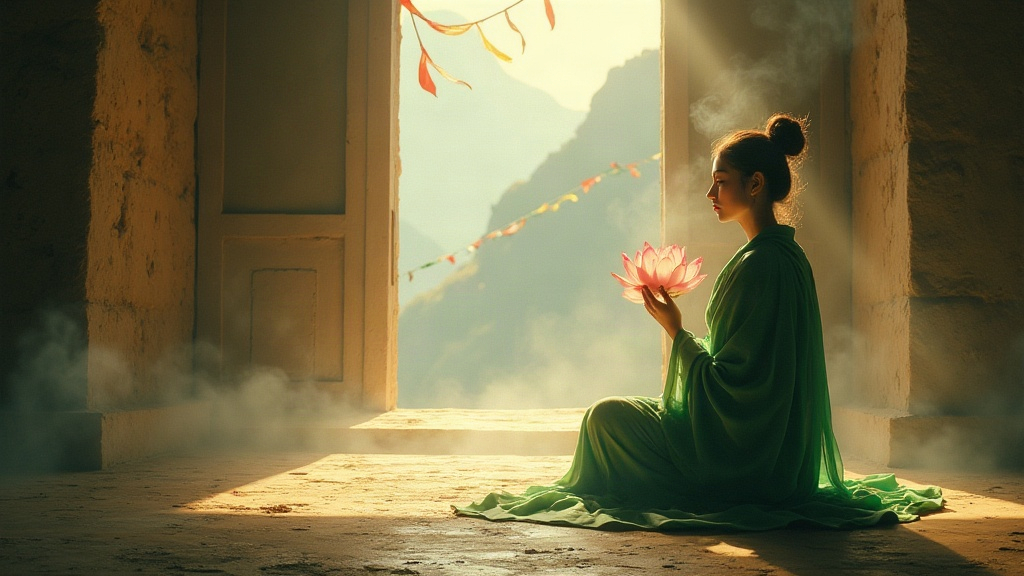
The sutra's name itself points to its core metaphor. In Buddhist symbolism, the lotus grows from mud but blooms pure above water: a perfect image of potential hidden in the mired. Just as the lotus emerges clean from filth, so can any mind achieve buddhahood no matter how weighted by karma or delusion.
The Sutra's Structure and Dramatic Arc
The Lotus Sutra unfolds as a sermon of twenty-eight chapters, each one deepening the same essential teaching from a different angle. It is literature as theology. The text reads less like philosophy and more like a cosmic drama with set pieces, reversals, and moments of profound grace.
The opening draws us into a vivid scene. The Buddha Shakyamuni (the historical Buddha) sits atop Vulture Peak mountain with twelve thousand monks and an assembly of bodhisattvas (enlightenment-seekers), gods, and supernatural beings. The atmosphere crackles with anticipation. Something momentous is about to be revealed.
For the first fourteen chapters, the Buddha teaches the core message: he has been holding back a secret. In earlier sermons, he taught three paths to liberation (the ways of the disciple, the solitary sage, and the bodhisattva). But this was compassionate fiction, a kind of spiritual lie for the unprepared. The truth, he now reveals, is singular: there is only one vehicle, the Buddha-vehicle. Everyone, eventually, will ride it to buddhahood.
The second half pivots. The Buddha introduces the Bodhisattva Avalokiteshvara, whose very name means "the Lord Who Observes the Sounds of the World." Avalokiteshvara hears every cry, every prayer, and manifests in thirty-three different forms (as a merchant, a prostitute, a hunter, a child) to meet people where they suffer. This is the spirit the sutra celebrates: compassion that bends to the shape of whoever needs help.
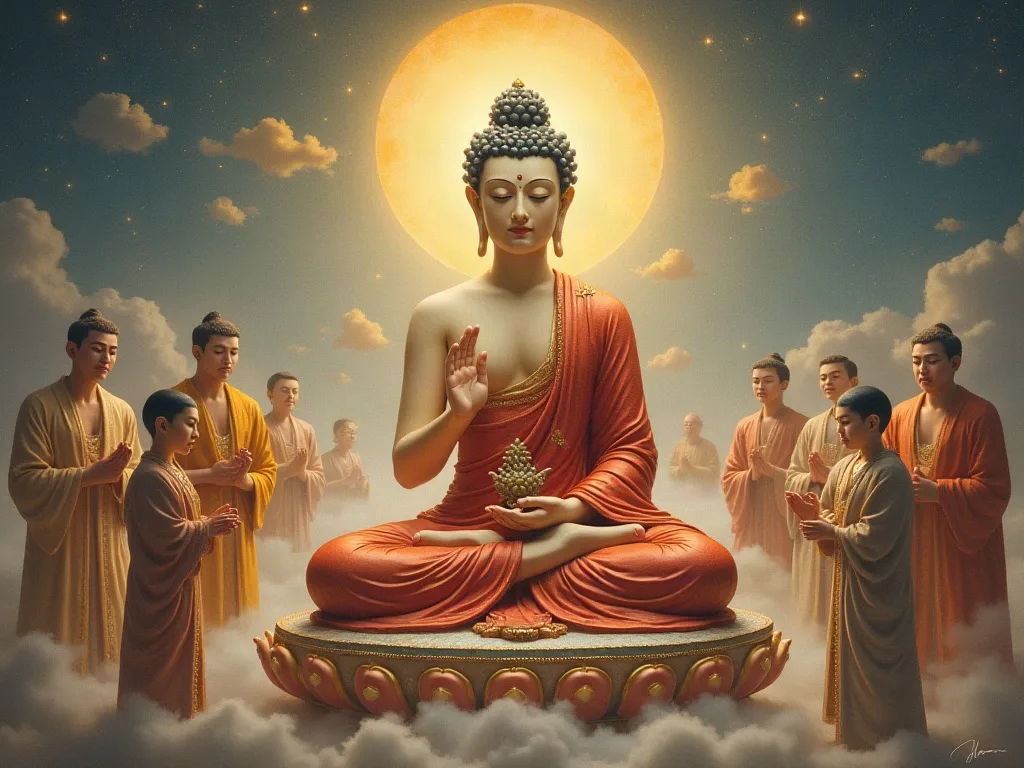
One chapter showcases Bodhisattva Never Despise, a sage who bows to everyone he meets, saying, "I dare not despise you, for you will all become Buddhas." Even when people strike him with sticks, he keeps bowing. The teaching is radical: enlightened perspective sees Buddha-nature in every being, even one's attackers. Especially one's attackers.
By the sutra's end, the Buddha entrusts the teaching to Bodhisattva Manjushri and withdraws. The assembly vows to spread these words. The earth quakes. Flowers fall from the sky. The text closes not with closure but with commitment: the story continues through whoever hears these words and acts.
The Universal Path: Buddhism's Turning Point
Before the Lotus Sutra, Buddhism was split. The older traditions (now called Theravada) held that only monks and nuns could achieve nirvana; laypeople could only earn a better rebirth. Enlightenment was a monastery matter. The emerging Mahayana (Greater Vehicle) disagreed, but the Lotus Sutra transformed that disagreement from philosophy into visceral narrative.
The sutra's ninth chapter tells the story of the Dragon Princess. She is a child. She is female. In her realm, there is a law: no female can become a Buddha. Yet she stands before the Buddha Prabhutaratna (a Buddha from the distant past who has manifested to verify the sutra's truth) and announces she will achieve buddhahood in eight years. The assembled gods laugh. Impossible. But as the chapter ends, she does.
This chapter became a lightning rod in cultures where women's spiritual capacity was doubted. It meant nuns were not second-class practitioners. It meant a girl could be enlightened. In medieval Japan and China, this story inspired women mystics and fueled a shift in how female practitioners saw themselves.
Similarly, the sutra promises buddhahood to the most despised of the Buddha's own followers: Devadatta, his cousin, a man who tried to kill him. As Shakyamuni speaks, Devadatta receives a prophecy that he will become a Buddha named Heavenly King in the distant future. Even the betrayer has a path.
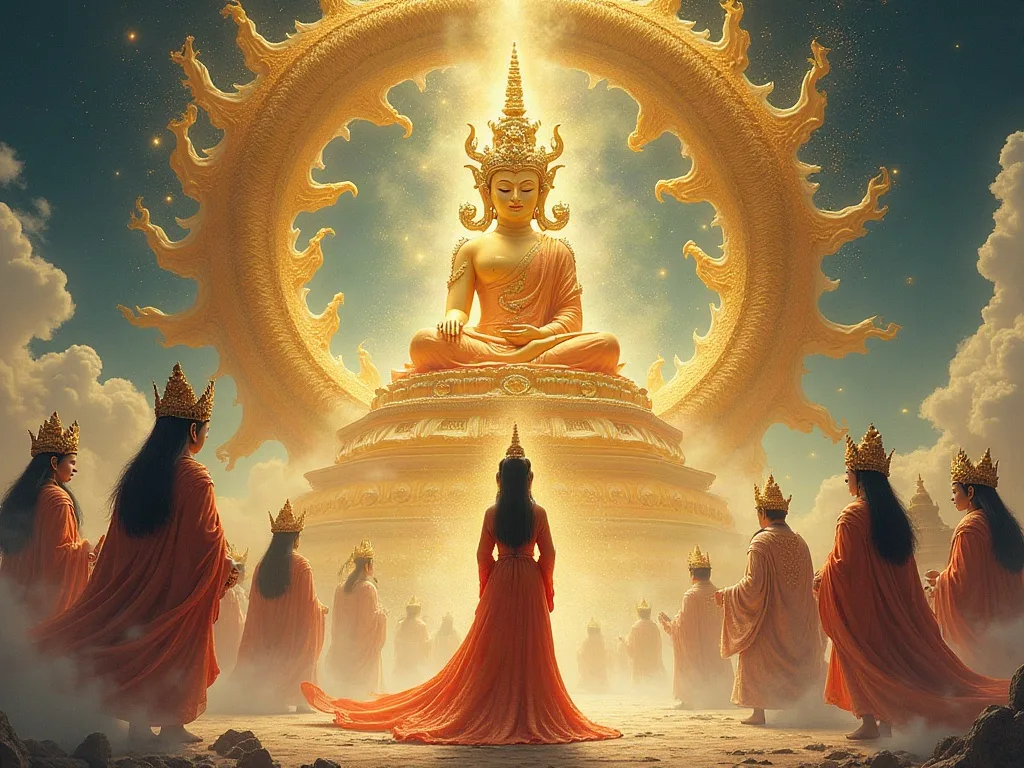
The sutra also speaks to children and animals. In chapter ten, the Buddha's own son, Rahula, learns he is destined for buddhahood. A serpent-woman becomes a Buddha. An eight-year-old girl becomes enlightened before the assembly's eyes. The message ripples outward: birth, gender, species, caste, moral history, none of these block the way. The seed of Buddha-nature is universal.
This teaching fundamentally altered Buddhism's social reach. In societies touched by the Lotus Sutra's influence, monasticism remained honored but was no longer the sole path. Parents could pursue enlightenment while raising children. Merchants could seek the Way while handling money. The sick could practice from bed. This made Buddhism a path for civilizations, not just for renunciates.
The Sacred Geography and Supernatural Wonder
The Lotus Sutra is not a homely text. It luxuriates in cosmic imagery with a kind of rapture. When bodhisattvas and gods appear, the sutra paints them in jeweled, luminous detail.
The Bodhisattva Avalokiteshvara is described with an eye of compassion that sees all suffering across infinite worlds. In one passage, if a woman wishes to bear a son, she can make offerings to Avalokiteshvara and give birth to a wise child; if she wishes a daughter, she receives one who will be blessed and virtuous. The bodhisattva does not judge the wish; he meets the sincere heart with grace.
The sutra describes supernatural beings who vow to protect the text: heavenly kings, celestial maidens, dragon-gods, even demons bound to become guardians. The Earth Goddess herself steps forward and pledges to shelter anyone who spreads the sutra's teaching. The cosmos is woven into the text's defense. To recite the sutra is to align oneself with cosmic protection.
One of the sutra's most beloved passages introduces the Bodhisattva Avalokiteshvara in his thirty-three manifestations. A merchant drowning at sea cries out the bodhisattva's name and is saved. A woman in childbirth calls his name and delivers safely. A prisoner about to be executed speaks the name, and the blade shatters. These are not metaphors but literal miracles woven throughout the sutra. Faith in Avalokiteshvara works. The sutra stakes its power on this claim.
This mythological richness distinguishes the Lotus Sutra from other Buddhist texts. The Buddha here is not a serene teacher but a cosmic actor commanding supernatural forces, speaking truths that shake the heavens. He is a storyteller, a deceiver (he admits lying to suit his audience), and a savior whose compassion is bottomless.
Why the Lotus Sutra Survived and Flourished
Most Buddhist texts are studied by specialists. The Lotus Sutra has been loved by millions. Why?
Part of it is accessibility. Unlike the dense philosophical works (the Abhidharma texts, the Madhyamaka treatises), the sutra tells stories. Even an illiterate peasant could hear the tale of the Dragon Princess or the bowing Bodhisattva Never Despise and grasp the message: you matter, and you can become a Buddha. The teaching does not require advanced philosophy. It requires faith and intention.
Part of it is hope. Many Buddhist paths emphasized the difficulty of enlightenment, the depths of human delusion, the rarity of a human birth. The Lotus Sutra reverses the message: awakening is your birthright. Every obstacle becomes part of the path. Suffering itself becomes a signal of Buddha-nature. As the sutra says, the Buddha comes into the world for one purpose only: to teach all beings that they possess Buddha-nature and can attain Buddhahood.
The sutra was also portable. Monks carried it across the Silk Road. Traders memorized passages. In China, the sutra was translated multiple times (the most famous translation by the monk Kumarajiva in 406 CE), each version finding new readers. The text became so beloved that by the Song Dynasty, mere possession of a hand-copied sutra was seen as a protective charm.
In Japan, the sutra became the foundation of Pure Land Buddhism and Nichiren Buddhism, two of the most widespread schools. Followers chanted "Namu Myoho Renge Kyo" (Homage to the Sutra of the Lotus of the Wonderful Dharma) millions of times daily. The chant itself was said to invoke the sutra's power. Prayer beads were counted off in sets of 108 repetitions. A single sutra recitation could purify lifetimes of karma.
In medieval Europe, when Christian texts compared Buddhism to Christianity, the Lotus Sutra often stood as Buddhism's counterpart to the Gospels: a text of universal salvation, a savior figure (the Buddha, or in some readings, Avalokiteshvara), and a promise available to all.
The Question of Authorship and Textual Layers
Modern scholarship has revealed something fascinating: the Lotus Sutra is not a single sermon but a text that grew over centuries. The earliest core (perhaps chapters 1-9) may date to the 1st century BCE or 1st century CE in a pre-Sanskrit form, likely in a north Indian language. Later chapters were added, chapters on Avalokiteshvara (chapter 25), on the Bodhisattva Never Despise (chapter 28), as the tradition expanded.
The text was composed in Sanskrit (though earlier oral versions may have circulated in Prakrit, the vernacular language of ancient India). It was then translated into Chinese, Tibetan, Japanese, and dozens of other languages, with each translation sometimes adding local interpretations or expanded passages.
This layering matters because it shows how the Lotus Sutra itself embodies its own teaching: it grows, it adapts, it meets new audiences with new language. The sutra is not a fixed monument but a living teaching. Later monks added the Bodhisattva Avalokiteshvara chapter because they saw Avalokiteshvara's compassion as central to the sutra's promise of universal salvation. They wove their own faith into the text.
Scholars debate which passages are "original" and which are "additions." But the sutra's power does not rest on these questions. For millions of devotees, the Lotus Sutra in all its versions and recitations is the complete, sacred word. The text's growth is its grace.
The Sutra in Art and Practice
Few texts have inspired as much art. In Buddhist temples across Asia, the sutra's stories appear on walls, in sculpture, on silk scrolls. The Dragon Princess became a favorite subject in Chinese and Japanese painting. The Bodhisattva Never Despise appears in relief sculptures bowing eternally. Avalokiteshvara in her thirty-three manifestations is painted on the largest of temple walls, each figure a moment of compassion captured.
The sutra also shaped ritual. In Japan, ceremonies called Hokke-do (Lotus Hall rituals) were held where the entire sutra was recited over days. In Tibet, the sutra was inscribed on prayer wheels; each rotation released the text's blessing into the world. In China, sutra chanting competitions drew crowds. The most skillful chanters were celebrated as artists.
The sutra also influenced daily practice. Ordinary Buddhists would recite a single passage, not for intellectual understanding but for spiritual transformation. A mother facing her child's illness would chant about Avalokiteshvara. A warrior before battle would invoke the protection promised to sutra-keepers. A nun would copy the entire text by hand, each character a meditation.
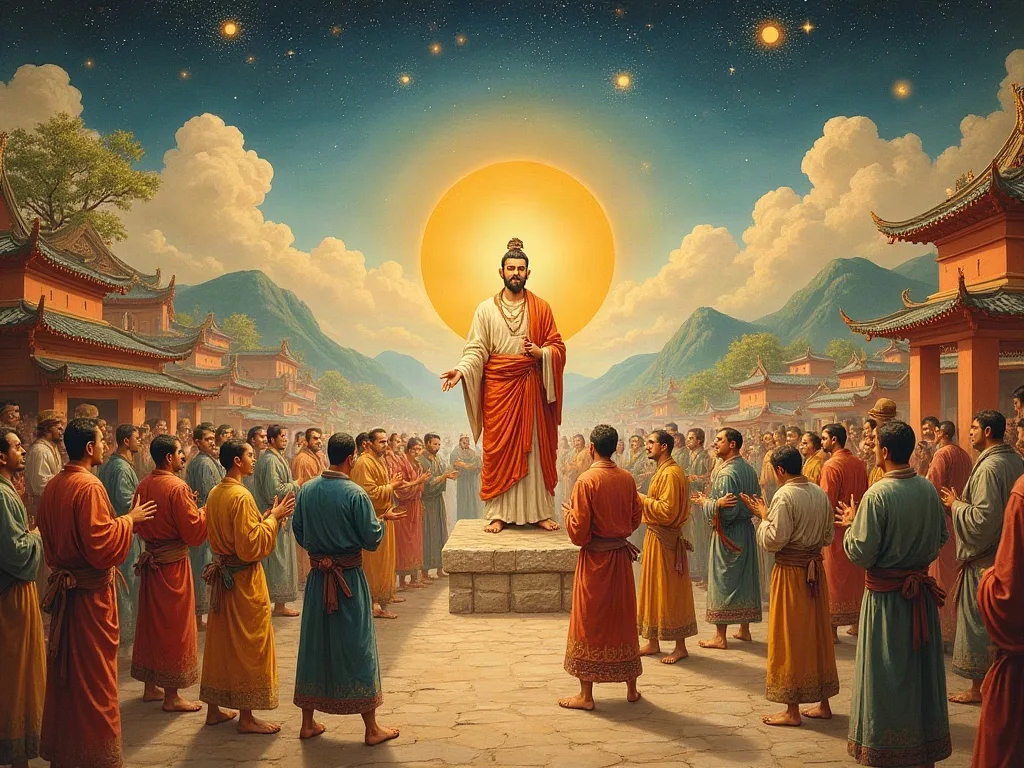
One practice exemplifies this: in medieval China and Japan, people would bind copies of the sutra into stone or throw them into rivers as offerings. These "sutra deposits" were acts of devotion but also insurance: the sutra, thrown into the earth or water, would eventually be discovered and spread its blessing. The practice reveals how the Lotus Sutra was not merely read but animated, given agency, treated as a living being capable of miraculous work.
The Sutra's Challenge to Orthodoxy
The Lotus Sutra's radicalism created tensions within Buddhism itself. Conservative Buddhist scholars objected that the sutra contradicted earlier teachings. If the Buddha's earlier sermons were fully true, how could he now say he had been lying? If there are three vehicles (three paths to enlightenment), how is there only one?
The sutra's answer (and the answer developed by later Buddhist philosophers like Zhiyi, the founder of the Tiantai school in 6th-century China) was to embrace apparent contradiction as depth. The Buddha's earlier teaching was true for those who needed it. It was skillful, compassionate misdirection. Just as a parent tells a child that monsters are not real even though fears are real, so did the Buddha teach in stages.
This doctrine of "skillful means" (upaya in Sanskrit) became the sutra's philosophical engine. The Buddha is not a truth-teller in the conventional sense; he is a healer who says whatever cures. Sometimes the cure is strict discipline. Sometimes it is stories about dragons becoming Buddhas. The truth is not about words but about liberation.
This teaching scandalized some schools and liberated others. In East Asian Buddhism, the Lotus Sutra became gospel precisely because it justified adapting the teaching to local cultures, local needs, local speech. In Tibet, where the sutra was respected but less central, the emphasis remained on philosophical rigor and monastic discipline. Both approaches could coexist because the sutra itself had taught that many paths lead to the same destination.
Buddhism's Democratic Turn
If Buddhism had remained what it was before the Lotus Sutra's ascendance, it would likely be a different religion today. It might have remained monastic, scholastic, confined to elite practitioners. Instead, the sutra helped democratize enlightenment.
In China, the sutra inspired lay movements. Pure Land Buddhism, the most widespread form of Buddhism in East Asia, drew heavily on the sutra's promise that Avalokiteshvara and other bodhisattvas would assist anyone who called on them with sincere faith. A farmer chanting Avalokiteshvara's name while plowing had access to the sacred. Enlightenment was not locked behind monastery gates.
In Japan, Nichiren (1222-1282) declared the sutra the only text needed for enlightenment. His movement, Nichiren Buddhism, made the chant "Namu Myoho Renge Kyo" (Homage to the Lotus Sutra) a complete spiritual practice. No hierarchy. No esoteric secrets. Just sincere recitation. This made Buddhism a living practice for entire families.
In Vietnam and other Southeast Asian contexts, the sutra's teaching that all beings possess Buddha-nature reinforced indigenous concepts of sacred presence throughout nature. The teaching felt both foreign and deeply familiar.
The Lotus Sutra did not create these movements, but it gave them a scriptural foundation. It said, in effect: your ordinariness is not a barrier to enlightenment. Your job, your family, your place in society, none of these disqualify you. The sutra's vision rippled outward, shaping how Buddhism understood itself.
Parallels and Echoes in Other Traditions
The Lotus Sutra's promise of universal salvation echoes through other religious traditions. Christian scholars, encountering Buddhism in the colonial period, were struck by the parallels: a savior figure who suffers for all (the Buddha), the promise of salvation available to all (buddhahood), even the miraculous powers (Buddha's supernatural feats).
These parallels are real but complex. The Buddha of the Lotus Sutra does not die for humanity; he withdraws into transcendence. Avalokiteshvara does not atone but assists. Buddhahood is not a state of grace bestowed but a nature activated within each being. The metaphysics differ profoundly.
Yet the emotional terrain is similar: both traditions assert that the desperate, the outcast, the sinful, the weak have a path to the sacred. Both teach that compassion transcends judgment. Both offer transformation available to the sincere.
The sutra also parallels other texts that teach universal potential. The Hindu Bhagavad Gita, though focused on dharma (duty), teaches that all paths lead to Krishna and liberation is available to anyone of sincere faith. The Quran asserts that all believers have equal standing before God. The sutra sits alongside these texts as a teaching that dignity and spiritual potential are distributed equally across humanity.
Frequently asked questions about the Lotus Sutra
Frequently asked questions
Is the Lotus Sutra the oldest Buddhist text?
No. The oldest Buddhist texts are the Pali Suttas, which were likely recorded before the Lotus Sutra was written down. The Lotus Sutra emerged between the 1st and 2nd centuries CE as Buddhism was spreading from India into new lands. It builds on earlier Buddhist teachings but represents a later development, though it now rivals the Pali texts in influence across much of Asia.
Why is Avalokiteshvara so prominent in the Lotus Sutra?
The Bodhisattva Avalokiteshvara embodies the sutra's core message: boundless compassion that meets suffering wherever it appears. Avalokiteshvara's thirty-three manifestations show that compassion is not one-size-fits-all but adapts to the needs of the listener. The sutra teaches that this kind of responsive, selfless care is the highest spiritual practice, making Avalokiteshvara the living model of what the sutra asks of all Buddhists.
How do scholars explain the contradiction between the Buddha's earlier and later teachings in the Lotus Sutra?
The sutra itself introduces the concept of upaya or "skillful means." The Buddha taught that his earlier sermons were compassionate adaptations for audiences not yet ready for the full truth. Later Buddhist philosophers, particularly Zhiyi of the Tiantai school, developed this into a complete framework: the Buddha teaches in stages, and all his teachings are equally true and necessary, just aimed at different levels of understanding. This resolves the contradiction philosophically and makes the sutra's apparent inconsistencies into signs of profound wisdom.
Is the Lotus Sutra used in all schools of Buddhism?
No. The Lotus Sutra is most central in East Asian Buddhism (China, Japan, Vietnam, Korea) where it inspired major schools like Pure Land and Nichiren Buddhism. In Theravada Buddhism (Southeast Asia) and Tibetan Buddhism, while the sutra is respected, other texts and practices take priority. The variation shows how Buddhism itself is not monolithic; different traditions find different teachings most essential to their practice.
What does it mean that the Dragon Princess becomes a Buddha in eight years?
In the sutra's world, buddhahood is not impossible or infinitely distant; it can happen swiftly for anyone with sincere aspiration. The Dragon Princess overcomes multiple obstacles (she is young, female, a supernatural being, and in many cultures considered inherently spiritually weaker) and achieves buddhahood before the assembly's eyes. This chapter became profoundly important for women practitioners and shows that what seems impossible through human law is possible through Buddha-nature.
How did the Lotus Sutra survive when so many other Buddhist texts were lost?
The sutra's accessibility, its hope, and its compatibility with lay practice made it beloved across Asia. It was translated multiple times into different languages, copied obsessively by devotees, and made central to practice by powerful schools. Its promise that ordinary people could achieve enlightenment meant it spread far beyond monastery walls. Unlike more specialized philosophical texts, the sutra had a constituency that actively preserved and propagated it.
The Unfinished Path
The Lotus Sutra does not end with the Buddha's final teaching. It ends with a commitment. The bodhisattvas vow to spread the sutra to all beings across all worlds. The earth quakes. Flowers fall. The ceremony of the sutra, as the text itself teaches, continues wherever someone hears these words and dedicates themselves to enlightenment.
This is why the sutra remains alive after two thousand years. It is not a closed book but an invitation. Each reader, each chanter, each person who hears "you will become a Buddha" becomes part of the ongoing teaching. The text does not stand apart from practice; it is practice. To recite the sutra, to study it, to embody its message of universal compassion, this is the continuation of what Shakyamuni began on Vulture Peak.
The sutra's vision has proven resilient because it is fundamentally hopeful. In a world where suffering seems total and transformation seems impossible, the Lotus Sutra whispers: you already possess what you seek. The Buddha-nature is not something to earn. It is something to awaken. Every being, no matter how lost, how despised, how distant from awakening, carries this seed.
That promise has spoken to mothers and merchants, monks and outcasts, across a thousand years and countless cultures. It speaks still.
Read the full book
Want the whole story?
The complete edition is an instant PDF download here, with a paperback on Amazon for selected titles.
Buddhist
The Buddhist Mythology Book: Mara, Avalokiteshvara, Mahakala, and the Sacred Cosmology Beyond Meditation
Demons, Bodhisattvas, and the Cosmic Architecture of Buddhism
The mythological layer of Buddhism: Mara's temptation, the Bodhisattvas, Vajrayana fierce deities, the Eight Hells, Mount Meru, and the Jataka tales. Delivered within 24 hours of purchase.
More from Buddhism
All articles
Buddhism
Vesak: The Festival Celebrating Buddha's Birth, Enlightenment, and Death
Vesak marks the three most pivotal moments in Siddhartha Gautama's life, all on a single day. Discover how Buddhists across Asia transform this holy date into a festival of light, moral renewal, and collective remembrance of the Buddha's journey to awakening.
Buddhism
Tara: The Mother of Liberation in Mahayana Buddhism
Tara embodies compassion in action, the Tibetan Buddhist goddess who hears suffering and moves to end it. Known as the Mother of Liberation, she appears in multiple forms, each one a different answer to human need.
Buddhism
The Six Realms of Samsara: Buddhist Cosmology and Rebirth
Buddhist cosmology maps existence across six realms of rebirth, from heavens where joy becomes suffering to hells where torment teaches detachment. Discover how this ancient map of consciousness shapes Buddhist ethics and practice.

Buddhism
Nagas: Serpent Deities and Protectors of Buddhist Teachings
Nagas are divine serpents woven through Buddhist mythology as guardians of dharma, possessors of cosmic wisdom, and agents of transformation. Discover how these shape-shifting beings became central to Buddhist practice across Asia.