
Tara: The Mother of Liberation in Mahayana Buddhism
Tara embodies compassion in action, the Tibetan Buddhist goddess who hears suffering and moves to end it. Known as the Mother of Liberation, she appears in multiple forms, each one a different answer to human need.
Contents
In the mountains of Tibet, pilgrims spin prayer wheels and whisper her name. In caves across the Himalayas, monks spend decades meditating on her form. Tara sits at the heart of one of Buddhism's most practiced traditions: not because she demands worship, but because she listens and acts. When someone cries out in fear or pain, Tara doesn't philosophise. She moves.
The goddess known as Tara (Sanskrit Tara, Tibetan Dolma) represents something radical in Buddhist thought: a female deity whose power flows not from cosmic rulership but from instant, uncompromising compassion. She is the antidote to paralysis. Where her male counterparts in the pantheon often sit in meditation, Tara stands ready, feet planted, as if about to jump into the world. Her name itself means "star" or "one who crosses over"; she is the ferryman who guides beings across the ocean of suffering to the shore of enlightenment.
This is not a distant god. Tara appears wherever someone needs her. That nearness is why millions of Buddhists have called on her for over a thousand years.
The Origins of Tara in Buddhist Cosmology
The earliest mentions of Tara arrive in Indian Sanskrit texts around the 6th to 7th century, though her roots run deeper into folk practice and regional belief. She emerges fully formed in Tibetan Buddhism by the 11th century, where she becomes central to daily ritual and meditation.
The most famous origin story comes from the compassion of Avalokiteshvara, the bodhisattva of mercy. In one version preserved in Buddhist texts, Avalokiteshvara weeps for the suffering of all beings. His tears fall like rain. From the left tear, a lotus blooms, and from that lotus steps Tara. Some texts say she was born from his enlightened mind; others claim she arose from his compassion itself, as if suffering could be transmuted directly into the power to heal.
This origin matters. Tara is not worshipped as a supreme being to be placated. She is the living expression of compassion that refuses to look away. She chose to remain in the world, refusing complete transcendence, so that others might be freed from their chains.

The Tara Tantra, one of the core texts in Tibetan Buddhist practice, describes her emergence from emptiness during a cosmic conversation between the Buddha Shakyamuni and assembled deities. She sits at the moment before creation, and through her, all liberation becomes possible. She is not a creator (Buddhism rejects that idea), but a liberator; not a judge, but a midwife to enlightenment.
The Two Faces of Tara: Green and White
Tara never appears as a single figure. The tradition recognises her in multiple forms, each tailored to different needs. The two most widespread are Green Tara and White Tara, and they tell two stories about how compassion works.
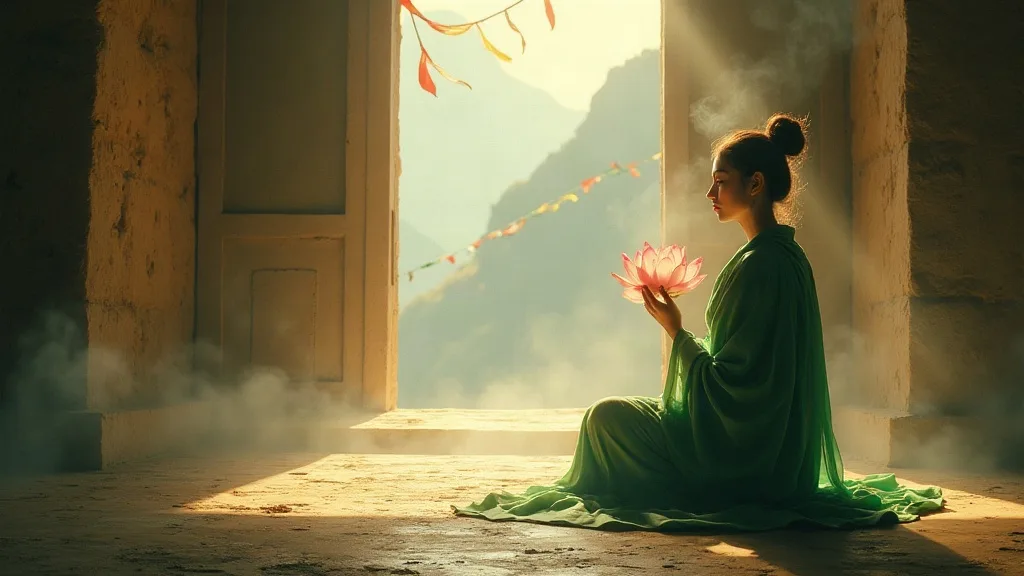
Green Tara embodies action. She sits in what practitioners call the "posture of ease"; her right foot dangles, as if she might stand up at any moment to run into the world. Her skin glows jade green, the colour of renewal and growth. In her right hand, she makes a gesture of gift-giving; in her left, she holds a lotus bud, the symbol of enlightenment not yet bloomed. The gesture says: I am here, I am ready, what do you need?
Meditators call on Green Tara when they face immediate crisis: illness, danger, fear. She is not gentle in the way people sometimes expect goddesses to be. She is the warrior of compassion. When a practitioner sits before her image and recites her mantra (often "Om Tara Tuttare Ture Svaha," invoking her in three aspects), they are not asking permission or hoping for mercy. They are aligning themselves with her energy, the force that will not tolerate suffering if action can stop it.
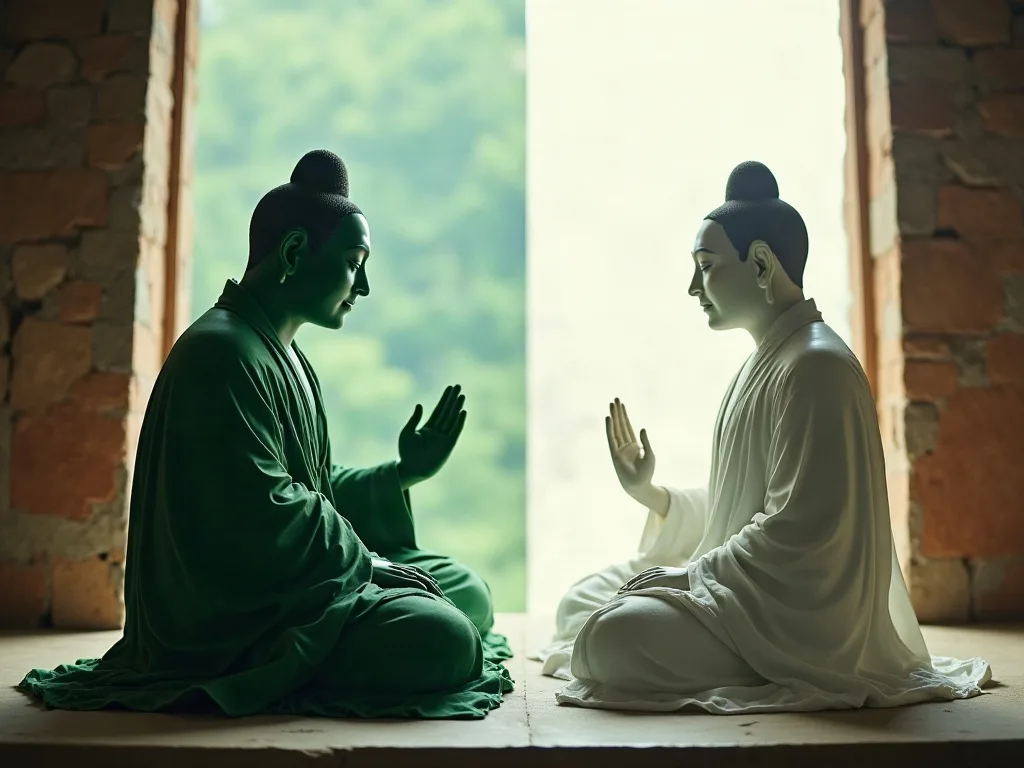
White Tara represents long-term healing and spiritual maturation. Her skin is luminous white, radiating calm radiance. She bears an extra pair of eyes: on each of her palms, on the soles of her feet, and a third eye on her forehead. These eyes see suffering everywhere and nowhere; she watches without clinging, without despair. Her gesture is slower, more meditative. White Tara is called on for longevity, for gentleness, for the compassion that endures even when change moves slowly.
Both forms do the same work: liberation. They simply approach it from different angles.
The tradition recognises up to 21 forms of Tara, each one a variation on the theme. There is Yellow Tara for prosperity and protection, Red Tara for destruction of inner poisons, Black Tara for ferocity against obstacles. Even in Buddhist iconography, where the same deity might appear dozens of times, the core idea remains: Tara adapts. She meets the practitioner where they are.
The Mantra and the Practice
The most common invocation to Tara is her mantra: "Om Tara Tuttare Ture Svaha." Buddhists chant it in hundreds of thousands of repetitions, sometimes millions in a lifetime. The words don't translate neatly into English. Tara calls on her directly. Tuttare invokes her as the one who leads beings across the river of suffering. Ture invokes her as the one who rushes to rescue, the one who does not hesitate. Svaha seals the prayer, an affirmation that this is true.
Tara practice sits at the heart of Tibetan Buddhist training, especially in the Kagyu and Gelug schools. A formal initiation called the "Tara Empowerment" introduces practitioners into the method. During the ritual, a lama (a Tibetan Buddhist teacher) guides the student through visualisations. The student imagines Tara before them, vivid and present. They see rays of light flowing from her body, healing their confusion. They receive her blessings, not as passive recipients but as participants in the healing itself.
The visualisation that follows demands extraordinary mental precision. The practitioner must hold the image of Tara in their mind with perfect clarity, without distraction, for hours at a time. It sounds abstract, but its purpose is utterly practical: clarity of mind and stability of compassion. If you can hold Tara's image without distraction, your mind has just become capable of witnessing suffering without turning away. That capacity is the first step toward liberation for yourself and others.
After months or years of practice, something shifts. Tara is no longer "out there." She becomes inseparable from the practitioner's own deepest compassion. The meditation reveals what practitioners claim has always been true: Tara is not outside the mind. She is the awakened compassion within it, waiting to be recognised.
Tara Across the Buddhist World
Tara's reach extends far beyond Tibet. In Nepal, practitioners invoke her during Puja ceremonies. In Japan, she appears in esoteric Buddhist schools under the name Tarani, less prominent than Jizo or Kannon (the Japanese form of Avalokiteshvara), but still honoured. In Cambodia, Vietnam, and across Southeast Asia, folk Buddhist practice includes her, often merged with local protective goddesses.
In Bhutan, Green Tara holds special significance. She appears in the national emblem and in countless household shrines. Her mantra is so common that even non-initiated Bhutanese hum it without thinking, the way someone might hum a childhood song.
The most striking feature of Tara's spread is how she adapts. In Tibet, she is fierce and immediate. In Nepal, she often appears gentler, more like the Hindu goddesses her form sometimes echoes. In Vietnam, she shares attributes with the Bodhisattva Avalokiteshvara in ways that would have seemed odd in India. Each culture takes Tara and makes her speak its own language of suffering and liberation.
This adaptability is not weakness or dilution. It is a feature, not a bug. Tara's entire theology rests on the idea that compassion must meet people where they are. If she showed up the same way everywhere, she would be a philosophical abstraction. Because she changes, she remains alive.
The Relationship Between Tara and Avalokiteshvara
One question haunts Tara scholarship: what is her relationship to Avalokiteshvara, the bodhisattva from whom (in some accounts) she was born? Are they separate beings? Two aspects of the same force? The relationship is complex, and no single answer satisfies all traditions.
In some Tibetan texts, Tara is listed among Avalokiteshvara's emanations. She is the compassion of Avalokiteshvara in its most active, particularised form. In others, they are presented as equals, two facets of the same enlightened intention. In still others, Tara eventually supersedes Avalokiteshvara in the practitioner's devotion; she becomes the more direct, more accessible form of compassion.
What is clear: Tara never serves as a subordinate figure. She is not Avalokiteshvara's consort or complement in the way some Hindu goddesses function in relation to their partners. She stands independently, with her own mantra, her own ritual cycle, her own cosmic function. The relationship between them is one of complementary aspects of a single reality: the awakened mind's response to suffering.
In practice, many Tibetan Buddhists invoke both. They call on Avalokiteshvara for patience and inward compassion. They call on Tara when that compassion must become action.
Tara in Western Buddhist Practice
Over the past forty years, as Tibetan Buddhism has spread to Europe and the Americas, Tara has become one of the most widely practiced deities in Western Buddhist centres. She appeals to practitioners in secular societies who might otherwise resist deity practice. She is not a creator god or cosmic judge. She is compassion itself, and that compassion is as real and as needful in New York or Berlin as it was in Lhasa.
Western practitioners often approach Tara through a cognitive framework: she represents the activation of one's own compassion, the turning of wisdom into action. This is not foreign to the Tibetan understanding, but Western practitioners tend to emphasise the psychological dimension. Tara becomes a focus for integrating the parts of the psyche that feel isolated or afraid.
This shift is not corruption. Many Tibetan teachers who now teach in the West say that Tara herself requires this translation. Her fundamental message is: "I am here, your suffering matters, freedom is possible." The language changes. The truth remains.
Practitioners in Western cities light candles before Tara's image in Buddhist centres or home shrines. They chant her mantra before job interviews, medical procedures, arguments with loved ones. They speak of her as a friend, present, witnessing, ready to remind them that paralysis is a choice, that movement is always possible.
The Scholarly Debate: History Versus Revelation
Scholars of Buddhism fall into several camps when discussing Tara. Historians note her emergence in Indian tantric texts and trace her lineage through Sanskrit commentaries. They place her within the broader evolution of the bodhisattva concept and note how her iconography shifts across regions and centuries.
Other scholars emphasise the lived experience of practitioners. For them, the question "where did Tara really come from?" misses the point entirely. Tara arises in the mind of someone who practices her, and that arising is real. The history of her texts and images matters, but it is not more real than the transformation that happens when a practitioner genuinely experiences her presence during meditation.
This tension never fully resolves. It shouldn't. Both perspectives hold truths that the other cannot fully capture. Tara is simultaneously a historical figure in Buddhist textual tradition and a living presence in the minds of millions. She is both a creation of human devotion and something that transcends its creators.
Tara's Symbols and Their Meanings
Every element of Tara's appearance carries meaning. Her green or white skin. The lotus in her hand. The colour of her robes. The jewels at her throat. Even her seated posture speaks.
The lotus is perhaps the most essential. In Buddhist symbolism, the lotus grows in mud and mire, its roots deep in filth, yet emerges unblemished. It represents enlightenment arising from the world of suffering without being contaminated by it. When Tara holds a lotus, she reminds practitioners that purity and suffering are not opposites; enlightenment blooms precisely from willingness to engage with the world as it is.
Her right foot extended (in Green Tara's case) signals readiness to act. It is a gesture of immediacy that challenges the Western romantic notion of spirituality as withdrawal and passivity. Tara's spirituality is engaged. She cannot meditate alone. Her enlightenment consists in acting for others.
The jewels that ornament her body represent her perfection and her value. She is precious. And this precision matters: she reminds practitioners that their own minds, their own compassion, their own deepest nature is precious. You are worthy. Your suffering matters. Your liberation matters.
Tara's Echoes in Popular Devotion
In Tibetan culture, Tara is not confined to formal tantric practice. She appears in folk songs and children's stories. Mothers invoke her protection over their children. Merchants whisper her name before entering difficult negotiations. Artists paint her in every conceivable style, from classical religious paintings to contemporary street art.
This popular dimension is not secondary to the scholarly or mystical dimensions. It is the living continuation of her presence. When a Tibetan mother calls on Tara to watch over her sick child, she is not performing a ritual from a textbook. She is participating in a continuous chain of invocation that stretches back centuries.
Similarly, in the diaspora communities of Buddhists living outside Asia, Tara has become a figure of refuge. She represents the possibility that one's own suffering, one's own fear, one's own paralysis, can be transformed into action. For people living in societies that often feel chaotic or hostile to spiritual practice, Tara offers a radical message: you do not need to withdraw to be spiritual. You do not need to become passive. Liberation means moving.
The Question of Historical Tara
One mystery persists: was there a historical Tara? Some Buddhist texts suggest she was a human practitioner in ancient India who achieved enlightenment and vowed to remain in the world in female form to liberate beings. Others place her eternally outside history, an aspect of cosmic consciousness that has no personal biography.
This question mirrors the debate about other bodhisattvas. For scholars, it matters. For practitioners, the answer is simpler: Tara is real in the way that matters. She appears when called. She changes those who encounter her.
Frequently asked questions about Tara in Mahayana Buddhism?
Frequently asked questions
Why is Tara female when most Buddhist deities seem male?
Tara is female because the Buddhist tradition, despite its patriarchal structures, recognised that compassion, wisdom, and liberation know no gender. In tantric Buddhism especially, the feminine principle (Shakti in Hindu terms, though Buddhism uses different language) represents the active, manifesting aspect of enlightenment. Tara embodies compassion in motion, and that force is explicitly feminine. Her femaleness is not incidental; it is theologically central.
What is the difference between Tara practice and other forms of Buddhist meditation?
Most Buddhist meditation aims at directly perceiving the nature of mind and reality. Tara practice works through visualization and devotion to accomplish the same end, but via the path of compassion. The practitioner is not trying to escape the world; they are trying to become so clear and so compassionate that they cannot help but serve others' liberation. It is a more engaged path than some forms of meditation, though no less rigorous.
Can non-Buddhists practice Tara meditation?
Formally, no. A Tara empowerment requires initiation from a qualified Tibetan Buddhist teacher. Practically, many non-Buddhists chant her mantra or meditate on her image for peace and compassion, and teachers often tolerate this. Some Tibetan lamas now offer introductory Tara teachings to anyone interested, recognising that Tara's compassion need not be rationed. But the full practice still requires commitment to the Buddhist path.
How does Tara relate to Kwan Yin or other compassion goddesses in Asian Buddhism?
Tara is concentrated in Tibetan and Indian Buddhist traditions. In East Asian Buddhism, Avalokiteshvara becomes Kwan Yin (Chinese) or Kannon (Japanese), a feminine figure who serves a similar role as the embodiment of active compassion. These are not the same being, but they express parallel truths in their respective traditions: compassion has a face, it listens, and it acts. The differences in how each tradition depicts these figures reflect cultural and theological nuances, not a disagreement about the core insight.
What is the most famous Tara mantra, and what does it do?
"Om Tara Tuttare Ture Svaha" is the most widely chanted Tara mantra. In practice, it does not "do" anything magical; instead, it tunes the practitioner's mind toward Tara's energy. Chanting it creates a resonance between the practitioner's own deepest compassion and the ideal of Tara embodied in the mantra. Some practitioners report that years of chanting change how they respond to suffering, making action more natural and paralysis less possible.
The Unfinished Work: Tara in a Suffering World
Tara remains one of Buddhism's most alive figures precisely because her work is never complete. Every day brings new suffering, new paralysis, new beings who need a witness and a guide. She does not rest in some celestial realm, satisfied with cosmic rulership. She remains active, responsive, present.
This may be why she has endured so long and spread so far. In a world drowning in suffering yet saturated with the message that individual action doesn't matter, Tara insists on something radical: compassion is not an emotion, it is a force. And that force, when aligned, can move mountains. It can free prisoners. It can heal the broken. Not because Tara is magic, but because Tara embodies what becomes possible when someone refuses to look away.
Read the full book
Want the whole story?
The complete edition is an instant PDF download here, with a paperback on Amazon for selected titles.
Buddhist
The Buddhist Mythology Book: Mara, Avalokiteshvara, Mahakala, and the Sacred Cosmology Beyond Meditation
Demons, Bodhisattvas, and the Cosmic Architecture of Buddhism
The mythological layer of Buddhism: Mara's temptation, the Bodhisattvas, Vajrayana fierce deities, the Eight Hells, Mount Meru, and the Jataka tales. Delivered within 24 hours of purchase.
More from Buddhism
All articles
Buddhism
Vesak: The Festival Celebrating Buddha's Birth, Enlightenment, and Death
Vesak marks the three most pivotal moments in Siddhartha Gautama's life, all on a single day. Discover how Buddhists across Asia transform this holy date into a festival of light, moral renewal, and collective remembrance of the Buddha's journey to awakening.

Buddhism
The Lotus Sutra: Sacred Text of Universal Buddhahood
The Lotus Sutra teaches that every being, no matter how lost, can achieve buddhahood. Discover how Buddhism's most beloved scripture rewrote enlightenment and shaped a thousand years of practice.
Buddhism
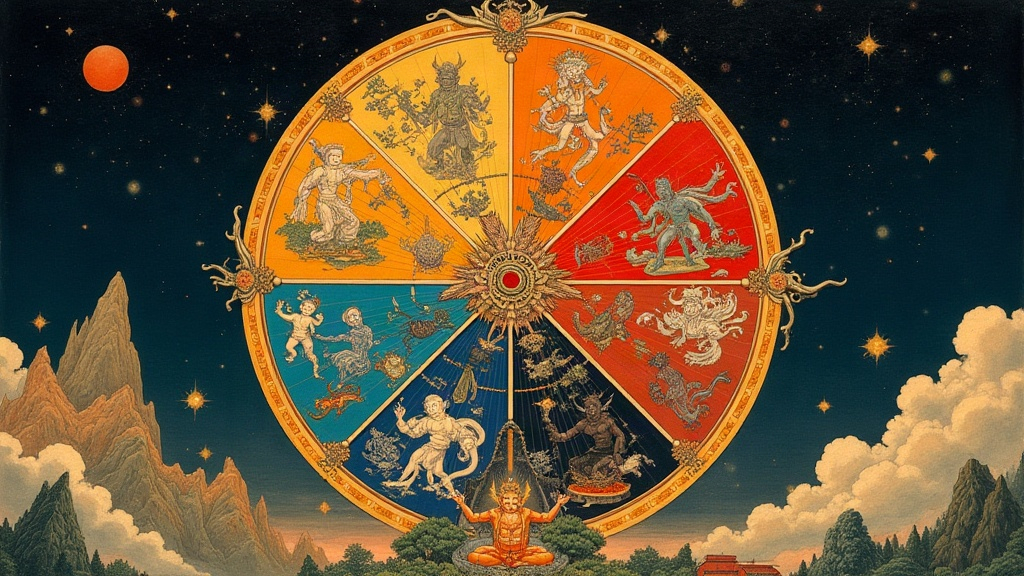
The Six Realms of Samsara: Buddhist Cosmology and Rebirth
Buddhist cosmology maps existence across six realms of rebirth, from heavens where joy becomes suffering to hells where torment teaches detachment. Discover how this ancient map of consciousness shapes Buddhist ethics and practice.

Buddhism
Nagas: Serpent Deities and Protectors of Buddhist Teachings
Nagas are divine serpents woven through Buddhist mythology as guardians of dharma, possessors of cosmic wisdom, and agents of transformation. Discover how these shape-shifting beings became central to Buddhist practice across Asia.