
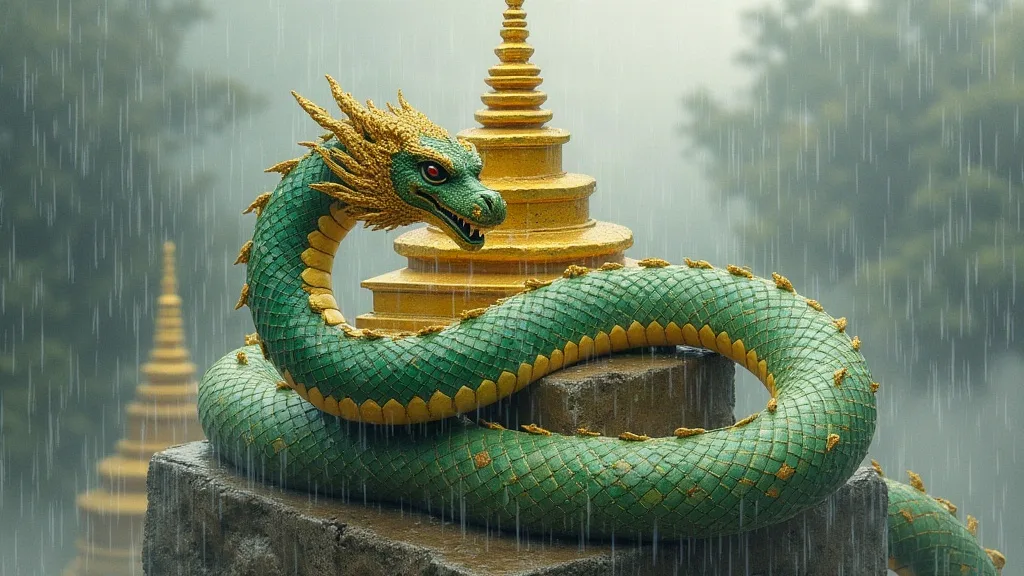
Nagas: Serpent Deities and Protectors of Buddhist Teachings
Nagas are divine serpents woven through Buddhist mythology as guardians of dharma, possessors of cosmic wisdom, and agents of transformation. Discover how these shape-shifting beings became central to Buddhist practice across Asia.
Contents
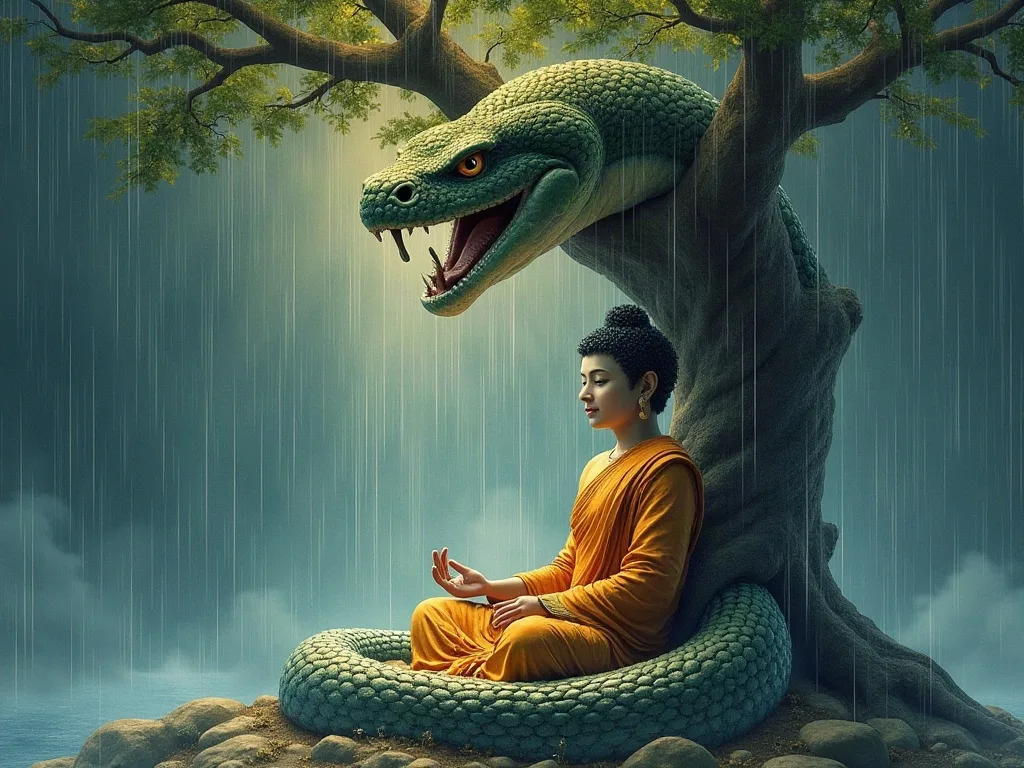
The serpent emerged from beneath the bodhi tree as the monk sat in meditation, rain falling in torrents. The creature was no ordinary snake. Its hood expanded, sheltering the future Buddha with its coils, protecting him from the storm and from the demon Mara's assault. This serpent was Mucalinda, a naga king, and his act became one of the most recognizable moments in Buddhist narrative: the compassionate protection of enlightenment itself.
Nagas: Serpent Deities and Protectors of Buddhist Teachings are far more than wildlife in the Buddhist cosmos. They are divine beings who inhabit underground realms, guard treasures both material and spiritual, and embody the liminal spaces between the human world and the waters of creation. They appear in Sanskrit texts, Pali scriptures, Tibetan ritual, and East Asian art as semi-divine creatures capable of enlightenment, shape-shifting, and profound wisdom. Some are benevolent guardians; others are dangerous forces requiring appeasement. All of them occupy a unique place in Buddhist thought: creatures who are neither fully divine nor entirely bestial, yet crucial to the survival of the dharma.
Their story reaches back before Buddhism itself, to the layers of Hindu and pre-Vedic cosmology where serpents ruled underground kingdoms and guarded the treasures of the earth. Buddhism inherited these beings and transformed them, bringing them into service of the Buddha's teaching and integrating them into systems of protection, ritual, and metaphysical geography.
The Naga in Ancient Hindu and Buddhist Texts
In the oldest Hindu sources, the Rigveda (composed roughly 1500-1200 BCE) mentions serpent beings called ahi or sarpa, often portrayed as obstacles to be overcome. By the time of the epics like the Mahabharata (composed between roughly 400 BCE and 400 CE), nagas had become a distinct race: humanoid from the waist up, serpentine below, with the power to assume fully human form or fully serpentine shape at will. They were said to dwell in Nagaloka, their underground kingdom, and to possess jewels of unimaginable value.
When Buddhism emerged around the 5th century BCE, it encountered a world where nagas already held religious significance. Rather than dismissing them, Buddhist texts incorporated them as fully realized beings capable of understanding and protecting the dharma. The Pali Canon, the earliest recorded Buddhist scriptures (compiled in the centuries after the Buddha's death, roughly 5th century BCE), includes dozens of naga encounters.
One of the most important is the account of the Buddha's enlightenment itself. After the Buddha achieved wisdom beneath the bodhi tree, he sat in meditation for seven days and nights. A massive storm threatened his repose. Mucalinda, the naga king whose realm lay beneath the tree's roots, rose up. His five-hooded cobra form expanded around the Buddha, sheltering him completely, while his tail wrapped around him for warmth. Only when the Buddha was ready did Mucalinda withdraw, assume a human form, and bow in reverence. This act symbolizes something critical to Buddhist thought: enlightenment itself requires protection, and beings of vast power willingly serve wisdom when it appears.
The Mahasamghika school of Buddhism preserved another version of the naga guardian myth. According to these texts, hundreds of nagas surrounded the Buddha during his early years of preaching, ensuring no demons or opposing forces could disrupt his teaching. They formed an invisible ring of protection, their loyalty absolute.

The Naga Realms: Geography of the Divine Underground
Nagas rule kingdoms that exist beneath the surface of the earth and at the bottom of great waters. In Buddhist cosmology, these realms are not metaphorical. They are described with geographic precision in the Pali Canon and later Sanskrit texts.
The largest naga kingdom is said to lie beneath the Himalayas, in a place called Bhogavati, or the "City of Enjoyment." This underground city is described as far more magnificent than human capital cities: its buildings are crafted from jewels, its streets are paved with gold, and its inhabitants live in luxury that rivals the realms of the gods themselves. The greatest nagas are said to possess treasure-houses so vast that single serpents accumulate wealth across entire valleys.
Vasuki, the king of serpents in Hindu mythology and adopted into Buddhist texts, is sometimes placed in this realm. Vasuki is portrayed as an enormous cobra so vast that his body encircles Mount Mandara, the cosmic mountain at the center of the world. His breath can poison the atmosphere, but his loyalty is total. In texts like the Vishnu Purana, Vasuki is said to have served as a rope for the devas and asuras (gods and demons) to churn the cosmic ocean in search of the elixir of immortality, amrita. Buddhism incorporates Vasuki without requiring this exact role, but maintains his character as a figure of immense power and dignity.
Other naga realms exist in specific lakes and rivers. The Anavatapta lake, also called the Lake of No Sorrow, sits in the high mountains and is said to be the dwelling place of dozens of naga kings, each ruling their own tributary. The Ganges River itself is home to nagas, and Buddhist texts sometimes place them in its deepest waters where human sight cannot reach.
What makes these realms significant is not their physical location but their function in Buddhist cosmology. They represent the boundary between the civilized human realm and the wild, pre-human world. They are places of immense wealth and power, yet places that remain outside human control. When a naga chooses to interact with humans, especially to protect the dharma, they are crossing that boundary with intention.
The Buddha and His Naga Encounters
The most famous naga story in Buddhist tradition is not simply Mucalinda's shelter. It is the account of the Naga King Apalala and how the Buddha subdued him without violence.
Apalala was a fierce naga whose kingdom lay in the Subhavastu River in what is now Pakistan. For generations, he had demanded tribute: whenever merchants crossed his waters, he would cause floods or storms, demanding offerings of gold and livestock. The people grew desperate. When news of the Buddha reached them, they invited him to their land.
The Buddha approached the river calmly. Rather than confronting Apalala with force, he sat in meditation and made a spiritual offering. His compassion and wisdom radiated outward. The naga, perceiving the Buddha's enlightenment, recognized a power greater than physical strength. The naga emerged and bowed, asking to be taught the dharma. The Buddha agreed. Apalala became a protector of that river and of the Buddha's teachings, and rivers throughout the Buddhist world came to be associated with nagas as their guardians.
This pattern repeats throughout Buddhist narratives: nagas are not enemies to be defeated, but beings to be understood, respected, and brought into relationship with the dharma. The Buddha is portrayed as someone who can communicate with them, appeal to their wisdom, and enlist their aid not through coercion but through truth.
Another significant encounter involves nagas attending the first Buddhist council. According to the Pali Canon, after the Buddha's death, his disciples gathered to codify his teachings. The texts report that nagas were present at this assembly, listening and learning alongside human monks. Some versions say the nagas attended invisibly; others claim they manifested physically to witness the preservation of the dharma. This detail is crucial: it establishes nagas as legitimate members of the Buddhist community, not outsiders or obstacles, but participants in the continuation of wisdom.
Nagas as Shapeshifters and Keepers of Treasure
In Buddhist texts, nagas are described as possessing powers of transformation that exceed those of almost any other being. A naga can appear as a human of breathtaking beauty, as a serpent of impossible size, as an invisible force, or as anything in between. This shapeshifting ability is not mere magic; it represents their liminal nature, their ability to exist between realms and forms.
This power brings constant danger. In several texts, nagas assume human form and encounter human women or men. These encounters often result in relationships that blur the boundary between human and divine. Some of these stories are cautionary tales: a human who falls in love with a naga lover may discover their partner's true form and face either transformation themselves or death from shock. Others celebrate the union as a bridge between worlds.
More importantly, nagas are the guardians of treasures that humans desire but cannot rightfully access. The jewels of Nagaloka are said to be impossible to steal because nagas will never leave them unguarded. But more subtly, nagas guard treasures of knowledge. In some Buddhist schools, particularly Mahayana Buddhism, the most important scriptures are said to be kept in naga realms. The famous bodhisattva Manjushri, the embodiment of wisdom, is sometimes described as having retrieved Buddhist texts from the nagas who kept them safe during periods when humans were not ready to receive them.
The most dramatic example is the recovery of the Lotus Sutra, one of Mahayana Buddhism's most sacred texts. According to Mahayana accounts, the Lotus Sutra was preserved in naga hands for centuries, protected until the Buddha's teachings could spread to the Chinese lands where it would find a broad audience. A human of sufficient virtue could request this text from the nagas, but only if their commitment to the dharma was absolute.
Nagas Across Buddhist Schools and Regions
The way nagas appear varies significantly across the Buddhist traditions that spread from India into Tibet, China, Japan, Thailand, and beyond.
In Theravada Buddhism (the tradition closest to the oldest Pali texts), nagas are understood primarily as powerful non-human beings deserving respect and capable of understanding the dharma. They are not worshipped as gods, but they may be offered respect and appealed to for protection. Many Thai temples keep images of the seven-headed naga or single-headed serpent as protectors. Monks may chant sutras (Buddhist scriptures) directed toward nagas, both as teaching and as a form of respect. In Thailand, the annual Rocket Festival and other celebrations include naga veneration, reflecting a belief that nagas influence the rains and therefore the harvest.
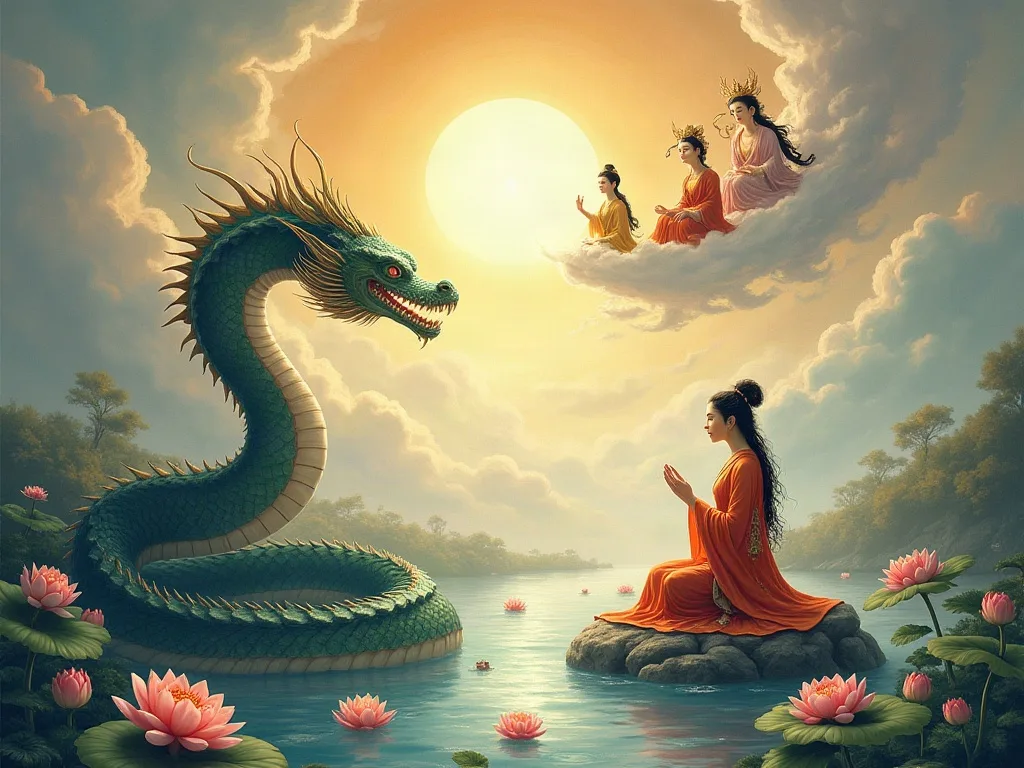
In Mahayana Buddhism (the form dominant in East Asia, Tibet, and Vietnam), nagas are more fully integrated into the pantheon. They appear in major sutras as divine attendants and protectors. The Lotus Sutra, one of Mahayana's most central texts, explicitly mentions nagas among the celestial beings who come to hear the Buddha's teaching. One of the most famous passages describes the Dragon King's daughter (a naga princess) achieving enlightenment instantly upon meeting a bodhisattva. This moment, found in the Lotus Sutra, was revolutionary: it suggested that even a female, even a non-human, could achieve enlightenment swiftly, challenging assumptions about who was capable of wisdom.
In Vajrayana Buddhism (the tantric Buddhism of Tibet), nagas are incorporated into ritual practice. Practitioners may invoke naga protectors during meditation, envisioning them as fierce allies in the transformation of consciousness. Some Tibetan deity forms, particularly wrathful protectors, are depicted with serpent imagery or emerging from nagas. The nagas are understood as forces of raw power and transformation that, when properly understood, accelerate the path to enlightenment.
In Japanese Buddhism, the naga becomes the ryu (竜), a dragon that blends serpentine and draconic features. Japanese temples often feature ryu imagery in their architecture and ritual. The Shingon school of Japanese Buddhism includes ryu in its protective pantheon explicitly. Japanese Buddhist art depicts ryus in rain clouds, suggesting their connection to water, fertility, and cosmic order.
In Chinese Buddhism, the naga is the long (龙), the dragon. Chinese Buddhism absorbed and transformed Indian nagas to fit the existing Chinese dragon mythology, in which dragons are auspicious, cosmic regulators of water and weather. Chinese temples feature dragons prominently as auspicious protectors. The integration was so complete that many Chinese Buddhists who venerate dragons are not always consciously aware they are honoring figures with Indic origins.
Nagas as Enlightenment and Transformation
One of the most profound aspects of naga mythology in Buddhism is the idea that nagas themselves can achieve enlightenment and transcend their serpentine form. This is radical within Buddhist thought: enlightenment is not species-specific. A naga can recognize the dharma, practice it, and ascend beyond the realm of rebirth entirely.
The Pali Canon includes accounts of nagas who became arhats, beings who have achieved the highest level of spiritual attainment and will not be reborn. These texts describe such nagas sometimes choosing to remain in their naga form to protect the dharma, and sometimes choosing to pass into final enlightenment, leaving the world entirely.
This opens a profound theological point: the serpent form is not a punishment or a curse, but a temporary circumstance of birth. A naga's task is to use whatever intelligence and power their form gives them. And if a naga becomes enlightened while remaining a naga, they have achieved something special: enlightenment without needing to change their fundamental nature.
The Lotus Sutra, in one of its most famous passages, describes a bodhisattva named Avalokiteshvara (the embodiment of compassion) teaching a naga princess. Upon hearing the dharma explained, the princess "instantly attained enlightenment" in her naga form, still a female, still a serpent, yet fully awakened. This passage moved countless readers because it suggested that the barriers to enlightenment were less fixed than many assumed.
Nagas and the Protection of Sacred Texts
Throughout Buddhist history, nagas have played a specific protective role: guardians of sacred writings and repositories of knowledge. This reflects both their connection to treasure and wealth, and a deeper symbolic link between nagas and the power of preservation.
In Tibet, where many texts had to be hidden during periods of religious suppression, nagas are sometimes invoked as protectors of hidden teachings. Certain texts are said to be kept in naga realms, waiting for the moment when they can be safely transmitted. This is not merely metaphorical; Tibetan Buddhists who believe in the literal existence of such naga realms also believe these texts are genuinely preserved, protected by spiritual forces beyond human interference.
In India, several important Buddhist sites had guardian nagas. The monastery at Nalanda, once the greatest Buddhist university in the world, was said to have a protective naga king whose realm lay beneath its buildings. When Nalanda was destroyed by invaders in the 12th century, this naga guardian is said to have protected the most sacred texts, keeping them safe for transmission to Tibet and China.
The recovery of the Mahayana Sutra of the Infinite Light in Chinese territory is attributed in some traditions to a negotiation between a monk and a naga king. The monk had cultivated such virtue that the naga agreed to release a copy of the text, allowing it to spread among humans. This narrative places nagas as custodians of wisdom, releasing it when conditions are right, withholding it when humans are not ready.
Naga Symbolism: Water, Fertility, and Cosmic Balance
The persistent link between nagas and water is no accident. In Buddhist iconography and cosmology, nagas symbolize water in all its forms: rain, rivers, lakes, oceans, and also the metaphorical waters of wisdom and transformation.
This connection comes partly from Hindu sources, where nagas are associated with the subterranean waters that feed the earth. When a naga is pleased, rains fall and crops flourish. When a naga is angered, floods devastate the land. This mirrors a reality in the Indian subcontinent: unpredictable water systems were literally matters of life and death.
Buddhism elevates this to a metaphysical level. Water becomes the medium of transformation itself. The same water that quenches thirst also cleanses and purifies. A naga, as a water being, is therefore a figure of purification and renewal. In Buddhist practice, water rituals often invoke or honor nagas, asking for blessing and cleansing.
The fertility association with nagas extends beyond physical agriculture. In some texts, nagas are associated with the fertility of spiritual practice: the ability to produce results, to generate merit, to cause teachings to flourish. A practitioner might invoke a naga's aid in establishing a meditation practice, in the same way that farmers might invoke nagas for rain.
In East Asian Buddhism, particularly in Chinese and Japanese contexts, the dragon naga became so thoroughly integrated with the concept of imperial power and cosmic order that nagas appear on royal regalia, temple roofs, and the borders of formal documents. A naga is an auspicious presence, suggesting blessing and alignment with natural cosmic forces.
The Danger and Wildness of Nagas
Not all naga stories end with the serpent bowing to the Buddha. Some nagas are portrayed as dangerous, difficult beings requiring appeasement or control.
In certain texts, a naga's anger is described as swift and devastating. A naga whose realm is violated, or who is insulted, can unleash floods, poison the water supply, or cause disease. Some Buddhist texts include protective rituals and chants specifically designed to appease angry nagas or to prevent their aggression.
The Atharva Veda, a pre-Buddhist Hindu text, includes chants to protect against snakebite and serpent harm. While Buddhism de-emphasized these protective spells, they reflect the lived reality: ordinary serpents were a genuine threat, and by extension, supernatural serpent beings could not be assumed to be benevolent.
This duality is essential to understanding nagas in Buddhist thought. They are not demons or enemies. But neither are they automatically friendly. They are powerful non-human beings with their own agendas, bound by their own karma (the consequences of their past actions), and capable of both compassion and anger. The Buddha's encounters with nagas work because the Buddha approaches them with respect and understanding, not with force.
One ritual text describes a method for determining whether a naga has been offended: unusual weather patterns, unexpected deaths of livestock, or sickness in children are all interpreted as signs of naga displeasure. The response is never anger but propitiation: the community gathers to make offerings, chant sutras, and request forgiveness.
This reflects a sophisticated ecological awareness embedded in mythology: respect the forces you don't fully control, acknowledge their power, and maintain right relationship with them.
Nagas in Art and Iconography
Buddhist art across centuries portrays nagas with remarkable consistency and variation. The seven-headed cobra with its hood expanded remains the most iconic image. This form appears in:
- Thai and Cambodian temple architecture, where nagas wind along balustrades and crown the tops of buildings.
- Tibetan thangka paintings, where nagas are depicted in subtle colors surrounded by clouds, often in the corners of compositions showing scenes of Buddhist practice.
- Chinese Buddhist art, where the dragon naga blends serpentine and draconic features, depicted in clouds and water.
- Japanese Buddhist sculpture, where ryu appear in temple carvings and on ritual objects like bells.
One of the most famous artistic representations is the Mucalinda protecting the Buddha. This scene has been rendered countless times across Asia: the Buddha in meditation beneath the tree, the naga's hood forming a shelter, rain falling, the moment of absolute peace surrounded by absolute protection. The image conveys what words cannot: the certainty that when truth appears, protection follows.
Another significant artistic motif is the naga jewel or mani, the pearl or gem that nagas carry. In some depictions, a naga is shown holding a glowing orb. This jewel symbolizes enlightenment itself, or sometimes specific teachings that the naga guards. A practitioner seeking such wisdom is sometimes depicted bowing before the naga, requesting its teaching.
The naga king Vasuki is sometimes depicted coiled around sacred mountains or forming the boundary between realms. His five-hooded form (in some depictions) or his massive serpentine body suggests infinite power under perfect control.
Nagas and Modern Buddhist Practice
In contemporary Buddhism, how nagas function varies widely depending on tradition and geography. In Southeast Asian Theravada Buddhism, naga veneration remains active. Thai monks might make specific offerings to nagas during the rainy season, asking for measured rains and good harvests. Some Thai monasteries maintain shrines where practitioners can leave offerings specifically directed toward naga protection.
In Tibetan Buddhism, nagas are part of formal ritual practice. The ritual text Naga Offering is chanted in many Tibetan temples. This is not worship but a form of respect and reciprocal relationship: humans honor the nagas, make offerings, and request their protection and blessing in return.
In Japanese Buddhism, dragon veneration through naga-derived practices continues, often blended with indigenous Shinto veneration of kami (spirits). Many Japanese temples have a room dedicated to water rites where practitioners can honor the water kami and by extension, the water dragons.
In Western Buddhism, nagas are sometimes treated as mythological rather than literal beings. Yet even practitioners who approach them as symbols recognize their power. The naga becomes a symbol of the untamed forces of nature and consciousness, the wildness that enlightenment can embrace without dominating.
Frequently asked questions about Nagas: Serpent Deities and Protectors of Buddhist Teachings
Frequently asked questions
Are nagas real beings or symbolic figures in Buddhism?
Buddhist texts treat nagas as real beings inhabiting realms that exist alongside the human world, not as pure metaphors. Whether contemporary Buddhists interpret them literally or symbolically varies by tradition: Theravada Buddhism tends to leave open whether nagas exist as physical entities; Mahayana and Vajrayana Buddhism more openly assert their reality. What matters in practice is that nagas deserve respect and can influence human affairs, whether understood as literal beings or as expressions of natural and psychological forces.
Can nagas achieve enlightenment in Buddhist teaching?
Yes, definitively. The Pali Canon and all major Buddhist schools teach that nagas can recognize the dharma, practice it, and achieve enlightenment, ultimately escaping the cycle of rebirth. The Lotus Sutra's account of the dragon king's daughter achieving instant enlightenment is one of Buddhism's most famous illustrations of this principle.
Why are nagas associated with water in Buddhist mythology?
Nagas are described as dwelling in underground realms and waters, from underground springs to rivers to the ocean. This connection reflects both practical reality (water systems in South Asia are unpredictable and life-giving) and metaphysical meaning: water symbolizes purification, transformation, and the flow of wisdom. In Buddhist cosmology, a naga's connection to water extends to fertility, blessing, and the conditions necessary for spiritual practice to flourish.
What is the relationship between Hindu nagas and Buddhist nagas?
Buddhism inherited naga mythology from pre-existing Hindu and Vedic traditions, where serpent beings already ruled underground kingdoms and guarded treasure. Buddhism transformed them: rather than being primarily obstacles or forces requiring appeasement, Buddhist texts present nagas as beings capable of wisdom and protection. Many of the same naga kings appear in both Hindu and Buddhist sources (like Vasuki), but their roles and significance shift according to Buddhist ethics and cosmology.
How do different Buddhist cultures portray nagas differently?
Theravada Buddhism (Southeast Asia) maintains close adherence to early texts, viewing nagas as powerful non-human beings deserving respect but not worship. Mahayana Buddhism (East Asia) more fully integrates nagas into ritual and cosmology, often with higher status. In Tibet, nagas are part of protective ritual practice. In China and Japan, nagas evolved into dragons (long and ryu respectively), blending with indigenous dragon mythology. All traditions, however, recognize nagas as protectors and beings capable of enlightenment.
What role did nagas play in preserving Buddhist texts?
According to Buddhist tradition, nagas guarded sacred scriptures during periods of danger or when humans were not ready to receive them. The most famous example involves the Lotus Sutra, which Mahayana Buddhism teaches was preserved in naga realms before being transmitted widely to humans. This narrative reflects a broader Buddhist idea that nagas are custodians of wisdom, releasing teachings when conditions allow.
Nagas Beyond Buddhism: Echoes in Global Mythology
The naga figure, so thoroughly Buddhist and Hindu in its origin, has echoed across cultures and millennia. Whether through trade, cultural transmission, or the seemingly universal human fascination with serpents as symbols of power and transformation, naga-like beings appear throughout the world.
In Islamic mysticism, particularly in Sufism, serpent figures emerge as symbols of divine wisdom and the path of self-annihilation. The serpent in Islamic tradition is more often associated with temptation than enlightenment, yet Sufi poets sometimes invert this to suggest that the serpent's knowledge is precisely the dangerous wisdom needed for spiritual transformation.
In Western alchemy and esoteric traditions, the serpent consuming its own tail (the ouroboros) carries meanings strikingly similar to naga symbolism: eternal return, transformation, the unity of all things. Medieval European bestiaries included descriptions of serpents and dragons that, while not directly influenced by Buddhist sources, suggest that humans across cultures recognize serpents as liminal, transformative beings.
The literary and artistic reception of nagas in modern culture remains vibrant. Contemporary Buddhist artists across the world depict nagas with fresh energy. Some visualize them through a lens of environmental concern: nagas as symbols of respect for waters threatened by human activity. Others use naga imagery to explore questions of identity and transformation. The figure remains alive, not as a relic but as an active element of how humans understand power, wisdom, and the boundary between the human world and everything beyond it.
Nagas remind us of something fundamental to Buddhism: enlightenment is not opposed to wildness or power, but a refinement of it. Even a serpent, a creature defined by alien nature and potential danger, can recognize wisdom and choose to serve it. This principle, embedded in countless stories across two millennia and multiple cultures, suggests that Buddhism held a fundamentally optimistic view of consciousness itself: that awareness and compassion can emerge anywhere, in any form, if given the right conditions and the right teacher.
Read the full book
Want the whole story?
The complete edition is an instant PDF download here, with a paperback on Amazon for selected titles.
Buddhist
The Buddhist Mythology Book: Mara, Avalokiteshvara, Mahakala, and the Sacred Cosmology Beyond Meditation
Demons, Bodhisattvas, and the Cosmic Architecture of Buddhism
The mythological layer of Buddhism: Mara's temptation, the Bodhisattvas, Vajrayana fierce deities, the Eight Hells, Mount Meru, and the Jataka tales. Delivered within 24 hours of purchase.
More from Buddhism
All articles
Buddhism
Vesak: The Festival Celebrating Buddha's Birth, Enlightenment, and Death
Vesak marks the three most pivotal moments in Siddhartha Gautama's life, all on a single day. Discover how Buddhists across Asia transform this holy date into a festival of light, moral renewal, and collective remembrance of the Buddha's journey to awakening.
Buddhism
Tara: The Mother of Liberation in Mahayana Buddhism
Tara embodies compassion in action, the Tibetan Buddhist goddess who hears suffering and moves to end it. Known as the Mother of Liberation, she appears in multiple forms, each one a different answer to human need.

Buddhism
The Lotus Sutra: Sacred Text of Universal Buddhahood
The Lotus Sutra teaches that every being, no matter how lost, can achieve buddhahood. Discover how Buddhism's most beloved scripture rewrote enlightenment and shaped a thousand years of practice.
Buddhism
The Six Realms of Samsara: Buddhist Cosmology and Rebirth
Buddhist cosmology maps existence across six realms of rebirth, from heavens where joy becomes suffering to hells where torment teaches detachment. Discover how this ancient map of consciousness shapes Buddhist ethics and practice.