
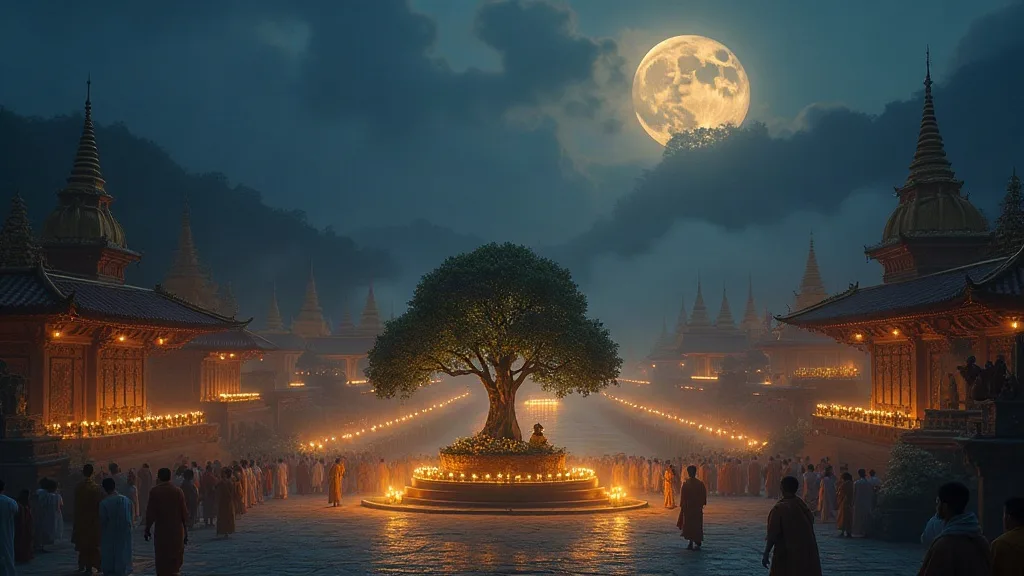
Vesak: The Festival Celebrating Buddha's Birth, Enlightenment, and Death
Vesak marks the three most pivotal moments in Siddhartha Gautama's life, all on a single day. Discover how Buddhists across Asia transform this holy date into a festival of light, moral renewal, and collective remembrance of the Buddha's journey to awakening.
Contents
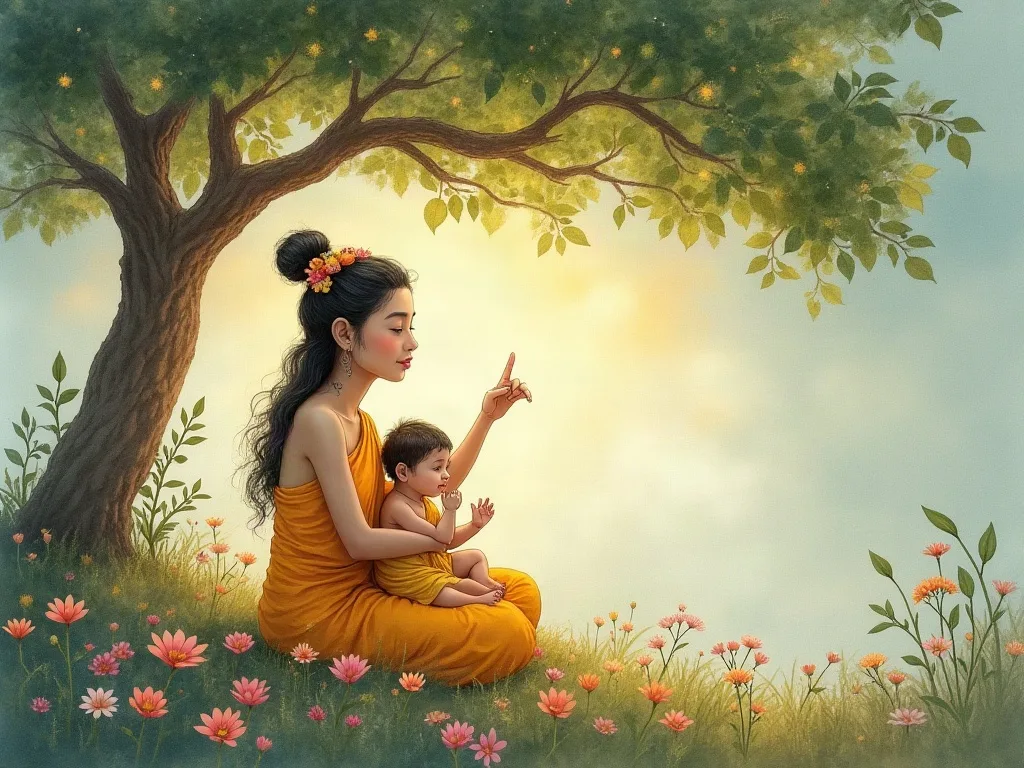
In a garden in northern India, sometime around 500 BCE, a child was born beneath a sal tree. His mother, Queen Maya, held him aloft; he took seven steps and declared he would end suffering. That boy became the Buddha, and in one extraordinary day each year, millions of Buddhists worldwide commemorate his arrival, his enlightenment, and his death, all celebrated together as Vesak, the festival of the Buddha's life.
No other festival condenses such profound spiritual weight into a single observance. For nearly 2,500 years, Vesak has drawn Buddhists from Thailand to Tibet, from Japan to Sri Lanka, into temples and streets to mark the arc of a single human being's transformation into an awakened one. It is the most important date on the Buddhist calendar, celebrated with incense, flowers, processions, and the symbolic bathing of the Buddha's image. Yet most of the world barely knows its name.
The Three Moments in One Day
Vesak's power rests on a singular convergence: the same lunar date that witnessed the Buddha's birth also marked his enlightenment and his final passing into nirvana. This may seem a cosmological coincidence, but Buddhist tradition reads it as profound necessity. The cycle of a life devoted entirely to liberation, compressed into one sacred day.
The Buddha, born Siddhartha Gautama, entered the world on the full moon day of the month of Vaisakha (a lunar month in spring, roughly April or May in the Western calendar). This was his birth, called Lumbini in Sanskrit texts because his mother delivered him in the Lumbini Grove in what is now Nepal. Twenty-nine years later, on the same lunar date, he sat beneath the Bodhi tree in Bodh Gaya and achieved enlightenment, the awakening that made him the Buddha. And forty-five years after that enlightenment, on the identical date, he lay down between two sal trees in Kushinagar and entered parinirvana, the final release from the cycle of rebirth.
Three events. One date. No escaping the symbolic logic: birth, awakening, and transcendence aligned by what Buddhists understand as cosmic destiny.
The historical evidence for these exact dates is disputed among scholars. Medieval Buddhist texts, particularly the Pali Canon (the oldest written record of the Buddha's teachings, compiled several centuries after his death), fix this triple anniversary. Western historians note that we cannot be certain of the precise year the Buddha lived, let alone the exact day. Some scholars place him in the 6th century BCE, others in the 5th. But the mythic and devotional truth matters more than historical precision here: for practicing Buddhists, Vesak is the day that holds the entire arc of enlightenment.
How Vesak Is Celebrated Across the Buddhist World
Vesak manifests differently across regions and schools, yet the core rituals are recognizable everywhere: bathing the Buddha's image, taking vows, circumambulating temples, releasing captive animals, and offering flowers and light.
The Bathing of the Buddha
The most iconic ritual is the bathing ceremony. In temples across Asia, a small statue of the infant Buddha is placed in a specially prepared basin or shrine. Devotees line up to pour scented water (often mixed with fragrant oils or flower petals) over the figure while chanting or praying. This act reenacts Queen Maya's first bathing of her newborn, but it also carries a deeper meaning: each person who participates washes away their own defilements and rededges themselves to the path of ethics and mindfulness.
In Sri Lanka, the Vesak season (which can stretch over days) fills temples with thousands. The National Vesak Celebrations in Colombo draw crowds rivaling a major sporting event. In Thailand, water is shared not just with statues but among the entire community. The pouring of water becomes a blessing, and in the heat of the Thai spring, the festival takes on a carnival energy. Children drench their elders; strangers splash playfully at strangers. The boundary between sacred and celebratory blurs.
Light and Lanterns
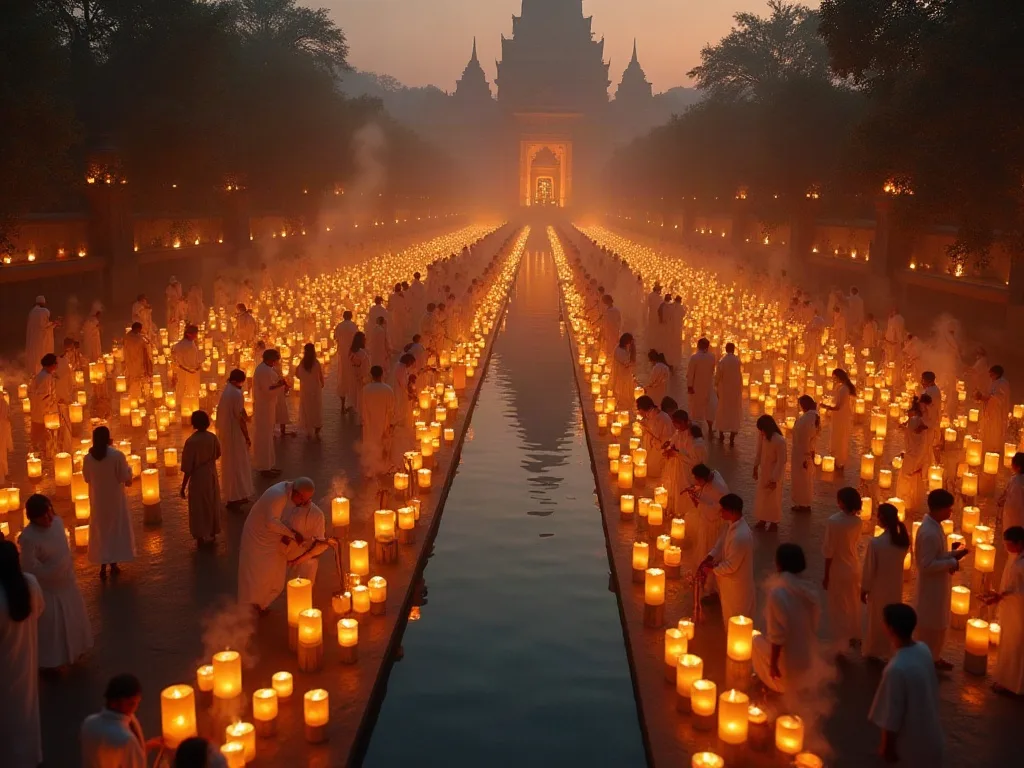
Buddhists illuminate the darkness with lanterns, candles, and electric bulbs strung across temple courtyards and rooftops. In countries like Thailand and Laos, enormous cylindrical lanterns made of paper are erected, some standing as tall as a house. These lai kratip (Lao) or decorative arches in Thailand may depict scenes from the Buddha's life or abstract patterns of light. When night falls, entire neighborhoods glow.
The symbolism is explicit: light represents wisdom breaking through ignorance. The Buddha's enlightenment is a radiant explosion of understanding. Vesak becomes a festival where the physical landscape mirrors inner awakening.
Processions and Circumambulation
In countries such as Sri Lanka, Malaysia, and Singapore, Vesak processions move through the streets at night, often lit by thousands of candles. Floats depicting the Buddha's birth, the Bodhi tree, and scenes of his teaching roll slowly through towns. Monks in saffron robes walk behind, chanting sutras (Buddhist sacred texts). Devotees follow, many carrying flowers or incense, turning the procession into a moving meditation.
The procession serves a public function too: it reminds the entire city of the Buddha's existence and teachings. It is not hidden within temple walls but spilled into the shared space of the streets. Non-Buddhists often participate or watch respectfully, understanding that they are witnessing something holy.
Moral Renewal and the Five Precepts
Vesak is a day of intensified ethical commitment. Many Buddhists take or renew the Five Precepts, the basic moral vows of Buddhism: abstaining from killing, stealing, sexual misconduct, false speech, and intoxicants. Some take these vows for the day only; others recommit to them as a lifelong practice.
This is not punishment or guilt-driven repentance. It is a positive turning toward the Buddha's example. By vowing to live as the Buddha taught, devotees align themselves with the path he walked.
The Buddha's Life in Buddhist Texts and Memory
Understanding Vesak requires knowing the narrative the festival carries. The story of the Buddha exists in multiple textual traditions, each adding layers of meaning and legend.
The earliest accounts come from the Pali Canon, particularly the Jataka tales (stories of the Buddha's previous lives) and biographical texts like the Mahavastu. These were composed centuries after Siddhartha's death but preserve what scholars believe are old oral traditions. The Buddha's biography in these texts is not a simple chronology; it is a spiritual teaching encoded in narrative.
Birth and Renunciation
The Buddha was born a prince, Siddhartha Gautama, in the kingdom of the Shakyas (in present-day Nepal and northern India). His father, King Suddhodana, sheltered him in a palace, determined that his son would become a great ruler, not a wandering ascetic. Queen Maya died seven days after his birth, a detail that Buddhist texts read as her release from the cycle of rebirth, her task of bearing the Buddha complete.
The young prince grew up in luxury, insulated from suffering. But at age twenty-nine, Siddhartha encountered four sights that shattered his isolation: an old man bent with age, a sick person wracked with disease, a corpse being carried to cremation, and a wandering ascetic who had renounced the world. These encounters, known as the Four Sights, awakened him to the reality of suffering that all humans face.
That night, Siddhartha left the palace, leaving behind his wife, Yashodhara, and his young son, Rahula. This was not portrayed as abandonment in the Buddhist tradition but as the ultimate act of compassion: the Buddha's future teachings would liberate not just his family but all beings from suffering.
The Enlightenment
For six years, Siddhartha practiced extreme asceticism, nearly starving himself in the belief that mortification would yield insight. But insight did not come. One day, a wandering ascetic offered him a bowl of milk rice (a simple, nourishing meal), and Siddhartha accepted. This act of accepting nourishment after rejecting it for so long became a teaching in itself: the Middle Way, the path between indulgence and self-denial.
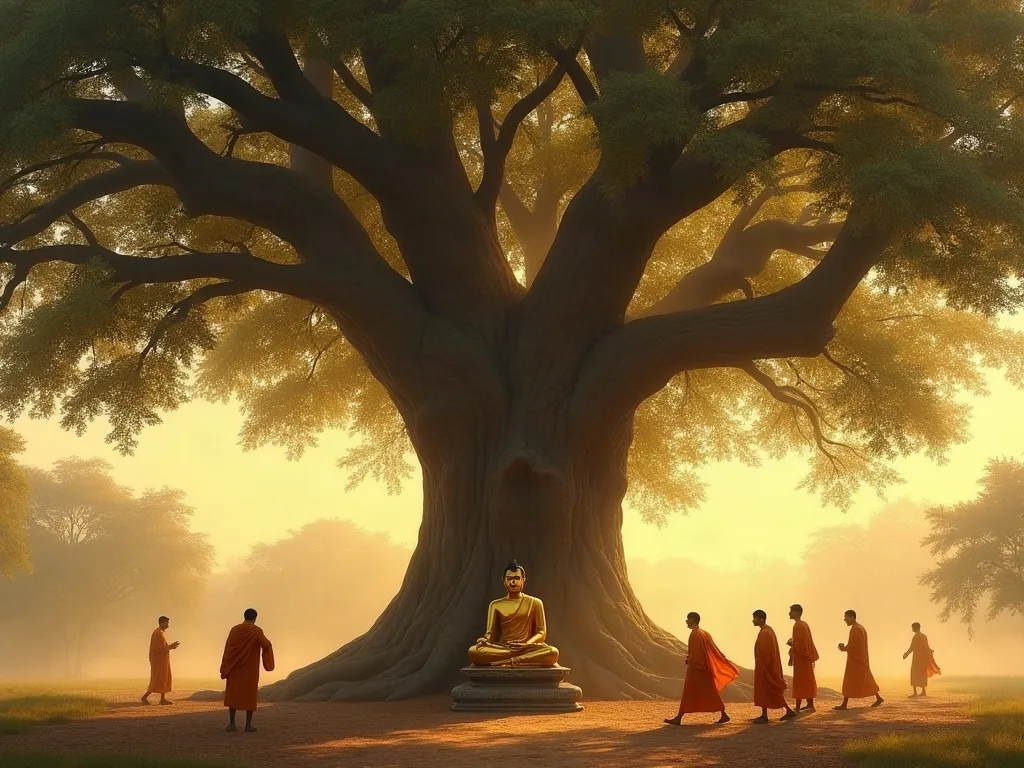
He then sat beneath the Bodhi tree (the "tree of awakening") in Bodh Gaya and vowed not to rise until he had understood the nature of suffering and the way to transcend it. Throughout the night, he was assailed by Mara, a demon-figure representing delusion and attachment. Mara sent armies of monsters, temptations of desire, and assaults of fear. But Siddhartha remained unmoved, his mind settling deeper into meditation.
At dawn, as the morning star rose, Siddhartha's mind exploded into clarity. He understood the Four Noble Truths: that suffering exists, that suffering has a cause (craving and attachment), that suffering can end, and that there is a path to that ending. He became the Buddha, the "Awakened One," at that moment.
Forty-Five Years of Teaching
The Buddha then spent forty-five years wandering across northern India, teaching. He had no fixed home, no central authority, no written scripture during his lifetime. He taught differently to different people, adapting his message to what each person could understand. To monks, he taught profound philosophical truths. To farmers and merchants, he taught practical ethics and the cultivation of mind. His teachings were always aimed at alleviating suffering.
The Buddha accepted women as monks, broke caste boundaries by welcoming people from all social classes, and built a monastic community (the Sangha) that would preserve his teachings long after his death. When his death came, he instructed his followers not to grieve but to recall his teachings and to become lamps unto themselves, each person responsible for their own awakening.
Vesak Across Different Buddhist Traditions
Buddhism split into many schools and regions, yet Vesak remains universally recognized. However, the emphasis and practice vary.
Theravada Buddhism (Southeast Asia)
In countries like Thailand, Sri Lanka, Myanmar, and Cambodia, Vesak is a major national holiday. The Theravada school, which emphasizes the earliest teachings and the ideal of individual enlightenment, celebrates Vesak with particular fervor. Temples are cleaned and decorated. Food is offered to monks. There is often a vegetarian feast. The night processions with thousands of candles are especially prominent in this tradition.
In Sri Lanka, Vesak is a public holiday called Vesak Poya. The country essentially shuts down for observance. Temple visits spike, and families gather to listen to sermons and share meals. The Perahera, a grand procession in Colombo, draws international visitors.
Mahayana Buddhism (East Asia)
In Japan, China, Vietnam, and Korea, Vesak (called Hanamatsuri in Japan, meaning "Flower Festival") is also widely observed, though the date may vary. The Mahayana tradition, which emphasizes the Buddha's continued presence through celestial Buddhas and the possibility of enlightenment for all beings, celebrates with flowers and elaborate temple decorations. In Japan, children participate in a ritual called Kanbutsu-e, where they pour sweetened tea (representing the first bath) over a small Buddha image.
Tibetan Buddhism
In Tibet and among Tibetan Buddhists, Vesak is called Saga Dawa, and it is considered the most sacred month. The festival extends beyond a single day to encompass the entire month of Vaisakha. Pilgrims circle holy mountains (particularly Mount Kailash and Lhasa's Jokhang Temple) in unprecedented numbers. The circumambulation of sacred sites, called kora, is believed to be especially meritorious during this period. Monks perform elaborate rituals, and lay Buddhists engage in intensive practice and moral renewal.
The Symbolism Woven Through Vesak
Every element of Vesak carries meaning rooted in Buddhist philosophy.
Light represents wisdom and the dispelling of ignorance. The Buddha is often called the Light of the World in Buddhist texts. By illuminating temples and cities during Vesak, Buddhists enact their aspiration to bring clarity and understanding to all beings.
Water symbolizes purification. The bathing of the Buddha's image washes away defilements and renews the commitment to ethical living. The literal act of pouring water mirrors the internal process of washing away greed, hatred, and delusion.
Flowers represent the transience and beauty of existence. The Buddha taught that all conditioned things are impermanent. By adorning temples with flowers that will wilt and die, Buddhists contemplate this fundamental truth. Flowers also symbolize the unfolding of the Buddha's wisdom, blooming like a lotus from the mud of ignorance.
Processions enact community and collective devotion. By moving together through streets, the community declares that the Buddha's path is not private but shared. The procession is both a celebration and a witness.
Vesak in the Modern Era
Today, Vesak faces both globalization and localization. In majority-Buddhist countries like Thailand and Sri Lanka, it remains a public holiday integrated into national identity. In Buddhist diaspora communities across Europe, North America, and Australia, Vesak has become a way for immigrant communities to maintain connection to their heritage. Many cities now hold Vesak celebrations organized by Buddhist societies, with participation from curious non-Buddhists.
The United Nations recognized Vesak in 1999, designating it as an international day of observance. This recognition reflects Buddhism's growing visibility in the global consciousness, though it also raises questions: Does official sanction dilute the spiritual essence? Does internationalism rob it of local meaning?
Different communities answer differently. Some embrace Vesak as a tool for interfaith dialogue and education. Others insist on the festival's fundamentally Buddhist character. Most threads together: Vesak remains, in every iteration, a day when Buddhists pause to honor the Buddha's journey and to recommit themselves to his vision of a world free from unnecessary suffering.
Frequently asked questions about Vesak?
Frequently asked questions
What is the difference between Vesak and other Buddhist holidays?
Vesak is the most important date on the Buddhist calendar because it commemorates three moments simultaneously: the Buddha's birth, enlightenment, and final death. Other Buddhist holidays celebrate more specific or regional events. For example, Bodhi Day (celebrated primarily in East Asia) focuses solely on the enlightenment, while Asalha Puja marks the Buddha's first sermon. Vesak's triple significance makes it universal across all Buddhist schools.
Why is Vesak celebrated on the same day across so many different countries?
Vesak is observed on the full moon day of the lunar month of Vaisakha (roughly April or May), following the lunar calendar that most Asian cultures traditionally used. However, some regions convert this to different Western dates: Japan celebrates on April 8, while China and Vietnam may observe it in May or even October. The lunar basis ensures the festival remains tied to the same celestial moment it has honored for 2,500 years, even as calendar systems evolve.
What is the significance of bathing the Buddha statue during Vesak?
The bathing ritual commemorates the first bath Queen Maya gave her newborn son. But it carries deeper meaning: each person who pours water over the statue symbolically cleanses themselves of greed, hatred, and delusion, the three poisons in Buddhist philosophy. The scented water sanctifies the act, turning a simple gesture into a profound commitment to ethical living and mental purification.
Is Vesak celebrated the same way in every Buddhist country?
No. While core elements like bathing the Buddha's image, taking moral vows, and illuminating temples appear across traditions, the emphasis and scale vary. Thailand and Sri Lanka make Vesak a nationwide event with public holidays and large processions. Japan emphasizes flowers and temple rituals. Tibet observes an entire month of heightened practice rather than a single day. These variations reflect how Buddhism adapted to local cultures while preserving the festival's essential meaning.
Who was the Buddha, and why do Buddhists revere him during Vesak?
The Buddha, born Siddhartha Gautama around the 5th century BCE in what is now Nepal, was a human being who achieved enlightenment through meditation and ethical living. He is not worshipped as a god in most Buddhist traditions but revered as an awakened teacher who showed the path to liberation from suffering. Vesak honors him not as a divine being but as the supreme exemplar of what any human can achieve through dedication to insight and compassion.
The Buddha's Legacy and Vesak's Enduring Power
The Buddha died over 2,400 years ago, yet his teachings remain alive in the minds of roughly 500 million Buddhists worldwide. Vesak is the festival that connects them all to that distant figure beneath the Bodhi tree and to the journey he undertook to free himself and all beings from suffering.
What makes Vesak remarkable is not its grandeur of spectacle, though some celebrations are breathtaking, but its consistency of purpose. Whether in a bustling Thai temple or a quiet meditation hall in Berlin, when Vesak arrives, Buddhists perform similar acts: they light lamps, they pour water, they renew their vows. They are not commemorating a myth but honoring a path that remains open and available to anyone willing to walk it.
The festival also highlights something often missed about Buddhism: despite its reputation as ascetic and austere, it has always been deeply woven into community and celebration. Vesak proves that Buddhism is not purely individual but collective, not joyless but full of beauty and gathering. The flowers, the light, the shared meals, the processions through the streets, the children's laughter in temple courtyards, all of these are as Buddhist as meditation.
For Buddhists, Vesak is both a looking backward and a looking forward. It honors the Buddha's achievement while inviting each practitioner to undertake their own journey. The festival asks: Can you, too, see clearly? Can you, too, awaken? Can you, too, contribute to a world where suffering is diminished? These questions, asked every Vesak for nearly two and a half millennia, have yet to lose their power to move the human heart.
Read the full book
Want the whole story?
The complete edition is an instant PDF download here, with a paperback on Amazon for selected titles.
Buddhist
The Buddhist Mythology Book: Mara, Avalokiteshvara, Mahakala, and the Sacred Cosmology Beyond Meditation
Demons, Bodhisattvas, and the Cosmic Architecture of Buddhism
The mythological layer of Buddhism: Mara's temptation, the Bodhisattvas, Vajrayana fierce deities, the Eight Hells, Mount Meru, and the Jataka tales. Delivered within 24 hours of purchase.
More from Buddhism
All articles
Buddhism
Tara: The Mother of Liberation in Mahayana Buddhism
Tara embodies compassion in action, the Tibetan Buddhist goddess who hears suffering and moves to end it. Known as the Mother of Liberation, she appears in multiple forms, each one a different answer to human need.

Buddhism
The Lotus Sutra: Sacred Text of Universal Buddhahood
The Lotus Sutra teaches that every being, no matter how lost, can achieve buddhahood. Discover how Buddhism's most beloved scripture rewrote enlightenment and shaped a thousand years of practice.
Buddhism
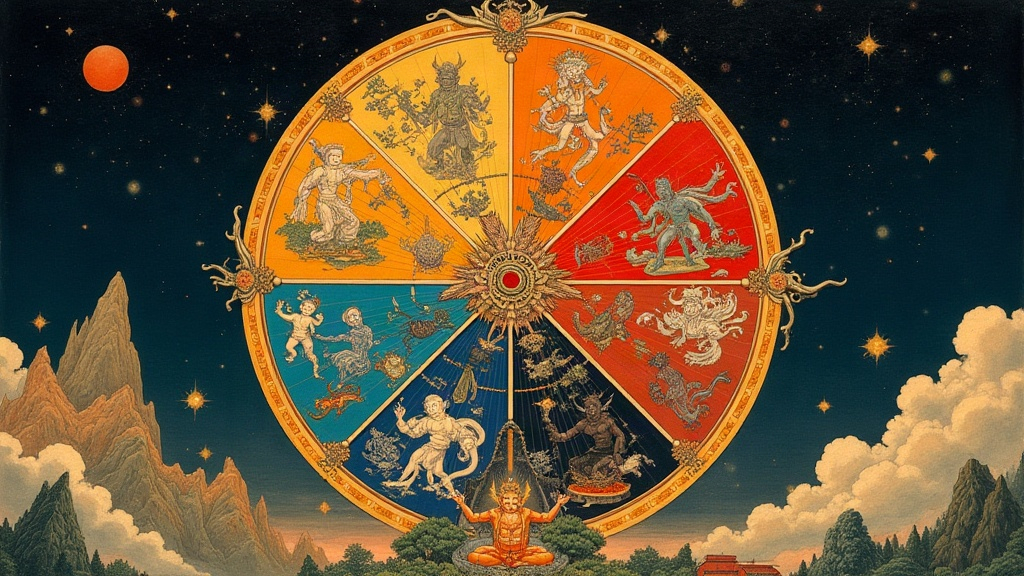
The Six Realms of Samsara: Buddhist Cosmology and Rebirth
Buddhist cosmology maps existence across six realms of rebirth, from heavens where joy becomes suffering to hells where torment teaches detachment. Discover how this ancient map of consciousness shapes Buddhist ethics and practice.

Buddhism
Nagas: Serpent Deities and Protectors of Buddhist Teachings
Nagas are divine serpents woven through Buddhist mythology as guardians of dharma, possessors of cosmic wisdom, and agents of transformation. Discover how these shape-shifting beings became central to Buddhist practice across Asia.