
Mara: The Demon of Desire and Death in Buddhist Mythology
Mara is the Buddhist demon who embodies desire, delusion, and the fear of death itself. He tempted the Buddha at the moment of enlightenment and rules the realm of rebirth. Explore his nature, his mythology, and why he remains Buddhism's most intimate adversary.
Contents
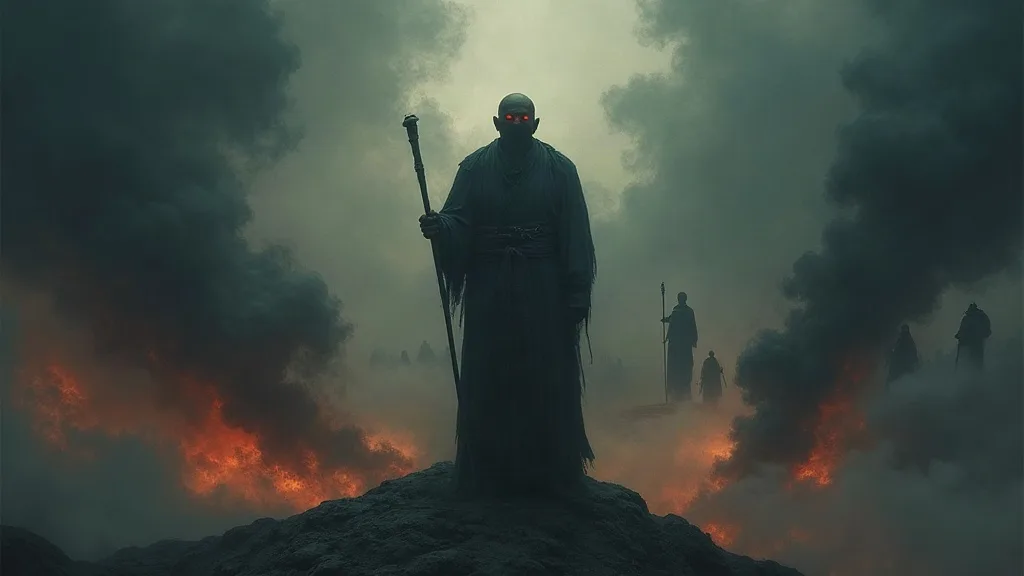
In the moment when Mara: The Demon of Desire and Death should have claimed his greatest victory, he instead witnessed his most absolute defeat. The Buddha, a man named Siddhartha Gautama, sat beneath a Bodhi tree and prepared to cross the threshold into enlightenment. Mara did not accept this quietly. He summoned armies of demons, hurled mountains of flame, sent seductions in the form of beautiful women, and whispered doubts that would shatter any mortal mind. Yet the Buddha did not move. When Mara finally retreated, it was not because the Buddha had conquered him with force. The Buddha had simply seen through him, the way light exposes shadow as nothing more than the absence of itself.
This is the central paradox of Mara's story. He is not a distant enemy, not some external tempter imprisoned in a distant hell. Mara embodies the very forces that keep all sentient beings trapped in cycles of suffering. He is desire unexamined, the clinging to life, the denial of impermanence, the delusion that a separate self can endure forever. To encounter Mara is to encounter your own deepest resistances to awakening. To defeat him requires not violence but clarity.
Who is Mara in Buddhist Cosmology
Mara (Mara in Sanskrit and Pali) translates loosely as "death" or "killer," but the name carries layers. He is the lord of Kamadatu, the Desire Realm, the lowest and most densely populated of the three realms in Buddhist cosmology. Above the Desire Realm sits the Form Realm, where beings have material bodies but no sexual desire. Above that sits the Formless Realm, where even matter dissolves. Mara does not rule these higher realms, and this fact wounds his pride continually.
In the texts, especially the Sutta Pitaka (the collection of Buddha's discourses), Mara is given a genealogy. He is the son of Dhamma and grandson of the universe itself. In some accounts, he was once a deva, a celestial being of great power, who through pride and attachment to his position in the Desire Realm became something other. He did not fall into evil through malice so much as through the refusal to see beyond his own desires. This refusal crystallized into a nature: Mara became the embodiment of grasping, denial, and the will to endure at any cost.
He has retinues. Armies of demons serve him, generated by his own mental power and the collective mental formations of beings still trapped in the Desire Realm. These demons are not independent creatures but extensions of Mara's will, manifestations of greed, hatred, and delusion. When Mara appears in the sutras, he sometimes speaks; when he commands his armies, they move as one organism.
Mara also has daughters, whose names recur in Buddhist texts with dark elegance: Rati (desire), Arati (discontent), and Tanha (craving). These are not mere female characters; they represent the psychological mechanisms through which he ensnares beings. Rati is the seduction of pleasure; Arati is the despair that follows pleasure's loss; Tanha is the endless thirst that can never be satisfied. Together, they form a trinity of suffering that Mara has perfected across countless ages.
The Temptation of the Buddha
The most famous encounter between Mara and a spiritual aspirant occurs in the night of the Buddha's awakening, roughly 2,500 years ago. The texts describing this event appear in numerous Buddhist canons, with variations that show how different schools understood Mara's nature.
Siddhartha had abandoned his princely life six years prior. He had fasted, meditated, practiced every austerity known to the mendicant traditions of ancient India. Yet awakening eluded him. On the night he determined to sit beneath the Bodhi tree and not rise until he had achieved liberation or died, something shifted. As his meditation deepened, as he moved through the jhanas (meditative absorptions) that trained beings enter when the mind stills completely, Mara sensed a threat.
Mara appeared first in splendor, riding upon an elephant, flanked by armies numbering in the millions according to some texts. He hurled weapons: clubs of flame, discs of razor-sharp light, torrents of sand and mud and water. None of them touched Siddhartha. The weapons fell around him like flower petals, the mud became fragrant, the water became cool. Mara's armies could not pierce the field of concentration that had formed around the meditator.
Mara then shifted tactics. If force could not work, seduction might. He sent beautiful women, apsaras (celestial dancers), to distract Siddhartha with music and charm. These were not merely physical temptations; they represented attachment, the craving for sensory pleasure that keeps beings bound to existence. Siddhartha did not turn away in disgust; he simply observed them without grasping. His mind remained clear.
Finally, Mara approached directly and made his most cutting attack: doubt. He questioned Siddhartha's very right to seek awakening. "You are not a spiritual being," Mara is recorded as saying. "You are a man, of lowborn status, with no teacher to guide you, no community to support you. How can you possibly achieve what countless ascetics before you have failed to achieve?" This is Mara's deepest weapon: the suggestion that the person seeking liberation is fundamentally inadequate, that the quest itself is futile.
Yet the Buddha responded not with rejection but with acknowledgment. He reached down and touched the earth. In that gesture, he invoked the earth itself as a witness to his previous lives of spiritual practice, his accumulated merit and resolve across countless existences. The earth trembled. Mara, seeing this, understood that his time was finished. He departed, defeated not because the Buddha had fought him but because the Buddha had seen through every layer of illusion Mara could generate.
This event, called the Mara-Vijaya (the victory over Mara), became the template for how Buddhists understood spiritual struggle. It was not conquest through force but liberation through clarity. Every being faced Mara; every being could overcome him by seeing his true nature: a pattern of craving with no substance, a momentum of denial mistaken for existence.
The Nature of Mara's Power
Mara is not a tempter in the Abrahamic sense, offering you something you secretly want while hiding its cost. He works by a more subtle mechanism. He presents seduction and terror, yes, but beneath these lies a more fundamental operation: he obscures the fundamental nature of reality. He makes impermanence appear permanent, makes the aggregation of body, sensations, perceptions, mental formations, and consciousness appear to be a unified self, makes suffering appear to be pleasure or at worst an acceptable price for existing.
In the Dhammapada, the Buddha's teachings recorded in verse, Mara is described as stalking beings like a hunter stalking prey. But the hunter succeeds only because the prey does not recognize the snare. A being who truly grasps the nature of impermanence, who genuinely understands that no phenomenon within the Desire Realm can provide lasting happiness, has already slipped the noose. Mara cannot bind such a being. His daughters, Rati and Arati and Tanha, lose all power over them.
This is why in Buddhist psychology, Mara is sometimes understood not as an external being at all but as a metaphor for the forces of ignorance that arise within the mind itself. The advanced meditator might encounter Mara as a vivid, personal apparition; the philosophical commentator might speak of Mara as a principle. Both are true, in the Buddhist understanding. The external and internal are not separate. Mara manifests wherever there is craving, aversion, and delusion.
The texts also describe Mara as profoundly unhappy, despite his dominion over the Desire Realm. He is a deva, a being of great celestial power and longevity, yet he cannot accept the fact that even his realm will one day dissolve. All compounded things are impermanent; even the Desire Realm will eventually collapse in a cosmic cycle. This knowledge gnaws at Mara. His endless scheming, his obsession with preventing beings from escaping his realm, is itself a form of suffering. He is caught in the same trap as every other being, but he refuses to acknowledge it.
Mara's Armies and Retinues
Mara does not act alone. The texts describe him as commanding vast legions of demons (asuras, yakshas, pretas, kumbhandas), each with specific roles in the machinery of delusion. These are not merely allegorical. In Buddhist cosmology, these are real beings, born into realms corresponding to their karmic nature, serving Mara because they themselves are trapped in craving and hostility.
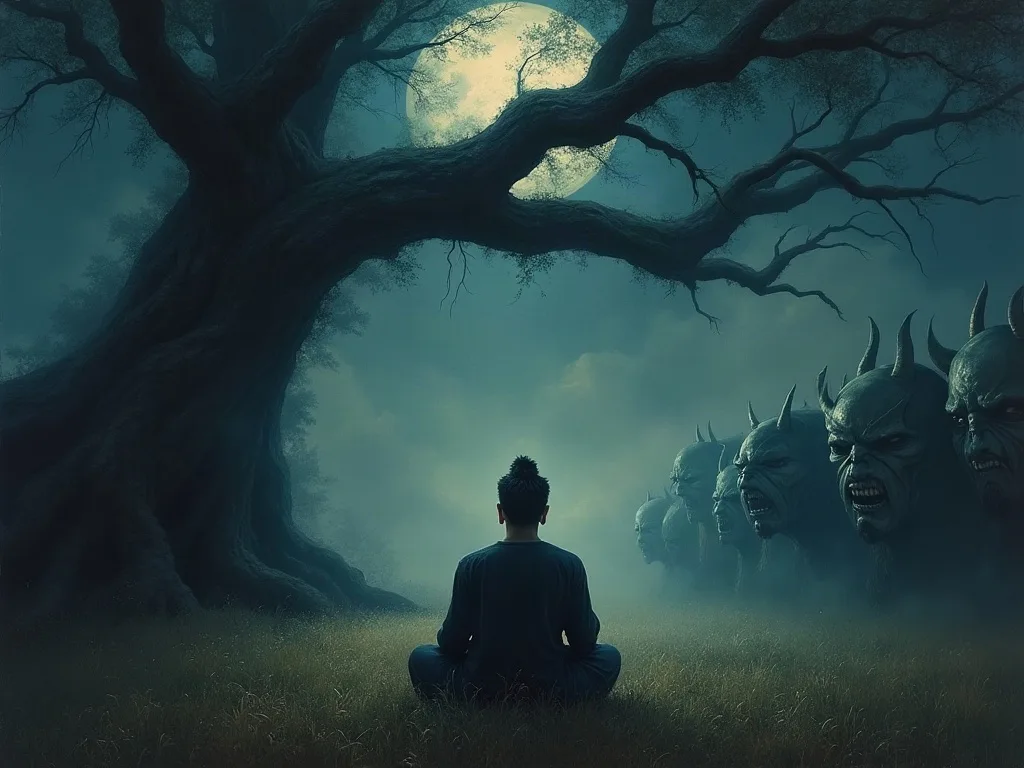
Some demons represent specific obstacles to practice: the demon of sleepiness (thinamiddha), the demon of restlessness (uddhacca), demons of doubt, of sensory craving, of ill-will. When a meditator sits to practice, these demons are said to become active, manifesting internally as mental turbulence. A yogi who has cultivated deep concentration might perceive them as actual entities, appearing in the mind's eye. Whether they are external beings telepathically attacking or psychological projections generated by the mind's own impurities, the effect is the same: they distract, they obstruct, they whisper seductions and fears.
Mara's daughters are often depicted in art and text as more sophisticated agents. Rati, goddess of desire, embodies the beauty and allure of sensual pleasure. She is not portrayed as repulsive; she is depicted as exquisitely lovely, knowing that the trap is most effective when the bait is genuine. Arati, the demon of discontent, appears when pleasure fades, generating the despair that drives beings to seek more pleasure, more distraction, more life. And Tanha, craving itself, is the fundamental thirst that never rests, that mistakes temporary satisfaction for real happiness.

Mara Across Buddhist Traditions
The story of Mara is told differently across the major schools of Buddhism, each interpretation revealing something about that school's understanding of enlightenment and the spiritual path.
In Theravada Buddhism, the oldest preserved form, Mara is primarily an external being, a deva with tremendous power but ultimately limited in scope. He cannot truly harm an enlightened being; he can only test the unenlightened. The texts, especially the Pali sutras, treat encounters with Mara as real events that the Buddha and his disciples experienced. A monk meditating alone might feel Mara's presence as a genuine psychic attack. The remedy is to deepen one's faith, concentration, and wisdom. Mara, in this view, is a real obstacle, but one that is overcome through the gradual cultivation of virtue, meditation, and insight.
In Mahayana Buddhism, which developed in China, Tibet, and Japan, Mara's role becomes more subtle. The Buddha is understood as infinite, omniscient, not bound by a single lifetime; Mara correspondingly becomes less of a specific adversary and more of a principle against which all Buddhist practice is set. Mara is ignorance (avidya) in its most fundamental form: the inability or refusal to see the Buddha-nature that pervades all existence. In some Tibetan texts, Mara is depicted as a cosmic principle of delusion, so vast that even his own manifestations cannot fully perceive his totality.
In Vajrayana Buddhism, practiced especially in Tibet and among tantric traditions, Mara takes on yet another dimension. The demon is not rejected or fled from but rather incorporated into the path through fierce meditation and ritual. A practitioner might visualize themselves as a deity wrathful and powerful enough to overcome Mara, absorbing his energy and transmuting it into spiritual fuel. Here, Mara is not an enemy to be defeated in the conventional sense but a force whose raw power can be redirected toward enlightenment. The demon becomes a teacher, albeit an unwilling one.
In Pure Land Buddhism, which emphasizes devotion to Amitabha Buddha, Mara appears as an obstacle to faith. A practitioner who doubts Amitabha's vow to bring all beings to his Pure Land is, in a sense, succumbing to Mara's whisper of despair. The solution is not intellectual rejection but deep trust in compassion vast enough to encompass all beings.
Mara and the Cosmic Cycle
Mara's rule is not eternal. Buddhist cosmology describes vast cycles of time in which universes arise, develop, decay, and dissolve. In each cycle, countless Buddhas arise and pass into the parinirvana (the complete cessation of existence), and countless beings are born, suffer, die, and are reborn. Mara reigns throughout these cycles, but his reign is conditional. When a Buddha awakens and teaches the path to liberation, beings escape his realm. When an age of dharma (cosmic law) declines and humans become increasingly deluded, Mara's power waxes.
There is a prophetic element here that appears in many Buddhist texts: a Buddha named Maitreya will arise in a future age. When he does, the world will have become so degraded, humanity so trapped in hatred and craving, that Mara's grip will seem absolute. Yet Maitreya's coming will signal the turning of a great cosmic wheel. Mara will be overcome again, not through the drama of a single night but through the gradual return of clarity to the world. This prophecy is not offered as doom but as reassurance: no matter how dark the age becomes, the cycle will turn again. Ignorance, like all compounded things, is impermanent.
Some Buddhist commentators have even suggested that Mara's ultimate fate is enlightenment. If all beings possess Buddha-nature, if the purpose of existence is to awaken to the truth of emptiness and interdependence, then even Mara must eventually awaken or be recognized as already awake in a form he does not yet comprehend. This is a minority view, but it reflects the Buddhist conviction that duality itself is an illusion, that even cosmic adversaries are ultimately aspects of a single awakening process.
Mara in Art and Iconography
Depictions of Mara vary widely across the Buddhist world, but certain motifs recur. In Thai and Cambodian temples, he is often shown as a dark figure riding a elephant, sometimes with multiple faces or limbs, each representing a different aspect of delusion. His eyes glow with greed or rage. Around him swirl his demon armies, contorted figures engaged in acts of violence or lust, representing the mental formations that bind beings to the Desire Realm.
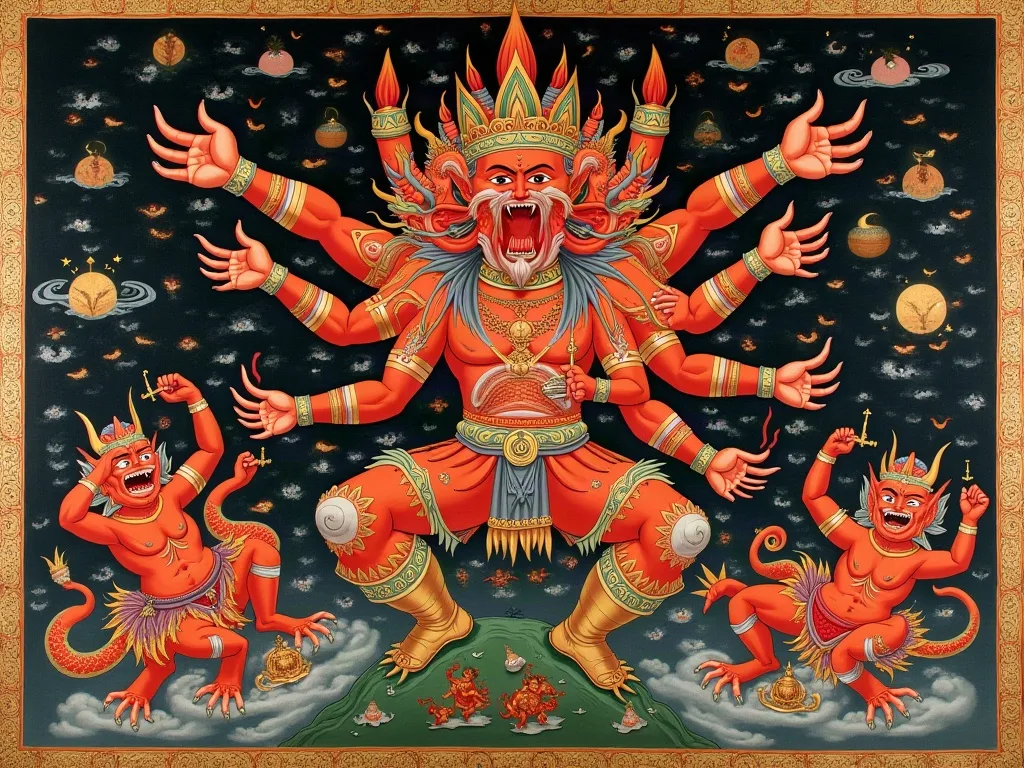
In Tibetan thangka paintings (scroll paintings), Mara is sometimes depicted as a black bull or a wrathful deity himself, teaching through his very ferocity. Some depictions show him with multiple heads, each representing a different form of obstacle: the head of a bull (ignorance), a lion (pride), a serpent (craving). This multiplicity reflects the truth that what we call "Mara" is not a single being but an entire ecosystem of mental habits and cosmic forces.
In Japanese Buddhism, Mara appears in narratives of the Buddha's temptation but with characteristically Japanese refinement. He is often portrayed with an almost aristocratic bearing, sometimes regretful of his role, sometimes defiant. The Japanese tradition, influenced by both Mahayana Buddhism and indigenous Shinto mythology, sometimes depicts Mara alongside or in dialogue with native demons, suggesting a recognition that every culture's adversaries are expressions of universal spiritual truths.
In Chinese and Korean temples, Mara sculptures guard entrances or appear in narrative reliefs on temple walls, always recognizable by his association with chaos, fire, or the writhing of bodies in states of craving. Yet even in these depictions, he is not portrayed as purely evil. He is portrayed as powerful, tragic, bound by the same laws of karma and impermanence that constrain all beings.
Mara as Metaphor and Lived Experience
Modern Buddhist teachers often speak of Mara in two registers simultaneously. At the metaphorical level, Mara represents the forces of habituation, the grooves worn into the mind by years of seeking pleasure and avoiding pain. The meditator who sits down and cannot stop thinking about work, about worries, about fantasy, is being attacked by Mara. The spiritual aspirant who feels that progress is impossible and gives up is listening to Mara's whisper of despair.
Yet many Buddhist practitioners, especially those with deep meditation experience, report genuine encounters with something that seems personal, malevolent, or at least resistant. A meditator in retreat might experience vivid visions of demons or presence of overwhelming hostility. Some interpret this psychologically: the deeper layers of the unconscious mind, normally filtered from awareness by the ego's protective mechanisms, becoming accessible and appearing in image-form. Others maintain that Mara and his armies are real beings, operating in realms adjacent to the human realm, and that the stability of deep meditation makes a person perceptible to them.
The Buddha's own attitude, as recorded in the sutras, was pragmatic rather than dogmatic. He did not ask his disciples to believe in Mara's metaphysical status. He taught them to recognize Mara's operation: whenever you feel seduced by pleasure without examining its consequences, whenever you feel despair that practice is impossible, whenever you feel the pull to maintain an identity at all costs, Mara is present. The remedy is always the same: awareness, gentleness, clarity about the nature of what is arising. You do not defeat Mara by hating him; you see through him by understanding his nature completely.
This is why the Buddha's relationship with Mara is portrayed as neither hostile nor accommodating but simply clear-eyed. In some texts, the Buddha and Mara converse like old acquaintances. The Buddha might even thank Mara for the occasion to practice, for Mara's temptations are, paradoxically, dharma (teaching) if understood rightly. They show the practitioner exactly where attachment arises, exactly where delusion operates. In this way, the enemy becomes the greatest teacher.
Mara's Echoes in Western Culture
The concept of Mara has intrigued Western philosophers and psychologists as a unique way of personifying forces that Western thought often leaves abstract. Carl Jung's concept of the shadow, the unacknowledged aspects of the psyche, bears some resonance with Mara. Like the shadow, Mara represents forces within the human mind that operate outside conscious awareness, that must be encountered and integrated rather than simply eliminated.
Some Western depth psychologists have suggested that figures like Mara represent the ego's primal fear: its own dissolution. The ego (in this reading) is inherently Maric in its operation; it clings to existence, denies impermanence, and generates seduction and terror to maintain itself. From this perspective, the Buddhist path is not a war against an external demon but a psychological transformation through which the ego's grip gradually loosens.
In contemporary Western Buddhism, teachers often find themselves explaining Mara to students raised in secular contexts who have no background in Buddhist cosmology. The explanation often works best when stripped down to psychology: Mara is the tendency of the mind to seek comfort in the familiar, to doubt its capacity for growth, to mistake the ego's survival for actual happiness. In this form, Mara is no longer exotic; he is as real as procrastination, self-doubt, and the hedgehog's curling-into-itself when threatened.
Yet some Western Buddhist practitioners who engage seriously with the tradition report experiences that push them beyond the purely psychological frame. A long-term meditator in retreat might encounter something that seems to possess a will of its own, that responds to their efforts with what feels like deliberate resistance or even malice. Whether this is a projection of the mind's own resistance, a genuine encounter with a being or force from another realm, or some combination remains open. The tradition holds both possibilities without insisting on one.
Frequently asked questions about Mara in Buddhist mythology
Frequently asked questions
Is Mara the same as Satan or the Devil in Western religion?
Mara and Satan are both tempters who embody opposition to spiritual awakening, but they operate on different principles. Satan in Christian theology is a conscious rebel who actively hates God and seeks to corrupt creation. Mara is less a conscious rebel than an embodiment of natural forces (craving, aversion, ignorance) that bind beings to suffering. Mara's ultimate nature is not malice but suffering itself; he is trapped in his own realm by the same mechanisms that trap all beings. Additionally, Christian theology emphasizes moral judgment and the Devil's inherent evil; Buddhist thought emphasizes ignorance (not seeing things as they truly are) as the root of suffering. A being under Mara's influence is not damned but rather deluded; the remedy is insight, not forgiveness from a higher power.
Did the historical Buddha really encounter Mara?
The accounts of Mara's temptation of the Buddha appear in early Buddhist texts like the Pali Sutta Pitaka and Sanskrit Mahayana sutras, likely recorded within a few centuries of the Buddha's life. Whether the historical Siddhartha Gautama experienced a literal encounter with a demon or whether the story represents a symbolic account of his spiritual struggle remains a matter of scholarly debate. What is clear is that early Buddhists understood awakening to involve confrontation with forces of delusion, and the Mara narrative is their way of expressing this. Modern historians are cautious about claims of literal historical accuracy, but the coherence of the story within Buddhist teaching suggests it preserved something important about the Buddha's experience, even if filtered through mythological language.
Can Mara harm an enlightened being?
In Buddhist texts, Mara cannot directly harm someone who has achieved enlightenment or even significant spiritual attainment. The Buddha himself was immune to Mara's attacks once his concentration was unshakeable. However, Mara can obscure the path for those still caught in delusion. He can generate obstacles to practice, sow doubt, create distractions. The texts describe Mara approaching awakened disciples after the Buddha's death, testing them, but finding no foothold. The protection is not external; it comes from wisdom. A being who fully understands the nature of impermanence, non-self, and suffering has nowhere for Mara's hooks to catch. Enlightenment itself is sometimes described as perfect protection against Mara.
What is Mara's ultimate fate in Buddhist cosmology?
Buddhist texts do not describe a final defeat of Mara in the manner of Christian apocalyptic literature. Instead, Mara endures through vast cosmic cycles, his power waxing and waning with ages. When a Buddha arises and teaches, beings escape his realm. When the dharma declines and humans become deeply deluded, his grip tightens. Some Buddhist commentators have speculated that Mara himself will eventually awaken or be recognized as already Buddha-nature, reflecting the conviction that no being is fundamentally outside the scope of awakening. But this remains philosophically open. What is certain is that as long as beings cling to existence through ignorance, Mara's realm endures.
How do modern Buddhist practitioners understand Mara?
Contemporary Buddhists often hold multiple interpretations in tension. Some view Mara psychologically as a metaphor for the ego's defenses, habitual patterns, and resistance to change. Others, especially those practicing intensive meditation, report experiences consistent with Mara being a real being or force. Most experienced teachers suggest that the distinction between metaphor and reality dissolves at deeper levels of practice; psychological patterns and cosmic forces are expressions of the same underlying laws. The pragmatic approach, consistent with the Buddha's own teaching, is to recognize Mara whenever you feel seduction by impermanent things, doubt in the path, or identification with a fixed self; and to respond with awareness rather than either indulgence or rejection.
The Demon's Question to Modern Buddhism
Mara: The Demon of Desire and Death persists in Buddhist thought not because Buddhism is antiquated but because he represents something permanently true about the human condition. Every being, in every era, must come to terms with desire, must face the reality of death and impermanence, must at some point choose between continuing to seek satisfaction in a Desire Realm that cannot provide it and attempting the escape into clarity.
The Buddha's teaching was not that Mara is unreal or that desire is inherently evil. Rather, it was that unseen desire, unexamined craving, operates behind the scenes as the engine of suffering. Mara is the personification of this unseen engine. To encounter him, truly to encounter him, is to come face-to-face with the mechanism of one's own suffering. At that moment, the possibility of liberation becomes real. Not because Mara can be destroyed from outside but because the mind that was bound by his operation can awaken to something beyond it.
In this sense, Mara remains eternally relevant. Every meditator who sits and finds the mind turning to distractions, every spiritual aspirant who doubts whether practice is possible, every human who feels trapped by the pursuit of pleasure and comfort, is in dialogue with Mara. The victory is not in defeating him violently but in seeing through him, in recognizing that the desires he offers are hollow, that the self he invites you to defend is a construct, that there is something deeper and more real available to those willing to look.
The Buddha left behind no myth of Mara's final extermination. Instead, he left the model of what it looks like to stand in Mara's presence and remain unmoved, not through force of will but through clarity of seeing. That model, transmitted across 2,500 years and countless cultures, remains the central resource for anyone who seeks to understand how ignorance operates and how awakening becomes possible.
Read the full book
Want the whole story?
The complete edition is an instant PDF download here, with a paperback on Amazon for selected titles.
Buddhist
The Buddhist Mythology Book: Mara, Avalokiteshvara, Mahakala, and the Sacred Cosmology Beyond Meditation
Demons, Bodhisattvas, and the Cosmic Architecture of Buddhism
The mythological layer of Buddhism: Mara's temptation, the Bodhisattvas, Vajrayana fierce deities, the Eight Hells, Mount Meru, and the Jataka tales. Delivered within 24 hours of purchase.
More from Buddhism
All articles
Buddhism
Vesak: The Festival Celebrating Buddha's Birth, Enlightenment, and Death
Vesak marks the three most pivotal moments in Siddhartha Gautama's life, all on a single day. Discover how Buddhists across Asia transform this holy date into a festival of light, moral renewal, and collective remembrance of the Buddha's journey to awakening.
Buddhism
Tara: The Mother of Liberation in Mahayana Buddhism
Tara embodies compassion in action, the Tibetan Buddhist goddess who hears suffering and moves to end it. Known as the Mother of Liberation, she appears in multiple forms, each one a different answer to human need.

Buddhism
The Lotus Sutra: Sacred Text of Universal Buddhahood
The Lotus Sutra teaches that every being, no matter how lost, can achieve buddhahood. Discover how Buddhism's most beloved scripture rewrote enlightenment and shaped a thousand years of practice.
Buddhism
The Six Realms of Samsara: Buddhist Cosmology and Rebirth
Buddhist cosmology maps existence across six realms of rebirth, from heavens where joy becomes suffering to hells where torment teaches detachment. Discover how this ancient map of consciousness shapes Buddhist ethics and practice.