
Yama: The Lord of Death and Judge of the Underworld
Yama rules the realm of the dead across Hindu and Buddhist traditions, weighing every soul's karma with perfect justice. Uncover the full story of death's most ancient judge.
Contents
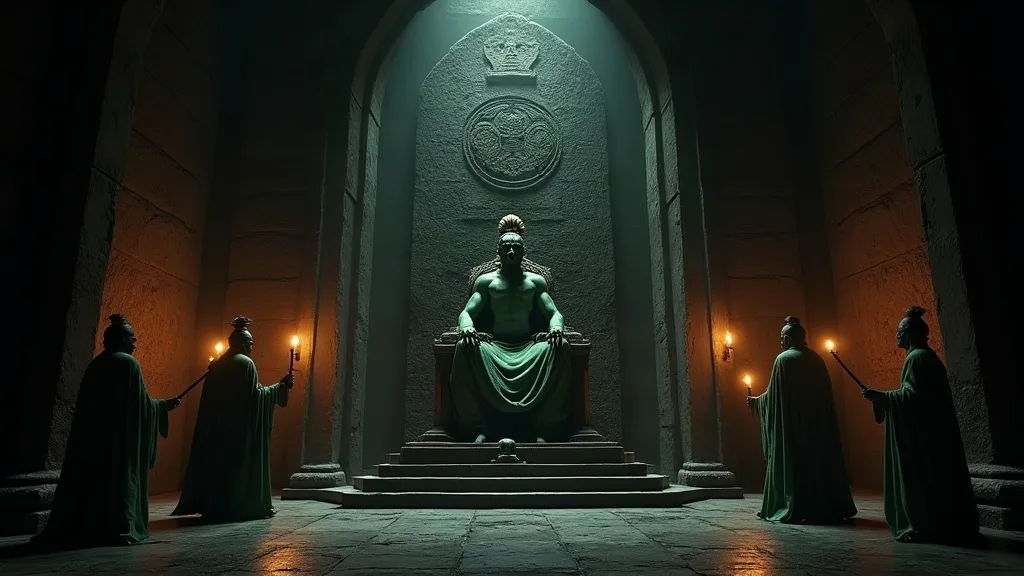
The moment a person dies, something happens before the body even grows cold. A pair of divine messengers arrives, invisible to the living. They carry the soul downward, through layers of dark air, toward a palace of iron and fire. At the gate sits a figure so vast he blocks the sky: four-armed, green-skinned, crowned with a single lotus, holding a staff topped with a human skull. His name is Yama, and he has been waiting.
No soul passes without his judgment. Yama, the Lord of Death and Judge of the Underworld, consults the Mirror of Karma, a polished surface that reflects every action a person ever committed, without exception, without mercy, without error. He does not hate the dead. He does not delight in punishment. He simply reads what is already written. That quality, the absolute neutrality of the scales, is what makes him one of the most important figures in all of Buddhist cosmology.
He is older than Buddhism itself. The Vedic hymns of ancient India, composed perhaps as early as 1500 BCE, already knew him as the first mortal to die and the king who now rules the dead. Buddhism inherited him, transformed him, and sent him across Asia, where he became Enma-O in Japan, Yanluo Wang in China, Gshin rje in Tibet. The same face, the same ledger, the same verdict, but the details shift in ways that reveal everything about how each culture understood death, justice, and the soul.
Yama Before Buddhism: The Vedic First Man
To understand the Buddhist Yama, you have to start in the Rigveda, the oldest layer of Sanskrit religious poetry. Hymn 10.14 addresses Yama directly, calling him the first of mortals to take the path of death, the one who "explored the passage" for all those who would follow. He did not die as punishment. He died first, and in doing so, became the guide and ruler of all who came after.
The Vedic Yama rules a paradise. His realm, described in the Rigveda and expanded in the later Atharva Veda, is a bright meadow where the righteous dead feast under trees and the sound of flutes never stops. He sits beneath an enormous tree with Varuna, the god of cosmic order, and together they drink soma, the sacred ritual drink. Death, in this early vision, is not punishment. It is arrival.
His twin sister in the Vedic texts is Yami, and their relationship is complicated. Yami presses Yama to father children with her, arguing that they are the first human pair and must continue the species. Yama refuses, insisting that cosmic law, rita, forbids the union. The refusal is significant. Even as the very first man, even before he was king of the dead, Yama already embodied law over desire. The role of judge was not given to him later. It was always in his nature.

Buddhism absorbed this figure but made two decisive changes. First, Yama's realm stopped being a paradise for the righteous and became a court of judgment, sorting souls toward their next rebirth. Second, Yama himself became a dharmaraja, a king of the law, whose entire function is to enforce the moral structure of the universe. His goodness is not kindness. It is precision.
The Buddhist Court of Yama: How Judgment Works
The Devaduta Sutta, recorded in the Majjhima Nikaya (the Middle Length Discourses, a Pali canonical text compiled after the Buddha's death in the 5th century BCE), gives the clearest early Buddhist account of what happens in Yama's court.
A newly dead soul arrives before Yama. He does not reach for a scale. He does not read from a scroll. He asks the soul a question: "Did you see the divine messengers?"
The first messenger is a newborn infant, screaming and helpless, smeared with birth-fluids. The message it carries: you too were born into a body subject to suffering. Did you act wisely?
The second messenger is a decrepit old person, bent double, teeth gone, eyes milky, unable to walk without support. The message: you too will age. Did you prepare?
The third messenger is a corpse, swollen and rotting, being carried to the burning ground. The message: you too will die. Did you live in a way that accounts for that?
If the soul answers honestly that it saw these messengers and ignored them, Yama speaks with what the text calls "gentle reproach." The soul, not Yama, has pronounced its own sentence. Yama then hands the soul to the guardians of hell, not as an act of cruelty but as a consequence of causality. The Buddhist hell realms are not eternal. They are correctional. Every soul eventually works through its karma and rises toward a better rebirth.
This detail matters enormously. In the Devaduta Sutta, Yama explicitly says he wishes he could be among the living, living virtuously, so he might one day escape his own office. He rules the dead not out of desire but out of cosmic obligation. He is, in a way, trapped by his role just as humans are trapped by their karma.
The Mirror of Karma and the Book of Life
In Chinese and Japanese Buddhist traditions, the judgment scene gained new props. The most iconic is the Mirror of Karma, called Gyokyo in Japanese and yejing in Chinese. It is described in texts like the Jizang jing (a Chinese apocryphal Buddhist sutra) and depicted in countless temple paintings across East Asia.
Yama sits enthroned. Before him, the mirror reflects not what a soul looks like but what it has done. Every lie, every act of generosity, every moment of violence, every hour of meditation, all of it appears in brilliant detail, impossible to dispute. The soul cannot argue. The mirror is not Yama's memory. It is reality itself, made visible.
Alongside the mirror, a divine scribe, often depicted as a blue-faced demon called Ju Lun, keeps the Book of Life. Every deed recorded. Every thought noted. Yama cross-references the mirror with the ledger, and the arithmetic is exact. The soul's next destination, whether one of the Buddhist hell realms, the hungry ghost realm, the animal realm, the human realm, or one of the heavens, follows directly from the calculation.
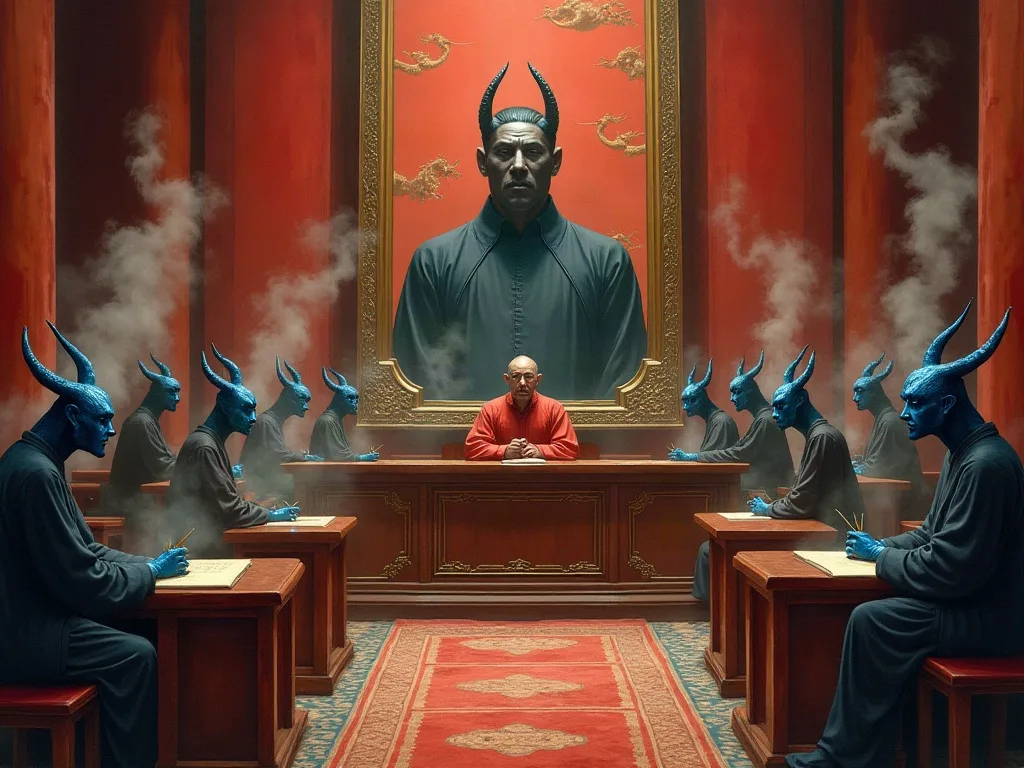
What strikes readers encountering this system for the first time is how impersonal it is. Yama does not decide anything. He reads. He confirms. The soul decided everything already, across an entire lifetime of choices. This is the Buddhist doctrine of karma made architectural: the judge is not an authority above the law but a functionary of the law, and the law is simply cause and effect operating at the moral level.
Yama Across Asia: One Figure, Many Faces
The spread of Buddhism carried Yama along every trade route and pilgrimage road. Each culture that received him adapted his image in ways that say as much about the receiving culture as about the original myth.
Yanluo Wang in Chinese Buddhism
In China, Yama became Yanluo Wang, king of the fifth of ten Buddhist hell courts. The Chinese system, developed between roughly the 7th and 10th centuries CE and encoded in texts like the Yuli (Jade Record), distributed judgment across ten kings, each responsible for a specific category of sin and a specific hell. Yanluo Wang's court handles those who died with unresolved karmic debt, particularly those who committed violence.
He is depicted in Chinese temple art as a robed magistrate, seated behind a high judicial bench, flanked by demon bailiffs. The setting mirrors a Tang dynasty court of law, a deliberate visual choice that made the supernatural feel institutional. You knew how a magistrate's court worked. Yama's court worked the same way, but with perfect evidence.
Enma-O in Japanese Buddhism
Japan received Yama through both Chinese Buddhist texts and direct imports from the Korean peninsula. Enma-O (sometimes written Emma-O) became one of the most recognisable figures in Japanese religious art, depicted in scroll paintings, temple sculptures, and woodblock prints.
The Ojoyoshu, a 985 CE text by the monk Genshin, gave Japanese readers the most detailed early description of Enma-O's court: the crushing noise, the stench of burning, the souls catalogued with ferocious efficiency. Genshin's text was enormously influential, shaping Japanese Buddhist art for centuries and feeding directly into the Japanese concept of jigoku, hell, which combined Buddhist cosmology with indigenous beliefs about the dead.
Enma-O appears in Japanese popular culture to this day, in anime, manga, and video games, usually as a stern but fair judge, sometimes comic, always authoritative.
Gshin rje in Tibetan Buddhism
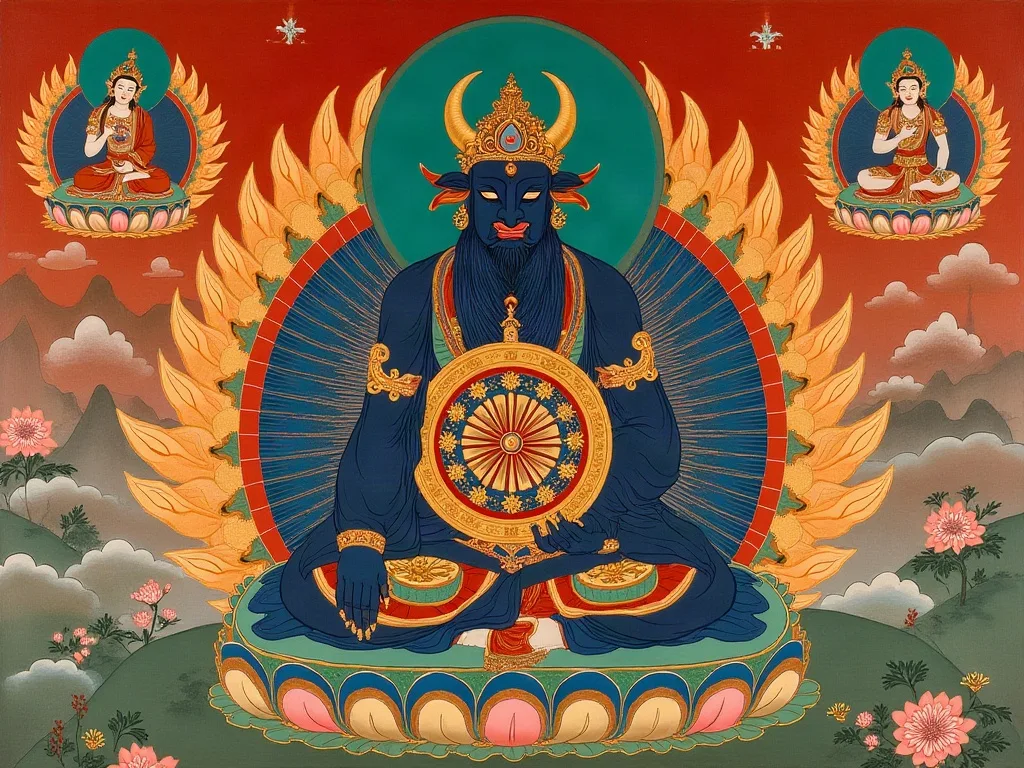
Tibetan Buddhism gave Yama perhaps his most terrifying visual form. Gshin rje (pronounced "Shinje"), meaning Lord of Death, is often depicted as a dark blue or black bull-headed figure, his body massive and wrathful, garlanded with skulls. He holds the Wheel of Life in his claws and teeth, the bhavachakra, the great diagram of the six realms of existence, of which he is the enforcer.
In Tibetan iconography, Gshin rje is sometimes called Dharmaraja, King of the Law, and his wrathful appearance is understood not as malice but as the ferocity of truth. He cannot be flattered. He cannot be bribed. The skulls he wears are not trophies. They are reminders.
The Bardo Thodol, commonly known in English as the Tibetan Book of the Dead (composed or compiled in the 8th century CE and attributed to Padmasambhava), gives Yama a pivotal role in the bardo, the intermediate state between death and rebirth. The text, read aloud to the dying and newly dead, instructs the soul on how to recognise Yama's demons as projections of the mind, not external tormentors. The black and white pebbles that Yama's assistants count to record good and bad deeds in this tradition are actually counted by the soul's own conscience, projected outward as figures.
The Bardo Thodol is, in a sense, a manual for passing through Yama's court without being terrified by it.
Yama and the Six Realms: His Place in Buddhist Cosmology
Yama, the Lord of Death and Judge of the Underworld, is inseparable from the Buddhist map of existence. The six realms, illustrated on the bhavachakra that Gshin rje holds, are:
- The deva (heavenly) realm, where beings enjoy long lives of pleasure but still cycle back
- The asura (demigod) realm, marked by jealousy and conflict
- The human realm, the only one from which enlightenment is fully possible
- The animal realm, dominated by instinct
- The preta (hungry ghost) realm, defined by insatiable craving
- The naraka (hell) realms, where Yama's courts operate, temporary but intense
Yama administers the sorting of souls into these realms after death. His court sits at the border between the human realm and the hell realms, though his jurisdiction technically covers all rebirths that are not self-determined (that is, not the rebirths of bodhisattvas who choose their next life deliberately).
The hell realms themselves are described in extraordinary detail across canonical texts. The Mahavastu, a Sanskrit Buddhist text from perhaps the 2nd century BCE, lists hot hells where temperatures exceed anything the living world can generate, and cold hells where the soul freezes into stillness. The Abhidharmakosa, a 4th-5th century CE philosophical compendium by the scholar Vasubandhu, sets the duration of hell realms in cosmic time units, with even the shortest lasting what would be billions of human years. But the key point, always restated, is that they end. Karma is spent, not eternal.
Yama's Relationship with the Bodhisattvas
One of the most striking features of Yama's Buddhist career is how often he is shown interacting with bodhisattvas, enlightened beings who remain in the cycle of rebirth to help others.
Ksitigarbha, known in Chinese as Dizang and in Japanese as Jizo, is the bodhisattva of hell beings. His vow, recorded in the Ksitigarbha Bodhisattva Purvapranidhana Sutra (a Chinese text from roughly the 7th century CE), is to empty all hell realms before accepting his own final enlightenment. He enters Yama's court not as a soul to be judged but as an advocate, interceding for those suffering the consequences of past actions.
The relationship between Yama and Ksitigarbha is one of the great theological tensions in East Asian Buddhism: the judge of karma versus the champion of mercy. Neither cancels the other. Karma still operates. But compassion can create new karma that mitigates the old. Yama, in this framing, is not the final word. He is the honest word, and Ksitigarbha's work happens inside that honesty, not against it.
Manjushri, the bodhisattva of wisdom, is sometimes depicted defeating Yama in Tibetan iconographic traditions, appearing in a fearsome form called Yamantaka, the "terminator of Yama." This is not a story of death being killed; rather, it is the symbolic overthrow of the fear of death through wisdom. Manjushri as Yamantaka shows that only insight into the nature of reality truly escapes death's grip.
Yama in Sacred Art: Reading the Iconography
Temple complexes from Kyoto to Kathmandu to Chengdu place Yama's image at specific locations, often near the entrance to the main hall, a reminder before worship rather than after. The placement is deliberate. You walk past death to reach the altar. You are reminded that time is finite before you pray.
Key iconographic markers that identify Yama across traditions:
- The skull-topped staff (khatvanga in Sanskrit): authority over the dead, the bones of all who came before
- Green or dark blue skin: in many traditions, the colour of decay, of what flesh becomes; in others, the colour of a deity who dwells between worlds
- The bull or buffalo: Yama's mount in Hindu traditions, retained in some Buddhist contexts; the animal's bulk and stubbornness mirror Yama's immovability
- The noose: used by Yama's messengers to bind the soul at death and draw it downward
- The Book and Mirror: the evidence that cannot be disputed
The wrathful forms of Yama in Tibetan thangka paintings follow a precise iconographic grammar developed over centuries. The number of arms, the objects held, the colours of each face, all carry specific doctrinal meanings. A Tibetan monk trained in iconography can read a painting of Gshin rje the way a musicologist reads a score: every element is information.
Frequently Asked Questions About Yama, Lord of Death
Frequently asked questions
Is Yama a god or a human who became divine?
In the earliest Vedic sources, Yama is the first mortal to die, a human king who became ruler of the dead through that primacy. The Rigveda (10.14) calls him the first to "find the path." Buddhism inherited this ambiguity. In some texts he is a great being who accumulated merit across many lives and earned the role of judgment king. In others he is a deity who has always existed as a structural function of the cosmos. The two readings coexist across Buddhist traditions without contradiction.
Are Yama's hell realms permanent in Buddhist teaching?
No. This is one of the sharpest differences between Buddhist and some other religious traditions. Yama's hell realms, however prolonged in cosmic time, are temporary states of karmic consequence. The Abhidharmakosa by Vasubandhu (4th-5th century CE) is explicit: every being in every hell realm will eventually exhaust that karmic debt and be reborn in a higher realm. Yama's courts are correctional, not punitive in the absolute sense.
What is the Mirror of Karma and where does it appear in Buddhist texts?
The Mirror of Karma is described in East Asian apocryphal Buddhist texts, particularly the Chinese Jizang jing, and appears extensively in Japanese Buddhist art from the Heian period onward. It reflects every action a soul ever took, making denial impossible. The mirror is not Yama's invention but a property of reality itself, the truth that karma leaves a record. The concept deepens the Buddhist teaching that no action, good or bad, disappears without consequence.
How does Yama relate to the Tibetan Book of the Dead?
The Bardo Thodol (Tibetan Book of the Dead), attributed to Padmasambhava and written down roughly in the 8th century CE, presents Yama's demons as projections of the dying person's own mind. The text is read to guide the soul through the bardo (the intermediate state) without fear. Yama's presence in the bardo is real but not external: the counting of black and white pebbles, representing bad and good deeds, is performed by an aspect of the soul's own karma, externalised as Yama's court for the purpose of judgment.
Is the Japanese Enma-O the same figure as the Buddhist Yama?
Yes, directly. Enma-O is the Japanese pronunciation of the Chinese Yanluo Wang, which itself translates the Sanskrit Yamaraja (King Yama). The doctrinal content is consistent: Enma-O judges the dead, consults records, and assigns rebirth. The visual style changed to reflect Japanese aesthetics, and texts like Genshin's Ojoyoshu (985 CE) gave him a distinctly Japanese cultural setting, but the theological function is unchanged from the Indian original.
Why does Yama wish he could escape his own role?
The Devaduta Sutta in the Pali Canon contains a remarkable passage in which Yama tells newly arrived souls that he envies those living in a time when the Buddha has appeared. He says he himself would take rebirth as a human if he could and practice the Dhamma to escape the cycle of existence. This detail reveals that Yama, for all his power, is not enlightened. He is a powerful being, a deva or cosmic official, still bound by karma and still subject to rebirth. The Lord of Death is not free from death.
Yama in Modern Thought: Law, Conscience, and the Psychology of Judgment
The 20th century brought Yama into conversation with psychoanalysis and depth psychology. Carl Jung, writing about the Eastern concept of self-judgment after death, saw in figures like Yama an externalisation of the superego, the part of the psyche that holds the record of every moral act and eventually presents the account. The Mirror of Karma, in this reading, is a projection of conscience made visible.
Buddhist modernists, particularly figures like D.T. Suzuki and Thich Nhat Hanh, argued that the hell realms and Yama's courts should be understood symbolically: the hungry ghost is not a literal creature but the experience of insatiable craving in this life; the hell realm is not a place underground but the state of mind produced by hatred and violence. In this reading, Yama does not judge us after death. We stand before his mirror in every moment of clear self-reflection.
The legal systems of several East Asian nations preserved echoes of Yama's cosmological court into the modern period. Tang dynasty Chinese law organised its bureaucracy partly on the model of the ten kings of hell, with different courts handling different categories of crime. The ritual recitation of sutras on behalf of the dead, still practised in Chinese, Japanese, Korean, and Vietnamese Buddhist communities, is understood as accumulating merit that can influence Yama's judgment, a form of legal advocacy in the cosmic court.
Yama, the Lord of Death and Judge of the Underworld, survives not because people fear death less than they once did, but because the problem he addresses is permanent. Every tradition that takes ethics seriously eventually asks the same question: what happens to the record of a life? Who reads it? Is there any accountability beyond what other humans can see?
The Buddhist answer is precise and old and, in its way, generous. There is a mirror. There is a judge. The judge is not cruel. And the mirror shows nothing that was not already there.
Read the full book
Want the whole story?
The complete edition is an instant PDF download here, with a paperback on Amazon for selected titles.
Buddhist
The Buddhist Mythology Book: Mara, Avalokiteshvara, Mahakala, and the Sacred Cosmology Beyond Meditation
Demons, Bodhisattvas, and the Cosmic Architecture of Buddhism
The mythological layer of Buddhism: Mara's temptation, the Bodhisattvas, Vajrayana fierce deities, the Eight Hells, Mount Meru, and the Jataka tales. Delivered within 24 hours of purchase.
More from Buddhism
All articles
Buddhism
Vesak: The Festival Celebrating Buddha's Birth, Enlightenment, and Death
Vesak marks the three most pivotal moments in Siddhartha Gautama's life, all on a single day. Discover how Buddhists across Asia transform this holy date into a festival of light, moral renewal, and collective remembrance of the Buddha's journey to awakening.
Buddhism
Tara: The Mother of Liberation in Mahayana Buddhism
Tara embodies compassion in action, the Tibetan Buddhist goddess who hears suffering and moves to end it. Known as the Mother of Liberation, she appears in multiple forms, each one a different answer to human need.

Buddhism
The Lotus Sutra: Sacred Text of Universal Buddhahood
The Lotus Sutra teaches that every being, no matter how lost, can achieve buddhahood. Discover how Buddhism's most beloved scripture rewrote enlightenment and shaped a thousand years of practice.
Buddhism
The Six Realms of Samsara: Buddhist Cosmology and Rebirth
Buddhist cosmology maps existence across six realms of rebirth, from heavens where joy becomes suffering to hells where torment teaches detachment. Discover how this ancient map of consciousness shapes Buddhist ethics and practice.