
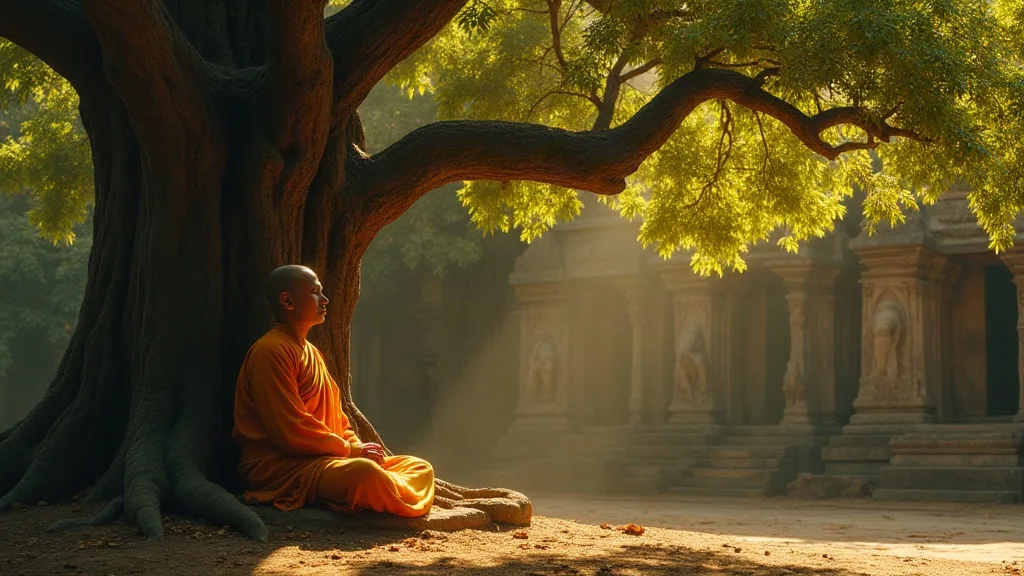
The Jataka Tales: Stories of the Buddha's Past Lives
The Jataka Tales are a collection of over 500 stories describing the Buddha's rebirths before his enlightenment. These narratives form a moral compass of Buddhism, weaving animal fables, ancient wisdom, and spiritual lessons into tales that have shaped Buddhist culture for over 2,000 years.
Contents
A merchant's son falls from a cliff and wakes as an ox. A king's adviser returns as a parrot. A bodhisattva sacrifices his own flesh to feed a starving tigress. These are not flights of fantasy. They are the Jataka Tales, a body of 547 stories that sit at the heart of Buddhist tradition, describing the Buddha's journey through countless lifetimes before he achieved enlightenment.
The Jataka Tales teach that awakening was not instant, not divine gift, but earned. Life after life, the Buddha cultivated virtue. Life after life, he learned. The stories exist to show that anyone, through the same commitment, can walk the same path. Enlightenment is not mystery. It is consequence.
What Are the Jataka Tales?
The Jataka Tales are narratives found in the Pali Canon, the oldest surviving collection of Buddhist teachings, written down around 100 BC. The word "jataka" comes from Sanskrit and Pali, meaning "birth" or "origin story". Each tale tells of a past incarnation of Siddhartha Gautama, the historical Buddha, before he was born as the prince who would eventually renounce his palace and seek enlightenment.
The tales span animal fables, courtly adventures, and moral parables. In some, the Buddha is a king. In others, he appears as a deer, a monkey, a cook, a slave. The cast changes, the lesson remains constant. Generosity, patience, wisdom, honesty, and compassion are not ornaments of virtue. They are the bedrock of spiritual progress.
The Jataka collection became standardized in the fifth century CE through the commentary of Buddhagosa, a monk from what is now Sri Lanka, who organized and preserved the full canon. But the stories themselves are far older, transmitted orally in monastic communities from the earliest centuries after the Buddha's death. They were a teaching tool. A monk could tell a story to a crowd of villagers and convey Buddhist philosophy without abstract language. A child could hear the tale of the generous hare and understand the value of sacrifice.
The Structure and Literary Form
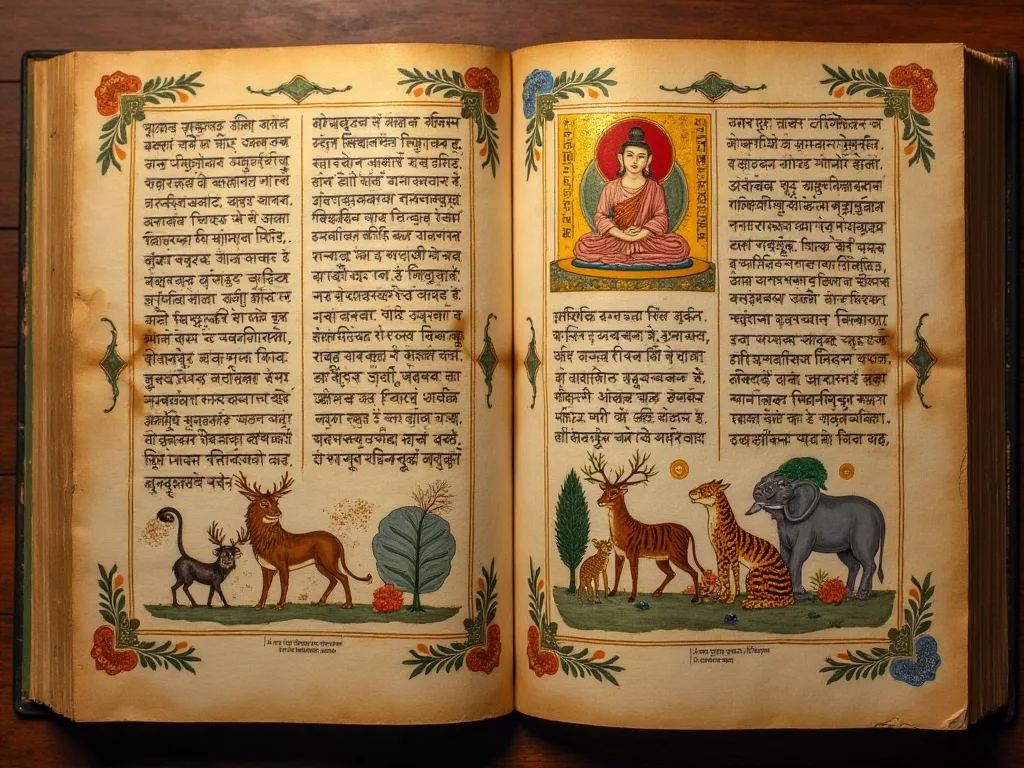
The Jataka Tales follow a consistent structure. Each story opens with a "frame narrative", a scene set in the Buddha's own lifetime. A situation arises in his monastic community or among lay followers. The Buddha then offers a Jataka story as explanation or answer, concluding with an identification: "That deer was me in a past life" or "That king's adviser was this monk in another birth."
This frame device serves two purposes. It grounds the ancient story in lived context. A lay follower struggling with anger hears a tale of a monkey who learned patience, and the Buddha's identification transforms the animal fable into personal instruction. Second, the frame asserts that rebirth is real. The Buddha remembers his past lives. The reader, listening, is invited to believe what the Buddha believed.
The actual Jataka narratives vary wildly in length and tone. Some are brief fables, no more than a paragraph. Others stretch to small novellas, with complex plots, dialogue, and dramatic arcs. The "Telapatta Jataka" tells of a slave's ingenious escape. The "Mahabodhi Jataka" narrates a king's quest for enlightenment. The "Vessantara Jataka", perhaps the most elaborate, spans the entire life of a prince who gives away everything, including his wife and children, to perfect generosity.
The language in which the tales survive is Pali, the liturgical language of Theravada Buddhism (the tradition most prevalent in Sri Lanka, Thailand, and Myanmar). But Sanskrit versions exist in Buddhist texts from northern India. Chinese, Tibetan, and Khmer versions diverge from the Pali originals, with different stories included and variants adapted to local cultures.
The Moral and Spiritual Architecture
Each Jataka tale illustrates one or more of the "Paramitas", the perfections that a bodhisattva (a being destined for Buddhahood) must cultivate. These are six or ten virtues, depending on the tradition. Generosity (dana), morality (sila), patience (khanti), effort (viriya), meditation (dhyana), and wisdom (panna) appear constantly. In later traditions, resolve, loving-kindness, and equanimity join the list.
In the "Sibi Jataka", a king gives his own flesh to a hawk that claims it hungers. The story illustrates generosity and compassion at their extreme. In the "Kalakalanda Jataka", a wise stag escapes a hunter's snare by staying calm and using reason. Wisdom and non-reactivity shine through. In the "Adi Jataka", a forgiving hermit grants mercy to a robber who repents. The teaching is patience and forgiveness.
The tales are not sentimentalised. Consequences are real. Wrong action brings suffering. Right action brings peace. This is not punishment from a cosmic judge. It is cause and effect, the law of karma operating through lifetimes. Every choice leaves an imprint on the mind. Over aeons, those imprints shape destiny.
Key Jataka Tales and Their Lessons
A handful of Jataka stories have become canonical in Buddhist culture, told and retold across Asia, illustrated in temples, performed in dance, and recited at festivals.
The Mahasara Jataka (The Great Elephant) describes a wild elephant who protects forest dwellers, never retaliating even when hunters attack. The beast's patience and strength serve others. The Buddha taught this story to monks tormented by rage. Let your strength be gentleness, the story says.
The Kaccani Jataka (The Archer's Arrow) tells of a skilled archer who can shoot an arrow through seven leaves hanging on a branch. But when the archer falls ill and grows weak, his skill fades. The story warns that virtue, like skill, requires constant practice. Spiritual discipline is not earned once and kept forever. It must be renewed daily.
The Ummagga Jataka (The Caravan Merchant) follows a merchant who guides a caravan across a perilous desert by virtue of his wisdom and memory of previous journeys. He succeeds not through magic but through careful thinking and knowledge. The Buddha taught this to monks who doubted that wisdom could be learned.
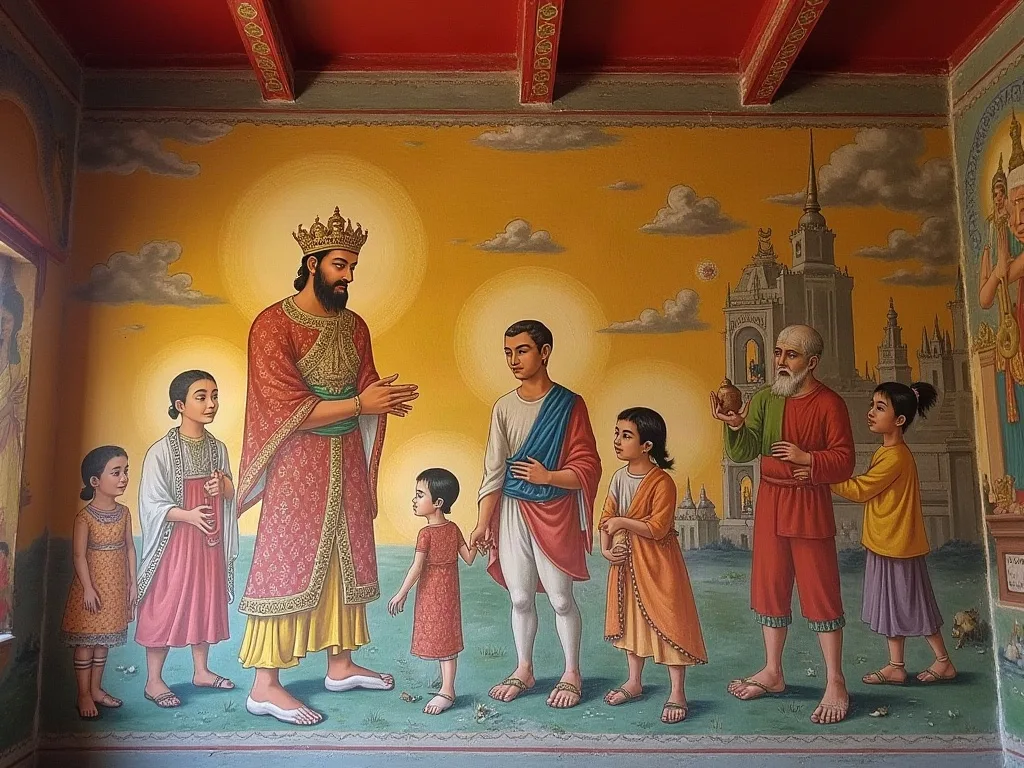
The Mahavessantara Jataka (The Great Gift), mentioned earlier, became so central to Buddhist practice in southern and southeast Asia that it earned its own festival. During Pavarana, a three-month retreat at the end of the monsoon season, monks recite this story across a single night, from dusk to dawn. The tale spans Prince Vessantara's entire life: he gives away his riches, his position, and finally his wife and children to an old brahmin beggar. When asked why, he replies that true generosity means letting go of the very attachments that bind us to suffering. Only by severing attachment can enlightenment dawn.
The Bodhisattva Path and Gradual Enlightenment
The Jataka Tales flesh out a concept central to Mahayana and Theravada Buddhism: the bodhisattva path. A bodhisattva is a being who has taken a vow to achieve Buddhahood, not for personal liberation alone, but to return and guide all sentient beings to enlightenment. The Jatakas show this path in action, across thousands of years.
In early Buddhist thought, the Buddha was unique. Siddhartha Gautama achieved enlightenment after aeons of practice, and the Jatakas chronicle those aeons. But the tales also imply a radical democracy of spiritual potential. The bodhisattva is not chosen by gods. He is not born with special power. He is ordinary, born as human and animal alike, and through tireless cultivation of virtue, he transforms himself.
This resonated deeply in cultures touched by Buddhism. Common folk listening to a Jataka tale about a peasant who became enlightened through honesty could believe their own enlightenment was possible. The tales were mirrors. They showed that the path was within reach.
Sources and Textual Transmission
The Jataka collection survives in multiple languages and versions, each with a history. The Pali Jatakas are preserved in the Khuddaka Nikaya, part of the Pali Canon. This is the oldest layer of text, likely composed in the first few centuries after the Buddha's parinirvana (his final passing, around 400 BCE, though scholars debate the exact date). The commentary of Buddhagosa, written in the fifth century CE, added narrative context and expanded each story.
Sanskrit versions exist in Buddhist texts recovered from Afghanistan, Pakistan, and northern India, often diverging from the Pali originals. Some include stories the Pali tradition omitted. Others reorder the same tales. Chinese Buddhist texts, translated from Sanskrit originals, preserve versions lost elsewhere. The "Avayana Jataka" exists in Sanskrit, Tibetan, and Chinese but is absent from the Pali Canon.
Scholars like Friederike Panzer and Margaret Cone have spent decades tracing the genealogies of these texts, showing how stories mutated as they traveled. A tale told in Theravada Sri Lanka became a different tale in Mahayana China. Yet the core remained: past lives, gradual enlightenment, moral cause and effect.
The Jatakas in Art, Temple, and Culture
For over 2,000 years, the Jataka Tales have animated Buddhist culture. Temple walls in Thailand, Sri Lanka, Myanmar, and Cambodia are painted with Jataka scenes. A visitor walking around a temple can read stories in pictures, watching as a previous incarnation of the Buddha sacrifices his life, teaches a lesson, or escapes danger through wisdom.
In Thailand, the Ramakien, an adaptation of the Indian Ramayana, blends into Jataka storytelling in performance. Dance-dramas called "khon" narrate Jataka tales with masks and music. During the Festival of Lights (Loy Krathong), monks recite Jataka stories to crowds gathered in temple courtyards. The tales remain alive, not museum artifacts but living scripture.
In Sri Lanka and Myanmar, where Theravada Buddhism is the majority religion, the Mahavessantara Jataka became so important that its recitation during monastic retreats became a form of community ritual. Families gather. The recitation can last from sunset to sunrise. The act of hearing the story is considered meritorious, a way of building spiritual capital.
In Tibet, the tales were incorporated into Tibetan Buddhist art and practice, though with local color added. Tibetan versions emphasize different lessons. A Tibetan Jataka might foreground the guru's role or the lama's teaching lineage, reflecting Tibetan religious structure.
Scholarly Debates and Historical Questions
Scholars have long asked: did these stories reflect historical facts about the Buddha's past lives, or are they didactic fables designed to teach virtue? The answer depends on who is asking.
For traditional Buddhist communities, the question does not arise. The Jatakas are sacred history. The Buddha remembers his past lives. Rebirth is a fact of cosmology. Skeptical Western scholars of the nineteenth and twentieth centuries were inclined to treat the Jatakas as folklore, borrowed from earlier Indian, Greek, or Persian sources, adapted to serve Buddhist ends.
Recent scholarship, particularly by scholars like Steven Collins and Peter Masefield, has steered toward a middle path. The tales are not historical biography. But they are also not random fables. They reflect genuine Buddhist teaching about karma, rebirth, and the path to enlightenment. Some stories may derive from older tales (the Grimm tales have parallels in medieval India), but Buddhist editors shaped them to convey Buddhist truth.
The question of whether individual Jatakas are older than Buddhism or composed within the Buddhist community remains open. The "Atanatiya Sutta", a text in the Pali Canon, references Jataka stories as though they are already established. This suggests some Jataka tales were circulating early. But when and where each story originated is difficult to trace.
The Jatakas as Global Literature
The Jataka Tales did not stay confined to Buddhist monastic circles. By the medieval period, tales had leaked into popular collections across Asia and the Middle East. The Panchatantra, a celebrated Sanskrit collection of animal fables from around the third century CE, shares story lines with Jatakas. Did the Panchatantra borrow from Jatakas? Or did both draw from common folk sources? Scholars disagree.
The Kalila wa-Dimna, an Arabic animal fable collection that traveled across the Islamic world and into medieval Europe, also shows parallels. European medieval bestiaries and fables sometimes mirror Jataka logic: animals teach moral lessons through their behavior. Whether this is direct inheritance or independent development is disputed.
What is clear is that the Jatakas entered world literature not as exotic Buddhist scripture but as practical wisdom. A merchant, a peasant, or a nobleman hearing a Jataka story did not need to believe in rebirth to benefit from the moral. Be honest. Be patient. Be generous. Virtue brings happiness. These lessons transcend theology.
The Jatakas and Modern Buddhism
In the twentieth and twenty-first centuries, the Jataka Tales have experienced something like a revival. As Western audiences have encountered Buddhism, translations of selected Jatakas have become available. Buddhist educators use Jataka stories to teach children. A simplified version of the Mahavessantara Jataka appears in school curricula in Thailand, Myanmar, and Sri Lanka.
Modern Buddhist teachers like Thich Nhat Hanh have drawn on Jataka imagery to illustrate concepts of mindfulness and interconnection. The tales have also attracted academic attention. Scholars of literature, religion, and ethics mine them for insights into ancient Indian narrative, Buddhist philosophy, and the psychology of moral education.
Yet in many Western Buddhist communities, especially Zen and Tibetan traditions, the Jatakas are less central than in Theravada. The focus shifts to other texts, other teachings. This is not criticism but recognition that every Buddhist tradition has its own canon, its own priorities. The Jatakas are the scripture of Theravada Buddhism. In other traditions, they are supplementary.
The Eternal Return: Why the Jatakas Matter
The Jataka Tales endure because they answer a primal human question: who am I becoming? Every choice I make, every kindness or cruelty I show, shapes not just my present moment but my future. Not in some abstract, metaphorical sense, but literally. Through lifetimes.
This is the Buddhism of the Jatakas: not pessimistic, not fatalistic, but radically hopeful. You are not trapped by your past. You are not judged by a cosmic authority. You are shaped by your choices. And since your choices are yours to make, your future is yours to build.
The Jatakas show this process unfolding across aeons. A character appears as a bird in one life, a human in the next, an animal in the next. Status, form, and circumstance change. But the essential work remains: cultivating wisdom, generosity, patience. Shedding attachment. Moving closer to awakening.
For over two millennia, this message has traveled. It has been painted on temple walls, recited in monastery courtyards, adapted into dance, and written into children's books. It has shaped ethics across Asia. The tales have also leaked into world literature, influencing animal fables and moral instruction far beyond Buddhism.
Today, the Jatakas remain what they have always been: a mirror and a map. A reader encounters a story and sees a possible self. The path to enlightenment is not mysterious. It is not reserved. It is open to anyone willing to cultivate virtue, lifetime after lifetime, until awakening dawns.
Frequently asked questions about the Jataka Tales
Frequently asked questions
Are the Jataka Tales considered sacred scripture in Buddhism?
Yes, in Theravada Buddhism, the Jatakas are canonical scripture, part of the Pali Canon and considered the direct words or teachings of the Buddha. In Mahayana and Tibetan Buddhist traditions, they are respected and studied but are not always considered as essential as other texts. Different schools prioritize different scriptures, but the Jatakas are universally recognized as authoritative on the bodhisattva path and karma.
How many Jataka Tales exist, and are they all preserved?
The traditional count is 547 Jatakas, compiled in the Khuddaka Nikaya of the Pali Canon. However, variations exist. Some traditions count 550. Buddhagosa's commentary identifies stories within this framework. Modern editions in different languages sometimes include or exclude stories differently. The majority of tales survive, though some texts mention Jatakas no longer fully extant.
Do Buddhists today believe the Buddha actually lived these past lives, or are the Jatakas morality tales?
Traditional Buddhists, especially in Theravada communities, believe the Jatakas describe actual past incarnations. The Buddha is said to have remembered his previous lives through meditation. Western and modernist Buddhists may read the tales more as didactic fables illustrating Buddhist philosophy. Both interpretations coexist within contemporary Buddhism.
What is the relationship between the Jataka Tales and the Indian Panchatantra?
Both are collections of animal fables with moral teachings, and some stories overlap or share common sources. It is unclear whether one directly influenced the other or whether both drew from shared oral traditions circulating in ancient India. Scholars continue to debate the genealogy. What is certain is that both traditions prize animal narratives as vehicles for teaching virtue and wisdom.
Which Jataka Tales are most commonly told and recognized in Buddhist practice?
The Mahavessantara Jataka, about the prince who gives away everything, is the most significant in Theravada countries. The Kaccani Jataka, the Sibi Jataka, the Mahasara Jataka, and the Adi Jataka are widely recited and illustrated. In Mahayana traditions, different tales may be emphasized, though the Mahavessantara remains central across Buddhist cultures.
Are there translations of the Jataka Tales available in English?
Yes. The Pali Text Society published the complete Jataka collection in English translation in the late nineteenth century. More recent accessible selections have been published by Buddhist educational presses. University presses have also released scholarly translations with commentary. Many are freely available online through Buddhist organizations.
The Living Lineage of Jataka Transmission
The Jatakas continue to evolve in contemporary culture. Thai and Lao temples commission new Jataka murals annually. Burmese monks publish modern Jataka collections with contemporary illustrations. Indian scholars have begun rediscovering Sanskrit versions of Jatakas, revealing connections to Hindu epics and folk narratives long forgotten in the modern Indian context.
Moreover, the Jatakas have begun crossing into secular contexts. Universities teach them as world literature. Psychologists reference them when discussing narrative and moral development. Environmental advocates cite Jatakas that teach respect for animals and nature. The tales, born in monasteries as teaching tools, have become shared human heritage.
Yet the core transmission remains monastic and devotional. A monk in Sri Lanka recites a Jataka during morning alms gathering. A Thai family listens to a Jataka during Visakha Bucha, the festival celebrating the Buddha's birth, enlightenment, and death, all on the same lunar day. A Cambodian child sees a Jataka painted on a temple wall and asks her mother what it means. Through these acts of telling and retelling, the tales stay alive.
The Jatakas are not history in the modern sense. They are not autobiography. They are spiritual technology, designed to rewire the human heart. Each story plants a seed. Generosity, patience, wisdom, non-attachment. Live long enough with these seeds, and they grow. The Jatakas promise that enlightenment is not a gift from the gods. It is a harvest you cultivate yourself.
Read the full book
Want the whole story?
The complete edition is an instant PDF download here, with a paperback on Amazon for selected titles.
Buddhist
The Buddhist Mythology Book: Mara, Avalokiteshvara, Mahakala, and the Sacred Cosmology Beyond Meditation
Demons, Bodhisattvas, and the Cosmic Architecture of Buddhism
The mythological layer of Buddhism: Mara's temptation, the Bodhisattvas, Vajrayana fierce deities, the Eight Hells, Mount Meru, and the Jataka tales. Delivered within 24 hours of purchase.
More from Buddhism
All articles
Buddhism
Vesak: The Festival Celebrating Buddha's Birth, Enlightenment, and Death
Vesak marks the three most pivotal moments in Siddhartha Gautama's life, all on a single day. Discover how Buddhists across Asia transform this holy date into a festival of light, moral renewal, and collective remembrance of the Buddha's journey to awakening.
Buddhism
Tara: The Mother of Liberation in Mahayana Buddhism
Tara embodies compassion in action, the Tibetan Buddhist goddess who hears suffering and moves to end it. Known as the Mother of Liberation, she appears in multiple forms, each one a different answer to human need.

Buddhism
The Lotus Sutra: Sacred Text of Universal Buddhahood
The Lotus Sutra teaches that every being, no matter how lost, can achieve buddhahood. Discover how Buddhism's most beloved scripture rewrote enlightenment and shaped a thousand years of practice.
Buddhism
The Six Realms of Samsara: Buddhist Cosmology and Rebirth
Buddhist cosmology maps existence across six realms of rebirth, from heavens where joy becomes suffering to hells where torment teaches detachment. Discover how this ancient map of consciousness shapes Buddhist ethics and practice.