
Mount Meru: The Sacred Cosmic Mountain of Buddhist Cosmology
At the center of all existence stands Mount Meru, a cosmic mountain that anchors Buddhist understanding of space, the divine, and human rebirth. Explore how Buddhists mapped the universe around this axis.
Contents
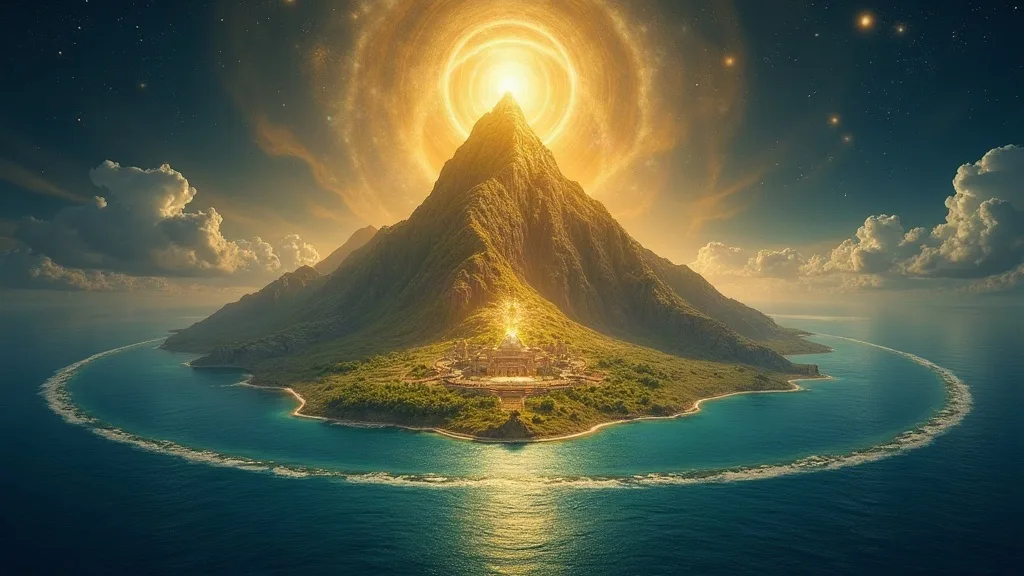
At the heart of Buddhist imagination stands a mountain that has no footprint on any modern map. Mount Meru rises at the center of the universe itself, its golden peak so tall that ordinary measurement falters. Everything else orbits this axis: oceans, continents, the realms where gods and humans and animals exist. It is the anchor of all worlds, the cosmic spindle around which dharma itself turns.
The Buddhist cosmos is not empty space. It is ordered, layered, inhabited at every level. And at its core is Meru, a place both geographically concrete and utterly metaphysical. The mountain appears in dozens of texts across Buddhist traditions. It shapes the painted walls of temples from Nepal to Japan. For more than two thousand years, it has taught Buddhists how to visualize their place in existence.
What is Mount Meru?
Mount Meru is the axial center of the Buddhist universe. In the cosmologies described in texts like the Abhidharmakosa (a foundational Buddhist philosophical work from the 4th century) and the Visuddhimagga (the classical Pali text on Buddhist meditation), Meru rises at the middle of an ocean called the Salt Sea. Around it circle four great continents, one in each cardinal direction. Separated from the continents by rings of smaller mountains, beyond them extends the realm of the gods, ascending in stories toward the heavens themselves.
The mountain is not simply tall. Its measurements are cosmic. Different Buddhist schools give different figures, but the Abhidharmakosa describes Meru as 80,000 yojanas high (a yojana in Buddhist texts typically means several kilometers). Its base is equally vast, buried deep beneath the waters of the Salt Sea. The peak glows with gold. The slopes are lined with seven concentric mountain rings. Trees grow at every level. The air itself becomes rarer and more divine as one ascends.
The mountain does not exist as a geographical reference point that Buddhist scholars thought they could visit. Rather, Meru is a map of consciousness and cosmic order. It organizes the entire realm of sentient existence into zones of suffering and celestial bliss. Buddhist monks and nuns were taught to visualize Meru during meditation. Artists carved it into stone and painted it on silk scrolls. It became the template for how temples were built, how mandala designs were drawn, how devotees understood where they stood in the cycle of rebirth.
The Structure Around Meru
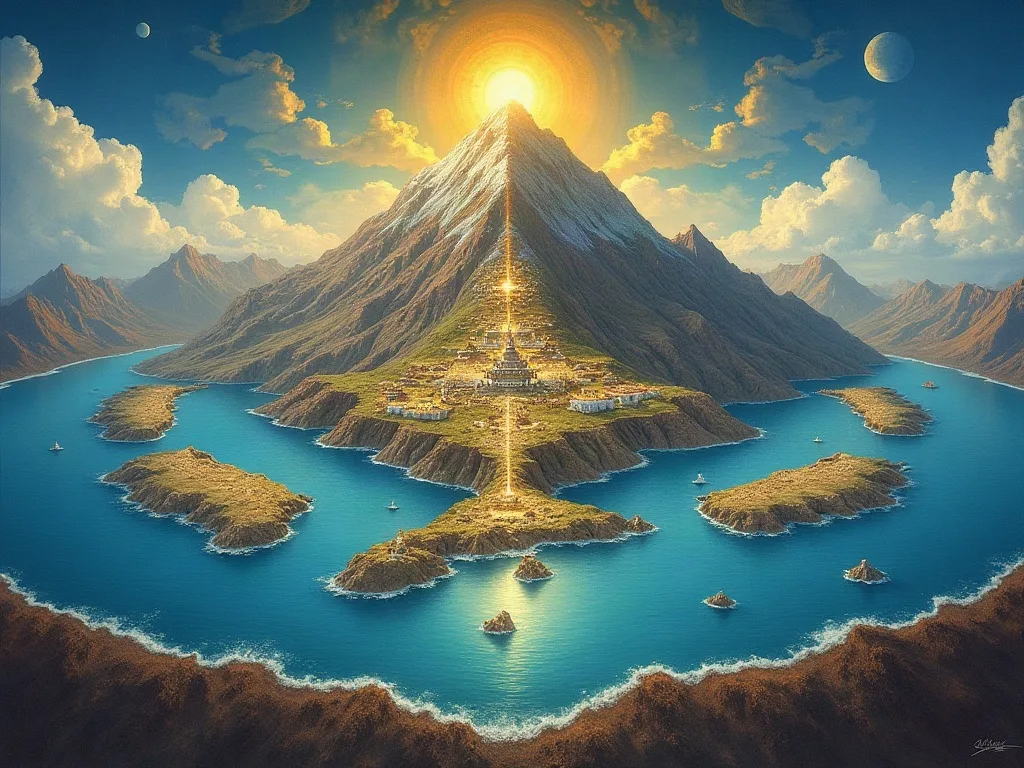
Surrounding Mount Meru in concentric rings are the four great continents. Each one houses the human realm in Buddhist cosmology. To the east lies Purva-videha (or Purvariddhi), the realm of cattle-herders. To the south is Jambu-dvipa (or Jambudvipa), the continent of action and karma. This is where humans are born, where they suffer and strive, where Buddhist practice takes root. To the west is Apara-godaniya, and to the north is Uttarakuru. Each continent is separated from the next by lesser mountain ranges.
The Salt Sea itself circles all of this. Beyond the Salt Sea lie rings of smaller mountains and other continents. Some texts describe eight additional continents paired with the four great ones. Others add further layers of geographical abstraction: wheels of gold and silver, islands of precious gems, realms that belong to no single tradition but shimmer at the edges of what Buddhists could map.
Above Meru rises the heaven of the Thirty-Three Gods, ruled by Indra (a deity known as Shakra in Sanskrit, Sakka in Pali). This heaven forms a disc around the summit. The god Brahma, the highest of the Hindu deities that appear in Buddhist texts, dwells in even higher realms above Meru's peak. Between these divine zones and the human realm below lies the intermediate space where the four Heavenly Kings hold watch, one on each face of the mountain. They are guardians of dharma, each one more powerful than any human, yet still bound to the wheel of rebirth.
Below the human realms, the mountain descends into darker zones. The animal realm occupies waters and caves. Below that lies the realm of hungry ghosts, beings tormented by craving they can never satisfy. And at the deepest level is Naraka, the hellish realms where beings experience intense suffering as a result of past actions. These are not eternal. Buddhist cosmology teaches that even hellish beings will eventually be reborn, perhaps as humans or gods, and have another chance to practice and escape suffering.
Meru in Buddhist Sacred Texts
The most detailed descriptions of Mount Meru come from the Abhidharmakosa, written by the scholar Vasubandhu in the 4th century. Vasubandhu was a systematic thinker who wanted to organize Buddhist teaching into a coherent framework. His work became authoritative across many Buddhist schools. In the Abhidharmakosa, Meru is described with exact measurements and spatial relationships. Nothing is left to vague imagination. The cosmology is precise, almost architectural.
The Visuddhimagga, compiled by Buddhaghosa in the 5th century, offers another crucial account. This text is a complete meditation manual for practitioners. It instructs them how to visualize Meru, step by step, as part of their inner work. Buddhaghosa explains that meditating on the cosmic structure helps the practitioner understand impermanence, non-self, and the nature of suffering across all realms. Seeing Meru in the mind's eye teaches dharma directly.
The Mahayana tradition, which took root across East Asia, preserved Meru in slightly different forms. The Lotus Sutra, one of the most beloved Mahayana texts, mentions Meru as the highest of mountains, a place where celestial beings and bodhisattvas gather. Bodhisattvas are enlightened beings who postpone final liberation to help others. Many Mahayana temples placed a miniature Meru at the center of their grounds or drew it into their mandalas as the organizing principle of the sacred space.
The text called the Kalachakra Tantra, one of the most complex works in Tibetan Buddhist philosophy, describes a tantric version of the cosmos that still centers on Meru. In Tibetan practice, meditators would visualize themselves at the peak of Meru, looking down over all realms, to cultivate compassion for all beings in all zones below.
The Four Guardian Kings
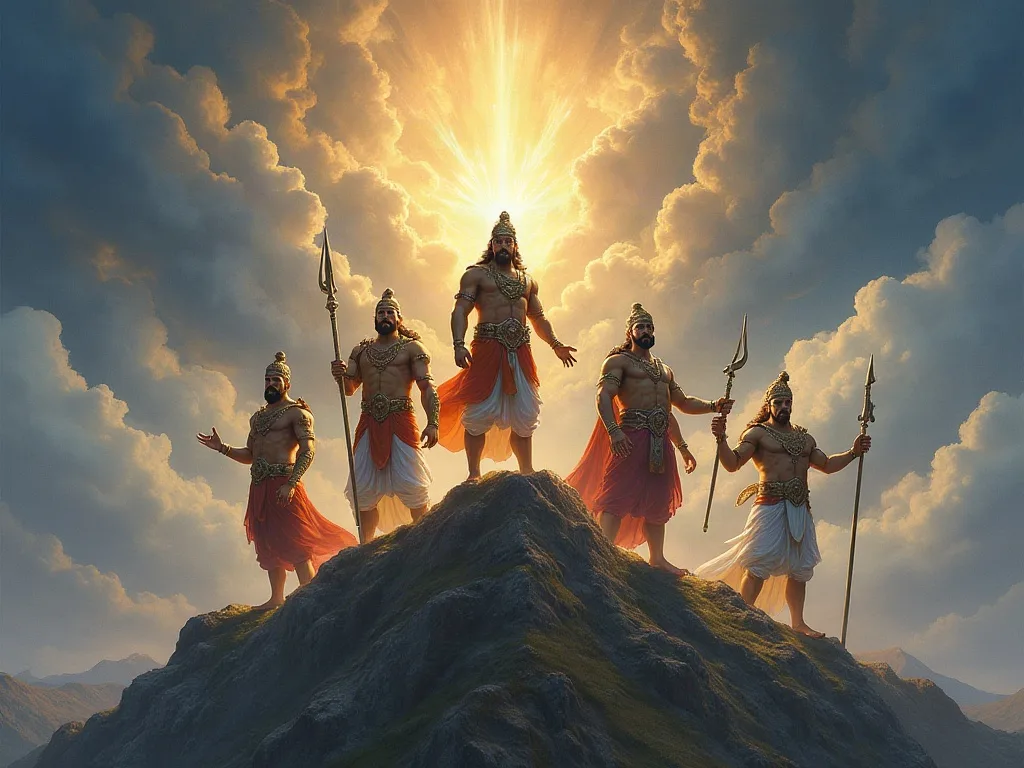
Standing sentinel on the four cardinal slopes of Mount Meru are the Catur Maharaja, the Four Heavenly Kings. Each one is a bodhisattva in his own right, a powerful being who has vowed to protect dharma and its practitioners. In Pali and Sanskrit texts, they are named Dhritarashtra (east), Virupaksha (west), Virudhaka (south), and Kubera (north). Each rules over his own heaven and commands armies of divine and semi-divine beings.
These kings are not abstract symbols. They are real inhabitants of the Buddhist cosmos, as real as Meru itself within the Buddhist imagination. They can be invoked in prayers for protection. They stand guard over the four directions. Temples across Asia place statues of these four kings at their entrances or in protective shrines, affirming their role as watchers of the dharma.
Kubera, the northern king, is also known as Vaisravana. He is god of wealth, a figure who appears in Hindu texts as well. In Buddhist contexts, Kubera's wealth is spiritual treasure, the accumulated merit of dharma practice. His abundance is a blessing on those who guard the teachings.
The Realms Above and Below Meru
The Buddhist cosmology organized around Mount Meru is a map of consciousness as much as geography. The higher one ascends the mountain or dwells in the celestial realms, the more subtle and refined existence becomes. The gods experience pleasure so refined that they scarcely feel the weight of karma. Yet even the highest gods are not free from the cycle of rebirth. Eventually, their merit exhausts itself, and they too fall back into lower realms.
The human realm, located on Jambu-dvipa to the south of Meru, occupies a middle position. This placement is not random. Human existence offers a unique advantage: humans suffer enough to be motivated toward spiritual practice, yet they retain enough stability and freedom to actually practice. The heavens are too comfortable for liberation. The hellish realms are too painful. Only humans, Buddhists teach, have struck the right balance for enlightenment to be possible.
Above the realm of the Thirty-Three Gods, the Buddhist cosmologies describe further heavens, each increasingly subtle and rarefied. In the Pali Canon (the oldest surviving Buddhist texts, composed in Sri Lanka), these upper heavens are ruled by Brahma. They are silent, contemplative zones where beings who have attained the deepest meditative states are reborn. These are not permanent dwelling places. When the merit that placed them there exhausts itself, these beings too will fall.
Below, in the depths, the hells are not ruled by a single dark lord. Rather, they are natural consequences of karma. A being whose actions were rooted in extreme greed, hatred, or delusion finds itself reborn in a hellish state. The suffering is intense, but it is not eternal. It is purgatorial: a working-out of past misdeeds. Eventually the being will be reborn elsewhere and have another chance to awaken.
Meru Across Buddhist Traditions
The structure of Mount Meru remained consistent across nearly all Buddhist schools, though regional variations emerged. In Theravada Buddhism, which preserves the oldest Pali texts, Meru is described in the Abhidharmakosa commentaries and the Pali Visuddhimagga. Meditation on Meru is a classical practice.
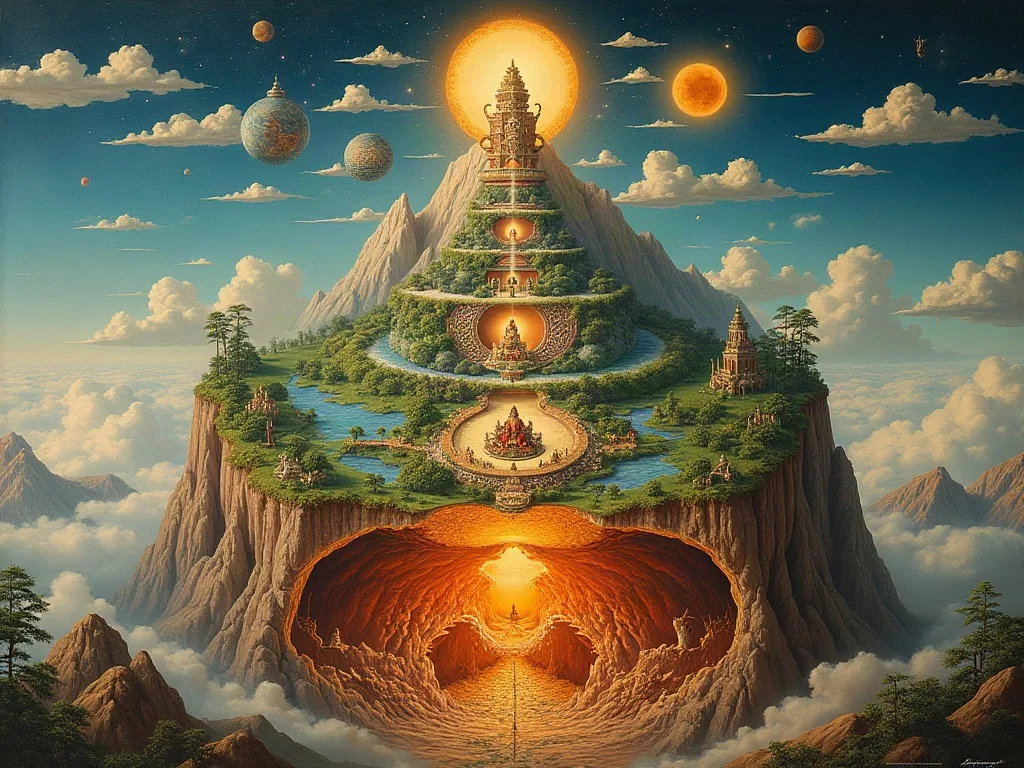
In Mahayana Buddhism, Meru took on additional symbolic weight. Many East Asian temples were designed to echo the shape of Meru: a central pagoda or sanctuary rising upward, surrounded by concentric courtyards and protective structures. The great pagodas of China, Japan, and Korea often attempt to capture this cosmic mountain in brick and timber.
In Tibetan Buddhism, Mount Meru became central to the practice of mandala meditation. A mandala is a geometric representation of the cosmos. The most famous is the mandala of Kalachakra, a tantric system of extraordinary complexity. In these mandalas, Meru rises at the center in four-square form, surrounded by rings of mountains, continents, and celestial palaces. A practitioner would visualize themselves, or a deity they were meditating on, at the center or peak of Meru, looking out over all realms and cultivating wisdom and compassion.
The Shingon school of Japanese Buddhism incorporated Meru into its cosmological diagrams. The Tendai school of Japan, and the Jingtu (Pure Land) schools of East Asia, all held the basic Meru cosmology as foundational, even if they emphasized other practices like mantra repetition or faith in a Buddha.
In Southeast Asia, where Theravada Buddhism predominates, temples were sometimes designed with a central shrine representing Meru, surrounded by lesser structures representing the continents and outer realms. The arrangement of architecture became a living mandala, a three-dimensional representation of the Buddhist cosmos.
Meru's Relationship to Hindu Cosmology
Mount Meru did not originate with Buddhism. The mountain appears in much older Hindu and Sanskrit texts, including the Mahabharata and the Puranas. In Hinduism, Meru is the cosmic mountain where the gods hold court, where Indra rules, where the Rig Veda describes the gods taking their seats. Meru is the axis of the whole world, the place where heaven and earth meet.
When Buddhism arose in India around the 5th century BCE, it encountered this existing cosmological model. Rather than reject it, early Buddhist teachers integrated it. The Buddha and his followers were not interested in creating entirely new cosmographies. Instead, they took the widely accepted Hindu model of Meru and reinterpreted it through their own lens. They kept the mountain, the continents, the realms of gods and humans. But they reframed what those realms meant: not as permanent homes of eternal beings, but as temporary dwelling places within an endless cycle of rebirth, all of it driven by karma.
This reframing was profound. In Hindu thought, certain beings (especially the gods) occupied secure, high positions. In Buddhist thought, no position is secure. A god's time in heaven is temporary. When their merit runs out, they fall. Even the highest celestial realm is eventually exhausted. Every being is caught in samsara, the endless cycle of suffering and rebirth, until they awaken to the truth of non-self and find nirvana.
The shared geography between Hinduism and Buddhism reflected centuries of cultural exchange in ancient India. Buddhist teachers were not isolated from Hindu thought. They debated Hindu philosophers. They borrowed existing cosmological frameworks and reinterpreted them. Meru became a shared vocabulary between traditions.
Meru in Buddhist Art and Architecture
For over two thousand years, Mount Meru has been rendered in paint and stone across Asia. The most common artistic tradition is the mandala, a geometric representation of the cosmos with Meru at its center. Mandalas appear in Tibetan sand-painting rituals, in painted scrolls from Nepal, in embroidered textiles from Central Asia. Each mandala shows the same basic structure: Meru rising at the center, surrounded by rings of mountains, celestial palaces, guardian figures, and the four continents arranged in cardinal directions.
In China and Japan, temple architecture itself became a representation of Meru. A central pagoda rose from the temple grounds, often surrounded by smaller halls and courtyards arranged in concentric rings. The highest story of the pagoda represented the peak of Meru. The base represented the lower realms. Walking through the temple was a physical journey through the Buddhist cosmos.
In Nepal, the great stupa of Boudhanath has a mandala-like layout when viewed from above: a central dome representing Meru, surrounded by concentric paths. Pilgrims walk clockwise around the structure, a practice called circumambulation, physically retracing the orbit of worlds around the cosmic mountain.
In Thailand and Cambodia, the temples of Angkor Wat and many Thai royal temples show Meru-influenced architecture. The central sanctuary, often square in plan, represents Meru. The surrounding galleries and outer walls represent the mountain ranges and realms beyond.
In Tibetan Buddhism, sand mandalas are created and destroyed in ritual ceremonies. An artist spends days or weeks creating an intricate, colored-sand mandala representing the cosmos. Meru glows at its center. Every element is placed with precise intention. Then, in a moment of profound teaching, the sand is swept away, returning to undifferentiated matter. The ritual demonstrates impermanence and non-attachment, core Buddhist truths.
Scroll paintings from across East Asia show Meru in its full glory. The mountain rises in the center, its peak often rendered in gold leaf. Gods and bodhisattvas dwell in celestial palaces on its slopes and surrounding realms. Humans and animals move through lower zones. Dragons circle the waters of the Salt Sea. The entire cosmos is visible in a single image, making the invisible visible.
The Scientific Question: What Did Buddhists Think They Were Describing?
Modern scholars have debated whether Buddhist monks who wrote detailed descriptions of Meru cosmology believed they were describing literal geography or understood it as metaphorical. The evidence suggests a both-and answer. The texts are written with such specificity (exact measurements, compass directions, named locations) that at least some teachers seem to have believed in a literal Meru. Yet the cosmology never quite matched what geographers and astronomers were discovering about the actual world.
By the medieval period, when Buddhism had spread across Asia, educated Buddhist scholars were aware that the Meru cosmology did not align with empirical geography. Yet they did not discard it. Instead, they treated it as a map of consciousness and karma rather than a literal earth-map. The mountain became more valuable, not less, when understood primarily as a meditation aid and a teaching tool.
This flexibility was a strength of Buddhist thought. The cosmology could remain stable and central to practice while simultaneously being reinterpreted as each era's science advanced. Meru did not need to be literally true to teach essential truths about rebirth, karma, and the structure of suffering.
Meru as a Teaching of Interdependence
At the deepest level, Mount Meru teaches interdependence. Every realm depends on the mountain's existence. Every being, from the highest god to the lowest creature in hell, is connected to every other through Meru's vertical axis and the horizontal rings of mountains and oceans. A being reborn as a god dwells above a being reborn as an animal, but they are not separate. Both will eventually be reborn again. Both experience the consequences of karma. Both are equally part of the cosmos organized around Meru.
This understanding dissolves hierarchy even as it acknowledges the hierarchy of realms. A god is not superior by nature, only by merit. That merit is temporary. A hell being is not inferior by nature, only by current karma. Their suffering will eventually be exhausted. The cycle is impartial and inexorable.
Meru also teaches that the cosmos is interconnected and purposeful, not chaotic. Every level, every realm, every being has a place and a function in the larger system. Suffering exists at all levels. Compassion is therefore a universal imperative. Even gods suffer the ultimate suffering of impermanence. Even hell beings have a chance at liberation.
Frequently Asked Questions About Mount Meru
Frequently asked questions
Is Mount Meru a real mountain?
Mount Meru is not a geographical location that can be visited. It exists in Buddhist cosmology and meditation practice as the axis of the universe. No Buddhist text offers directions to find it on a map. Some scholars have speculated that the original concept might have been inspired by a real mountain such as Kailash in Tibet, but Buddhism transformed it into a cosmic structure that maps the mind and the structure of rebirth rather than physical terrain.
Why do Buddhists place Mount Meru at the center of their cosmos?
Placing Meru at the center allows Buddhists to organize all realms of existence into a coherent system. It makes clear that human existence is in the middle: not too comfortable to spur spiritual effort, not too painful to be hopeless. Meru also serves as a meditation aid, allowing practitioners to visualize the entire cosmos and their place in the cycle of rebirth, which deepens understanding of karma and impermanence.
How does Mount Meru relate to physical mountains like Mount Kailash?
Mount Kailash in Tibet is a real mountain sacred to multiple traditions, including Hinduism, Buddhism, Jainism, and the indigenous Bon tradition. While some scholars suggest that the mythological Meru might have been inspired by Kailash or other Himalayan peaks, Buddhist texts treat Meru as a cosmic structure, not a specific earthly location. Kailash has its own separate sacred status, but it is not identified as Meru in classical Buddhist texts.
Do all Buddhist schools teach the same Mount Meru cosmology?
The basic structure of Meru as the center of the cosmos, surrounded by four continents and rings of mountains, is shared across Theravada, Mahayana, and Vajrayana Buddhist traditions. However, the emphasis and integration of Meru varies. In Tibet, Meru is central to tantric mandala practice. In East Asia, it influences temple architecture. In Southeast Asia, it remains part of cosmological teaching but may be less emphasized in contemporary practice. The core image, however, remains consistent.
What happens at the peak of Mount Meru in Buddhist practice?
The peak of Meru is traditionally the realm of the Thirty-Three Gods, ruled by Indra or Shakra. Higher still are the Brahma heavens, the most refined celestial realms. In meditation and tantric practice, visualizing oneself at the peak of Meru represents a state of clarity, compassion, and access to celestial wisdom. It is not a place one can dwell permanently; even the gods eventually fall from their heavens. But reaching the peak in visualization represents a state of elevated consciousness within practice.
Meru in Contemporary Buddhism and Beyond
In the modern era, Mount Meru remains a living part of Buddhist thought, even as Buddhist teachers acknowledge that the literal cosmology does not match modern physics. In Tibetan monasteries, monks still study the detailed descriptions of Meru in classical texts. The mountain still appears in mandala construction and in visualization practices. In Japan, the pagoda form still echoes Meru's shape.
Yet the mountain has also entered secular imagination in the West. Writers and artists have drawn on the Meru cosmology as inspiration, seeking in it a different way of imagining cosmic structure. Some environmental thinkers have interpreted Meru as a teaching about interconnection and the mutual dependence of all beings on a shared center. The mountain becomes a symbol of systems thinking and ecological interdependence.
In recent decades, some Buddhist teachers have explicitly reframed Meru as a teaching about the mind rather than about outer space. This is not a new move; it echoes medieval Buddhist philosophy. But it emphasizes the continuity between outer cosmos and inner consciousness. To understand the structure of Meru is to understand the structure of one's own mind: layered, organized, with lower and higher impulses, with attachment and aversion at the base and wisdom and clarity potentially at the summit.
This reinterpretation has allowed Meru cosmology to remain relevant to practitioners who understand the universe through modern astronomy rather than ancient Buddhist geography. The mountain becomes a mandala, a map that teaches universal principles rather than describing literal space. Its truth is not scientific but spiritual: a truth about suffering, interdependence, impermanence, and the possibility of awakening from the endless cycle of rebirth.
Read the full book
Want the whole story?
The complete edition is an instant PDF download here, with a paperback on Amazon for selected titles.
Buddhist
The Buddhist Mythology Book: Mara, Avalokiteshvara, Mahakala, and the Sacred Cosmology Beyond Meditation
Demons, Bodhisattvas, and the Cosmic Architecture of Buddhism
The mythological layer of Buddhism: Mara's temptation, the Bodhisattvas, Vajrayana fierce deities, the Eight Hells, Mount Meru, and the Jataka tales. Delivered within 24 hours of purchase.
More from Buddhism
All articles
Buddhism
Vesak: The Festival Celebrating Buddha's Birth, Enlightenment, and Death
Vesak marks the three most pivotal moments in Siddhartha Gautama's life, all on a single day. Discover how Buddhists across Asia transform this holy date into a festival of light, moral renewal, and collective remembrance of the Buddha's journey to awakening.
Buddhism
Tara: The Mother of Liberation in Mahayana Buddhism
Tara embodies compassion in action, the Tibetan Buddhist goddess who hears suffering and moves to end it. Known as the Mother of Liberation, she appears in multiple forms, each one a different answer to human need.

Buddhism
The Lotus Sutra: Sacred Text of Universal Buddhahood
The Lotus Sutra teaches that every being, no matter how lost, can achieve buddhahood. Discover how Buddhism's most beloved scripture rewrote enlightenment and shaped a thousand years of practice.
Buddhism
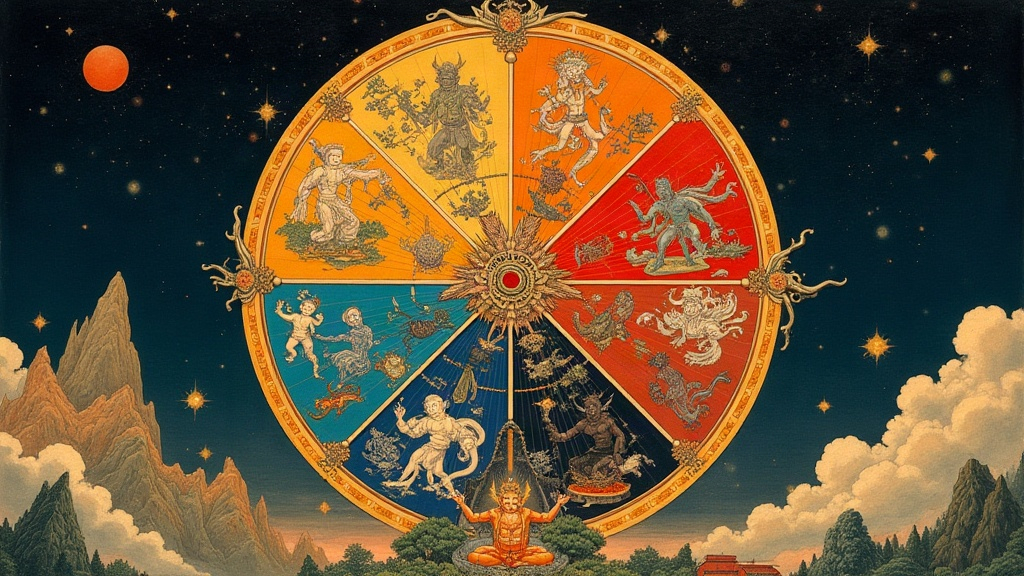
The Six Realms of Samsara: Buddhist Cosmology and Rebirth
Buddhist cosmology maps existence across six realms of rebirth, from heavens where joy becomes suffering to hells where torment teaches detachment. Discover how this ancient map of consciousness shapes Buddhist ethics and practice.