
The Wheel of Dharma: Buddhism's Most Sacred Symbol
The Dharmachakra has guided Buddhist thought for over 2,500 years. Learn what each spoke, rim, and hub truly means, and why this ancient wheel still turns today.
Contents
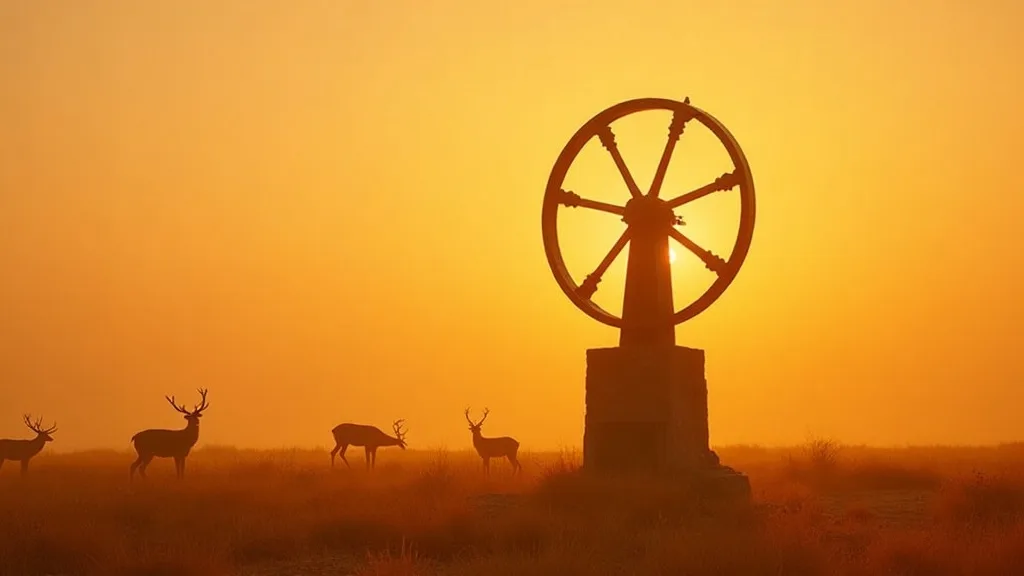
A golden wheel spins above the deer park in Sarnath. Eight spokes catch the morning light. A small group of wanderers sits in the dust below, listening to a man who had, just weeks before, sat motionless beneath a fig tree until something in him permanently changed. He speaks, and what he sets in motion that day, his listeners will later call the first turning of the Wheel of Dharma.
That image, a wheel with eight spokes, became one of the oldest continuously used religious symbols on earth. It predates the Buddha's era as a royal and cosmic emblem, and it outlasted every empire that ever tried to claim it. Today it sits at the center of the Indian national flag, on monastery walls from Ladakh to Laos, and on the robes of monks who have never stopped counting its spokes.
The wheel is not decoration. Every curve of its rim, every spoke, every hub carries a precise meaning built over millennia by teachers, monks, artists, and philosophers across a dozen distinct Buddhist traditions. To read the Dharmachakra is to read the core of Buddhist cosmology in a single glance.
Origins Before the Buddha: The Cosmic Wheel in Ancient India
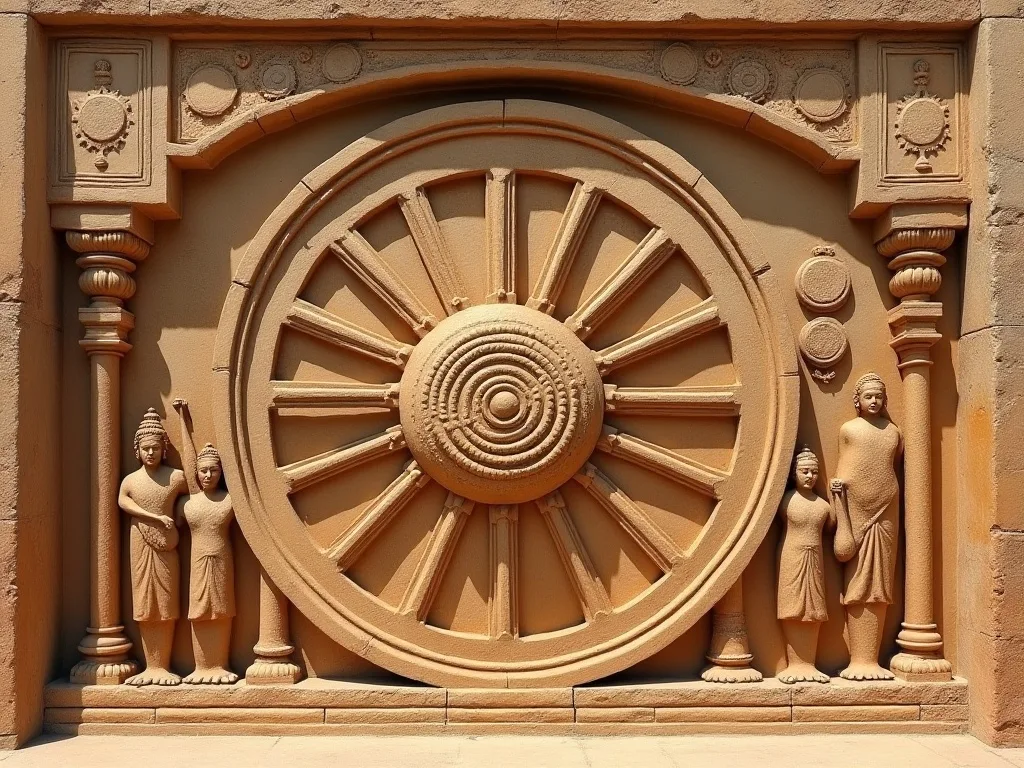
The wheel as a symbol of cosmic power was already ancient when Siddhartha Gautama was born around 563 BCE in Lumbini (in present-day Nepal). Vedic literature, the oldest religious texts of the Indian subcontinent, knew the chakravartin, a Sanskrit term meaning "wheel-turner" or "one who sets the wheel in motion." A chakravartin was a universal monarch whose divine chariot wheel rolled across the earth without obstruction, a sign that the cosmos had aligned behind his rule.
The Rigveda, composed roughly between 1500 and 1200 BCE, connects the solar disc to the concept of rita, the cosmic order that holds the universe in balance. The wheel, spinning on its axis, was the most intuitive image ancient Indian thinkers had for this orderly motion, the sun crossing the sky, the seasons returning, births following deaths following births.
When the early Buddhist communities chose a symbol for the Dharma, they did not invent one from nothing. They took this already-charged image and gave it a new center of gravity. The chakravartin's wheel now turned not through military conquest but through truth. The universal monarch was replaced by a universal teacher.
Archaeological evidence confirms how quickly this reframing took hold. The lion capital of Ashoka, the Mauryan emperor who embraced Buddhism in the 3rd century BCE, places a wheel at the top of a polished sandstone pillar at Sarnath, the very site of the first teaching. Ashoka's edicts, carved into rock faces across his empire, describe his own reign as a "turning of the Dharmachakra" through righteous governance rather than war. The symbol had become the official emblem of a Buddhist political vision that would reshape Asia.
Explore how Vedic cosmology shaped the symbolism inherited by early Buddhism
The First Turning: Sarnath and the Birth of the Dhammacakka
The Pali Canon, the earliest surviving collection of Buddhist scriptures compiled in Sri Lanka around the 1st century BCE but preserving oral traditions far older, records the moment the wheel metaphor entered Buddhist history. The text is the Dhammacakkappavattana Sutta, a Pali phrase meaning "the discourse that sets the wheel of the Dharma in motion."
The setting is the Isipatana Migadaya, the deer park at Sarnath near Varanasi. The Buddha, freshly awakened, walks to find five former companions who had abandoned him when he gave up extreme asceticism. He could have moved on. Instead he sits with them and speaks for the first time about what he had understood beneath the Bodhi tree.
He begins with the Middle Way, the path between sensual indulgence and painful self-mortification that he had discovered through years of personal experiment. He then lays out the Four Noble Truths: that suffering (dukkha) exists; that craving (tanha) causes it; that craving can cease; and that the Eightfold Path leads to that cessation. The text records that as he taught, one of the five men, Kondanna, suddenly understood, and the cosmos trembled.
The trembling matters. The Dhammacakkappavattana Sutta describes the gods relaying the news upward through the heavens, level by level, until the whole universe reverberates with the announcement. The first turning of the wheel is not a quiet lecture. It is a cosmological event. Something locked has been released.
Read about the life of Siddhartha Gautama and his path to awakening
Anatomy of the Wheel: What Each Part Means
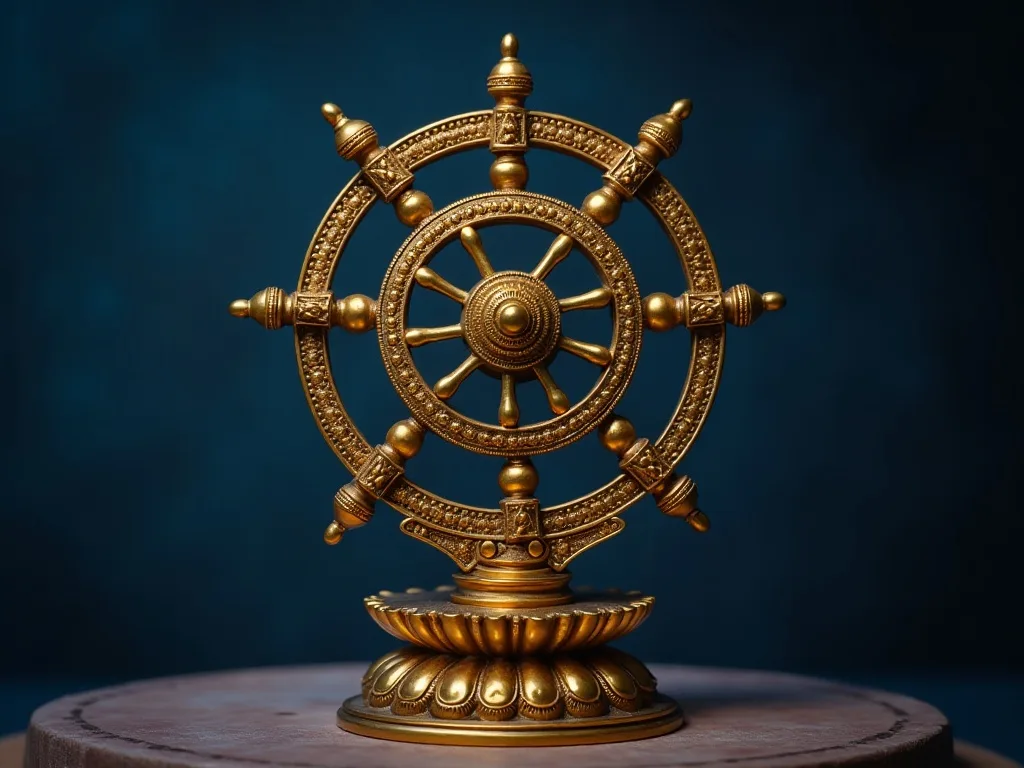
The Dharmachakra as it appears in Buddhist art is not a freehand sketch. It has a standardized anatomy, each element carrying a distinct layer of meaning. Traditions differ slightly on details, but the core structure holds across Theravada, Mahayana, and Vajrayana schools.
The Hub: Concentration and Discipline
The hub at the center of the wheel represents samadhi, the focused concentration that forms the core of Buddhist meditation practice. Without a stable center, no wheel can roll straight. Some traditions interpret the hub as discipline (sila), the moral conduct that holds everything else in place. In Tibetan Vajrayana iconography, the hub sometimes contains the "three poisons": a pig (ignorance), a snake (hatred), and a rooster (greed), chasing each other in a circle, because the wheel of samsara (the cycle of rebirth) is driven by these forces. The Dharmachakra exists precisely to stop that spin.
The Eight Spokes: The Noble Eightfold Path
The eight spokes are the most doctrinally specific part of the wheel. Each spoke corresponds to one element of the Noble Eightfold Path:
- Right View - understanding the Four Noble Truths and the nature of reality
- Right Intention - commitment to renunciation, goodwill, and harmlessness
- Right Speech - truthful, kind, and purposeful use of language
- Right Action - ethical behavior, avoiding harm, theft, and misconduct
- Right Livelihood - earning a living in ways that do not cause harm
- Right Effort - the energy to cultivate wholesome states and abandon harmful ones
- Right Mindfulness - clear, sustained awareness of body, feeling, mind, and phenomena
- Right Concentration - the meditative development that leads to deep stillness
The Buddha grouped these eight into three clusters: wisdom (prajna: spokes 1-2), ethical conduct (sila: spokes 3-5), and mental cultivation (samadhi: spokes 6-8). The path is not sequential but mutually reinforcing, the way each spoke supports the others while sharing the same hub.
The Rim: Mindfulness and Unity
The outer rim that connects all the spokes represents mindfulness holding the path together, or, in some interpretations, the unity of the Dharma itself. Without the rim, each spoke is just a stick pointing nowhere. The rim makes the wheel coherent and gives it the capacity to roll.
Some Tibetan commentators add a further symbolic layer: the rim represents the teaching as a whole, complete, circular, without beginning or end, a truth that does not depend on a first cause or a final authority outside itself.
Three Turnings: How the Wheel Rolled Through History
Buddhist tradition, particularly within Mahayana schools, speaks of three separate turnings of the Wheel of Dharma, each revealing a deeper or more expansive layer of the teaching.
The first turning at Sarnath established the Four Noble Truths and the Eightfold Path. This is the foundational teaching preserved most directly in Theravada Buddhism, which regards this layer as sufficient and complete.
The second turning is associated with the Prajnaparamita sutras, the "Perfection of Wisdom" texts composed roughly between 100 BCE and 600 CE. These texts, which include the famous Heart Sutra and the Diamond Sutra, teach sunyata, the Sanskrit term for emptiness or "openness." They argue that all phenomena lack fixed, independent existence. The wheel has turned deeper: suffering is not merely caused by craving; it is rooted in the fundamental misconception that a fixed self exists in the first place.
The third turning is linked to Yogacara philosophy, developed by the brothers Asanga and Vasubandhu in the 4th and 5th centuries CE. Where the second turning asked what phenomena are (empty of inherent existence), Yogacara asked how they appear at all. Its answer was the alaya-vijnana (Sanskrit: "storehouse consciousness"), a subliminal mental stratum that accumulates bija (Sanskrit: "seeds"), karmic impressions deposited by every thought, word, and action. These seeds ripen into perceptions, and perceptions construct the apparent world. For Yogacara, the wheel of Dharma does not merely describe the path out of suffering; it describes the architecture of the mind that generates the illusion of a fixed external reality in the first place. Two closely related doctrines crystallized around this insight. Vijnanavada ("consciousness-only") holds that what we call the outer world is a projection of mental processes; Cittamatra ("mind-only") reinforces this by insisting that no object can be established independent of the mind that cognizes it. Tibetan commentators, notably Mipham Rinpoche in the 19th century, argued that the third turning's real contribution to wheel symbolism was this: it showed that the hub, the still center around which all eight spokes revolve, is not a theological abstraction but the luminous, unobstructed quality of awareness itself, rigpa in Tibetan. The wheel has now turned into the very mechanism of perception, and understanding that mechanism is the final revolution.
The Dharmachakra Across Buddhist Traditions
What is striking about the Wheel of Dharma is how each Buddhist tradition has pressed it into its own visual language without ever abandoning its core meaning.
Theravada Buddhism, practiced primarily in Sri Lanka, Thailand, Myanmar, Cambodia, and Laos, keeps the wheel simple: eight clean spokes, a clear rim, a plain hub. The Theravada emphasis is on the historical Buddha and his recorded teachings, so the wheel functions as a direct pointer to the Dhammacakkappavattana Sutta and nothing more elaborate.
Mahayana Buddhism, the larger vehicle that spread north into China, Korea, Japan, and Vietnam, often places the wheel in the hands of bodhisattvas (beings who have attained the capacity for awakening but remain in the world to help others). In Chinese Buddhist art, the wheel appears alongside the lotus and the vase as part of a standard set of auspicious symbols. Japanese Shingon Buddhism, a Vajrayana-inflected school, embeds the wheel within elaborate mandala compositions where its position relative to other symbols generates additional layers of meaning.
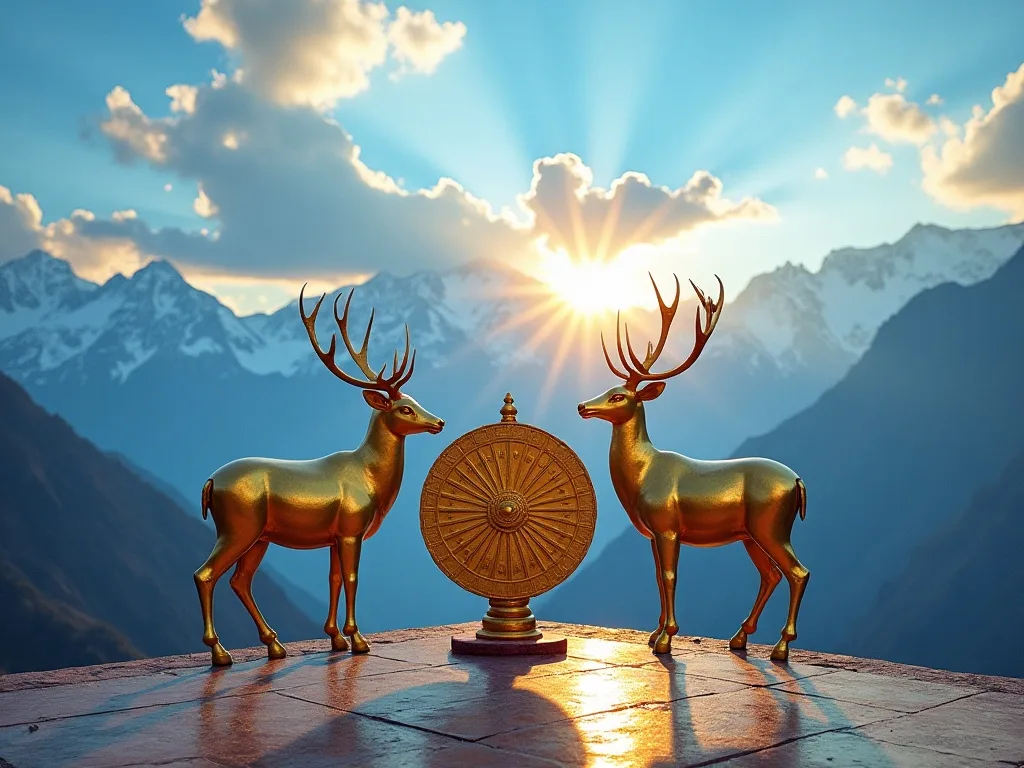
Vajrayana Buddhism, practiced across Tibet, Bhutan, Mongolia, and parts of Nepal, gives the wheel perhaps its most visually dramatic context. The Dharmachakra appears at the apex of monastery rooftops, flanked by two golden deer, a direct reference to the deer park at Sarnath. This rooftop ensemble is called the Dharmachakra mudra in Tibetan art, and it signals to anyone approaching that the building contains authentic Dharma teaching.
In the Tibetan Wheel of Life (bhavachakra), a related but distinct image, the entire cycle of rebirth is represented as a wheel gripped by Yama (the lord of death). This is not the Dharmachakra but its cosmological counterpoint: the wheel of samsara that the Dharma wheel is meant to stop. The contrast the Comparison block above makes vivid is equally visible in monastery entrance halls across Tibet, where the bhavachakra mural faces the door so that every practitioner walks in past the turning of suffering before approaching the altar where the Dharmachakra stands.
Explore the six realms of the Bhavachakra and Tibetan Buddhist cosmology
The Wheel as Political Emblem: Ashoka to the Indian Republic
No symbol travels without being claimed. The Dharmachakra's political biography is almost as long as its spiritual one.
Ashoka Maurya (reigned approximately 268-232 BCE) made the wheel the centerpiece of his imperial identity. After the brutal Kalinga War, in which perhaps 100,000 people died and 150,000 were deported, Ashoka converted to Buddhism and attempted to govern through Dharma: compassion, non-violence, religious tolerance, and public welfare. His pillars, erected across his empire from Afghanistan to southern India, each bore a wheel at the top. The most famous, at Sarnath, carries the Ashoka Chakra, a 24-spoked wheel that in 1947 was placed at the center of the new Indian national flag, replacing the spinning wheel of Gandhi's independence movement.
The choice was deliberate. The 24 spokes of the Ashoka Chakra are often interpreted as the 24 hours of the day, suggesting perpetual motion and progress, or as 24 virtues described in later Buddhist commentaries. Either way, independent India chose to open its national identity with a Buddhist symbol of righteous governance rather than any emblem specific to Hinduism, Islam, or Christianity. The wheel carried enough weight, and enough neutrality, to speak for an entire subcontinent.
Discover how Ashoka's Buddhist statecraft shaped the art of the ancient world
Scholarly Debates: How Old Is the Symbol, and What Did It Originally Mean?
Scholars have spent considerable energy arguing about whether the wheel was primarily a solar symbol, a royal emblem, or a cosmic map before Buddhism adopted it.
Art historian Ananda Coomaraswamy, writing in the early 20th century, traced the chakra motif across Vedic, Jain, and Buddhist material and argued that the solar interpretation was primary. The wheel was first the sun, then power, then Dharma.
More recent scholarship, particularly the work of Robert DeCaroli on early Indian Buddhism and Gregory Schopen's analysis of epigraphic evidence, suggests the process was less linear. The wheel entered Buddhist symbolic vocabulary early, but its specific doctrinal loading, the eight spokes as the Eightfold Path, likely crystallized through artistic convention as much as through theological decree. The spokes in the earliest Ashokan wheels vary in number. The standardization to eight appears to have been gradual, matching the formalization of doctrine.
A separate debate concerns the relationship between the Dharmachakra and the Jain dharma-chakra, which also appears in early Indian art. Some scholars argue for independent parallel development; others see cross-pollination between two traditions that shared geography, terminology, and monastic culture. The question remains open.
Frequently Asked Questions About the Wheel of Dharma
Frequently asked questions
What is the Dharmachakra and what does it represent?
The Dharmachakra (Pali: dhammacakka) is the eight-spoked wheel used as the central symbol of Buddhism. It represents the Buddha's teaching, specifically the Noble Eightfold Path (one spoke per element), the Dharma as cosmic truth, and the act of setting that truth in motion through the first sermon at Sarnath. The hub, spokes, and rim each carry distinct doctrinal meanings related to concentration, the path, and mindfulness respectively.
Why does the Wheel of Dharma have eight spokes?
The eight spokes correspond to the eight elements of the Noble Eightfold Path: Right View, Right Intention, Right Speech, Right Action, Right Livelihood, Right Effort, Right Mindfulness, and Right Concentration. This is the path the Buddha described in his first teaching at Sarnath. The standardization to eight spokes developed gradually through the early centuries of Buddhist art, matching the consolidation of this core doctrine.
What is the difference between the Dharmachakra and the Wheel of Life (bhavachakra)?
These are two distinct symbols. The Dharmachakra is the teaching wheel, representing the path to liberation. The bhavachakra (Wheel of Life) is a Tibetan Buddhist diagram showing the six realms of rebirth, the twelve links of dependent origination, and the three poisons at the center. The Wheel of Life is held by Yama, the lord of death, and represents the cycle of samsara that Buddhist practice aims to escape. The Dharmachakra is, in a sense, the antidote to the bhavachakra.
How did the Wheel of Dharma end up on the Indian national flag?
The Ashoka Chakra, a 24-spoked version of the Dharmachakra, was adopted from the lion capital of Ashoka at Sarnath. When India became independent in 1947, the wheel replaced the spinning wheel on Gandhi's Congress flag. The choice signaled continuity with one of India's most celebrated ancient rulers and with a universalist, non-sectarian ethic. The 24 spokes are often interpreted as representing 24 hours of the day, suggesting continuous motion and progress, though Buddhist commentaries also associate them with 24 virtues.
What are the three turnings of the Wheel of Dharma?
Mahayana Buddhism describes three historical expansions of the Buddha's teaching. The first turning, at Sarnath, established the Four Noble Truths and the Eightfold Path. The second turning, associated with the Prajnaparamita sutras, taught sunyata (emptiness), arguing that all phenomena lack fixed independent existence. The third turning, developed by Asanga and Vasubandhu in the 4th-5th centuries CE, explored the nature of consciousness through Yogacara philosophy, introducing the concept of the alaya-vijnana (storehouse consciousness) and the Cittamatra (mind-only) doctrine. Each turning is understood as a deepening rather than a contradiction of the previous one.
Is the Wheel of Dharma symbol older than Buddhism?
Yes. The wheel as a cosmic and royal symbol predates the Buddha by centuries in South Asian culture. Vedic literature used the chakravartin (wheel-turning monarch) concept to describe universal kingship, and the solar wheel appears in some of the oldest Indic art. Buddhism did not invent the wheel symbol; it reinterpreted an already powerful image, redirecting its meaning from military or solar dominion toward the moral and spiritual order of the Dharma. The specific doctrinal layering of the eight spokes as the Eightfold Path is distinctly Buddhist.
The Living Wheel: Modern Resonances and Unanswered Questions
The Wheel of Dharma did not stop turning with the ancient commentators. Its interpretive life is very much ongoing, and some of its most interesting chapters are unresolved.
In contemporary engaged Buddhism, a movement associated with teachers like Thich Nhat Hanh and the 14th Dalai Lama, the wheel's ethical spokes, particularly Right Livelihood and Right Action, are being reread in light of climate change, economic inequality, and digital technology. What does Right Livelihood mean when supply chains circle the globe? Scholars and practitioners are actively debating whether the Buddha's original framing can stretch to cover structural injustice or whether it was always primarily a personal practice.
In academic Buddhist studies, the question of the "three turnings" is not merely historical. Scholars like Paul Williams (in his landmark Mahayana Buddhism: The Doctrinal Foundations, 1989) and Jan Nattier have examined how later schools constructed the idea of sequential turnings to authorize their own texts as authentic Buddha-word. The wheel metaphor, it turns out, was itself a rhetorical device used by competing schools to claim legitimacy. That observation does not invalidate the symbol; it adds a layer of human texture to its long life.
Perhaps the deepest unanswered question is the simplest one. The wheel rolls. A rolling wheel does not stand still; it moves toward somewhere. Buddhism has debated for 2,500 years whether the destination, nirvana, is an extinction of self or a radiant, deathless awareness beyond description. The spokes point inward to the hub as much as outward to the rim. The center is both the still point around which everything turns and the emptiness at the heart of the turning.
That tension, motion and stillness held together in a single image, is probably why the Dharmachakra has outlasted every empire that ever put it on a flag.
Read the full book
Want the whole story?
The complete edition is an instant PDF download here, with a paperback on Amazon for selected titles.
Buddhist
The Buddhist Mythology Book: Mara, Avalokiteshvara, Mahakala, and the Sacred Cosmology Beyond Meditation
Demons, Bodhisattvas, and the Cosmic Architecture of Buddhism
The mythological layer of Buddhism: Mara's temptation, the Bodhisattvas, Vajrayana fierce deities, the Eight Hells, Mount Meru, and the Jataka tales. Delivered within 24 hours of purchase.
More from Buddhism
All articles
Buddhism
Vesak: The Festival Celebrating Buddha's Birth, Enlightenment, and Death
Vesak marks the three most pivotal moments in Siddhartha Gautama's life, all on a single day. Discover how Buddhists across Asia transform this holy date into a festival of light, moral renewal, and collective remembrance of the Buddha's journey to awakening.
Buddhism
Tara: The Mother of Liberation in Mahayana Buddhism
Tara embodies compassion in action, the Tibetan Buddhist goddess who hears suffering and moves to end it. Known as the Mother of Liberation, she appears in multiple forms, each one a different answer to human need.

Buddhism
The Lotus Sutra: Sacred Text of Universal Buddhahood
The Lotus Sutra teaches that every being, no matter how lost, can achieve buddhahood. Discover how Buddhism's most beloved scripture rewrote enlightenment and shaped a thousand years of practice.
Buddhism
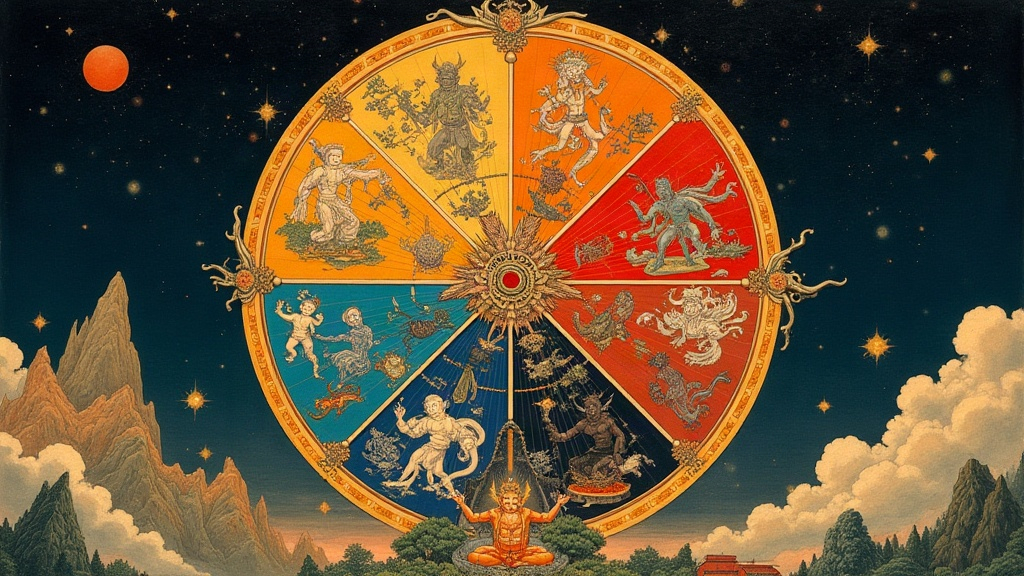
The Six Realms of Samsara: Buddhist Cosmology and Rebirth
Buddhist cosmology maps existence across six realms of rebirth, from heavens where joy becomes suffering to hells where torment teaches detachment. Discover how this ancient map of consciousness shapes Buddhist ethics and practice.