
Dangun: The Divine Founder of Korea
Dangun, the bear-born king who shaped a civilization, stands at the heart of Korean mythology. Learn the myth, its sources, and why it still matters today.
Contents
A bear waits in a cave. She has been given twenty days, a bundle of mugwort, and twenty cloves of garlic. Light does not reach her. She does not leave. When she walks out again, she is a woman.
That woman will become the mother of Dangun, the divine founder of Korea, the patriarch of an entire civilization. His story is not a mere origin legend tucked away in a temple archive. It is the founding myth of a people who have kept it alive for more than three thousand years, through conquest, colonization, and the rise of a modern nation.
The myth holds everything Korea has ever argued about itself: where it came from, what makes it sacred, and why the land matters. Pull on any thread and you find theology, ecology, and politics knotted together beneath the surface.
The Divine Chain: Hwanin, Hwanung, and the Birth of a Myth
Every Korean schoolchild knows three names before the story even begins: Hwanin (환인), Hwanung (환웅), and Dangun.
Hwanin is the Lord of Heaven, the supreme celestial god. His son Hwanung longs to leave the sky and live among humans on earth below. Hwanin looks down at the world, sees that it is worth governing, and grants his son permission to descend. He gives Hwanung three heavenly seals, symbols of divine authority, and sends him down with three thousand followers.
Hwanung lands on Mount Taebaek, which most scholars identify with a peak in the Baekdu mountain range along the modern border between North Korea and China. He settles beneath a sandalwood tree, the sindansu (신단수), a tree so sacred it functions as the axis connecting heaven and earth. Under it, he founds a sacred city called Sinsi (신시), the City of God.
Three ministers accompany him: the Earl of Wind, the Master of Rain, and the Master of Cloud. Together they govern three hundred and sixty domains of human life, from agriculture and medicine to justice and morality. Hwanung does not rule from a distance. He is in the grain fields, in the courts, in the healing of the sick.
The Bear, the Tiger, and Twenty Days of Darkness
At this point the myth introduces two animals who want something extraordinary. A bear and a tiger come before Hwanung and ask to become human. He gives them identical instructions: stay in a cave, avoid sunlight, eat nothing but mugwort and garlic for one hundred days. In some versions the trial lasts twenty-one days.
The tiger cannot bear it. After a few weeks it breaks, walks into the light, and returns to being a tiger forever.
The bear stays. On the twenty-first day she steps out of the cave as a woman, Ungnyeo (웅녀), the Bear Woman. Hwanung, moved by her transformation, takes her as his wife. She conceives a son.
That son is Dangun Wanggeom (단군왕검). Wanggeom means something close to "priest-king" or "divine ruler," a compound of royal and shamanic authority. He is born where heaven and earth meet, son of a god and a creature that earned its humanity through endurance and self-discipline.
In 2333 BC, according to the traditional Korean calendar, Dangun founds Gojoseon (고조선), the "Old Joseon" kingdom, the first Korean state. The name Joseon means "Land of the Morning Calm," a phrase Korea still carries in its own language today: Joseon, the name Koreans used for their country until 1897.
What the Cave Trial Actually Means
The garlic and mugwort episode seems strange until you read it as a test of yin qualities, the capacity for stillness, patience, and inner transformation rather than outward strength. Both plants have deep roots in Korean folk medicine. Mugwort, ssuk (쑥) in Korean, is still burned in moxibustion treatments. Garlic, maneul (마늘), is practically a sacred object in Korean cuisine.
The tiger, the animal of fire, speed, and external power, cannot last. The bear, slower and oriented inward, succeeds. Many scholars read this as a mythological argument that civilization itself is built not on conquest but on the capacity to endure and change.
The anthropologist Choi Nam-seon (1890-1957), one of the first Koreans to study Dangun systematically, argued in the early 20th century that the bear figure connects to circumpolar bear-worship traditions stretching across Siberia and into the Korean peninsula. The linguistic parallels are real: bear-ancestor myths exist among the Ainu of northern Japan, the Manchu, and various Siberian groups. Dangun sits at the edge of a much larger cultural zone.

Dangun's Kingdom: Gojoseon and the Sacred Geography
The Samguk Yusa places Dangun's capital first at Asadal (아사달), a name that probably means "morning land" or "land of the morning sun." This is significant. The founding of the kingdom is tied not to conquest but to cosmology: the king rules where the sun first arrives.
Dangun governs Gojoseon for an extraordinarily long time. Different manuscripts give different numbers, but the Samguk Yusa states he ruled for 1,500 years. Some accounts say 1,908 years. He then withdraws to Mount Asadal and becomes a mountain spirit, a sansin (산신). He does not die in any ordinary sense. He transforms again, just as his mother transformed before him.
That continuity between Ungnyeo's transformation and Dangun's final transformation is not accidental. The myth is structured around metamorphosis: bear into woman, celestial being into human ruler, human ruler into mountain god. Everything changes, nothing is lost.
Gojoseon as a historical state is real and documented. Chinese records from the 4th and 3rd centuries BC mention a kingdom called Joseon in the northeast. Archaeologists identify the Korean Bronze Age culture (roughly 2000-300 BC) as the material world in which Gojoseon grew. The myth and the archaeology do not perfectly overlap, but they rhyme.
Heavenly Seals and Shamanic Kingship
The three heavenly seals Hwanin gives to Hwanung carry weight beyond ceremony. In Korean, they are sometimes called cheonbu insa (천부인 삼), and their exact nature has been debated for centuries. Some interpreters read them as mirrors, swords, and bells, the three sacred objects also central to Japanese imperial mythology. Others see them as abstract symbols of divine mandate.
What they signal clearly is a model of kingship that fuses the sacred with the administrative. Hwanung and Dangun after him are not just political leaders. They are shamans in the deepest sense: figures who bridge the human and the divine, who translate heaven's order into earthly life.
Korean shamanism, musok (무속), has its own living tradition of such bridges. The mudang (무당), the Korean shaman, is still a practicing figure in contemporary South Korea, consulted before major life decisions, called upon during illness and crisis. The mythological structure of Dangun, the priest-king who mediates between heaven and earth, runs directly into this living practice.
Scholars like Gim Yeol-gyu have argued that the Dangun myth should be read as a founding charter for Korean shamanic religion, not just political statehood. The mountain the king returns to as a spirit is not an abstraction. Mountains in Korean religious practice are inhabited by gods, and every significant peak has its own sansin shrine.
Dangun in Korean National Identity: A Complicated History
The myth was not always treated as sacred national history. During the Joseon dynasty (1392-1897), when Confucianism dominated state ideology, Dangun's story was tolerated but not central. It was the Buddhist and folk traditions that kept it alive.
Then came Japanese colonial rule (1910-1945). The Japanese colonial government promoted its own founding myths, centering on the divine descent of the Japanese imperial line. Korean intellectuals responded by elevating Dangun to the status of a national ancestor whose story directly countered Japanese claims to cultural and racial superiority over Koreans.
Choi Nam-seon and other historians wrote extensively about Dangun not just as mythology but as documented history. The independence movement of 1919, the Samil Movement (삼일 운동), drew on Dangun rhetoric explicitly. A new religion called Cheondogyo (천도교), meaning "Heavenly Way," and later Daejongism (대종교), which venerates Dangun directly as a deity, both grew during this period.
After liberation in 1945, North Korea and South Korea handled the myth very differently. South Korea adopted the Dangi calendar (단기), counting years from Dangun's traditional founding date of 2333 BC. The year 2026 AD is thus 4359 in the Dangi system. The government officially used this calendar until 1962, when it switched to the Gregorian calendar for international purposes, though Dangi dates still appear on official documents.
North Korea took a different path. In 1993, archaeologists in Pyongyang announced they had found what they claimed were the actual bones of Dangun and his wife, buried in a reconstructed tomb outside the capital. The announcement was politically driven: Kim Il-sung's government used the "discovery" to argue that the Korean nation was racially pure, continuous, and rooted in Korean soil rather than derived from Chinese civilization. Most scholars outside North Korea treat the announcement with skepticism.
Cross-Cultural Echoes: Dangun and Other Divine Founders
Dangun is not alone among divine founder figures who are part-god and part-mortal, born from a union that crosses the boundary between worlds.
Romulus, the legendary founder of Rome, is the son of the war god Mars and a Vestal Virgin. He too founds a city, rules for generations, and disappears at the end of his life into the divine. Jimmu, the first emperor of Japan in the Nihon Shoki (a chronicle from 720 AD), descends from the sun goddess Amaterasu and leads his people to the place appointed for a kingdom. The structural parallels are striking: celestial descent, terrestrial founding, a sacred geography.
What separates Dangun is the specificity of the transformation trial. Most divine founders inherit their divinity passively, through bloodline. Dangun's mother earns her humanity actively, through suffering and discipline. The founder is not simply given. He is produced by a creature who chose to become something else. That gives the Korean founding myth an unusual moral weight: the nation begins in an act of will, not just an act of grace.
Izanagi and Izanami, the Japanese creator couple, generate islands from a primordial ocean. The Korean cosmos, by contrast, is already present when Hwanung descends. He does not create the world; he governs it. The mythological emphasis is on civilization, not cosmogony.
Dangun in Modern Korean Culture
The myth has not faded into museum rooms. South Korea celebrates Gaecheonjeol (개천절) on October 3rd each year, a national holiday whose name means "Day of the Opening of Heaven." It marks the day Hwanung descended to Mount Taebaek and, by extension, the founding moment of Korean civilization. Schools hold ceremonies. The flag flies. Official rites are performed at Chamseongdan, a stone altar on the summit of Manisan mountain on Ganghwa Island, which tradition identifies as the altar Dangun himself built to offer sacrifices to heaven.
Mount Baekdu, the volcanic peak on the North Korea-China border and the site of Hwanung's descent, carries enormous symbolic weight in both Koreas. North Korea calls it the "holy mountain of the revolution" and claims Kim Jong-il was born there. South Korea sees it as the spiritual headwaters of the Korean peninsula, the source of the Baekdu Daegan (백두대간), the great mountain spine that runs the length of the country.
Contemporary Korean artists, novelists, and filmmakers return to Dangun regularly. The myth appears in webtoons, animated films, fantasy novels, and historical dramas. Each retelling shifts the emphasis: sometimes Dangun is a warrior king, sometimes a wise shaman, sometimes a symbol of resistance against foreign domination. The myth absorbs the anxieties of each era and reflects them back transformed, much as the bear once absorbed darkness in a cave and walked out changed.
Frequently Asked Questions About Dangun, the Divine Founder of Korea
Frequently asked questions
What is the primary source for the Dangun myth?
The most complete version appears in the Samguk Yusa ("Memorabilia of the Three Kingdoms"), compiled by the Buddhist monk Iryeon around 1281 AD during the Goryeo dynasty. Iryeon cited earlier Chinese sources, including the Weishu from the 6th century AD, which records a tradition of Dangun independently of Korean texts. A second major source is the Jewang Ungi ("Songs of Emperors and Kings"), a verse history from around the same period by Yi Seung-hyu.
Is Dangun considered a real historical figure in Korea?
The traditional date of 2333 BC for Dangun's founding of Gojoseon is accepted in Korean cultural and calendar tradition, and the historical state of Gojoseon is documented in Chinese records from the 4th century BC onward. Most historians treat Dangun himself as a mythological figure representing the origin of Korean civilization rather than a literal individual. North Korea's 1993 claim to have found Dangun's actual tomb is rejected by the international scholarly community.
What does the bear symbolize in the Dangun myth?
The bear is widely interpreted as a totem animal of an early Korean or proto-Korean tribal group. Anthropologists including Choi Nam-seon have linked the bear figure to circumpolar bear-worship traditions across Siberia, Manchuria, and the northern Korean peninsula. Within the myth itself, the bear represents the qualities of patience, endurance, and inner transformation, the capacity to become something greater through sustained discipline rather than brute strength.
What is Gaecheonjeol and how is Dangun honored today?
Gaecheonjeol (개천절), celebrated on October 3rd, is a South Korean national holiday marking the founding of Gojoseon and the descent of Hwanung to Mount Taebaek. The name translates as "Opening of Heaven Day." Ritual ceremonies are performed at Chamseongdan, a stone altar on Manisan mountain on Ganghwa Island, historically associated with Dangun. The religion of Daejongism (대종교) venerates Dangun as a divine ancestor and continues to hold formal rites in his honor.
How does the Dangun myth relate to Korean shamanism?
The myth encodes a model of shamanic kingship: Dangun's father Hwanung governs three hundred and sixty domains of human life and mediates between heaven and earth, exactly the role of the mudang (무당), the Korean shaman, in folk religion. After his reign, Dangun becomes a sansin (산신), a mountain spirit, connecting the founding myth directly to the living Korean practice of mountain veneration. Scholars such as Gim Yeol-gyu argue the myth should be read as a founding charter for Korean shamanic religion alongside its political dimension.
Why did the Dangun myth become politically important in the 20th century?
During Japanese colonial rule (1910-1945), the Japanese government promoted its own imperial founding myths to assert cultural dominance over Korea. Korean intellectuals responded by centering Dangun as proof of Korea's independent, ancient, and divinely grounded civilization. The myth became a tool of cultural resistance. After liberation, both North and South Korea used it to anchor national identity, though in very different ways: South Korea through the national holiday and calendar system, North Korea through the contested 1993 tomb claim and nationalist ideology.
The Myth That Keeps Becoming New
Most founding myths calcify. They become bronze statues in public squares, repeated without being read. Dangun has done the opposite.
Each generation of Koreans has opened the cave again and argued about what comes out. Colonial-era historians used the myth to assert civilizational parity with China and Japan. Post-liberation nationalists used it to argue for Korean racial uniqueness, sometimes in ways that became exclusionary. Contemporary scholars, particularly those working at the intersection of Korean studies and comparative religion, have begun reading it as a story about cultural synthesis: a celestial tradition meeting a local animal-totem tradition, producing something neither could have made alone.
That reading may be the most honest. Gojoseon, the historical state Dangun supposedly founded, sat at a crossroads. Bronze Age Korean culture absorbed influences from northern China, from the Manchurian steppe, from the Liaoning peninsula. The myth of a god-born king with a bear for a mother may encode exactly that: a fusion of different peoples and traditions, producing a civilization that called itself, proudly, the Land of the Morning Calm.
The bear walked out of the cave. The king came down from the mountain. And the myth kept walking forward, generation after generation, never quite arriving at a final meaning, which is precisely what makes it alive.
Read the full book
Want the whole story?
The complete edition is an instant PDF download here, with a paperback on Amazon for selected titles.
Korean
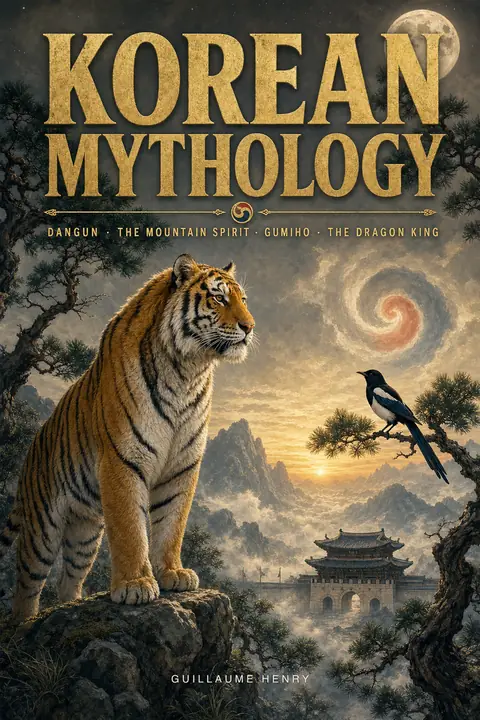
The Korean Mythology Book: Dangun, Bari, the Dokkaebi Tricksters, and the Shamanic Stories of the Peninsula
From Hwanin's Heaven to the Underworld and Back
The shamanic mythology of Korea: Dangun the founder, Bari the death-walker, the Yongwang Dragon Kings, the dokkaebi goblins, and the gumiho fox spirits.
More from Korean
All articles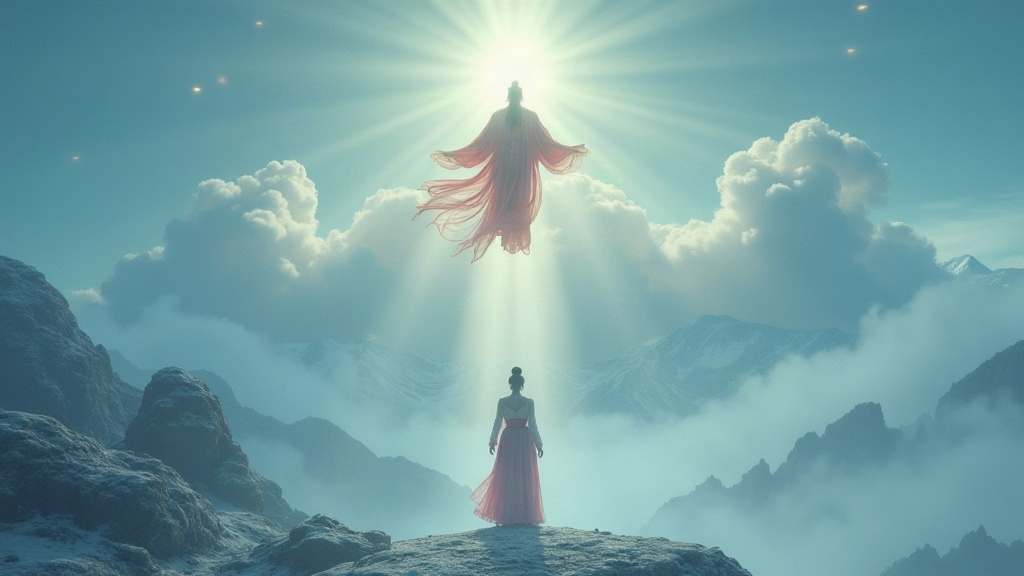
Korean
Hwanung: The Heavenly Prince Who Descended to Earth
Hwanung, the celestial prince of Korean myth, descended from heaven to establish human civilization. His union with a bear-woman bore Tangun, founder of Gojoseon, Korea's first kingdom. Discover how this cosmic descent shaped Korean identity and continues to echo through the nation's cultural memory.
Korean
Mago Halmi: The Primordial Creatrix Goddess
Mago Halmi shaped existence itself before time began. The Korean primordial goddess stands at the root of all creation, a force older than the heavens, wiser than fate itself.

Korean
Jumong: The Archer Hero and Founder of Goguryeo
Jumong, a legendary archer and divine prince, fled a deadly throne and established Goguryeo, one of Korea's greatest kingdoms. His story of exile, resurrection, and martial mastery shaped a nation.
Korean
The Seven Star Maidens: Chilseong and Celestial Worship in Korean Tradition
The Seven Star Maidens weave Korean spirituality with the night sky itself. Chilseong worship shaped household rituals, artistic tradition, and how ordinary people imagined fortune for centuries.