
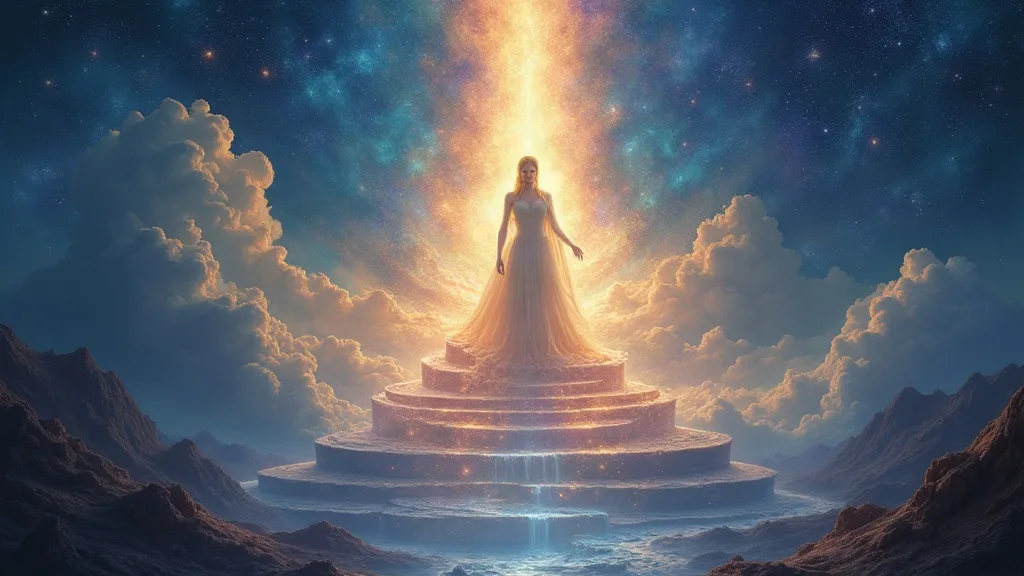
Mago Halmi: The Primordial Creatrix Goddess
Mago Halmi shaped existence itself before time began. The Korean primordial goddess stands at the root of all creation, a force older than the heavens, wiser than fate itself.
Contents
In the beginning, before the sky knew its own shape, Mago Halmi stood alone in the void. She was not born. She simply was, eternal, generative, the grandmother of all things. Korean mythology places her at the threshold of creation, the primordial creatrix goddess who conceived the universe through her own body and will, bringing forth the cosmos from pure, undifferentiated energy.
Her name carries its own power. "Mago" means mother or grandmother in archaic Korean; "Halmi" is a respectful title for an ancient woman or ancestress. Together, Mago Halmi is "the Primordial Mother," the eldest of all grandmothers, the one who existed before grandmothers had a name. Unlike the gods who come after her, the thunder deities and the spirits of mountains and streams, Mago Halmi belongs to no nation, no season, no particular domain. She is the ground from which all domains arise.
The lineage of Mago Halmi appears scattered across Korean shamanic texts, cosmological poems, and oral traditions that survived suppression through centuries of Confucian orthodoxy and Japanese colonial rule. Modern Korean spirituality has recovered her as a symbol of feminine creative power, reclaiming a strand of mythology that official histories tried to bury. Today, she stands as one of the most intellectually intriguing figures in East Asian comparative mythology, challenging how we think about creation itself.
The Architecture of Creation: Mago Halmi's Cosmogony
Korean cosmogony is not a narrative of conflict between primordial forces, as we find in Mesopotamian myth or Hindu cosmology. It is an architecture of emanation, a gradual unfurling, like a seed becoming a tree. Mago Halmi sits at the crown of this unfolding.
According to the mythological cycle preserved in Korean shamanic traditions and reconstructed by scholars like Yi Okt'ae and later researchers of Danhak (the Way of the Heavenly Light), Mago Halmi's creation moves through nine stages, or "nine heavens." She does not command creation like a demiurge; she generates it. Her body is the template. Her intention is the seed.
The first heaven emerges from Mago Halmi herself. She divides into dual principles: Gung (male, brightness, the vertical impulse) and Gang (female, depth, the receptive nature). These are not gods wrestling for dominance. They are complementary currents within her own substance, beginning the process of differentiation. From this primary duality, all subsequent creation unfolds. The male principle rises toward heaven; the female sinks toward earth. Between them, the in-between space crystallizes, the realm where humans will one day stand.
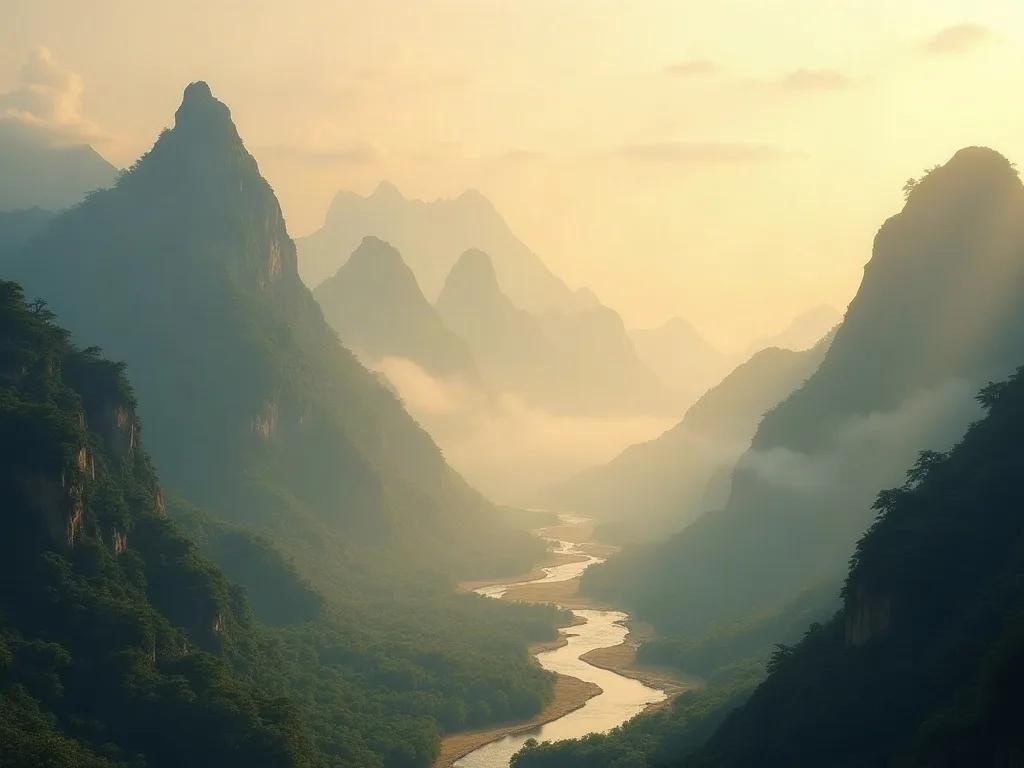
The five great mountains of Korea, Baekdu, Halla, Jiri, Seorak, and Taebaek, are understood in this cosmogony as the bones of Mago Halmi herself. Her spine becomes the spine of the land. The rivers are her blood vessels, carrying her generative power through the landscape. This is not metaphor in the Korean shamanic understanding; it is literal spiritual anatomy. To walk a mountain is to walk the body of the primordial goddess.
This distinction matters. In monotheistic traditions, a creator stands outside creation, issuing commands. In Mago Halmi's cosmology, there is no separation. She is immanent, within everything, animating everything, never distant. This is why shamanic practice in Korea often involves journeying to her realm, not to pray for intervention but to align oneself with the creative current already flowing through existence.
The Nine Heavens and Hierarchies Below
The traditional account places Mago Halmi in the topmost heaven, often called the "Ninth Heaven" or the "Palace of the Primordial Mother." Below her sit layers of lesser deities, the Hananim (celestial deities), the Sanshin (mountain spirits), the Muryeong (water spirits), and finally the terrestrial and ancestral realms that shade into folk religion and household practice.
This layering is crucial. Mago Halmi does not micromanage the world. Instead, her creative power flows downward through these hierarchies, each level filtering, refining, and localizing her infinite potential into specific acts, a thunder storm, a harvest, the protection of a village, the blessing of a child. The deities beneath her are, in a real sense, instruments through which her will operates. They are not independent powers but emanations, each closer to the particular and temporal while she remains universal and eternal.
One Korean shamanic text describes Mago Halmi as seated in a palace of nine-layered light, holding a great loom. On this loom she weaves the patterns of fate and circumstance. Every thread is both freely woven and inevitable, a paradox that Korean philosophical thought has grappled with for centuries. She is at once the source of human free will and the weaver of cosmic destiny. This is not contradiction in the Korean mind but complementarity.
Mago Halmi and the Founding of Korea
The legendary founding of Korea under the reign of Dangun, the culture hero credited with establishing Gojoseon around 2333 BCE, carries traces of Mago Halmi's influence, though often implicit. Dangun himself is said to be descended from Hwanung, a divine being who mated with a bear-woman transformed by ritual. The lineage thus descends from the heavens into flesh, a movement echoing the great downward flow from Mago Halmi through all the intermediate realms.
Some interpretations of Korean foundation mythology suggest that the land itself, the Korean peninsula, is considered a sacred manifestation of Mago Halmi's body. The establishment of the first kingdom is not a conquest of empty earth but a recognition of sacred geography already alive with the primordial goddess's presence. The capital city is built on a carefully chosen location where her energy flows most powerfully. This practice of geomancy (pungsu or feng shui in Chinese terms) became central to Korean court planning and architecture.
The figure of Mago Halmi recedes from public narrative as official Korean history becomes dominated by Confucian orthodoxy during the Goryeo (918-1392) and Joseon (1392-1910) dynasties. Confucianism's patriarchal hierarchy left little room for a primordial feminine creative power. Yet she never vanished. Shamanic practitioners (mudang or manshin) kept her memory alive in household rituals, in the great seasonal festivals (gut), and in the mystical teachings passed between initiates.
Scholarly Recovery and Modern Reinterpretation
The recovery of Mago Halmi as a central figure in Korean mythology is a 20th-century development, driven by the work of independent scholars and spiritual teachers working outside official academia. Yi Okt'ae's reconstruction of Korean cosmology placed her at the center. Later, the Danhak spiritual movement (founded in the 1980s) made her veneration a cornerstone of a new Korean spirituality that explicitly rejected imported ideologies and reclaimed indigenous roots.
This scholarly recovery raises fascinating questions. How much of Mago Halmi's prominence in modern Korean thought reflects ancient belief, and how much is creative reinterpretation? The honest answer is: we do not know precisely. The earliest written records of Korea (the Samguk Sagi, compiled in the 12th century) do not center her prominently. The most detailed accounts come from shamanic oral tradition, which is fluid, context-dependent, and consciously evolves to meet present needs.
This does not make Mago Halmi less "real" in a cultural sense. Mythology is not frozen history. It is living meaning-making. The fact that modern Koreans have found in Mago Halmi a symbol of feminine creative power, of indigenous spirituality, and of a cosmology based on harmony rather than domination, makes her culturally and spiritually vital, whether or not every detail matches a hypothetical ancient original.
Comparative scholars have noted parallels between Mago Halmi and other primordial feminine figures: the Hindu Shakti or Prakriti (the feminine principle underlying all existence), the Norse Ymir's body becoming the world, even Gaia in Greek cosmogony. Yet Mago Halmi remains distinctly Korean in her emphasis on gradual emanation, on immanence rather than intervention, and on the absence of violent cosmogonic struggle.
Mago Halmi in Korean Shamanic Practice
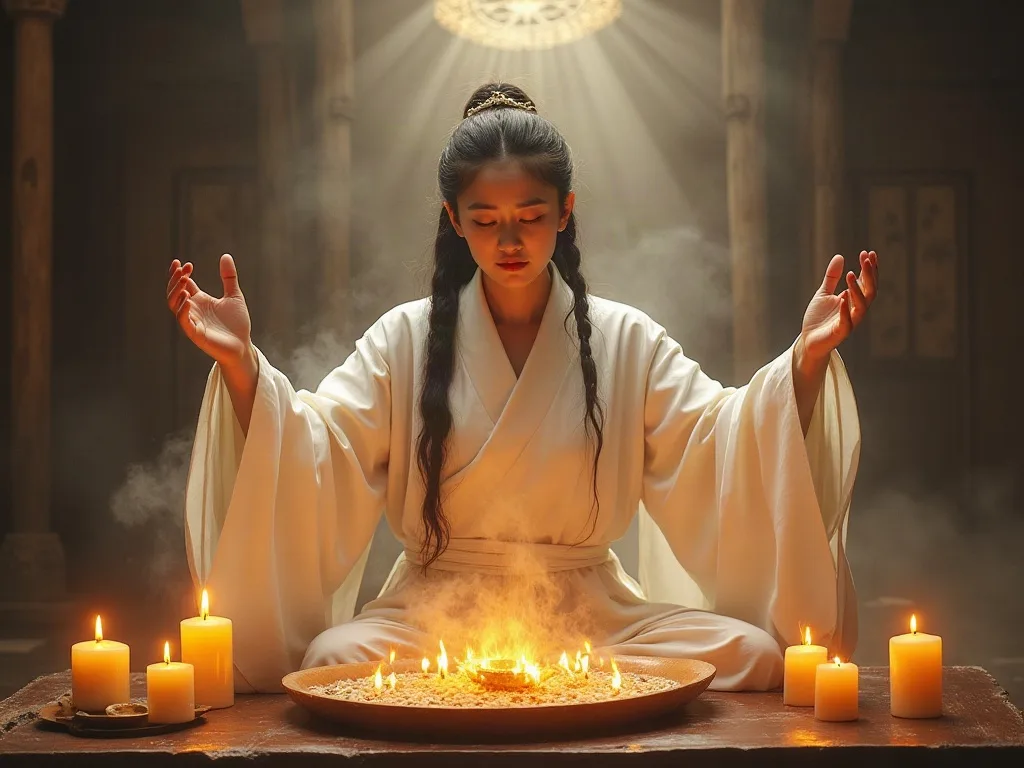
To understand Mago Halmi not as abstract doctrine but as a living presence, one must look at Korean shamanism. The shamanic worldview treats her as accessible, present, responsive. A skilled mudang can journey to her palace, can petition her for guidance, can receive blessings that ripple down through all the lower realms.
The great shamanic festivals, particularly the gut (a multi-day ritual that can last several weeks), invoke Mago Halmi's presence. The gut is not a ceremony to appease an angry deity or to gain favor through sacrifice. It is a rebalancing, a ceremonial alignment with the cosmic order that flows from her. When a village holds a gut, they are, in effect, tuning themselves to the frequency of creation itself, reinforcing the channels through which her generative power moves through their community.
Shamanic cosmology distinguishes between the "upper realms" (heaven and the divine) and the "lower realms" (earth and the ancestors). Mago Halmi presides over both. She is simultaneously the most distant and the most intimate, far above in her palace of light, yet woven into every rock, every stream, every person's body. This paradox is not resolved in Korean thought but inhabited.
The Feminine Divine in Korean Religious History
The prominence of Mago Halmi in shamanic Korean spirituality stands in striking contrast to the official narratives of Confucianism, which dominated Korean elite culture for nearly five centuries. Confucianism's emphasis on patrilineal hierarchy, filial piety centered on the father, and the subordination of women in both family and state structure created a gap between official ideology and lived religious practice.
Shamanism, historically practiced predominantly by women (though not exclusively), and focused on healing, fertility, community balance, and direct access to the spiritual, became a carrier of alternative cosmologies. In a patriarchal society, the shamanic figure, often a woman, often inspired or possessed by spirits, wielded genuine authority. The mudang might be scorned by Confucian scholars, but a family in crisis would call her. She knew the spirits. She could negotiate with them. She was essential.
Mago Halmi, in this context, is not merely a mythological figure. She is a source of legitimacy. Her centrality in Korean shamanic cosmology asserts that the universe is not, fundamentally, a hierarchy of fathers and sons. It is an emanation from a feminine principle that generates, sustains, and guides all becoming. The mudang who invokes her is not a marginal figure working in defiance of cosmic order; she is aligned with the deepest truth of that order.
Mago Halmi and Contemporary Korean Spirituality
Since the mid-20th century, as Korea underwent rapid modernization and underwent a spiritual reckoning with its own traditions, Mago Halmi has been repositioned as a symbol of authentic Korean spirituality, feminine power, and environmental consciousness. New religious movements, feminist reinterpretations of Korean myth, and academic efforts to recover indigenous cosmologies have all centered her.
The Danhak movement, in particular, has made her central to a spirituality that blends traditional Korean shamanism with modern environmental ethics and gender consciousness. In Danhak teaching, Mago Halmi is not a distant creator who set the world in motion and withdrew. She is continuously present, continuously creative. Humans can align themselves with her generative flow through meditation, ritual, and ethical living. The destruction of nature becomes, in this framework, a violation of Mago Halmi's body. Equality between genders becomes a reflection of cosmic principle rather than a modern political demand.
This reinterpretation is not "inauthentic", a common charge leveled at modern spiritual movements. Rather, it is alive. It takes a traditional figure and allows her meaning to evolve in response to contemporary needs and understandings. Mago Halmi, understood as an eternal principle rather than a frozen mythological image, can bear new interpretations without losing her essential nature.
Comparative Perspectives: Creation Without Conflict
One of the most remarkable features of Mago Halmi's cosmogony is the near-absence of creation conflict. There is no cosmogonic war, no slaying of a primordial chaos monster, no violent emergence of order from chaos. Instead, there is emanation, differentiation, gradual unfurling.
This sets Korean cosmology apart from many other mythological traditions. The Babylonian Enuma Elish describes Marduk's brutal victory over Tiamat. Hindu mythology places the cosmos within cycles of creation and destruction, with conflict and sacrifice essential to renewal. Even in Norse mythology, Odin and his brothers must slay Ymir to create the world from his corpse.
The Korean cosmology of Mago Halmi suggests an alternative vision: creation as natural, inevitable, continuous emanation. Order does not have to be violently imposed on chaos. It emerges, like a flower from seed, from the inherent tendency of existence toward differentiation and manifestation. This cosmological difference likely reflects deeper cultural values, a greater emphasis on harmony, complementarity, and balance than on struggle and domination.
Whether this reflects a genuinely "ancient" Korean philosophy or represents a modern idealization is debatable. But the contrast is real and illuminating. It reminds us that creation itself can be imagined in radically different ways.
Mago Halmi: Presence in Modern Scholarship
Academic study of Mago Halmi remains limited in English-language scholarship, though it is growing. Korean scholars, including specialists in Korean religion, shamanism, and comparative mythology, have devoted increasing attention to her since the 1980s. The challenge for Western scholars is partly linguistic, the most detailed sources are in Korean, and partly epistemological. How do you study a figure whose "historical" reality is uncertain, whose power is spiritual rather than institutional, and whose transmission is oral, fluid, and deliberately hidden from official record?
The honest answer is that rigorous scholarship requires holding multiple truths simultaneously. We can acknowledge that our sources are late, fragmentary, and shaped by the intentions of modern interpreters. We can also recognize that Mago Halmi represents a genuine strand of Korean spiritual tradition, one that connects to practices and beliefs with real historical depth. The mythology may not be "authentic" in the sense of being unchanged from some prehistoric origin, but it is authentic in the sense of being alive, meaningful, and rooted in real Korean religious practice.
Frequently asked questions about Mago Halmi
Frequently asked questions
Is Mago Halmi mentioned in ancient Korean texts?
Not explicitly in the earliest written records. The most detailed accounts of Mago Halmi come from shamanic tradition, oral transmission, and modern reinterpretations, particularly the Danhak movement. She is referenced indirectly in foundation mythology and in implicit assumptions about cosmic structure in Korean cosmology, but explicit, detailed narratives are primarily modern scholarly reconstructions and spiritual reinterpretations.
How does Mago Halmi compare to other primordial goddesses in Asian mythology?
Unlike the Hindu Shakti (who embodies active power through male gods) or the Japanese Izanami (who partners with Izanagi in creation), Mago Halmi stands alone as the sole primordial source. She needs no male counterpart; instead, duality arises within her. This makes her cosmologically unique in East Asian mythology, a self-sufficient, self-differentiating creative principle.
Why did Mago Halmi disappear from official Korean history?
Confucian orthodoxy, which dominated Korean elite culture from the 15th century onward, privileged patrilineal hierarchy and subordinated feminine symbols. A primordial feminine creative power did not fit this worldview. She survived in shamanic practice, which was marginalized but never fully eradicated, particularly because shamanism addressed real spiritual and healing needs that Confucianism could not meet.
Can Mago Halmi be understood as a universal principle rather than just a Korean goddess?
Yes, modern interpretations increasingly frame her this way. In Danhak and other contemporary Korean spiritualities, Mago Halmi represents the universal generative principle underlying all existence, a principle that can be called by different names in different traditions but is fundamentally the same. This interpretation echoes comparative philosophy and perennial mysticism, allowing her to resonate beyond specifically Korean contexts.
What role does Mago Halmi play in Korean shamanic ritual?
She is the ultimate source invoked in major shamanic ceremonies, particularly the gut. While shamanic practice engages many spirits and deities, Mago Halmi represents the ultimate generative power underlying all of them. Shamans invoke her not to command her directly (which would be presumptuous) but to align themselves and their communities with the cosmic order that flows from her.
Why is Mago Halmi significant to modern feminist interpretations of Korean spirituality?
She offers a cosmological foundation for feminine creative power, not as subordinate to masculine authority but as prior to and primary to all existence. In a cultural context shaped by centuries of Confucian patriarchy, recovering Mago Halmi as the supreme creative principle serves as both spiritual reclamation and cultural critique.
The Paradox of the Eternal Mother
Mago Halmi remains, in many ways, a paradox. She is ancient, yet her prominence in modern thought is recent. She is central to Korean spirituality, yet absent from official records. She is utterly transcendent, the source of all existence, yet intimately immanent, woven into every mountain, every river, every person.
This paradox is not a flaw in the mythology but perhaps its deepest truth. A truly primordial principle cannot be fully captured in narrative or doctrine. It can only be approached, intuited, embodied through practice. The mudang who journeys to her palace, the meditator who aligns with her creative flow, the scholar who reconstructs her cosmology, each touches her differently, and all are correct.
In an age of spiritual searching, in a world where the sacred has been driven underground by rationalism and consumer culture, Mago Halmi represents something rare: a genuinely Korean path back to the sacred, rooted in real tradition yet alive and evolving. She is not a goddess frozen in ancient text, to be studied and filed away. She is a living presence, a creative principle that calls each generation to reimagine her according to present need and understanding. That is the mark of a mythology that has not merely survived but is genuinely alive.
Read the full book
Want the whole story?
The complete edition is an instant PDF download here, with a paperback on Amazon for selected titles.
Korean
The Korean Mythology Book: Dangun, Bari, the Dokkaebi Tricksters, and the Shamanic Stories of the Peninsula
From Hwanin's Heaven to the Underworld and Back
The shamanic mythology of Korea: Dangun the founder, Bari the death-walker, the Yongwang Dragon Kings, the dokkaebi goblins, and the gumiho fox spirits.
More from Korean
All articles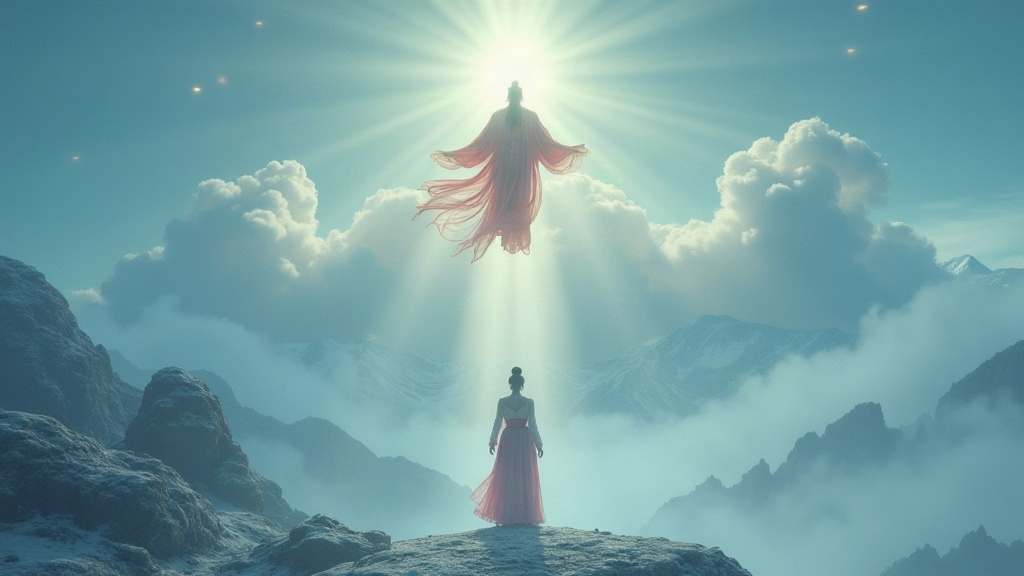
Korean
Hwanung: The Heavenly Prince Who Descended to Earth
Hwanung, the celestial prince of Korean myth, descended from heaven to establish human civilization. His union with a bear-woman bore Tangun, founder of Gojoseon, Korea's first kingdom. Discover how this cosmic descent shaped Korean identity and continues to echo through the nation's cultural memory.

Korean
Jumong: The Archer Hero and Founder of Goguryeo
Jumong, a legendary archer and divine prince, fled a deadly throne and established Goguryeo, one of Korea's greatest kingdoms. His story of exile, resurrection, and martial mastery shaped a nation.
Korean
The Seven Star Maidens: Chilseong and Celestial Worship in Korean Tradition
The Seven Star Maidens weave Korean spirituality with the night sky itself. Chilseong worship shaped household rituals, artistic tradition, and how ordinary people imagined fortune for centuries.

Korean
Baekdu Mountain: The Sacred Peak of Korean Cosmology
Baekdu Mountain rises at the heart of Korean myth as the birthplace of the first kingdom and the cosmic axis binding earth to heaven. Discover how this real volcano became the sacred peak where gods walked and legends were born.