

Jumong: The Archer Hero and Founder of Goguryeo
Jumong, a legendary archer and divine prince, fled a deadly throne and established Goguryeo, one of Korea's greatest kingdoms. His story of exile, resurrection, and martial mastery shaped a nation.
Contents
The arrow flew through open air. A young man, hunted and desperate, pulled the bow taut and struck three targets at once. His enemy fell. His refuge stood firm. This was Jumong, the archer who would not die, whose blood ran part divine, whose name would echo through Korean history as the founder of Goguryeo, one of East Asia's most powerful kingdoms.
The world into which Jumong was born was violent and uncertain. Around the first century BC, the Korean peninsula was fragmented into competing kingdoms and tribal confederations. Goguryeo would not yet exist. But the legend of Jumong insisted that he was no ordinary heir. His mother was Yuhwa, a divine being or daughter of the sun god Hwanung. His father was Geumwa, king of Buyeo, one of the northern kingdoms that would shape Korean destiny. This was his curse and his gift: to be caught between worlds, divine and mortal, until one side demanded everything.
The Birth of a Cursed Prince
The Samguk Sagi, Korea's oldest historical chronicle compiled in the twelfth century, records Jumong's origin with stark simplicity. His mother Yuhwa was no ordinary woman. Some versions say she was an elemental spirit, daughter of Hwanung, the divine being who brought heaven's culture to earth. Other tellings describe her as a princess already, blessed or cursed by celestial parentage. What all sources agree on: her pregnancy was impossible to hide, and the king's court erupted in alarm.
Geumwa, Jumong's mortal father, did not raise him as heir. Instead, the boy grew up in a stable, far from royal chambers, training with horses and servants while his half-brothers from Geumwa's other wives learned court protocol and statecraft. This separation was deliberate. A prophecy hung over Jumong's birth: he would become an archer of such skill that he would pose a grave threat to the kingdom. Some versions say the prophecy spoke directly: a child born of Hwanung's line would bring ruin to Buyeo.
The court's response was immediate. The king ordered the boy's execution.
Jumong, still a child, escaped. His story pivots here from legend into the realm of pure myth. He fled to a river, pursued by Geumwa's assassins. The water parted before him, or the fish and turtles of the river rose up and created a bridge from their backs. He crossed safely. His hunters could not follow. The very world had chosen his side.
This is the defining pattern of Jumong's mythological arc: rejection, divine intervention, and emergence. He was cast out but protected by forces older than any kingdom.
The Apprenticeship Years and the Three Trials
After his escape, Jumong wandered the borderlands between kingdoms. Some traditions place him in areas near the Yalu River, the boundary between what would become Goguryeo and China. He was no longer Buyeo's cursed prince. He was an exile, a fugitive with nothing but his bloodline and his wits.
Stories tell of him living in poverty, moving among common people, learning the crafts of survival. This period transformed him from a hunted child into something far more dangerous: a man. The archer's skill that had been prophesied began to emerge not through royal training but through necessity and practice.
When Jumong eventually gathered followers, his authority came not from his birth but from demonstrated prowess. He performed miraculous feats of archery that became legendary. In one tradition, he shot three separate targets with three arrows simultaneously, never missing. In another, he defended a river crossing against an entire pursuing force with his bow alone. These acts were not merely displays of skill. They were proof that the divine protection that had saved him as a child had not abandoned him. He was marked.
The Founding of Goguryeo: Birth of a Kingdom
Around 37 BC, Jumong established Goguryeo in the region of the Yalu River valley. This was not a conquest of an existing settled state but the founding of a new kingdom from scattered tribes and peoples who gathered around his leadership. Some sources suggest he was crowned by his followers; others imply he declared himself. What matters historically is that Goguryeo emerged as a recognizable political entity under his rule, with him as its founder and first king.
Jumong took the royal title Dongmyeong, meaning "Bright East." The name itself was significant: it positioned the new kingdom as the illuminated, emerging power, the future dominant force on the peninsula. He established his capital, initially at Jolbon (or Zhuolu, as it appears in Chinese records), and began consolidating the scattered tribal confederations into a coherent state.
His reign transformed a marginal border region into a nascent kingdom with military capacity, administrative structure, and legitimacy. Within generations, Goguryeo would become one of the great powers of East Asia, rivaling China's dynasties and dominating much of the Korean peninsula. This was the fruit of Jumong's flight and his refusal to accept the death sentence pronounced upon him at birth.

The Archer as Archetype: What Jumong's Bow Meant
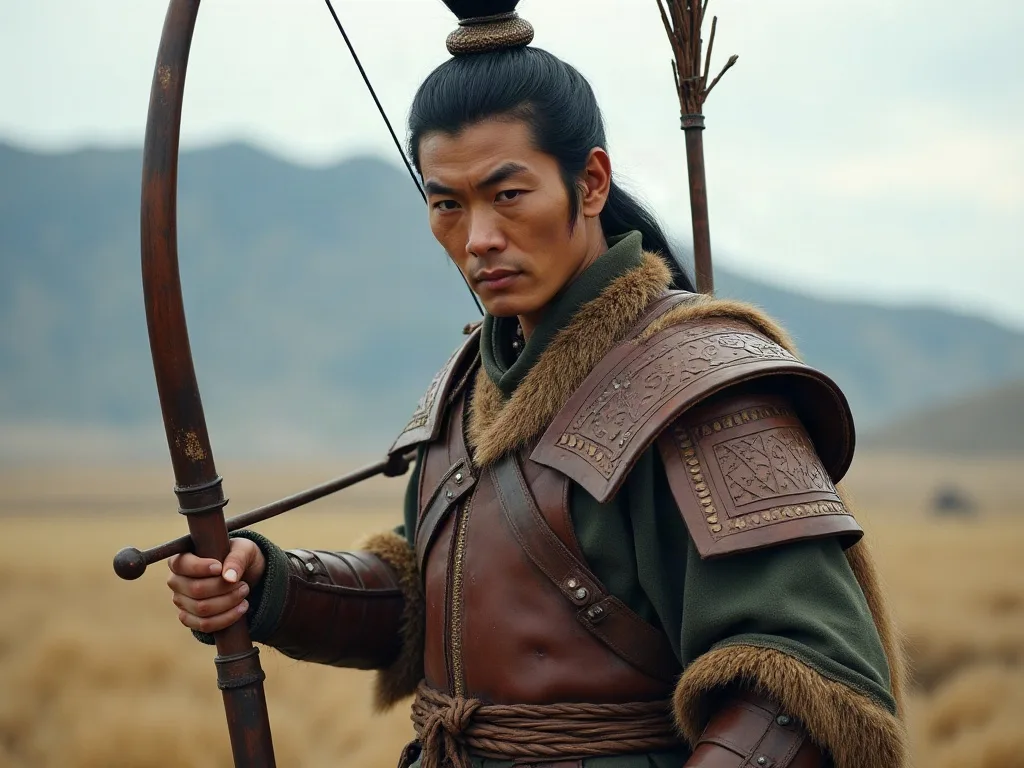
The bow was central to Jumong's identity and to Goguryeo's military culture. Early Korean states, particularly those in the north, were renowned throughout East Asia for their mounted archery. The Xiongnu confederation to the northwest and various northern peoples had made the bow the supreme weapon of steppe warfare. Goguryeo inherited and mastered this tradition.
But in Jumong's legend, the bow carried deeper meaning. It was the sign of his divine blood made manifest. An ordinary man could be trained to shoot accurately. But Jumong's arrow never wavered, never missed, never doubted. His marksmanship was not technique alone; it was proof of spiritual alignment, of being in harmony with heaven's will. This idea was central to Korean hero narratives: the greatest warrior was not merely skilled but cosmically ordained.
The bow also represented Jumong's solitude and his power. Unlike a king surrounded by generals and courtiers, the archer stands alone, drawing his own strength, releasing it at the moment of his choosing. This fit Jumong's narrative perfectly: a man rejected, who relied on no court and needed no throne's permission to become a king.
Jumong's Heirs and the Dynasty's Continuity
Jumong ruled Goguryeo for approximately twenty years, until his death around 19 BC. He had a son named Yuri, born to Sogong (or So of Buyeo), a wife he took during his reign. Yuri succeeded him as the second king of Goguryeo, establishing a dynasty that would rule for nearly seven hundred years.
The transition was not seamless. Some sources hint at conflict between Jumong and Yuri, perhaps arising from questions of legitimacy or the proper order of succession. But what matters is that Goguryeo survived its founder's death and continued to grow. By the time of Jumong's great-grandson Gwanggaeto the Great (ruled 391-413 AD), Goguryeo had become a continental power, dominating much of Manchuria and the Korean peninsula, rivaling the Chinese dynasties for regional supremacy.
This trajectory of power and expansion was rooted in what Jumong established: not merely a kingdom's borders but a kingdom's spirit. Goguryeo became known for military ferocity, administrative competence, and a fierce independence from Chinese cultural and political dominance. All of this traced back to its founder's refusal to accept exile or death.
The Divine Bloodline: Jumong and Hwanung's Legacy
To understand Jumong's power, one must understand his connection to Hwanung, the divine civilizer of Korean myth. According to the foundational Korean myth of Gojoseon, Hwanung descended from heaven and took human form to mate with Ungnyeo, a woman transformed from a bear. Their son was Dangun, the legendary founder of Gojoseon, Korea's first kingdom, supposedly established in 2333 BC.
Jumong came much later historically, but his mythology deliberately linked him to this earlier divine lineage. His mother Yuhwa was sometimes described as a descendant of Hwanung or even a daughter of the sun god, placing Jumong within the same sacred genealogy that began with heaven's descent. This was not incidental. It was the mythological foundation of his authority.
In Korean royal ideology, the king was not merely a political ruler but a conduit of cosmic order, a being whose legitimacy derived from alignment with heaven. Jumong's miraculous birth, his escapes through divine protection, his flawless archery, and his ability to gather followers all expressed this cosmic alignment. He was heaven's chosen instrument for establishing Goguryeo's dynasty.
This understanding persisted throughout Goguryeo's history. Kings of Goguryeo were understood as inheritors of Jumong's sacred legacy. The kingdom itself was not merely a political state but a cosmic entity, the earthly manifestation of heaven's will. This ideology made Goguryeo's warriors fight with an intensity rooted in something deeper than mere patriotism. They fought for the fulfillment of a cosmic destiny.
Jumong in Later Korean Tradition and Performance
The legend of Jumong survived Goguryeo's fall in 668 AD. As Korea fragmented and reformed, as dynasties rose and crumbled, Jumong's story endured. It appeared in later histories, in oral traditions, in folk narratives that passed through centuries.
In the Joseon dynasty (1392-1910), which looked back to Korea's ancient heritage with scholarly precision, the Samguk Sagi and the Samguk Yusa (Legends and Histories of the Three Kingdoms, compiled in the thirteenth century) preserved Jumong's narrative in writing. Scholars debated how much was history, how much was myth. This question was not merely academic. The founding stories of a kingdom carry power. To remember Jumong was to remember that Korea had produced a world-class power, that Korean rulers had commanded respect from Chinese emperors, that the peninsula's destiny was not mere tributary status but independent greatness.
In the twentieth and twenty-first centuries, Jumong has experienced a renaissance. Television dramas, historical fiction, and popular history have made him accessible to new generations of Korean readers and viewers. The 2006 MBC television series Jumong became a cultural phenomenon across East Asia, introducing the archer-king to millions who had never read the ancient chronicles. In these modern tellings, the emphasis often shifts: Jumong becomes a romantic figure, a hero overcoming personal tragedy, a warrior whose spiritual power is explained through montages of training and inner strength.
The historical Jumong, insofar as one can be recovered from the legends, may have been very different from these modern interpretations. But the core of his legend persists because it answers something deep in human consciousness: the story of the rejected one who refuses to accept rejection, who is protected by forces greater than any court, who establishes something that lasts.
Scholarly Debates: History and Legend
Modern historians and archaeologists face a persistent problem with Jumong. The legends place his founding of Goguryeo around 37 BC. Chinese sources from the period do record the emergence of a kingdom called Goguryeo in that region, though they provide far less detail than Korean sources. Korean sources themselves were compiled centuries after the events they describe, by which point legend and history had woven together inextricably.
Some scholars argue that Jumong is entirely mythological, a hero tale constructed to provide Goguryeo with a legitimizing origin story. Others suggest there may have been a historical figure at the core, an early leader or founder, whose deeds were elaborated and sacralized over generations. The truth is probably somewhere between. What we have is a legend that shaped how Goguryeo understood itself, how it organized its authority, how it projected its identity.
The specific details of Jumong's life that come down to us, his miraculous birth, the river crossing, the three archery shots, are almost certainly mythological elaborations. But the fact of Goguryeo's founding, its early location in the Yalu River region, its rapid growth into a major power, and its warrior culture are historical realities. Jumong's legend captures these truths in mythological form.
Jumong's Global Echoes: The Hero Monomyth
Jumong's story follows a pattern that mythologist Joseph Campbell identified as the monomyth, or the hero's journey: the call to adventure (the prophecy that portends his danger), the refusal of the call (his initial helplessness as a child), the meeting with a mentor (his years of wandering and training), the crossing of the threshold (his escape to new territories), the trials and victories (his feats of archery and gathering of followers), and the return with the elixir (the founding of Goguryeo and the establishment of a dynasty that transforms the world).
Similar patterns appear across world mythologies. Moses, cast out by Egyptian royalty, becomes the liberator of his people. The Buddha, sheltered from suffering in a palace, must abandon that protection to achieve enlightenment. Aeneas, fleeing Troy, establishes Rome. These are not identical stories, but they follow recognizable templates. The hero born in one world must flee that world, undergo trials, and return transformed to establish a new order.
What makes Jumong's story distinctively Korean is not the basic pattern but the specifics: the archer's skill, the connection to divine descent through Hwanung, the northern geography of river valleys and mounted warriors, the founding of a kingdom that would genuinely become one of Asia's superpowers. His myth works because it grounds universal hero patterns in particular Korean realities.
Goguryeo's Legacy and Jumong's Continuing Presence
Goguryeo fell to Silla in 668 AD after a century of intense military pressure. But the kingdom's legacy persisted. Its territories, its cultural achievements, its warrior traditions were absorbed into the unified Korean peninsula. Later dynasties, particularly Goryeo (from which the name "Korea" derives), claimed cultural descent from Goguryeo and explicitly invoked Goguryeo's grandeur to legitimate their own rule.
Jumong, as Goguryeo's founder, became more than a historical figure. He was a symbol of Korean independence, of resistance to foreign dominance, of the peninsula's capacity to produce world-class powers. When Korea was colonized by Japan (1910-1945), Jumong became a figure of nationalist memory, a reminder that Koreans had once ruled a continental empire. When Korea divided after World War II, both North and South looked back to Goguryeo's era as a point of historical pride, though they drew different political lessons from it.
Today, Jumong appears in popular culture, historical scholarship, and national memory as one of Korea's greatest heroes. Museums in both North and South Korea feature exhibits related to Goguryeo and its founder. The Yalu River, where Jumong established his capital, remains a symbol of Korea's northern heritage, a geographical anchor for stories that otherwise float in the realm of legend.

Frequently asked questions about Jumong, the founder of Goguryeo?
Frequently asked questions
Was Jumong a real historical person or purely mythological?
Most likely, Jumong represents a legendary elaboration of an actual founder figure. Modern historians agree that Goguryeo emerged as a recognizable state around the first century BC in the Yalu River region, but the specific details of Jumong's miraculous birth, his archery feats, and his escapes are mythological constructions. The legend captures historical truth (Goguryeo's founding and rise to power) through the language of myth, in a pattern common to many ancient societies' origin stories.
What is the connection between Jumong and Hwanung in Korean mythology?
Jumong's mother, Yuhwa, was connected to Hwanung, the divine civilizer of Korean mythology who descended from heaven to mate with a woman and produce Dangun, founder of Gojoseon. By linking Jumong to this sacred genealogy, Korean sources positioned him as inheriting divine authority. This made Jumong more than a regional warlord; it made him heaven's chosen instrument for establishing Goguryeo, grounding political legitimacy in cosmic order.
Why is the bow so central to Jumong's legend and identity?
The bow was the supreme weapon of northern warfare, particularly among mounted peoples like those who inhabited the regions where Goguryeo emerged. But in mythological terms, Jumong's archery represented divine precision and cosmic alignment. His arrows never wavered because they expressed heaven's will, not mere human skill. The bow made him a solitary figure, a king who needed no court's permission to establish his authority.
How did Jumong's founding of Goguryeo transform the Korean peninsula?
Goguryeo became one of East Asia's great powers, rivaling Chinese dynasties and dominating much of the peninsula within generations. This was built on the military culture, administrative structures, and fierce independence that Jumong established. By the time of King Gwanggaeto the Great, Goguryeo controlled vast territories from Manchuria to the central peninsula. Jumong's legend captured this trajectory of expansion and power as the inevitable fulfillment of a cosmic destiny begun at his birth.
How has Jumong's legend changed in modern Korean popular culture?
Modern retellings, particularly television dramas and historical fiction, often emphasize Jumong as a romantic, personal hero overcoming tragedy through inner strength and training. Ancient sources focused more on his cosmic legitimacy and his role as an instrument of heaven's will. Both interpretations capture something true about the legend, but they reflect different eras' values: ancient Korea emphasized cosmic order, while modern audiences emphasize individual heroism and emotional authenticity.
The Archer Who Refused to Die: Jumong's Continuing Mythic Life
Jumong's legacy extends beyond history. Every Korean person who learns their nation's ancient past encounters Jumong at some point. His story teaches a particular vision of Korean identity: that the peninsula produced not mere regional powers but world-class kingdoms, that Korean warriors and leaders could command respect from Chinese dynasties, that independence and fierce determination were written into Korea's very origins.
The bow he drew, the arrow that never missed, the river that parted for him, the kingdom he established, these have become symbols in Korean consciousness, part of the basic vocabulary through which Koreans understand their own deepness in time. When modern Korea asserts its cultural identity, when historians recover Goguryeo's grandeur, when storytellers retell Jumong's flight and triumph, they are drawing on a mythic resource that has endured for two thousand years.
Jumong was rejected at birth. The prophecy that clung to him was a death sentence. Yet he escaped, trained, gathered followers, and established a dynasty that transformed Asia. This is not merely a story about a man. It is a story about refusal, about divine protection for those whom the world attempts to cast out, about the possibility of building something that lasts. In Korean mythology and history, that story belongs to Jumong, the archer-king who would not die.
Read the full book
Want the whole story?
The complete edition is an instant PDF download here, with a paperback on Amazon for selected titles.
Korean
The Korean Mythology Book: Dangun, Bari, the Dokkaebi Tricksters, and the Shamanic Stories of the Peninsula
From Hwanin's Heaven to the Underworld and Back
The shamanic mythology of Korea: Dangun the founder, Bari the death-walker, the Yongwang Dragon Kings, the dokkaebi goblins, and the gumiho fox spirits.
More from Korean
All articles
Korean
Hwanung: The Heavenly Prince Who Descended to Earth
Hwanung, the celestial prince of Korean myth, descended from heaven to establish human civilization. His union with a bear-woman bore Tangun, founder of Gojoseon, Korea's first kingdom. Discover how this cosmic descent shaped Korean identity and continues to echo through the nation's cultural memory.

Korean
Mago Halmi: The Primordial Creatrix Goddess
Mago Halmi shaped existence itself before time began. The Korean primordial goddess stands at the root of all creation, a force older than the heavens, wiser than fate itself.
Korean
The Seven Star Maidens: Chilseong and Celestial Worship in Korean Tradition
The Seven Star Maidens weave Korean spirituality with the night sky itself. Chilseong worship shaped household rituals, artistic tradition, and how ordinary people imagined fortune for centuries.

Korean
Baekdu Mountain: The Sacred Peak of Korean Cosmology
Baekdu Mountain rises at the heart of Korean myth as the birthplace of the first kingdom and the cosmic axis binding earth to heaven. Discover how this real volcano became the sacred peak where gods walked and legends were born.